Acer Nitro V 16 AI (ANV16-42) review – The Gaming Laptop That Refuses to Overheat
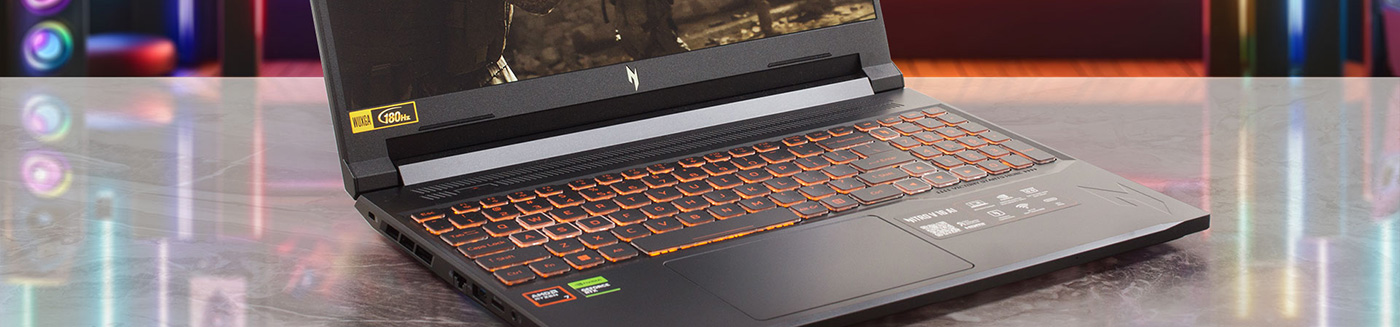
In the relentless race for the highest benchmark scores, many gaming laptops push their components to the absolute thermal limit. The Acer Nitro V 16 AI (ANV16-42) takes a different, smarter path. Instead of chasing a few extra points on a chart, Acer has engineered a machine that prioritizes what truly matters for a great long-term gaming experience: thermal stability, reliability, and impressive battery life. The result is a surprisingly balanced and responsible powerhouse that runs dramatically cooler than its direct competitors. But to achieve this cool-headed performance, there is one major sacrifice that users must be willing to make, and it’s a big one.
You can check the prices and configurations in our Specs System: https://laptopmedia.com/series/acer-nitro-v-16-ai-anv16-42/
Contents
- Specs, Drivers, What’s in the box
- Design and construction
- Display and Sound Quality, Display Profiles
- Get our profiles
- Work Performance: CPU, Storage, AI
- GPU and Gaming Performance
- [eBook Guide + Tools] How to MAX OUT Your Laptop
- Temperatures and Comfort, Noise, Stability
- Battery Life
- Disassembly, Upgrade options, and Maintenance
- Verdict
Specs, Drivers, What’s in the box
Acer Nitro V 16 AI (ANV16-42) - Specs


- HDD/SSD
- up to 8000GB SSD
- M.2 Slot
- 2x 2280 PCIe NVMe 4.0 x4 See photo
- RAM
- up to 64GB
- OS
- Windows 11 Pro, Windows 11 Home, No OS, Windows 10 Pro
- Battery
- 76Wh
- Body material
- Plastic / Polycarbonate
- Dimensions
- 360 x 276 x 24.5 mm (14.17" x 10.87" x 0.96")
- Weight
- 2.44 kg (5.4 lbs)
- Ports and connectivity
- 1x USB Type-A
- 3.2 Gen 1 (5 Gbps)
- 1x USB Type-A
- 3.2 Gen 2 (10 Gbps)
- 1x USB Type-A
- 3.2 Gen 1 (5 Gbps), Sleep and Charge
- 2x USB Type-C
- 4.0, Power Delivery (PD), DisplayPort
- HDMI
- 2.1
- Card reader
- microSD (microSD, microSDHC, microSDXC)
- Ethernet LAN
- 10, 100, 1000 Mbit/s
- Wi-Fi
- Wi-Fi 6E
- Bluetooth
- 5.3
- Audio jack
- 3.5mm Combo Jack
- Features
- Fingerprint reader
- optional
- Web camera
- HD with Temporal Noise Reduction
- Backlit keyboard
- Microphone
- 3x Microphone Array with Acer Purified Voice
- Speakers
- Speakers by DTS X: Ultra Audio
- Security Lock slot
- Kensington Lock
All Acer Nitro V 16 AI (ANV16-42) configurations
Drivers
All drivers and utilities for this notebook can be found here: https://www.acer.com/us-en/support/product-support/Nitro_ANV16-42/downloads?suggest=anv16-42;1
What’s in the box?
Acer keeps the unboxing experience for the Nitro V 16 AI focused and to the point.
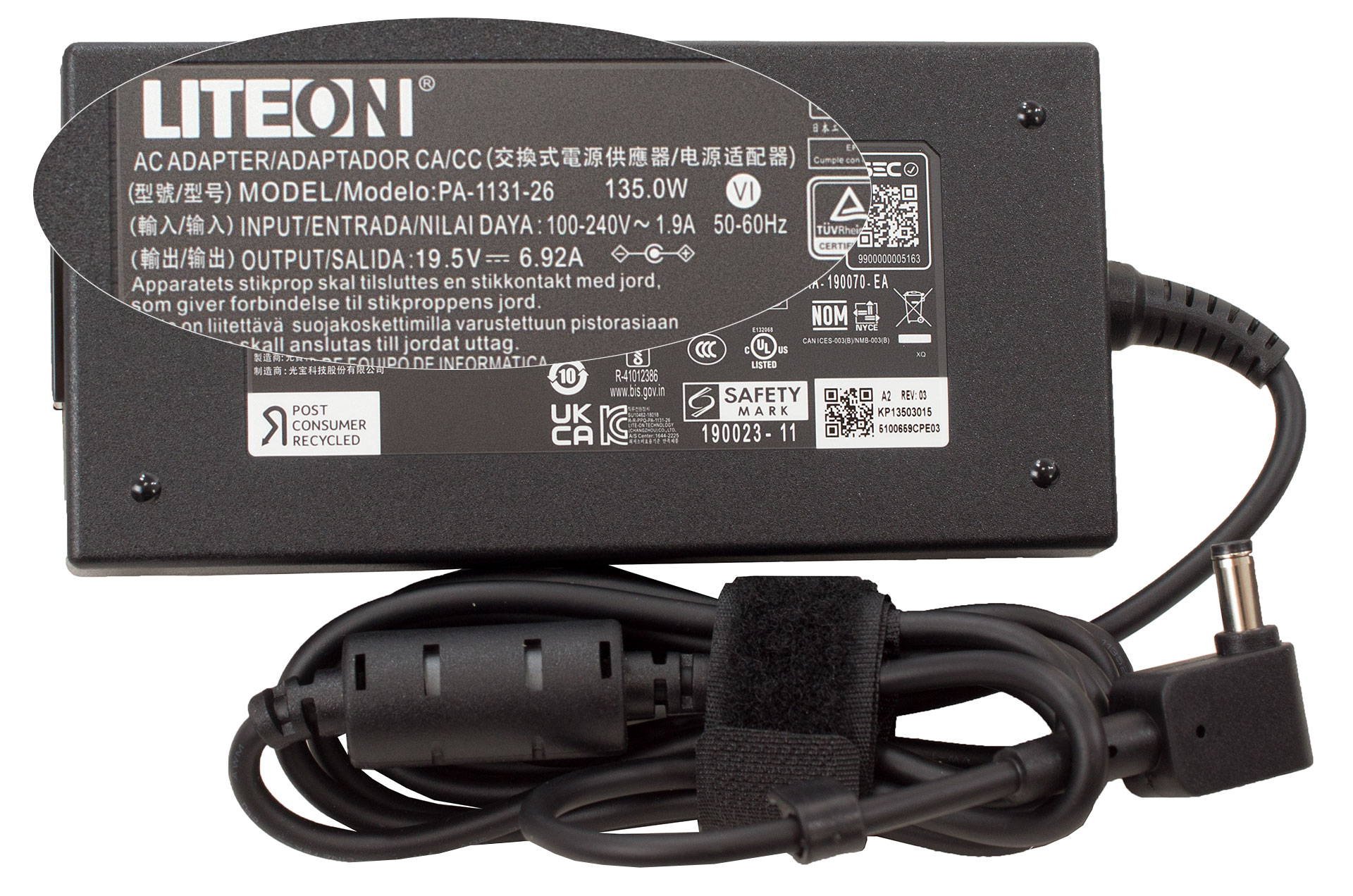
Inside, you’ll find just the essentials needed to jump into the action: the laptop itself, its 135W power adapter, and the usual small collection of setup guides.
Design and construction
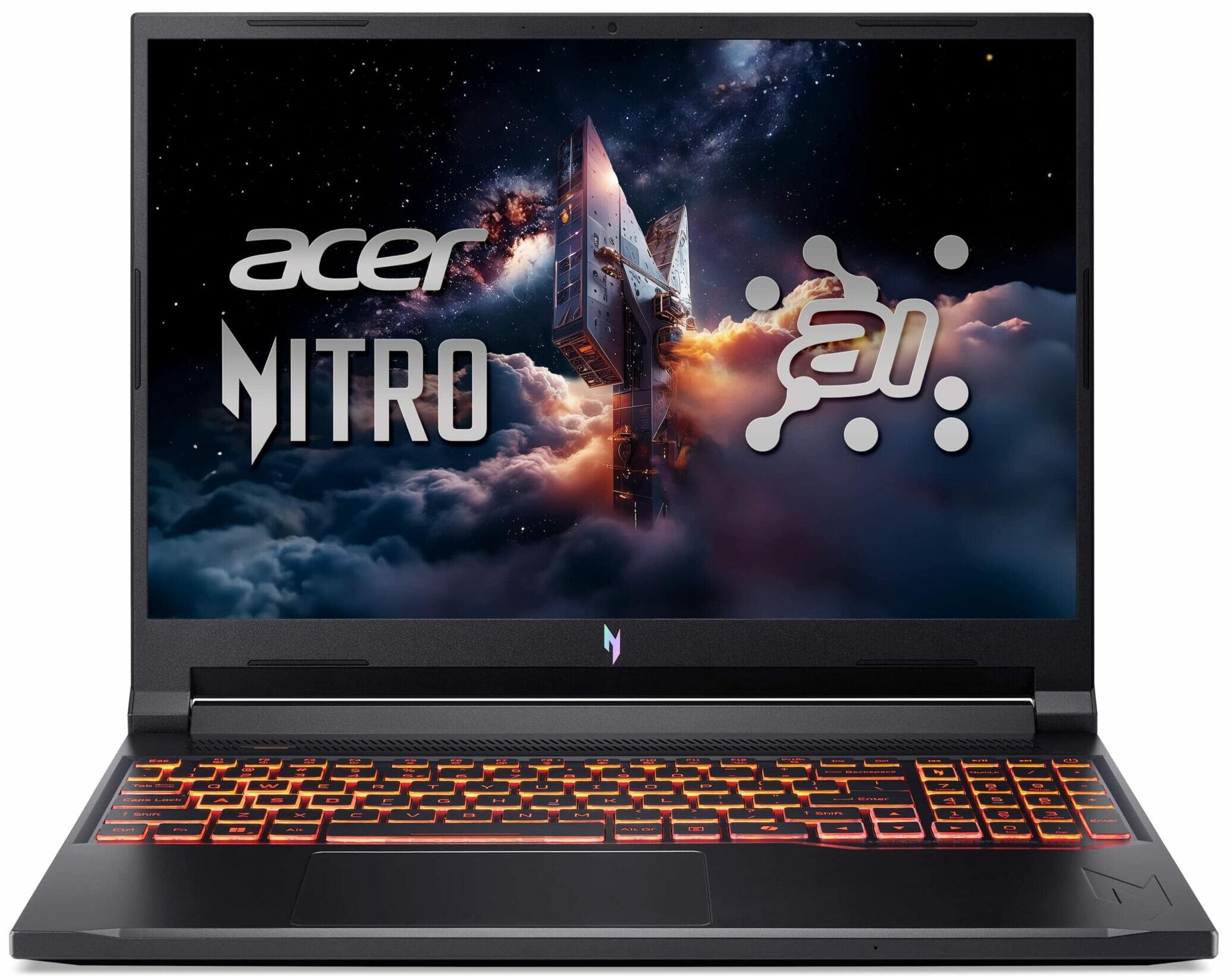
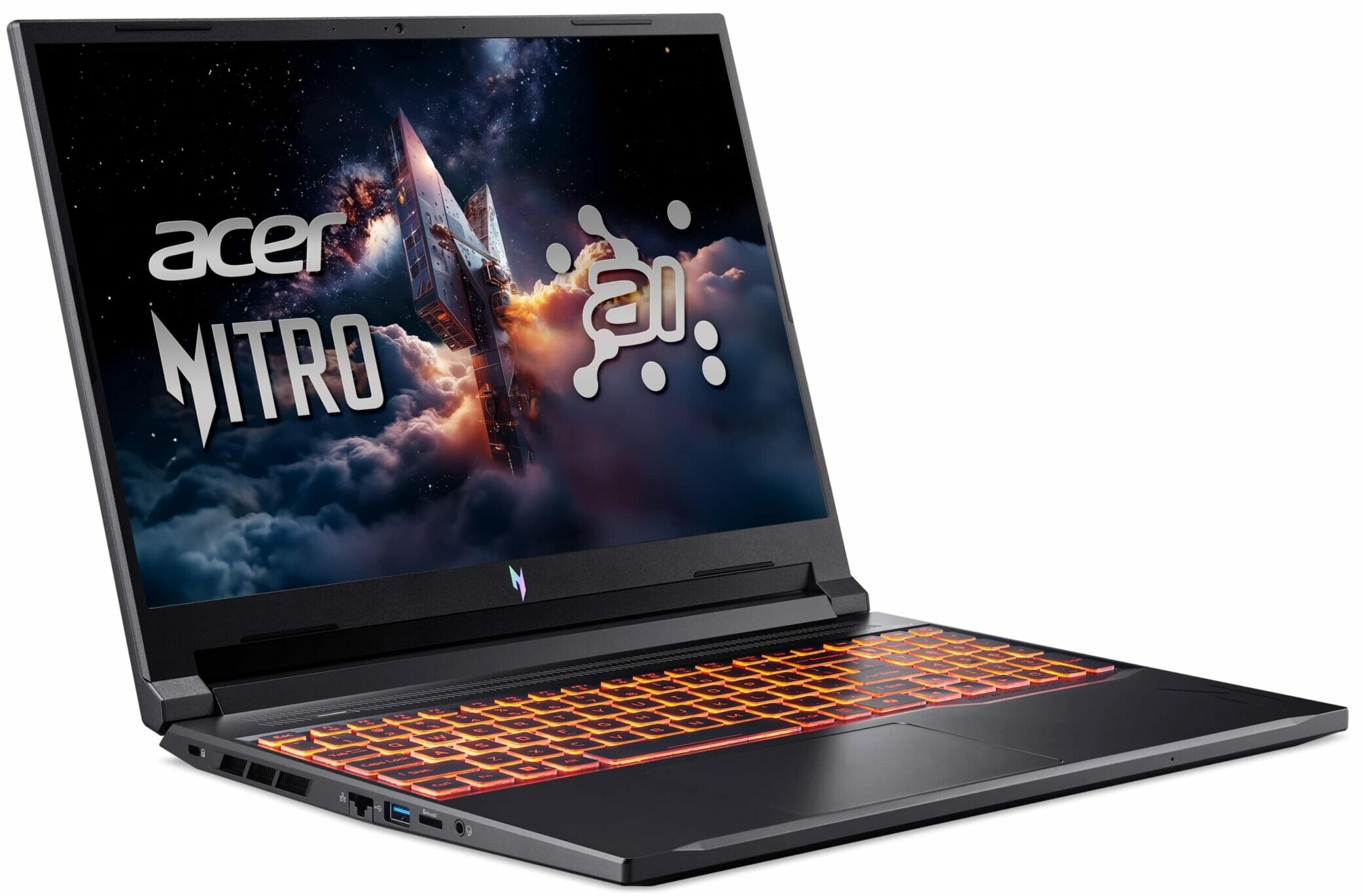
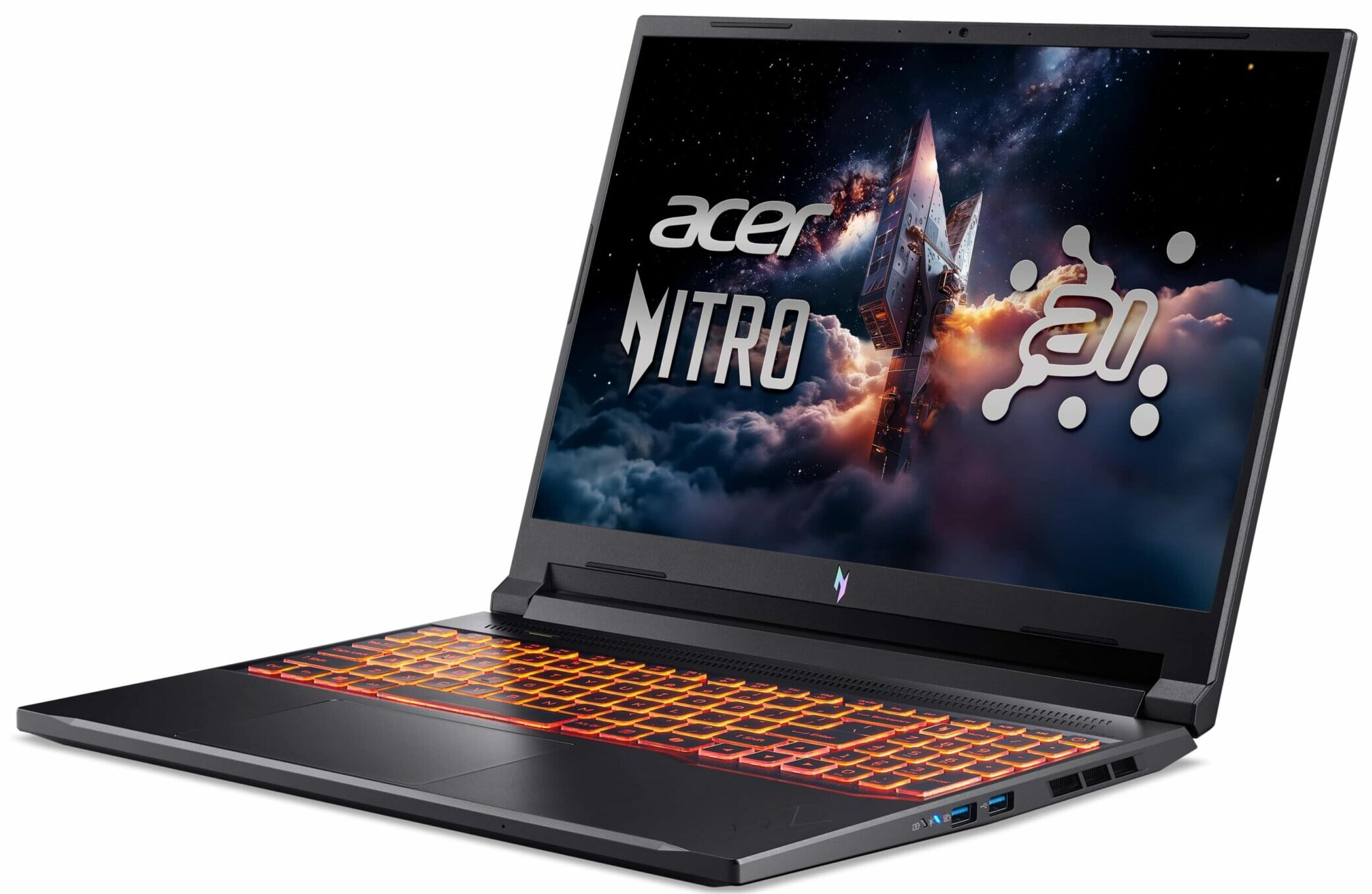
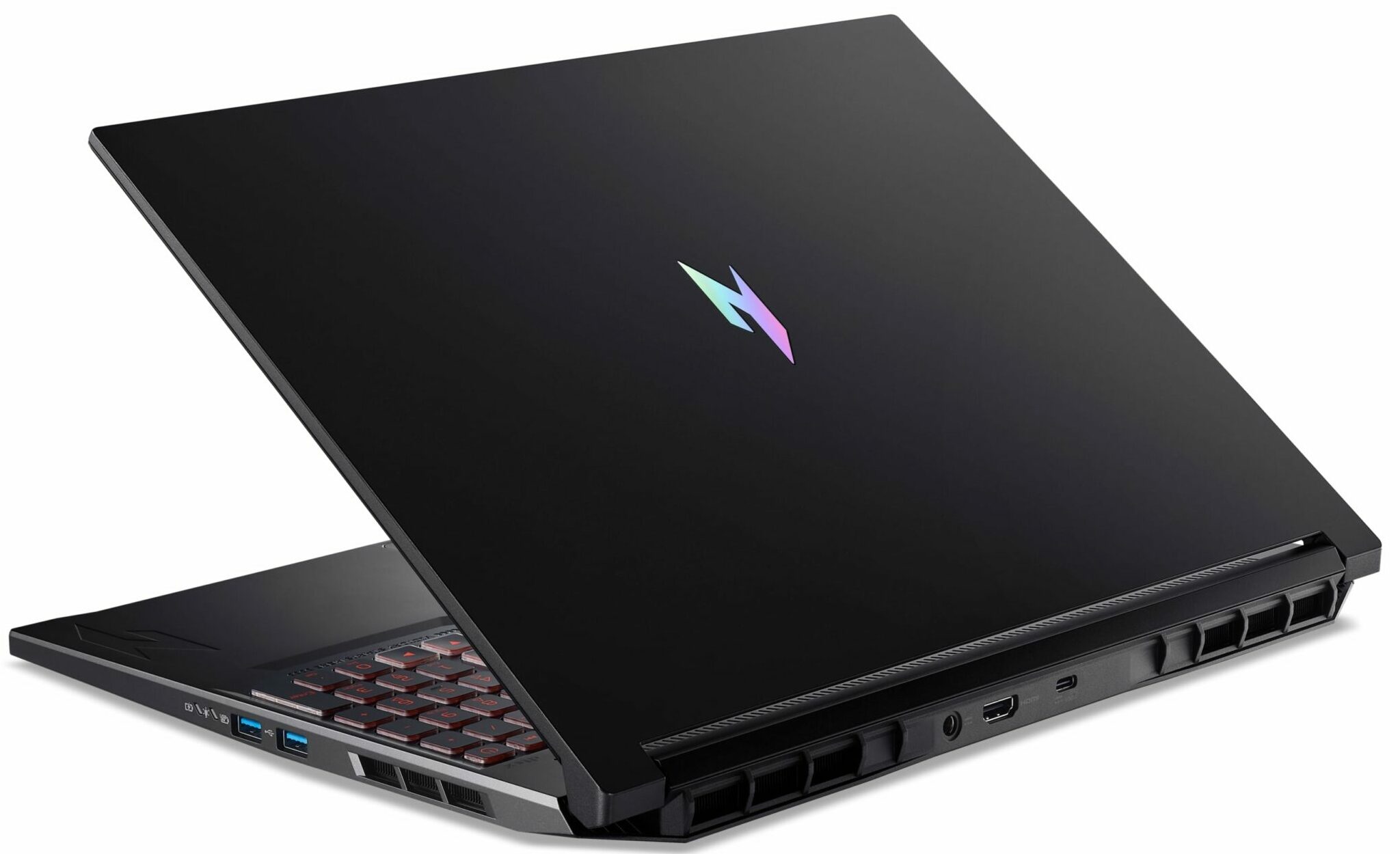
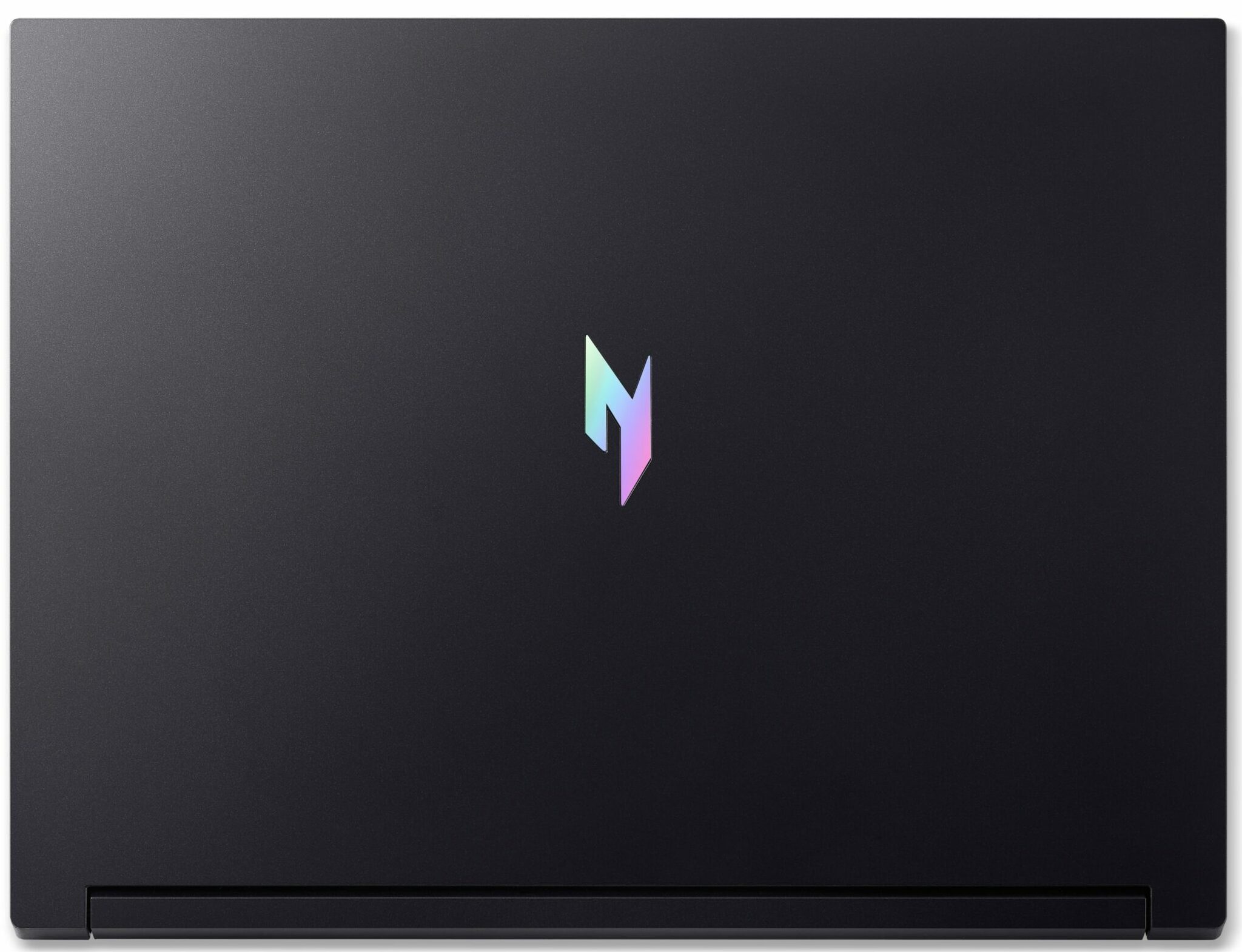
The Acer Nitro V 16 AI (ANV16-42) strikes a more refined and elegant pose than you might expect from a gaming laptop. It avoids overly aggressive angles and flashy gimmicks, opting instead for a clean, purposeful look. The all-black chassis, the only colour option available, looks sharp and modern, punctuated only by a mirrored Nitro logo on the lid that catches the light nicely.
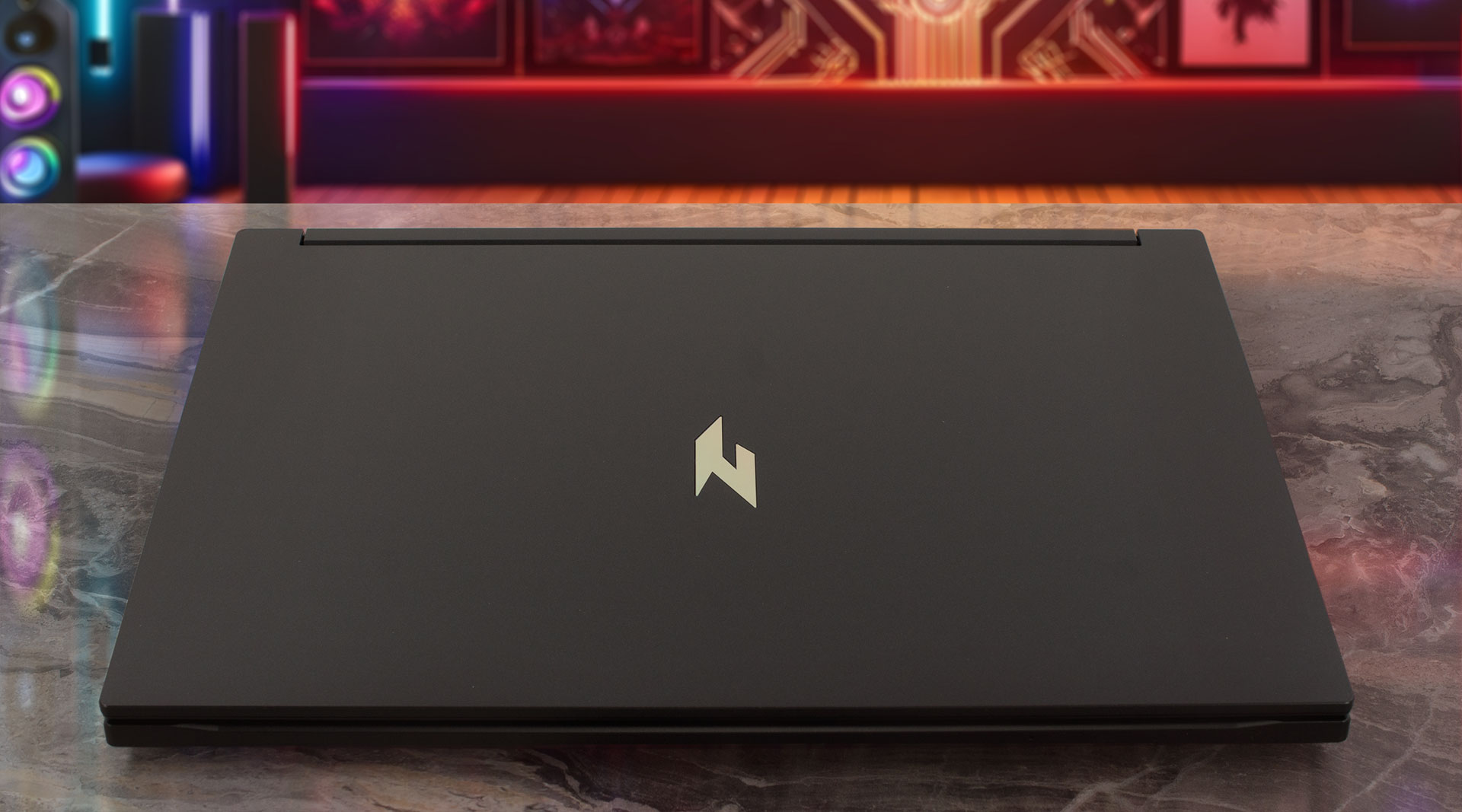
While the body is constructed from plastic, it’s clearly a high-quality polymer; the machine feels remarkably stable and solid in the hand, with no discernible flex or creaks in any area. It gives an impression of durability that belies its material composition. A practical highlight is the finish, which does a great job of resisting fingerprints. After extended use, you might spot some very faint smudges if you look for them under a specific angle of light, but for the most part, it stays looking clean and sharp.
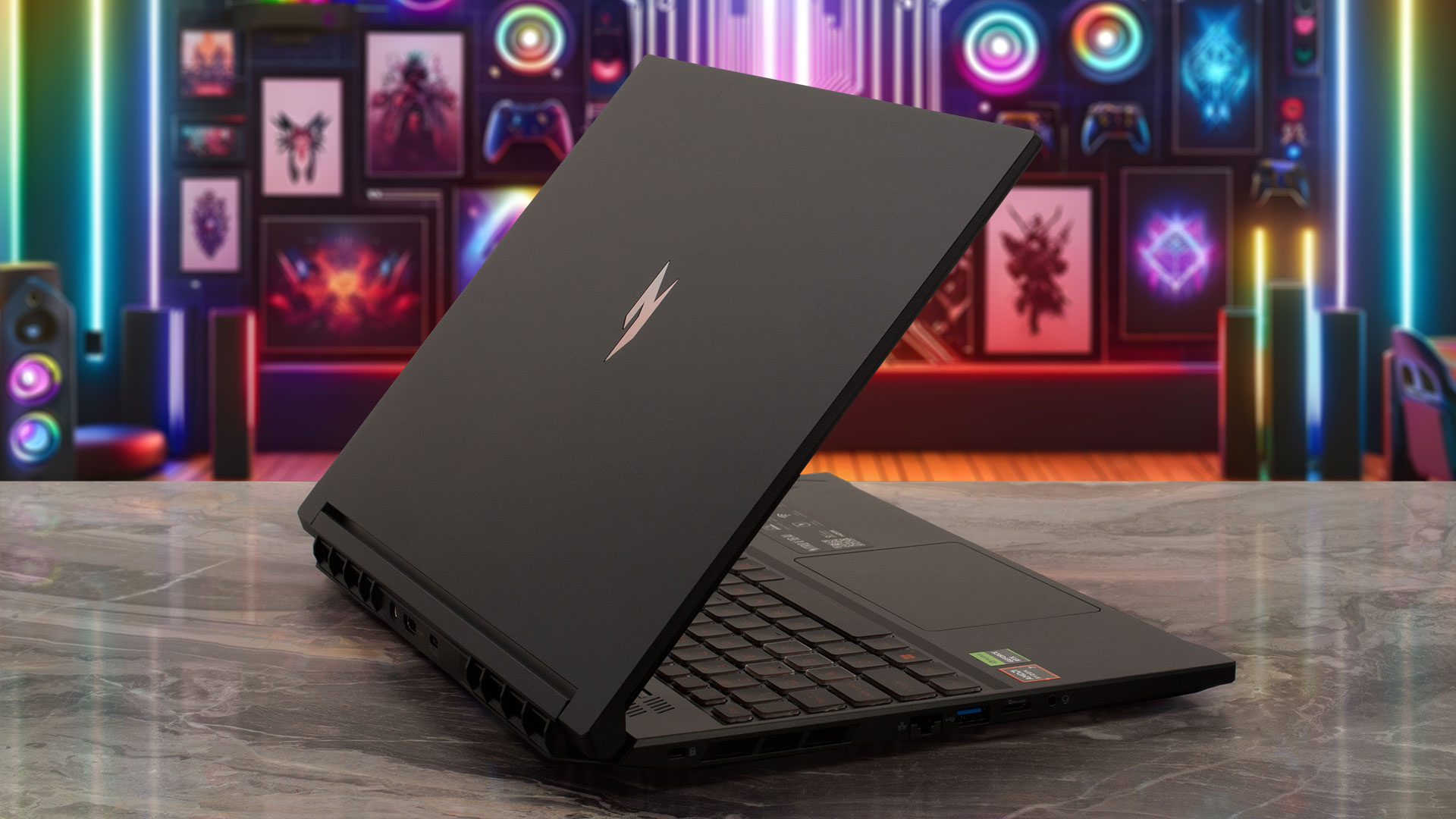
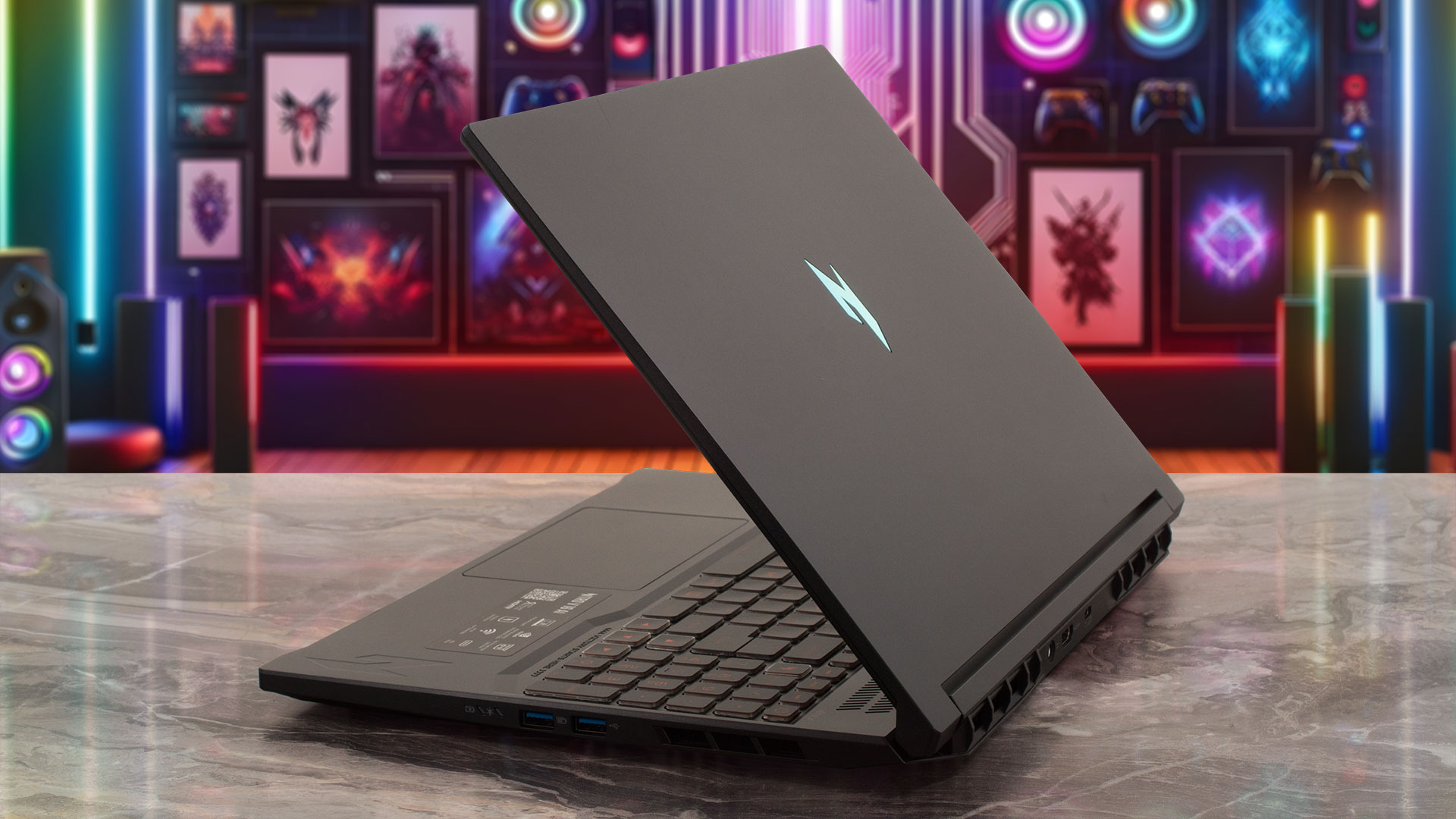
For a gaming machine that can be configured with up to an RTX 5070, the Nitro V 16 is impressively slim, featuring a tapered design that ranges from 16.1mm to 24.5mm (approximately 0.63 to 0.96 inches) in thickness. The weight is fairly standard for its class at 2.44 kg (approximately 5.38 lbs), making it substantial but still manageable for moving around. Opening the lid is a smooth, one-handed operation, a nice touch of convenience, and the hinges feel stable and reliable, holding the screen firmly in place. The display itself can tilt back to a maximum angle of about 140 degrees, which is perfectly sufficient for any gaming or viewing scenario.
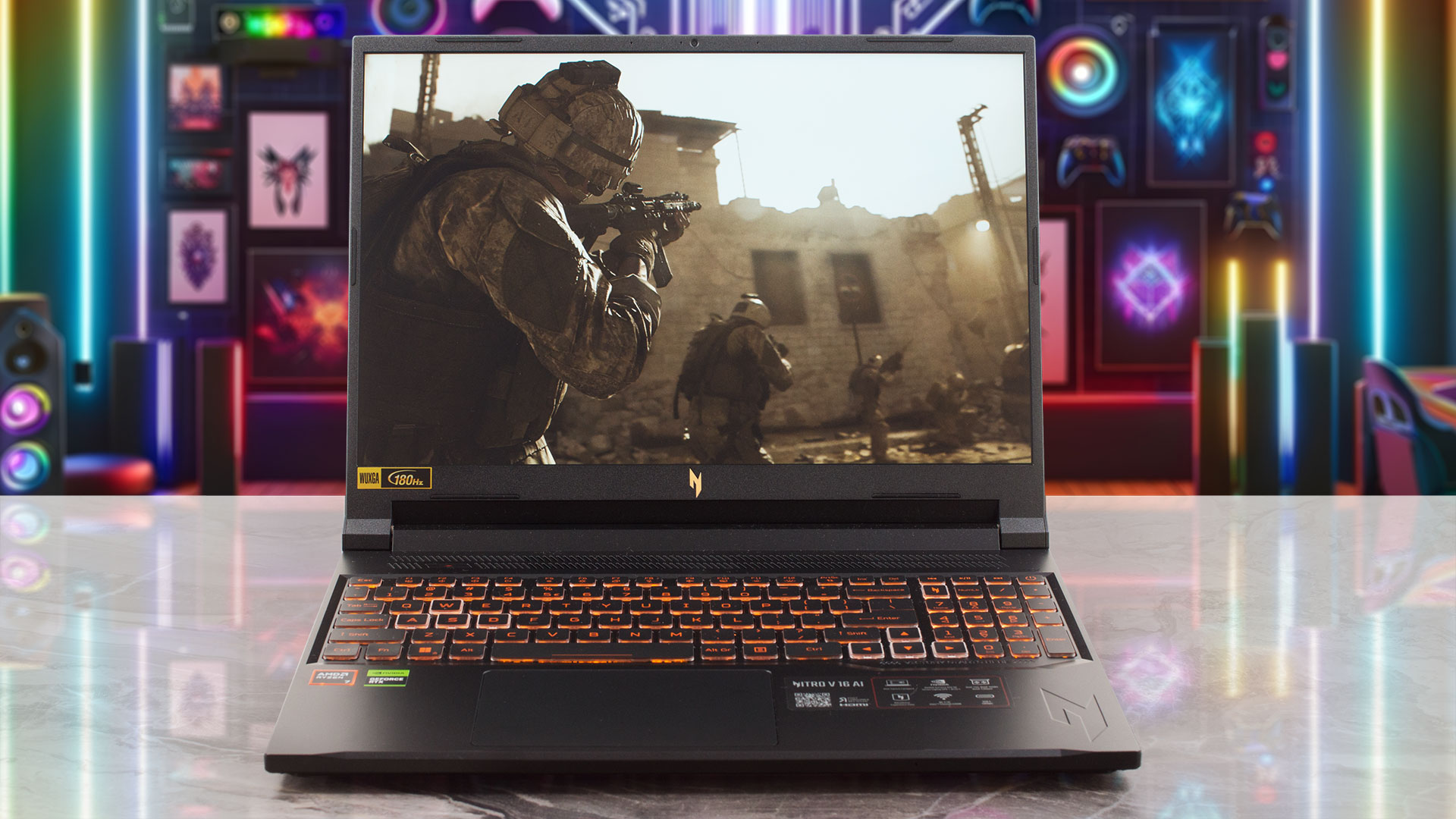
Once open, the screen is framed by relatively thin bezels – 7.5 mm on the sides and 11 mm at the top (approximately 0.30 x 0.43 inches). This top bezel houses a Narrow USB HD camera capable of 720p video at 30 fps, which is enhanced by Temporal Noise Reduction and a Blue Glass lens, and flanked by a dual-microphone array. A notable omission, however, is a physical privacy shutter for the webcam, a feature we always appreciate for guaranteed peace of mind.
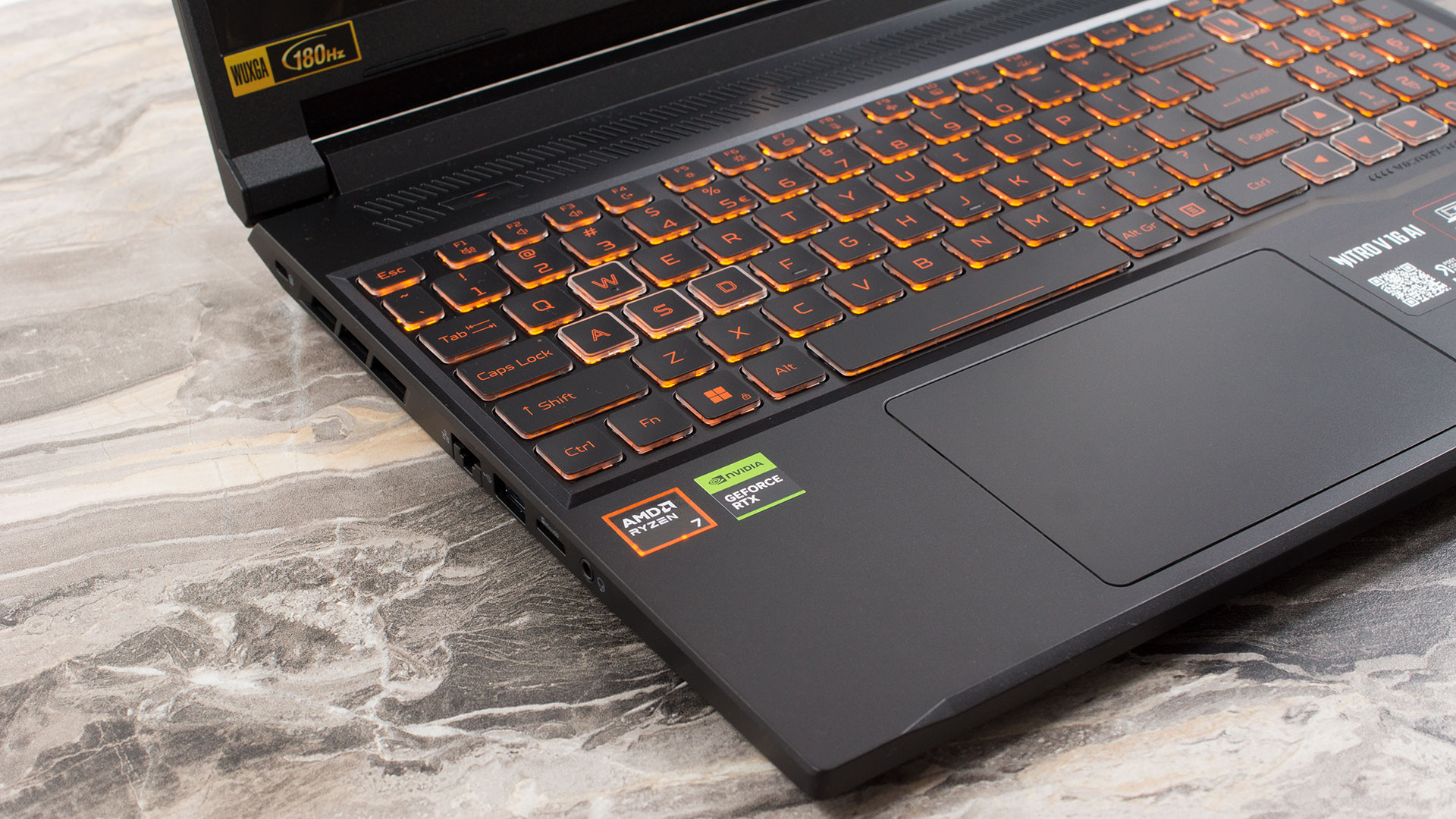
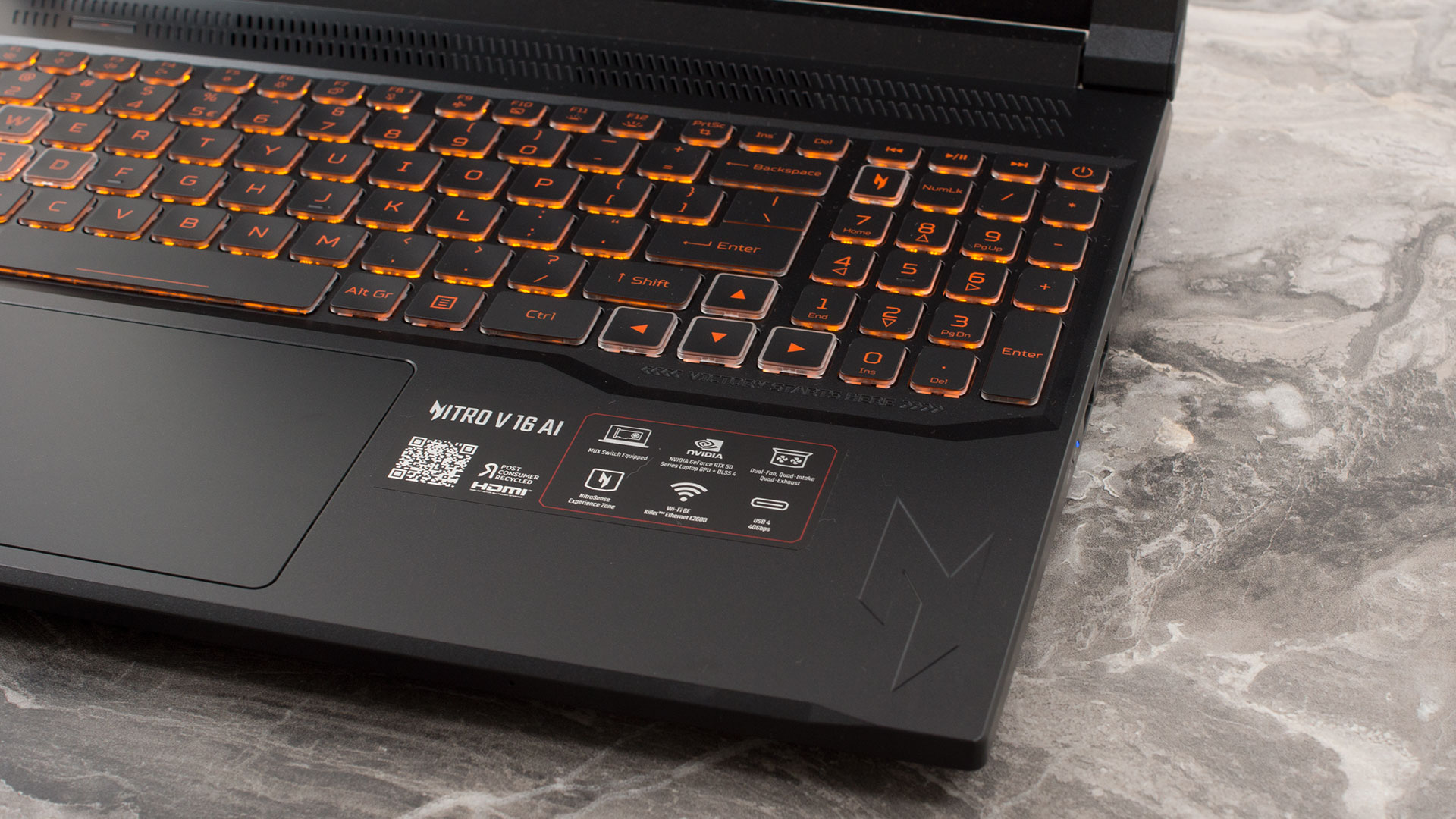
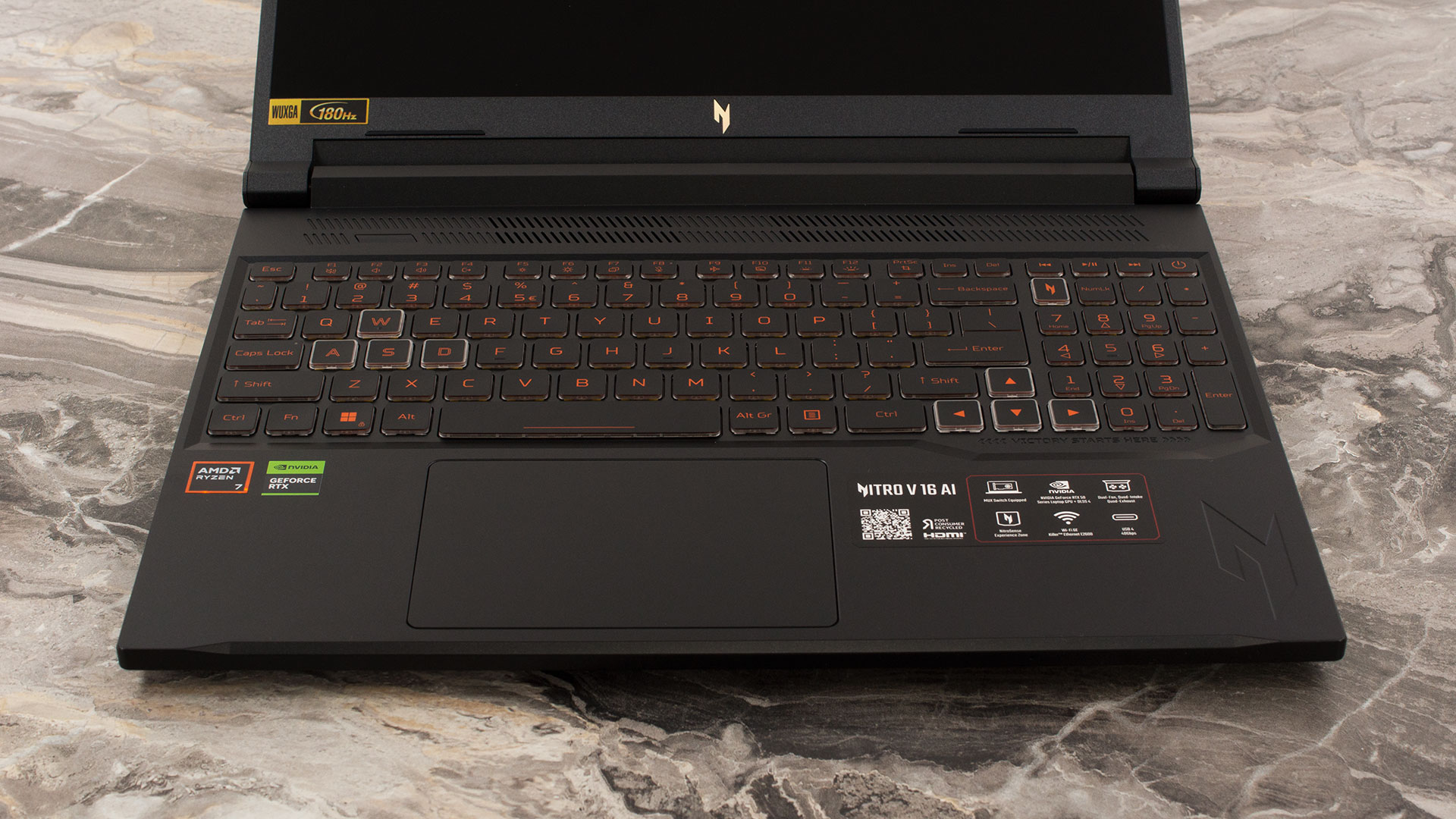
The keyboard deck is well-utilized, with Acer maximizing the space to include a full NumPad, a great feature for both productivity and assigning extra macros in games. The keyboard features a striking orange backlight, reinforcing its gaming identity. For biometric login, you’ll be relying on traditional passwords, as there is no fingerprint reader included. Below the keyboard sits a generously sized trackpad, measuring a large 126 x 83 mm (approximately 4.96 x 3.27 inches). We found it to be very comfortable and responsive, providing excellent navigation for those times when you’re not plugged in with a dedicated gaming mouse.
Ports and Connectivity
The Acer Nitro V 16 AI (ANV16-42) offers a practical distribution of ports across its chassis. On the left flank, you’ll find a Kensington lock slot for security and a Killer E2600 Gigabit Ethernet (RJ-45) port for a stable wired network connection. This side also includes a microSD card reader for accessing files from memory cards, a standard 3.5mm headphone/speaker jack, and one of the system’s three USB-A ports.

The right side houses the other two USB-A ports. In total, the three ports vary in capability: one operates at USB 3.2 Gen 1 (5Gbps) speeds, while the other two are faster USB 3.2 Gen 2 (10Gbps) ports, one of which also features power-off USB charging.

Key connectivity is located on the rear of the device, including the dedicated power connector and a powerful HDMI 2.1 port with HDCP support. Also on the rear is a highly versatile USB Type-C port featuring the USB4 40Gbps standard. This port supports DisplayPort video output (importantly, routed through the integrated GPU), can output 15W to charge other devices, and can also accept up to 65W for alternative, lighter-duty charging of the laptop itself.

For wireless communication, the Nitro V 16 AI is equipped with Wi-Fi 6E (802.11ax). This allows for connections across the 2.4 GHz, 5 GHz, and the less congested 6 GHz bands, utilizing 2×2 MU-MIMO technology for enhanced performance on compatible networks. This is complemented by Bluetooth 5.3 for connecting wireless peripherals such as mice, headphones, or controllers.
– Wi-Fi 6E vs Wi-Fi 6: Learn the Key Differences in 10 Seconds
– Wi-Fi 7 vs Wi-Fi 6E: Learn the Key Differences in 10 Seconds
Display and Sound Quality, Display Profiles
We ordered the middle option. If you need color accuracy, consider buying the 1600p configuration as it has 100% sRGB coverage. The 1200p 180 Hz turned out to be of mediocre quality but at least it scores high on eye-safety.
| Acer Nitro V 16 AI (ANV16-42) | 16.0″, WUXGA (1920 × 1200), 165 Hz, IPS | 16.0″, WUXGA (1920 × 1200), 180 Hz, IPS | 16.0″, WQXGA (2560 × 1600), 180 Hz, IPS |
| Panel ID | — | CSOT MNG007QX2-3 (CSW1664) | — |
| Diagonal | 16.0 inches (40.6 cm) | 16.0 inches (40.6 cm) | 16.0 inches (40.6 cm) |
| Panel Type | IPS | IPS | IPS |
| Resolution | 1920 × 1200 pixels | 1920 × 1200 pixels | 2560 × 1600 pixels |
| Max Refresh Rate | 165 Hz | 180 Hz | 180 Hz |
| Aspect Ratio | 16:10 | 16:10 | 16:10 |
| Pixel Density | 141 PPI | 141 PPI | 189 PPI |
| ‘Retina’ Distance | Greater than or equal to 62 cm | Greater than or equal to 62 cm | Greater than or equal to 46 cm |
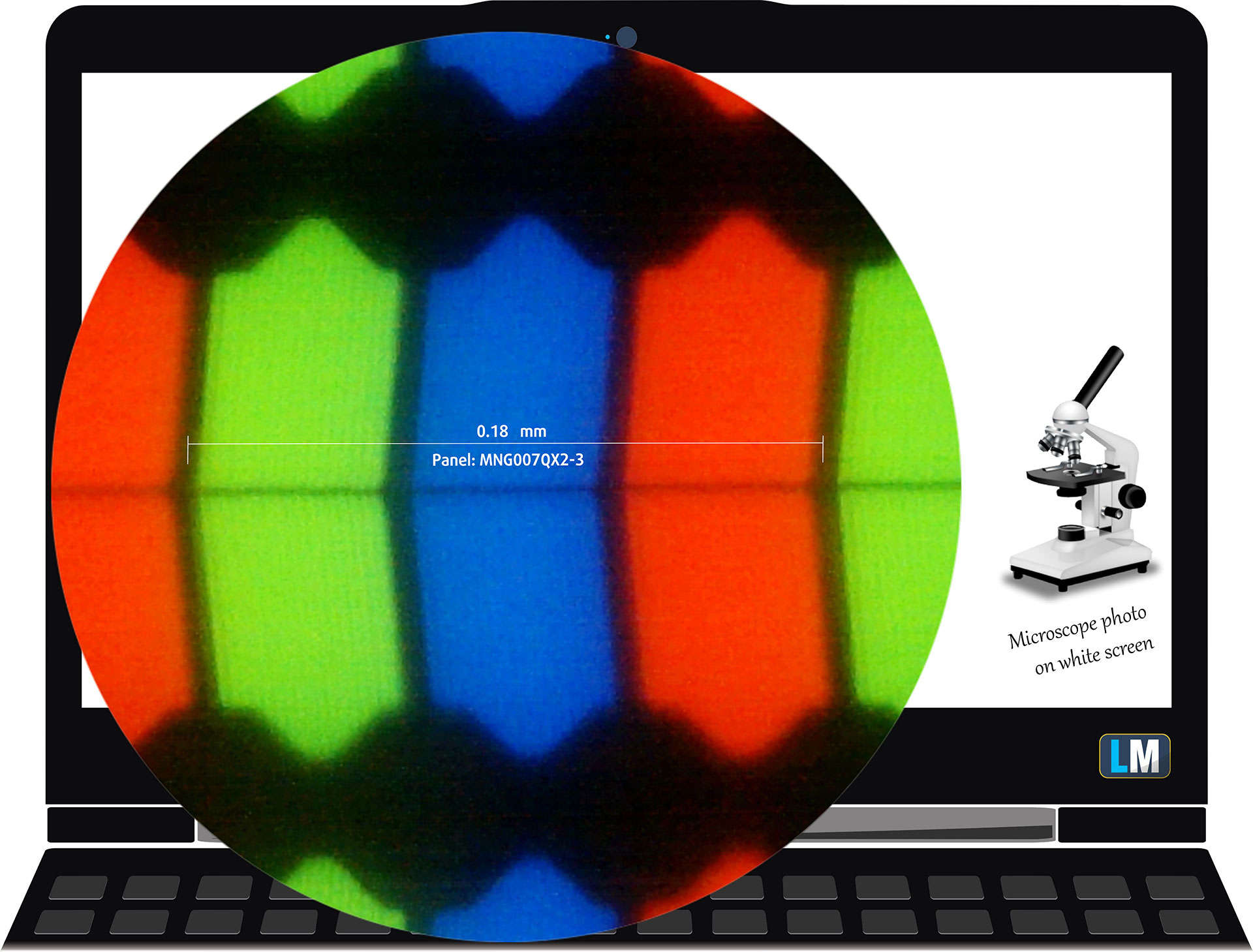
The 1200p 180 Hz panel of Acer Nitro V 16 AI (ANV16-42) under our microscope
Viewing Angles
Viewing angles are good. We take photos from different angles to evaluate the quality.
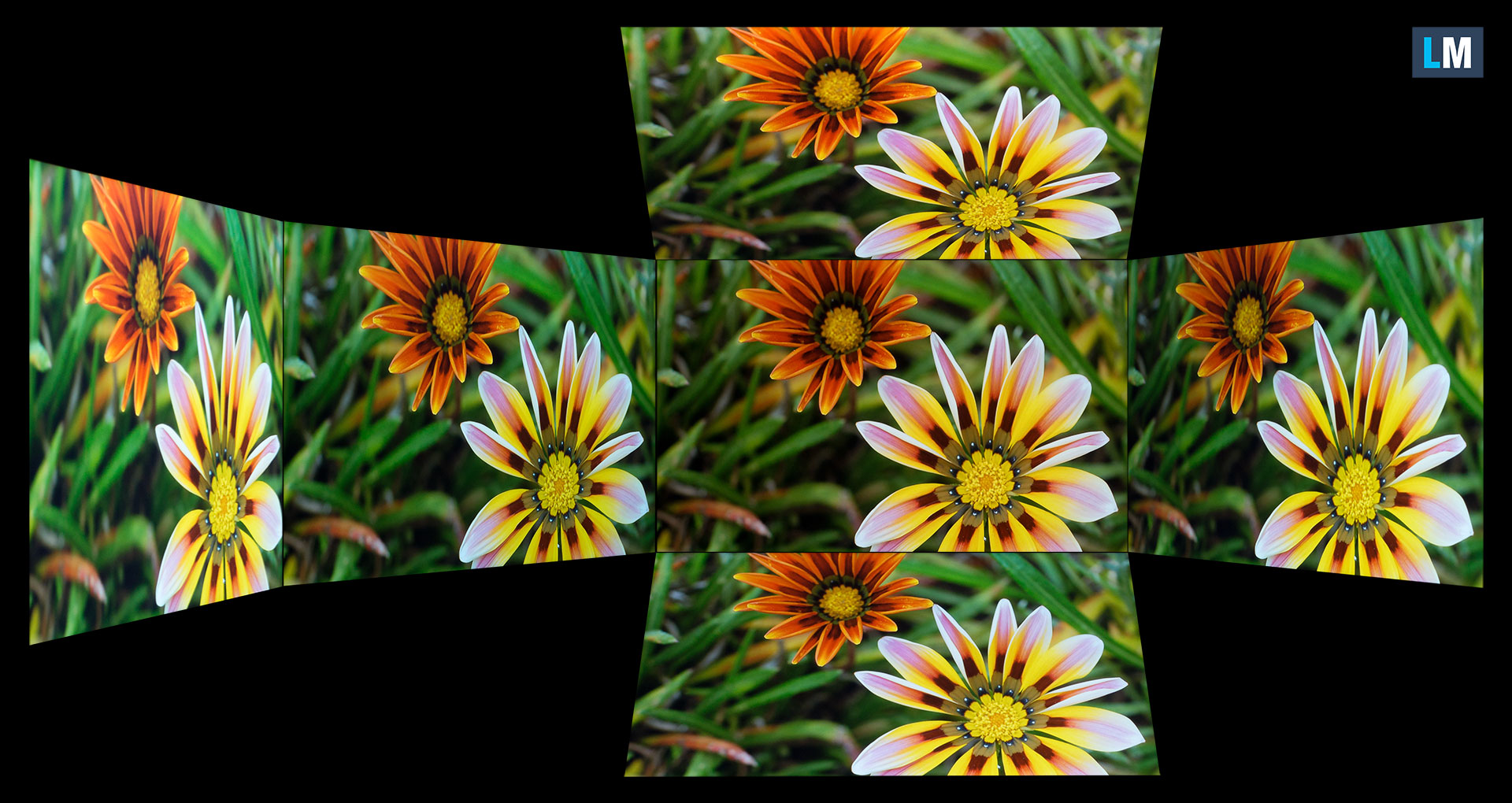
Also, a video with locked focus and exposure.
Color Coverage
The whole “sail-shaped” map below (Fig. 1) consists of all the colors we can see, while the black crooked line shows all the colors from real-world scenes and nature around us.
Then, we’ve drawn some of the most important and interesting color spaces, compared to the colors the panel of Acer Nitro V 16 AI (ANV16-42) can show:
Standard/For Web: sRGB – widely used color space for most consumer devices, ideal for Web design and development
For Print: AdobeRGB – used in professional photo editing, graphic design, and print
For Photographers/Video Editors: DCI-P3 – used in high-end film production, post-production, and digital cinema
Premium HDR: Rec.2020 – the widest consumer ITU color standard, covering a massive 75.8% of the visible spectrum, a benchmark for premium HDR content.
Acer Nitro V 16 AI (ANV16-42): the yellow dashed triangle (– – – – – –) represents the range of colors this display can show.
In our tests, we calculated the total color coverage of the display at 50% of the sRGB color gamut and 40% of the DCI-P3 color gamut.
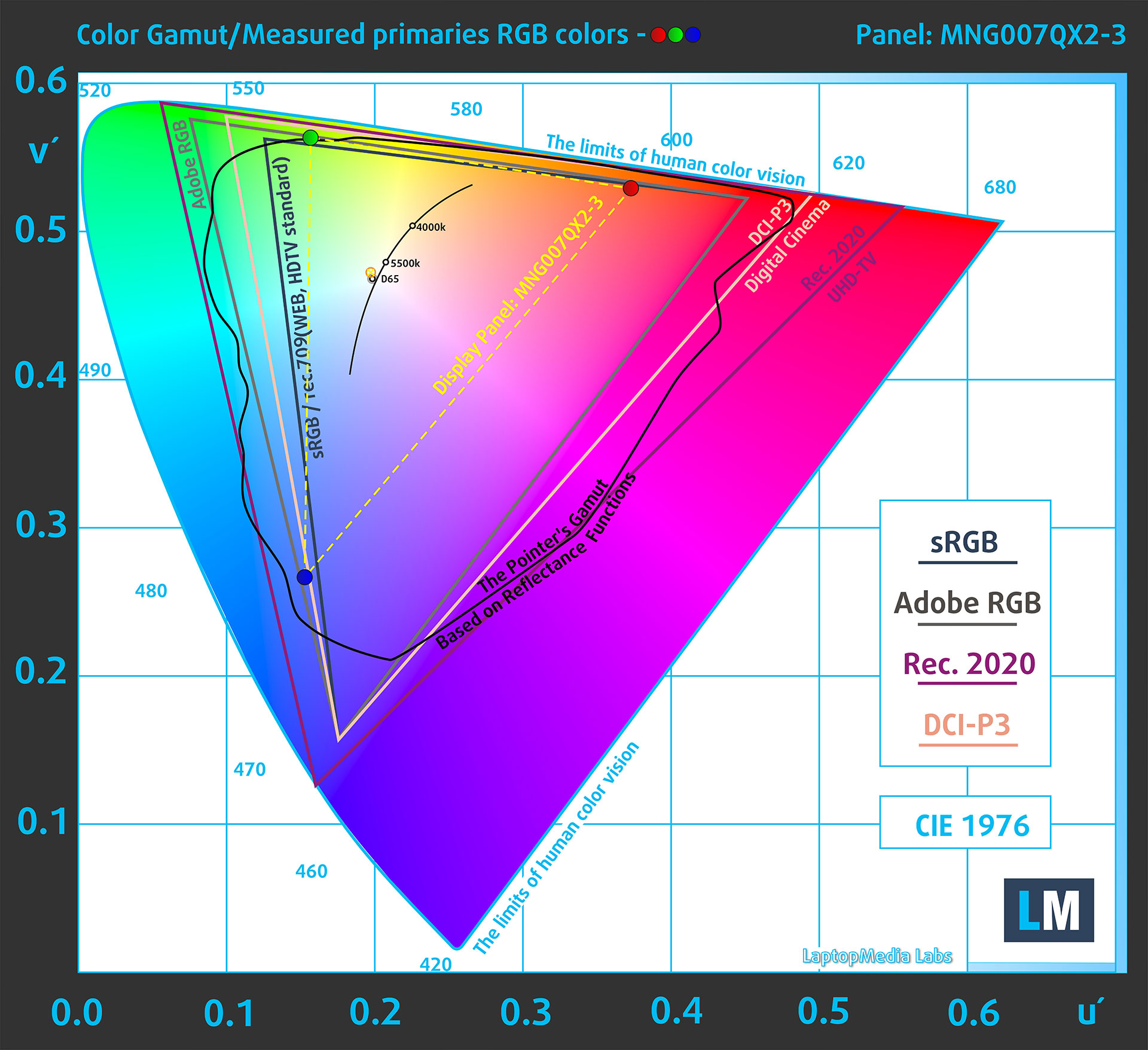
(Fig.1) Acer Nitro V 16 AI (ANV16-42) covers 50% of the sRGB gamut
Brightness and Contrast
The maximum brightness in SDR mode is 343 cd/m² in the center of the screen and 322 cd/m² averaged across the surface with a maximum deviation of 10%.
The Correlated Color Temperature (CCT) on a white screen at maximum brightness is 6270K.
The contrast ratio is 1430:1.
Uniformity: Luminance, Contrast, and Color Deviation
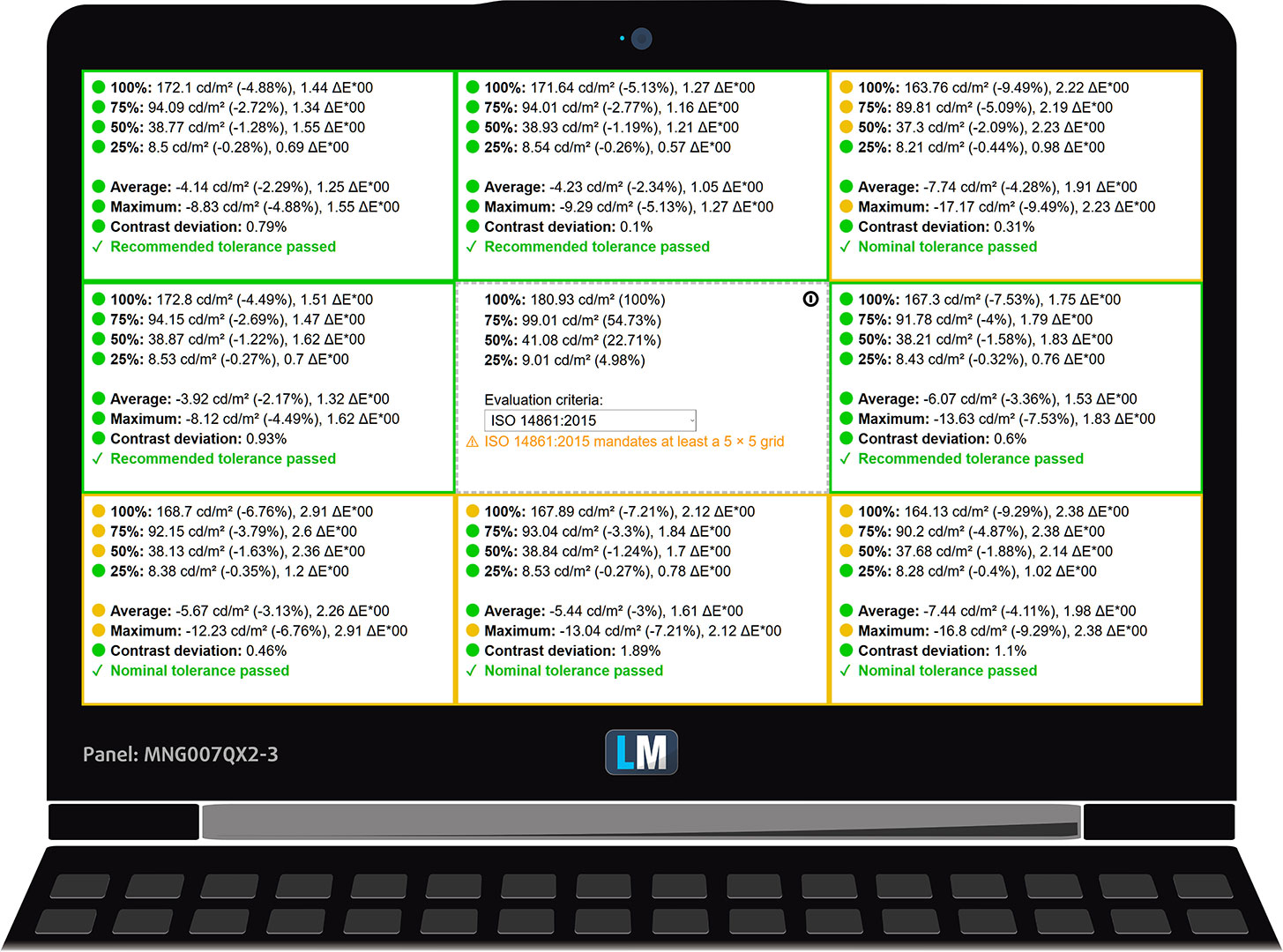
The figure below shows the results from our uniformity test across different sections of the screen. It’s measured at 181 nits (Windows slider = 43%) — a brightness level we consider typical for standard working conditions.
DeltaE values below 4.0 are acceptable for regular users. For those working with colors, screens with DeltaE values no higher than 2.0 are recommended.
Color Accuracy
Let’s check the difference between real colors and those you’ll see on the Acer Nitro V 16 AI (ANV16-42). We measure that distance in DeltaE – the higher the number, the more different they look.
Values below 4.0 are acceptable for regular users, while values below 2.0 are suitable for color-sensitive work. A value below 1.0 means the difference is indistinguishable to the naked eye.
For the next graph, we’ve selected 24 common colors, including dark/light skin, blue sky, green grass, etc.
Before our calibration of the Acer Nitro V 16 AI (ANV16-42), the Average color accuracy was 5.2 dE (Fig. 2), and with our Design and Gaming profile, it lowered to 4.0 dE (Fig. 3).
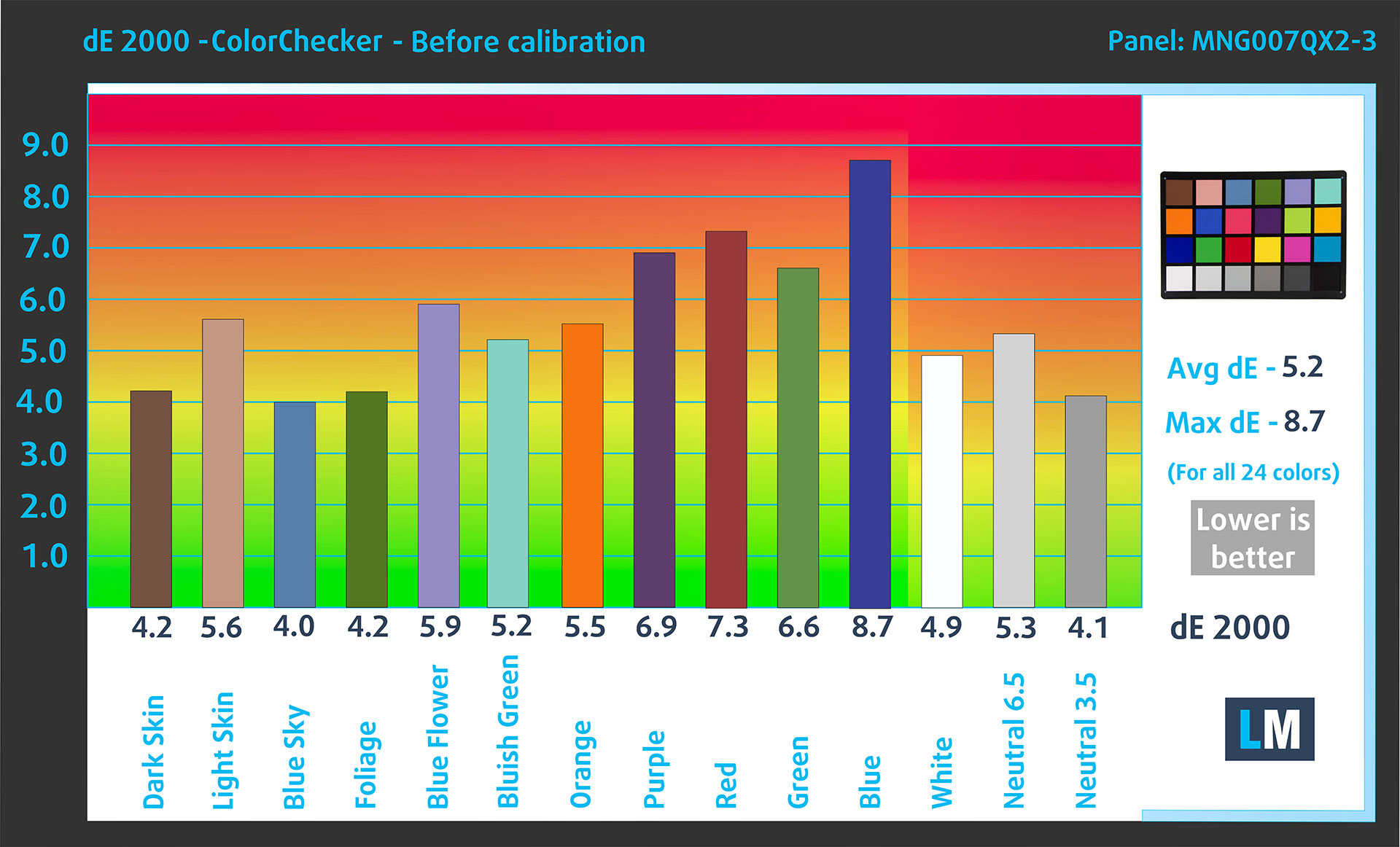
(Fig. 2) Acer Nitro V 16 AI (ANV16-42) in its factory condition
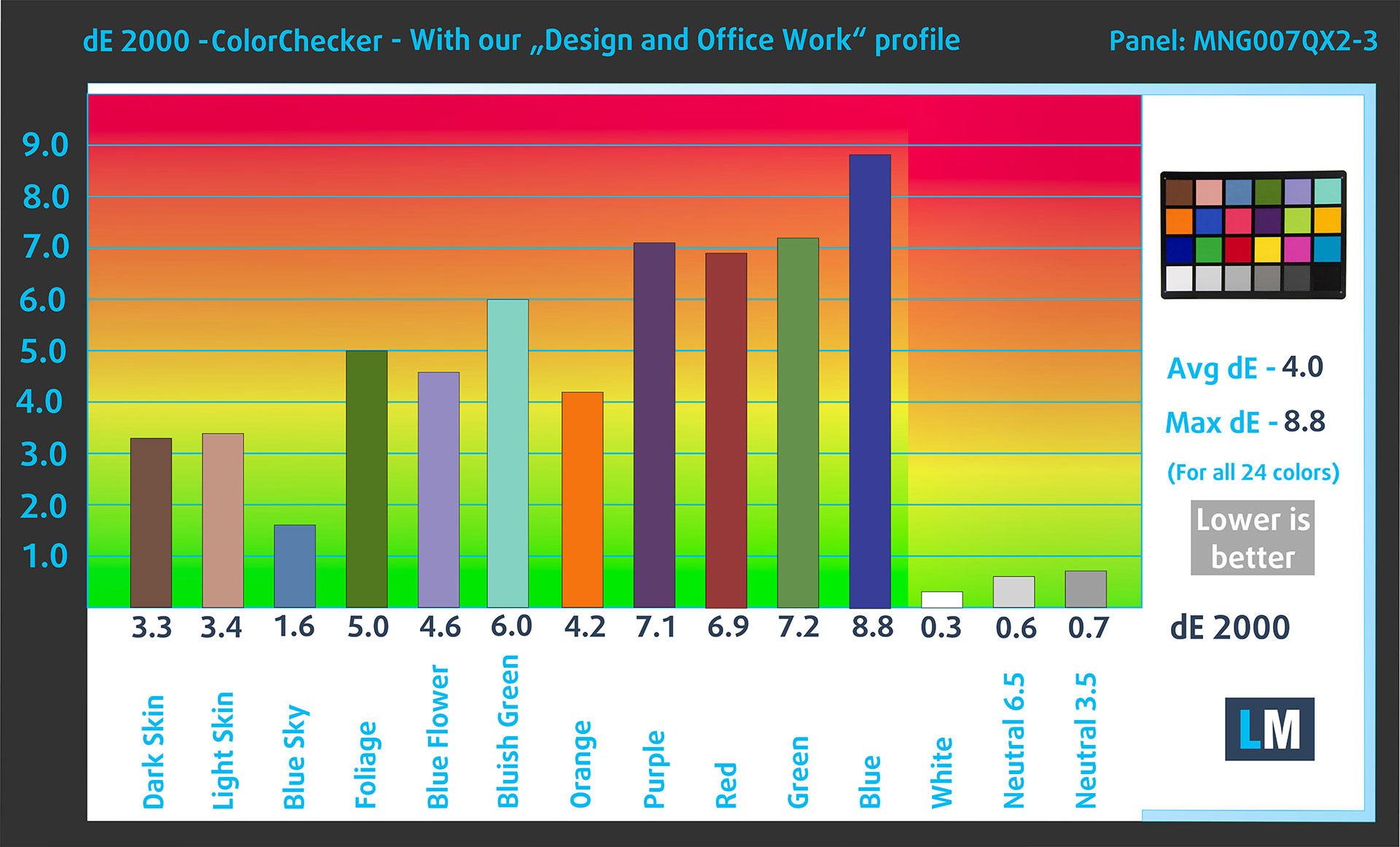
(Fig. 3) Acer Nitro V 16 AI (ANV16-42) with our display profile
Comparison in the sRGB color space.
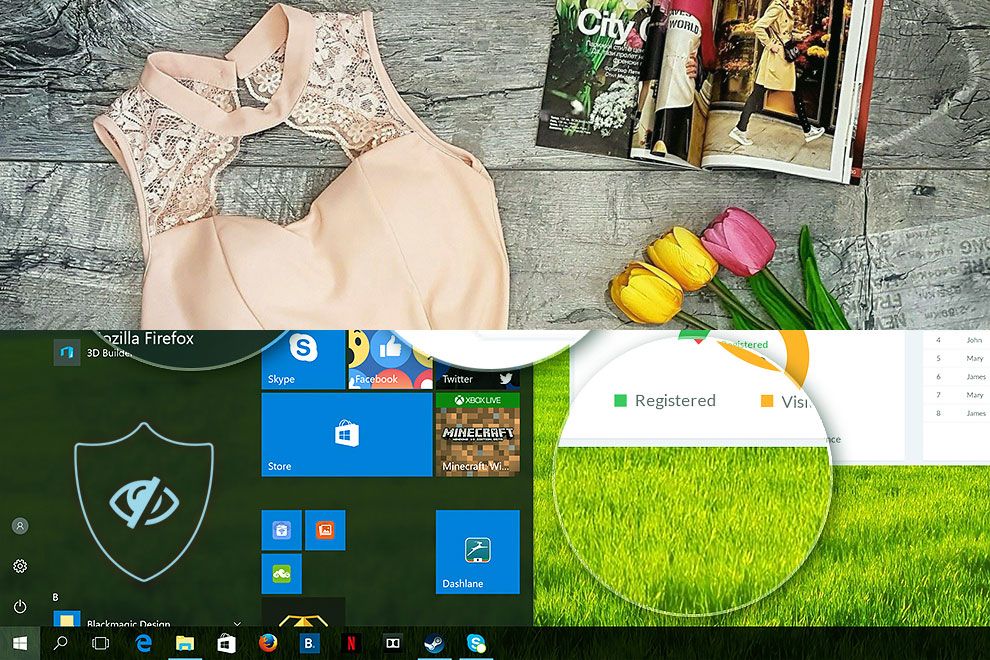
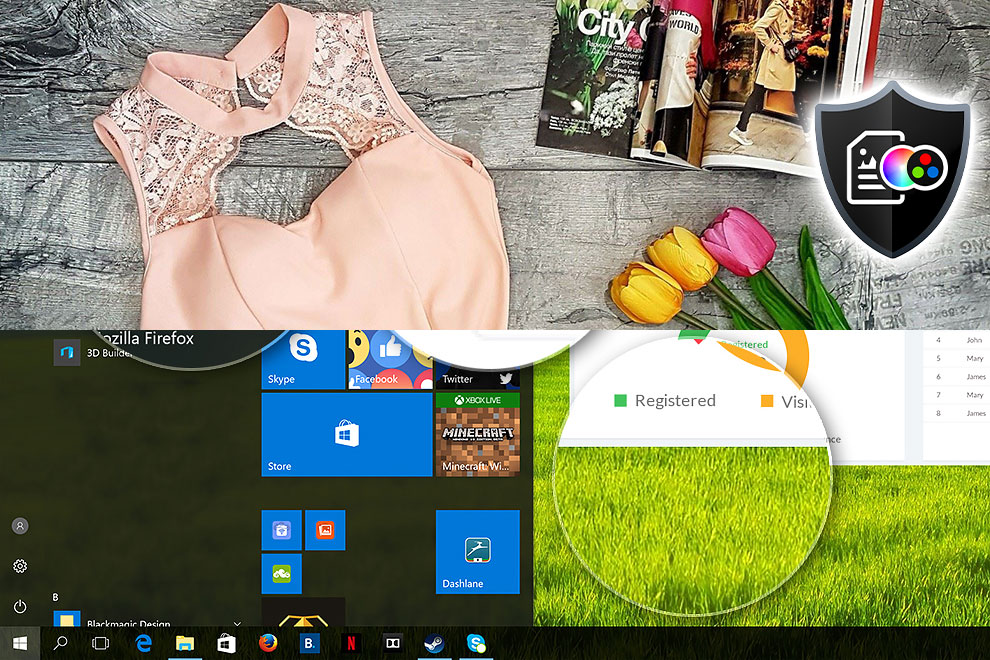
Here’s an illustration of what the Design and Office profile aims to deliver:
Left: No Profile | Drag the slider to see the difference | Right: Design & Office Profile
Visibility in dark scenes
Have you ever watched a movie with dark scenes where you could barely see anything? This often happens because many display panels struggle to differentiate the darkest nuances, making them appear the same.
The next figure illustrates how well the display reproduces these dark nuances. The left side of the image shows the display with stock settings, and the right side shows it with our Gaming and movies profile activated.
On the horizontal axis are the grayscale levels, and on the vertical axis – the corresponding display brightness.
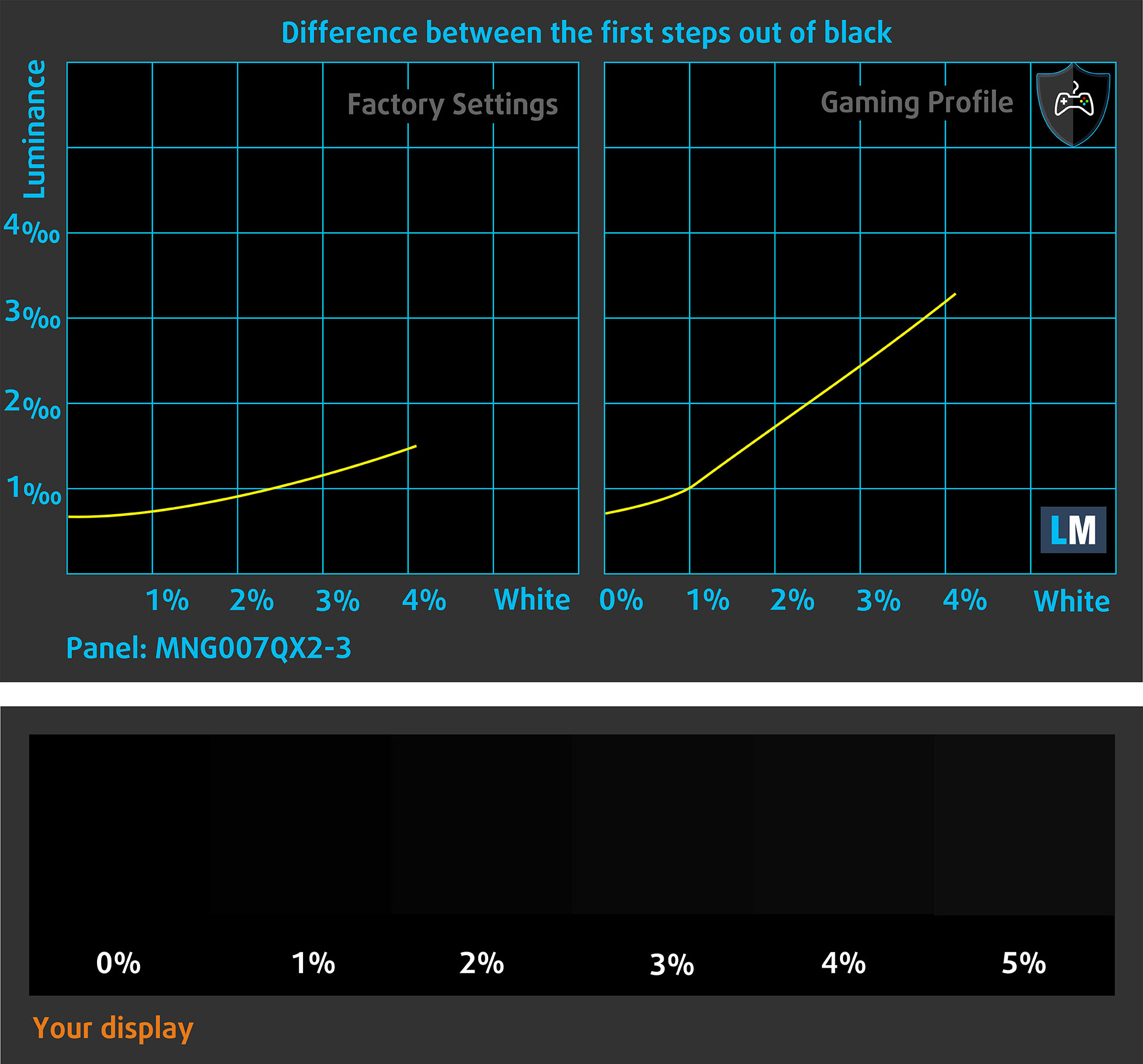
You can also check how your display handles the darkest nuances but keep in mind that this also depends on the settings of your current display and the surrounding light conditions.
Response time (Gaming capabilities)
We test the reaction time of the pixels with the usual “black-to-white” and “white-to-black” method from 10% to 90% and vice versa.
We recorded Fall Time + Rise Time = 6.6 ms. Short pixel response time is a prerequisite for a smooth picture in dynamic scenes.
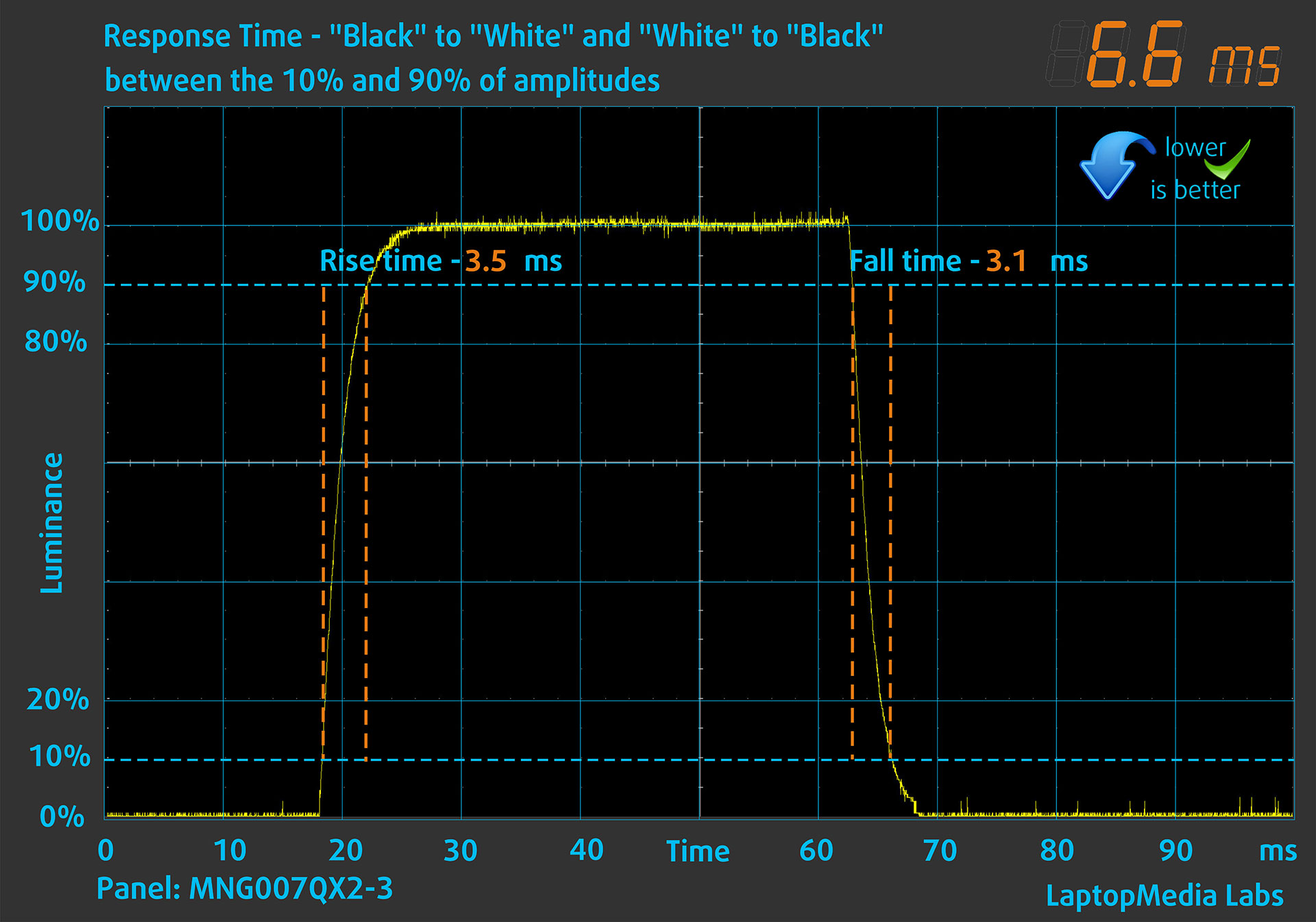
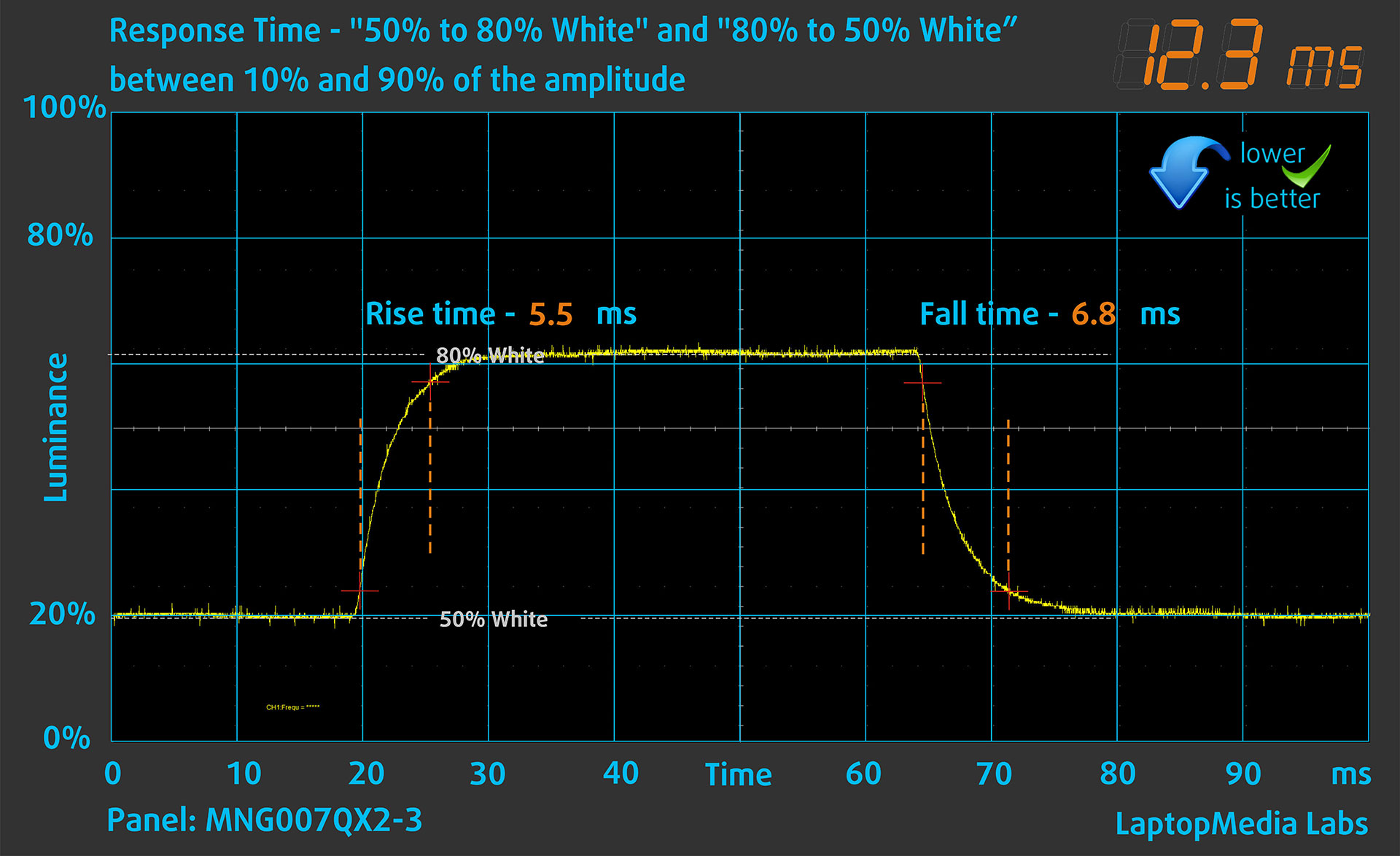
After that, we test the reaction time of the pixels with the usual “Gray-to-Gray” method from 50% White to 80% White and vice versa between 10% and 90% of the amplitude.
Health Impact: PWM (Screen flickering)
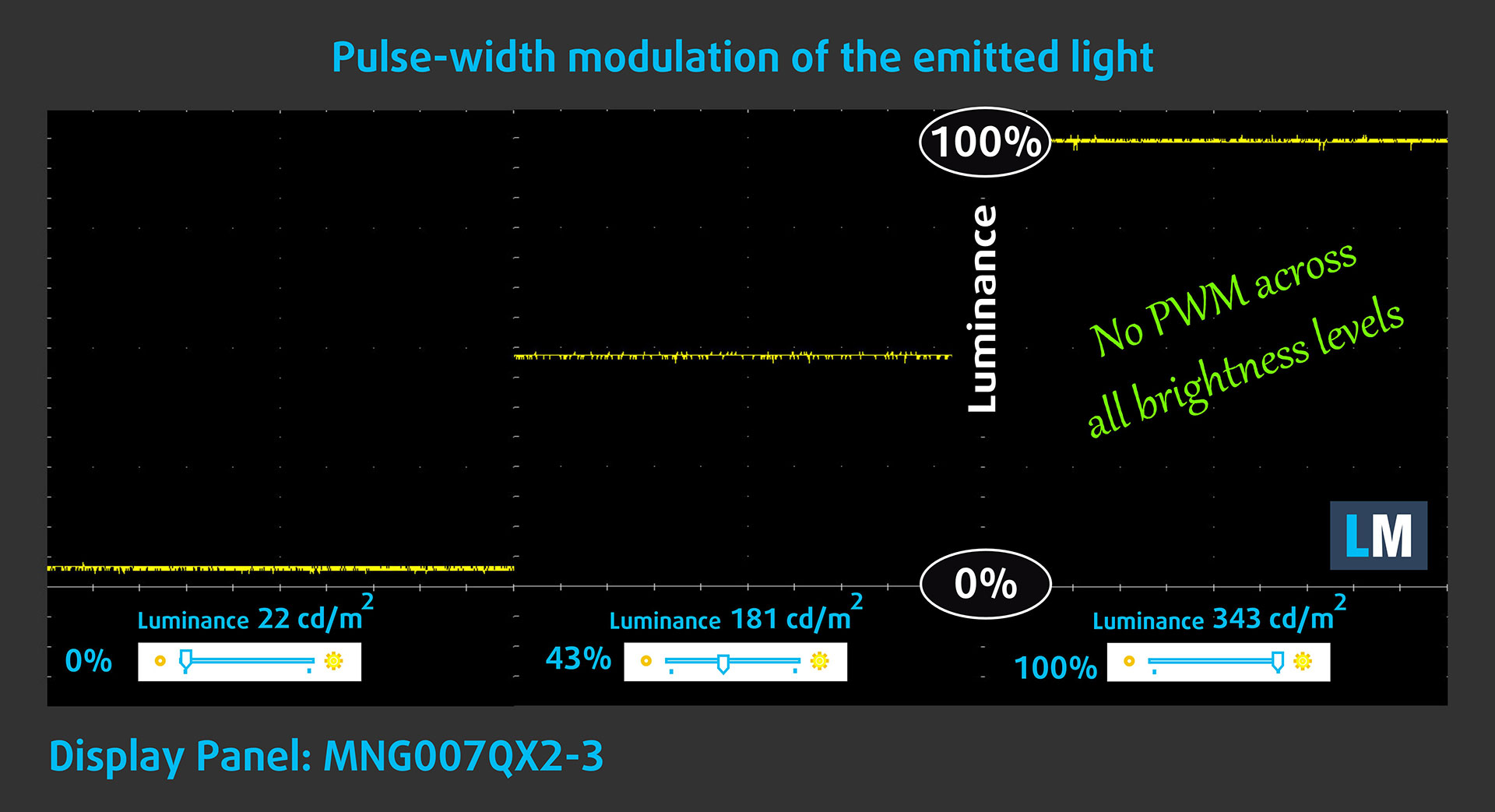
Some use PWM to regulate their brightness, which means that instead of reducing the light intensity, they pulse or flicker. Our brain merges the image, so it appears darker, but this strains both it and our vision, especially when the frequency of the pulses is low. You can read more about that in our dedicated article on PWM.
In the graph below, you see the intensity of light at different brightness levels—on the vertical axis is the brightness of the emitted light, and on the horizontal axis—time.
The light from the backlight of the Acer Nitro V 16 AI (ANV16-42) display is not pulse-width modulated, providing visual comfort in the discussed aspect.
Health Impact: Blue light emissions
Installing our Health-Guard profile reduces harmful Blue Light emissions while keeping the colors of the screen perceptually accurate.
If you’re not familiar with the Blue light, the TL;DR version is – emissions that negatively affect your eyes, skin, and your whole body. You can find more information about that in our dedicated article on Blue Light.
Health Impact: Screen Reflectance
Glossy-coated displays can cause eye fatigue in high ambient light conditions due to reflections. We measure the level of screen reflection with the display turned off, at a 60° angle.
The reflectance of the Acer Nitro V 16 AI (ANV16-42)’s screen is 50.1 GU. This is a very good result!
High Gloss: >70 GU
Medium Gloss: 30 – 70 GU
Low Gloss: <30 GU
Get our profiles
Since our profiles are tailored for each individual display model, this article and its respective profile package are meant for Acer Nitro V 16 AI (ANV16-42) configurations with MNG007QX2-3 (CSW1664), 1920 x 1200, IPS panel.
*Should you have problems with downloading the purchased file, try using a different browser to open the link you’ll receive via e-mail. If the download target is a .php file instead of an archive, change the file extension to .zip or contact us at [email protected].
Read more about the profiles HERE.
In addition to receiving efficient and health-friendly profiles, by buying LaptopMedia's products you also support the development of our labs, where we test devices in order to produce the most objective reviews possible.
Design and Office
The Design and Office profile makes display colors as close to real as possible.Ideal not only for professionals but also for everyday users, it meets sRGB standards (D65 white point, sRGB gamma) with minimal DeltaE for precise color reproduction on your panel.

Gaming and Movies
Have you ever watched a movie where, during dark scenes, you can barely see anything? Many displays fail to distinguish dark tones properly. Our Gaming and Movies profile enhances low-light performance, like HDR tech, using a gamma curve tailored to human perception — ideal for gamers seeking faster reactions and clearer visuals.

Health-Guard
Our Health-Guard profile protects your eyes by eliminating PWM flickering, reducing strain and fatigue, and minimizing harmful Blue light exposure that can disrupt sleep and health. It uses software dimming and a gamma curve tailored to human perception for comfort and safety during screen use.
Get All The Profiles With 33% Discount!

Sound
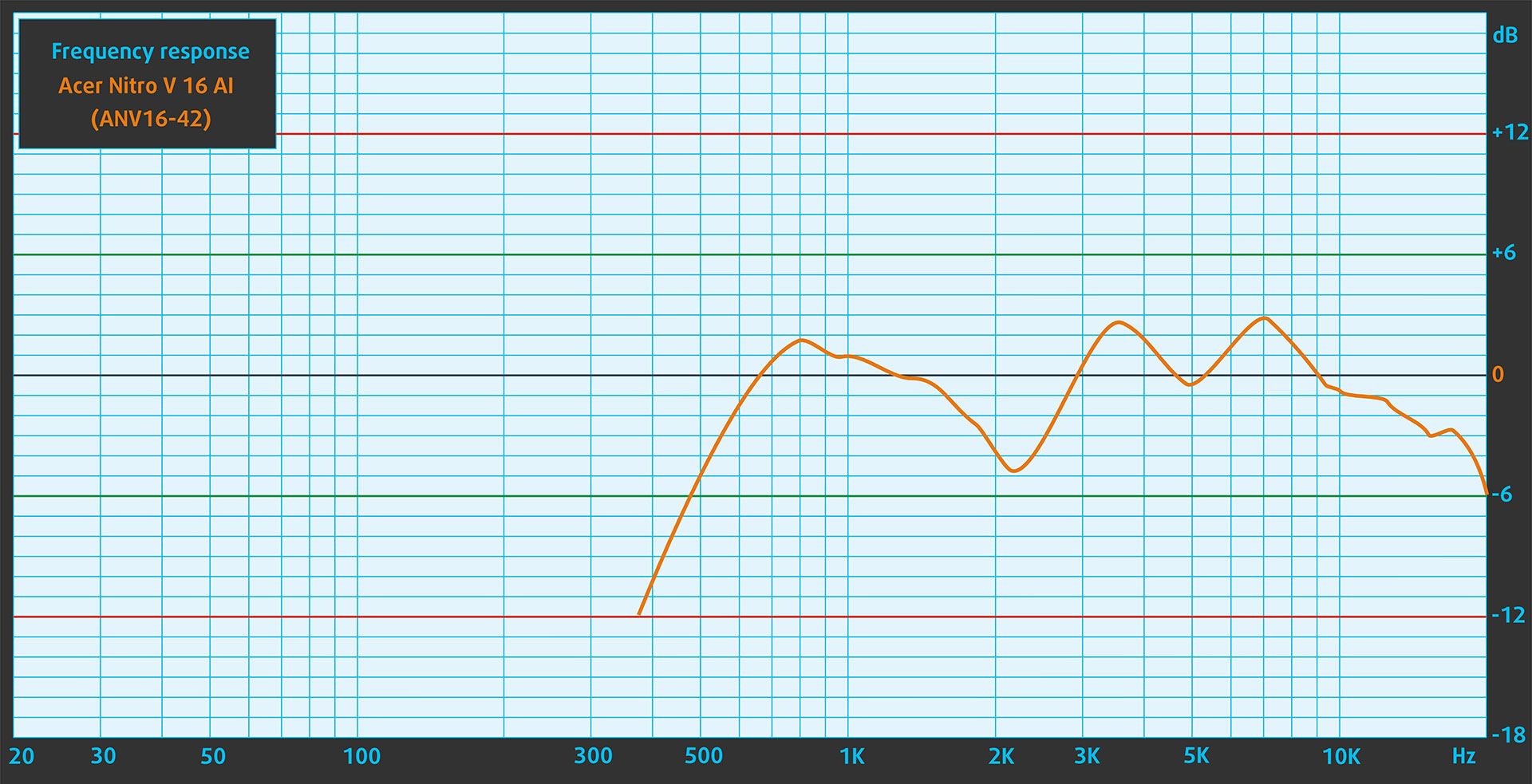
When we subjectively listen to a sound file through the built-in speakers (2x2W speakers), the sound quality offered by the Acer Nitro V 16 AI (ANV16-42) is very good. The low, mid, and high frequencies are clear.
Work Performance: CPU, Storage, AI
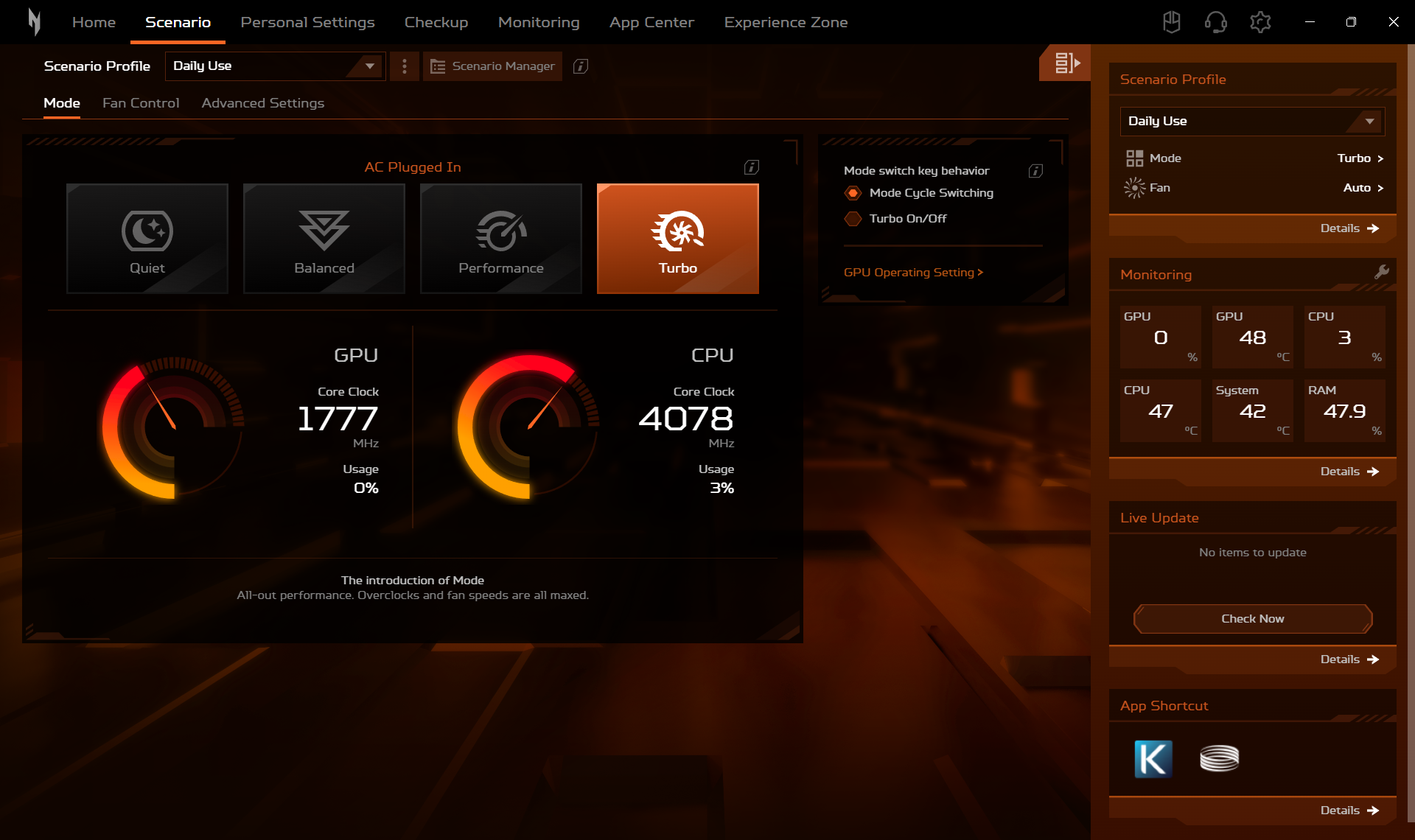
All performance and temperature tests are conducted with “Turbo” activated in NitroSense:
CPU and Work Performance
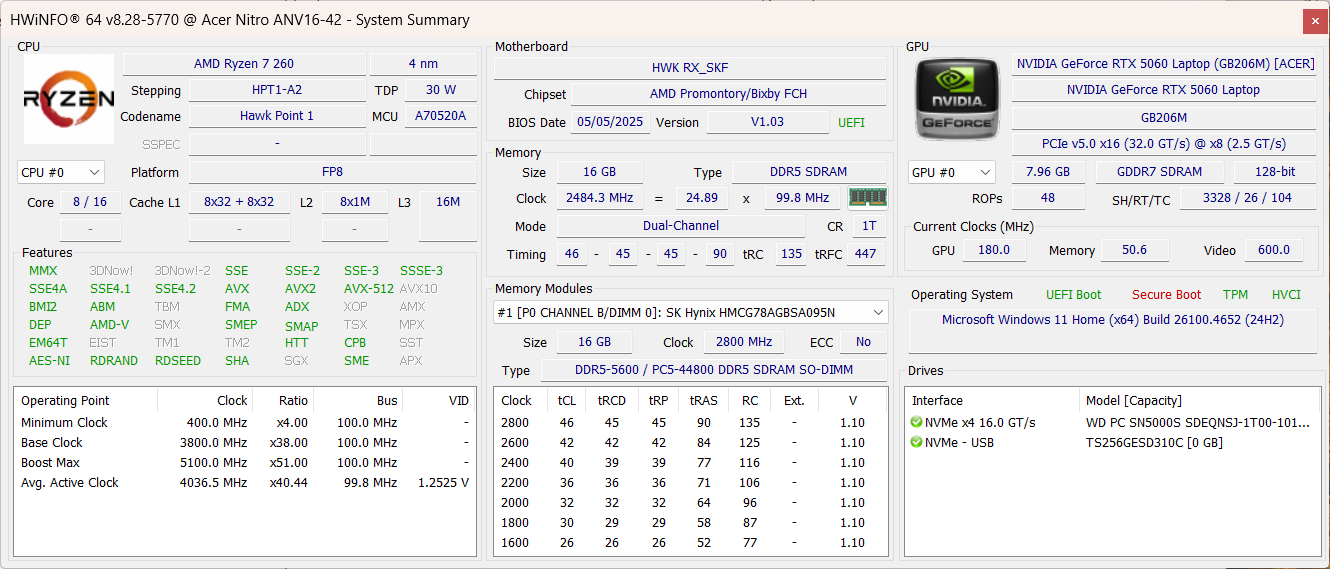
The Acer Nitro V 16 AI (ANV16-42) is powered by AMD Ryzen processors, with configurations including the Ryzen 7 260 – ranked #52 in our Top Laptop CPU Ranking, and a Ryzen 5 240 option for more budget-oriented users. These CPUs deliver strong multi-core performance for gaming, AI-assisted workflows, and multitasking in a mid-range gaming chassis.
Intel Core Ultra 9 275HX is from another league which is clearly visible in the multi-core tests but AMD Ryzen 7 260 remains a solid choice for everyday tasks. We have to note that the Ryzen 7 260 performs much better in Lenovo Legion 5, 15″, Gen 10 (detailed review). But is there a catch? Check out the Temperatures section below.
Single-core performance ensures smooth operation and responsiveness in operating systems, providing a better user experience.
Results are from the Geekbench 6 Single-Core test (higher is better)
Multi-core performance is essential for handling complex and demanding tasks, such as Video editing, CAD, and Scientific simulations.
Results are from the Geekbench 6 Multi-Core test (higher is better)
Here, we evaluate the CPU's performance using a real-world 3D rendering task, assessing its ability to handle complex computations and rendering workloads efficiently.
Results are from the Cinebench 2024 Multi-Core test (higher is better)
Storage Performance
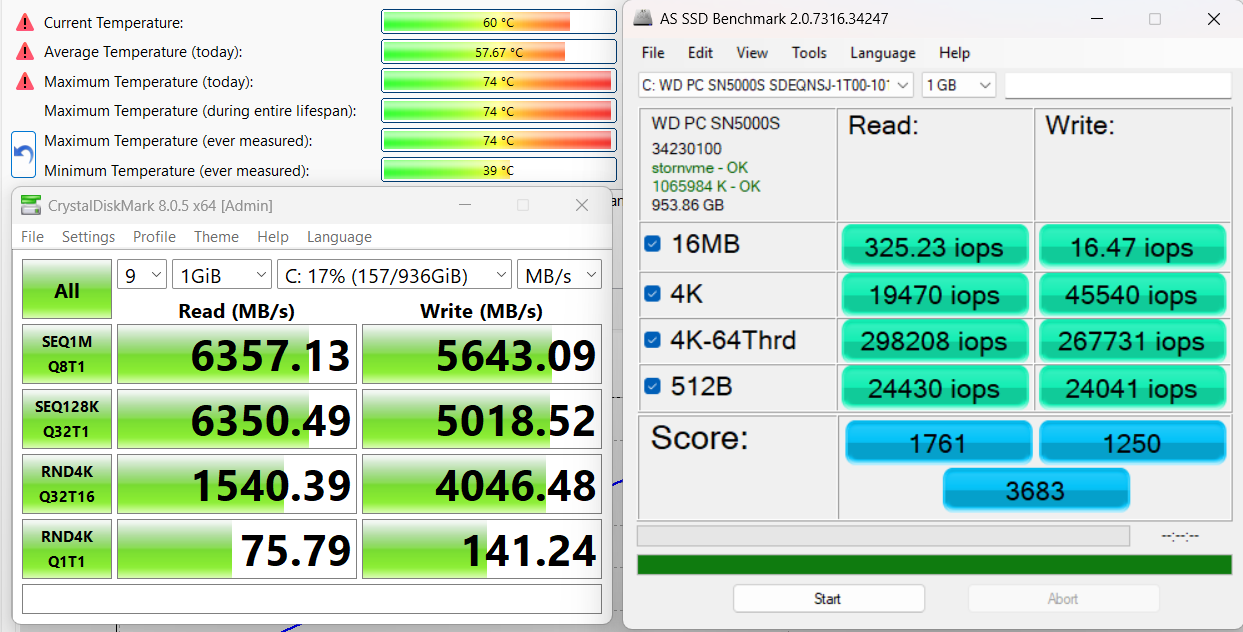
We ordered a 1TB configuration, and it arrived with the very popular Western Digital PC SN5000S (SDEQNSJ-1T00) NVMe SSD. It has 6.4GB/sec sequential read, and 5.6GB/sec sequential write speeds.
AI Performance
Here you can see the position of the GPUs and CPUs (NPUs) found within the Acer Nitro V 16 AI (ANV16-42) in our AI Hardware Performance Rankings based on their AI processing power, measured in TOPS (Tera Operations Per Second) - a critical metric indicating the computational throughput, particularly for AI tasks.
The first column shows peak performance for INT8/FP8 precision, which is the most widespread metric for evaluating AI inference capabilities. We exclude Sparsity to provide a more accurate reflection of AI performance in dense computation scenarios where sparsity optimizations may not be applicable. The second and third columns show the performance with Sparsity, and FP4 TFLOPS, when supported.
For SoCs, the results reflect the peak performance of the integrated NPU. Additionally, it’s important to note that, according to Microsoft, a NPU must have at least 40 TOPS of AI computing power for the PC to be considered “AI-capable.”
| # | GPU / CPU (NPU) | TOPS INT8/FP8 No Sparsity | TOPS INT8/FP8 Sparsity | TFLOPS FP4 Sparsity |
|---|---|---|---|---|
| 849. | NVIDIA GeForce RTX 5070 (Laptop, 8GB GDDR7) | 173 | 346 | 692 |
| 1014. | NVIDIA GeForce RTX 5060 (Laptop) | 133 | 266 | 532 |
| 1280. | NVIDIA GeForce RTX 4050 (Laptop) | 97 | 194 | — |
| 1702. | AMD Ryzen 5 240 | 16 | — | — |
| 1709. | AMD Ryzen 7 260 | 16 | — | — |
GPU and Gaming Performance
On the graphics front, the Nitro V 16 AI offers a diverse array of GPU options. At the high end, you can choose between NVIDIA GeForce RTX 5070 and RTX 5060 ranked #19 and #26 respectively in our Top Laptop Graphics Ranking. For balanced performance and value, the RTX 5050, ranked #47, is also available. Entry-level configurations include the RTX 4050 and the RTX 3050 (6 GB) at #182.
With 20% advantage over RTX 4060, and 10-14% behind RTX 5070, the RTX 5060 is probably the most balanced GPU choice in terms of price/performance.
The results are from 3DMark Time Spy (Graphics). Higher is better.
The results are from 3DMark Wild Life Extreme Unlimited. Higher is better.
Gaming tests

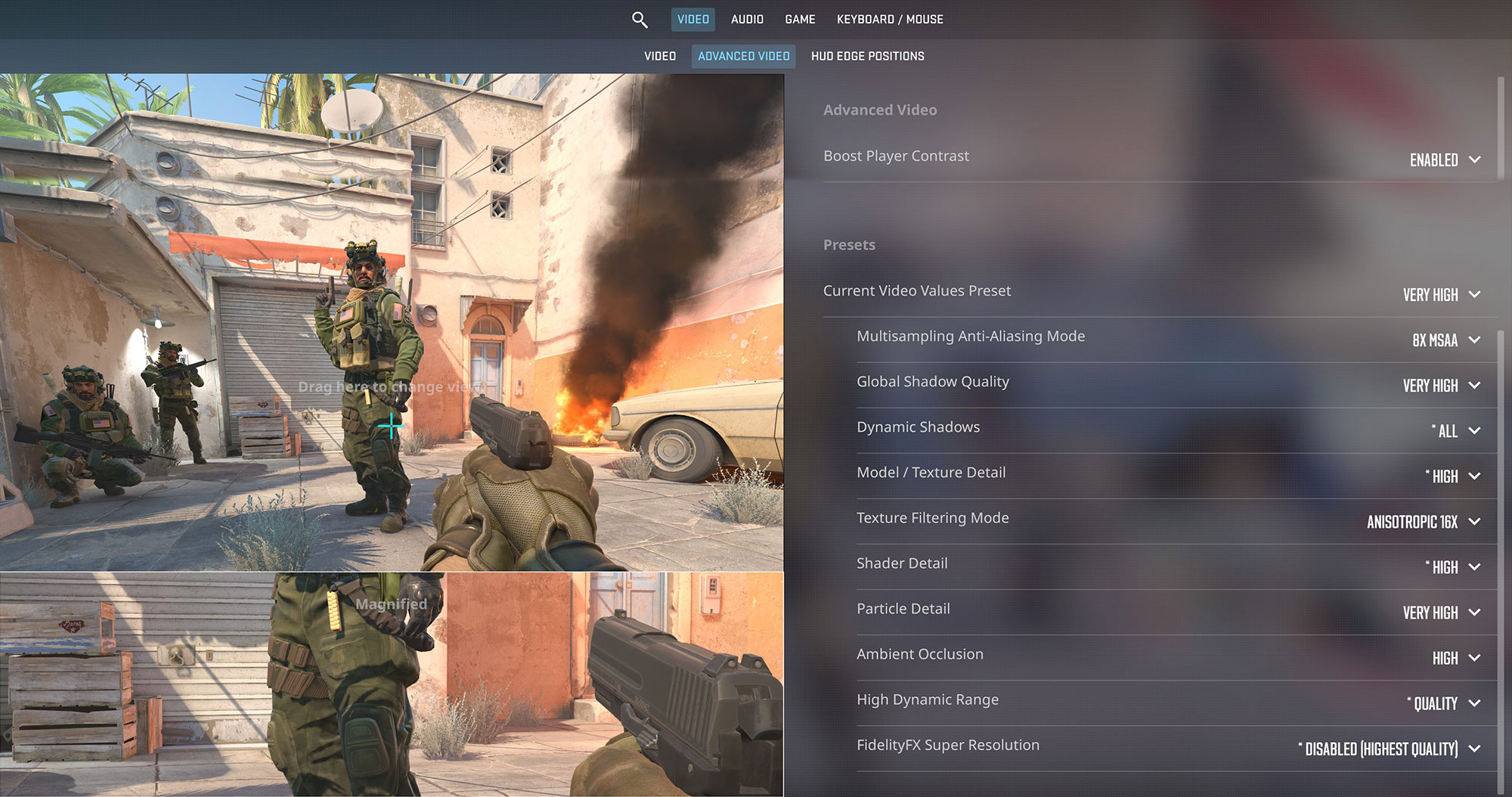
The RTX 5060 in Acer Nitro V 16 AI is excellent for competitive gaming. It easily pushes 162 FPS in Counter-Strike 2 at 1200p on Very High settings, providing a super fluid experience that pairs perfectly with its 180Hz display.
| Counter Strike 2 | 1200p, Very High (Check settings) |
| Average FPS | 162 FPS |

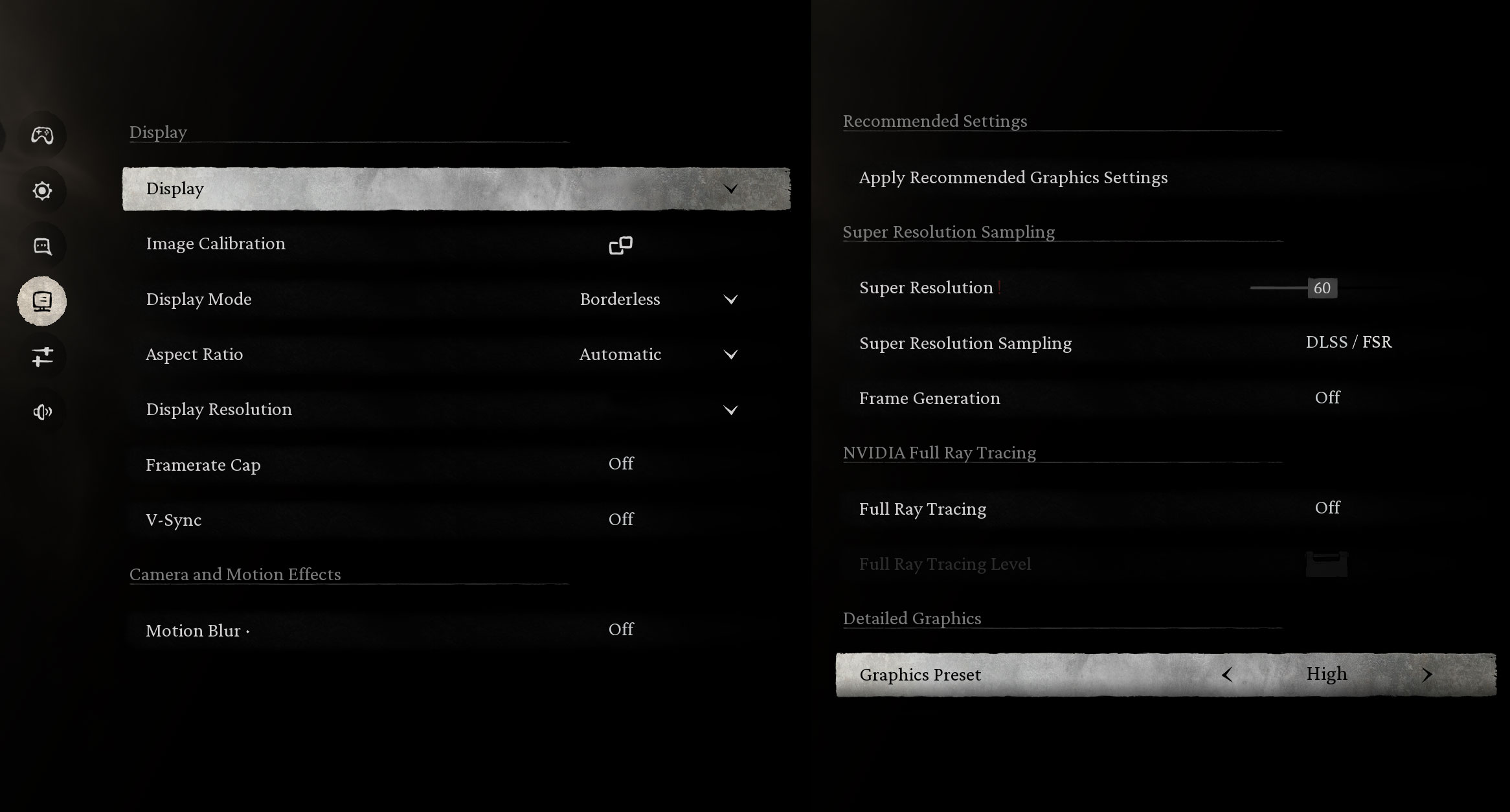
In the new and graphically intensive Black Myth: Wukong, the laptop delivers a very smooth 86 FPS at 1200p on High settings. This is a great result, showing strong performance in modern AAA titles.
| Black Myth: Wukong | 1200p, High (Check settings) |
| Average FPS | 86 FPS |

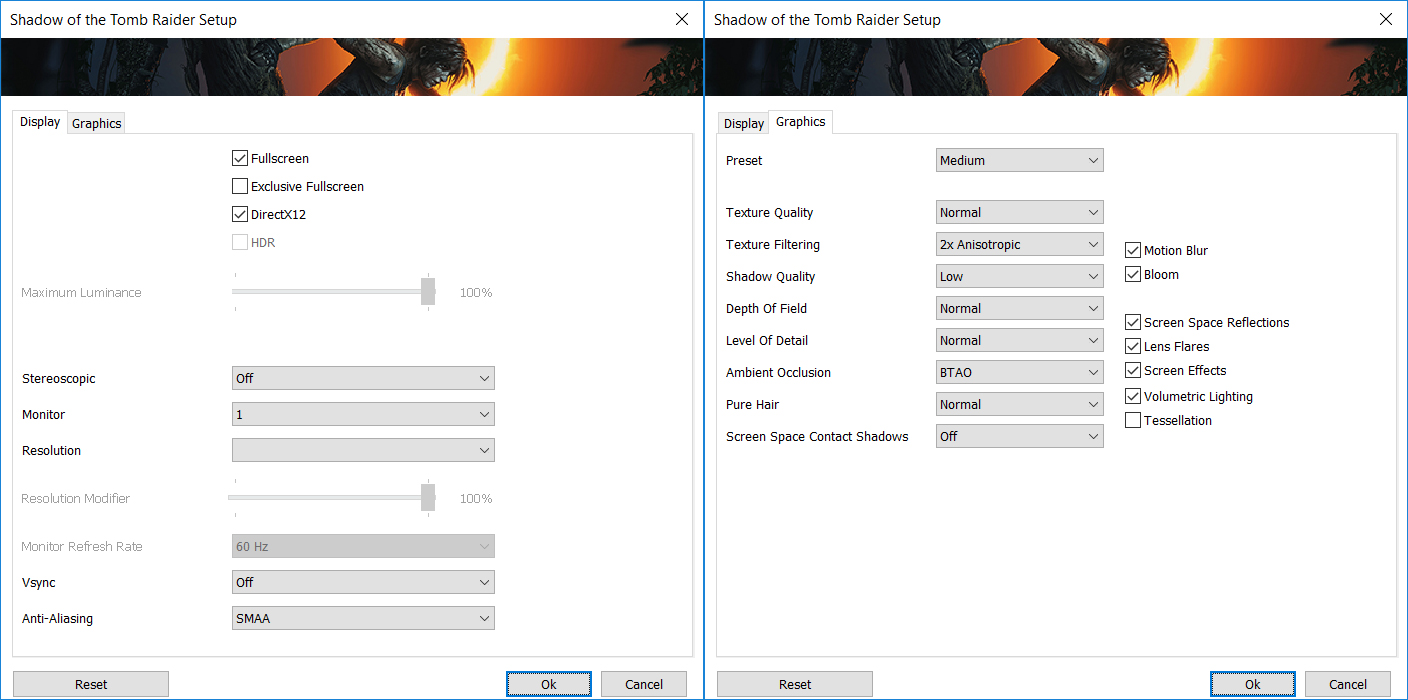
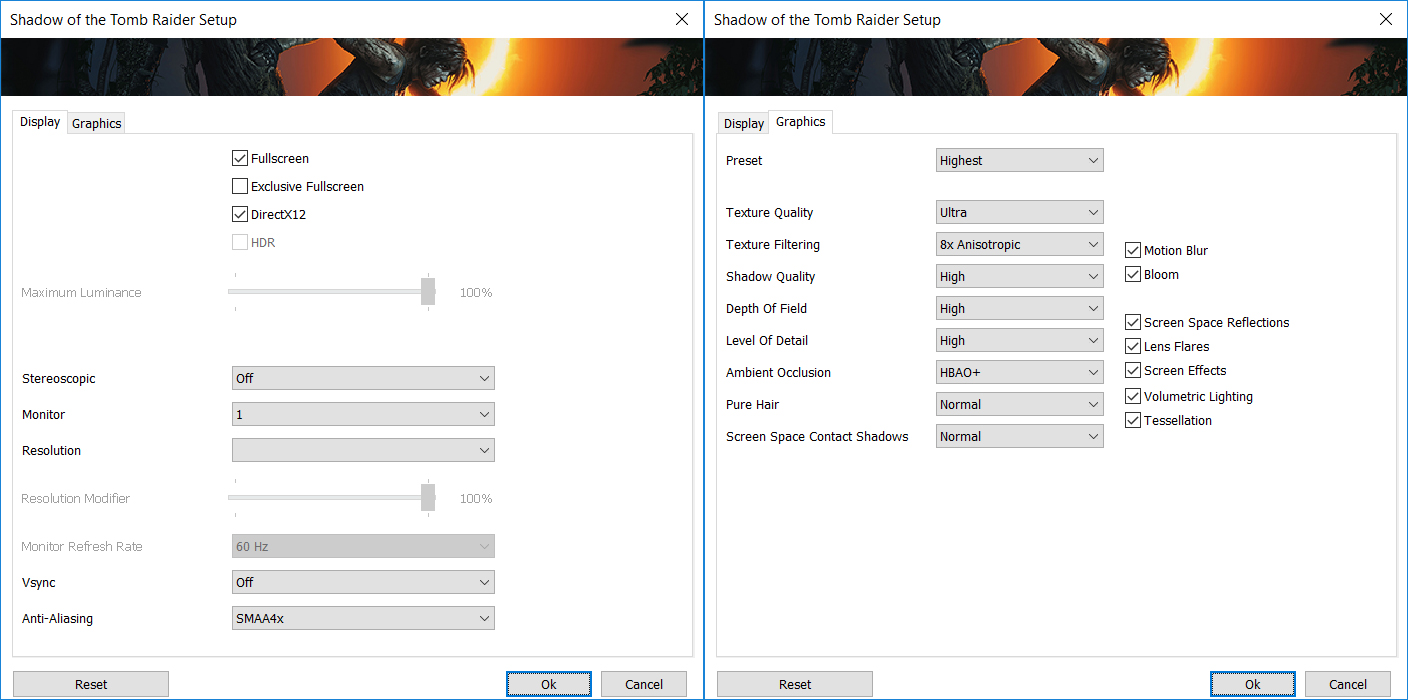
This machine handles Shadow of the Tomb Raider with ease. It achieves a fantastic 137 FPS on Medium settings and still maintains a very high 106 FPS on the Highest preset at 1200p, making for a beautiful and responsive gameplay experience.
| Shadow of the Tomb Raider | 1200p, Medium (Check settings) | 1200p, Highest (Check settings) |
| Average FPS | 137 FPS | 106 FPS |

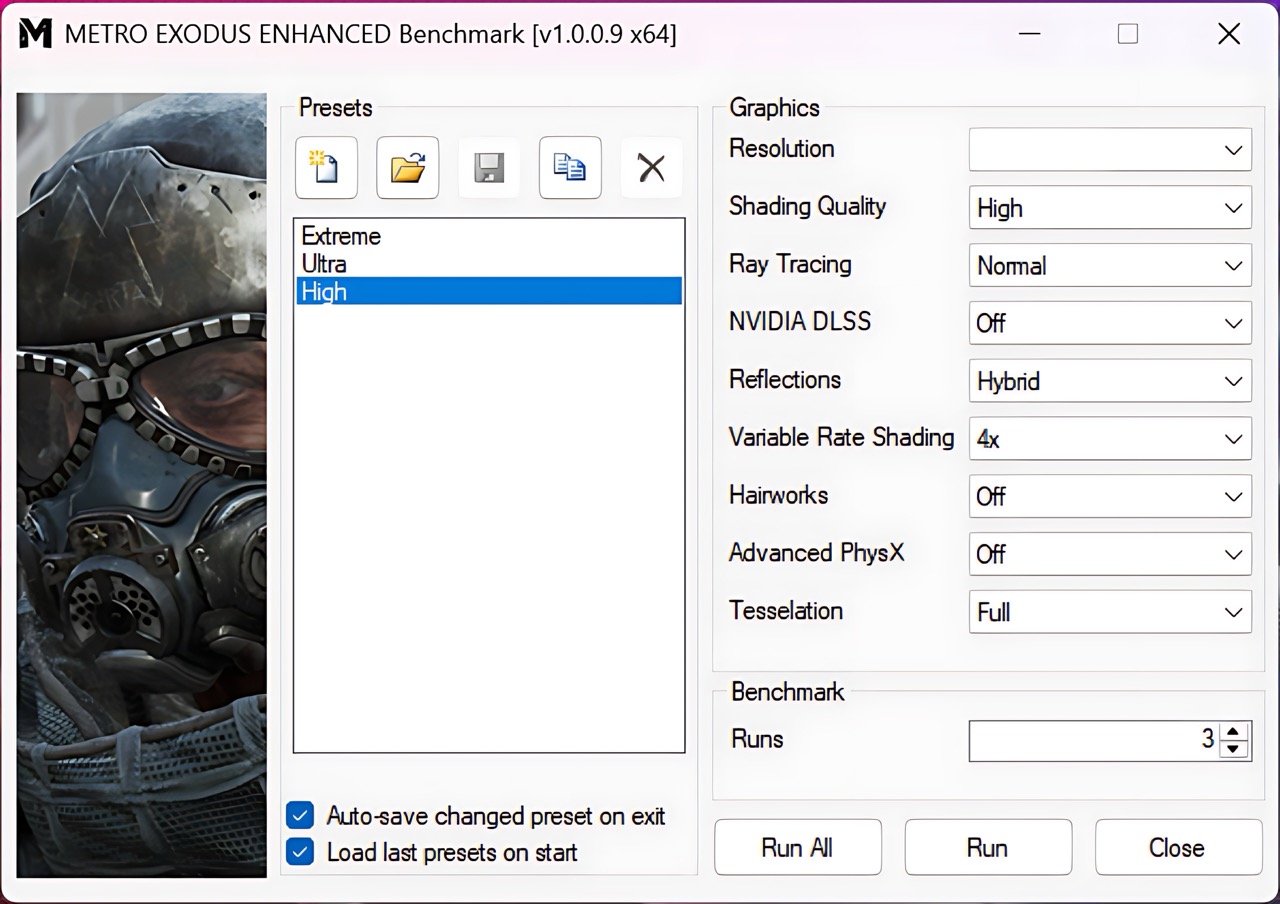
Even in the ray-tracing benchmark Metro Exodus Enhanced Edition, the RTX 5060 holds its ground. It provides a solid 79 FPS on High settings at 1200p, proving it’s more than capable of handling graphically demanding games.
| Metro Exodus Enhanced Edition | 1200p, High (Check settings) |
| Average FPS | 79 FPS |
[eBook Guide + Tools] How to MAX OUT Your Laptop
You can make your laptop Faster. LaptopMedia has tested thousands of models in the last 15 years, and we have yet to see a notebook that couldn't be made more powerful through modifications.
That's why we decided to bundle everything we know about how to achieve this in an Easy-to-Follow, Step-by-Step, and Laboratory-Tested, all in one project.
Read more about it here:
[eBook Guide + Tools] How to MAX OUT Your Laptop
🛠️ GPU Modifications: vBIOS, Overclocking, Undervolting
⚙️ Building Fast/Reliable RAID configuration
💻 Hardware upgrade tips for best results
🖼 Display enhancing
💾 OS Optimization for best performance
Temperatures and Comfort, Noise, Stability
At idle, the CPU package of the Acer Nitro V 16 AI maintains a temperature of 43ºC, and the notebook is barely audible despite the Turbo preset.
Office Work, Web Development, Design
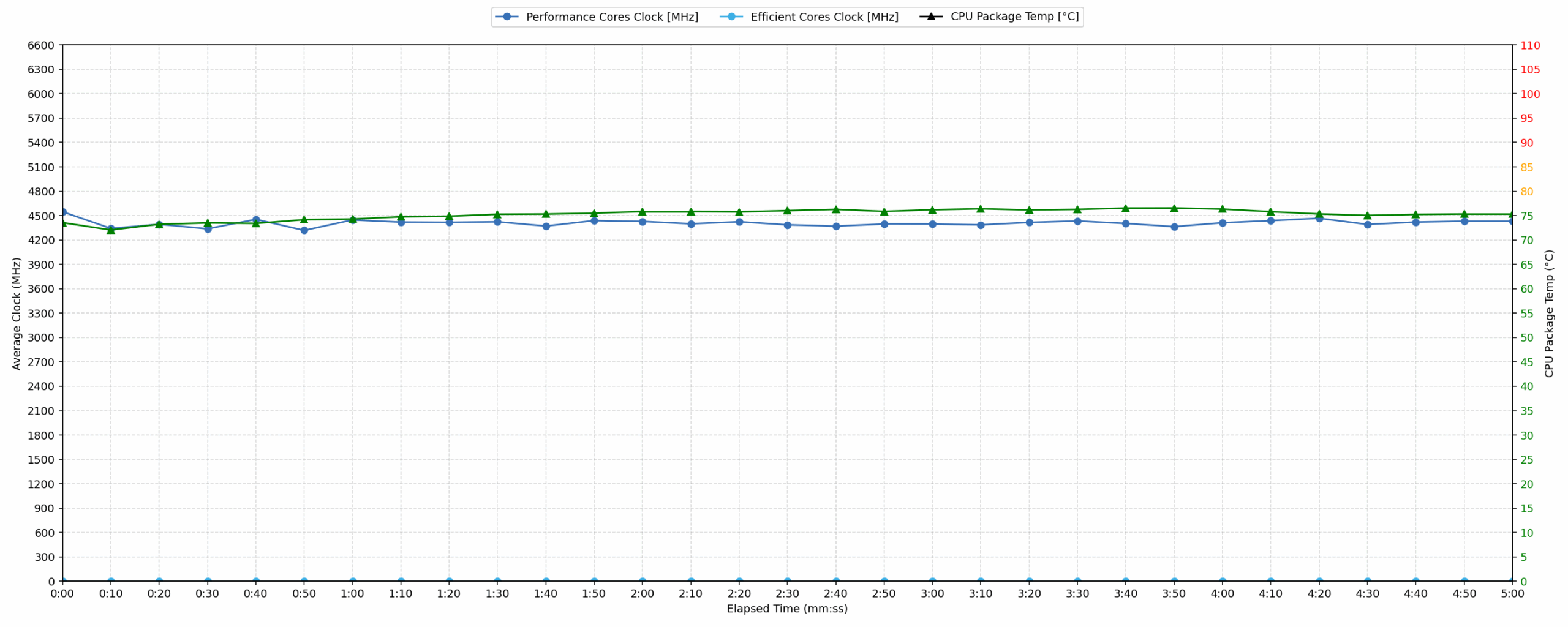
Short periods (0:00 – 0:10 s) of 100 % CPU load
This test shows the CPU behavior during short periods of serious load. It’s important for users who are looking for laptops suitable for tasks like Web Design and Programming.
| AMD Ryzen 7 260 | Avg. P-Core Clock | Avg. CPU Temp. | Avg. CPU Power |
| Lenovo Legion 5 (15″, Gen 10) | 4806 MHz | 90 °C | 84 W |
| Acer Nitro V 16 AI (ANV16-42) | 4547 MHz | 73 °C | 59 W |
The Acer Nitro V 16 AI exhibits strong initial performance for short bursts, reaching a peak CPU clock of 4663 MHz. Over the first ten seconds of 100% CPU load, the average clock speed is 4547 MHz, with an average temperature of 73 °C, which is well within the “good” range. The peak temperature observed was 80 °C, falling into the “acceptable” category. This indicates effective thermal management. Compared to a Lenovo Legion 5 with the same Ryzen 7 260 CPU, this Acer model operates at a slightly lower average clock speed (4547 MHz vs 4806 MHz) but maintains significantly lower average temperatures (73 °C vs 90 °C), suggesting a more conservative thermal profile for short loads.
Video editing, Scientific computing, Software compilation, 3D rendering
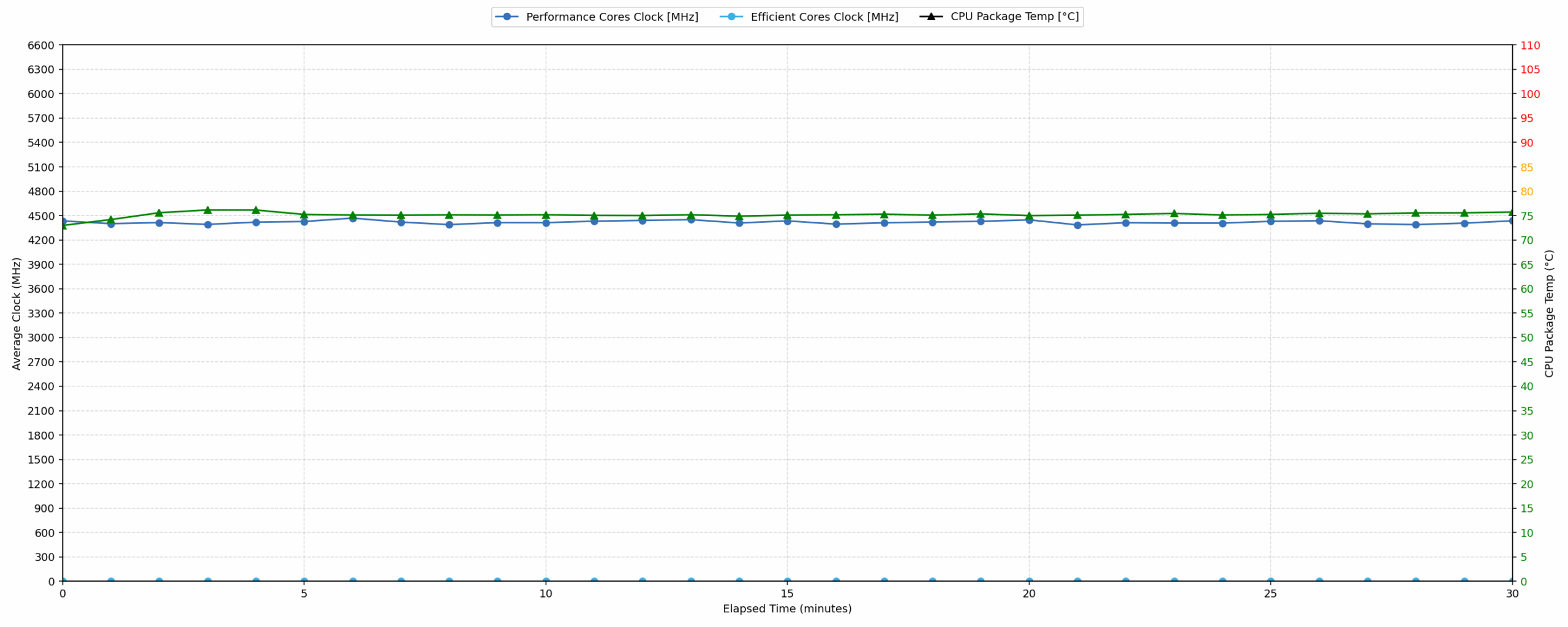
Long periods (0:00 – 30:00 min) of 100 % CPU load
This test shows the CPU behavior during long periods of serious load. It’s important for users who are looking for laptops suitable for tasks like Video Editing and 3D Rendering.
| AMD Ryzen 7 260 | Avg. P-Core Clock | Avg. CPU Temp. | Avg. CPU Power |
| Lenovo Legion 5 (15″, Gen 10) | 4674 MHz | 99 °C | 79 W |
| Acer Nitro V 16 AI (ANV16-42) | 4418 MHz | 75 °C | 53 W |
Under sustained 30-minute CPU load, the Acer Nitro V 16 AI maintains an average clock speed of 4418 MHz. The CPU registered a minimum clock of 3911 MHz during this period, indicating some clock throttling from its peak. Crucially, the average CPU temperature settled at 75 °C, which is well within the “good” operating range for extended tasks. The peak temperature remained at an acceptable 80 °C. Compared to other devices with the AMD Ryzen 7 260, such as the Lenovo Legion 5, this laptop delivers a slightly lower average clock speed (4418 MHz vs 4674 MHz) but exhibits significantly superior thermal management, operating at 75 °C versus the Legion 5’s high 99 °C average.
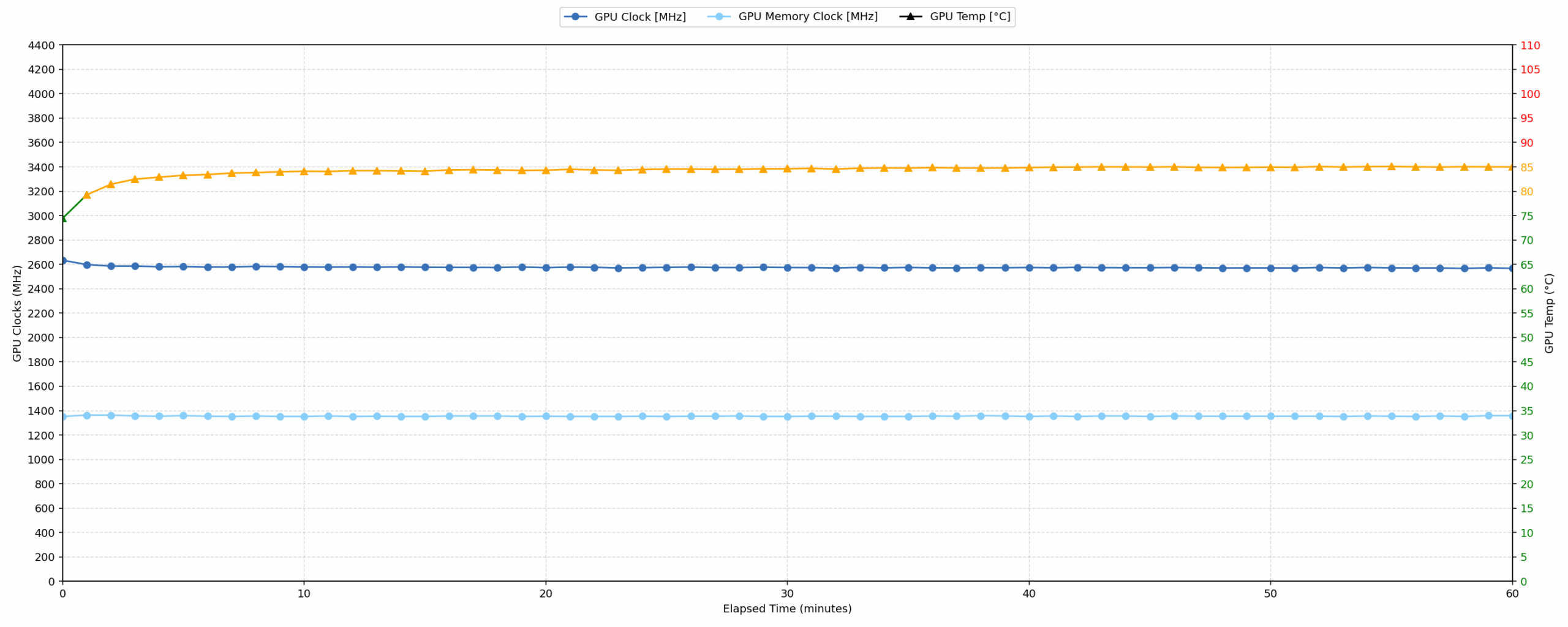
Gaming Stability
Continuous gaming (1-hour test)
This test evaluates the laptop’s performance under sustained GPU load and high CPU usage.
| NVIDIA GeForce RTX 5060 | Avg. GPU Clock | Avg. GPU Temp. | Avg. Memory Clock | Avg. GPU Mem Temp. | Avg. GPU Power |
| Lenovo LOQ 17IRX10 | 2742 MHz | 85 °C | 1393 MHz | 77 °C | 113 W |
| Acer Nitro V 16 AI (ANV16-42) | 2575 MHz | 84 °C | 1354 MHz | 79 °C | 93 W |
During continuous gaming over an hour, the Acer Nitro V 16 AI demonstrates stable GPU performance. The NVIDIA GeForce RTX 5060 maintains an average clock speed of 2575 MHz, with a minimum observed clock of 2482 MHz, indicating consistent operation. GPU core temperatures averaged 84 °C and peaked at 87 °C, both within the “good” range. Similarly, GPU memory temperatures averaged 79 °C and peaked at 86 °C, also performing well. This thermal control ensures no detrimental throttling. Compared to the Lenovo LOQ 17IRX10 with the same RTX 5060, this laptop delivers a slightly lower average GPU clock (2575 MHz vs 2742 MHz) but achieves very similar core and memory temperatures.
Battery Life
The Acer Nitro V 16 AI (ANV16-42) has a battery with 76Wh of energy.
We tested it with the Eco mode selected in NitroSense:
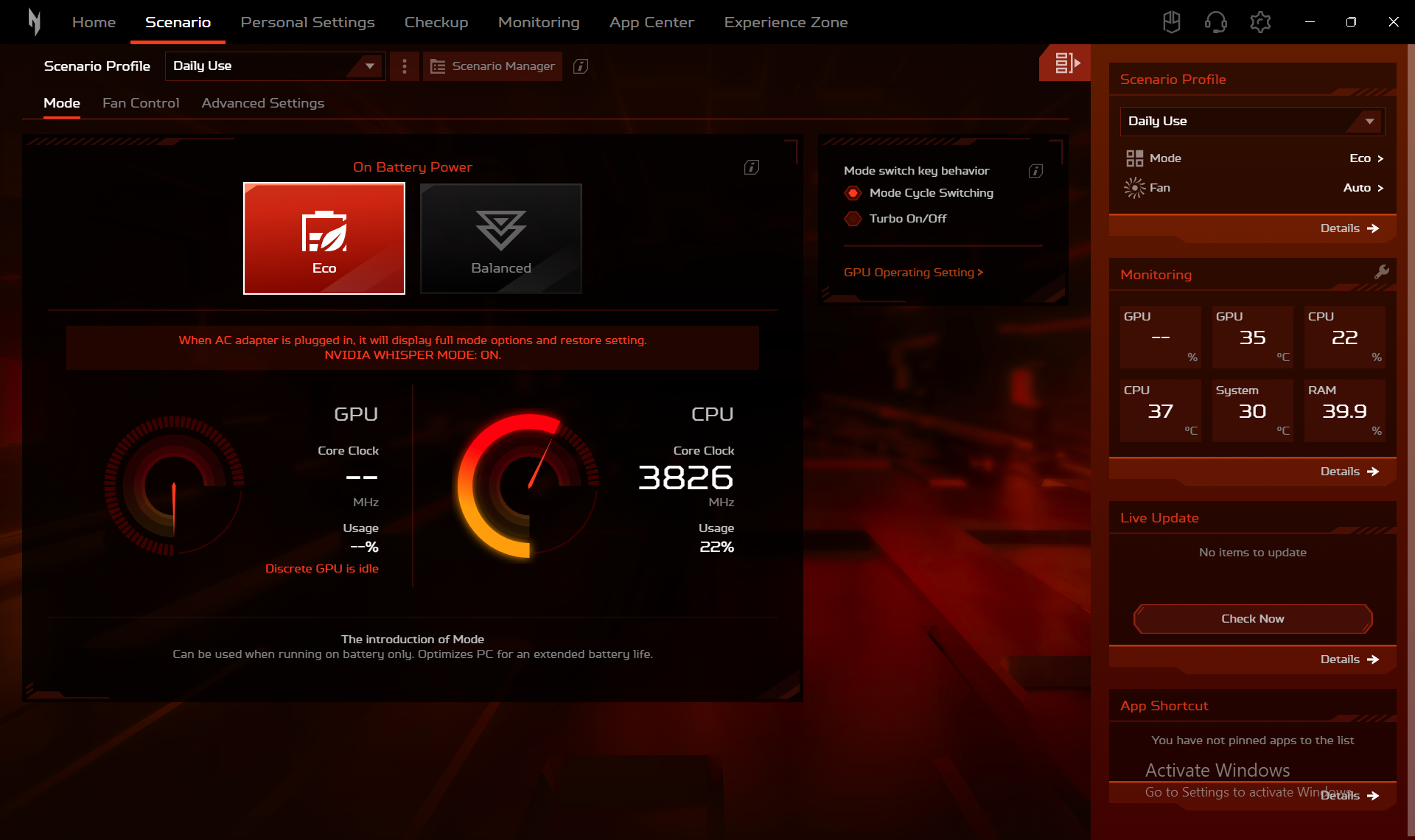
7 hours and a half of battery life is a very good result for a gaming laptop. The ASUS ProArt P16 H7606 (detailed review) is a record-breaker with its 90Wh battery (11 hours and 9 min).
Brightness: 180 nits; Display Mode: SDR
Time to Full Discharge: Higher is Better

Disassembly, Upgrade options, and Maintenance
Opening the Acer Nitro V 16 AI (ANV16-42) is simple: remove ten bottom screws and work a plastic pick around the edges to release the clips. The panel comes off cleanly without hidden fasteners.
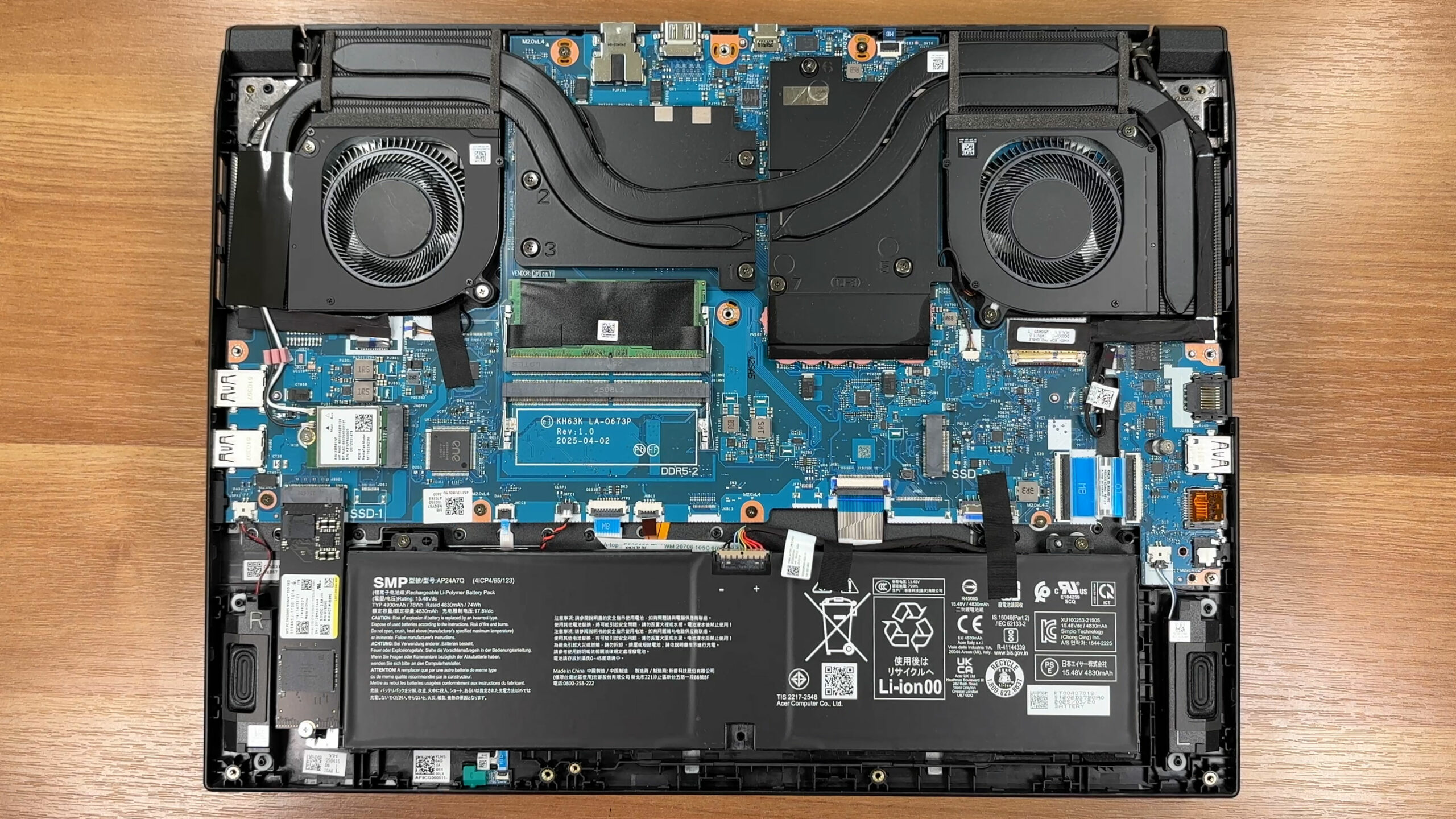
The internal layout is classic mid-range gaming—two centrifugal fans at the corners, several shared heat pipes across the CPU and GPU, and the memory and storage arranged in the center for easy access. Foam strips and pads guide airflow toward the fin stacks at the rear and sides.
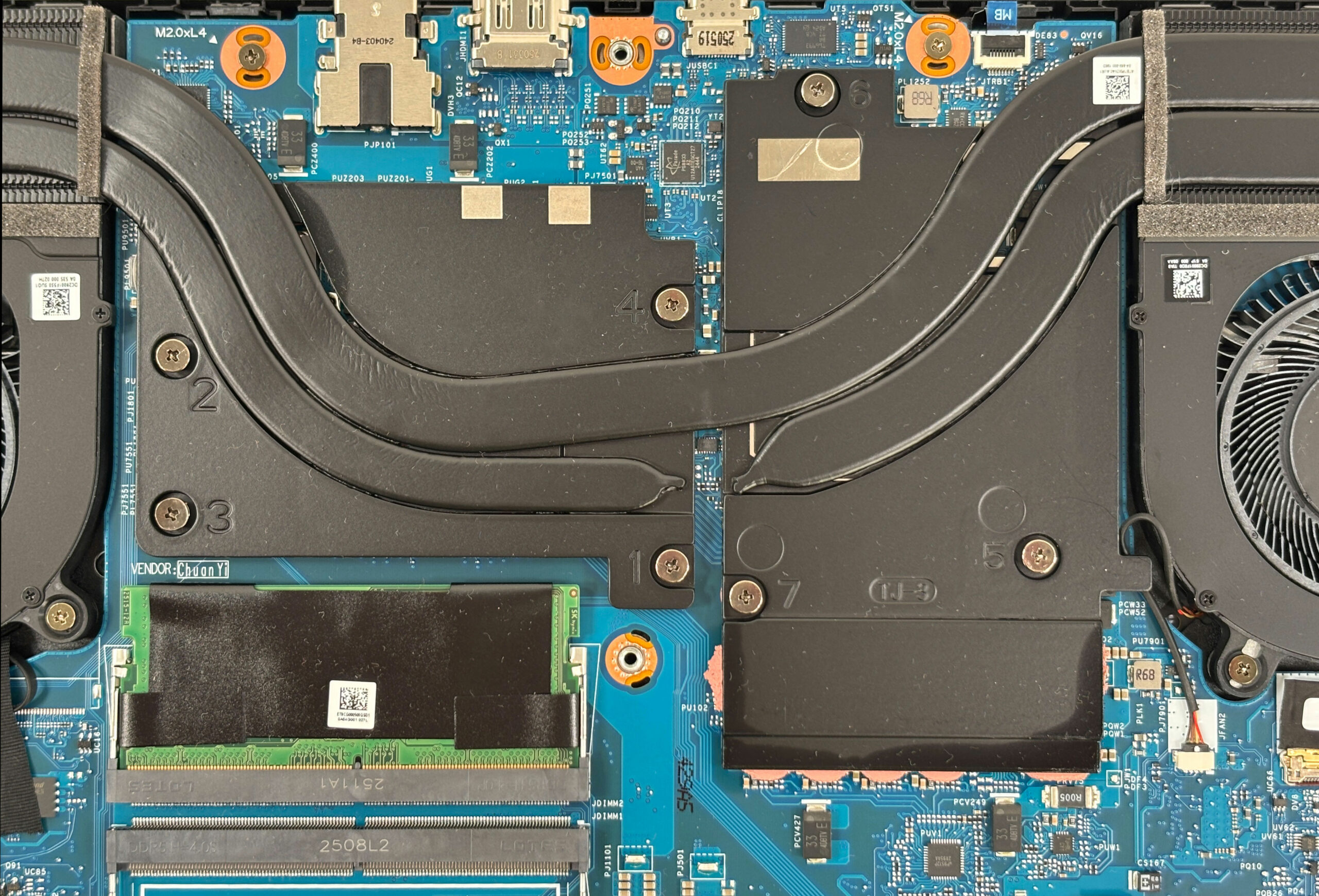
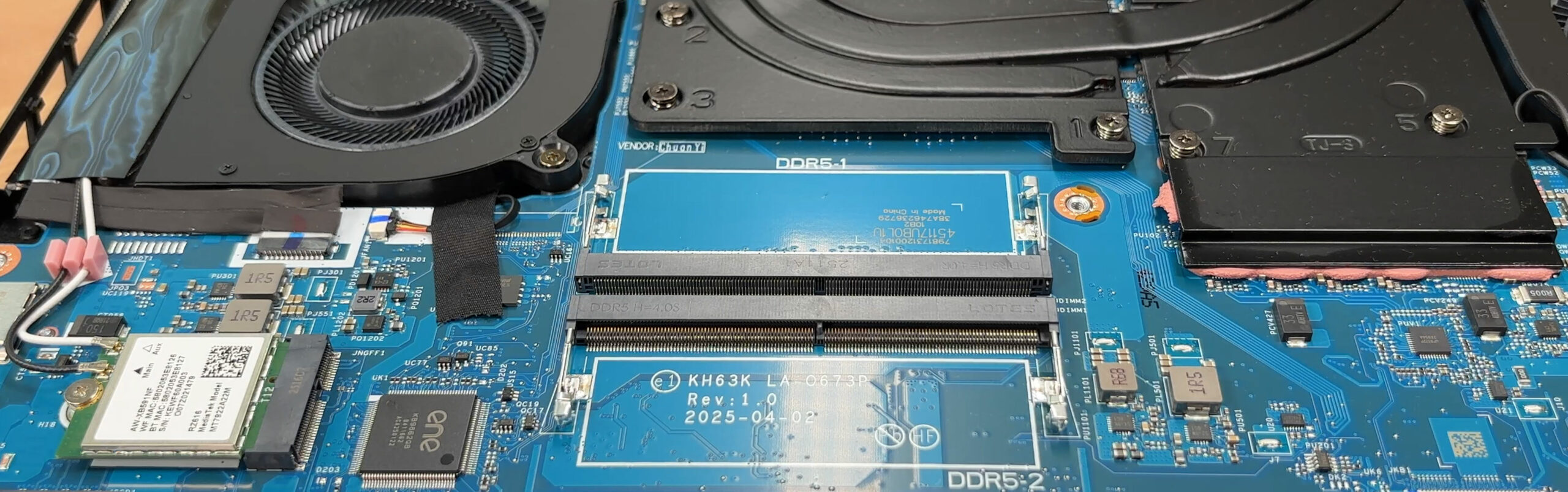
For memory, the motherboard provides two standard DDR5 SO-DIMM slots. Official support goes up to 5600 MT/s and there is no soldered RAM, so dual-channel is as easy as adding a second module. Our unit ships with one slot populated and one free for straightforward upgrades.
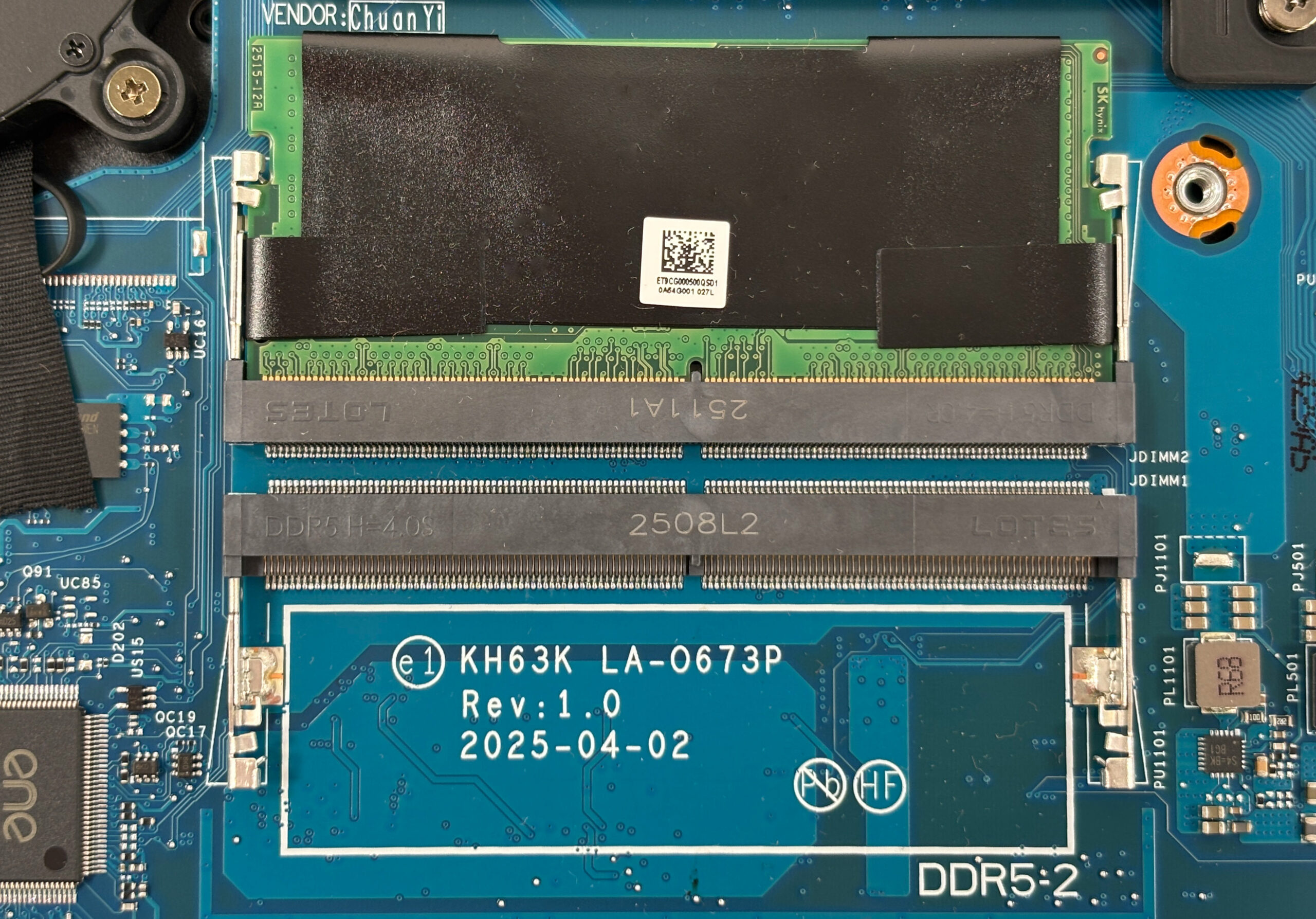
Storage is well covered with two M.2 2280 slots, both wired for PCIe 4.0 x4 NVMe drives. Thermal pads press against the bottom cover to help spread heat from the SSDs during sustained loads. There is no 2.5-inch bay, so all storage expansion happens through these two slots. The reviewed configuration includes a Western Digital PC SN5000S 1TB in the primary slot, while the secondary slot is empty.
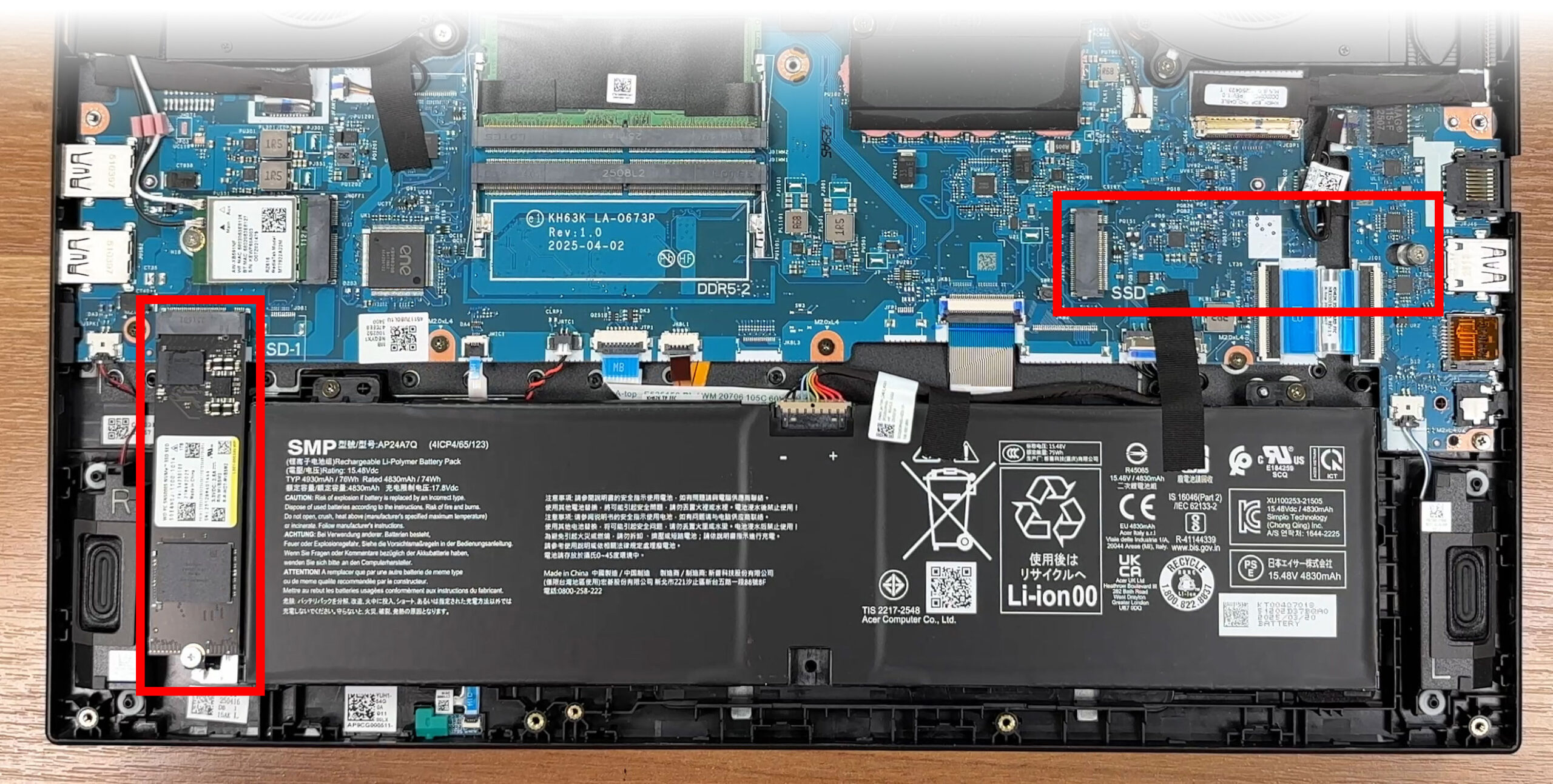
The wireless card is a replaceable M.2 Key E module. This particular unit carries a MediaTek MT7922A22M controller with Wi-Fi 6E and Bluetooth 5.2, and the antennas are easy to re-seat if you ever need to swap the card.
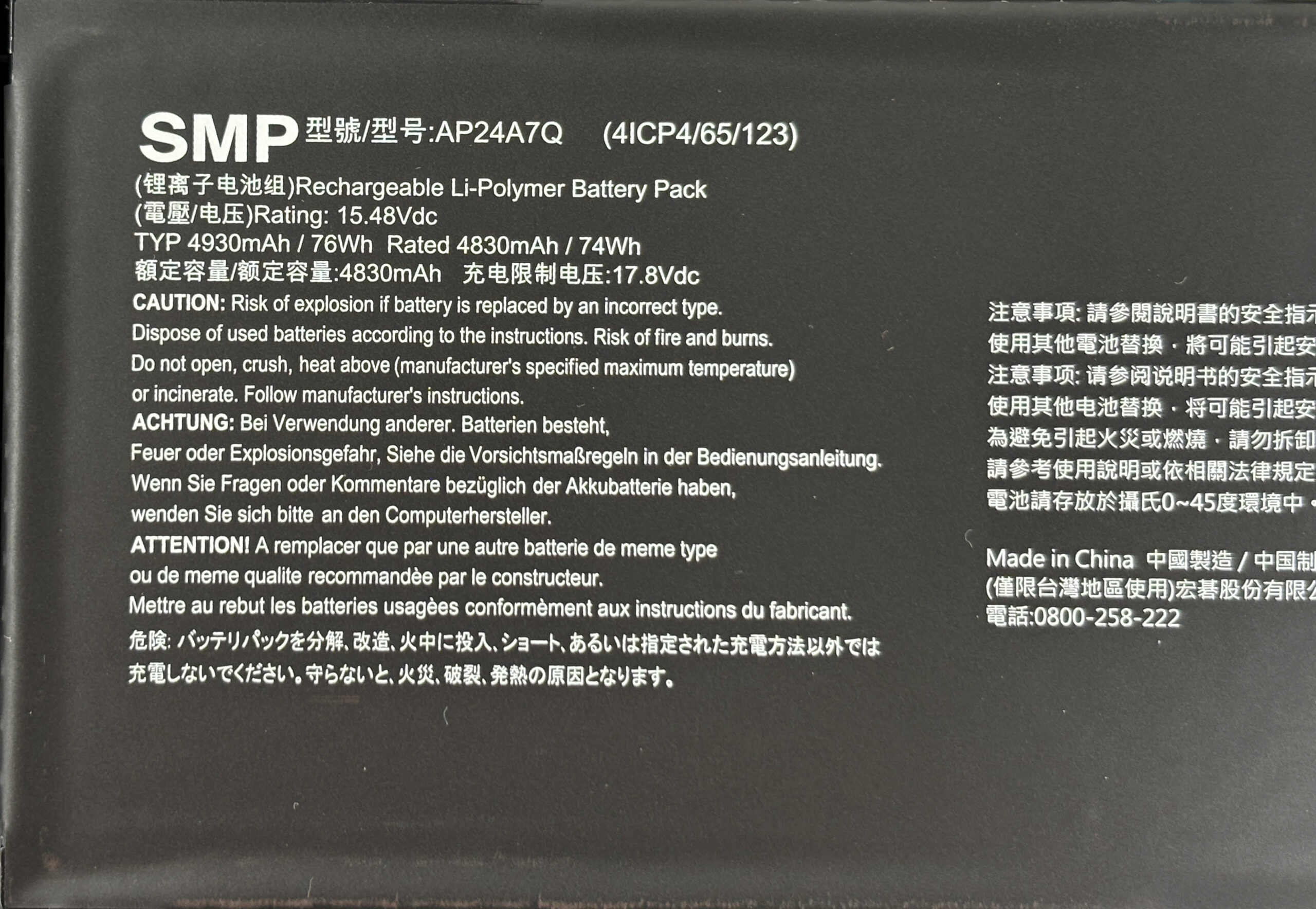
Power comes from a user-serviceable 4-cell battery. It is an SMP AP24A7Q pack with a typical capacity of 76 Wh (rated 74 Wh) at 15.48 V. It’s held by a few screws and a single board connector; disconnect the cable before any other work and it lifts out without fuss.
Overall, maintenance is beginner-friendly thanks to the standard screw layout, easy bottom cover removal, and wide-open access to memory, storage, and the battery.
Verdict
The Acer Nitro V 16 AI (ANV16-42) is a masterclass in intelligent, user-focused design for the mid-range gaming market. Instead of chasing the absolute highest benchmark scores, Acer has engineered a machine that prioritizes thermal stability, battery life, and long-term value. It’s a laptop that feels both powerful and responsible, offering a surprisingly balanced experience that stands out in a category often defined by extremes.
While it makes one significant compromise that will be a deal-breaker for some, the core package it delivers is so strong and thoughtfully executed that it stands as one of the most compelling and practical gaming laptops in its class.
✅ The Good
The absolute standout feature here is the exceptional thermal management. While competitors push their CPUs to the thermal limit, the Nitro V 16 maintains impressively low temperatures under sustained load. This results in a stable, reliable machine that prioritizes component longevity and user comfort over chart-topping, but dangerously hot, performance.
This thermal efficiency contributes to another huge win: great battery life. With over 7 hours of use on a single charge, it is a fantastic performer for a gaming laptop, offering a level of unplugged freedom that many of its rivals simply cannot match. The upgradeability is also top-notch, with two user-accessible RAM slots and two M.2 slots for storage, providing excellent long-term value.
Even the budget-oriented display has some critical strengths. It is completely PWM-free and has a fast response time, making it excellent for eye comfort and fluid gaming. The port selection is also very good, featuring a versatile USB4 port, and the overall design is solid and elegantly understated.
❌ The Bad
The single biggest compromise is the display’s visual quality. Our unit has a panel that has very poor color coverage, at just 50% sRGB. This results in a dull, washed-out image that is completely unsuitable for any color-sensitive creative work. If visual vibrancy is a priority, opting for the higher-tier 100% sRGB panel is an absolute must.
The trade-off for the excellent thermals is that the CPU performance is slightly lower than competitors using the exact same chip, as Acer has tuned it more conservatively. The laptop also lacks some quality-of-life features, such as a physical privacy shutter for the webcam and a fingerprint reader for biometric login.
🆚 The Competitors
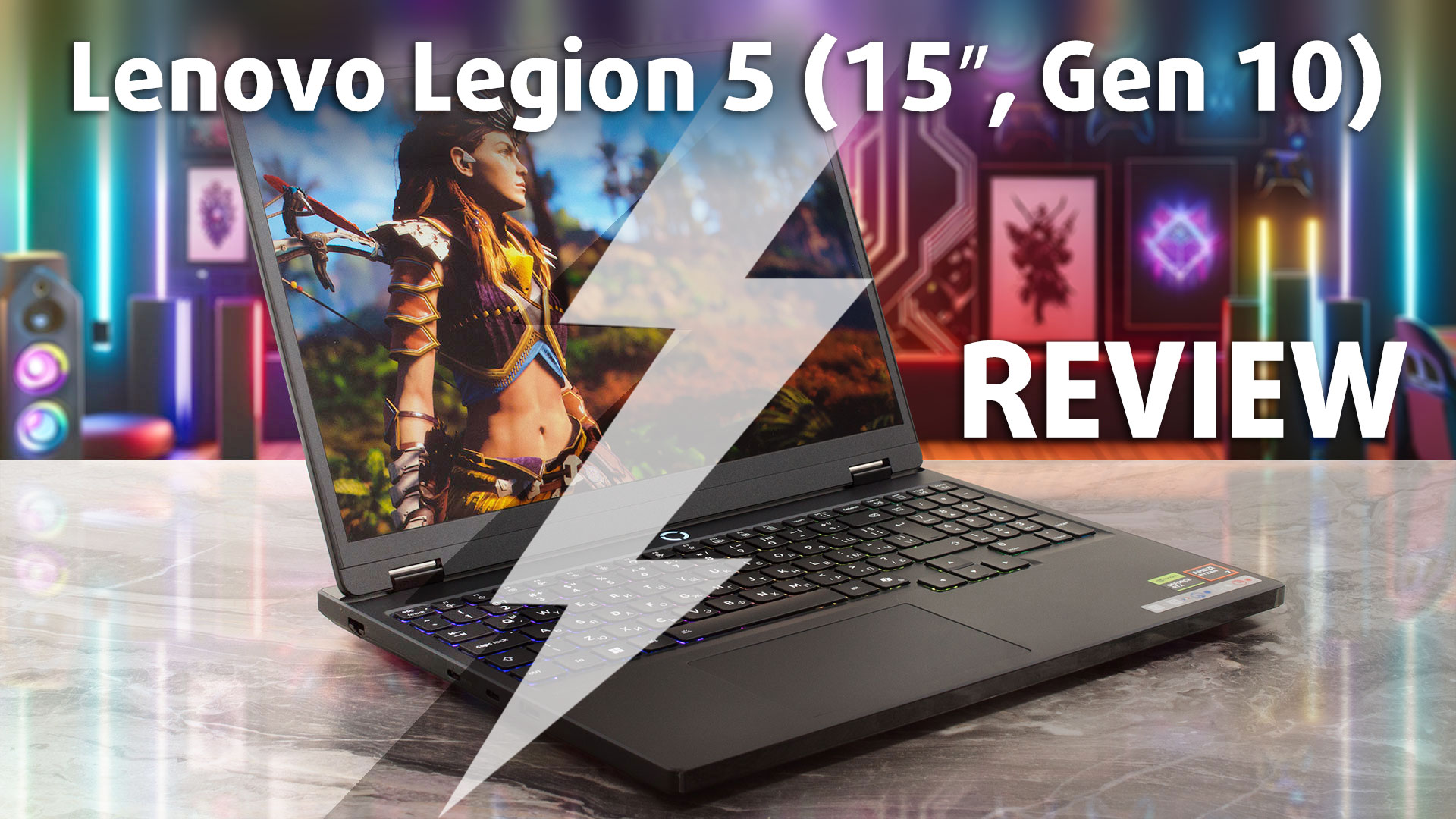 The most direct and fascinating comparison is with the Lenovo Legion 5, 15″, Gen 10 (detailed review). Both laptops can be configured with the same AMD Ryzen 7 260 CPU, but their philosophies are polar opposites. The Legion 5 pushes the chip for maximum performance, running it at a scorching 99°C. In stark contrast, the Nitro V 16 keeps the same CPU at a cool and comfortable 75°C, sacrificing a bit of peak performance for vastly superior thermal health.
This makes the choice for the user incredibly clear. If you want the absolute highest frame rates and benchmark scores, the Legion 5 is the choice. But if you value a cooler, more stable system with better long-term reliability, the Acer Nitro V 16 AI is the smarter, more responsible option.
You can check the prices and configurations in our Specs System: https://laptopmedia.com/series/acer-nitro-v-16-ai-anv16-42/
Pros
- Exceptional CPU thermal management keeps the system cool and stable
- Great battery life for a gaming laptop
- Fantastic upgradeability with two RAM and two M.2 slots
- PWM-free screen with a fast response time is great for the eyes
- Good port selection including a versatile USB4 port
- Solid and elegant design
Cons
- Base model display has very poor color coverage (50% sRGB)
- CPU performance is slightly lower than direct competitors
- No physical camera shutter or fingerprint reader
 Author: Simeon NikolovEditor-in-Chief at LaptopMedia.com with 20+ years of experience in testing and analyzing laptops and mobile devices.
 Author: eng. Kroum NikolovHead of Engineering at LaptopMedia.com, inventor and innovator with 40+ years of experience in electronics and high technology.
TOP 100 GAMING LAPTOPS


TOP LAPTOP RATINGS
HIGHLIGHTS view more
![[August 2026] Amazon Global: Top 10 Best-Selling Laptops – Apple MacBook Neo Dominates the Charts as Budget and Mid-Range Windows Portables Fight for Volume](https://laptopmedia.com/wp-content/uploads/2026/09/Best-Selling-Laptops-GLOBAL-Top-10-400x225.jpg)
[August 2026] Amazon Global: Top 10 Best-Selling Laptops – Apple MacBook Neo Dominates the Charts as Budget and Mid-Range Windows Portables Fight for Volume
Sep 12, 2026![[August 2026] Best-Selling Laptop Brands on Amazon Global – Apple Dominates Revenue While HP Leads in Model Variety](https://laptopmedia.com/wp-content/uploads/2026/09/GLOBAL-Best-Brands-400x225.jpg)
[August 2026] Best-Selling Laptop Brands on Amazon Global – Apple Dominates Revenue While HP Leads in Model Variety
Sep 12, 2026![[August 2026] Amazon Global: Top 10 Best-Selling Gaming Laptops – HP Victus 15 Captures the Crown as Budget-Friendly Models Dominate the Charts](https://laptopmedia.com/wp-content/uploads/2026/09/Best-Selling-Gaming-Laptops-GLOBAL-Top-10-400x225.jpg)
[August 2026] Amazon Global: Top 10 Best-Selling Gaming Laptops – HP Victus 15 Captures the Crown as Budget-Friendly Models Dominate the Charts
Sep 12, 2026![[August 2026] Best-Selling Laptop Brands on Amazon Japan – Apple Dominates Market Share and Revenue Led by Strong Unit Sales](https://laptopmedia.com/wp-content/uploads/2026/09/CO.JP-Best-Brands-1-400x225.jpg)
[August 2026] Best-Selling Laptop Brands on Amazon Japan – Apple Dominates Market Share and Revenue Led by Strong Unit Sales
Sep 10, 2026![[August 2026] Best-Selling Laptop Brands on Amazon USA – Apple Dominates Market Revenue and Volume Despite Lower Model Diversity](https://laptopmedia.com/wp-content/uploads/2026/09/COM-Best-Brands-1-400x225.jpg)
[August 2026] Best-Selling Laptop Brands on Amazon USA – Apple Dominates Market Revenue and Volume Despite Lower Model Diversity
Sep 10, 2026
REVIEWS view more
Acer Nitro V 15 (ANV15-A31) review – A Practical Budget Gamer with One Major Catch
Aug 13, 2026Lenovo IdeaPad Slim 5a (16″, Gen 11) review – 2.8K OLED, Ryzen AI 7 450, and Rare Upgradeability
Aug 09, 2026HP OmniBook 5 16 (16-bc1000) review – Big Screen, Solid CPU, Limited Upgrades
Aug 06, 2026Lenovo ThinkPad X1 Carbon Gen 14 Aura Edition review – The Ultimate Business Laptop Gets Modular
Aug 03, 2026ASUS ExpertBook Ultra (B9406) review – Core Ultra X7 & Tandem OLED Tested
Jul 28, 2026
what is the tgp of the 5050? is it the same as other 5050 laptops? compared to the lenovo loq, which would be the better buy?
RTX 5070: 50-100W
RTX 5060: 45-100W
RTX 5050: 35-100W
you can buy a better charger for it and will it work? 135W feels like it wont be able to power the gpu and cpu completely
U can’t the overall consumption is locked throw the bios ( I have seen so many people talking about it)
Still couldn’t confirm it waiting for my laptop to arrive from Germany