ASUS ROG Strix G16 G614 (2025) review – INSANELY Powerful
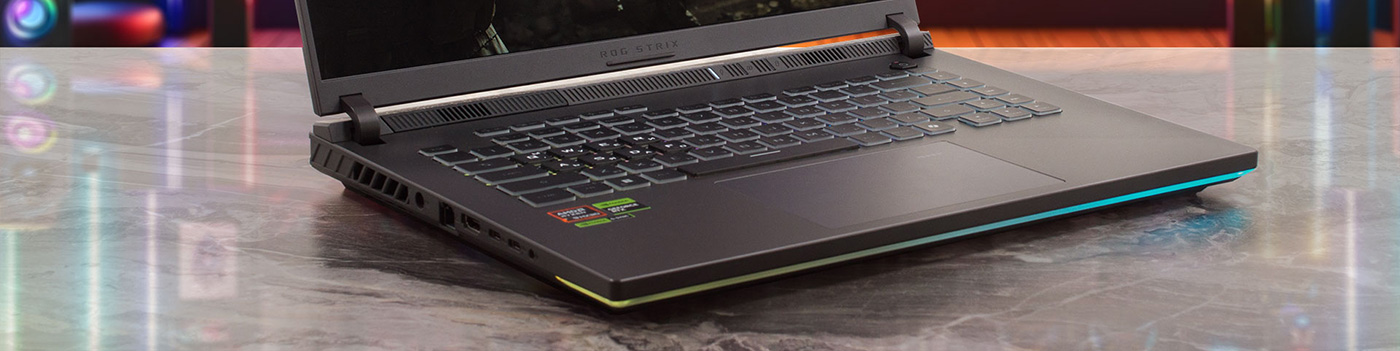
In a market crowded with powerful contenders, it’s rare to find a machine that feels like a true champion. The ASUS ROG Strix G16 (G614, 2025) is one of those rare machines. By pairing AMD’s most powerful mobile CPU with a top-tier NVIDIA GPU and backing it with a masterclass in thermal engineering, ASUS hasn’t just built a fast laptop; they’ve crafted one of the most balanced and complete gaming packages we’ve ever tested. It’s a device that gets so much right – from its performance to its display to its battery life, that our review process became less about finding its strengths and more about searching for any meaningful weakness. The question isn’t if it’s good, but if it’s truly the new king of the hill.
You can check the prices and configurations in our Specs System: https://laptopmedia.com/series/asus-rog-strix-g16-g614-2025/
Contents
- Specs, Drivers, What’s in the box
- Design and construction
- Display and Sound Quality, Display Profiles
- Get our profiles
- Work Performance: CPU, Storage, AI
- GPU and Gaming Performance
- [eBook Guide + Tools] How to MAX OUT Your Laptop
- Temperatures and Comfort, Stability
- Battery Life
- Disassembly, Upgrade options, and Maintenance
- Verdict
Specs, Drivers, What’s in the box
ASUS ROG Strix G16 (G614, 2025) - Specs

- HDD/SSD
- up to 16000GB SSD
- M.2 Slot
- 1x 2280 M.2 NVMe PCIe 4.0 x4 See photo
- RAM
- up to 128GB
- OS
- Windows 11 Pro, Windows 11 Home, Windows 10 Home, Windows 10 Pro, Chrome OS
- Body material
- Plastic / Polycarbonate, Aluminum
- Dimensions
- 354 x 264 x 22.6 - 30.4 mm (13.94" x 10.39" x 0.89")
- Weight
- 2.50 kg (5.5 lbs)
- Ports and connectivity
- 2x USB Type-A
- 3.2 Gen 2 (10 Gbps)
- 1x USB Type-C
- 4.0, DisplayPort
- 1x USB Type-C
- 4.0, Power Delivery (PD), DisplayPort
- HDMI
- 2.1
- Card reader
- Ethernet LAN
- 10, 100, 1000 Mbit/s
- Wi-Fi
- Wi-Fi 6E
- Bluetooth
- 5.3
- Audio jack
- 3.5mm Combo Jack
- Features
- Fingerprint reader
- Web camera
- FHD
- Backlit keyboard
- Microphone
- Array Microphone with AI noise-canceling technology
- Speakers
- 2x Stereo Speakers, Smart Amp, Dolby Atmos
- Security Lock slot
All ASUS ROG Strix G16 (G614, 2025) configurations
Drivers
All drivers and utilities for this notebook can be found here: https://rog.asus.com/laptops/rog-strix/rog-strix-g16-2025-g614/helpdesk_download/
What’s in the box?
ASUS continues its tradition of making the unboxing a bit of a regional lottery with the ROG Strix G16 G614 (2025).

Depending on your territory, you might find some excellent extras like a ROG backpack, a ROG Impact Gaming Mouse, or a compact 100W Type-C travel adapter, though it’s also entirely possible to receive none of them.
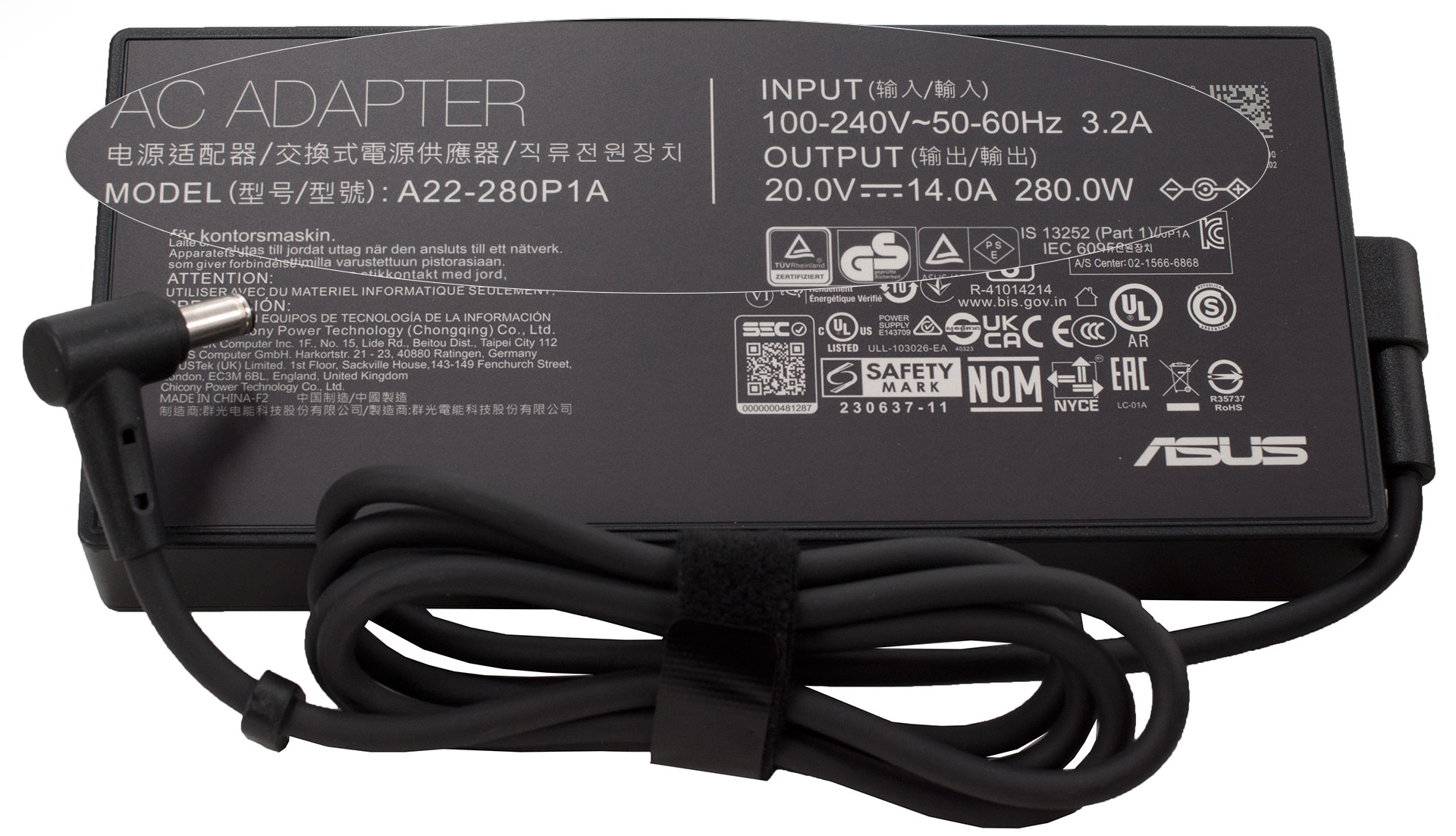
To sweeten the pot, a 3-month subscription to Xbox Game Pass for PC will be included, so it’s definitely worth checking with your local retailer to see exactly what your bundle contains. You’ll surely get at least the traditional AC adapter.
Design and construction
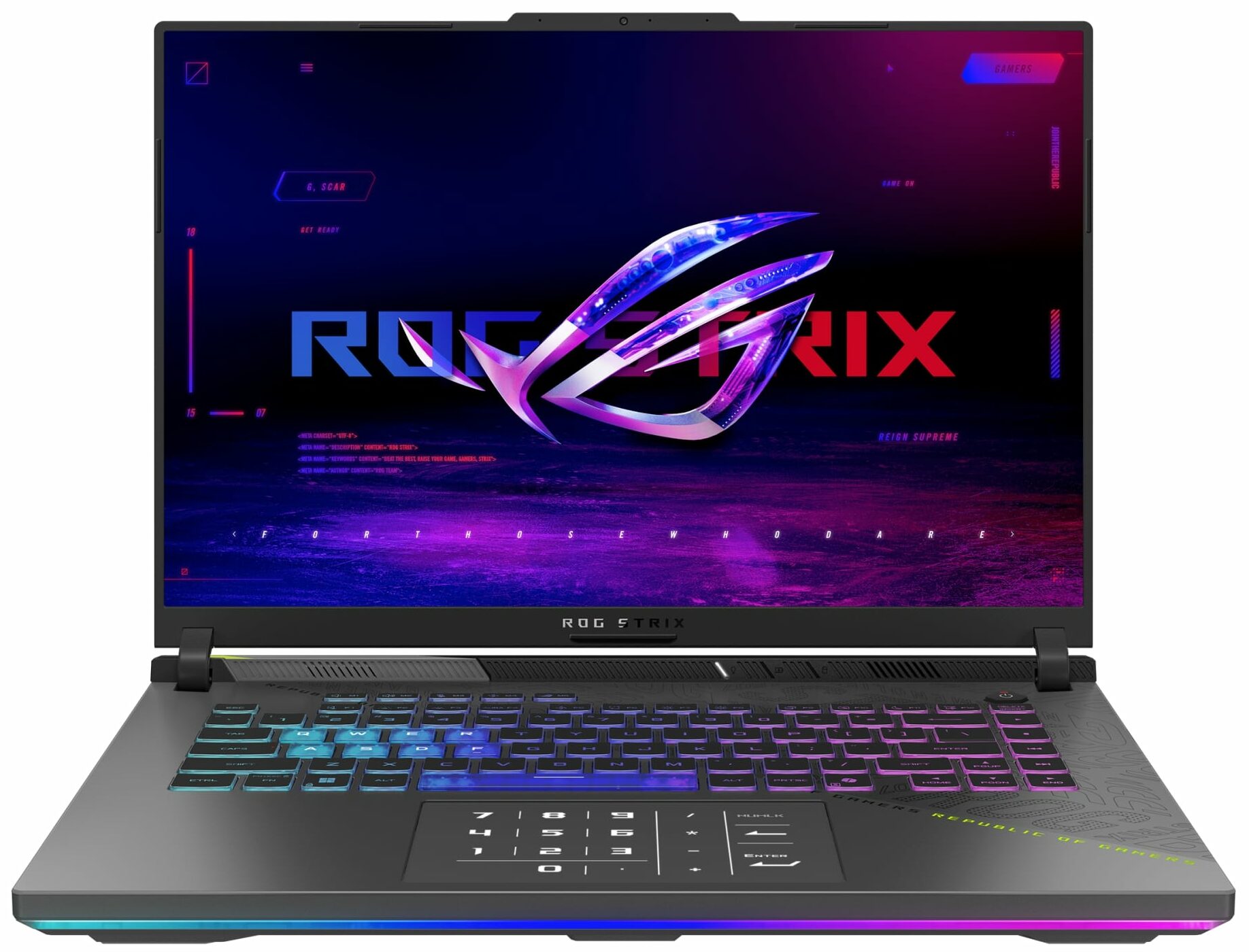
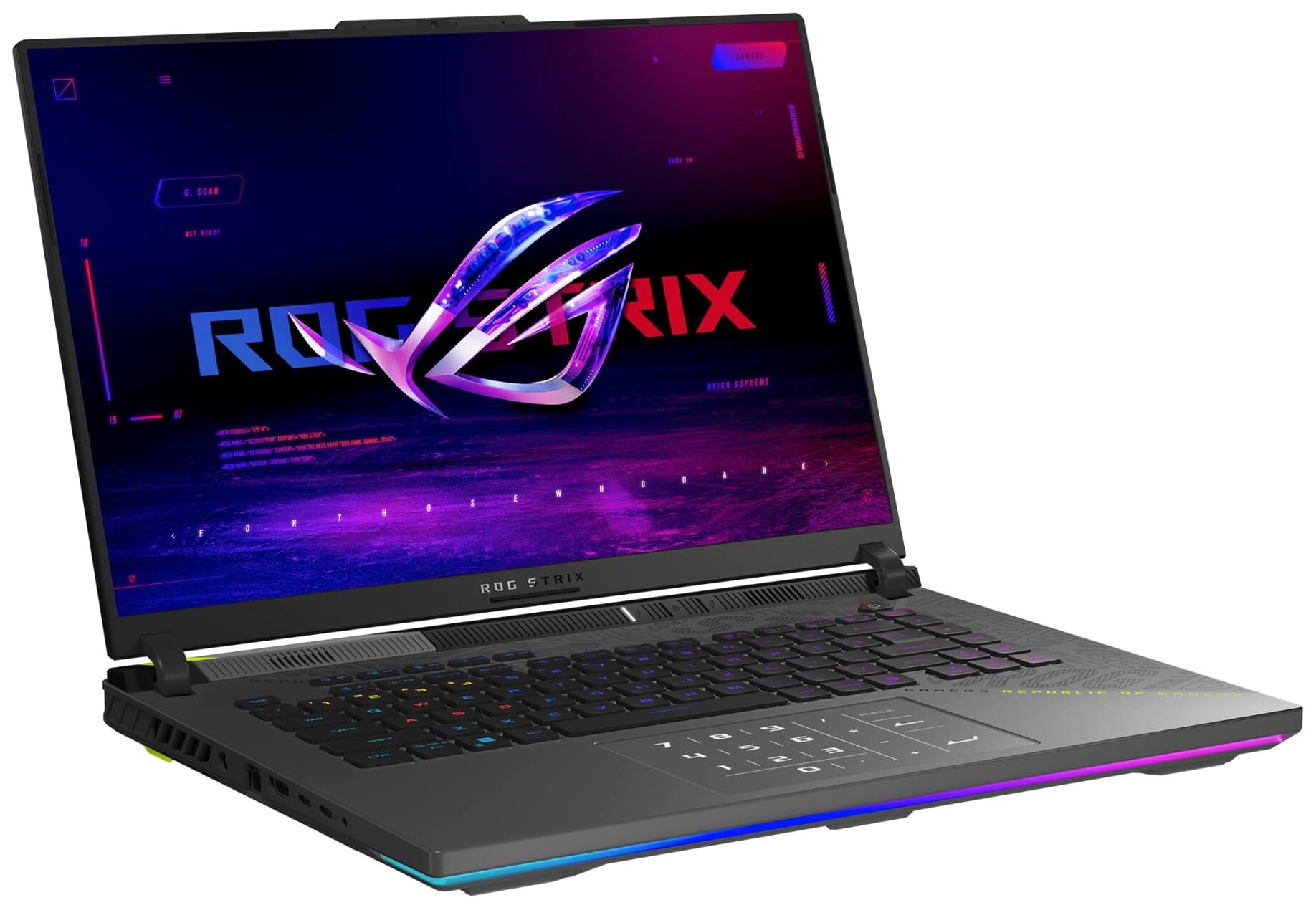
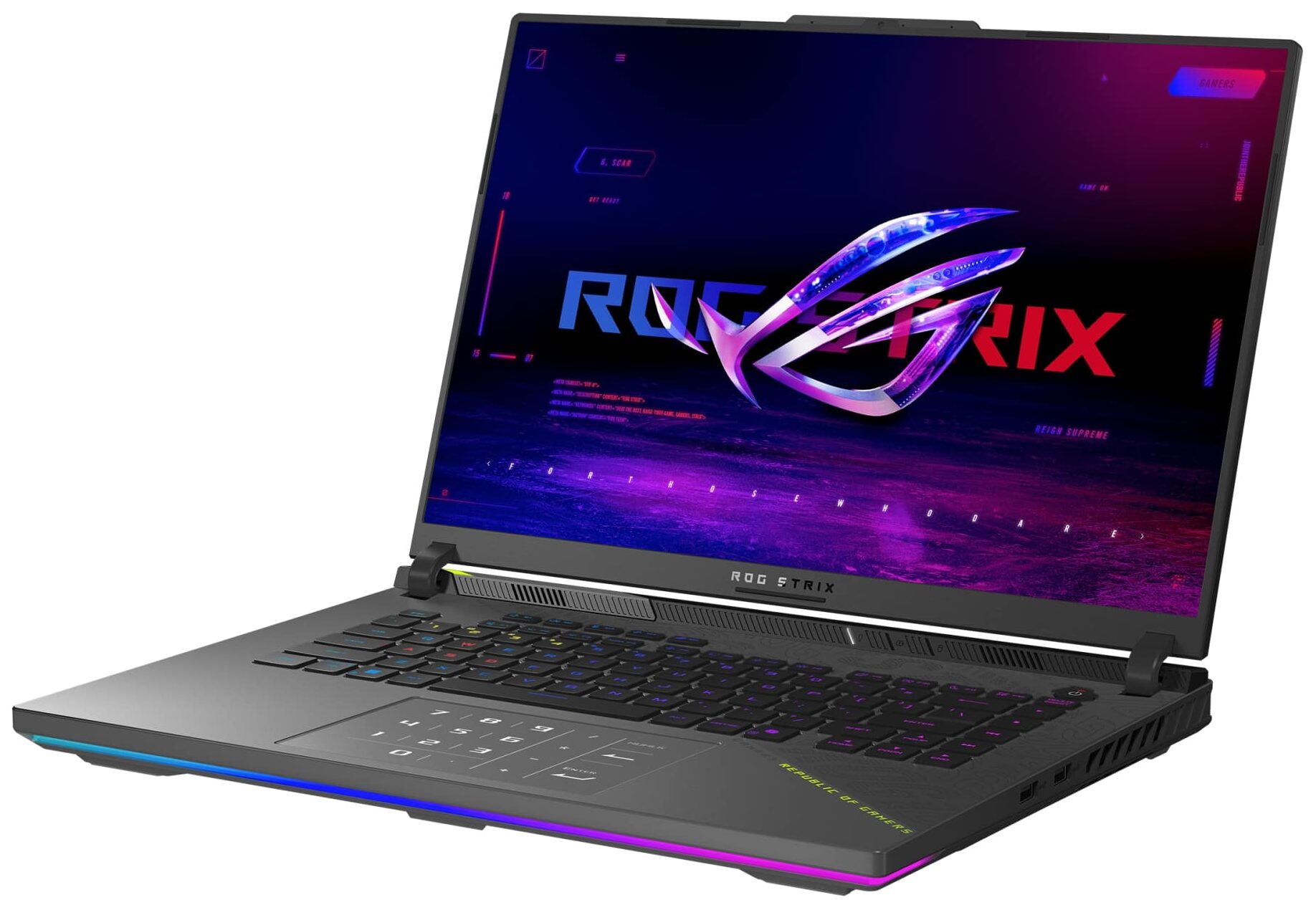
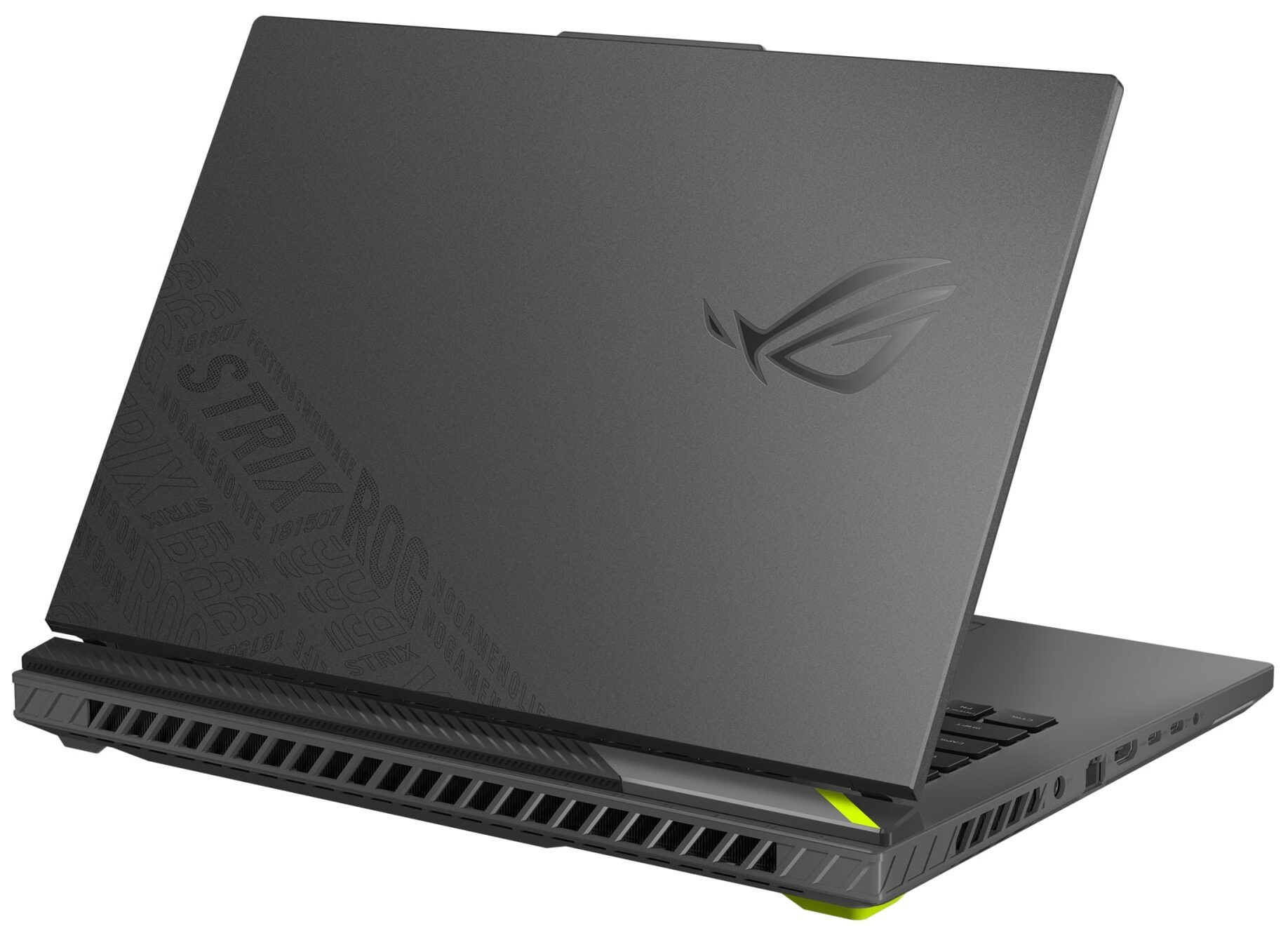
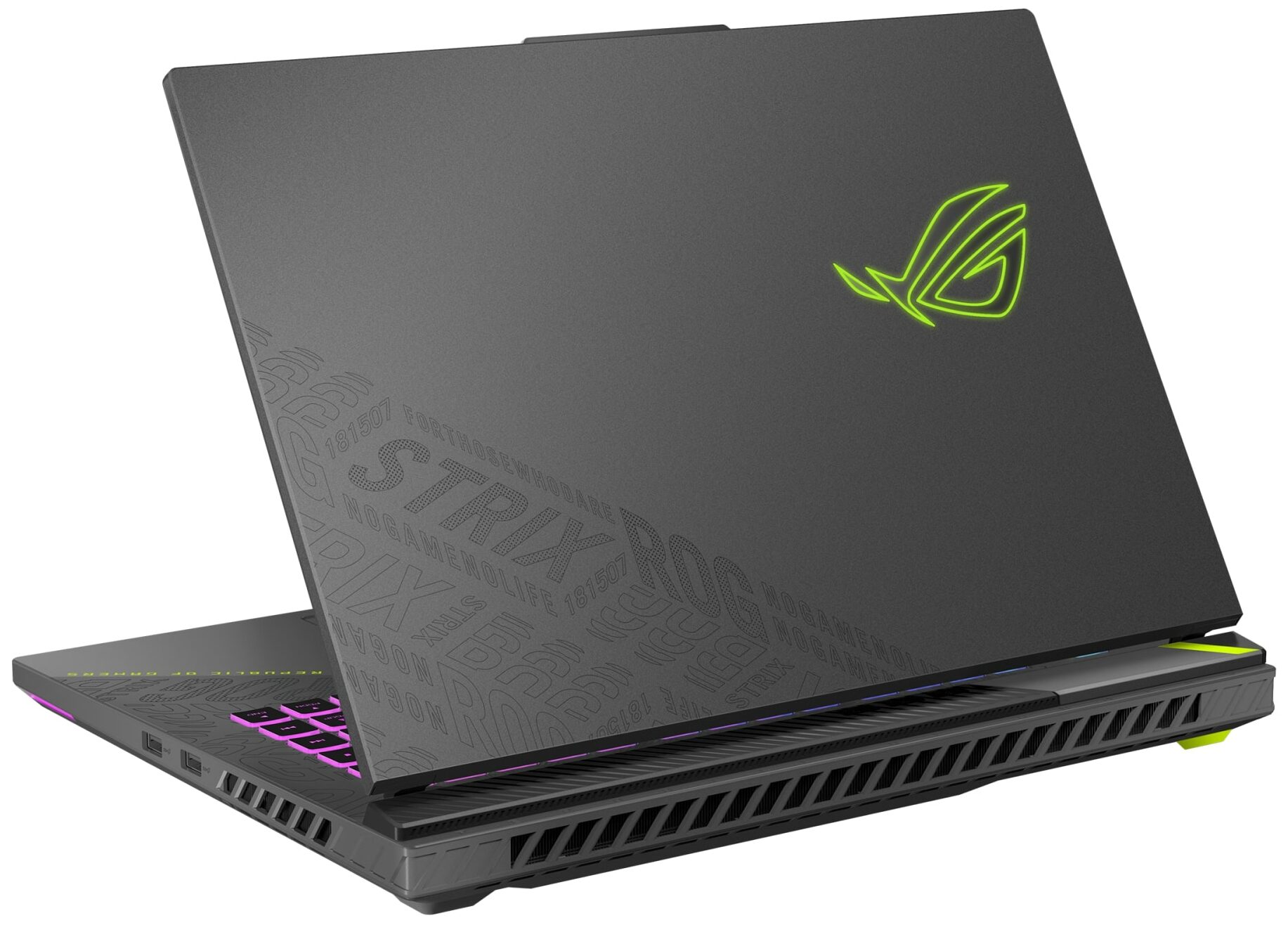
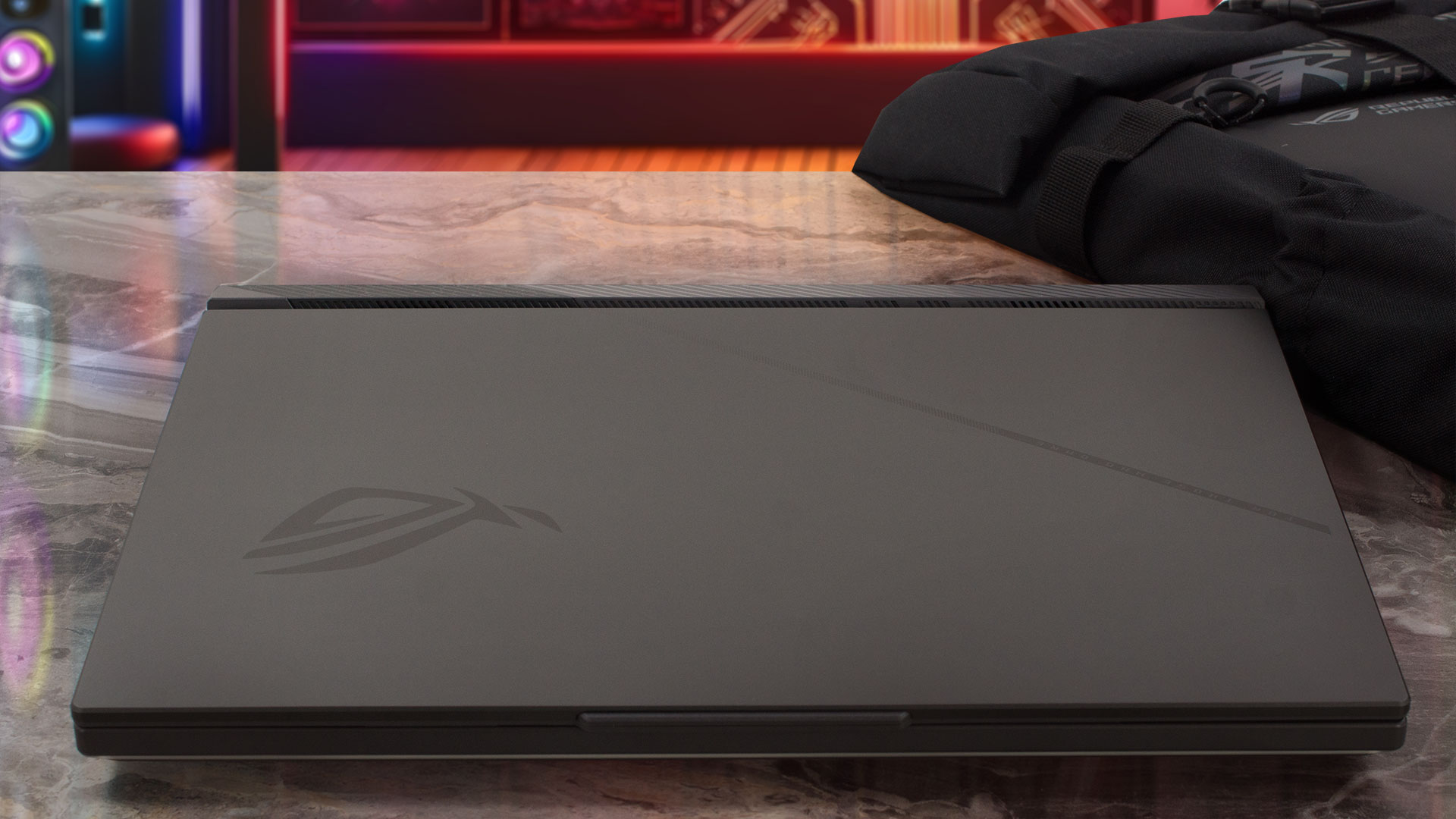
The ASUS ROG Strix G16 G614 (2025) lands with a design that’s both instantly recognizable and refreshingly refined. This is the classic, almost extraterrestrial ROG Strix aesthetic we’ve come to know and love, and the lack of radical surprises is a good thing – it’s a proven, successful formula. The chassis comes in two nearly identical flavours: the classic “Eclipse Gray” we have for review, and a “Volt Green” variant that adds a few electric green accents. With its metal lid and robust plastic body, it feels very solid, exhibiting no concerning flex or creaks. The finish does a good job of warding off heavy fingerprints, though you might notice some light, easily cleaned smudges after a while.
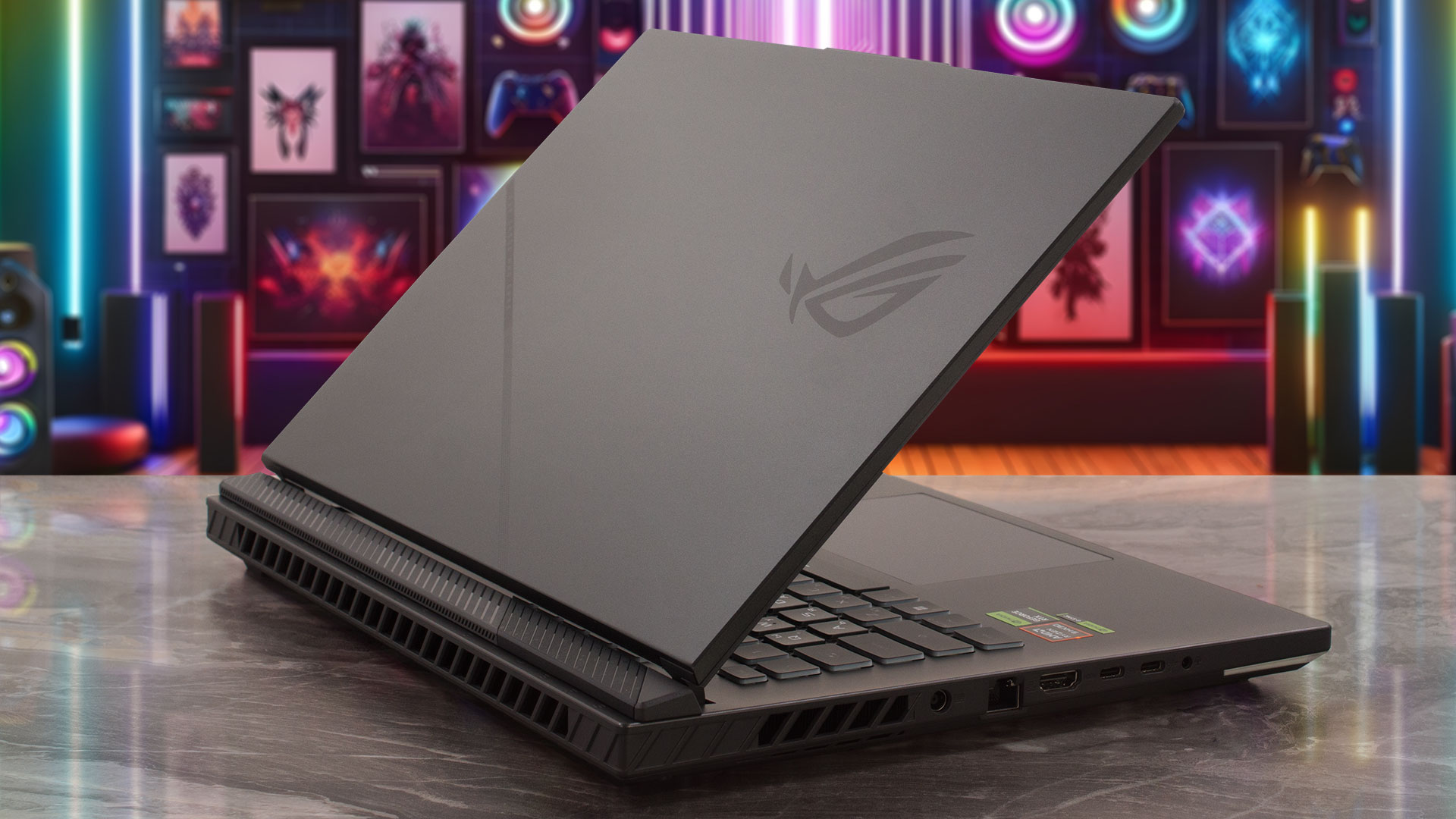
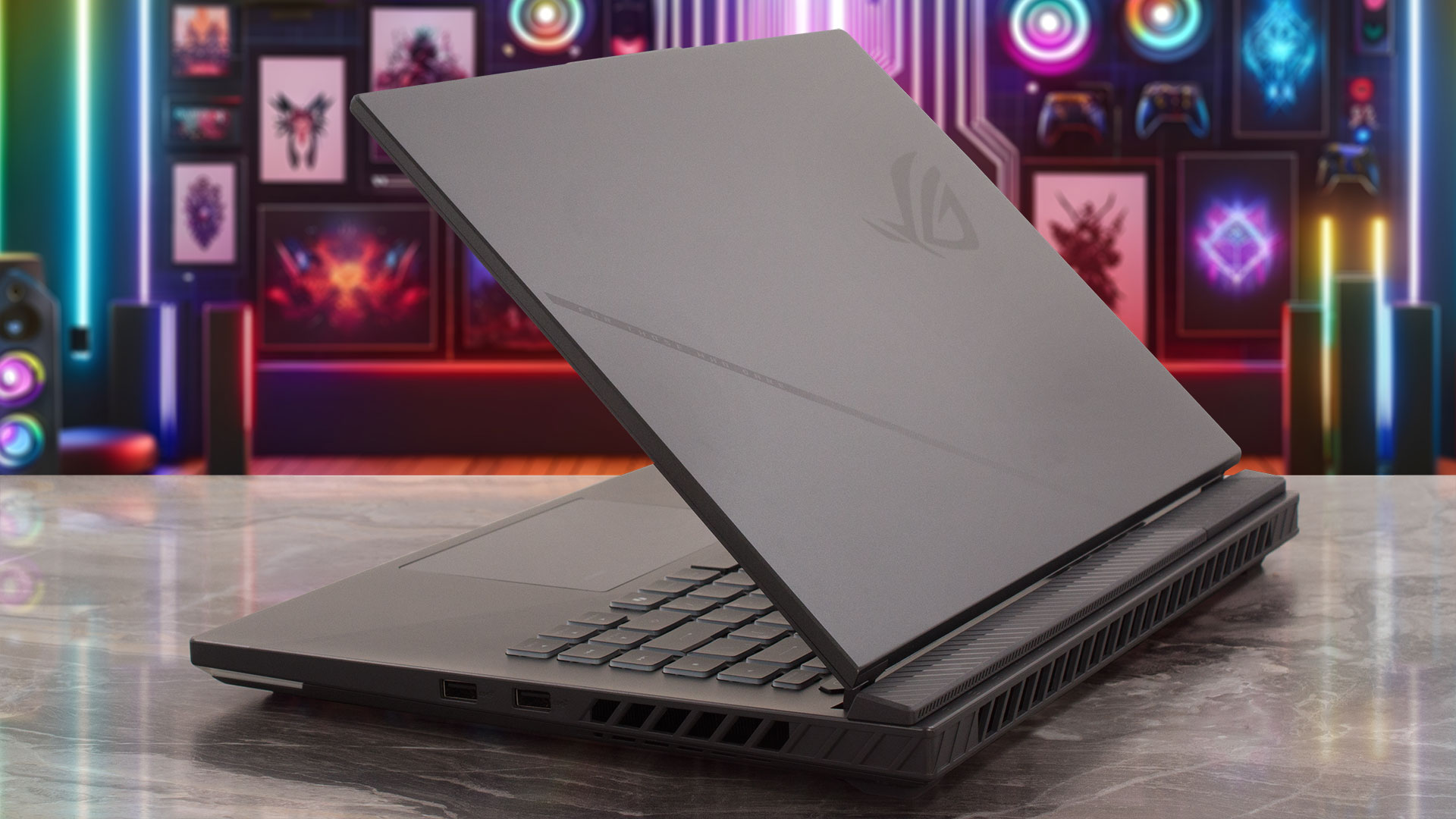
For a high-end gaming machine, the Strix G16 strikes a nice balance in portability. It’s a bit lighter than some of its direct competitors at 2.50 kg (5.51 lbs), though perhaps a fraction thicker, with a tapered profile measuring 35.4 x 26.4 x 2.26 ~ 3.04 cm (13.94″ x 10.39″ x 0.89″ ~ 1.20″). The hinges are well-tuned, holding the screen securely, which opens to a maximum angle of about 120 degrees – perfectly sufficient for a non-touchscreen gaming laptop.
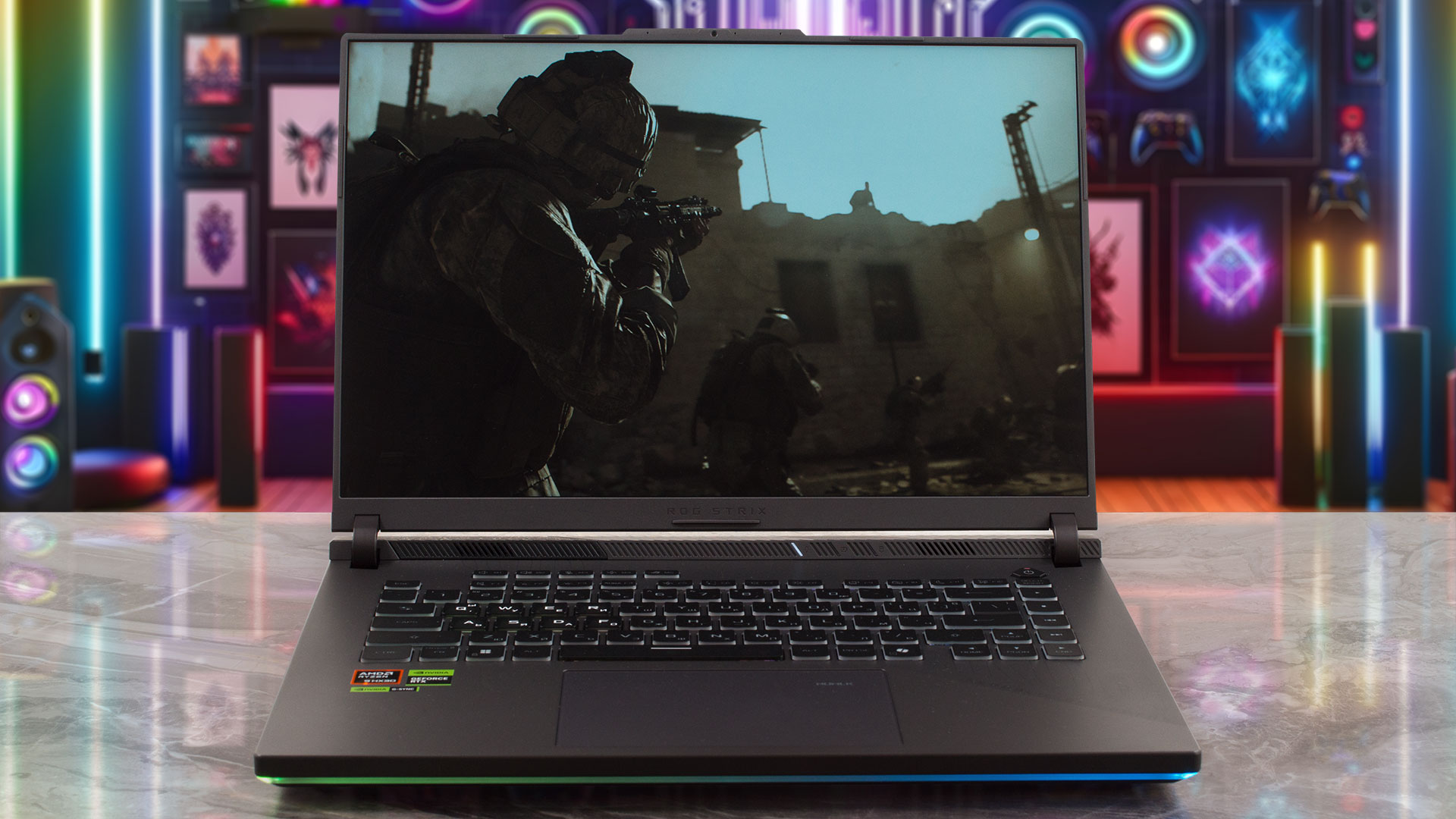
Once open, the display is where the Strix G16 truly pushes the envelope. The bezels are breathtakingly thin, quite possibly some of the narrowest on the market today. The side bezels are a mere 4.5 mm (approximately 0.18 inches). The top bezel is only slightly thicker at 7 mm (approximately 0.28 inches) in the center, a remarkable feat considering it houses a 1080P FHD camera and a built-in microphone array. However, this aggressive pursuit of a near-borderless display comes at a cost: there is no physical privacy shutter, a feature that has been sacrificed for the sake of aesthetics.
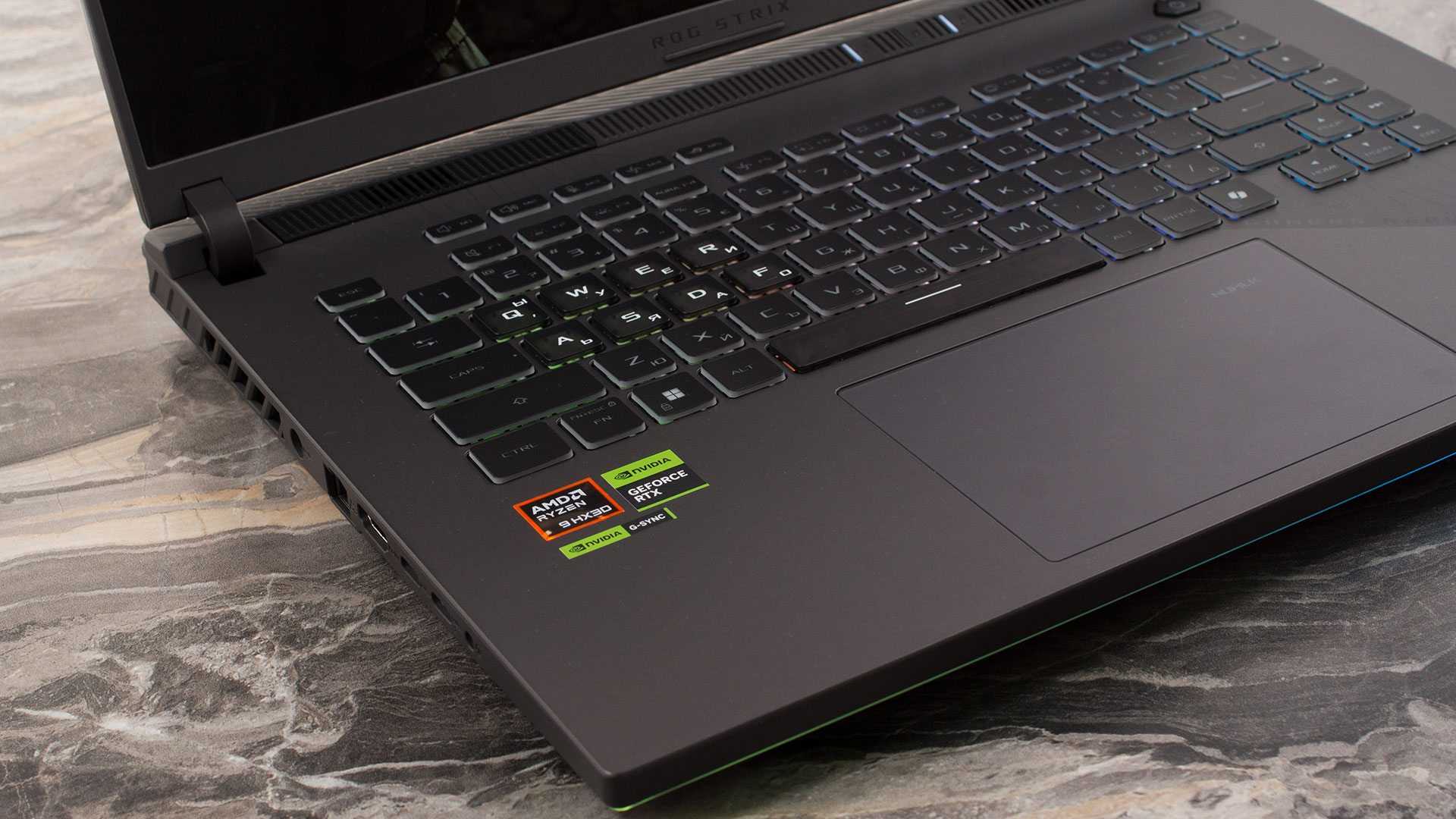
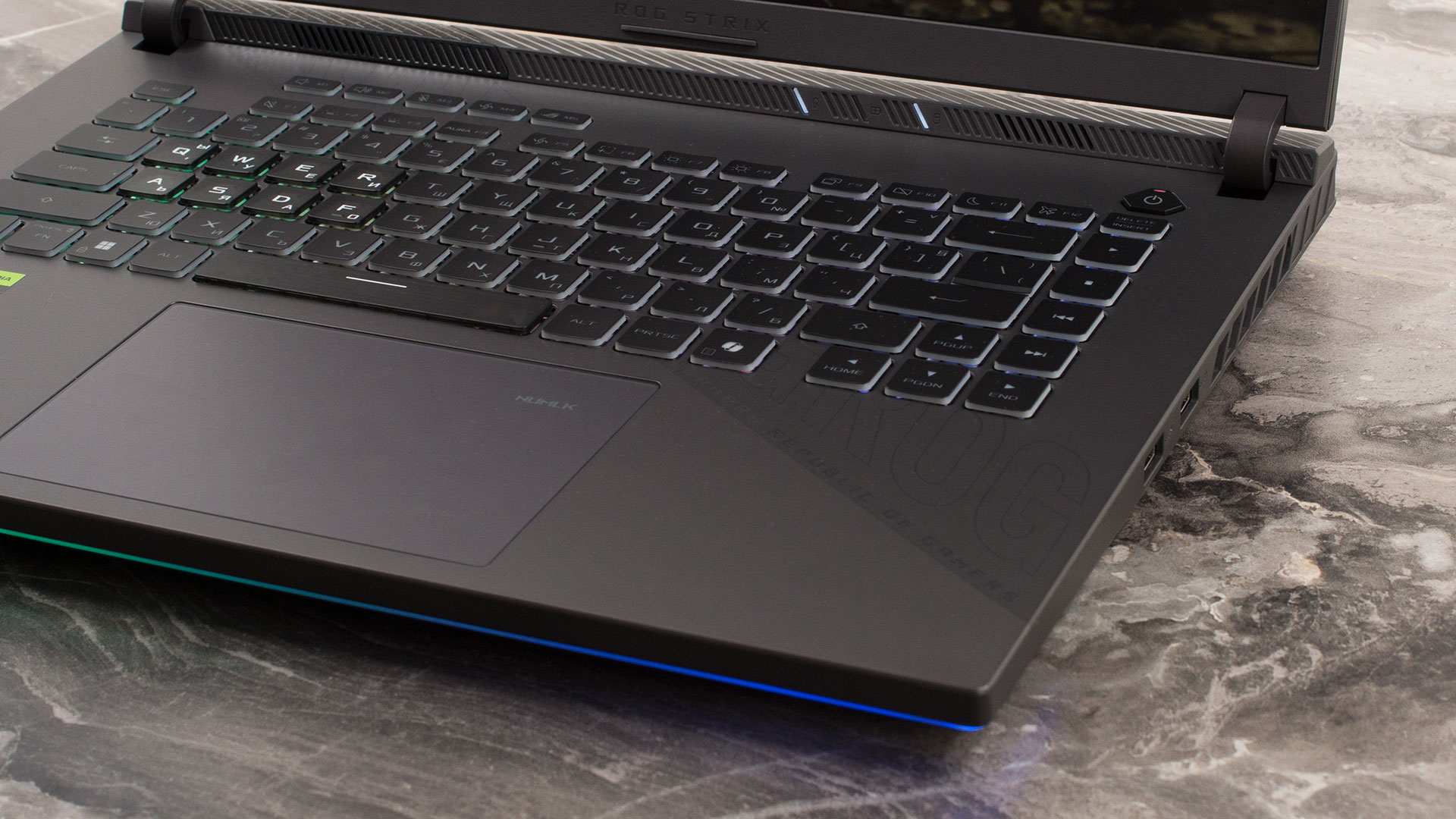
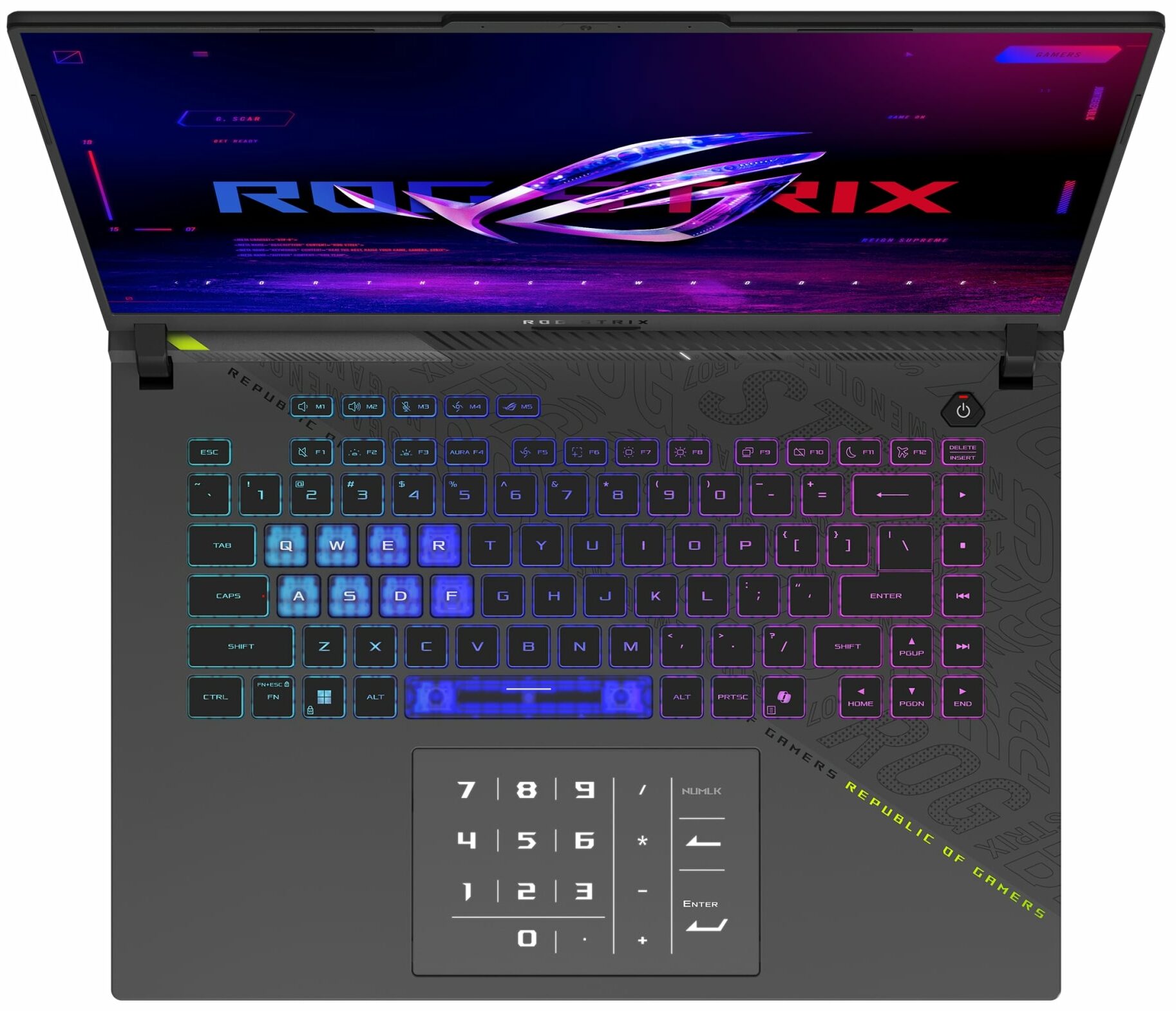
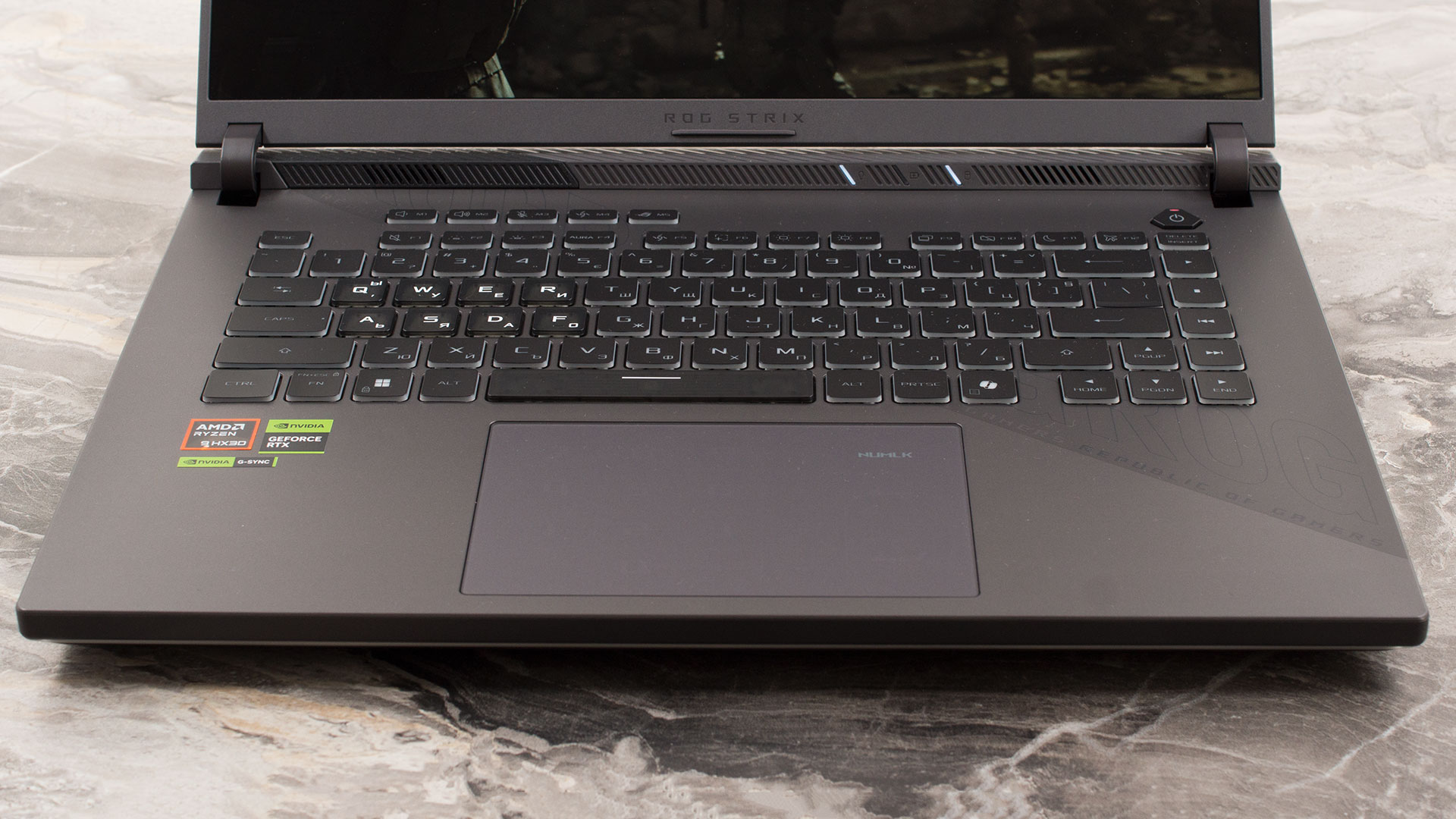
The keyboard deck is spacious and comfortable, featuring per-key RGB backlighting that appears to be standard across all configurations. The typing and gaming experience is excellent, with satisfying key travel, and the arrow keys are comfortably sized for gaming, even if they aren’t fully isolated from the main cluster. You’ll notice the absence of a dedicated, physical NumPad. Instead, ASUS employs its clever “NumberPad” solution: simply long-press the top-right corner of the trackpad for a second, and an illuminated numeric keypad appears directly on its surface. It’s an elegant, space-saving feature that works surprisingly well. For biometric login, you’ll be relying on passwords, as there are no configurations with a fingerprint reader. The trackpad itself is large, precise, and comfortable, measuring 130 x 85 mm (approximately 5.12 x 3.35 inches), providing ample space for navigation when a mouse isn’t in play.
Ports and Connectivity
The ASUS ROG Strix G16 G614 (2025) features a robust and modern port selection, with the majority of connections logically placed on the left side of the chassis. Here, you’ll find the dedicated power connector, an RJ45 LAN port for a stable wired network connection, and an HDMI 2.1 port specified with Full Rate Link (FRL), ensuring it can deliver the full bandwidth needed for high-resolution, high-refresh-rate displays like 4K at 120Hz. The highlight on this side is a pair of high-speed USB4 ports, both offering data transfer speeds up to 40Gbps and supporting DisplayPort for video output. It’s important to note the slight difference between them: one of these ports also supports Power Delivery for alternative charging, while the other does not. A standard 3.5mm combo audio jack for headsets rounds out the left-side I/O.

The right side of the laptop is kept more streamlined, which is a thoughtful design for gamers who need ample space for mouse movement. It houses two USB 3.2 Gen 2 Type-A ports. Crucially, both of these ports operate at the faster 10Gbps speed, providing high-performance connectivity for peripherals like external SSDs, mice, and keyboards without any compromise in speed. The overall physical port selection is comprehensive and geared towards high performance across the board.

For wireless connectivity, the Strix G16 is equipped with Wi-Fi 6E (802.11ax). This standard supports triple-band operation (2.4 GHz, 5 GHz, and the less-congested 6 GHz band) and utilizes a 2×2 antenna configuration for robust and reliable performance on compatible networks. This is paired with Bluetooth 5.3 for connecting a wide range of wireless accessories like headphones, controllers, and mice.

Display and Sound Quality, Display Profiles
There are two display variants – a “standard” 1200p 165 Hz panel, and a “ROG Nebula Display” with 1600p resolution and 240Hz refresh rate. We ordered the better variant, and it’s excellent, except for its average brightness and contrast. However, the 1200p variant has much lower brightness.
| ASUS ROG Strix G16 G614 (2025) | 2560 × 1600, 240 Hz, IPS-level | 1920 × 1200, 165 Hz, IPS-level |
| Panel ID | BOE NE160QDM-NZC (BOE0CFB) | — |
| Diagonal | 16.0 inches (40.6 cm) | 16.0 inches (40.6 cm) |
| Panel Type | IPS | IPS |
| Resolution | 2560 × 1600 pixels | 1920 × 1200 pixels |
| Max Refresh Rate | 240 Hz | 165 Hz |
| Aspect Ratio | 16:10 | 16:10 |
| Pixel Density | 189 PPI | 141 PPI |
| ‘Retina’ Distance | Greater than or equal to 46 cm | Greater than or equal to 62 cm |
| Brightness | ~500 nits | 300 nits |
| Surface | Anti-glare | Anti-glare |
| Color Gamut | 100% DCI-P3 | 100% sRGB |
| Response Time | ≈3 ms (GTG) | ≈3 ms (GTG) |
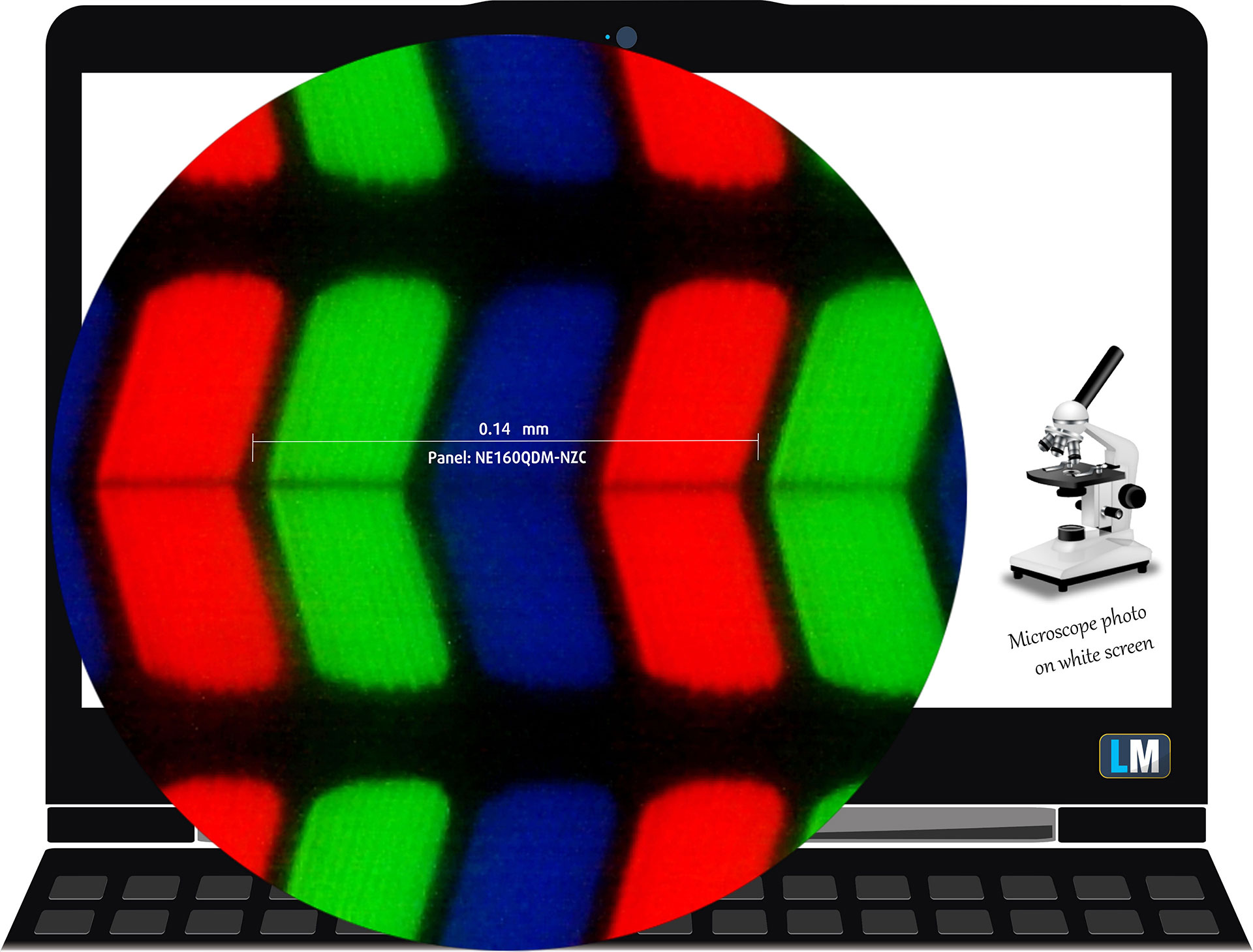
The 1600p, 240 Hz panel under our microscope
Viewing Angles
Viewing angles are good. We take photos from different angles to evaluate the quality.

Also, a video with locked focus and exposure.
Color Coverage
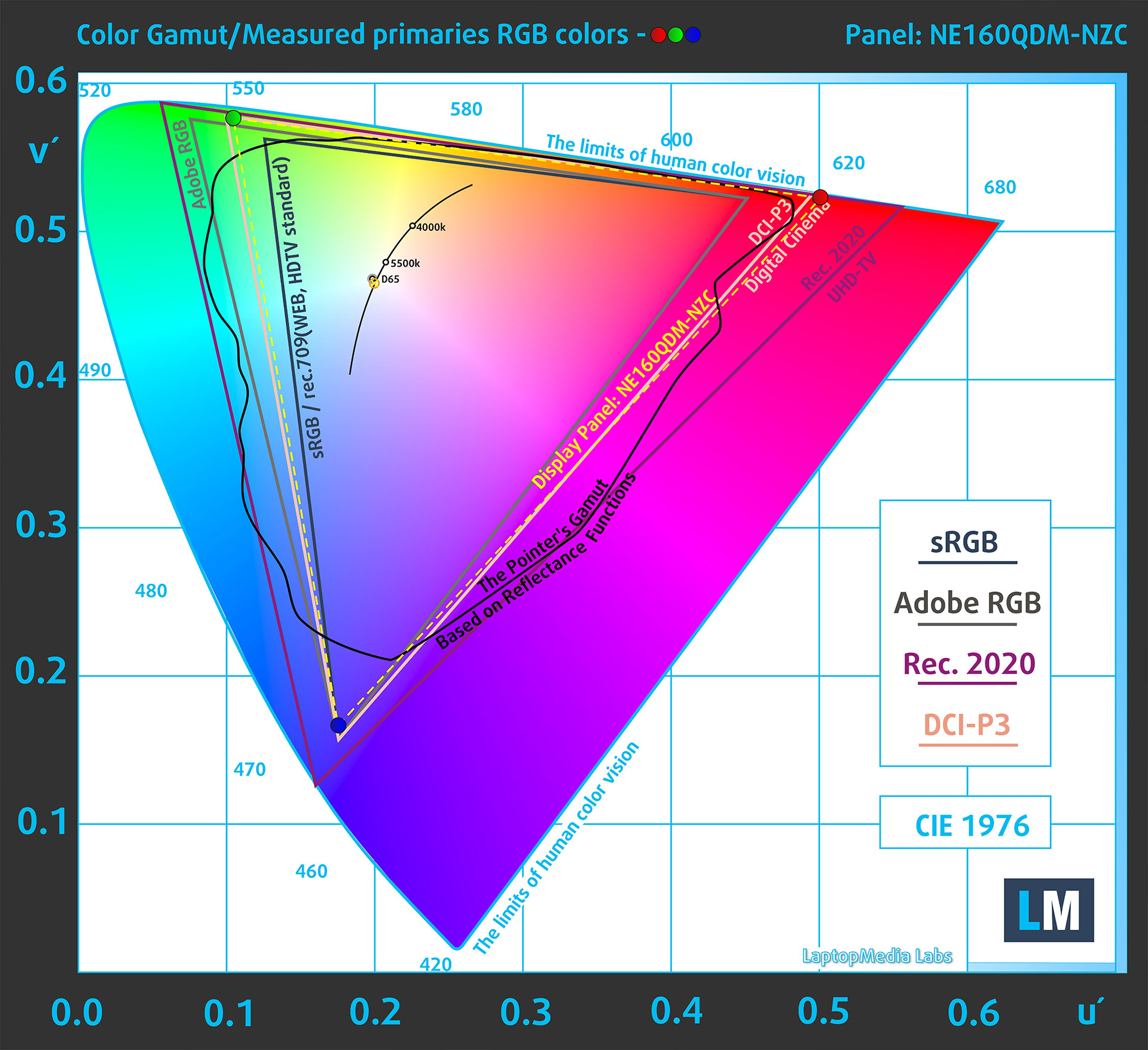
The whole “sail-shaped” map below (Fig. 1) consists of all the colors we can see, while the black crooked line shows all the colors from real-world scenes and nature around us.
Then, we’ve drawn some of the most important and interesting color spaces, compared to the colors the panel of ASUS ROG Strix G16 G614 (2025) can show:
Standard/For Web: sRGB – widely used color space for most consumer devices, ideal for Web design and development
For Print: AdobeRGB – used in professional photo editing, graphic design, and print
For Photographers/Video Editors: DCI-P3 – used in high-end film production, post-production, and digital cinema
Premium HDR: Rec.2020 – the widest consumer ITU color standard, covering a massive 75.8% of the visible spectrum, a benchmark for premium HDR content
ASUS ROG Strix G16 G614 (2025): the yellow dashed triangle (– – – – – –) represents the range of colors this display can show.
In our tests, we calculated the total color coverage of the display at 100% of the sRGB color gamut and 99% of the DCI-P3 color gamut.
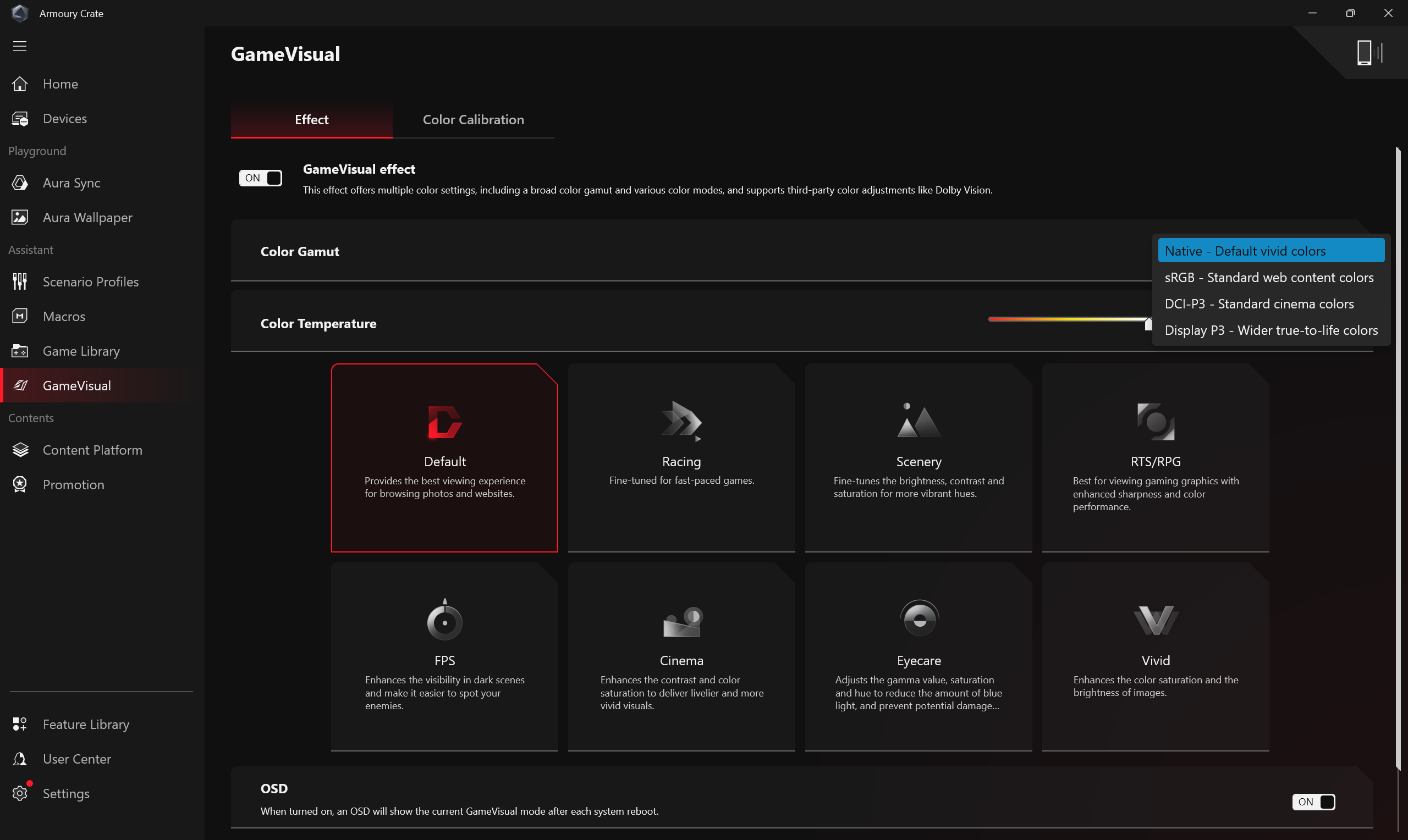
The “Armoury Crate” app emulates Display P3 and sRGB color spaces.
(Fig.2) Display P3
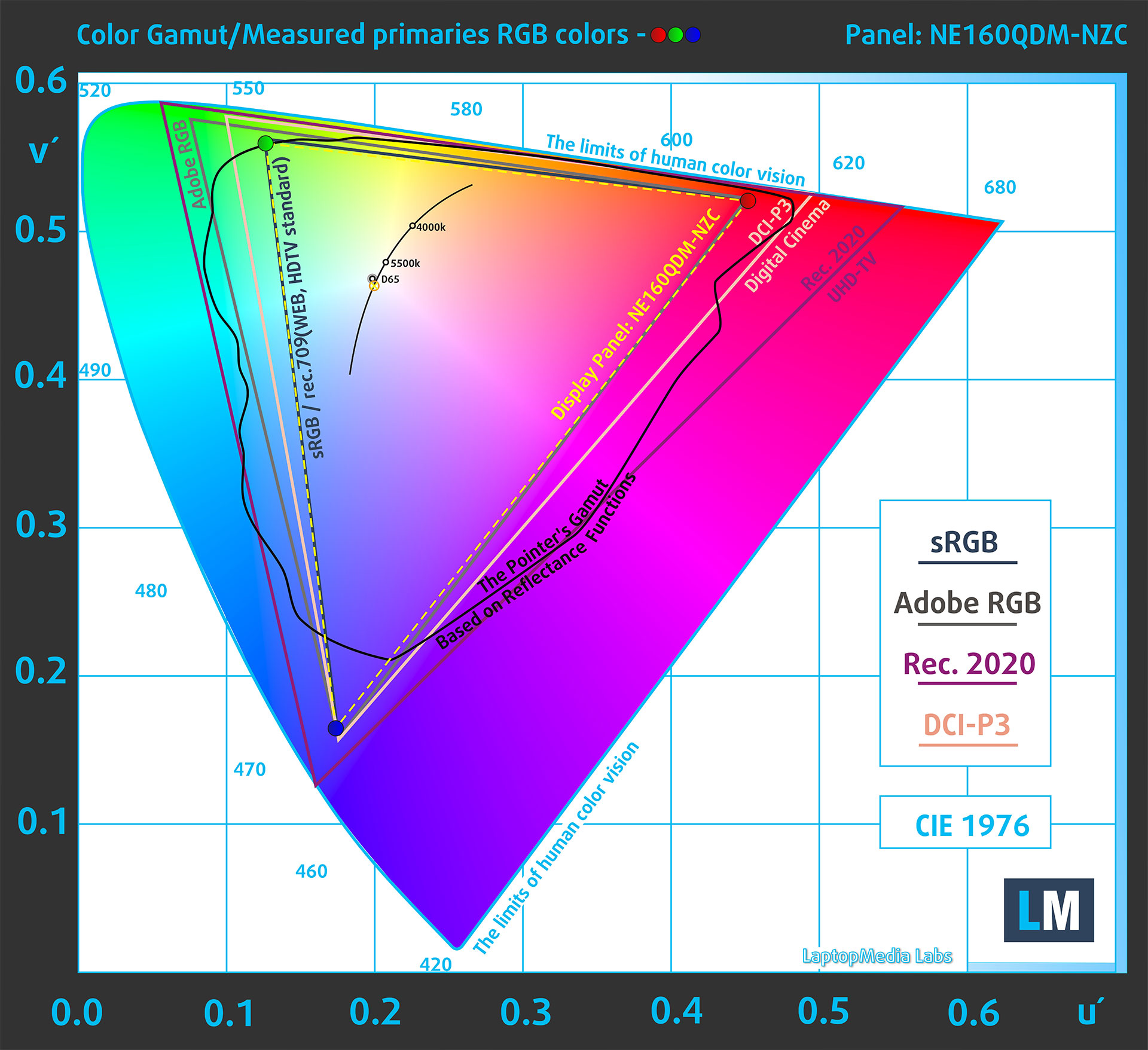
(Fig.3) sRGB
Brightness and Contrast
The maximum brightness in SDR mode is 508 cd/m² in the center of the screen and 489 cd/m² averaged across the surface with a maximum deviation of 12%.
The correlated color temperature (CCT) of a white screen at maximum brightness is 6680 K (“Native-Default” mode in “MyASUS – Armoury Crate” app).
The contrast ratio is 1350:1.

Uniformity: Luminance, Contrast, and Color Deviation
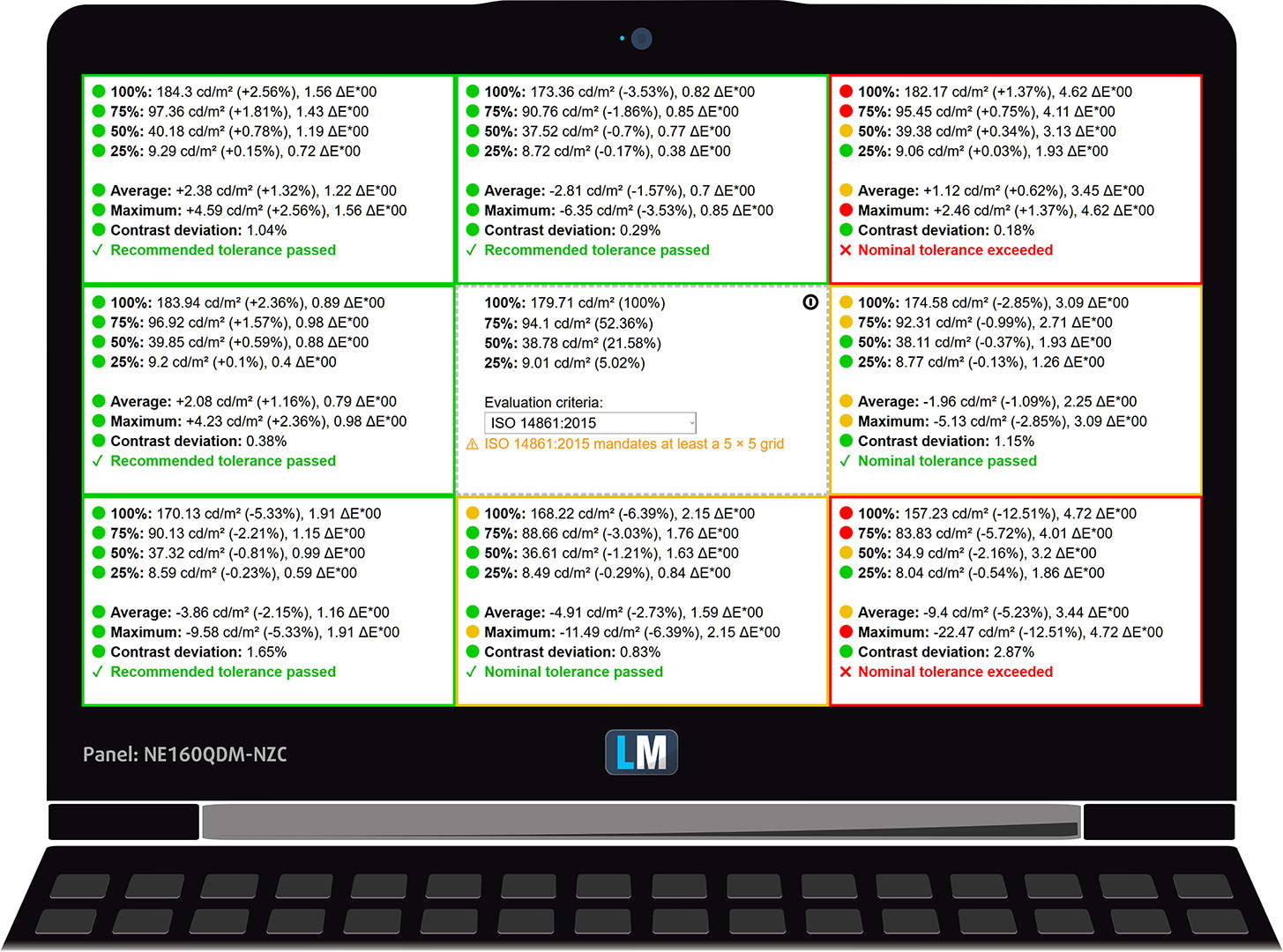
The figure below shows the results from our uniformity test across different sections of the screen. It’s measured at 180 nits (Windows slider = 56%) — a brightness level we consider typical for standard working conditions.
DeltaE values below 4.0 are acceptable for regular users. For those working with colors, screens with DeltaE values no higher than 2.0 are recommended.
Color Accuracy
Let’s check the difference between real colors and those you’ll see on the ASUS ROG Strix G16 G614 (2025). We measure that distance in DeltaE – the higher the number, the more different they look.
Values below 4.0 are acceptable for regular users, while values below 2.0 are suitable for color-sensitive work. A value below 1.0 means the difference is indistinguishable to the naked eye.
For the next graph, we’ve selected 24 common colors, including dark/light skin, blue sky, green grass, etc.
Before our calibration of the ASUS ROG Strix G16 G614 (2025), the Average color accuracy was 1.3 dE (Fig. 2) (“Display P3-Default” mode in “MyASUS – Armoury Crate” app), and with our Design and Gaming profile, it lowered to 1.2 dE (Fig. 3).
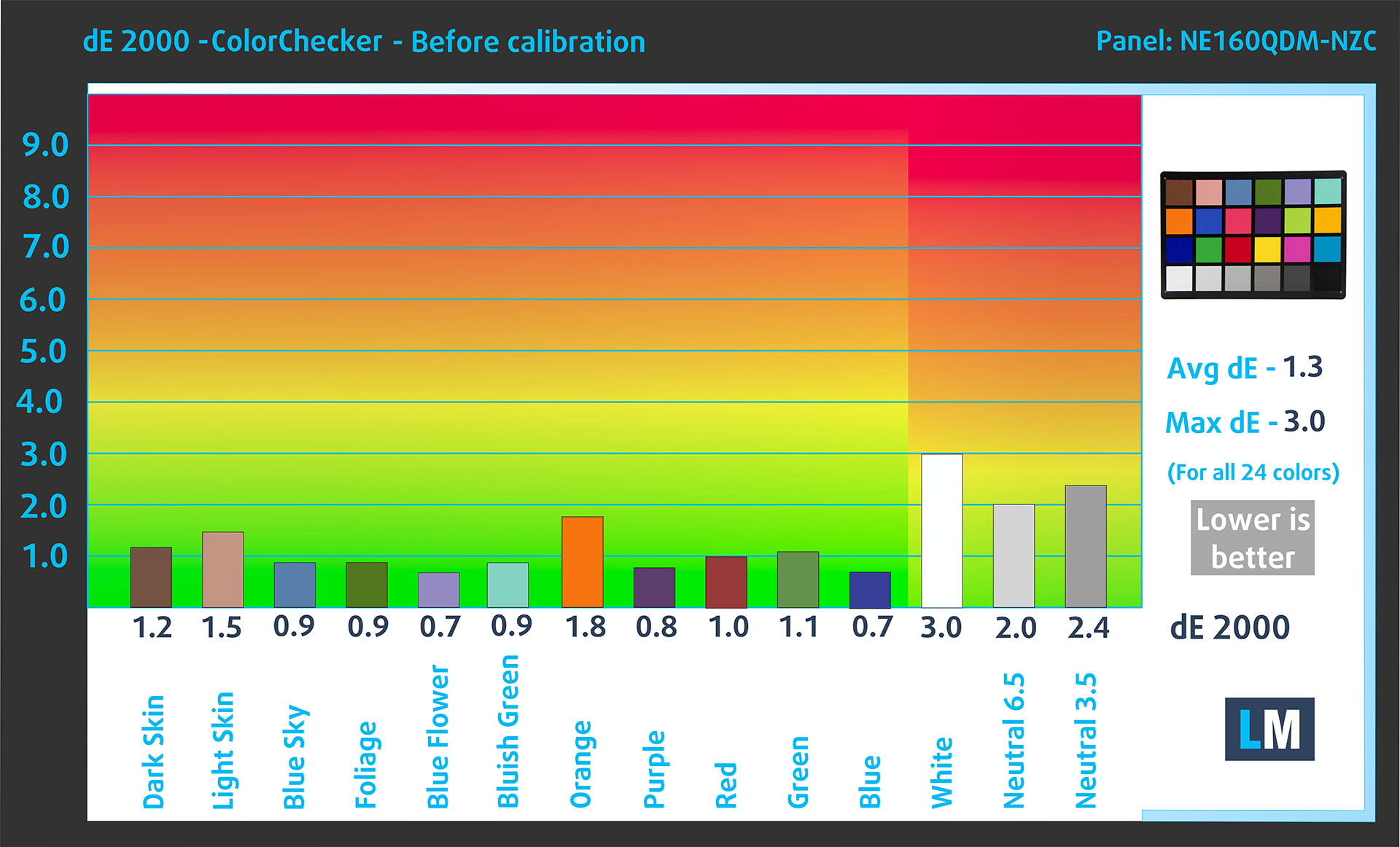
ASUS ROG Strix G16 G614 (2025) in its factory condition
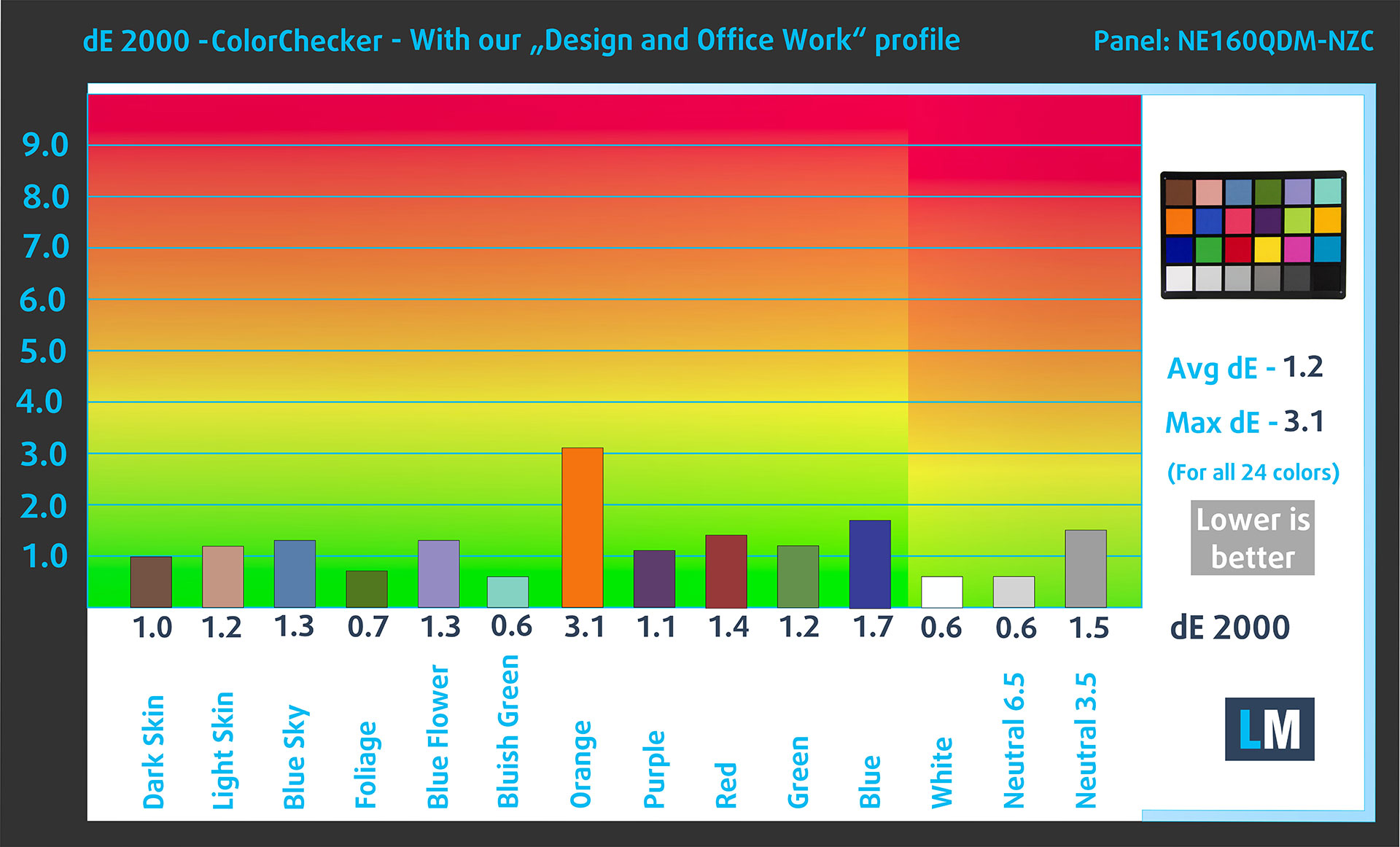
ASUS ROG Strix G16 G614 (2025) with our display profile
Comparison in the Display P3 color space.
Below are the results of the ASUS ROG Strix G16 G614 (2025) in its factory condition (“sRGB-Default” mode in “MyASUS – Armoury Crate” app) compared to sRGB color space.
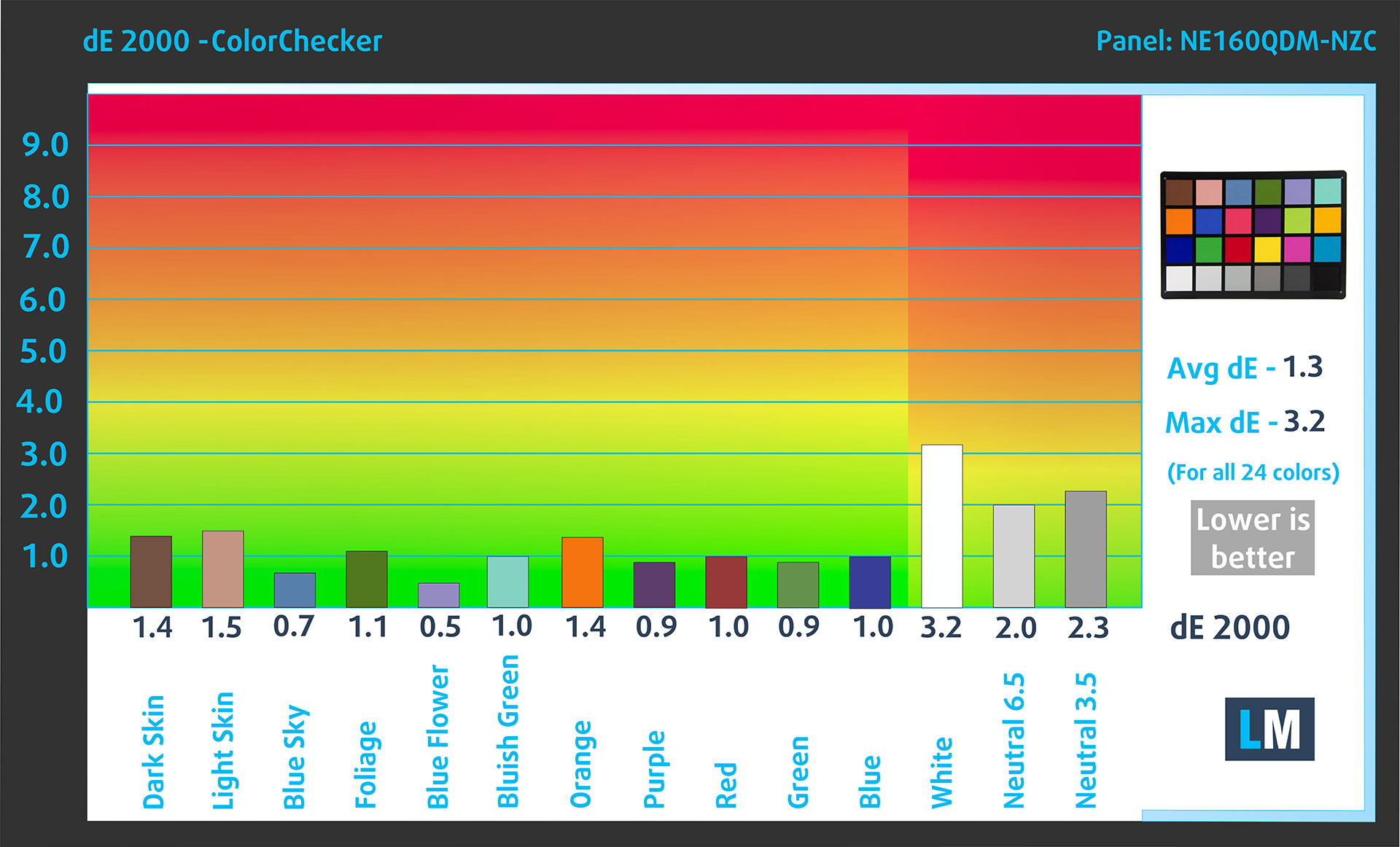
Here’s an illustration of what the Design and Office profile aims to deliver:
Left: No Profile | Drag the slider to see the difference | Right: Design & Office Profile


Visibility in dark scenes
Have you ever watched a movie with dark scenes where you could barely see anything? This often happens because many display panels struggle to differentiate the darkest nuances, making them appear the same.
The next figure illustrates how well the display reproduces these dark nuances. The left side of the image shows the display with stock settings, and the right side shows it with our Gaming and movies profile activated (Comparison is in “Native-Default” mode in “MyASUS – Armoury Crate” app).
On the horizontal axis are the grayscale levels, and on the vertical axis – the corresponding display brightness.
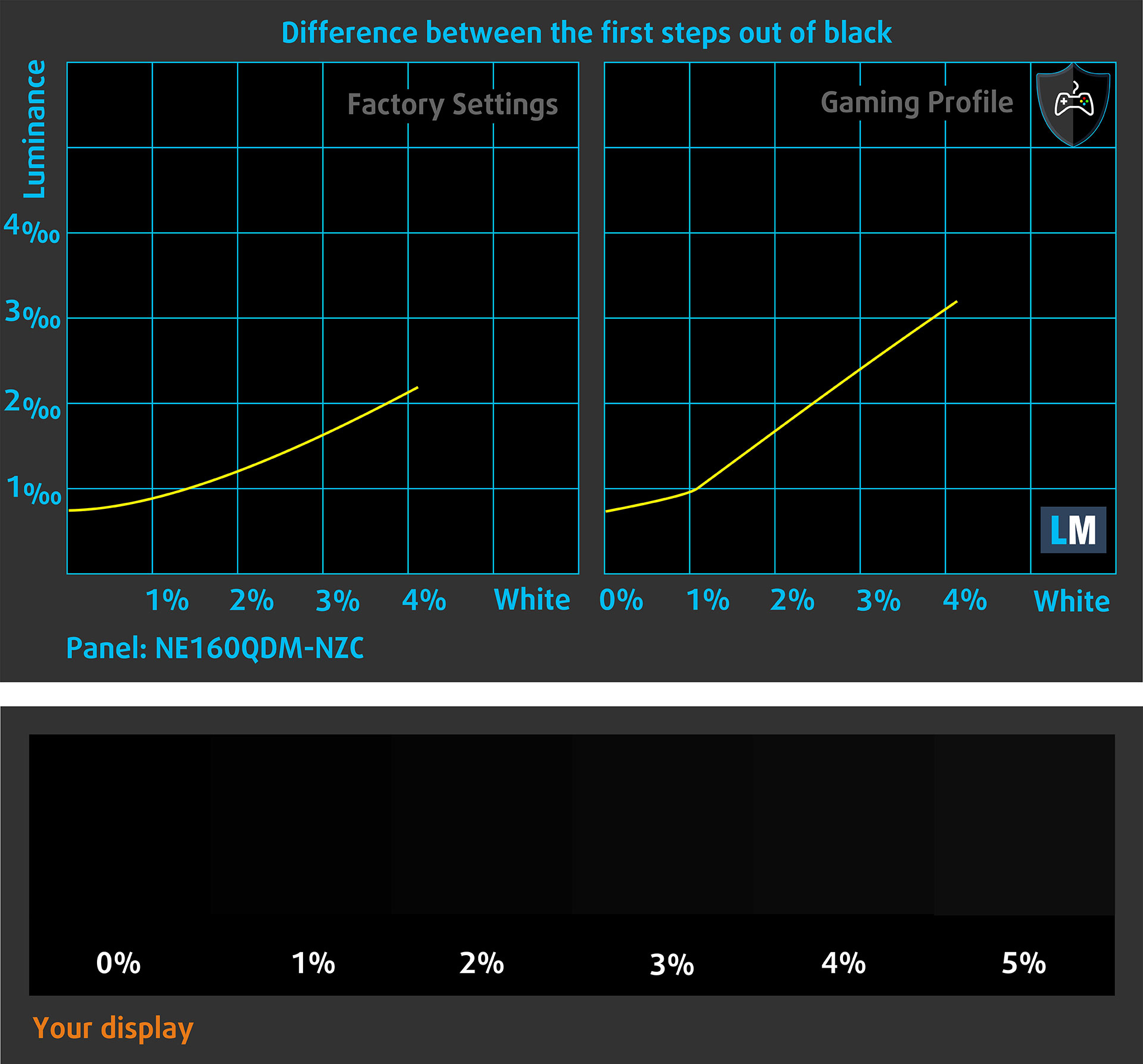
You can also check how your display handles the darkest nuances but keep in mind that this also depends on the settings of your current display and the surrounding light conditions.
Response time (Gaming capabilities)
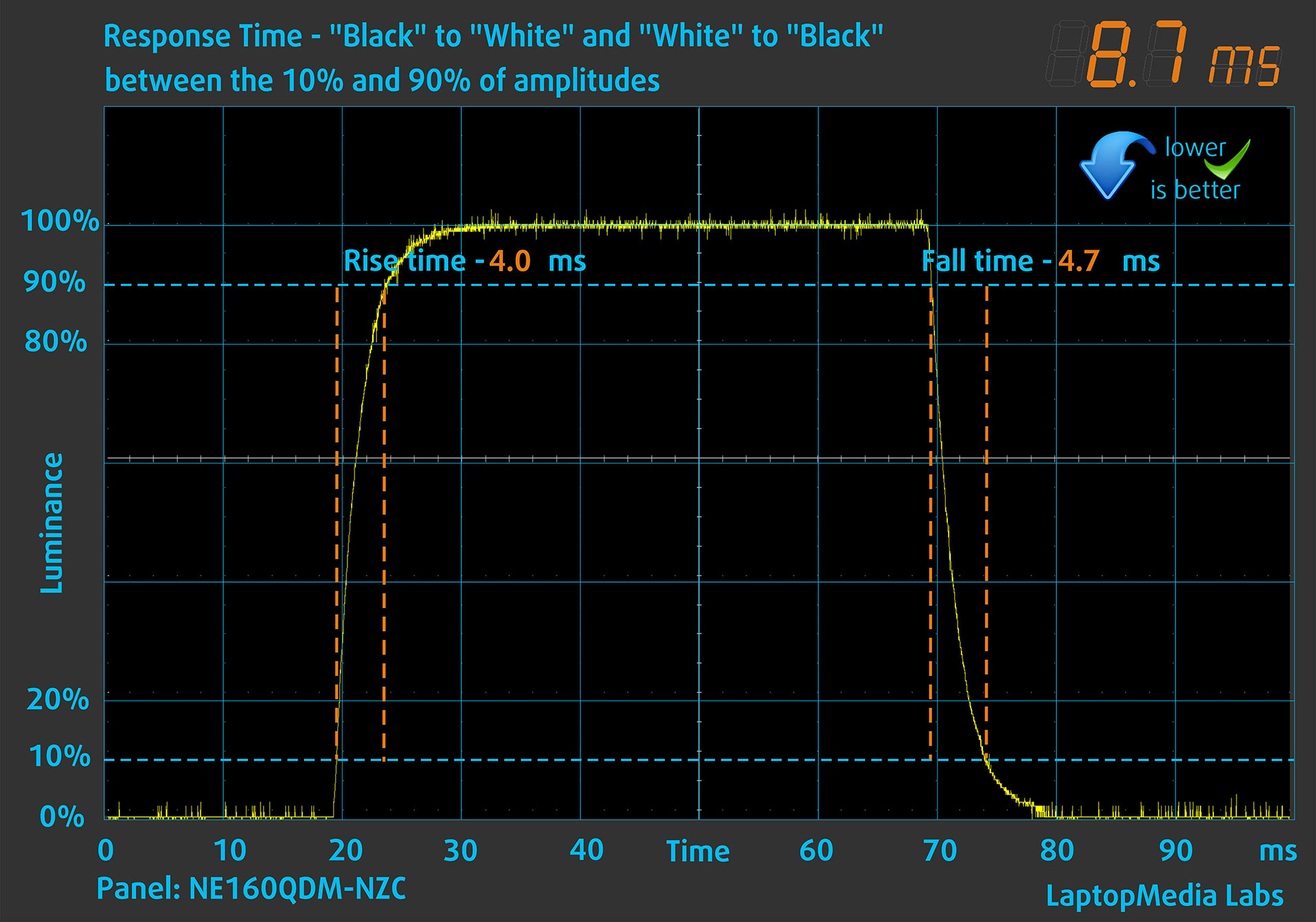
We test the reaction time of the pixels with the usual “black-to-white” and “white-to-black” method from 10% to 90% and vice versa.
We recorded Fall Time + Rise Time = 8.7 ms. Short pixel response time is a prerequisite for a smooth picture in dynamic scenes.
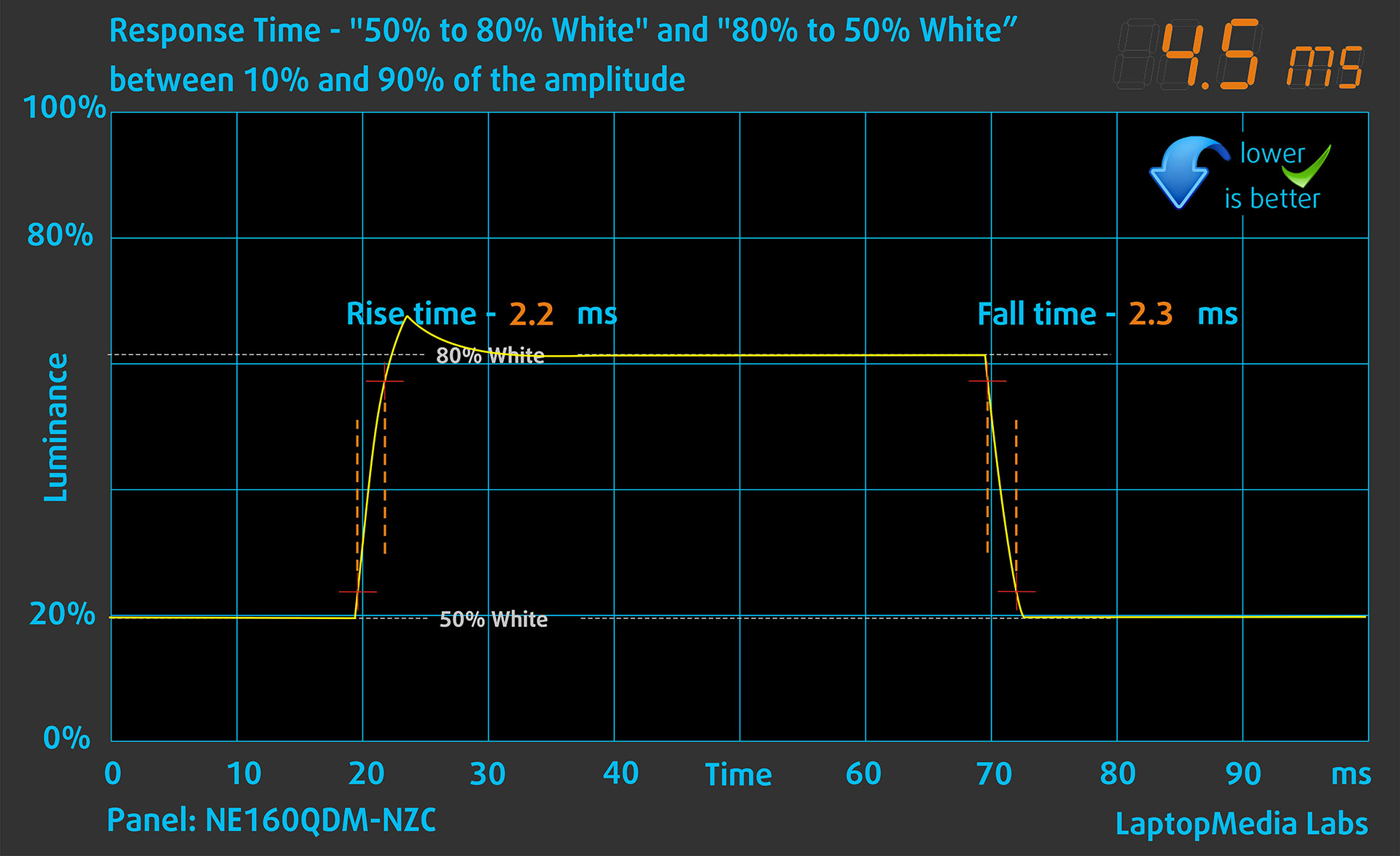
After that, we test the reaction time of the pixels with the usual “Gray-to-Gray” method from 50% White to 80% White and vice versa between 10% and 90% of the amplitude.
Health Impact: PWM (Screen flickering)
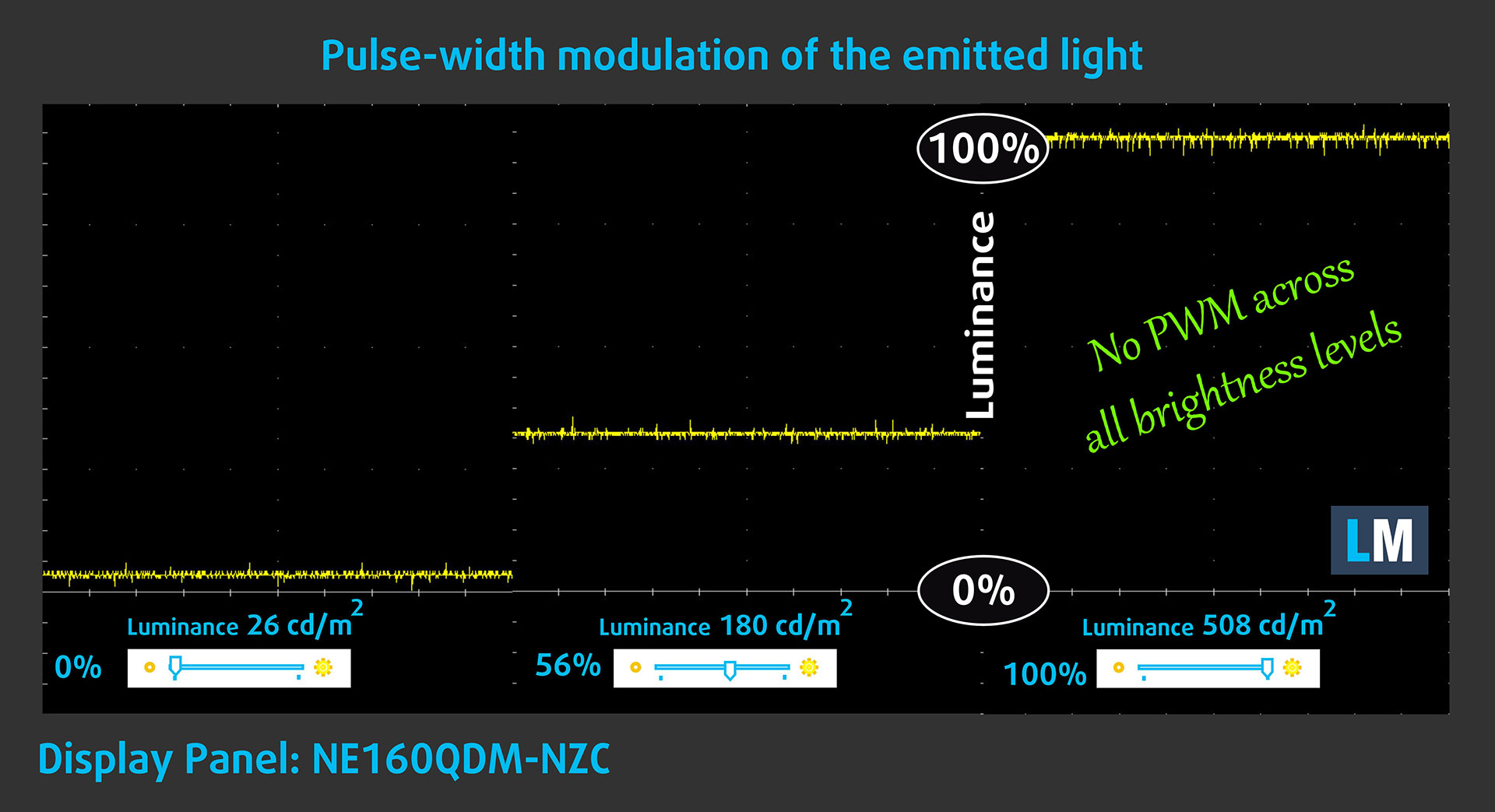
Some use PWM to regulate their brightness, which means that instead of reducing the light intensity, they pulse or flicker. Our brain merges the image, so it appears darker, but this strains both it and our vision, especially when the frequency of the pulses is low. You can read more about that in our dedicated article on PWM.
In the graph below, you see the intensity of light at different brightness levels—on the vertical axis is the brightness of the emitted light, and on the horizontal axis—time.
The light from the backlight of the ASUS ROG Strix G16 G614 (2025) display is not pulse-width modulated, providing visual comfort in the discussed aspect.
Health Impact: Blue light emissions
Installing our Health-Guard profile reduces harmful Blue Light emissions while keeping the colors of the screen perceptually accurate.
If you’re not familiar with the Blue light, the TL;DR version is – emissions that negatively affect your eyes, skin, and your whole body. You can find more information about that in our dedicated article on Blue Light.
Health Impact: Screen Reflectance
Glossy-coated displays can cause eye fatigue in high ambient light conditions due to reflections. We measure the level of screen reflection with the display turned off, at a 60° angle.
The reflectance of the ASUS ROG Strix G16 G614 (2025)’s screen is 30.8 GU. This is an exceptional result!
High Gloss: >70 GU
Medium Gloss: 30 – 70 GU
Low Gloss: <30 GU
Get our profiles
Since our profiles are tailored for each individual display model, this article and its respective profile package are meant for ASUS ROG Strix G16 G614 (2025) configurations with NE160QDM-NZC (BOE0CFB), 2560 х 1600, IPS panel.
*Should you have problems with downloading the purchased file, try using a different browser to open the link you’ll receive via e-mail. If the download target is a .php file instead of an archive, change the file extension to .zip or contact us at [email protected].
Read more about the profiles HERE.
In addition to receiving efficient and health-friendly profiles, by buying LaptopMedia's products you also support the development of our labs, where we test devices in order to produce the most objective reviews possible.

Design and Office
The Design and Office profile makes display colors as close to real as possible.Ideal not only for professionals but also for everyday users, it meets sRGB standards (D65 white point, sRGB gamma) with minimal DeltaE for precise color reproduction on your panel.

Gaming and Movies
Have you ever watched a movie where, during dark scenes, you can barely see anything? Many displays fail to distinguish dark tones properly. Our Gaming and Movies profile enhances low-light performance, like HDR tech, using a gamma curve tailored to human perception — ideal for gamers seeking faster reactions and clearer visuals.

Health-Guard
Our Health-Guard profile protects your eyes by eliminating PWM flickering, reducing strain and fatigue, and minimizing harmful Blue light exposure that can disrupt sleep and health. It uses software dimming and a gamma curve tailored to human perception for comfort and safety during screen use.
Get All The Profiles With 33% Discount!

Sound
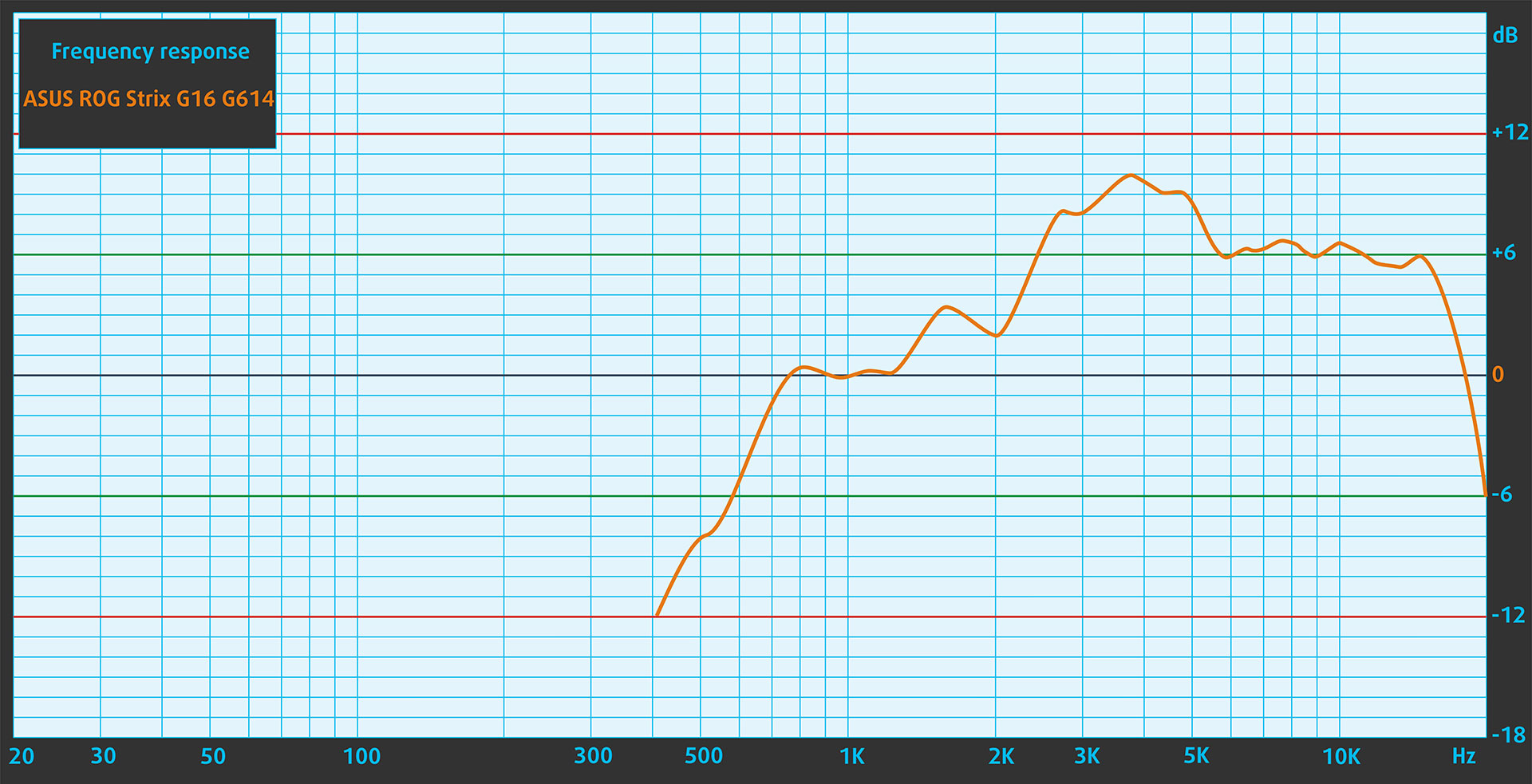
The ASUS ROG Strix G16 G614 (2025)’s sound is of very good quality. The low, mid, and high frequencies are clear.
Work Performance: CPU, Storage, AI
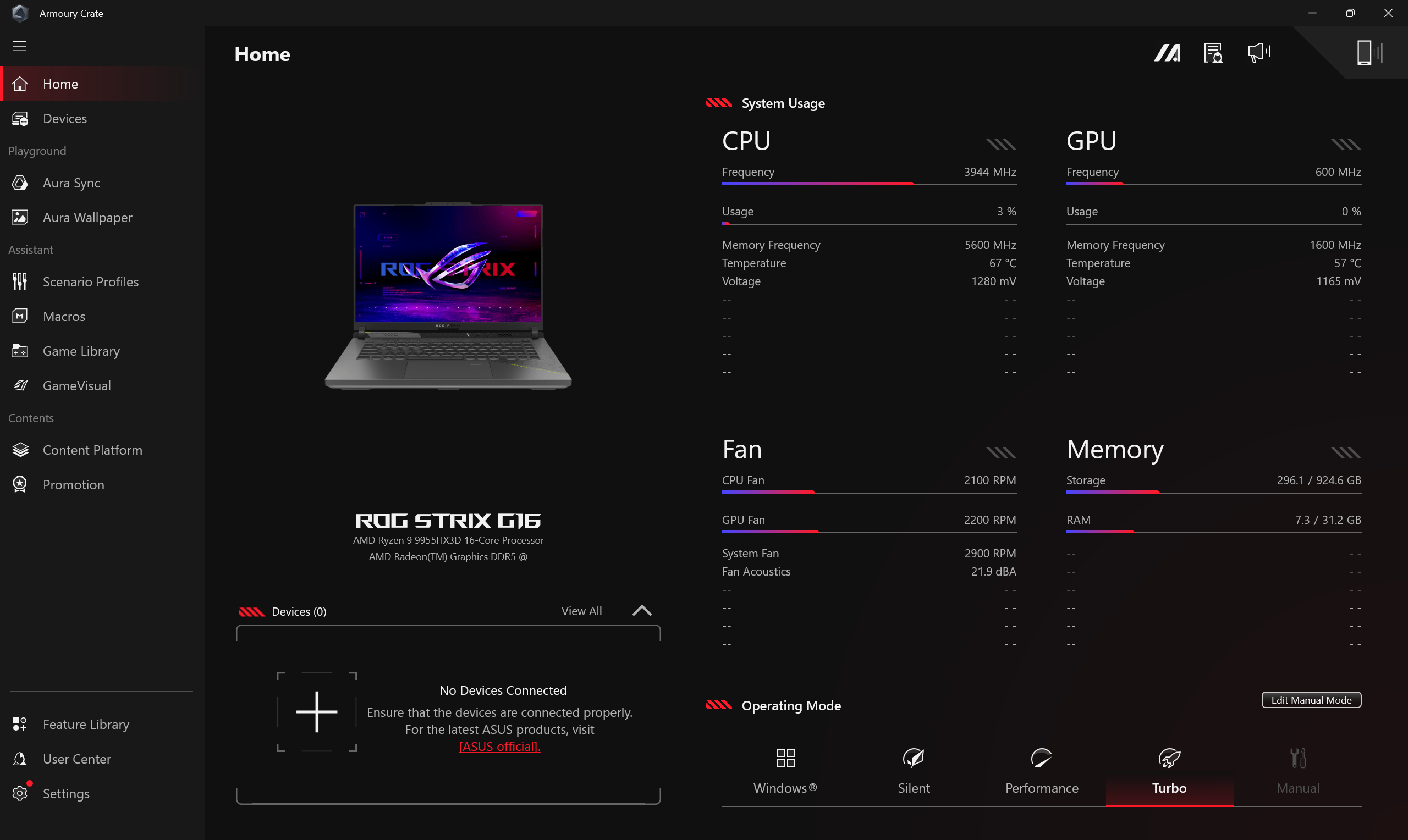
All performance and temperature tests are conducted with Turbo Mode activated in Armoury Crate:
CPU and Work Performance
The ASUS ROG Strix G16 G614 (2025) is offered with high-end AMD Ryzen processors, including the Ryzen 9 9955HX3D and Ryzen 9 9955HX – ranked #2 and #3 respectively in our Top Laptop CPU Ranking, as well as the Ryzen 9 8940HX at #11. These chips are aimed at power users, gamers, and creators who need strong multi-core performance in a portable format.
The Ryzen 9 9955HX3D is a real beast, and since all the other competitors use Intel Core Ultra 9 275HX, the ROG Strix G16 G614 is the fastest of them all in our Single-Core benchmark, while trailing 6% behind its bigger sibling ASUS ROG Strix G18 in Cinebench 2024.
Single-core performance ensures smooth operation and responsiveness in operating systems, providing a better user experience.
Results are from the Geekbench 6 Single-Core test (higher is better)
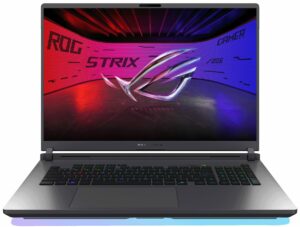
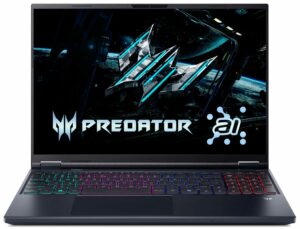
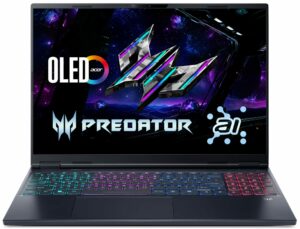

Multi-core performance is essential for handling complex and demanding tasks, such as Video editing, CAD, and Scientific simulations.
Results are from the Geekbench 6 Multi-Core test (higher is better)
Here, we evaluate the CPU's performance using a real-world 3D rendering task, assessing its ability to handle complex computations and rendering workloads efficiently.
Results are from the Cinebench 2024 Multi-Core test (higher is better)
Storage Performance
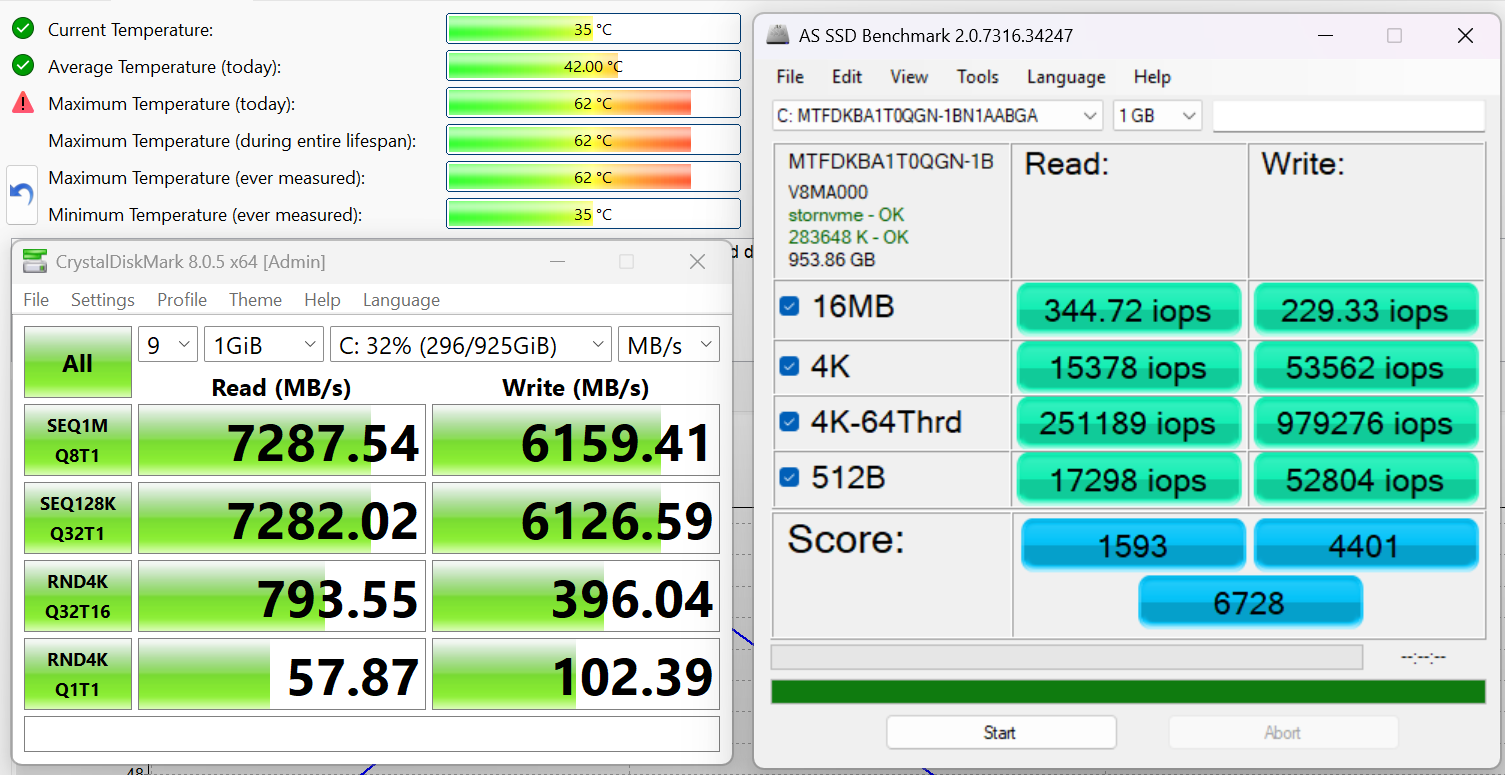
We ordered a 1TB configuration and it arrived with Micron NVMe SSD ( MTFDKBA1T0QGN-1BN1AABGA). It has very high sequential read and write speeds – 7.3GB/sec, and 6.2GB/sec, respectively. The temperatures are in check.
AI Performance
Here you can see the position of the GPUs and CPUs (NPUs) found within the ASUS ROG Strix G16 (G614, 2025) in our AI Hardware Performance Rankings based on their AI processing power, measured in TOPS (Tera Operations Per Second) - a critical metric indicating the computational throughput, particularly for AI tasks.
The first column shows peak performance for INT8/FP8 precision, which is the most widespread metric for evaluating AI inference capabilities. We exclude Sparsity to provide a more accurate reflection of AI performance in dense computation scenarios where sparsity optimizations may not be applicable. The second and third columns show the performance with Sparsity, and FP4 TFLOPS, when supported.
For SoCs, the results reflect the peak performance of the integrated NPU. Additionally, it’s important to note that, according to Microsoft, a NPU must have at least 40 TOPS of AI computing power for the PC to be considered “AI-capable.”
| # | GPU / CPU (NPU) | TOPS INT8/FP8 No Sparsity | TOPS INT8/FP8 Sparsity | TFLOPS FP4 Sparsity |
|---|---|---|---|---|
| 416. | NVIDIA GeForce RTX 5080 (Laptop) | 281 | 562 | 1124 |
| 669. | NVIDIA GeForce RTX 5070 Ti (Laptop) | 209 | 418 | 836 |
| 849. | NVIDIA GeForce RTX 5070 (Laptop, 8GB GDDR7) | 173 | 346 | 692 |
| 1013. | NVIDIA GeForce RTX 5060 (Laptop) | 133 | 266 | 532 |
GPU and Gaming Performance
On the graphics side, the Strix G16 offers NVIDIA GeForce RTX 5070 Ti (Laptop), RTX 5070 (Laptop), and RTX 5060 (Laptop) options, with the 5070 Ti placed at #12 in our Top Laptop Graphics Ranking. These GPUs support ray tracing and AI features, giving the notebook solid capabilities for modern AAA gaming and GPU-heavy workloads.
With its exceptional performance, the ASUS ROG Strix G16 G614 (2025) is the fastest RTX 5070 Ti laptop we’ve ever tested!
The results are from 3DMark Time Spy (Graphics). Higher is better.
The results are from 3DMark Wild Life Extreme Unlimited. Higher is better.
ASUS ROG Strix G16 (G614, 2025) GPU variants
Here you can see an approximate comparison between the GPUs that can be found in the ASUS ROG Strix G16 (G614, 2025) models on the market. This way you can decide for yourself which ASUS ROG Strix G16 (G614, 2025) model is the best bang for your buck.
Note: The chart shows the cheapest different GPU configurations so you should check what the other specifications of these laptops are by clicking on the laptop’s name / GPU.
The results are from 3DMark Time Spy (Graphics). Higher is better.
Results are from the 3DMark: Wild Life (Graphics) benchmark (higher the score, the better)
Gaming tests

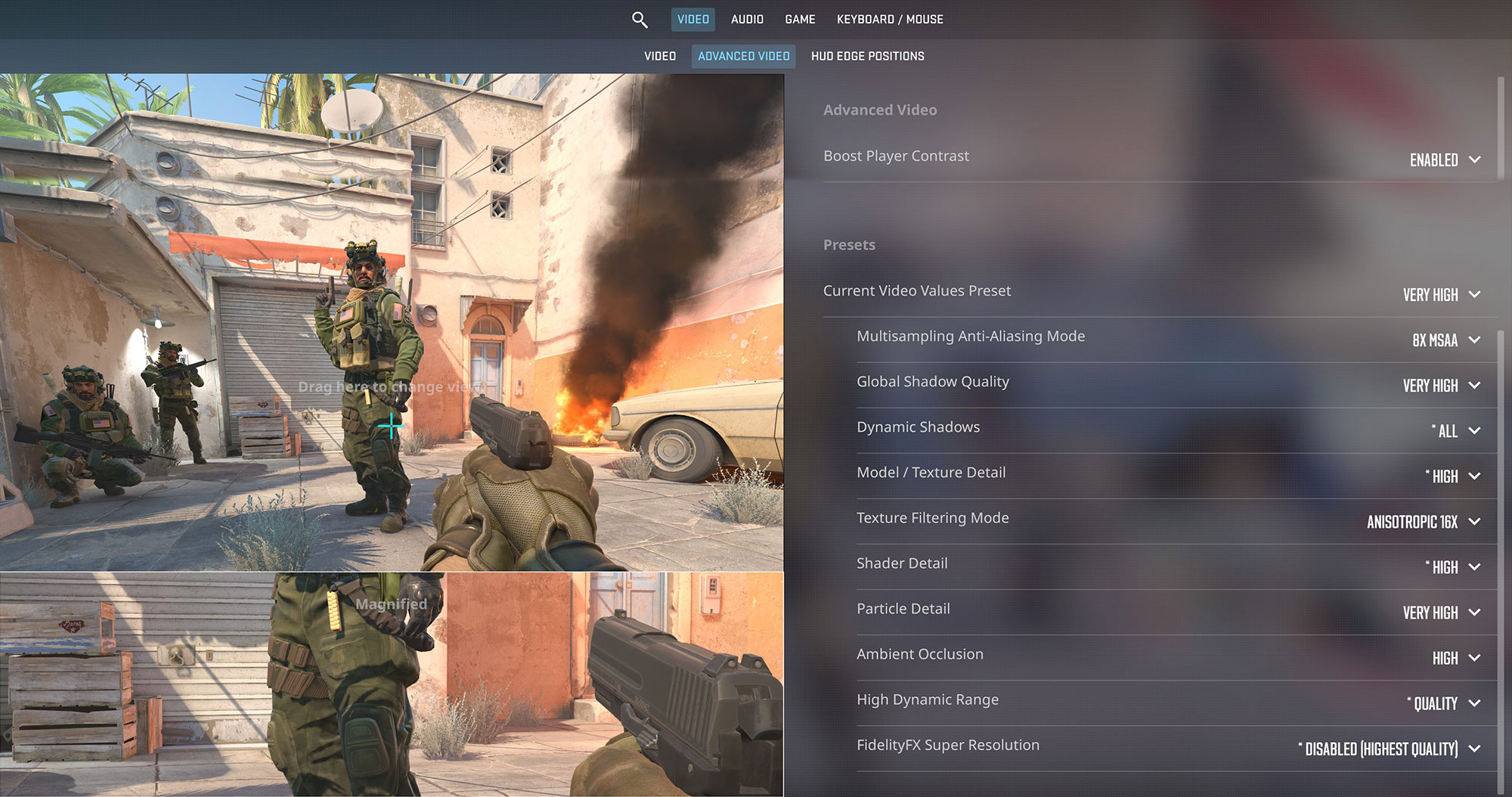
The combination of the Ryzen 9 9955HX3D and RTX 5070 Ti makes the ROG Strix G16 an esports powerhouse. In Counter-Strike 2, it achieves a massive 217 FPS at its native 1600p resolution on Very High settings, ensuring a buttery-smooth experience on the 240Hz display.
| Counter Strike 2 | 1600p, Very High (Check settings) |
| Average FPS | 217 FPS |

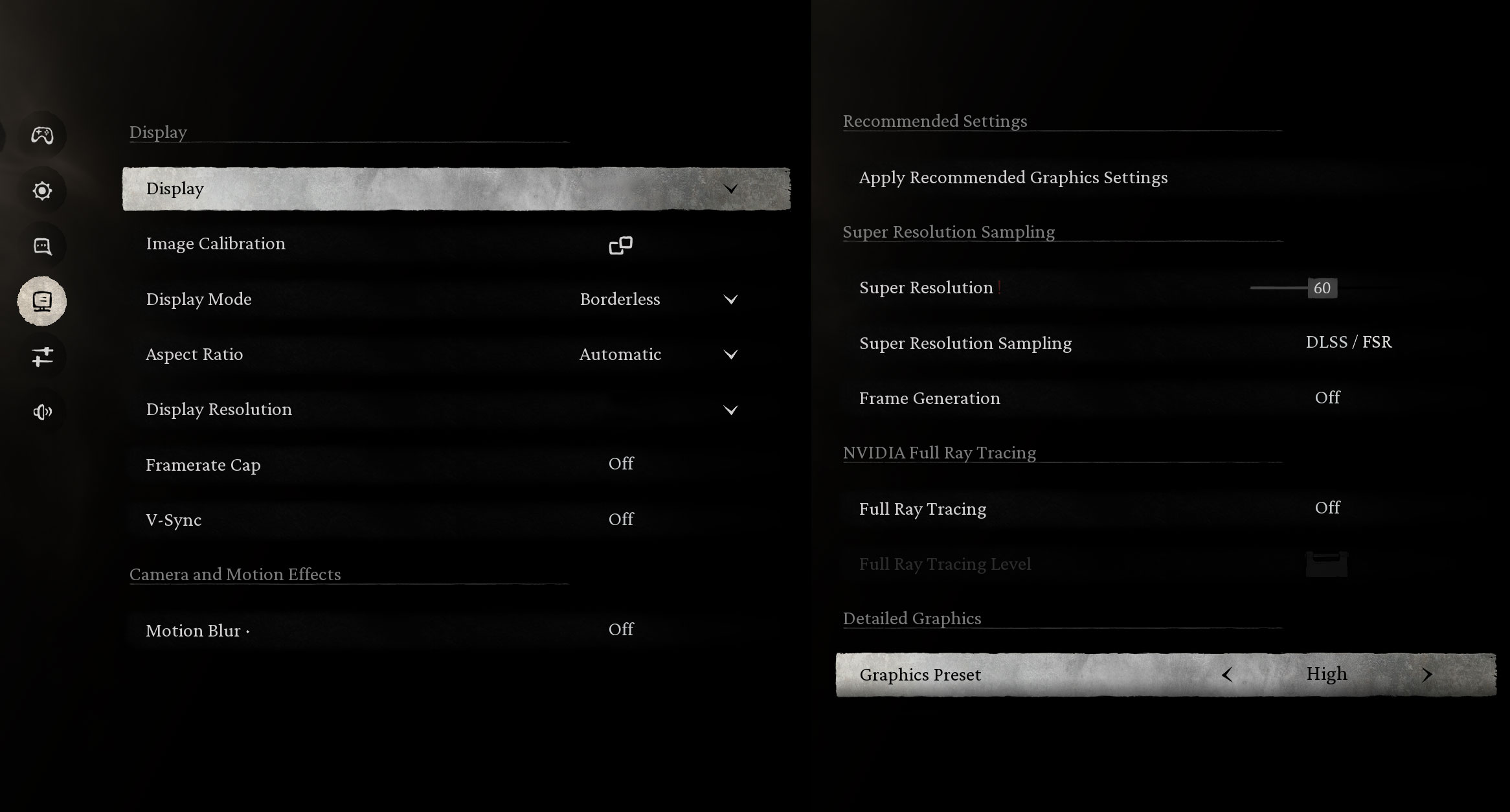
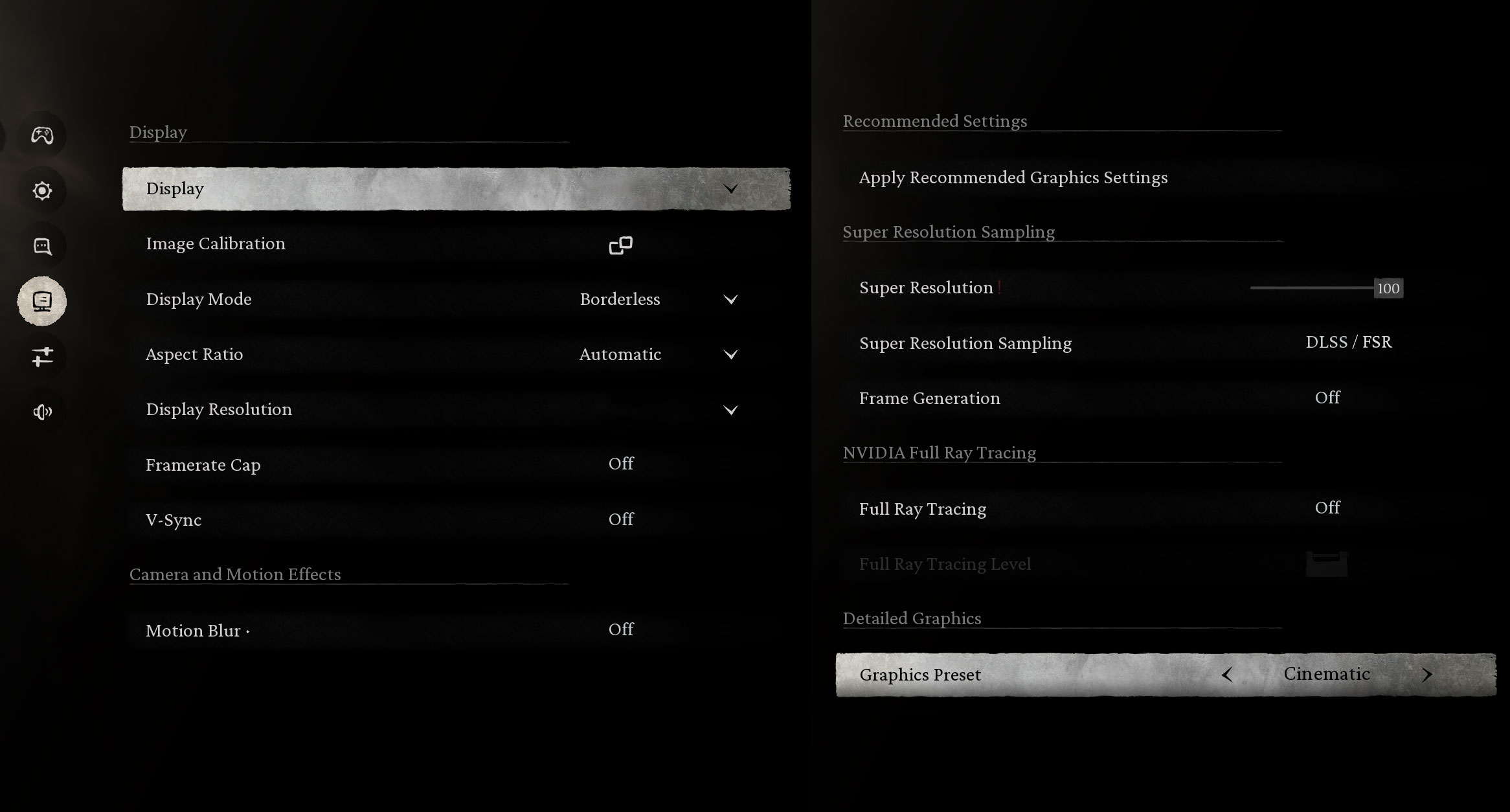
In the visually stunning Black Myth: Wukong, the laptop delivers a fantastic 101 FPS at 1600p on High settings. The ultra-demanding Cinematic preset still nets a playable 37 FPS.
| Black Myth: Wukong | 1600p, High (Check settings) | 1600p, Cinematic (Check settings) |
| Average FPS | 101 FPS | 37 FPS |

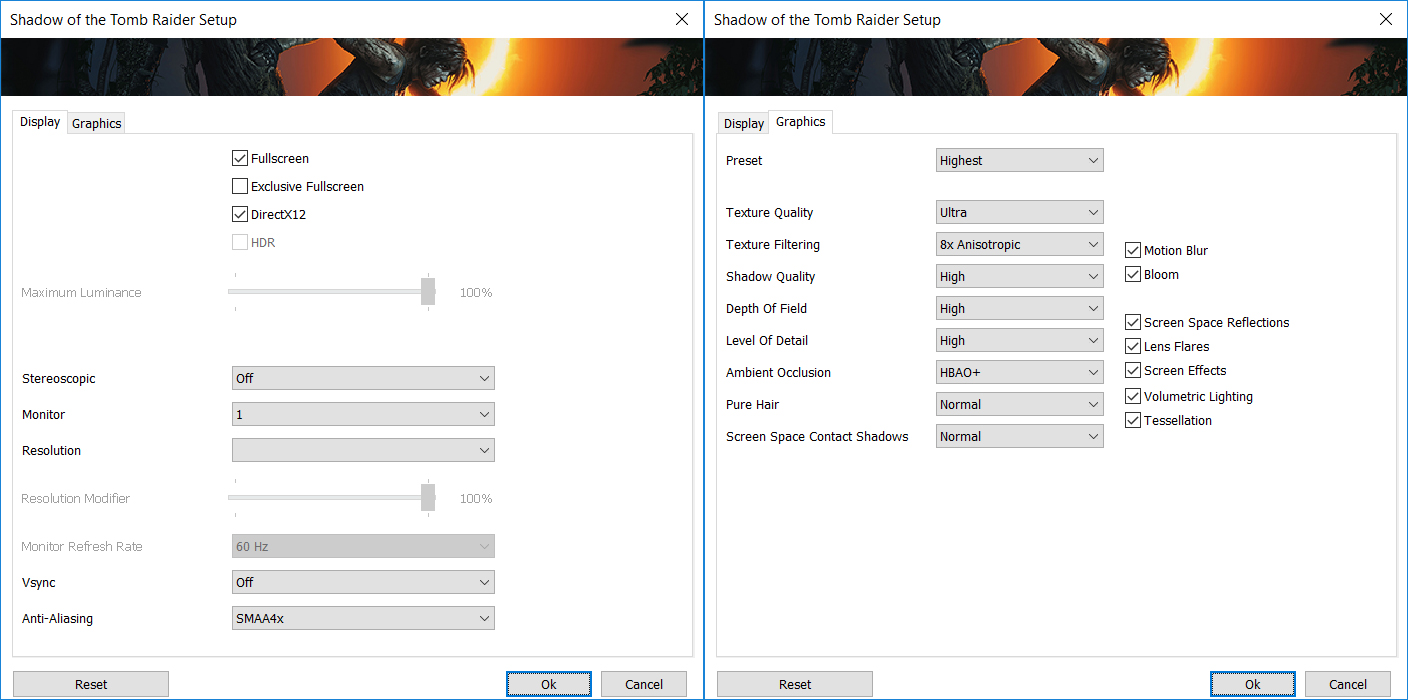
The Strix G16 tears through Shadow of the Tomb Raider, achieving an extremely high 162 FPS at 1200p. At the native 1600p resolution, it maintains an excellent 102 FPS, both on the Highest preset, making for a beautiful and incredibly fluid single-player journey.
| Shadow of the Tomb Raider | 1200p, Highest (Check settings) | 1600p, Highest (Check settings) |
| Average FPS | 162 FPS | 102 FPS |

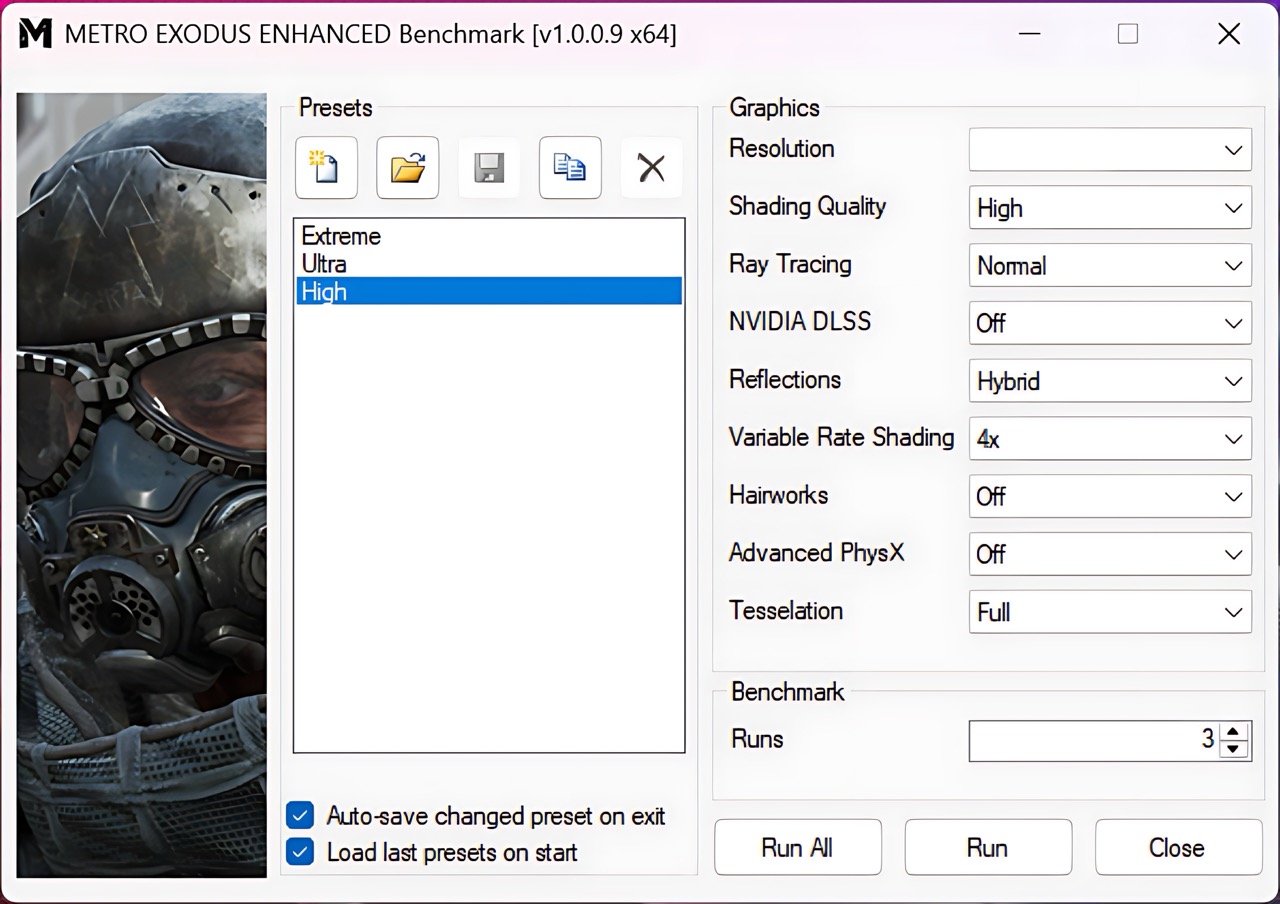
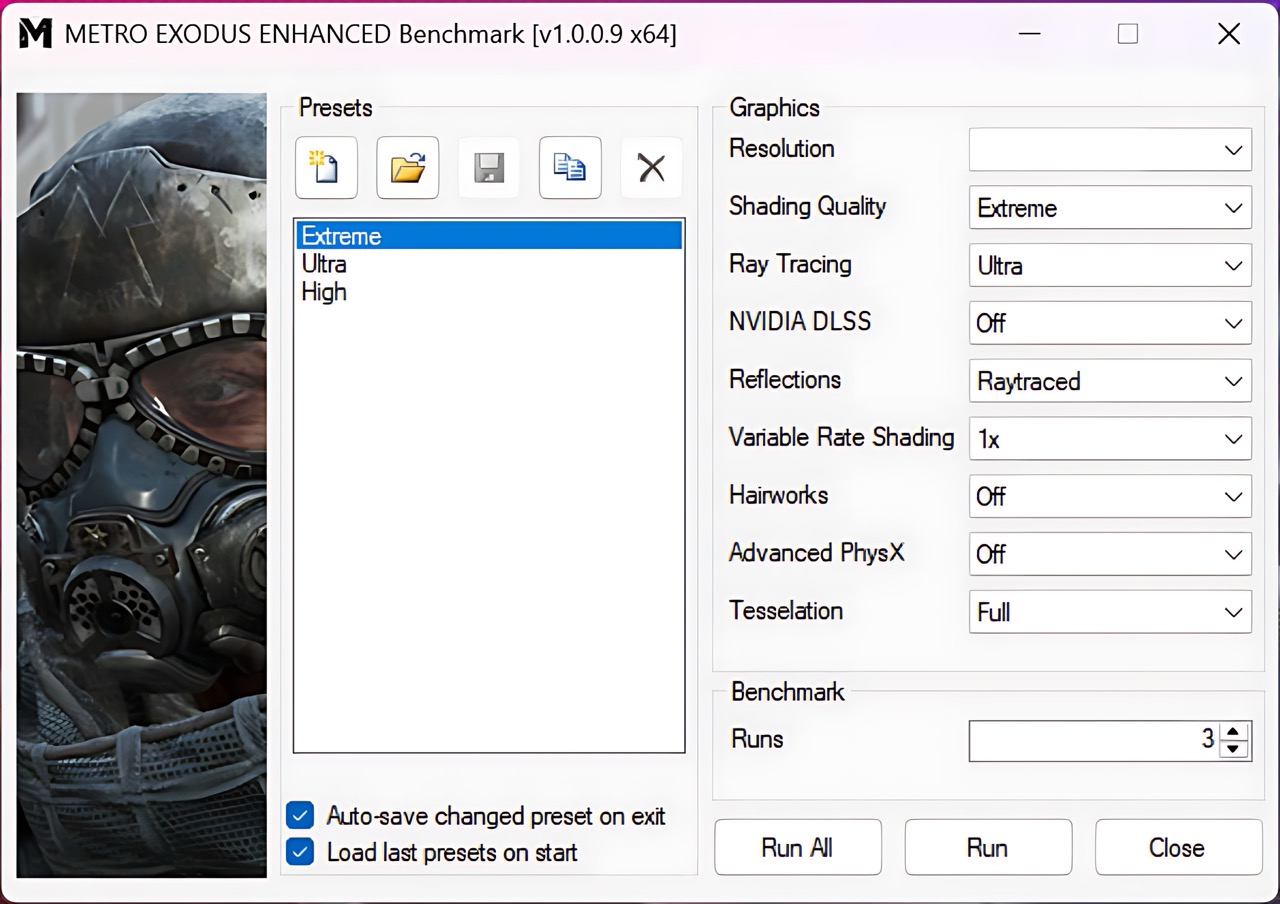
This laptop shows great performance in the ray-tracing-heavy Metro Exodus Enhanced Edition. It scores a playable 51 FPS at native 1600p on the demanding Extreme preset. At 1200p, it delivers a smooth 68 FPS on Extreme and a blazing 115 FPS on High settings.
| Metro Exodus Enhanced Edition | 1200p, High (Check settings) | 1200p, Extreme (Check settings) | 1600p, Extreme (Check settings) |
| Average FPS | 115 FPS | 68 FPS | 51 FPS |
[eBook Guide + Tools] How to MAX OUT Your Laptop
You can make your laptop Faster. LaptopMedia has tested thousands of models in the last 15 years, and we have yet to see a notebook that couldn't be made more powerful through modifications.
That's why we decided to bundle everything we know about how to achieve this in an Easy-to-Follow, Step-by-Step, and Laboratory-Tested, all in one project.
Read more about it here:
[eBook Guide + Tools] How to MAX OUT Your Laptop

🛠️ GPU Modifications: vBIOS, Overclocking, Undervolting
⚙️ Building Fast/Reliable RAID configuration
💻 Hardware upgrade tips for best results
🖼 Display enhancing
💾 OS Optimization for best performance
Temperatures and Comfort, Stability
At idle, the CPU package of the ASUS ROG Strix G16 (G614, 2025) maintains a temperature of 50ºC.
Office Work, Web Development, Design
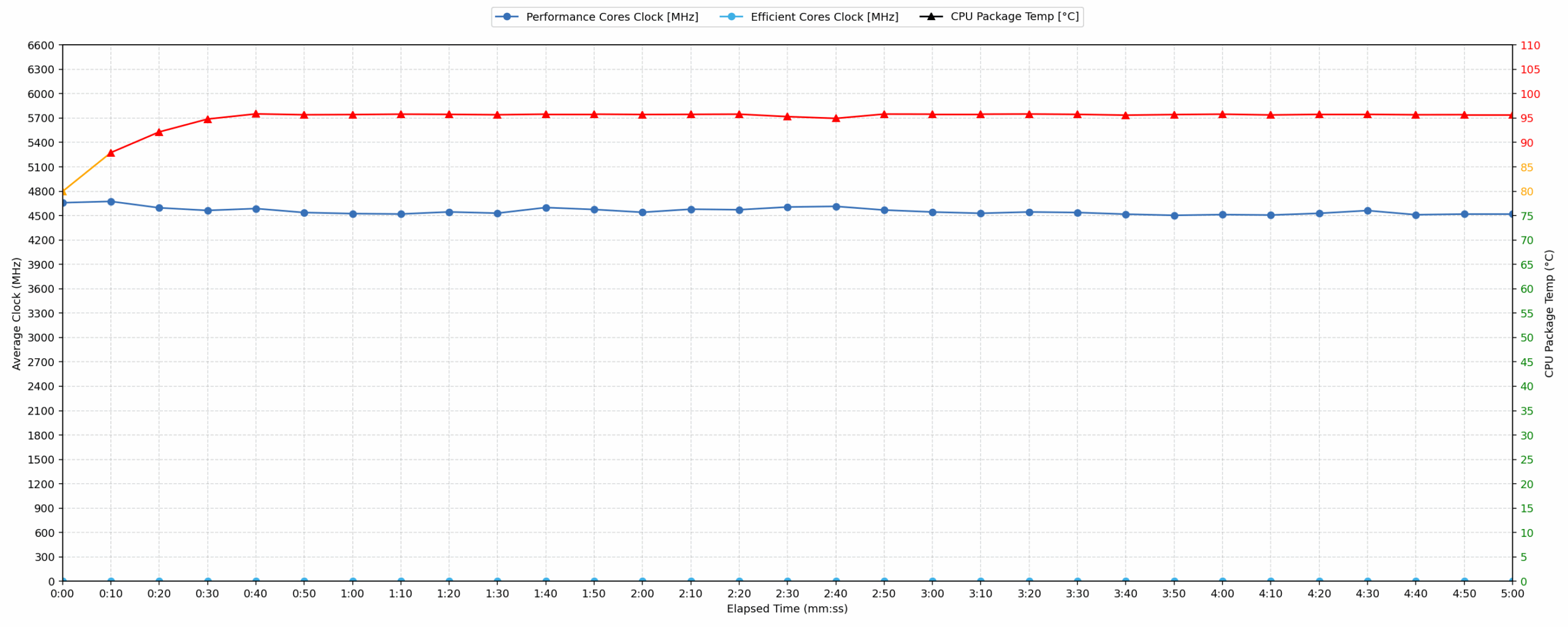
Short periods (0:00 – 0:10 s) of 100 % CPU load
This test shows the CPU behavior during short periods of serious load. It’s important for users who are looking for laptops suitable for tasks like Web Design and Programming.
| AMD Ryzen 9 9955HX3D | Avg. P-Core Clock | Avg. CPU Temp. | Avg. CPU Power |
| ASUS ROG Strix G16 G614 (2025) | 4658 MHz | 79 °C | 136 W |
| MSI Raider A18 HX (A9Wx) | 4653 MHz | 65 °C | 129 W |
The ASUS ROG Strix G16 G614 demonstrates strong CPU performance during short bursts of load, achieving an average clock speed of 4658 MHz over the initial 10 seconds, with a peak of 4775 MHz. The average CPU temperature of 79 °C is well within the good range, ensuring stable operation for quick tasks. However, a peak temperature of 96 °C was observed, falling into the high category, indicating brief thermal spikes. Drawing 136 W on average, this model slightly outperforms the MSI Raider A18 HX, which recorded 4653 MHz. The MSI maintained a significantly lower average temperature of 65 °C and drew less power at 129 W, suggesting the Strix G16 pushes higher performance at increased thermal levels in short bursts. Of course, we should note the size difference of the chassis – the Raider A18 is an 18-inch behemoth.
Video editing, Scientific computing, Software compilation, 3D rendering
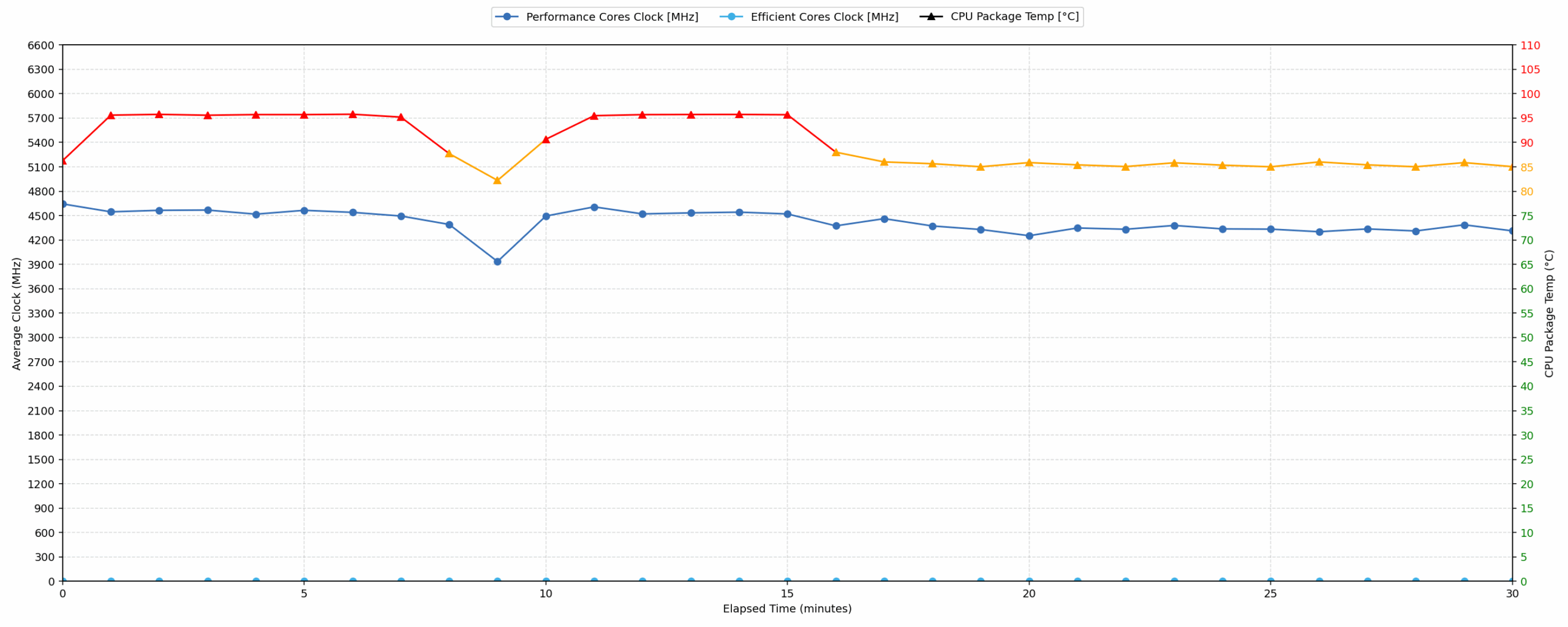
Long periods (0:00 – 30:00 min) of 100 % CPU load
This test shows the CPU behavior during long periods of serious load. It’s important for users who are looking for laptops suitable for tasks like Video Editing and 3D Rendering.
| AMD Ryzen 9 9955HX3D | Avg. P-Core Clock | Avg. CPU Temp. | Avg. CPU Power |
| ASUS ROG Strix G16 G614 (2025) | 4422 MHz | 89 °C | 119 W |
| MSI Raider A18 HX (A9Wx) | 4396 MHz | 79 °C | 115 W |
Under sustained 30-minute CPU load, the ASUS ROG Strix G16 G614 maintains a robust average clock speed of 4422 MHz. This strong performance is critical for demanding tasks like video editing and 3D rendering. The average CPU temperature settled at 89 °C, which falls within the acceptable range for prolonged usage, with an average power draw of 119 W. Notably, this model delivers a marginally higher average clock speed (26 MHz) compared to the MSI Raider A18 HX, which sustained 4396 MHz. However, the MSI operated at a significantly cooler 79 °C and drew slightly less power at 115 W, indicating the Strix G16 pushes for maximum sustained clock speed, resulting in higher but acceptable thermal output.
Gaming Stability
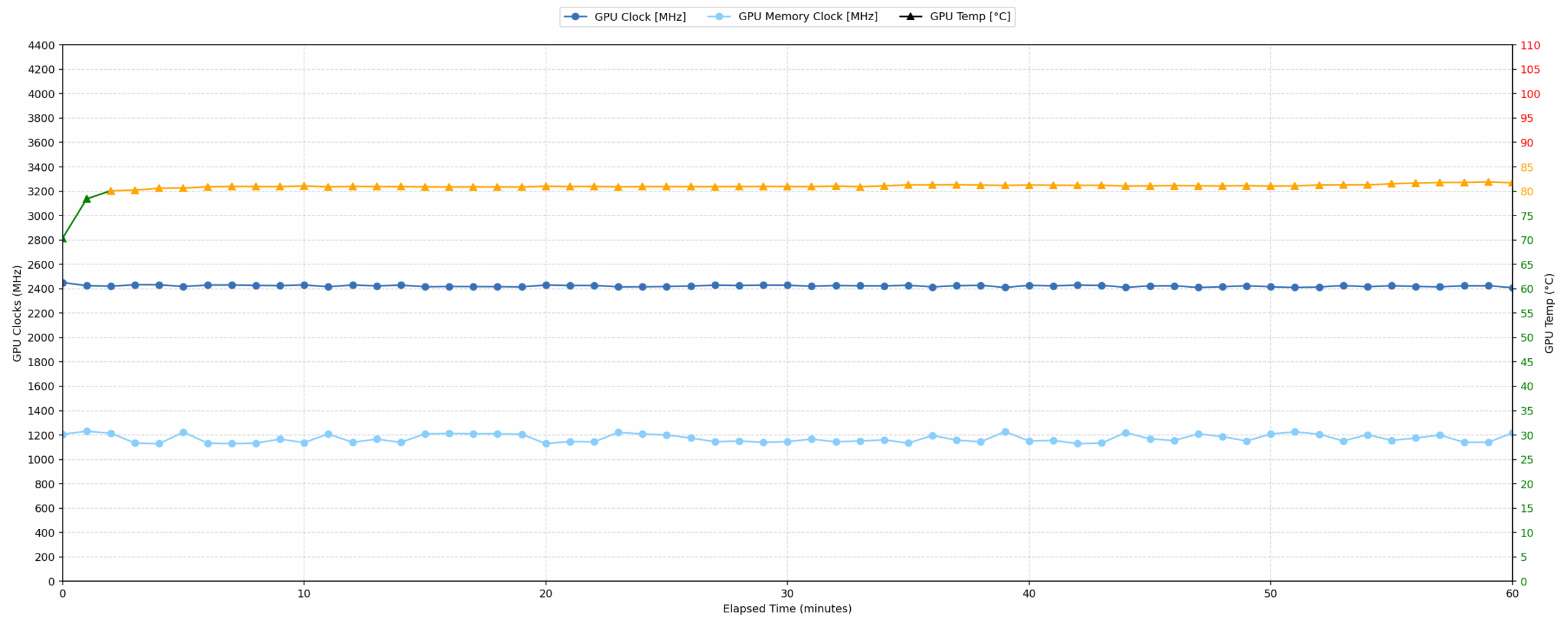
Continuous gaming (1-hour test)
This test evaluates the laptop’s performance under sustained GPU load and high CPU usage.
| NVIDIA GeForce RTX 5070 Ti | Avg. GPU Clock | Avg. GPU Temp. | Avg. Memory Clock | Avg. GPU Mem Temp. | Avg. GPU Power |
| HP OMEN MAX 16 (AMD, 16-ab0000, ak0000) | 2441 MHz | 75 °C | 1128 MHz | 76 °C | 138 W |
| ASUS ROG Strix G16 G614 (2025) | 2422 MHz | 80 °C | 1172 MHz | 77 °C | 138 W |
| ASUS ROG Strix G18 G815 (2025) | 2416 MHz | 71 °C | 1762 MHz | 72 °C | 138 W |
| ASUS ROG Strix G16 G615 | 2376 MHz | 79 °C | 1685 MHz | 77 °C | 138 W |
| MSI Vector 16 HX AI A2XW | 2362 MHz | 74 °C | 1750 MHz | 77 °C | 139 W |
| Acer Predator Helios Neo 16 AI (PHN16-73) | 2331 MHz | 82 °C | 1569 MHz | 81 °C | — |
| Acer Predator Helios Neo 16S AI (PHN16S-71) | 1935 MHz | 79 °C | 1125 MHz | 83 °C | 89 W |
The ASUS ROG Strix G16 G614 exhibits strong gaming stability over a 60-minute test. It maintains an impressive average GPU clock speed of 2422 MHz, with a peak of 2527 MHz and a minimum of 2302 MHz, ensuring consistent frame rates. Average GPU core temperature settled at 80 °C, and memory temperature at 77 °C, both well within the good range, even at their respective peaks of 82 °C and 80 °C. Power consumption averaged 138 W. In comparison to other RTX 5070 Ti laptops, the Strix G16 G614 performs exceptionally, securing the second-highest average GPU clock speed among the listed models, just behind the HP OMEN MAX 16. This indicates excellent thermal management supporting high sustained performance.
Battery Life
The battery of the ASUS ROG Strix G16 G614 (2025) is a 4-cell Li-polymer, model C41N2109. Its nominal voltage is 15.52 V and stores 90 Wh of electrical energy. It allows watching video offline for 5 h 58 min. This is a great result – The G16 lasts much longer than all of its competitors except for its Intel variant – G615.
Brightness: 180 nits; Display Mode: SDR
Time to Full Discharge: Higher is Better
Disassembly, Upgrade options, and Maintenance
The bottom panel of the ASUS ROG Strix G16 G614 (2025) comes off after undoing eleven Phillips screws, one of which is captive near the hinge, and then releasing a ring of plastic clips with a plastic pick. The interior is laid out cleanly with clear access to the main serviceable parts.
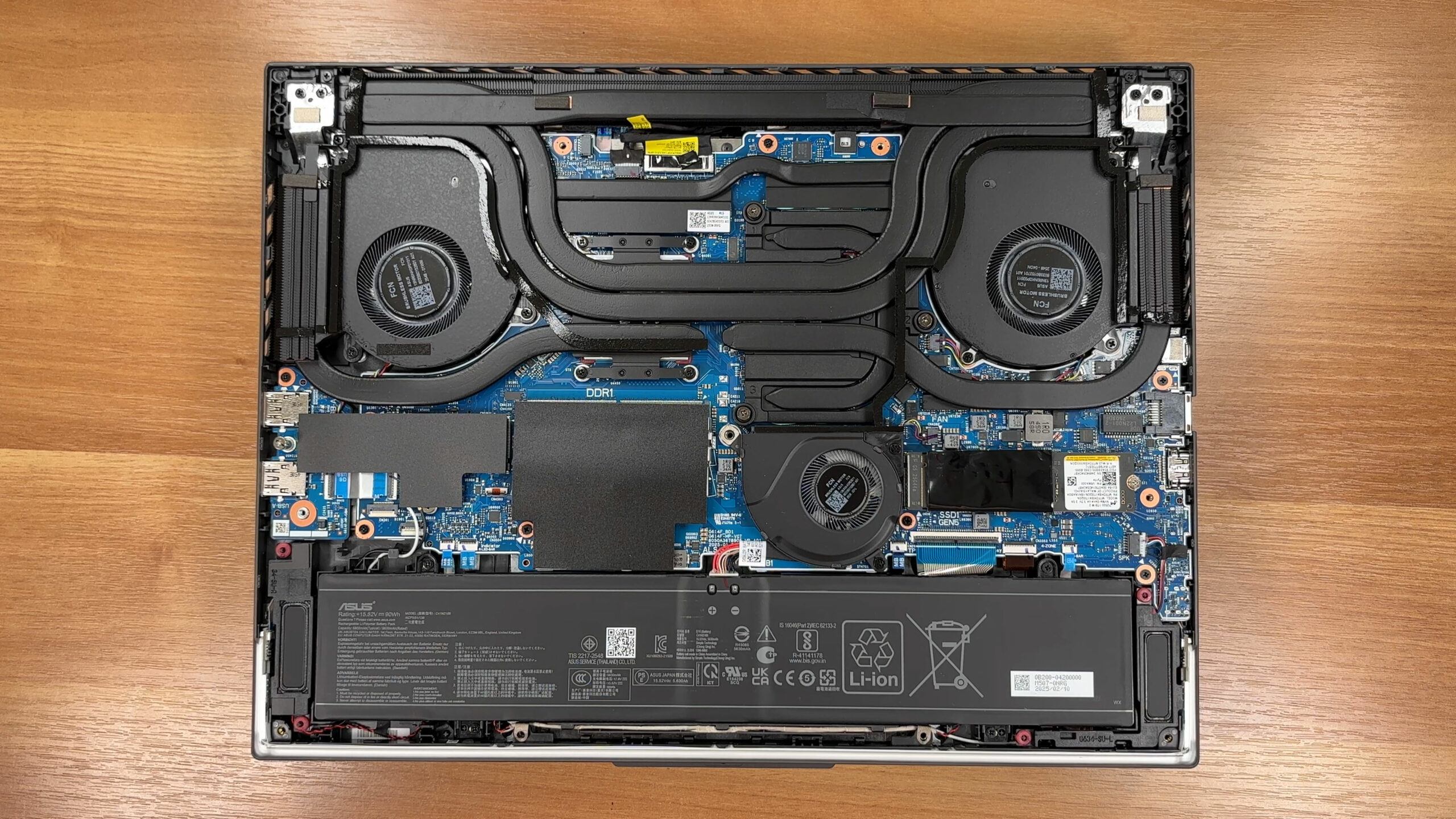
Cooling is handled by a tri-fan system that works with an active vapor chamber and seven heat pipes, while liquid-metal thermal compound is applied to both the CPU and the GPU. The layout pushes air toward large fin stacks at the sides and rear, and each fan can be removed once its screws and connector are released.
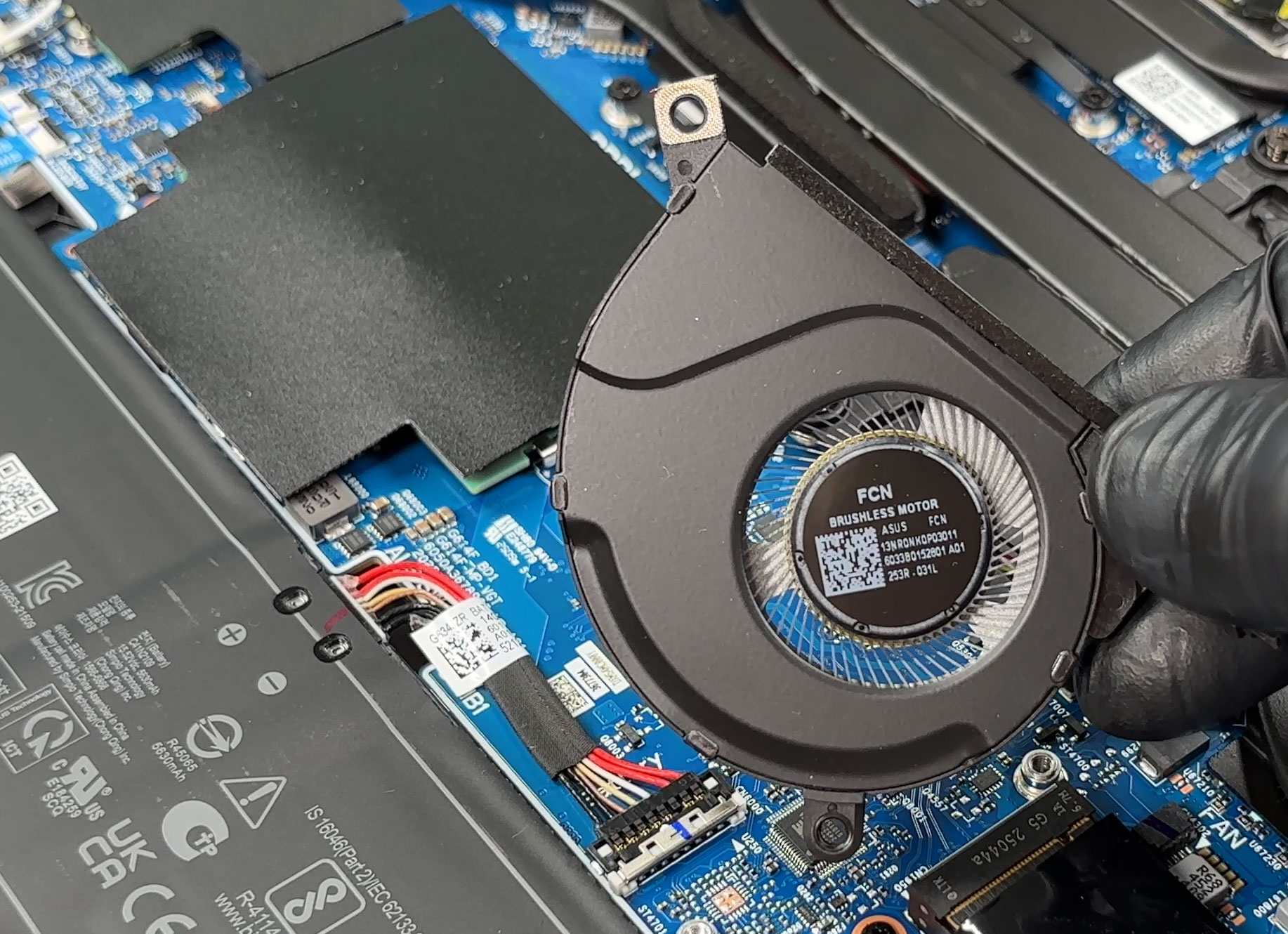
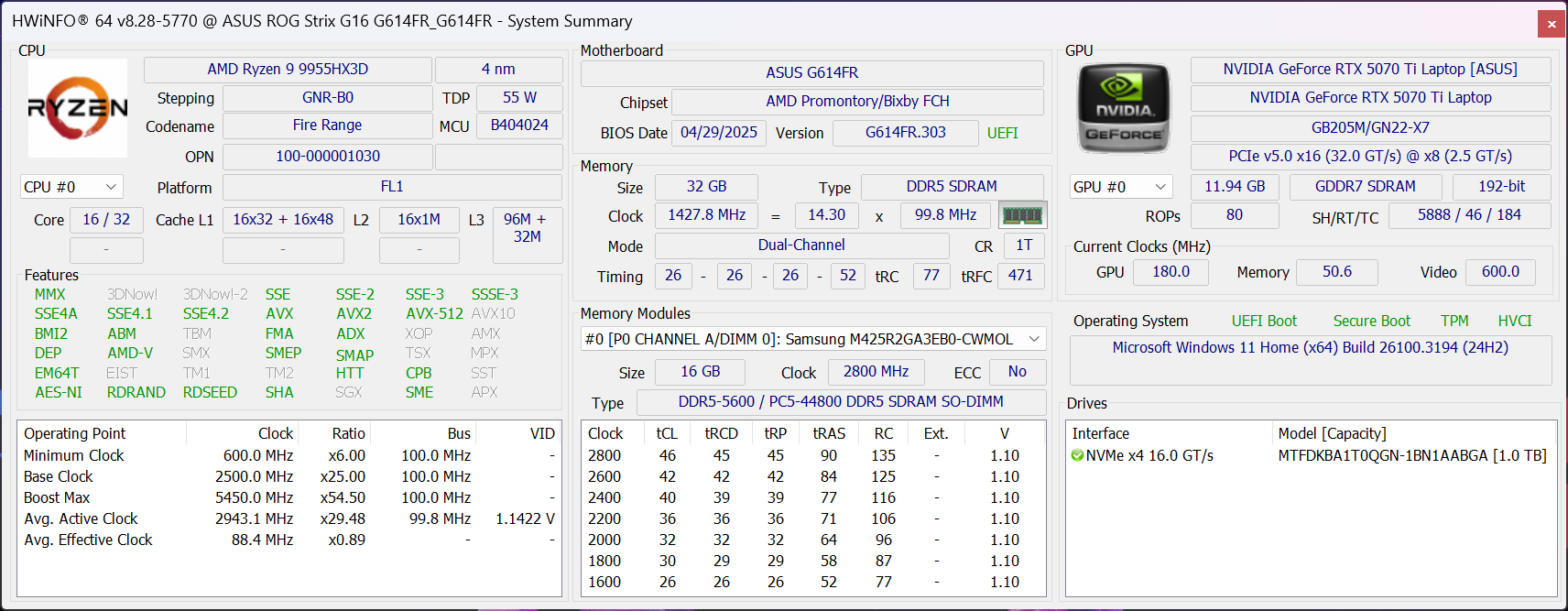
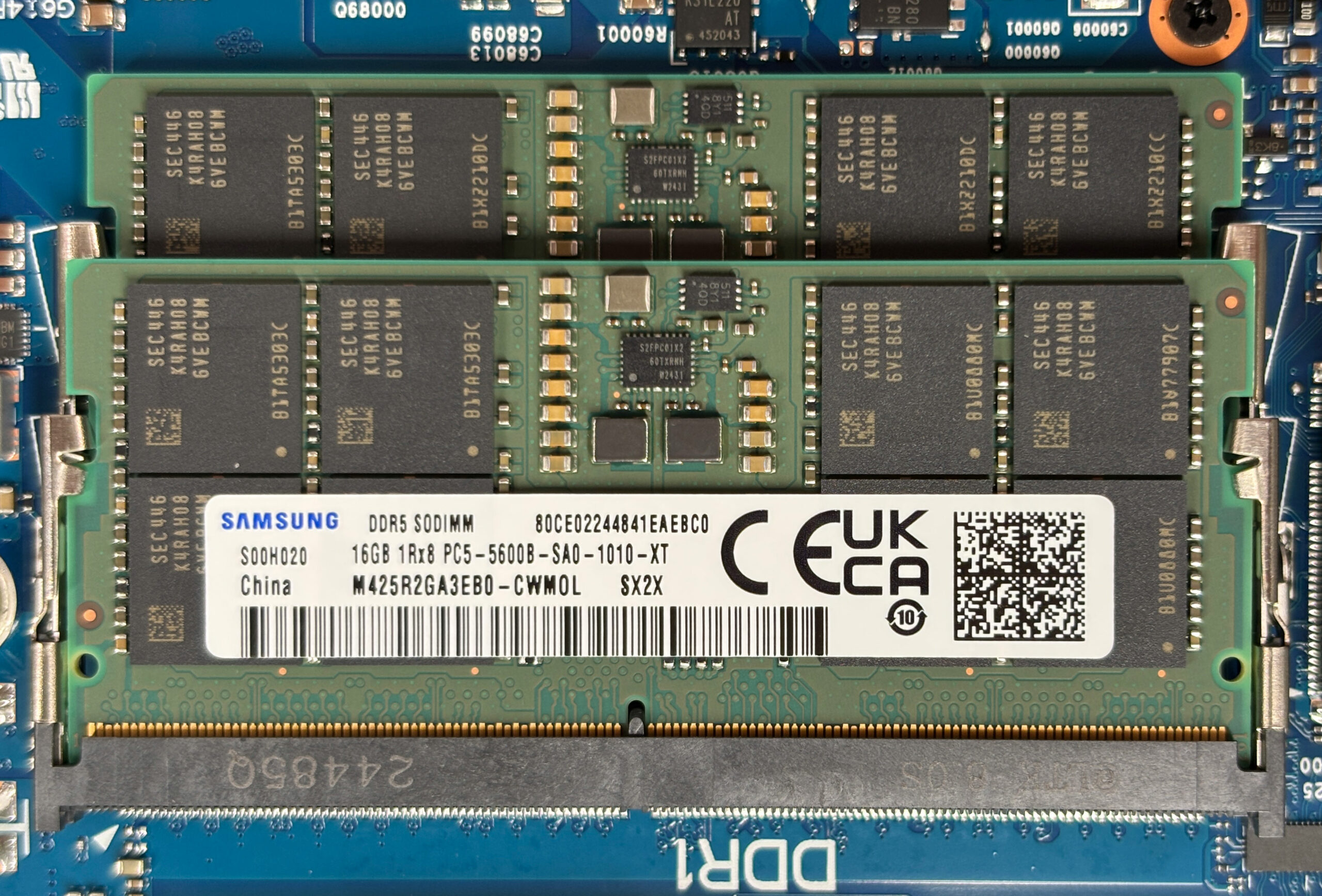
System memory is fully upgradeable via two DDR5-5600 SO-DIMM slots. ASUS officially supports up to 64 GB in dual-channel mode. Our reviewed configuration ships with 32 GB using two 16 GB Samsung modules, and you can swap them for higher capacity if needed.
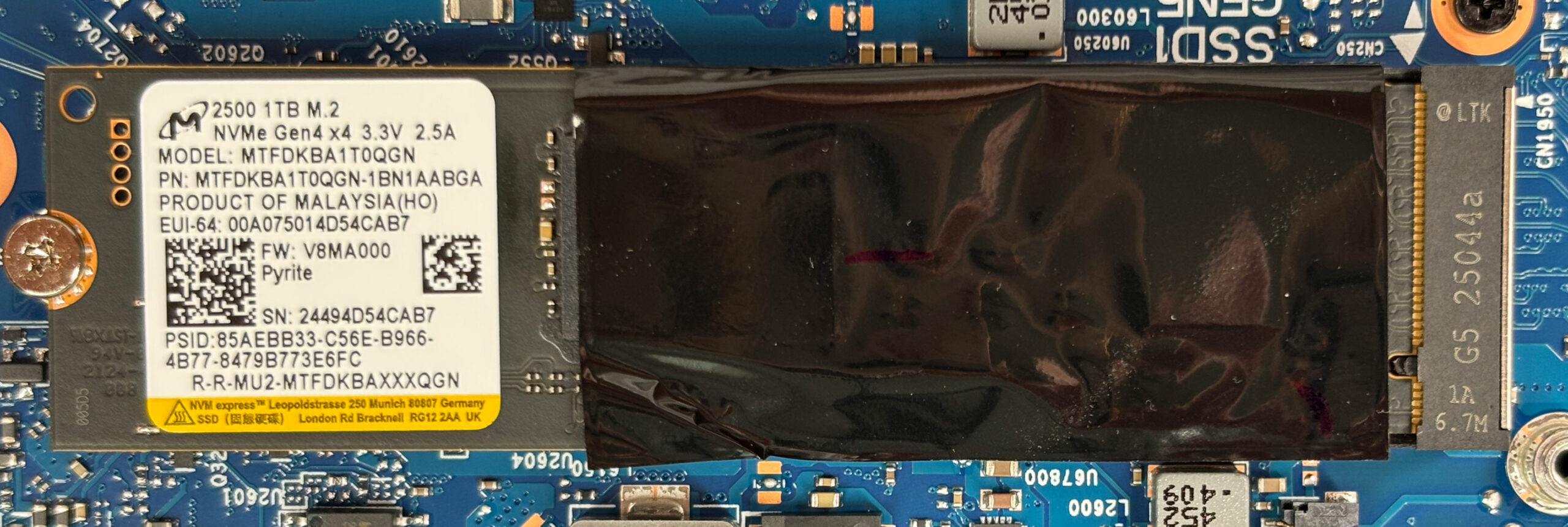
Storage is generous: there are two M.2 2280 PCIe Gen4x4 NVMe slots with RAID 0/1 capability and an official total of up to 4 TB (2 TB per slot). The laptop we tested comes with a Micron 2500 1 TB drive in the primary slot. The second bay is free for expansion; use standard-height drives and avoid very thick heatsinks because the wireless card sits just beneath the secondary slot.
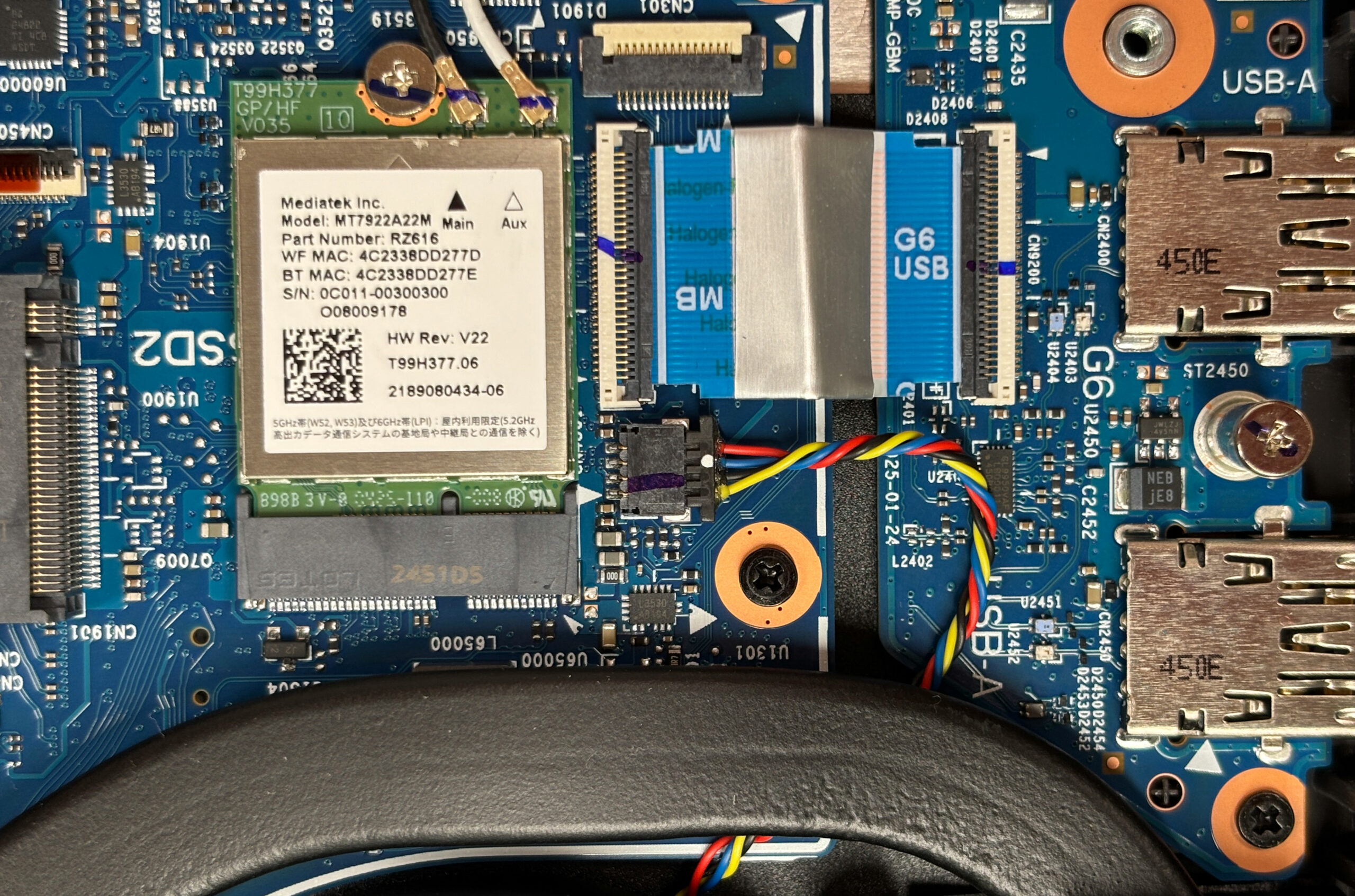
The wireless module is replaceable. Our unit features a MediaTek RZ616 (MT7922) card that provides Wi-Fi 6E (2×2) and Bluetooth 5.3, mounted in an M.2 2230 slot with easy access.
The battery is a 90 Wh 4-cell Li-ion pack (model C41N2109). It is secured by several screws and connects via a single cable, so replacement is straightforward. Fast-charge is supported, with a claimed up to 50% in around 40 minutes.
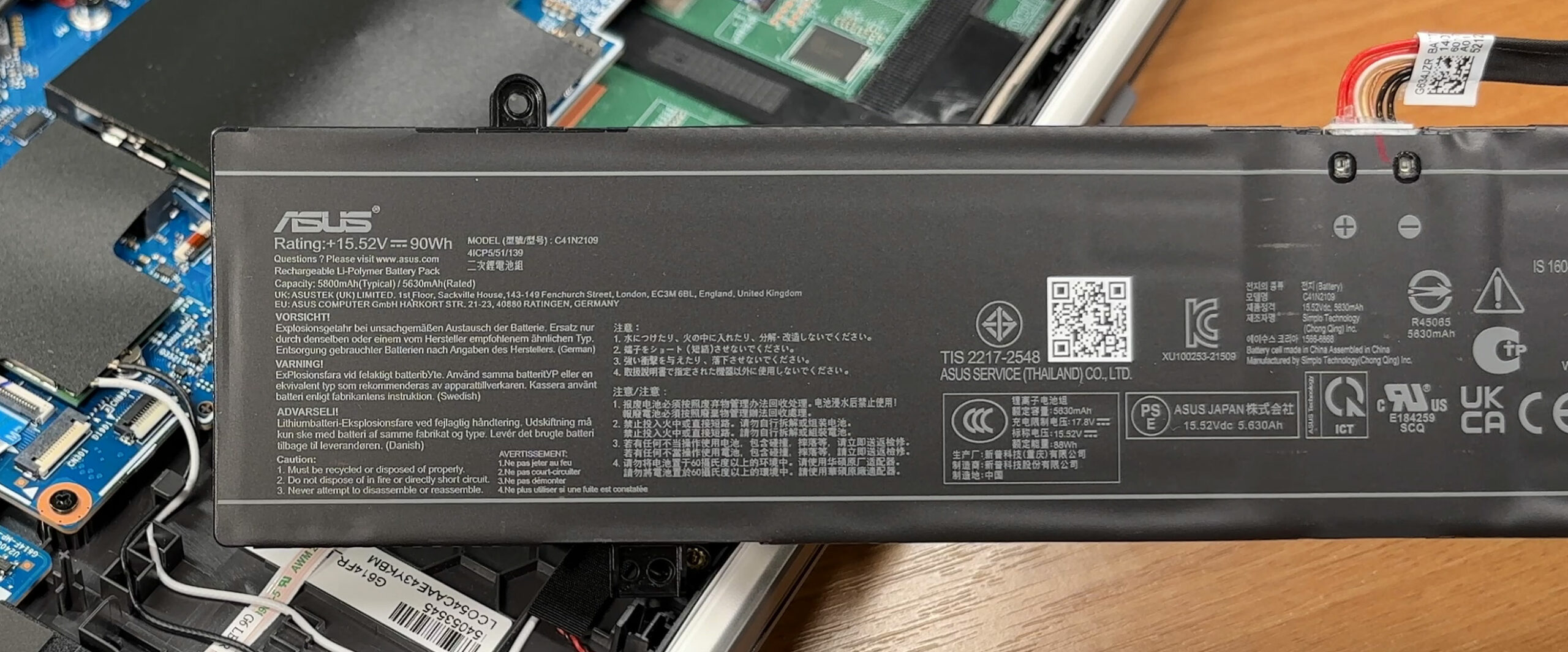
Other replaceable parts inside include the three fans, the speakers, and the clickpad’s small daughterboard and ribbon connectors, all of which can be reached once the bottom cover is off. Overall, the Strix G16 offers very good serviceability with standard screws, two SO-DIMM slots, two Gen4 NVMe bays, a replaceable Wi-Fi card, and a screwed-in 90 Wh battery, making upgrades and maintenance easy for enthusiasts.
Verdict
 The ASUS ROG Strix G16 (G614, 2025) is, in a word, a champion. It takes the already successful Strix formula and refines it to near perfection, creating what is arguably one of the most well-rounded and powerful 16-inch gaming laptops on the market. By pairing AMD’s flagship mobile processor with a top-tier NVIDIA GPU and an exceptional cooling system, ASUS has engineered a machine that consistently sits at the top of the performance charts.
This is a laptop that gets almost everything right, from its display to its battery life, making it incredibly difficult to find significant faults. It’s a true enthusiast-grade machine that delivers on every promise.
✅ The Good
The performance of the Strix G16 is simply phenomenal. It is, without a doubt, the fastest RTX 5070 Ti laptop we have ever tested, a feat made possible by its superb thermal management system that allows both the powerful Ryzen 9 CPU and the GPU to maintain high clock speeds under load.
This class-leading power is paired with a truly excellent 240Hz QHD+ “Nebula” display. With 99% DCI-P3 coverage, great color accuracy out of the box, and fast response times, it’s a dream for competitive gaming and creative work. Most importantly, the screen is completely PWM-free and features an exceptional anti-glare finish, making it incredibly comfortable for the eyes.
Rounding out the highlights is the surprisingly great battery life, offering nearly 6 hours of use, which is a standout result for this category. The fantastic upgradeability, modern port selection with dual USB4, and rock-solid build quality make this an incredibly complete package.
❌ The Bad
It is genuinely difficult to find major flaws with this machine, a testament to its excellent design. However, the aggressive pursuit of ultra-thin bezels has led to the omission of a physical privacy shutter for the webcam, a feature we always like to see for guaranteed peace of mind.
The other notable omission is the complete lack of any biometric login options. With no fingerprint reader or IR camera available, users are left with traditional passwords, which feels like a missed convenience on an otherwise premium, feature-packed laptop. While the cooling is great, the CPU does still run hot under sustained load, a common trade-off for this level of performance.
🆚 The Competitors
The ROG Strix G16 (G614) stands at the very top of its class. When compared to its own Intel-based sibling, the ASUS ROG Strix G16 G615 (detailed review), this AMD model consistently delivers superior overall performance. It also outperforms other 16-inch rivals like the MSI Vector 16 HX AI (detailed review) and the Acer Predator Helios Neo 16 AI (detailed review) in raw gaming power.
Perhaps its most compelling advantage is its battery life, which is significantly better than most of its direct competitors. While a larger machine like the ASUS ROG Strix G18 G815 (detailed review) can offer even better cooling, the G16 provides a near-perfect balance of top-tier performance, a great display, and surprising endurance in a more compact form factor.
You can check the prices and configurations in our Specs System: https://laptopmedia.com/series/asus-rog-strix-g16-g614-2025/
Pros
- Class-leading CPU and GPU performance, the fastest in its category
- Excellent thermal management allows for high, stable clock speeds
- Superb QHD+ 240Hz display with great colors and low glare
- Completely PWM-free screen is fantastic for eye comfort
- Great battery life for a high-performance gaming laptop
- Fantastic upgradeability with two RAM and two M.2 slots
Cons
- No physical privacy shutter for the webcam
- No biometric login options (fingerprint or IR camera)
- CPU still runs hot under sustained heavy load
 Author: Simeon NikolovEditor-in-Chief at LaptopMedia.com with 20+ years of experience in testing and analyzing laptops and mobile devices.
 Author: eng. Kroum NikolovHead of Engineering at LaptopMedia.com, inventor and innovator with 40+ years of experience in electronics and high technology.
TOP 100 GAMING LAPTOPS


TOP LAPTOP RATINGS
HIGHLIGHTS view more
![[August 2026] Amazon Global: Top 10 Best-Selling Laptops – Apple MacBook Neo Dominates the Charts as Budget and Mid-Range Windows Portables Fight for Volume](https://laptopmedia.com/wp-content/uploads/2026/09/Best-Selling-Laptops-GLOBAL-Top-10-400x225.jpg)
[August 2026] Amazon Global: Top 10 Best-Selling Laptops – Apple MacBook Neo Dominates the Charts as Budget and Mid-Range Windows Portables Fight for Volume
Sep 12, 2026![[August 2026] Best-Selling Laptop Brands on Amazon Global – Apple Dominates Revenue While HP Leads in Model Variety](https://laptopmedia.com/wp-content/uploads/2026/09/GLOBAL-Best-Brands-400x225.jpg)
[August 2026] Best-Selling Laptop Brands on Amazon Global – Apple Dominates Revenue While HP Leads in Model Variety
Sep 12, 2026![[August 2026] Amazon Global: Top 10 Best-Selling Gaming Laptops – HP Victus 15 Captures the Crown as Budget-Friendly Models Dominate the Charts](https://laptopmedia.com/wp-content/uploads/2026/09/Best-Selling-Gaming-Laptops-GLOBAL-Top-10-400x225.jpg)
[August 2026] Amazon Global: Top 10 Best-Selling Gaming Laptops – HP Victus 15 Captures the Crown as Budget-Friendly Models Dominate the Charts
Sep 12, 2026![[August 2026] Best-Selling Laptop Brands on Amazon Japan – Apple Dominates Market Share and Revenue Led by Strong Unit Sales](https://laptopmedia.com/wp-content/uploads/2026/09/CO.JP-Best-Brands-1-400x225.jpg)
[August 2026] Best-Selling Laptop Brands on Amazon Japan – Apple Dominates Market Share and Revenue Led by Strong Unit Sales
Sep 10, 2026![[August 2026] Best-Selling Laptop Brands on Amazon USA – Apple Dominates Market Revenue and Volume Despite Lower Model Diversity](https://laptopmedia.com/wp-content/uploads/2026/09/COM-Best-Brands-1-400x225.jpg)
[August 2026] Best-Selling Laptop Brands on Amazon USA – Apple Dominates Market Revenue and Volume Despite Lower Model Diversity
Sep 10, 2026
REVIEWS view more

Acer Nitro V 15 (ANV15-A31) review – A Practical Budget Gamer with One Major Catch
Aug 13, 2026Lenovo IdeaPad Slim 5a (16″, Gen 11) review – 2.8K OLED, Ryzen AI 7 450, and Rare Upgradeability
Aug 09, 2026HP OmniBook 5 16 (16-bc1000) review – Big Screen, Solid CPU, Limited Upgrades
Aug 06, 2026Lenovo ThinkPad X1 Carbon Gen 14 Aura Edition review – The Ultimate Business Laptop Gets Modular
Aug 03, 2026ASUS ExpertBook Ultra (B9406) review – Core Ultra X7 & Tandem OLED Tested
Jul 28, 2026
Asus Rog Strix G16 (G14PR) : 5070ti – 32GB – Ryzen 9 8940HX
A cooling pad reduces those temps to 81C and lower..
i absolutely adore my version of this chain, after 38 years of desktop use i have switched to a laptop and boy, am i glad.
<uses the HDMI out to fuel a Phillips OLED 65″
just my 2 cents, thanks for the review, this is the go-to compared to all others.