Wi-Fi 7 vs Wi-Fi 6E: Learn the Key Differences in 10 Seconds
As the tech world buzzes about the latest Wi-Fi standard, Wi-Fi 7, users are eager to know how Wi-Fi 7 stacks up against Wi-Fi 6E. And if you’re deciding between 6E and 6, check out our Wi-Fi 6E vs Wi-Fi 6: Learn the Key Differences in 10 Seconds article.
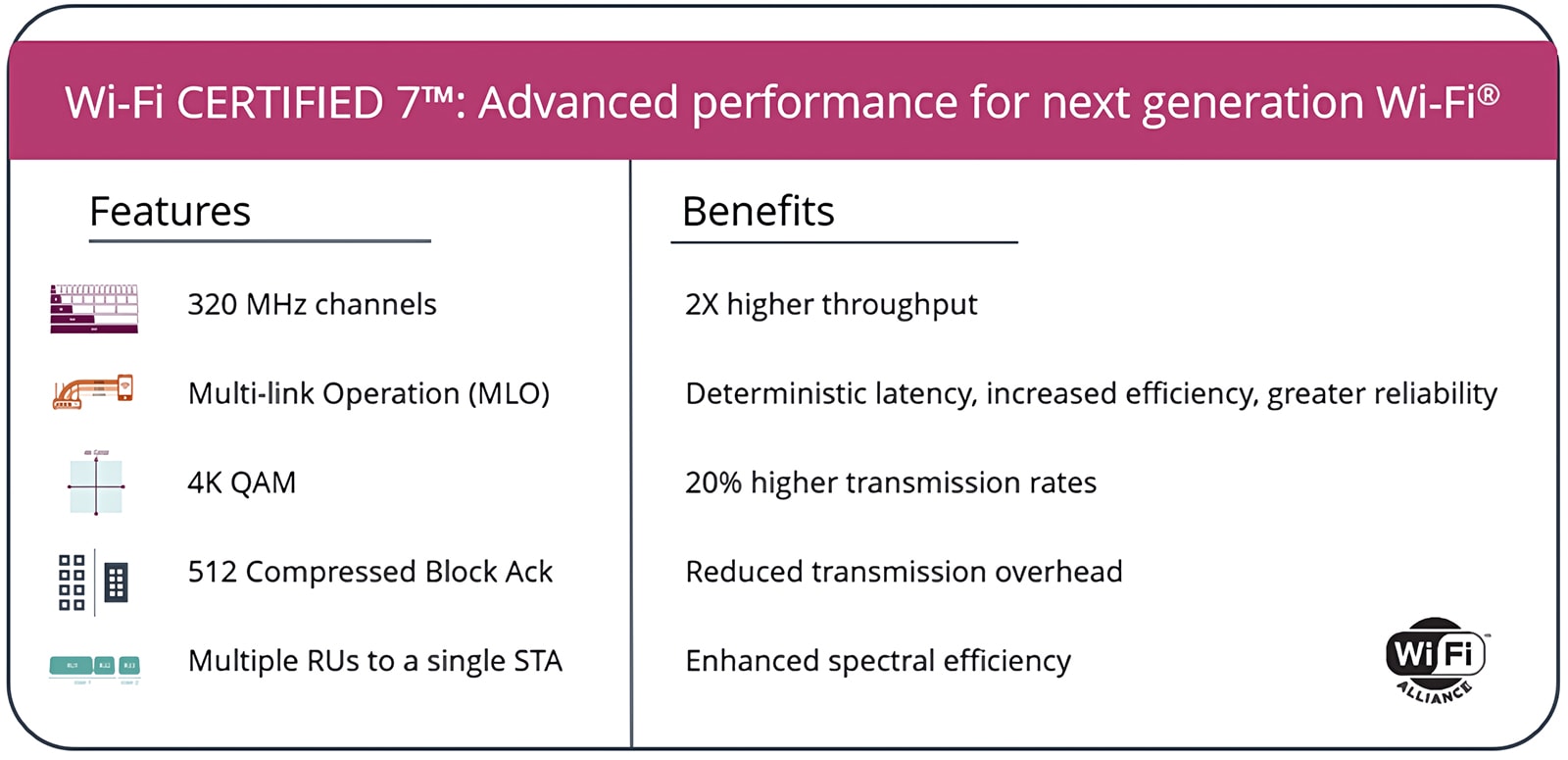
In essence, Wi-Fi 7 introduces even more impressive improvements: including increased speeds, lower latency, and greater efficiency across more bands. Think of it as upgrading from a superhighway to a hyperspace bypass.
Here’s a quick rundown of the differences:
| Wi-Fi 7 | Wi-Fi 6E | |
|---|---|---|
| Frequency Bands | 2.4 GHz, 5 GHz, and 6 GHz | 2.4 GHz, 5 GHz, and 6 GHz |
| Bandwidth | Up to 320 MHz, including new efficient spectrum usage techniques | Up to 160 MHz in 2.4 & 5 GHz, additional 1200 MHz in 6 GHz |
| Channels | More channels in all bands, enhancing capacity and reducing interference | 14 in 5 GHz + 59 in 6 GHz |
| Latency | **Even lower than Wi-Fi 6E**, designed for the most demanding real-time applications | Low |
| Interference | **Advanced techniques to further reduce interference** across all bands | Greatly reduced in the 6 GHz band |
| Use Cases | Next-gen gaming, immersive AR/VR, Ultra HD streaming, in densely populated smart cities | High-def streaming, online gaming, AR/VR, dense environments |
❓ Should You Upgrade?
Before leaping to Wi-Fi 7, evaluate your current setup and requirements:
🛜 For Wi-Fi 6E users
Step 1: Are you pushing the limits of your connection with high-bandwidth activities?
Yes → Wi-Fi 7 offers the next level of performance.
No → Go to Step 2
Step 2: Do you work in heavily populated, tech-savvy areas?
Yes → Wi-Fi 7’s advanced congestion management could be a game-changer.
No → Go to Step 3
Step 3: Do you have money to spare for the latest and greatest gadgets?
Yes → Consider Wi-Fi 7 for cool points.
No → Wi-Fi 6E remains an excellent choice.
🛜 For users of older Wi-Fi standards
Step 1: Is your current Wi-Fi performance lagging with your usage patterns?
Yes → Jumping to Wi-Fi 7 could be a transformative upgrade.
No → Consider the benefits of Wi-Fi 7.
Step 2: Are you planning to invest in smart home technologies or IoT devices?
Yes → Wi-Fi 7 will better support a multitude of devices.
No → Wi-Fi 6E might already meet your needs.
What’s Next?
Next is Wi-Fi 8 – IEEE 802.11bn. It’s going to be all about reliability but we’re not even close to adopting it, it’s coming in 2028.
 Author: Simeon NikolovEditor-in-Chief at LaptopMedia.com with 20+ years of experience in testing and analyzing laptops and mobile devices.

![[August 2026] Amazon Italy: Top 10 Best-Selling Laptops – Apple MacBook Neo Claims the Crown as Budget and Mid-Range Windows Machines Dominate Volume](https://laptopmedia.com/wp-content/uploads/2026/09/Best-Selling-Laptops-IT-Top-10-400x225.jpg)
![[August 2026] Amazon Italy: Top 7 Best-Selling Gaming Laptops – ASUS V16 Claims the #1 Spot Amid Strong Mid-Range Demand](https://laptopmedia.com/wp-content/uploads/2026/09/Best-Selling-Gaming-Laptops-IT-Top-10-400x225.jpg)
![[August 2026] Best-Selling Laptop Brands on Amazon Italy – Lenovo Dominates Market Share and Revenue Leadership](https://laptopmedia.com/wp-content/uploads/2026/09/IT-Best-Brands-400x225.jpg)
![[August 2026] Amazon India: Top 10 Best-Selling Laptops – Apple MacBook Neo Dominates the Charts with Massive Sales Lead](https://laptopmedia.com/wp-content/uploads/2026/09/Best-Selling-Laptops-IN-Top-10-400x225.jpg)
![[August 2026] Amazon India: Top 10 Best-Selling Gaming Laptops – HP Victus 15 Dominates the Market with Massive Unit Lead](https://laptopmedia.com/wp-content/uploads/2026/09/Best-Selling-Gaming-Laptops-IN-Top-10-400x225.jpg)