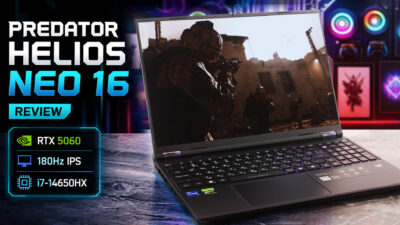
Acer Predator Helios Neo 16 (PHN16-I31) review – Stable RTX 5060 Gaming
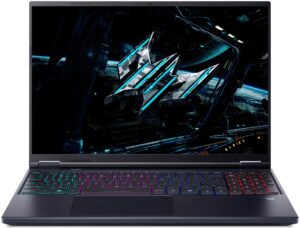
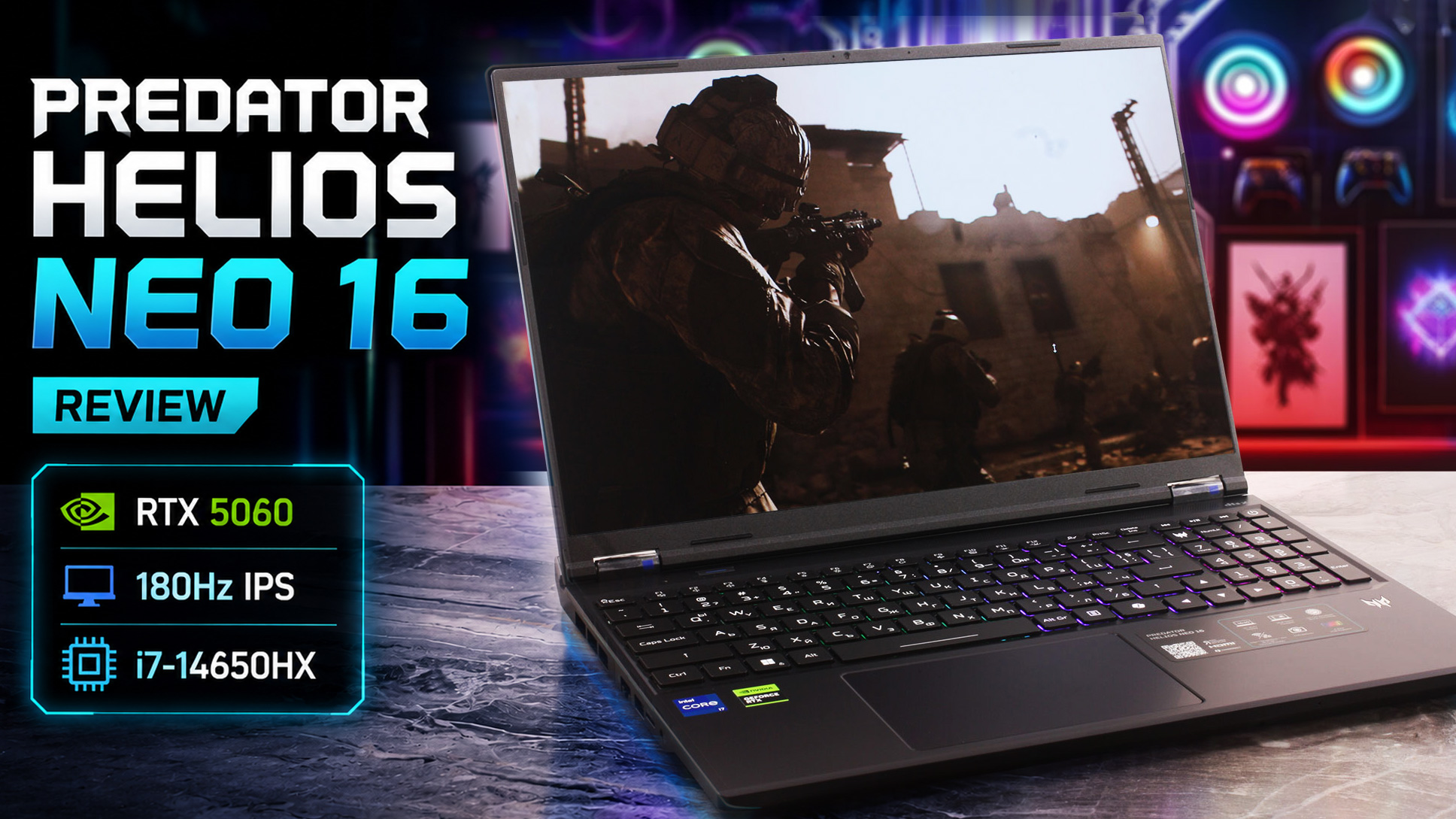 The Acer Predator Helios Neo 16 (PHN16-I31) is a substantial gaming laptop built for users who value sustained performance, strong connectivity, and extensive upgradeability more than portability or an ultra-slim design. Its 2.5 kg chassis, extended rear section, and massive 330W power adapter make it clear that this machine is intended to spend most of its time on a desk.
Our configuration combines the Intel Core i7-14650HX with an NVIDIA GeForce RTX 5060 Laptop GPU and a fast 180Hz WQXGA IPS display. During testing, it impressed us with stable gaming performance, a solid chassis, and convenient access to two RAM slots and two M.2 positions. Its cooling system is unusual, pairing one metal AeroBlade fan with a conventional plastic fan, yet it still maintains consistent performance during prolonged workloads.
There are some compromises. Turbo Mode pushes the processor to high temperatures and power consumption, the battery life is only average considering the 92Wh capacity, and Acer has omitted both a physical webcam shutter and biometric login. Even so, the Helios Neo 16 presents a compelling combination of performance, display quality, and long-term upgradeability.
TESTED CONFIGURATION:
– Intel Core i7-14650HX
– NVIDIA GeForce RTX 5060
– 16GB RAM
– 1TB SSD NVMe
– 16.0″, 2560 × 1600 (WQXGA), 180 Hz IPS
You can check the prices and configurations in our Specs System: https://laptopmedia.com/series/acer-predator-helios-neo-16-phn16-i31/
Contents
Specs, Drivers, What’s in the box
Acer Predator Helios Neo 16 (PHN16-I31) - Specs

- HDD/SSD
- up to 1000GB SSD
- RAM
- up to 32GB
- OS
- Windows 11 Home, Windows 11 Pro
- Battery
- 92Wh
- Dimensions
- 356.78 x 275.5 x 22.3 - 26.75 mm (14.05" x 10.85" x 0.88")
- Weight
- 2.50 kg (5.5 lbs)
- Ports and connectivity
- 1x USB Type-A
- 3.2 Gen 1 (5 Gbps)
- 1x USB Type-A
- 3.2 Gen 2 (10 Gbps)
- 1x USB Type-A
- 3.2 Gen 2 (10 Gbps), Sleep and Charge
- 2x USB Type-C
- Thunderbolt 4, Power Delivery (PD), DisplayPort
- HDMI
- 2.1
- Card reader
- microSD (microSD, microSDHC, microSDXC)
- Ethernet LAN
- 10, 100, 1000, 2500 Mbit/s
- Wi-Fi
- Wi-Fi 6E
- Bluetooth
- 5.4
- Audio jack
- 3.5mm Combo Jack
- Features
- Fingerprint reader
- Web camera
- FHD
- Backlit keyboard
- Microphone
- 3x Microphone Array with Acer Purified Voice
- Speakers
- Speakers by DTS X: Ultra Audio
- Security Lock slot
- Kensington Lock
All Acer Predator Helios Neo 16 (PHN16-I31) configurations
Drivers
All drivers and utilities for this notebook can be found here: https://www.acer.com/us-en/support/product-support/PHN16-I31/
What’s in the box?
Acer keeps things straight to the point with the packaging for the Helios Neo 16.
The box contains only the machine itself, the mandatory setup manuals, and its hefty 330W power adapter.
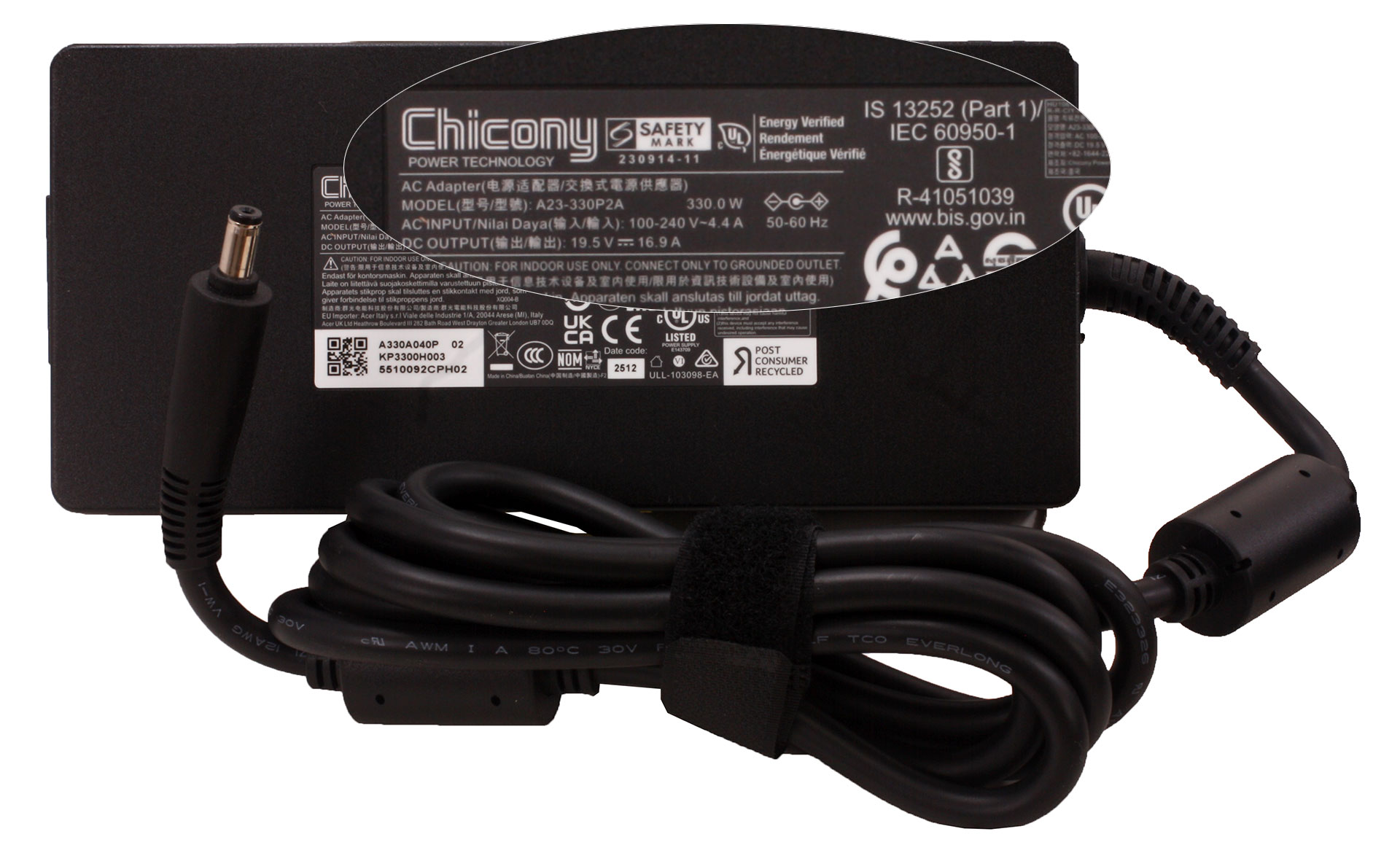
No extra frills here, just the raw power essentials you need to get up and running.
Design and construction
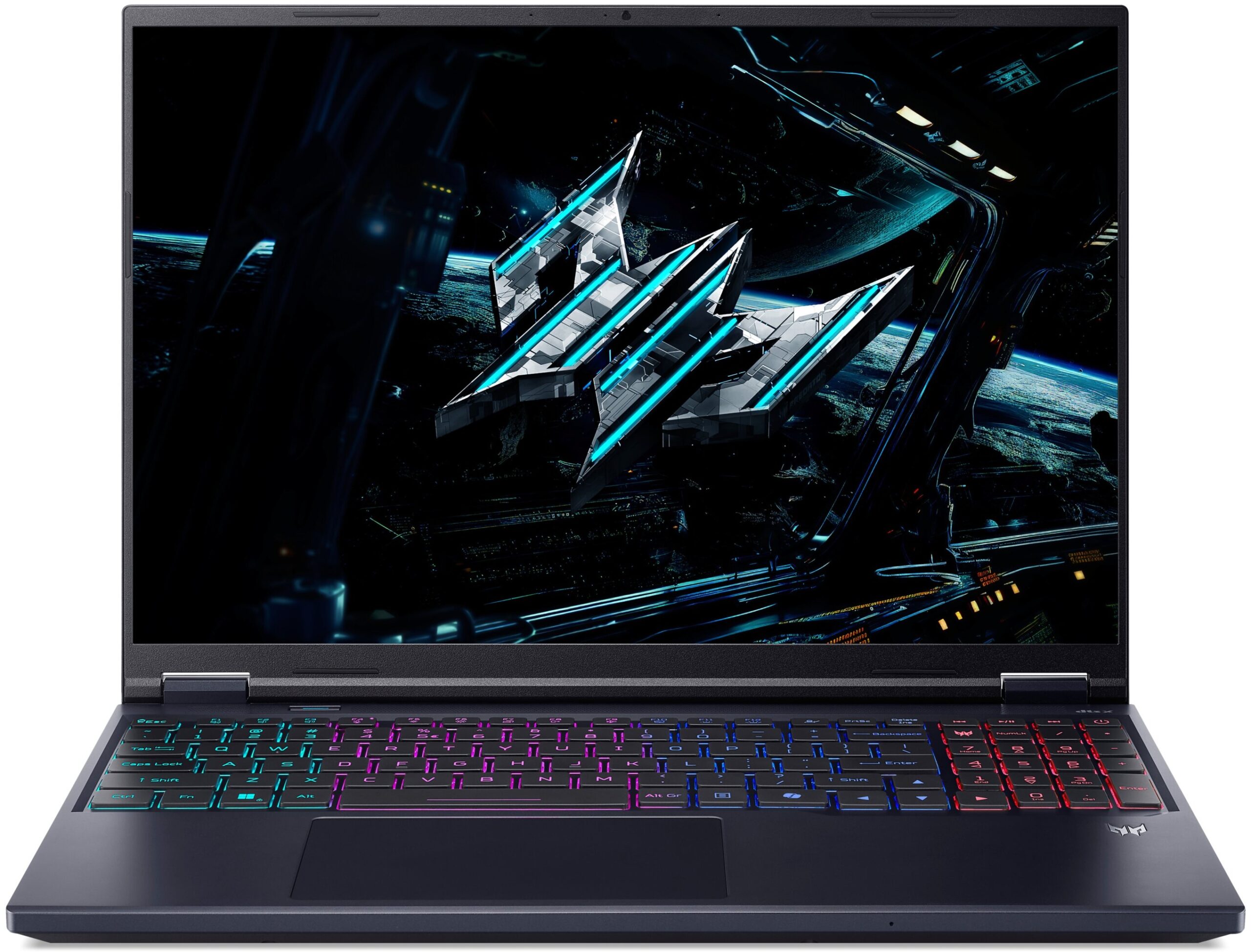
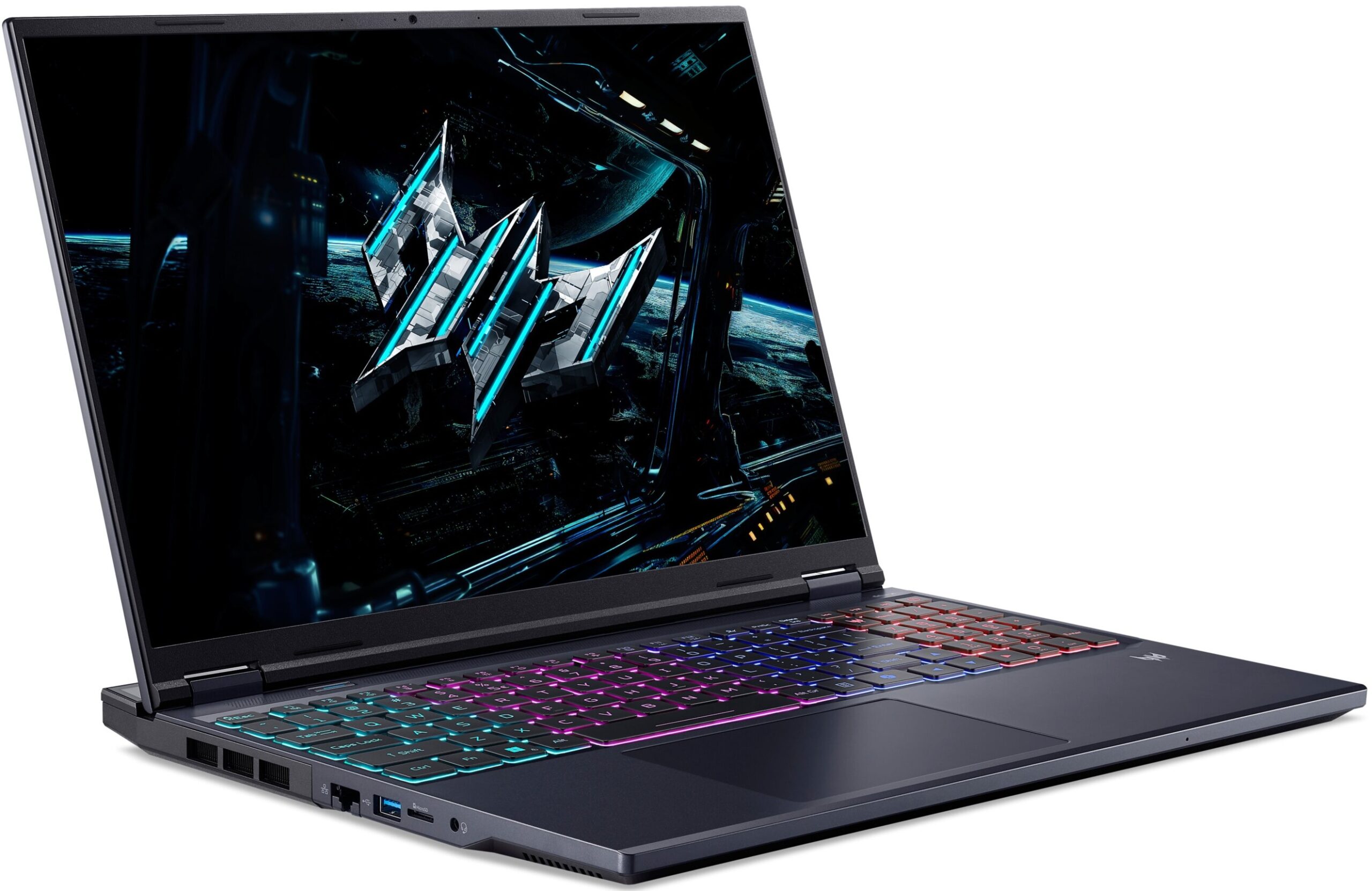
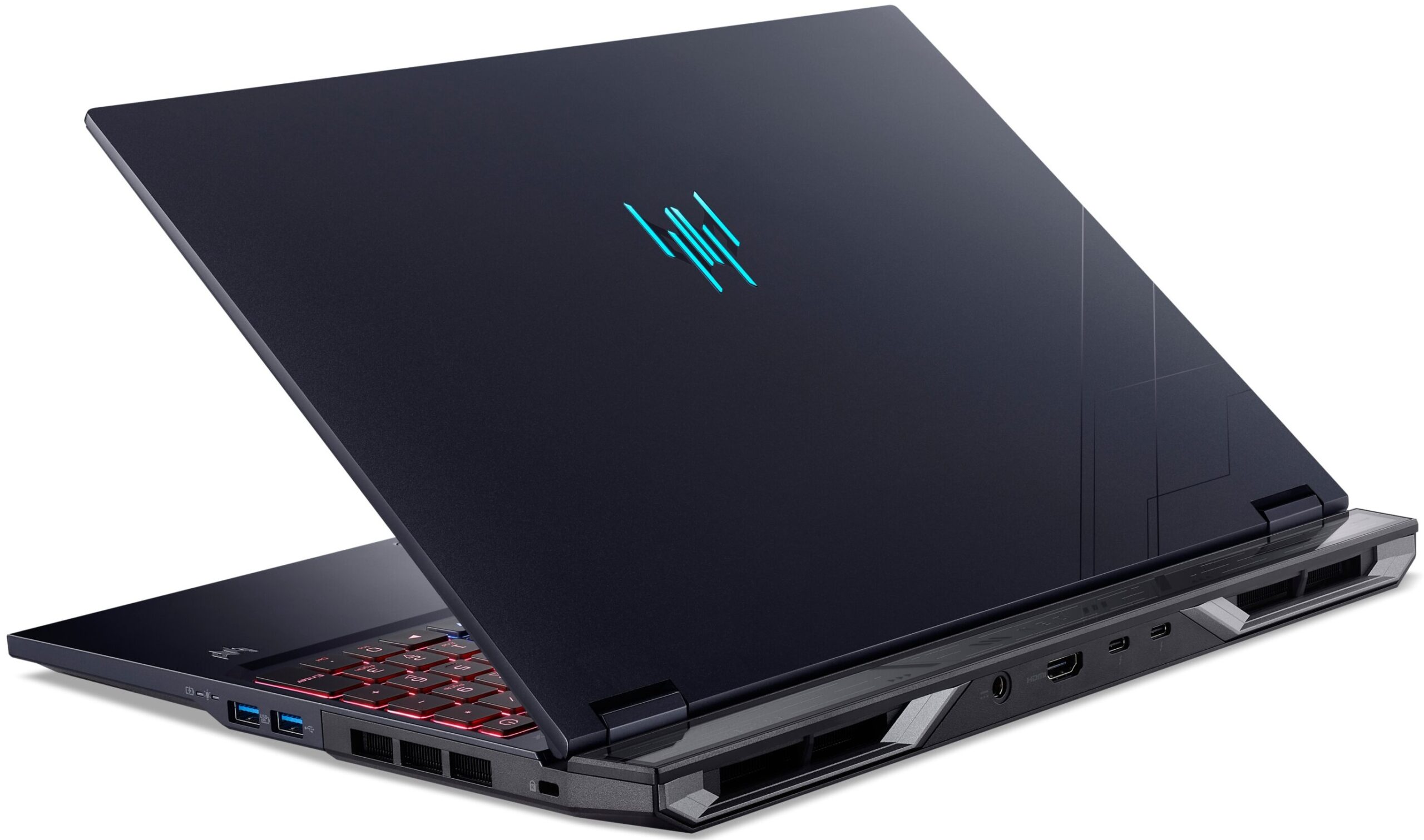
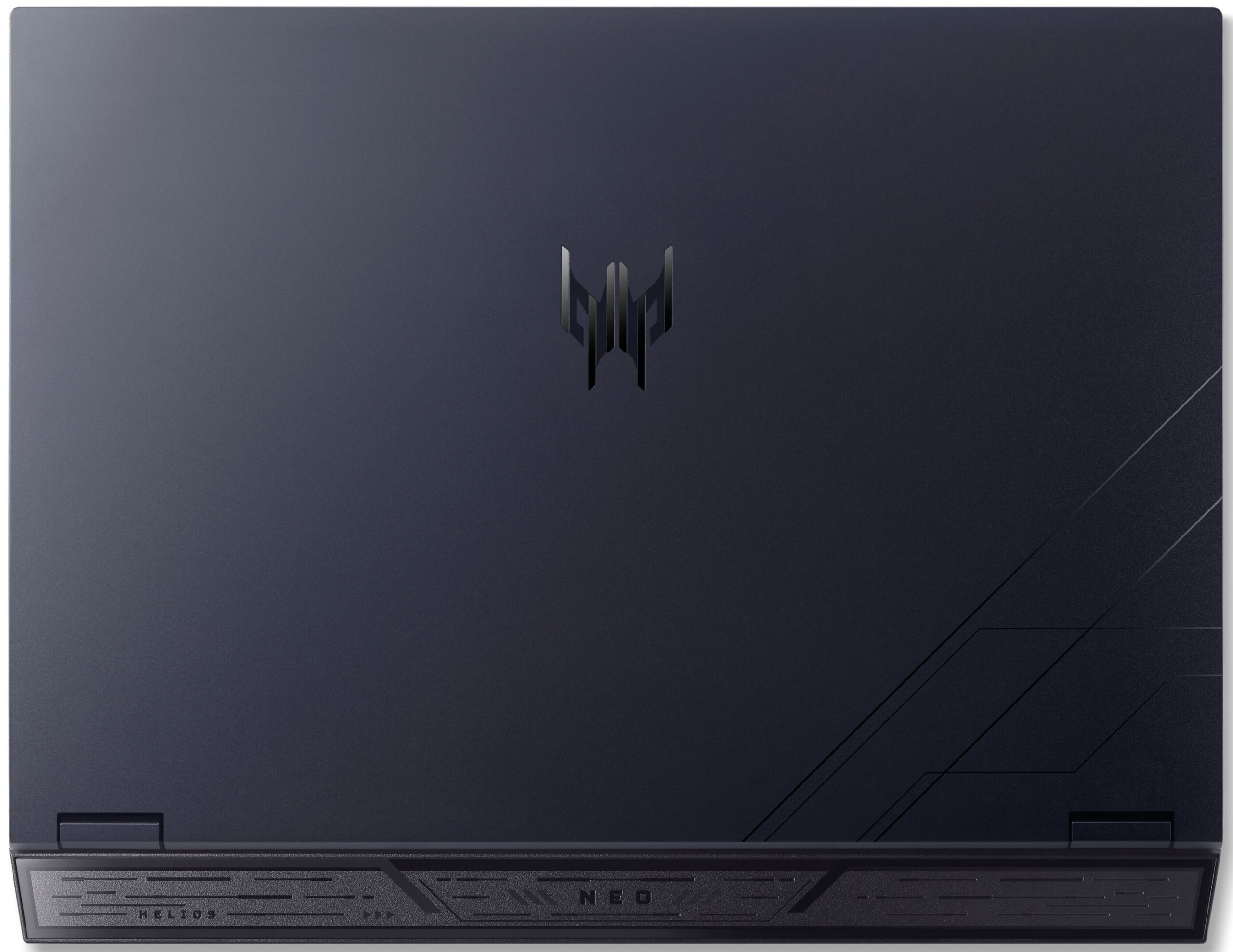
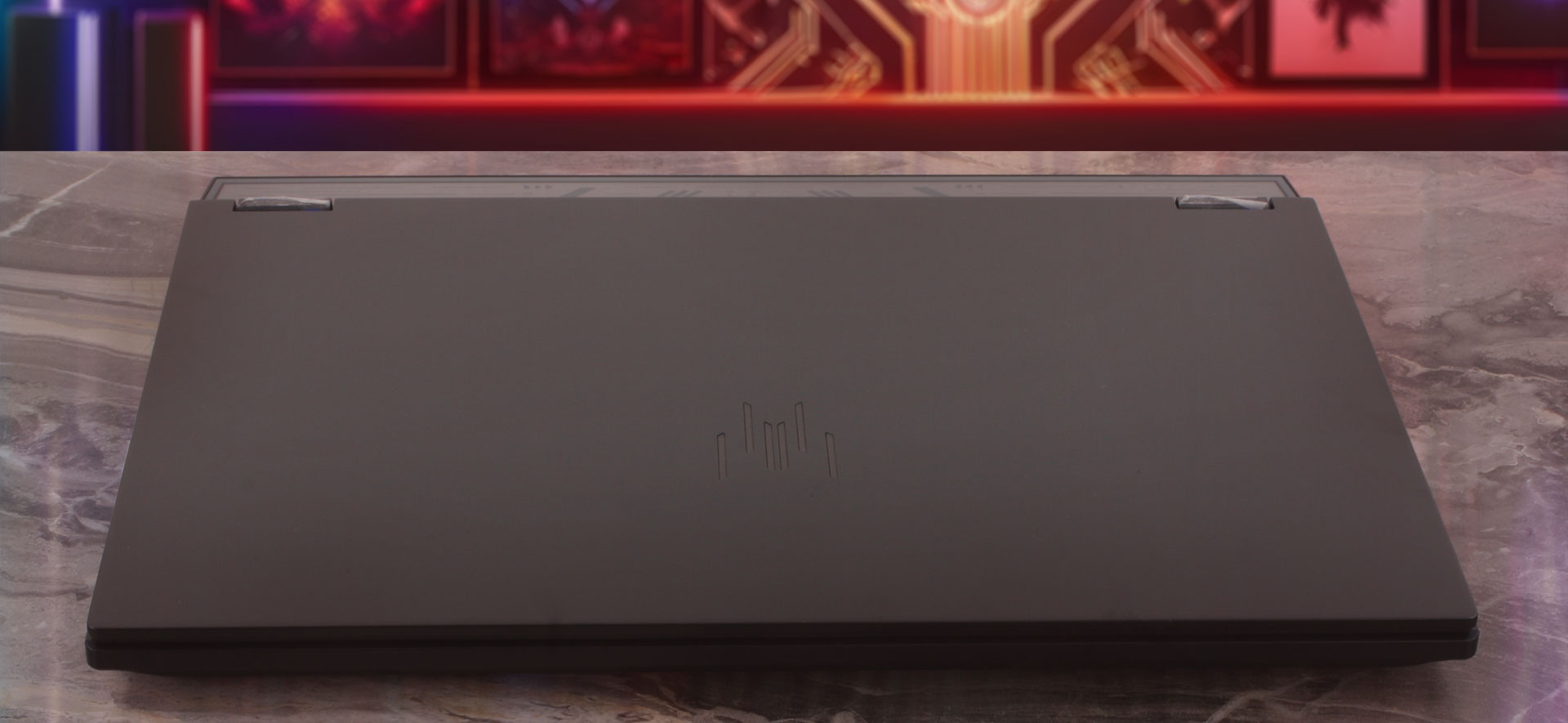
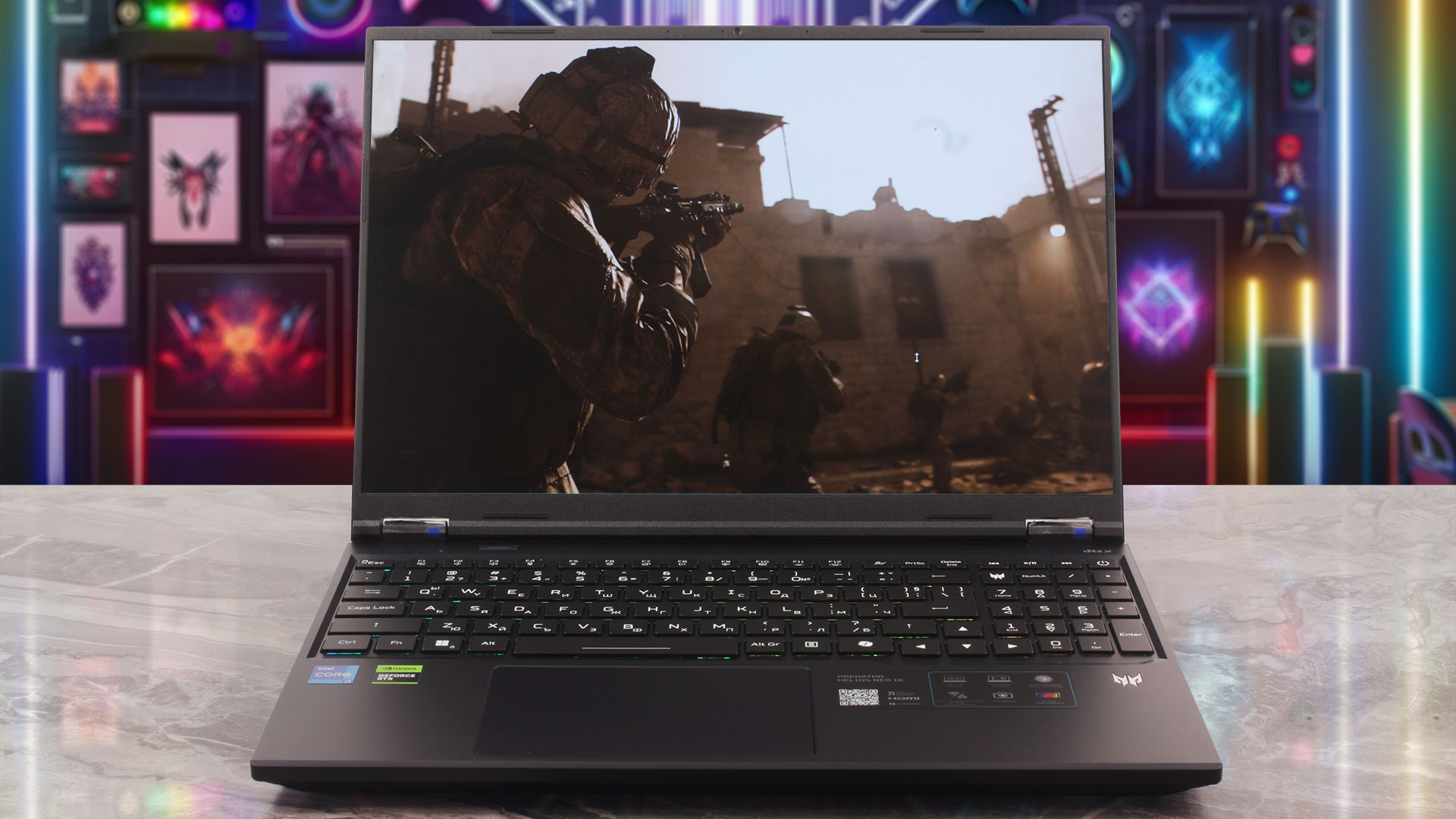
The Acer Predator Helios Neo 16 (PHN16-I31) strikes an interesting balance between restrained aesthetics and unmistakably gaming-focused hardware. Our machine combines Abyssal Black for the aluminum lid and keyboard deck with Shale Black for the display bezel and bottom panel. The lid is relatively clean, decorated only with subtle diagonal lines and a centrally positioned, illuminated Predator logo.
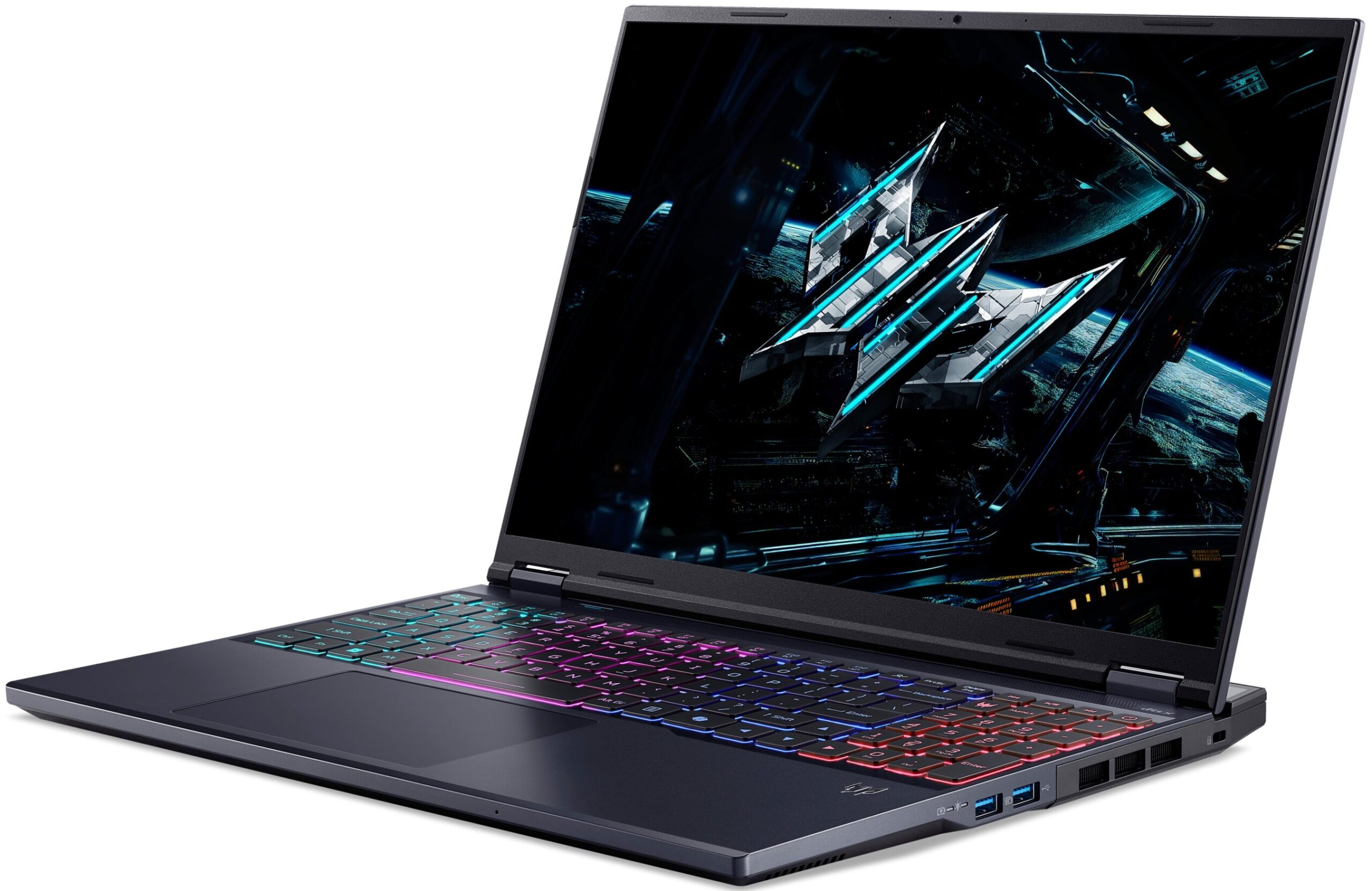
Open the laptop, however, and its gaming identity becomes much more obvious. The four-zone RGB keyboard immediately draws attention, while the extended rear section houses the main cooling exhausts, two Thunderbolt 4 ports, HDMI 2.1, and the power connector. Its deep chassis and substantial rear end clearly show that Acer has prioritized cooling capacity and connectivity over a slim, highly portable design. Even so, the straight lines, dark matte surfaces, and limited use of decorative elements prevent it from looking excessively flashy.
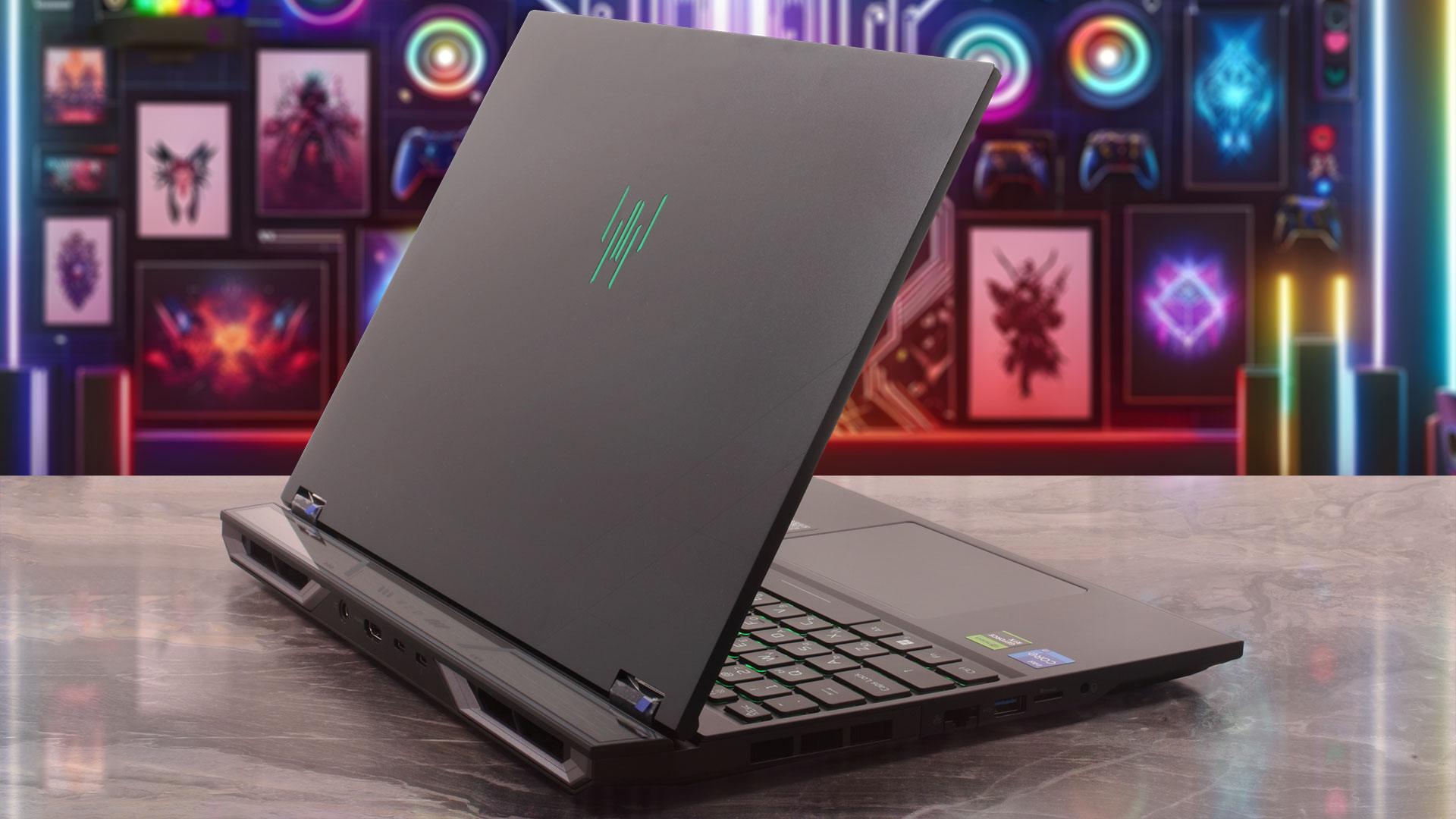
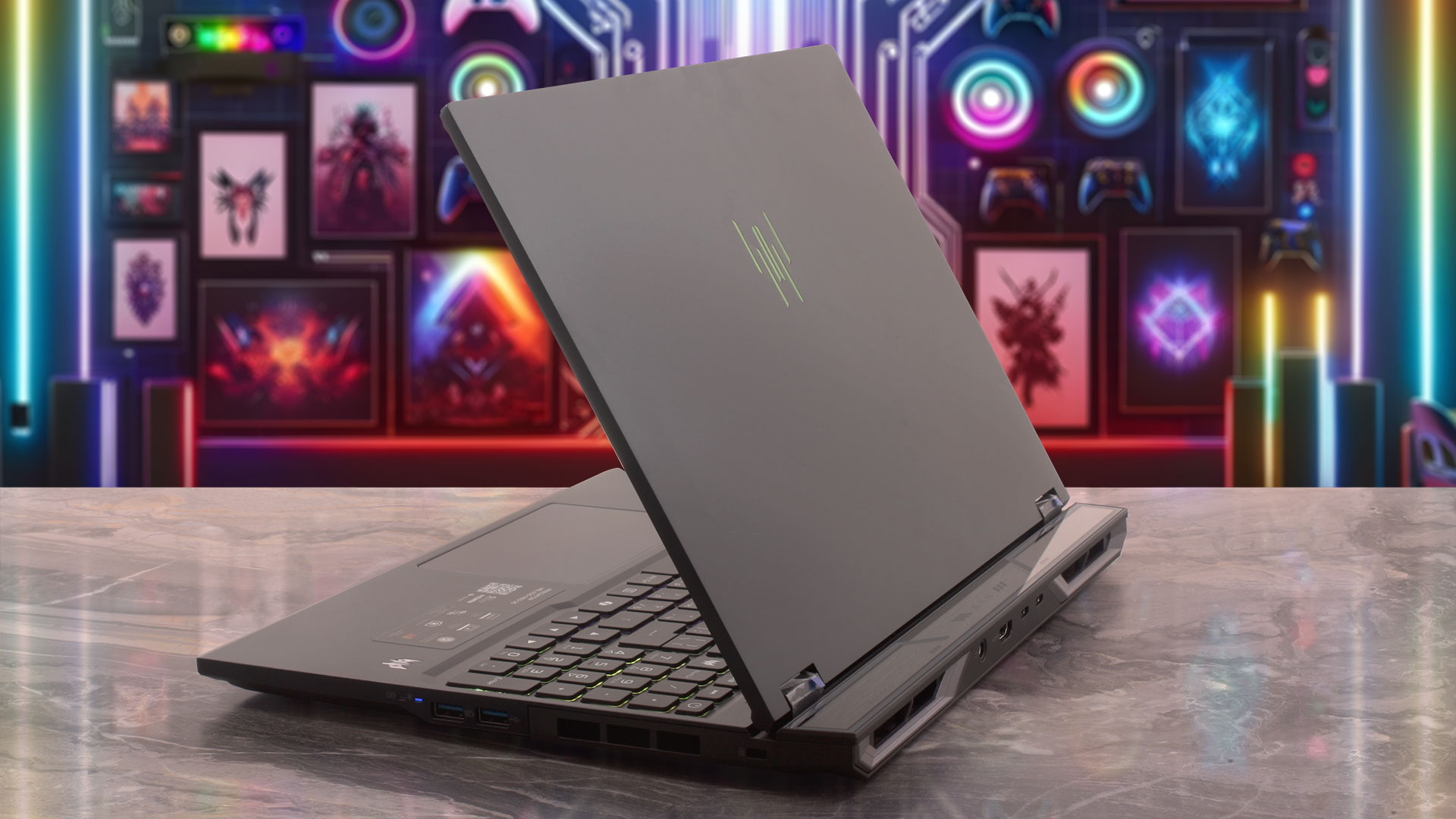
Make no mistake, this is a substantial piece of machinery. It is better suited to spending most of its time on a desk than being carried around throughout the day. Here is a closer look at its physical footprint:
| Acer Predator Helios Neo 16 (PHN16-I31) | Dimensions | Weight |
| Metric units | 356.78 x 275.5 x 22.3–26.75 mm | 2.5 kg |
| U.S. customary | 14.05 x 10.85 x 0.88–1.05 in | 5.51 lbs |
The 2.5 kg (5.51 lbs) figure applies to the laptop alone. Its enormous 330W power adapter adds approximately another 900 grams, bringing the combined weight to around 3.4 kg before the AC cable is taken into account.
Build quality is one of the stronger aspects of the Helios Neo 16. The plastic keyboard deck exhibits virtually no flex and provides a stable foundation during typing and gaming. The aluminum lid gives slightly in the center when deliberate pressure is applied, but not enough to cause concern. The matte plastic interior also does a good job of resisting visible smudges, although the metal lid attracts fingerprints more easily.
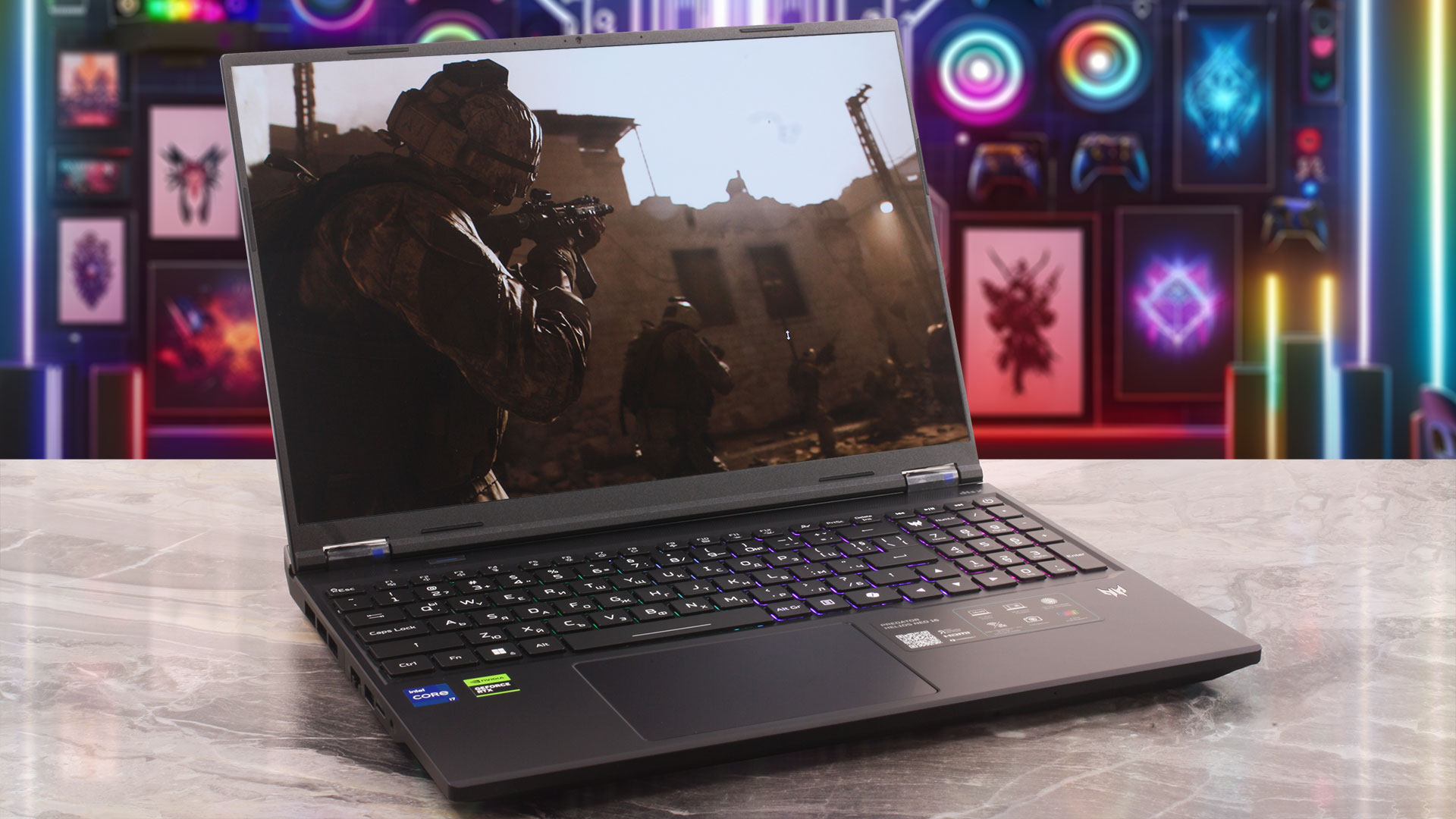
The hinges move smoothly and allow the display to tilt back to approximately 130 degrees.
The side bezels are reasonably thin for a gaming laptop, while the top and especially the bottom bezel are noticeably thicker. The upper bezel houses a 1080p Full HD webcam with support for Acer PurifiedView features. It is accompanied by an unusual three-microphone array, with two microphones positioned around the camera and a third beneath the display. Unfortunately, Acer has omitted a physical privacy shutter—a simple security feature that we believe should be standard on any modern laptop.
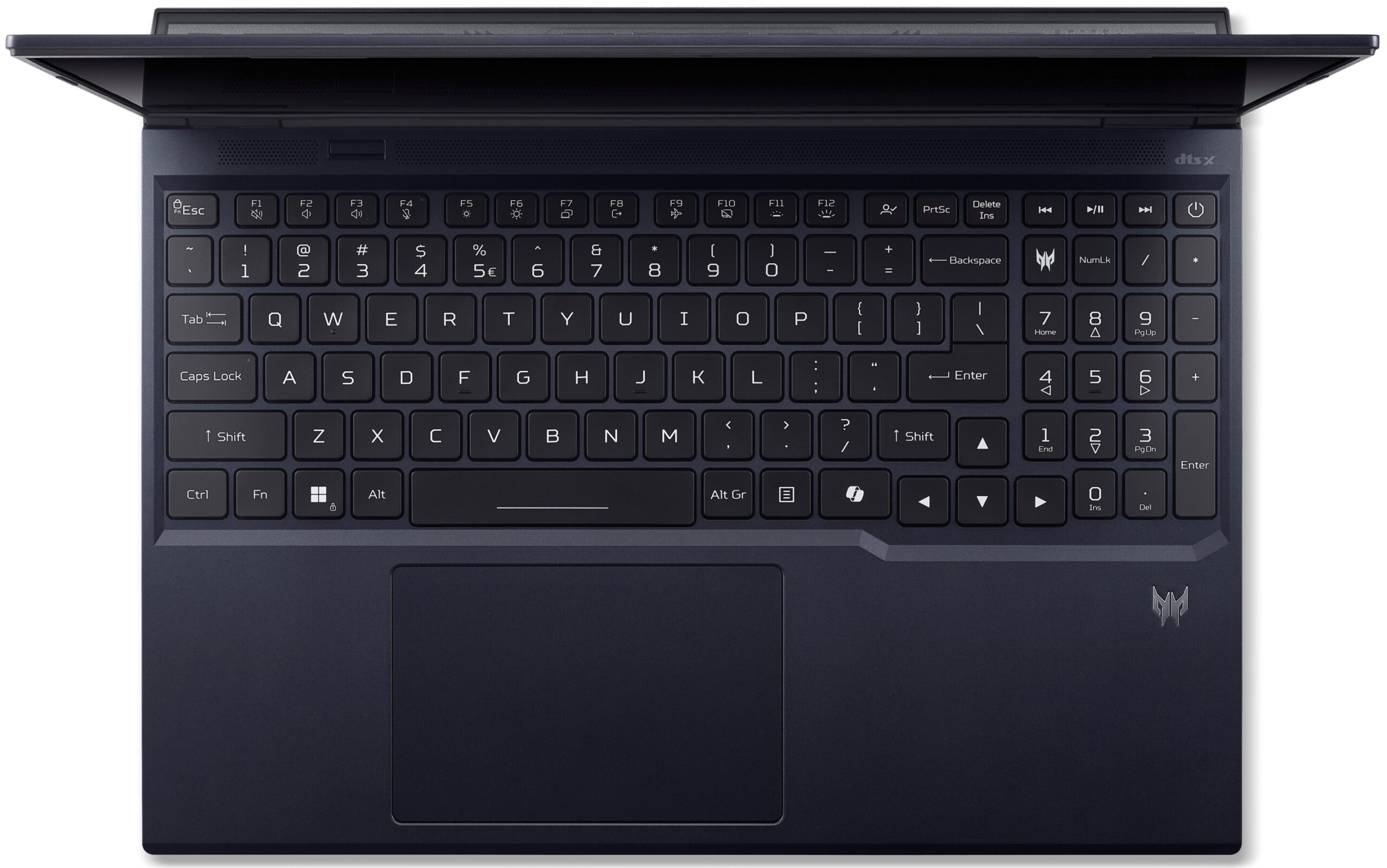
The input devices are another strong point. The spacious keyboard includes a full NumPad with a standard arrangement of mathematical operators and a dedicated Enter key. Its keys are slightly narrower than those in the main section, but the layout remains practical for data entry and games that make use of additional key bindings.
Acer specifies a generous 2.0 mm of key travel, and the keyboard is illuminated by a four-zone RGB backlight controlled through PredatorSense. The full-sized arrow keys are slightly separated from the surrounding buttons, making them considerably easier to locate by touch than the half-height arrows found on many laptops.
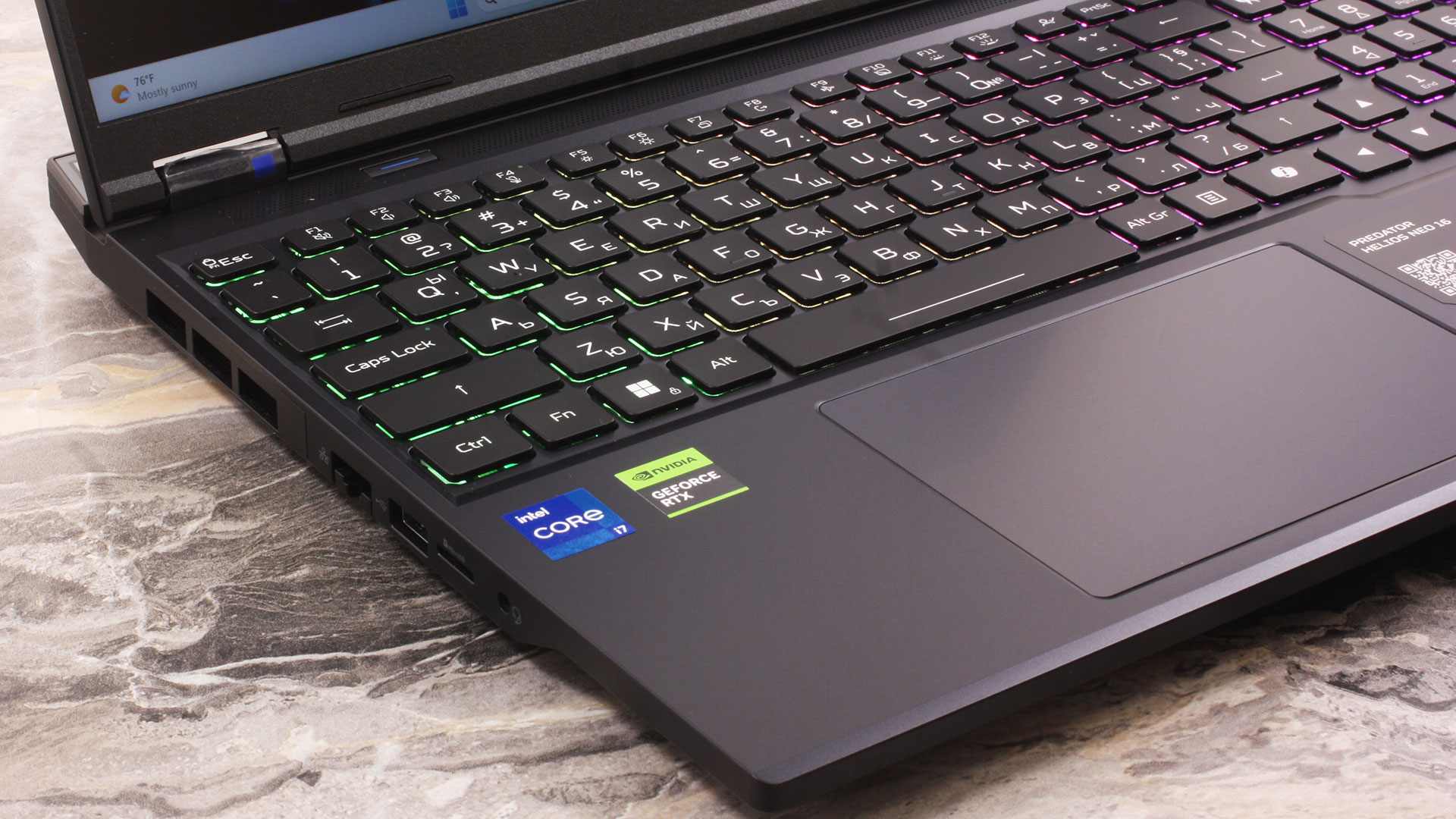
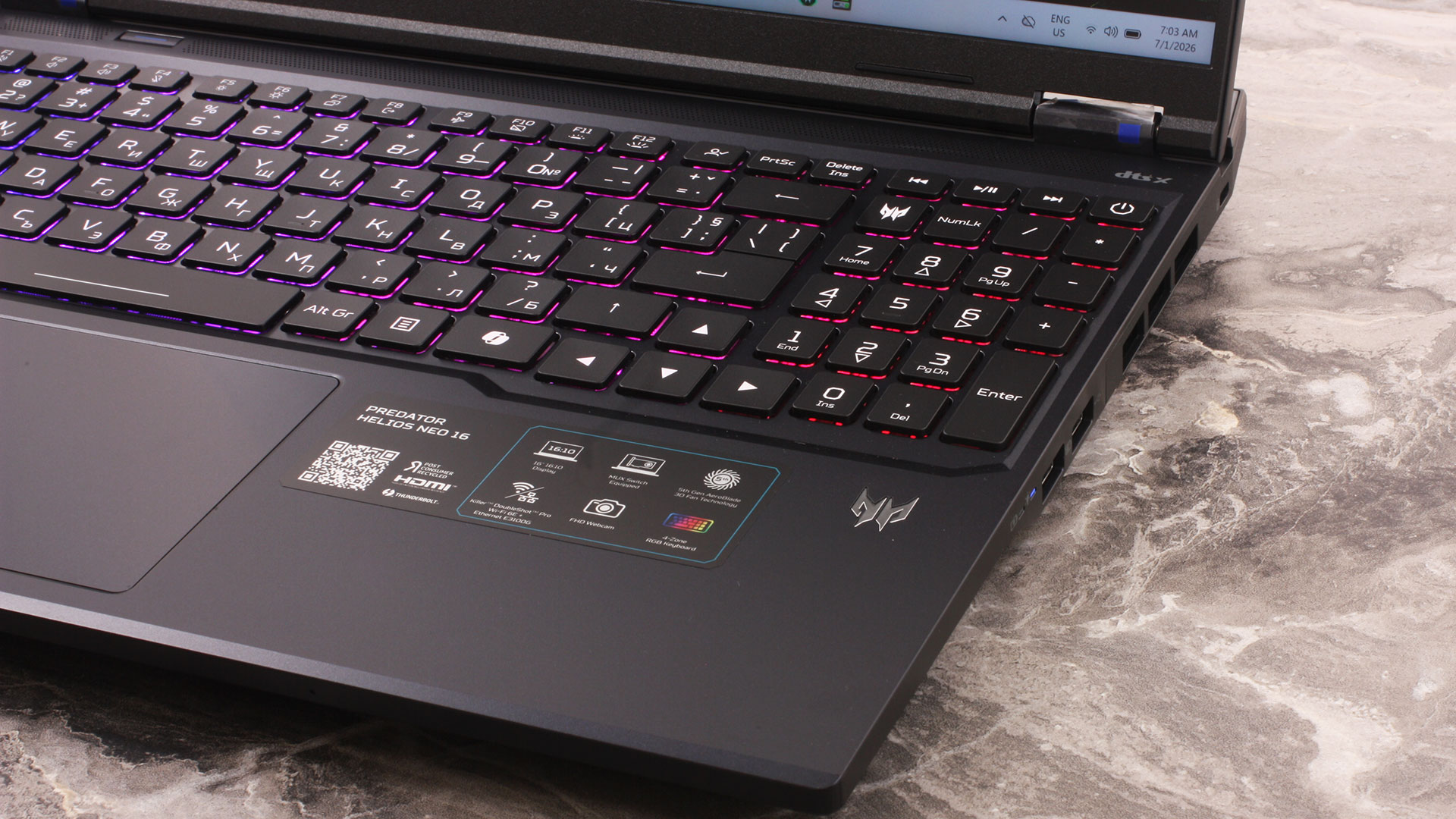
The keyboard also includes dedicated shortcuts for switching performance modes, opening PredatorSense, launching the customizable Acer My Key function, and accessing Microsoft Copilot. Media controls and the separate power button are positioned above the NumPad.
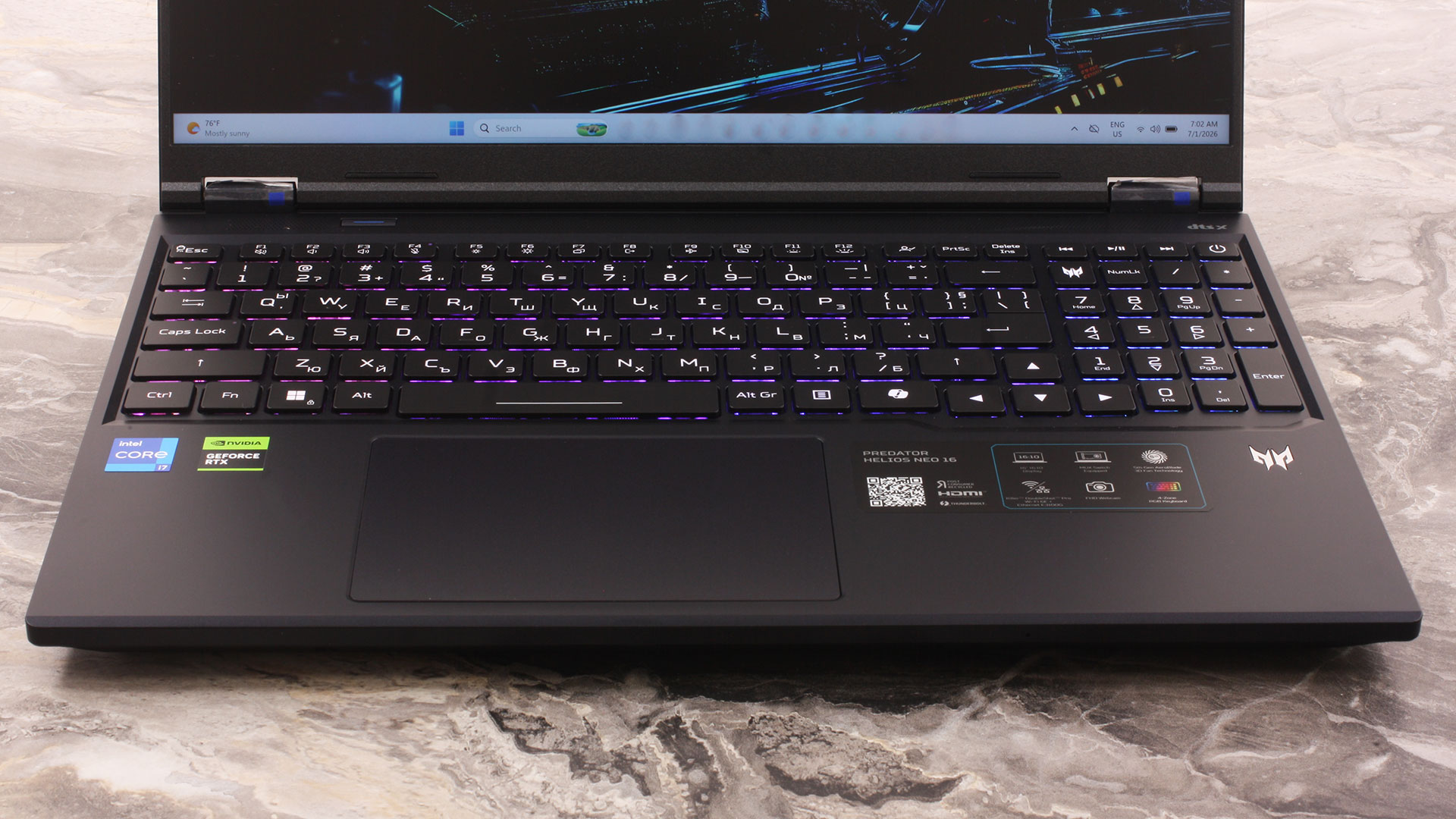
There is no fingerprint reader, so biometric login is not available through Windows Hello. The generously sized touchpad is shifted to the left to align more naturally with the main keyboard section rather than the entire chassis, which also includes the NumPad. Its smooth surface provides accurate tracking and enough room for multi-finger gestures, while the integrated buttons deliver a precise and satisfying click.
Ports and Connectivity
The Acer Predator Helios Neo 16 (PHN16-I31) distributes its ports across the left, right, and rear sides of the chassis, keeping most permanent cables away from the user’s hands.
On the left, there is a 2.5GbE RJ-45 port driven by a Killer E3100G controller, a USB 3.2 Gen 1 Type-A port with a transfer rate of up to 5Gbps, a microSD card reader, and a 3.5mm combo audio jack.
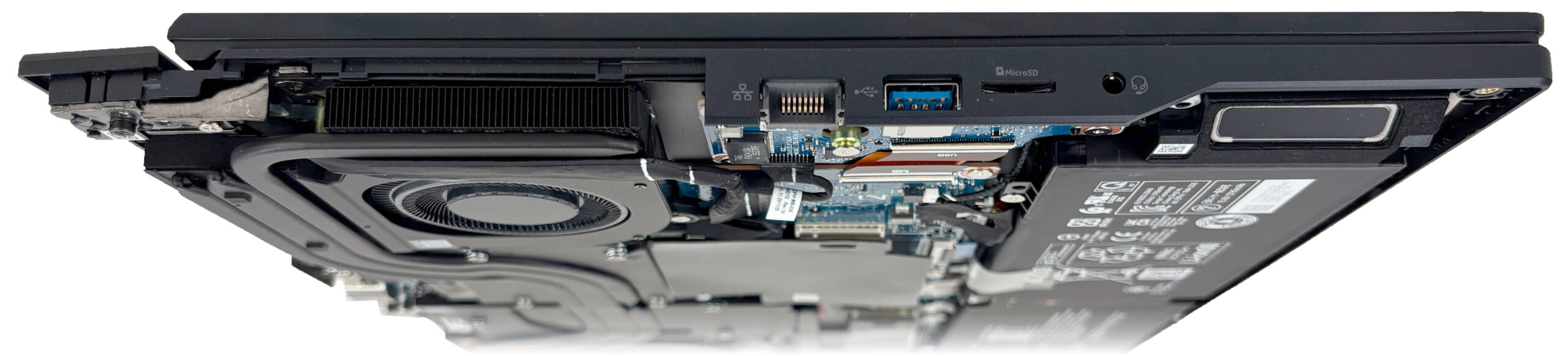
The right side houses a Kensington lock slot and two faster USB 3.2 Gen 2 Type-A ports, each supporting transfer rates of up to 10Gbps. One of them also supports power-off USB charging, allowing compatible peripherals to draw power while the laptop is switched off, provided that the feature is enabled.

The more permanent connections are positioned at the rear. These include the proprietary DC-in connector, an HDMI 2.1 output, and two Thunderbolt 4 ports. Both USB-C connections support data transfer rates of up to 40Gbps and DisplayPort 2.1 video output routed through the discrete GPU. They can also accept up to 100W of USB-C Power Delivery input, providing a lighter charging option for low-power use when the supplied 330W adapter is unnecessary.

There is an important limitation, however. Acer states that 100W Type-C charging is intended only for minimum or light usage. Charging may be slow under load, and the laptop cannot deliver its full gaming performance without the supplied 330W power adapter. Both USB-C ports are located at the rear, which helps create a tidy desktop setup but is slightly less convenient when quickly connecting a portable SSD, phone, or other Type-C accessory.
Wireless connectivity is handled by a Killer Wi-Fi 6E 1675i module, providing access to the 2.4GHz, 5GHz, and 6GHz bands. Together with the Killer E3100G Ethernet controller, it supports Killer DoubleShot Pro, which can use the wired and wireless connections simultaneously and prioritize latency-sensitive traffic. Bluetooth 5.4 is also supported, along with Bluetooth LE Audio and the LC3 codec. There is no SIM card slot or mobile-network connectivity.
Display and Sound Quality, Display Profiles
We ordered the Acer Predator Helios Neo 16 (PHN16-I31) with the higher-resolution 16-inch WQXGA (2560 × 1600), 180 Hz IPS display option (TL160ADMP37 / TMA2076). Acer also offers a lower-resolution WUXGA (1920 × 1200) IPS variant with the same advertised 180 Hz refresh rate, 3 ms response time, 100% sRGB coverage, and NVIDIA Advanced Optimus capability.
| Acer Predator Helios Neo 16 (PHN16-I31) | 16″, WUXGA (1920 × 1200), 180 Hz, IPS | 16″, WQXGA (2560 × 1600), 180 Hz, IPS (TL160ADMP37 / TMA2076) |
| Diagonal | 16.0 inches (40.6 cm) | 16.0 inches (40.6 cm) |
| Panel Type | IPS | IPS |
| Resolution | 1920 × 1200 pixels | 2560 × 1600 pixels |
| Max Refresh Rate | 180 Hz | 180 Hz |
| Aspect Ratio | 16:10 | 16:10 |
| Pixel Density | 141 PPI | 189 PPI |
| ‘Retina’ Distance | 62 cm or greater | 46 cm or greater |
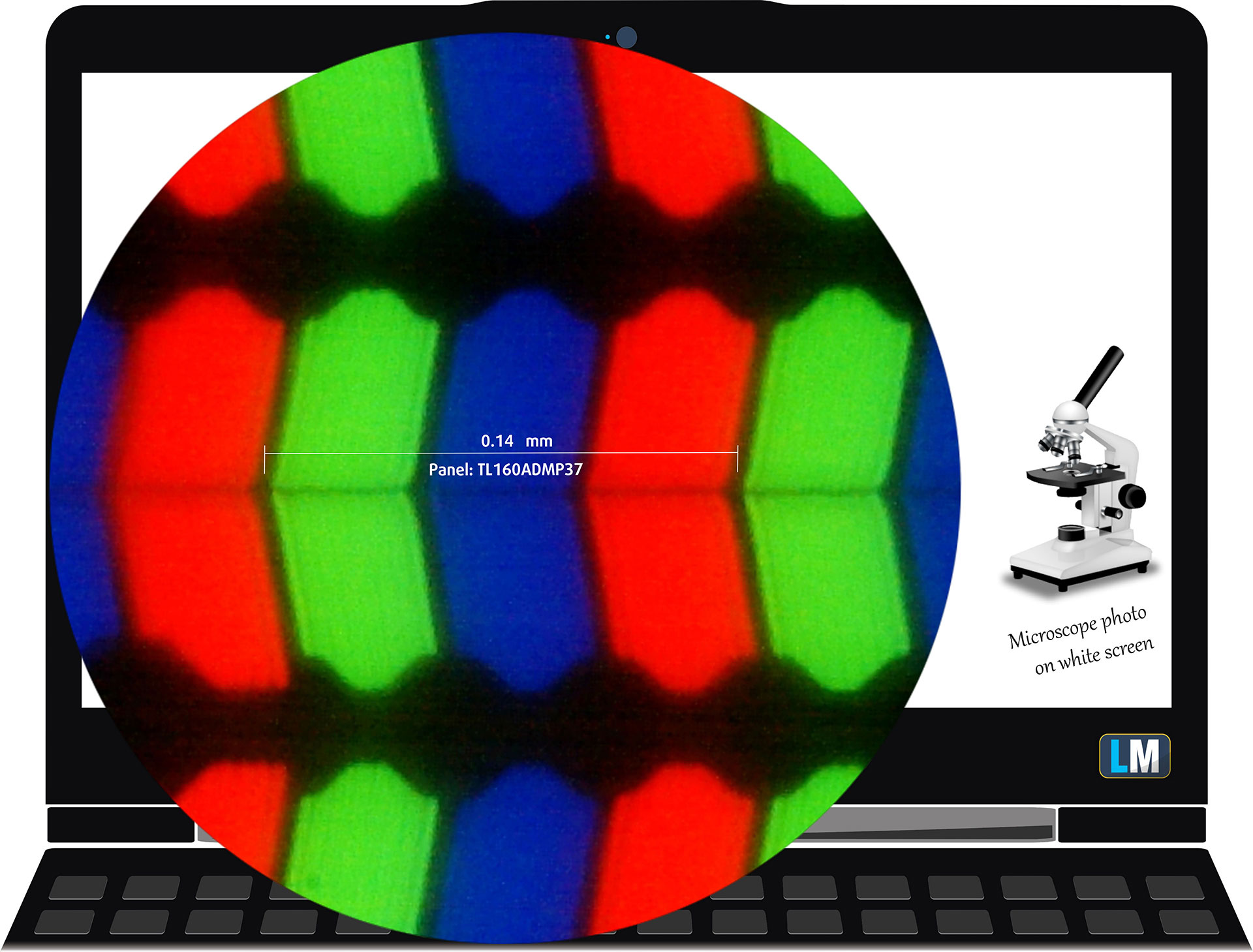
The WQXGA (2560 × 1600), 180 Hz IPS display variant under our microscope
Viewing Angles
The viewing angles are good. We take photos from different angles to evaluate the quality.
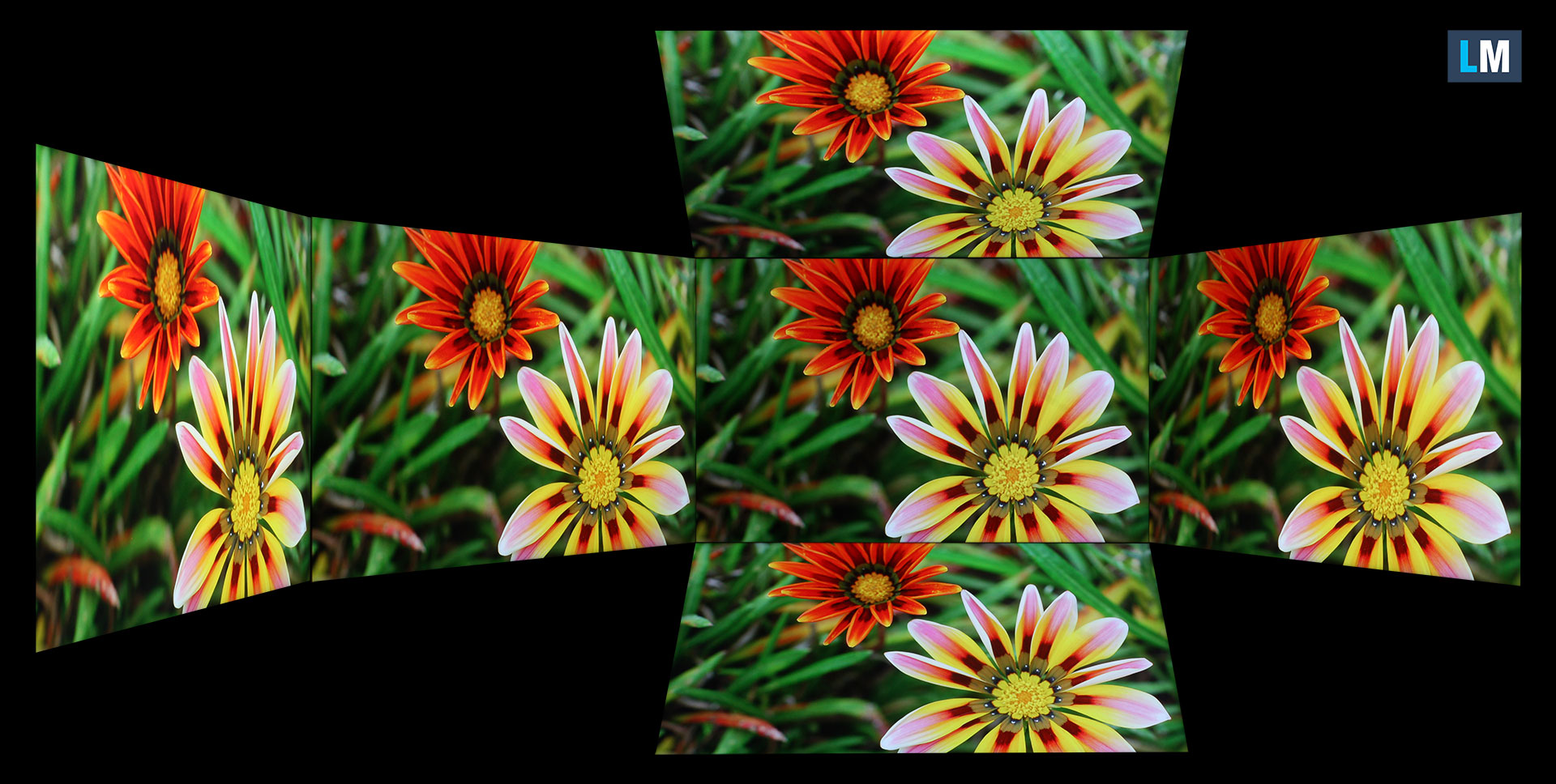
We also recorded a video with locked focus and exposure.
Color Coverage
The sail-shaped diagram represents the visible color space, while the black curved line represents Pointer’s gamut, which approximates the colors commonly found in nature.
We have also drawn some of the most important color spaces and compared them with the range of colors that the Acer Predator Helios Neo 16 (PHN16-I31)’s display can reproduce:
Standard/For Web: sRGB – the color space used by most consumer devices and the Web, making it particularly relevant to web design and development.
For Print: AdobeRGB – commonly used in professional photo editing, graphic design, and print production.
For Photographers/Video Editors: DCI-P3 – a wider color space used in film production, post-production, and digital cinema.
Premium HDR: Rec. 2020 – one of the widest consumer color standards, covering 75.8% of the visible spectrum and serving as a benchmark for premium HDR content.
Acer Predator Helios Neo 16 (PHN16-I31): the yellow dashed triangle (– – – – – –) represents the range of colors this display can reproduce.
In our tests, the display covered 99% of the sRGB color gamut and 80% of DCI-P3. The nearly complete sRGB coverage makes it well suited to gaming, web content, and general image editing, although its more limited DCI-P3 coverage prevents it from being a true wide-gamut panel for professional video production.
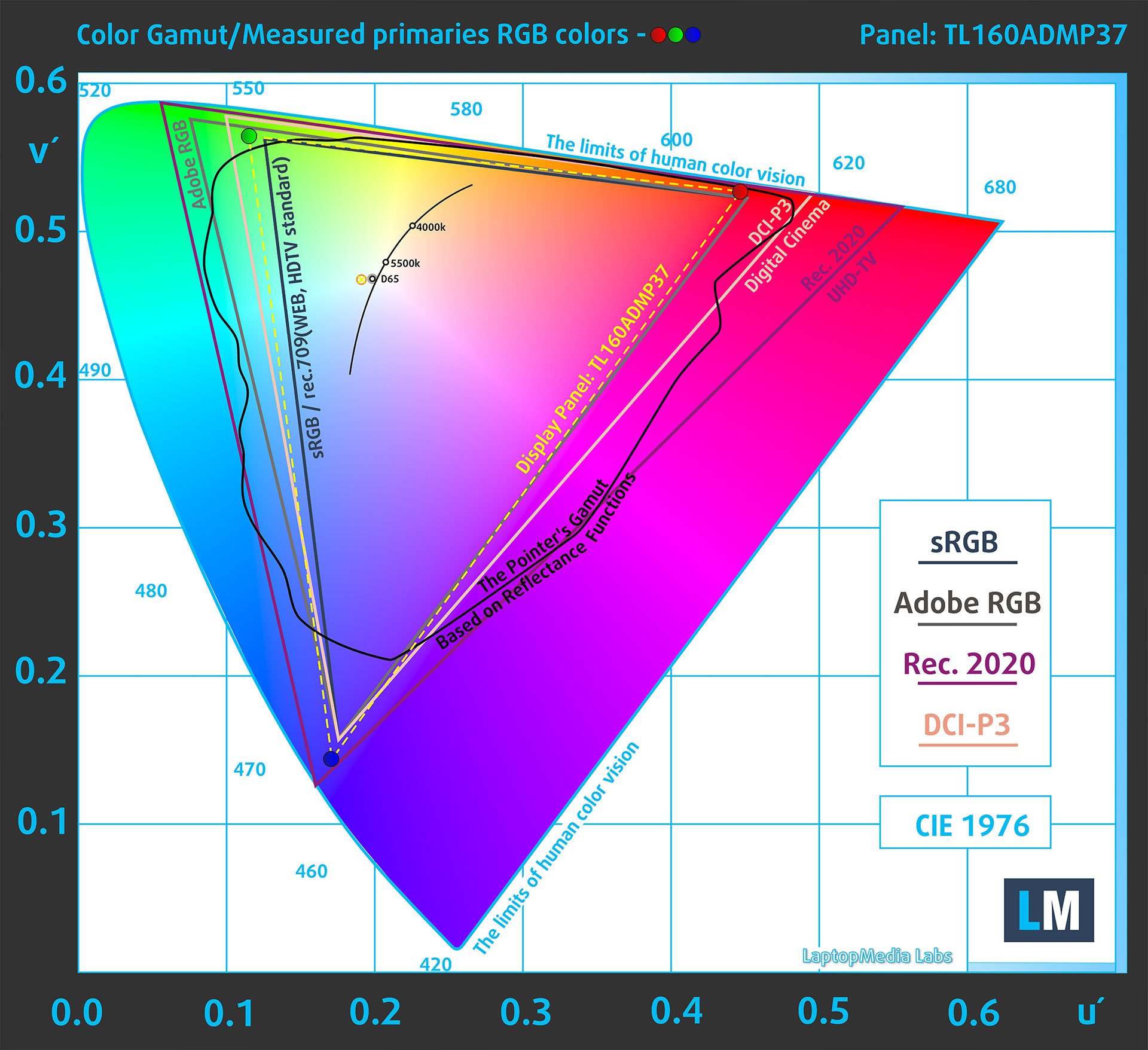
(Fig. 1) Acer Predator Helios Neo 16 (PHN16-I31) covers 99% of the sRGB gamut
Brightness and Contrast
The maximum brightness in SDR mode reaches 436 cd/m² in the center of the screen and averages 399 cd/m² across the display surface, with a maximum deviation of 13%. This means that the panel effectively meets Acer’s advertised 400-nit rating and remains comfortably visible in a brightly lit room.
The Correlated Color Temperature (CCT) on a white screen at maximum brightness is 7140 K, resulting in a slightly cooler-than-neutral appearance in the factory configuration.
The contrast ratio is 1400:1, which is a good result for an IPS-class display and provides reasonably deep blacks without relying on local dimming.
Despite Windows reporting support for HDR video streaming, the panel is not recognized as HDR-capable for games, applications, or desktop use. It lacks the brightness, wide color gamut, and local dimming required for a meaningful HDR experience, so it should be treated as an SDR display.

Uniformity: Luminance, Contrast, and Color Deviation
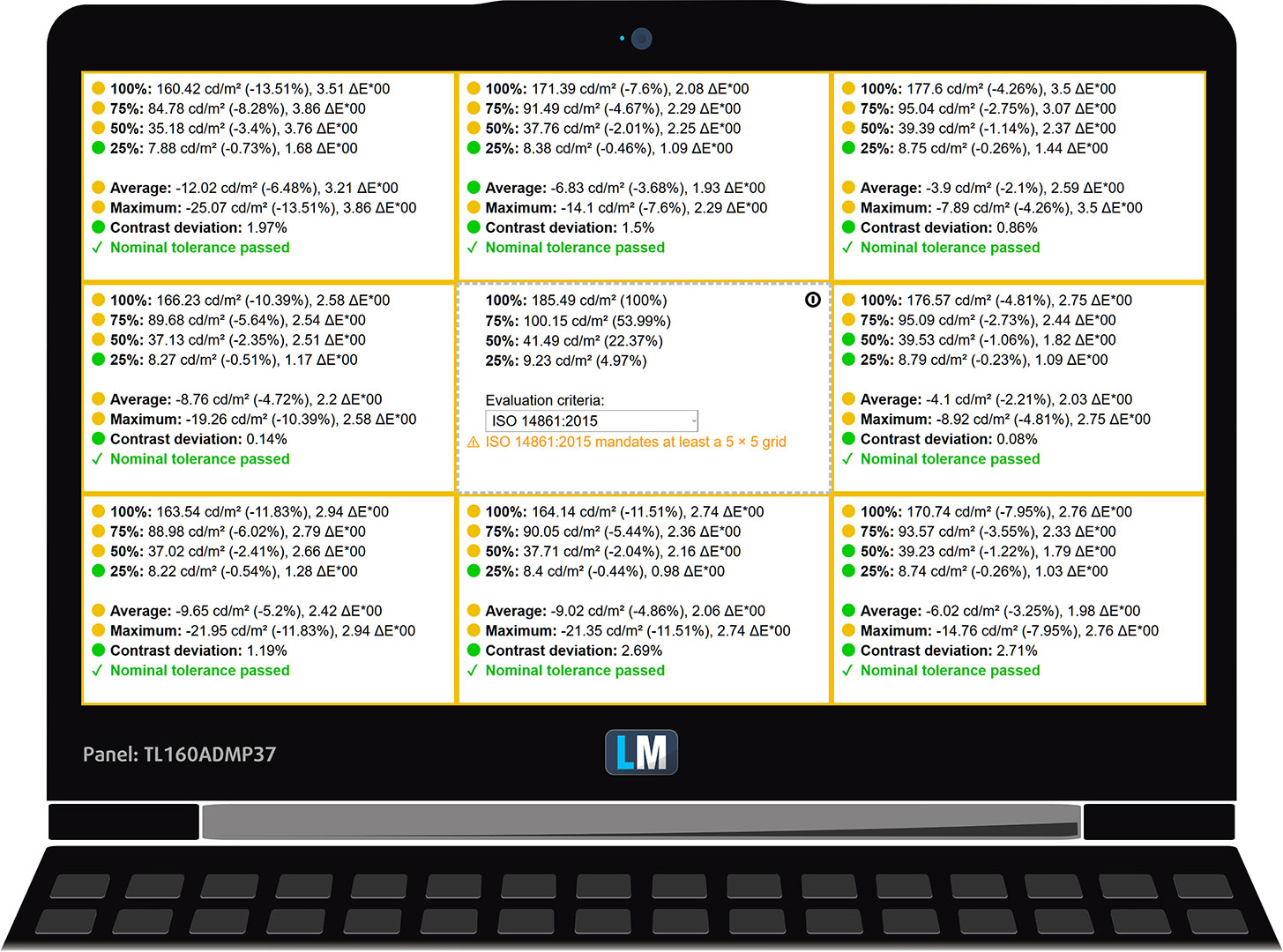
The figure below shows the results from our uniformity test across different sections of the screen. The measurements were taken at 186 nits (Windows slider = 43%) – a brightness level we consider typical for standard working conditions.
DeltaE values below 4.0 are acceptable for regular users. For color-sensitive work, displays with DeltaE values no higher than 2.0 are recommended.
Color Accuracy
Let’s check the difference between real colors and those displayed by the Acer Predator Helios Neo 16 (PHN16-I31). We measure that distance using DeltaE – the higher the value, the greater the visible difference.
Values below 4.0 are acceptable for regular users, while values below 2.0 are suitable for color-sensitive work. A value below 1.0 means that the difference is generally indistinguishable to the naked eye.
For the following test, we selected 24 commonly used colors, including dark and light skin tones, blue sky, green grass, and others.
In its factory condition, the display achieved an average color accuracy of 3.0 dE2000 (Fig. 2). This is acceptable for gaming and everyday use, but not accurate enough for color-sensitive professional work. With our Design and Office profile applied, the average deviation improved substantially to 1.1 dE2000 (Fig. 3), making the panel suitable for work within the sRGB color space.
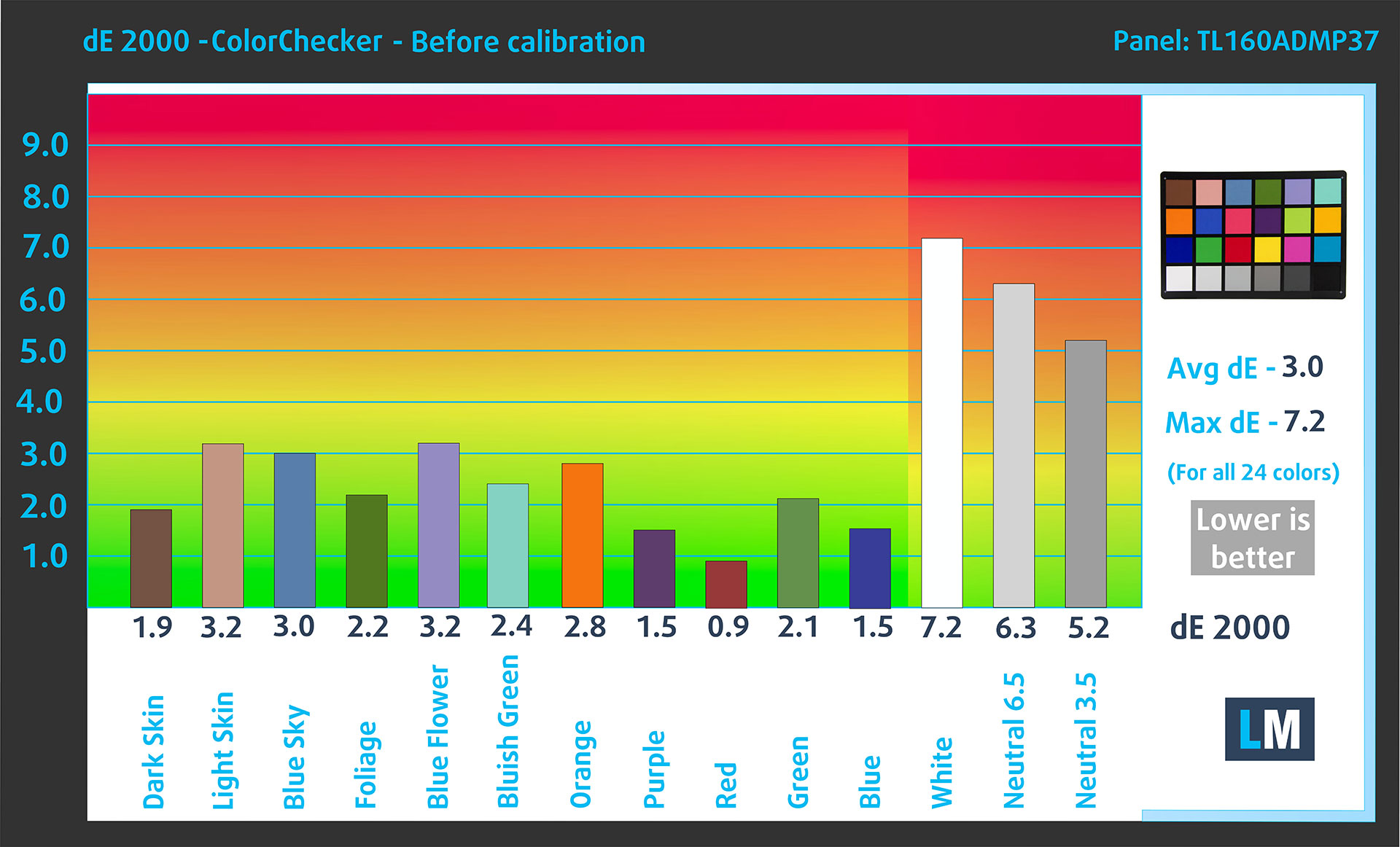
(Fig. 2) Acer Predator Helios Neo 16 (PHN16-I31) in its factory condition
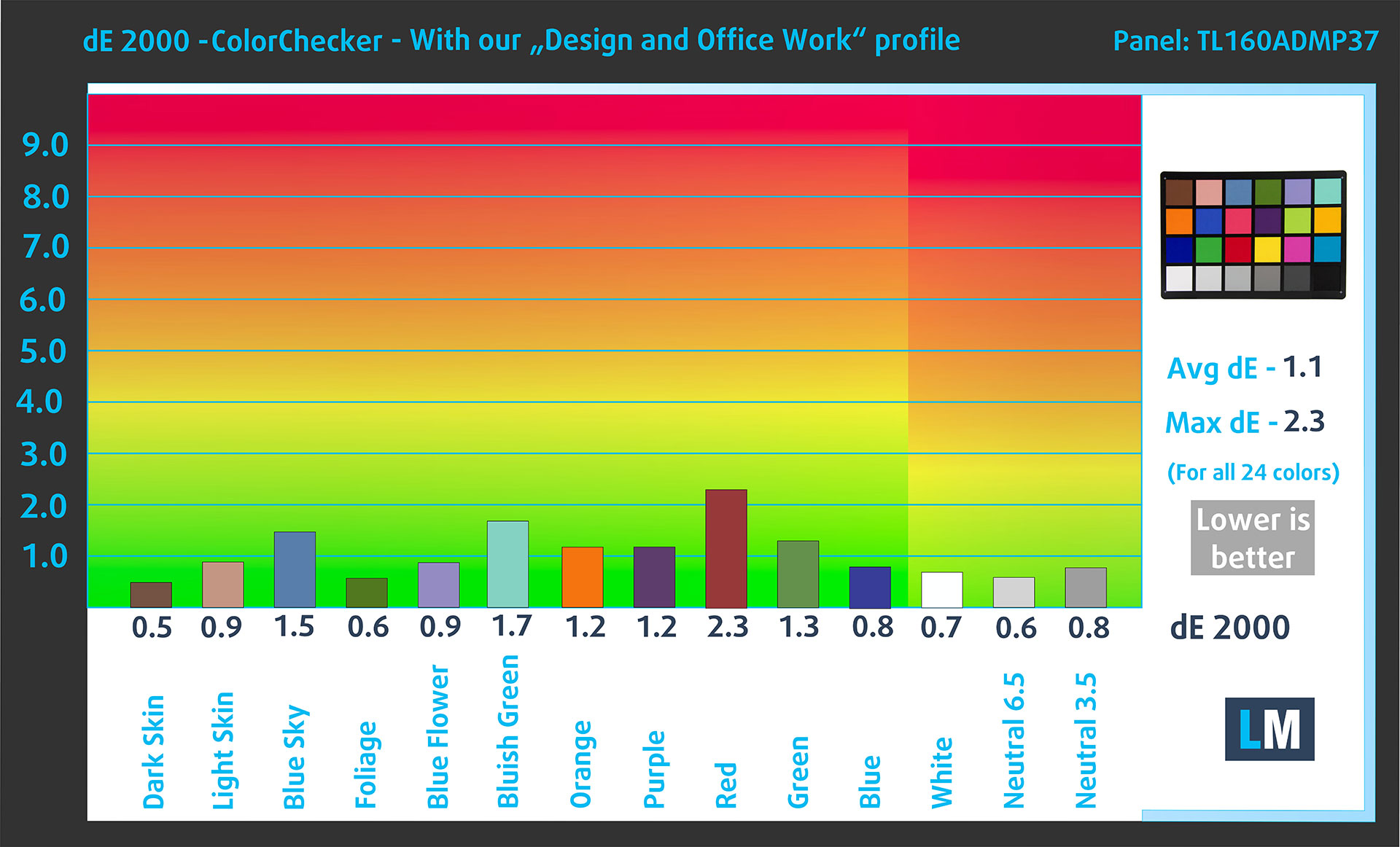
(Fig. 3) Acer Predator Helios Neo 16 (PHN16-I31) with our display profile
Comparison in the sRGB color space.
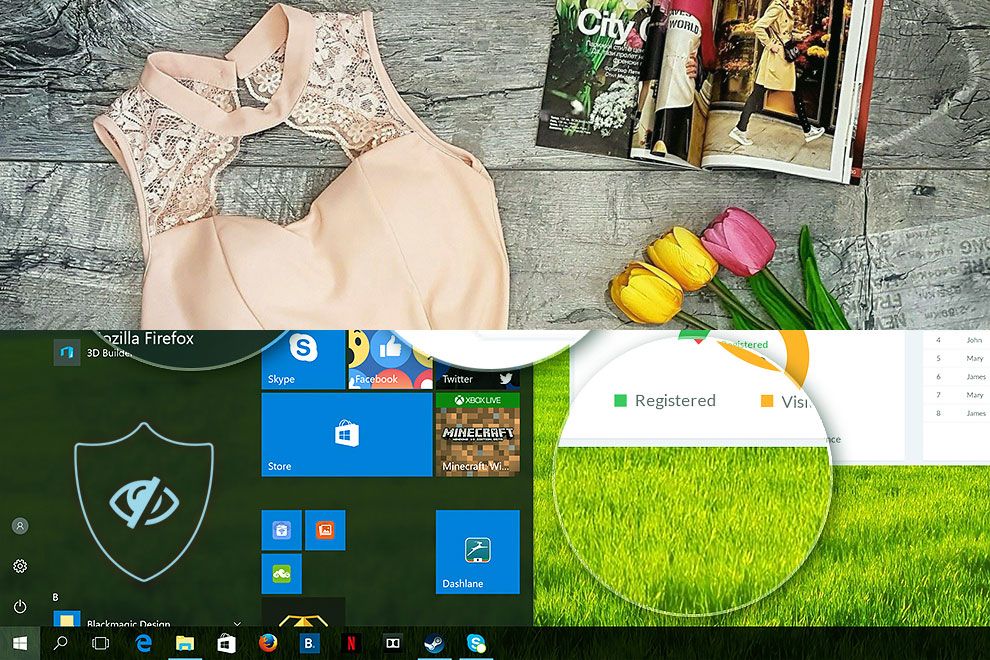
Here is an illustration of what the Design and Office Work profile aims to deliver:
Left: No Profile | Drag the slider to see the difference | Right: Design & Office Profile
Visibility in Dark Scenes
Have you ever watched a movie with dark scenes where you could barely see anything? This often happens because many display panels struggle to differentiate the darkest nuances, causing them to appear identical.
The following figure illustrates how well the display reproduces these dark nuances. The left side shows the display with its factory settings, while the right side shows it with our Gaming and Movies profile activated.
The horizontal axis represents the grayscale levels, while the vertical axis shows the corresponding display brightness.
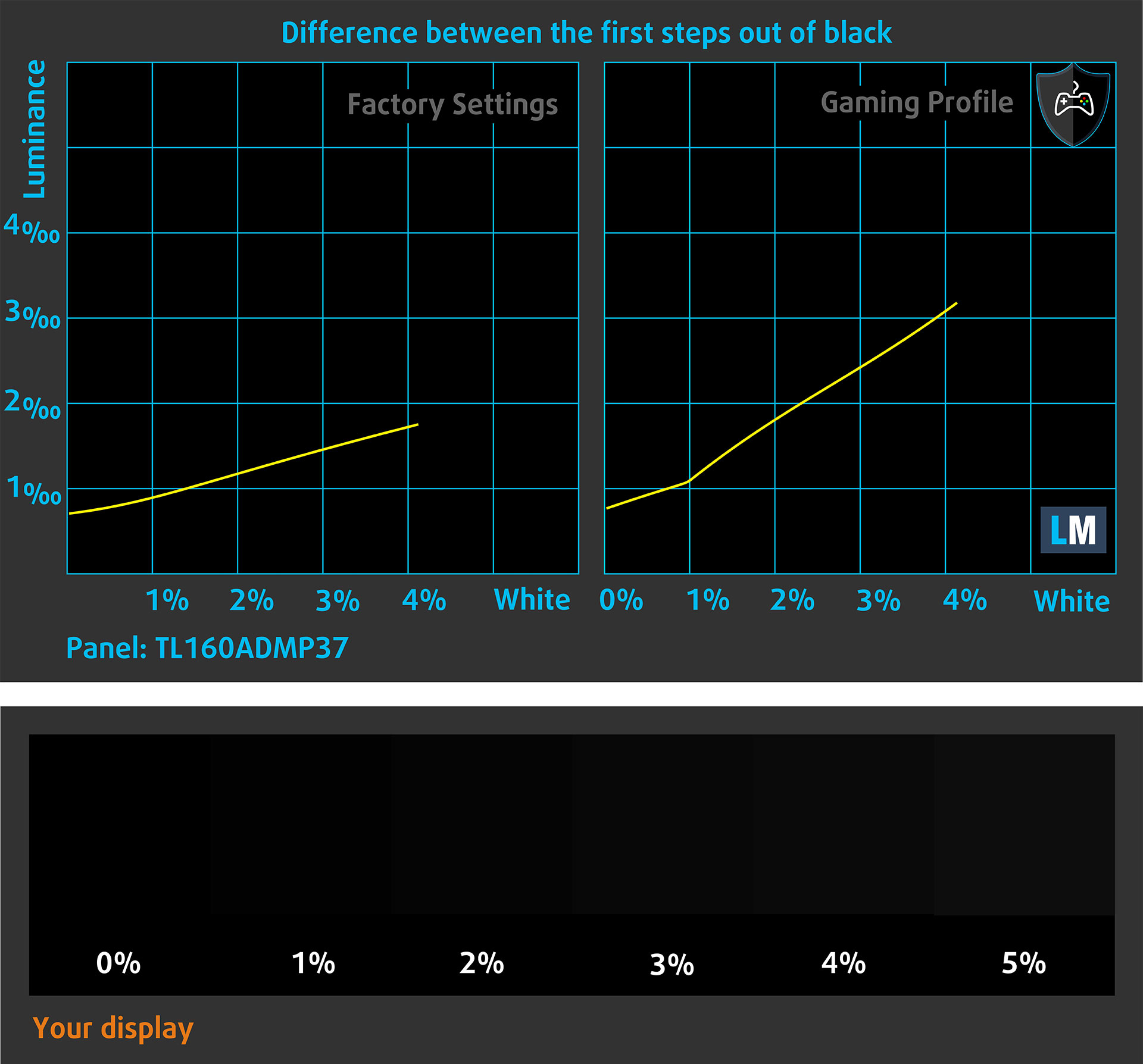
You can also check how your current display handles the darkest nuances, but keep in mind that the result also depends on its settings and the surrounding light conditions.
Response Time (Gaming Capabilities)
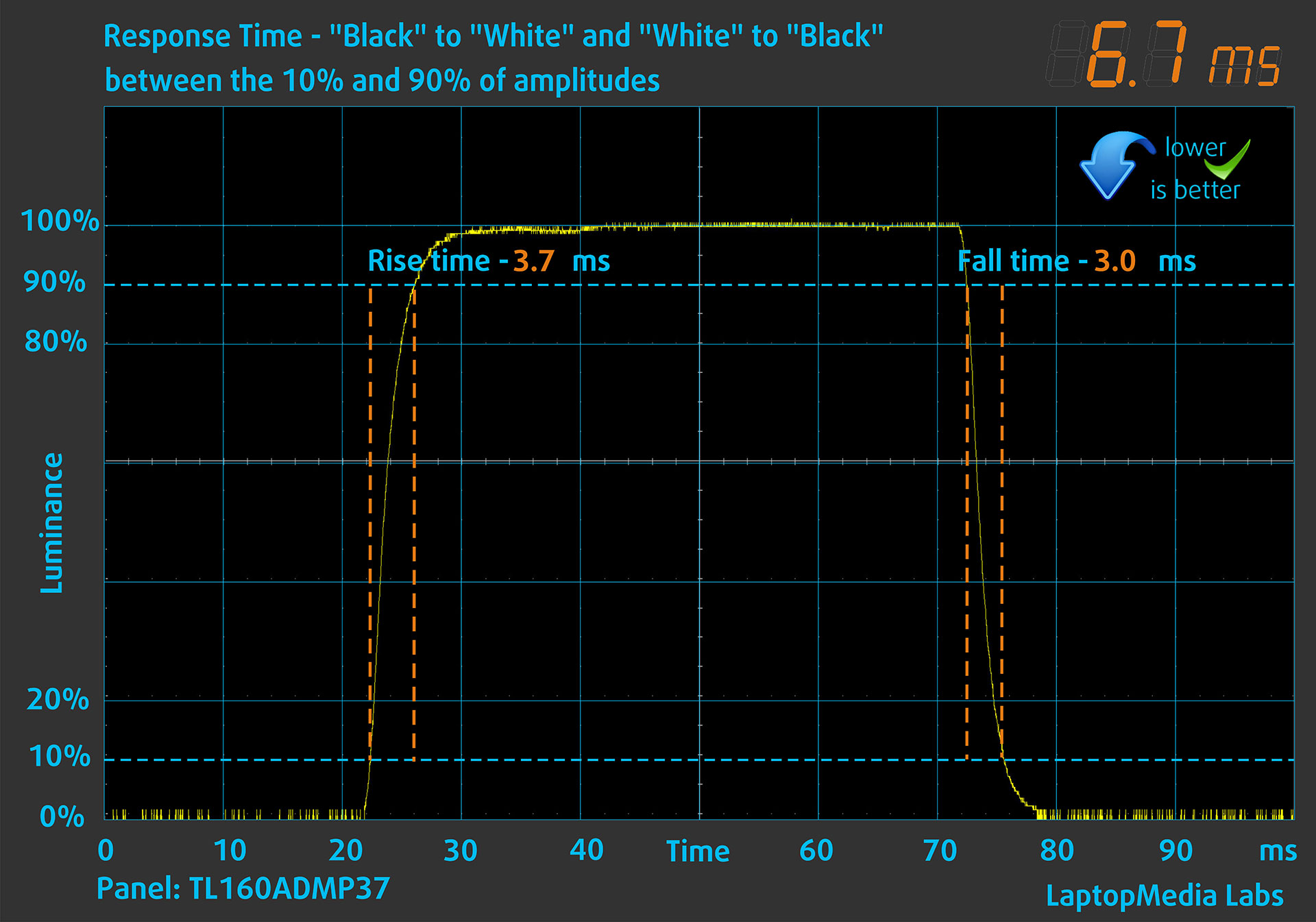
We first tested the pixel response time using the conventional black-to-white and white-to-black method, measuring the transitions between 10% and 90% of the signal amplitude. The combined rise-and-fall time was 6.7 ms, which is a good result for an IPS-class laptop display.
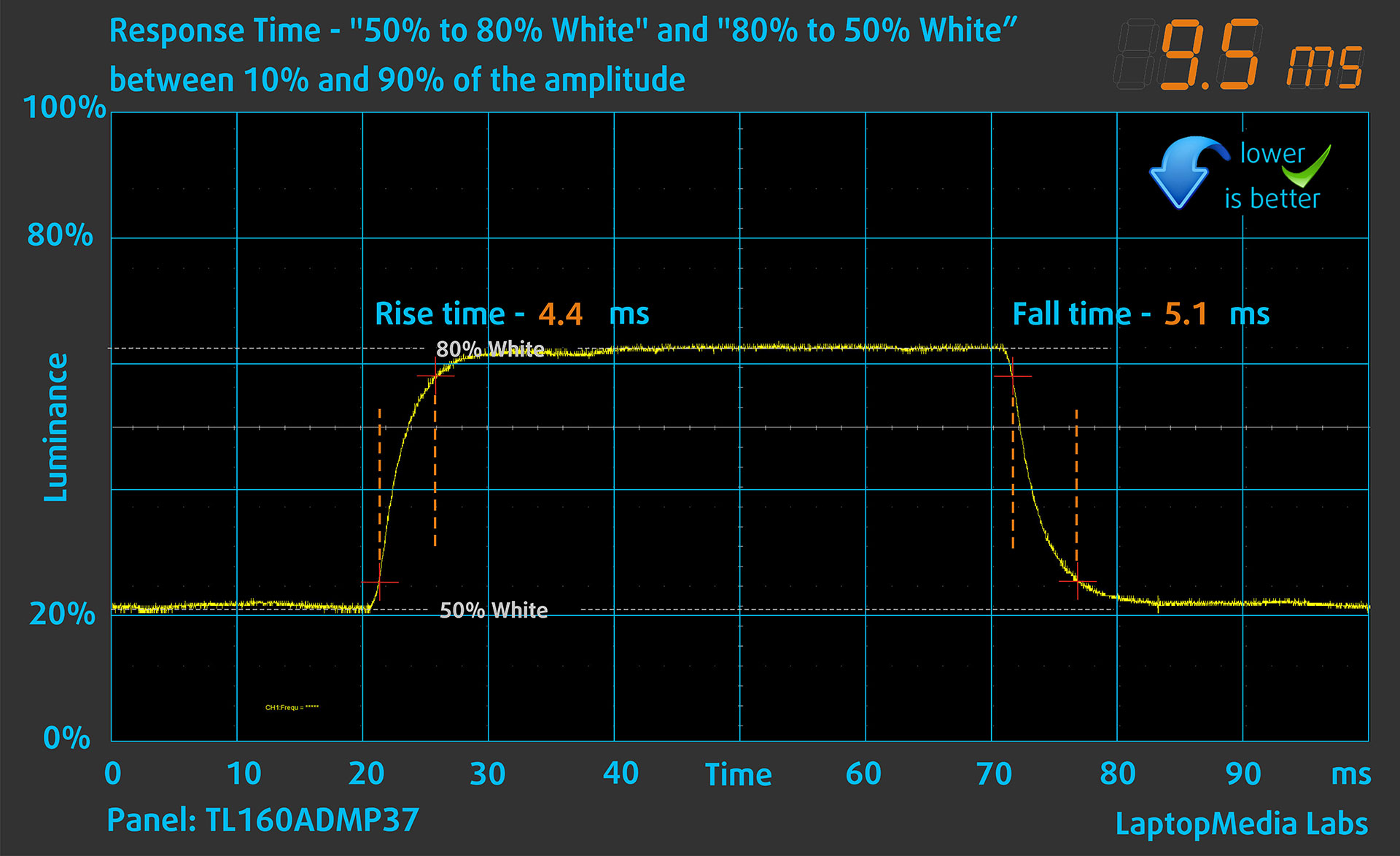
In the more demanding Gray-to-Gray test between 50% and 80% white, we measured a combined response time of 9.5 ms, consisting of a 4.4 ms rise time and a 5.1 ms fall time.
At 180 Hz, each refresh cycle lasts approximately 5.56 ms. The measured 4.4 ms rise time and 5.1 ms fall time both fit within a single refresh cycle, allowing the panel to keep pace well with its high refresh rate in this transition. Response times can vary between different shades, but this is a strong result for an IPS-class gaming display.
Health Impact: PWM (Screen Flickering)
Some displays use PWM to regulate brightness, which means that instead of reducing the light intensity continuously, they pulse or flicker. Our brain merges the rapidly changing image, so the screen appears darker, but this can increase eye strain, especially when the pulse frequency is low. You can read more about this in our dedicated article on PWM.
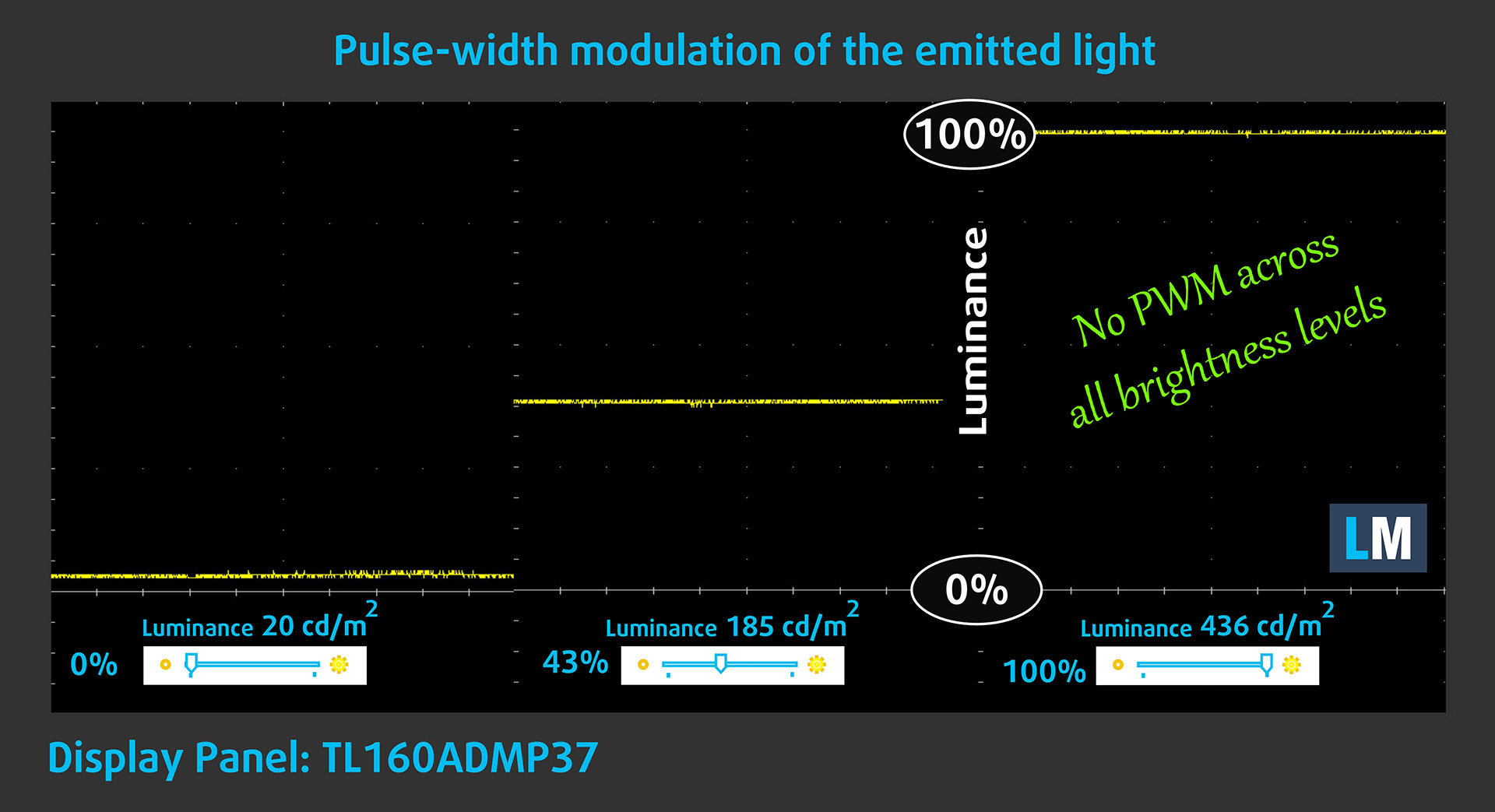
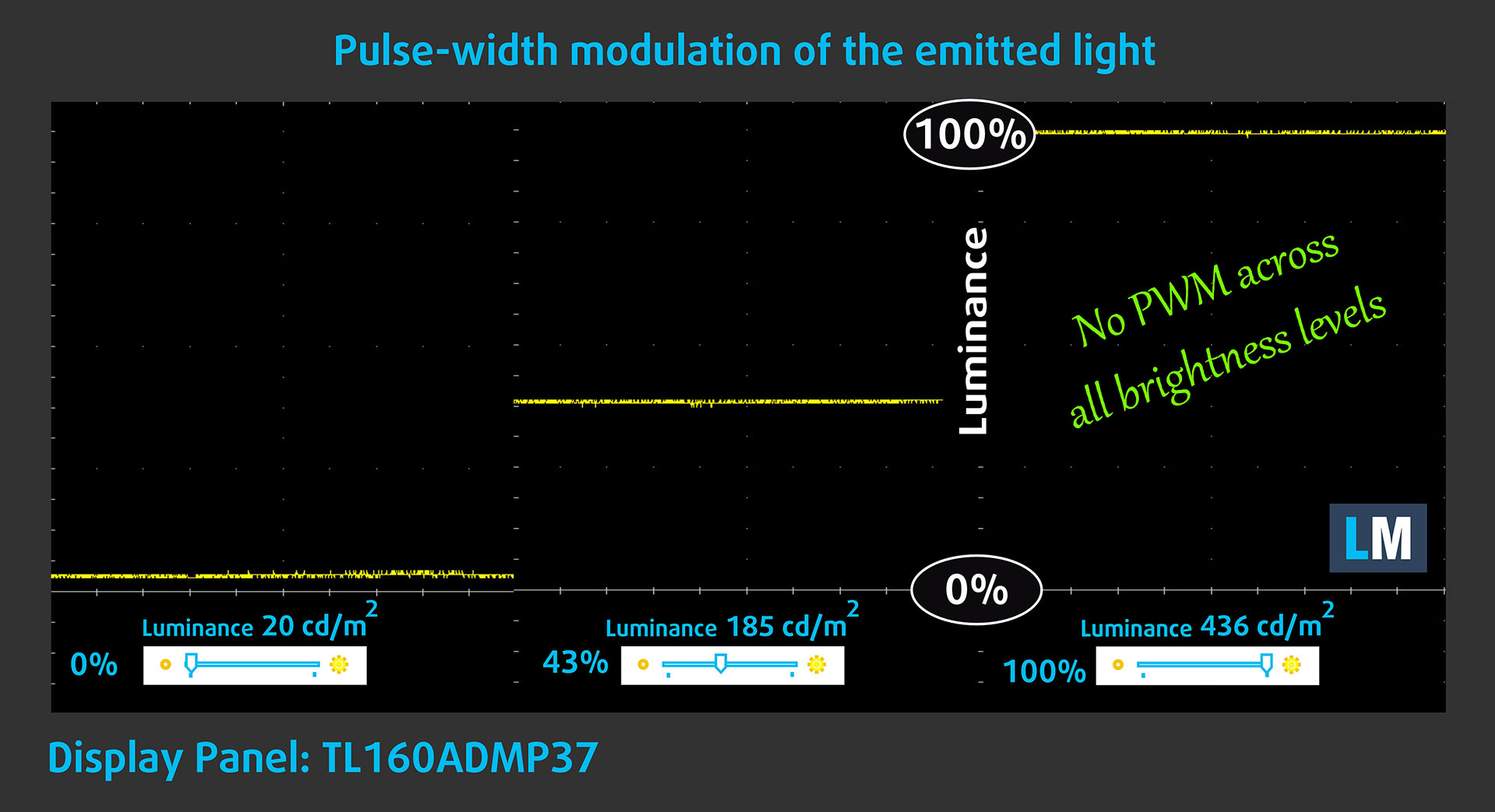
In the graph below, you can see the intensity of the emitted light at different brightness levels. The vertical axis represents brightness, while the horizontal axis represents time.
The Acer Predator Helios Neo 16 (PHN16-I31)‘s display does not use PWM to regulate brightness at any tested level. This makes it comfortable for prolonged use in this respect.
Health Impact: Blue Light Emissions
Our Health-Guard profile reduces blue light emissions and may improve viewing comfort, especially in the evening, while keeping colors perceptually accurate. On compatible PWM-controlled displays, it can also reduce flicker by keeping the backlight at a PWM-free level and adjusting perceived brightness through the profile. For maximum color accuracy, use the Design and Office profile.
You can find more information in our dedicated article on display blue light and our solutions.
Health Impact: Screen Reflectance
Displays with higher surface reflectance can cause eye fatigue in bright ambient conditions due to visible reflections. We measure screen reflectance with the display switched off and positioned at a 60° angle.
The reflectance of the Acer Predator Helios Neo 16 (PHN16-I31)’s screen is 53.6 GU.
Low Reflectance: < 45 GU
Medium Reflectance: 45–80 GU
High Reflectance: > 80 GU
With a measured reflectance of 53.6 GU, the screen falls within our Medium Reflectance category but remains relatively close to the low-reflectance threshold. Its matte surface controls reflections reasonably well, although strong light sources can still reduce visibility in darker scenes.
Get Our Profiles
Since our profiles are tailored to each individual display model, this article and its respective profile package are intended for Acer Predator Helios Neo 16 (PHN16-I31) configurations equipped with the TL160ADMP37 (TMA2076), 2560 × 1600 IPS panel.
Should you experience problems downloading the purchased file, try opening the link you receive via email in a different browser. If the downloaded file has a .php extension instead of being an archive, change its extension to .zip or contact us at [email protected].
Read more about the profiles HERE.
In addition to receiving efficient and health-friendly profiles, by buying LaptopMedia's products you also support the development of our labs, where we test devices in order to produce the most objective reviews possible.

Design and Office
The Design and Office profile makes display colors as close to real as possible.Ideal not only for professionals but also for everyday users, it meets sRGB standards (D65 white point, sRGB gamma) with minimal DeltaE for precise color reproduction on your panel.

Gaming and Movies
Have you ever watched a movie where, during dark scenes, you can barely see anything? Many displays fail to distinguish dark tones properly. Our Gaming and Movies profile enhances low-light performance, like HDR tech, using a gamma curve tailored to human perception — ideal for gamers seeking faster reactions and clearer visuals.

Health-Guard
Our Health-Guard profile protects your eyes by eliminating PWM flickering, reducing strain and fatigue, and minimizing harmful Blue light exposure that can disrupt sleep and health. It uses software dimming and a gamma curve tailored to human perception for comfort and safety during screen use.
Get All The Profiles With 33% Discount!

Sound Quality
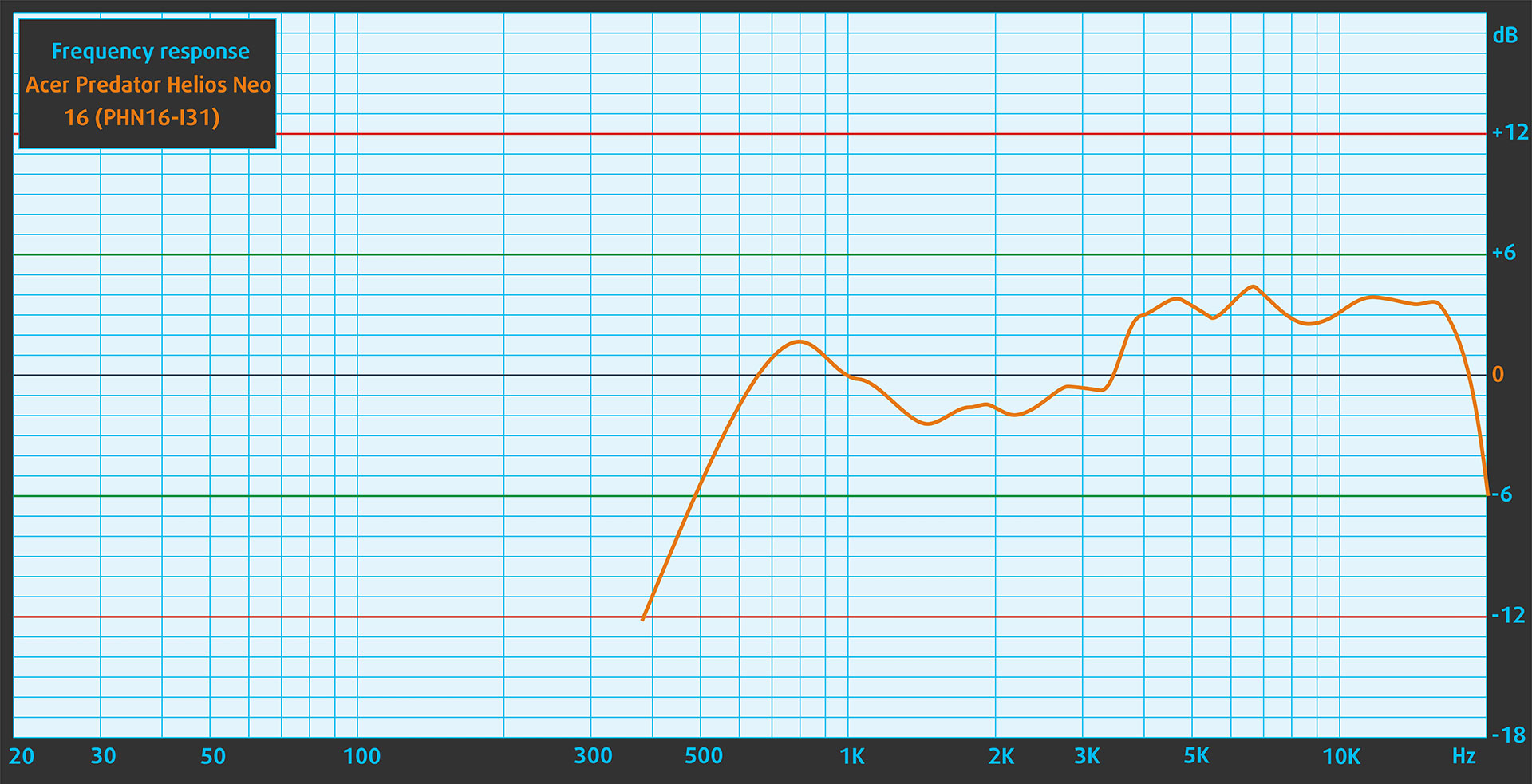
The Acer Predator Helios Neo 16 (PHN16-I31) uses a two-speaker audio system with DTS:X Ultra support. The speakers produce clear and intelligible mids and highs, while the bass is better represented than on many laptops in this class. As expected from built-in laptop speakers, however, they cannot reproduce true low-frequency depth, and a headset or external speakers remain preferable for a more immersive gaming experience.
Work Performance: CPU, Storage, AI
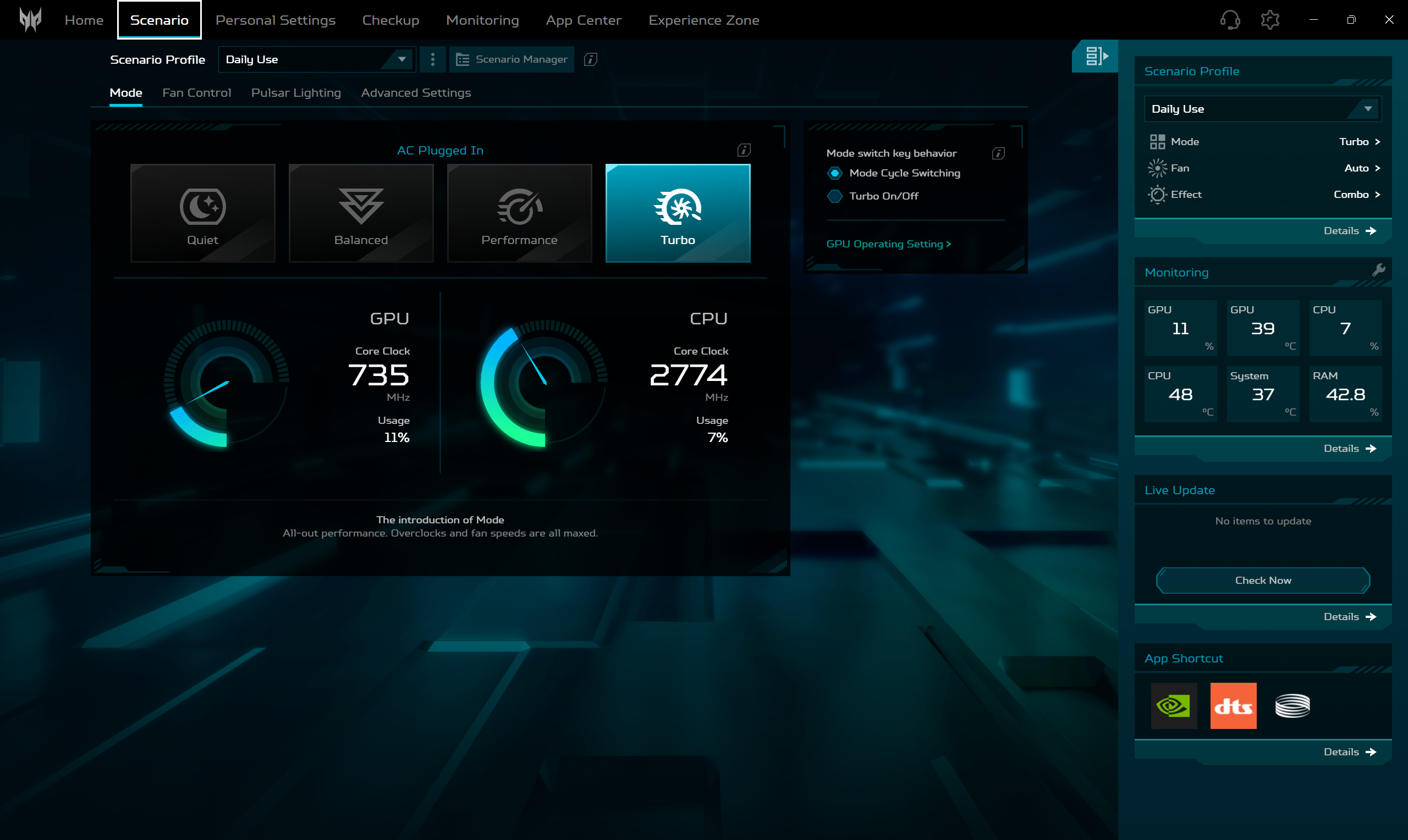
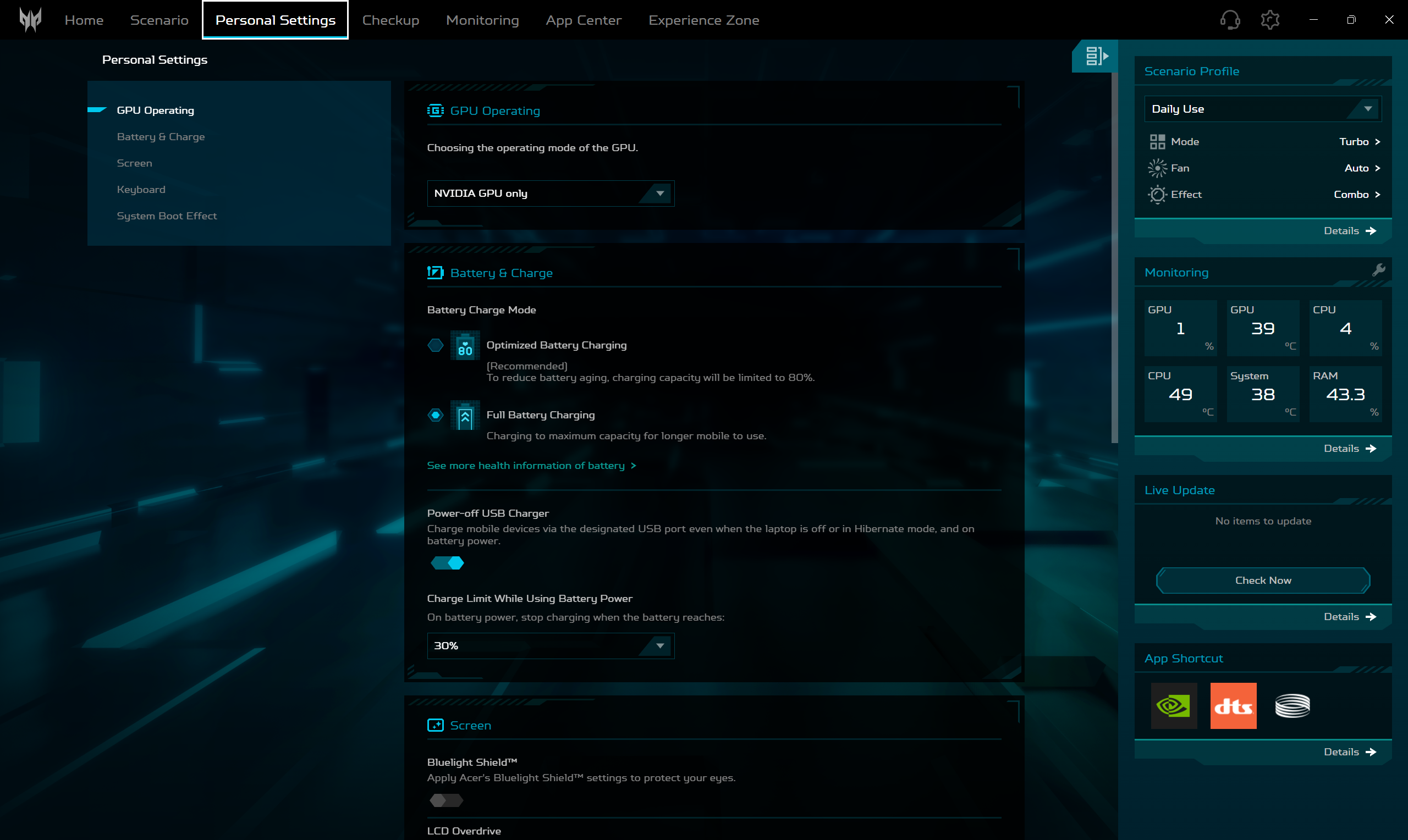
All performance and temperature tests below were conducted with Turbo Mode enabled in PredatorSense:
CPU and Work Performance
The Acer Predator Helios Neo 16 (PHN16-I31) is available with Intel HX-series processors, including the Core i5-14450HX, Core i7-14650HX, and Core i9-14900HX. All three use a hybrid architecture with Performance and Efficient cores, while the higher-tier chips offer more cache and higher boost clocks. Since the CPU range is fairly wide, it is worth checking our Top Laptop CPU Ranking before choosing a configuration.
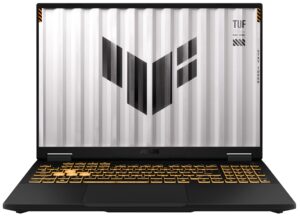
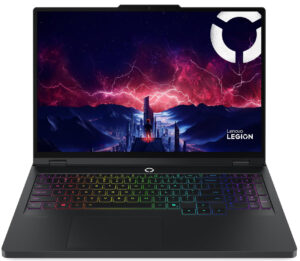
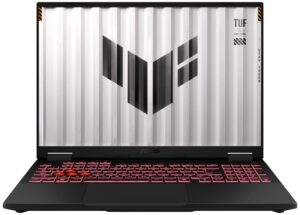
Our configuration uses the Core i7-14650HX, which sits between the Core i5 and Core i9 options. It delivers a meaningful performance uplift over the Core i5-14450HX in the ASUS TUF Gaming F16 FX608 (detailed review), particularly in sustained 3D rendering. It trails the Ryzen 7 8745HX in the Lenovo Legion Pro 5 (16″, Gen 10) (detailed review) slightly in Geekbench, but overtakes it in Cinebench 2024. The newer Ryzen AI 9 HX 470 in the Lenovo Legion 7a (16″, Gen 11) (detailed review) is faster overall, although the Core i7-14650HX remains reasonably close in 3D rendering. Intel’s 14th Gen HX platform is no longer cutting-edge, but it is still highly competitive for demanding productivity and rendering workloads.
Single-core performance ensures smooth operation and responsiveness in operating systems, providing a better user experience.
Results are from the Geekbench 6 Single-Core test (higher is better)


Multi-core performance is essential for handling complex and demanding tasks, such as Video editing, CAD, and Scientific simulations.
Results are from the Geekbench 6 Multi-Core test (higher is better)
Here, we evaluate the CPU's performance using a real-world 3D rendering task, assessing its ability to handle complex computations and rendering workloads efficiently.
Results are from the Cinebench 2024 Multi-Core test (higher is better)
Storage Performance
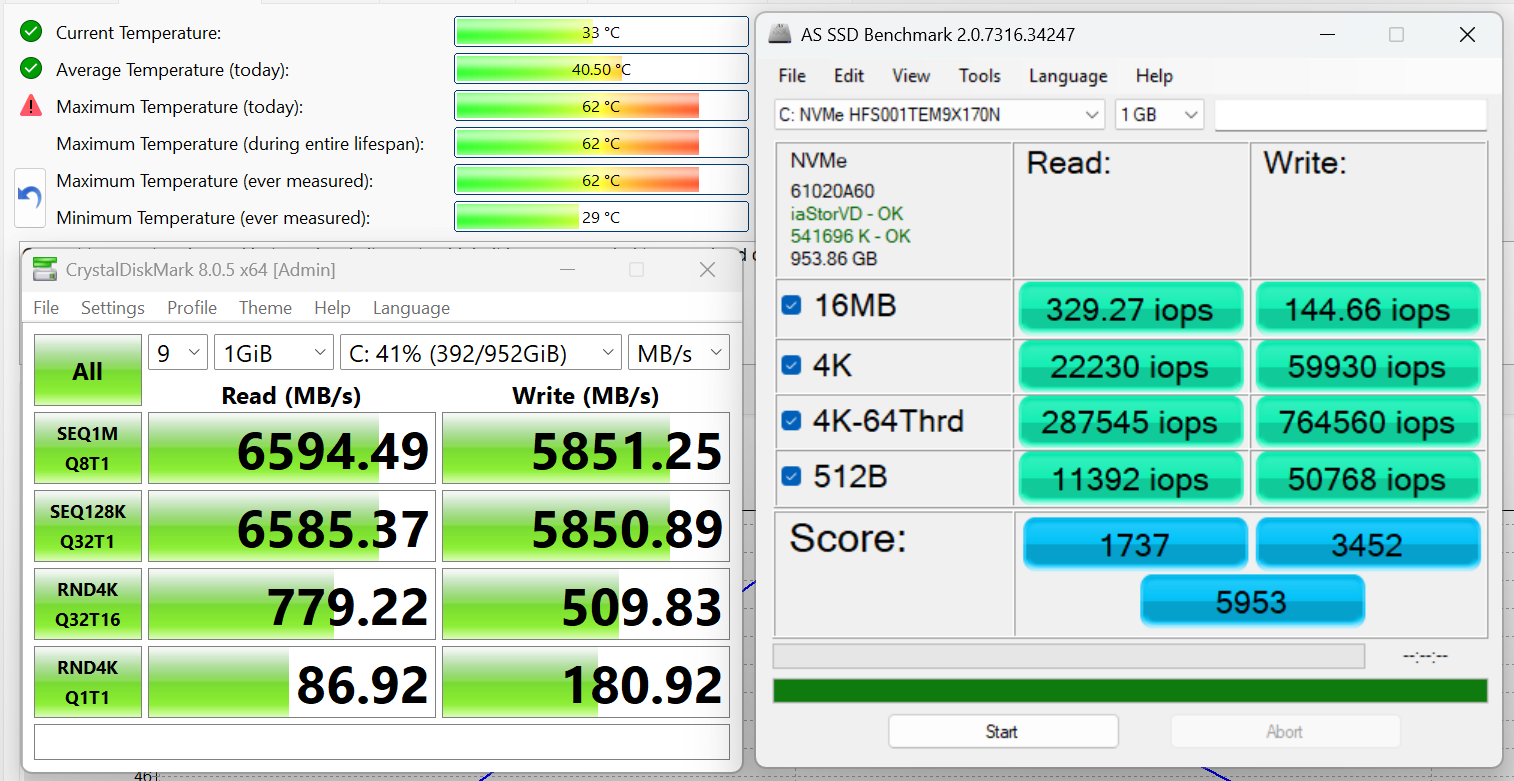
We ordered a configuration with 1TB of storage, and our Predator Helios Neo 16 arrived with an SK Hynix HFS001TEM9X170N PCIe 4.0 NVMe SSD.
The drive delivered excellent sequential performance in our tests, reaching approximately 6.6 GB/s read and 5.9 GB/s write speeds. Its highest recorded temperature during our storage testing was 62°C, which is warm but still acceptable for a high-performance NVMe drive.
AI Performance
AI performance depends primarily on the selected NVIDIA GPU. The RTX 5050, RTX 5060, and RTX 5070 configurations provide progressively more acceleration for local image generation, video processing, creative applications, and other GPU-assisted AI workloads.
Here you can see the position of the GPUs and CPUs (NPUs) found within the Acer Predator Helios Neo 16 (PHN16-I31) in our AI Hardware Performance Rankings based on their AI processing power, measured in TOPS (Tera Operations Per Second) - a critical metric indicating the computational throughput, particularly for AI tasks.
The first column shows peak performance for INT8/FP8 precision, which is the most widespread metric for evaluating AI inference capabilities. We exclude Sparsity to provide a more accurate reflection of AI performance in dense computation scenarios where sparsity optimizations may not be applicable. The second and third columns show the performance with Sparsity, and FP4 TFLOPS, when supported.
For SoCs, the results reflect the peak performance of the integrated NPU. Additionally, it’s important to note that, according to Microsoft, a NPU must have at least 40 TOPS of AI computing power for the PC to be considered “AI-capable.”
| # | GPU / CPU (NPU) | TOPS INT8/FP8 No Sparsity | TOPS INT8/FP8 Sparsity | TFLOPS FP4 Sparsity |
|---|---|---|---|---|
| 849. | NVIDIA GeForce RTX 5070 (Laptop, 8GB GDDR7) | 173 | 346 | 692 |
| 1015. | NVIDIA GeForce RTX 5060 (Laptop) | 133 | 266 | 532 |
GPU and Gaming Performance
The Acer Predator Helios Neo 16 (PHN16-I31) can be configured with an NVIDIA GeForce RTX 5050, RTX 5060, or RTX 5070 Laptop GPU. All three options use 8GB of GDDR7 memory on a 128-bit bus and are configured for up to 100W of GPU subsystem power. This gives the series several performance tiers, although upgrading to the RTX 5070 does not provide additional VRAM. You can compare these options with other laptop graphics solutions in our Top Laptop Graphics Ranking.
Our RTX 5060 configuration performs almost identically to the same GPU in the ASUS TUF Gaming F16 FX608 (detailed review). The Lenovo Legion Pro 5 (16″, Gen 10) (detailed review) remains around 4–5% faster in the two synthetic tests, while the Helios Neo 16 outperforms the slimmer Lenovo Legion 7a (16″, Gen 11) (detailed review). Overall, the RTX 5060 performs close to the faster implementations of the same GPU and delivers the level of performance expected from a full-sized gaming laptop.
The results are from 3DMark Time Spy (Graphics). Higher is better.
The results are from 3DMark Wild Life Extreme Unlimited. Higher is better.
Gaming Tests

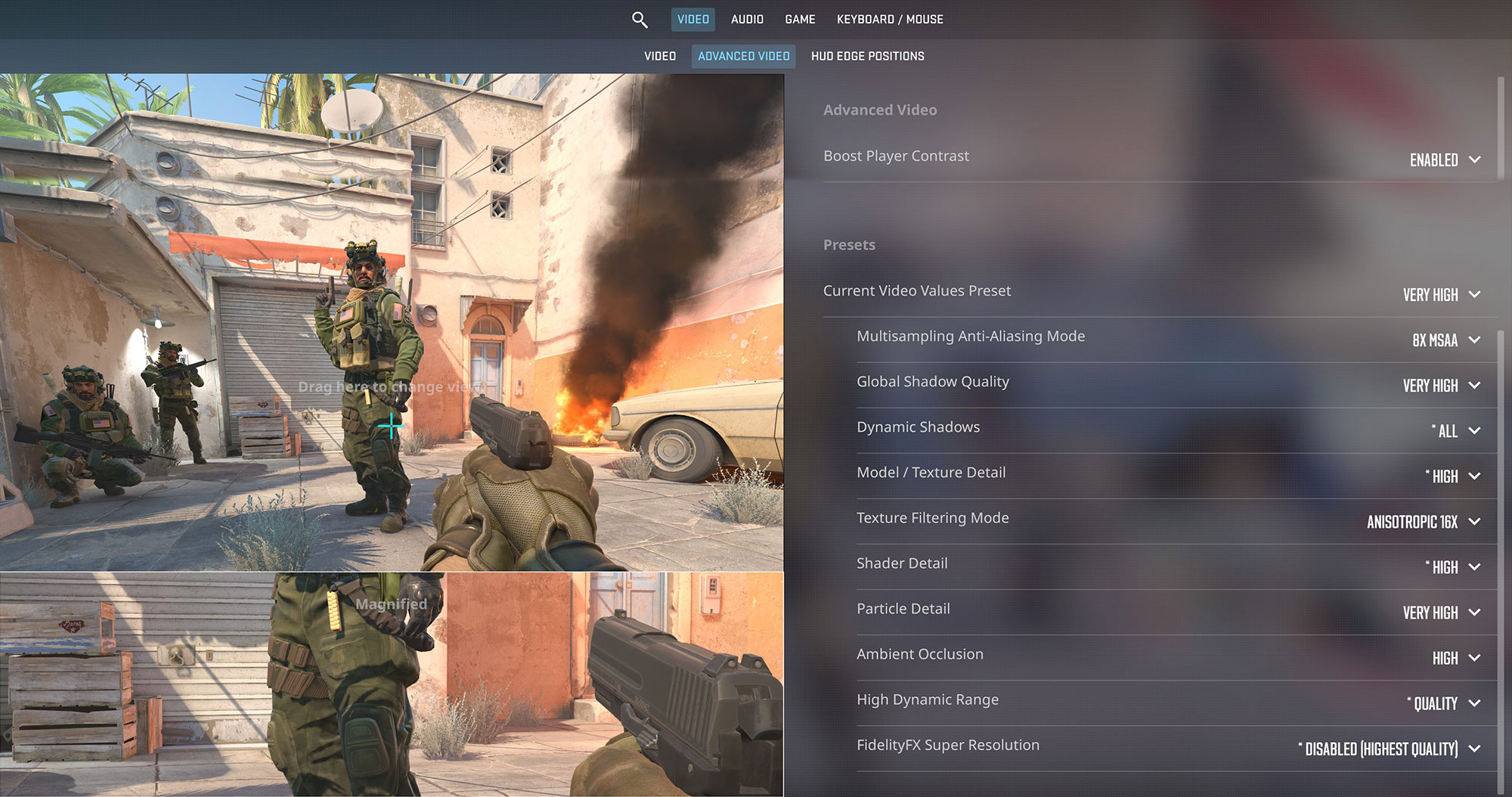
The Predator Helios Neo 16 delivers an excellent esports experience. In Counter-Strike 2, the RTX 5060 produced an average of 171 FPS at the native 1600p resolution using the Very High preset. Although this does not completely saturate the 180 Hz display at all times, it makes very good use of its high refresh rate.
| Counter-Strike 2 | 1600p, Very High (Check settings) |
| Average FPS | 171 FPS |

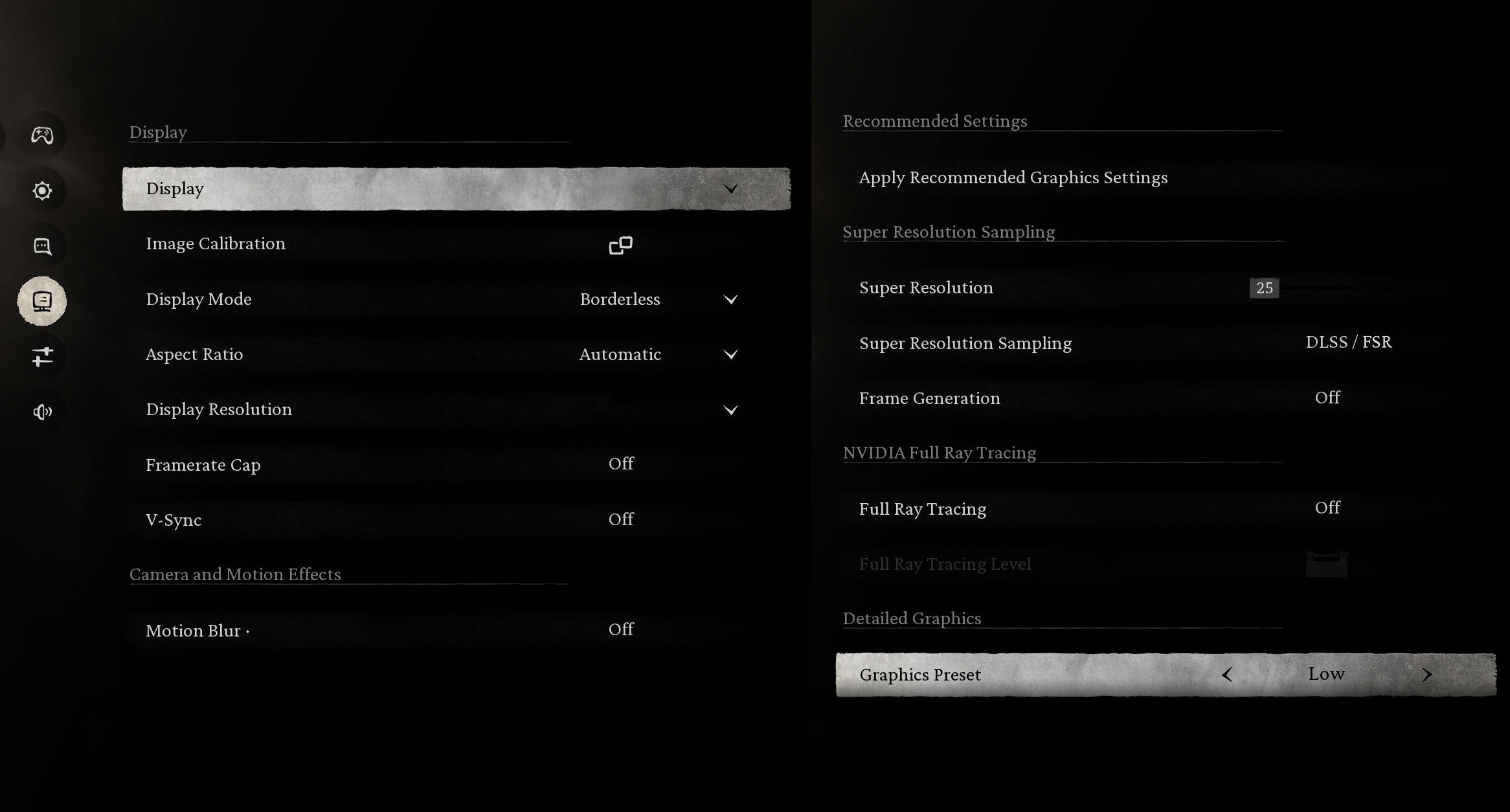
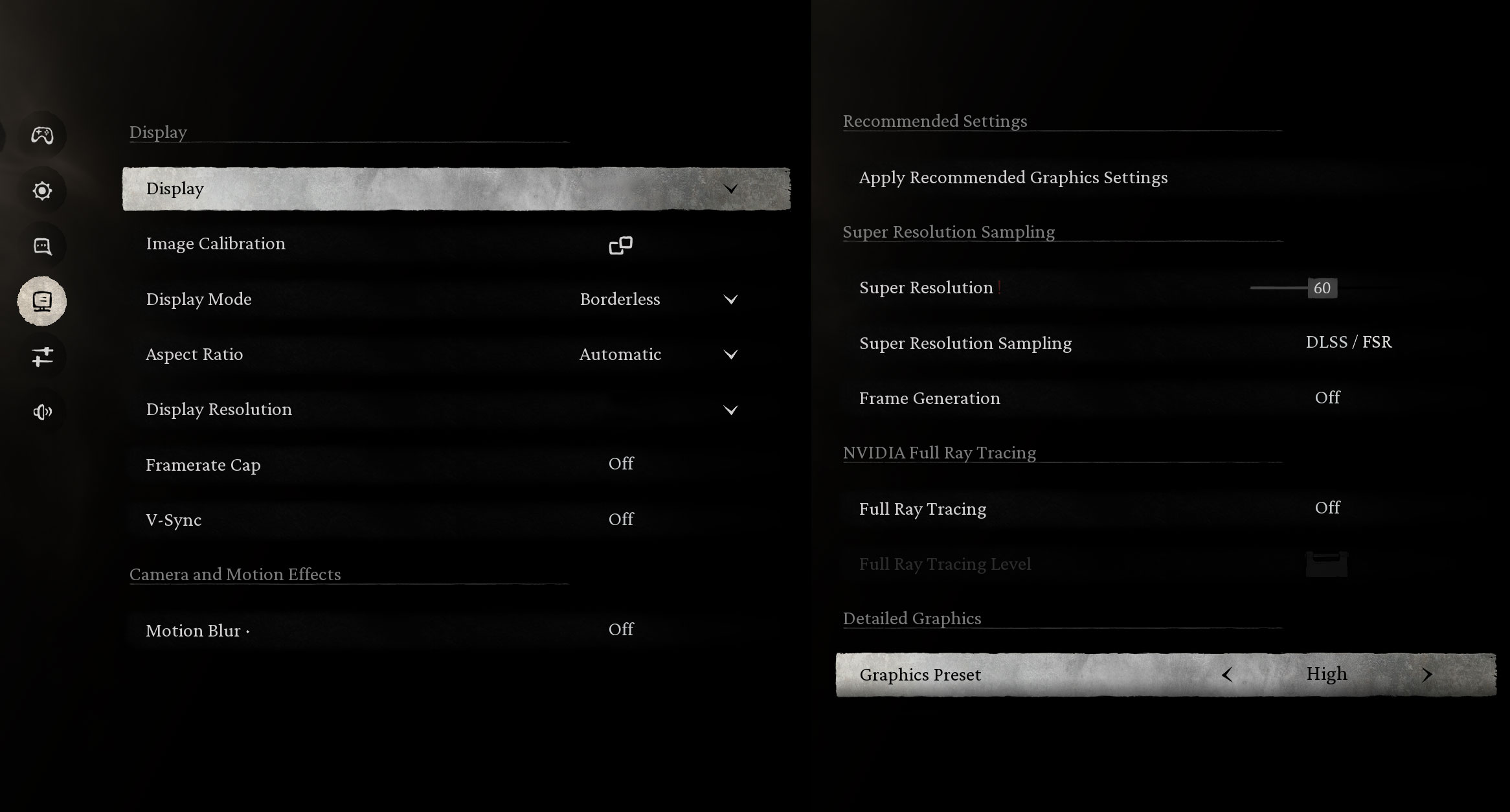
Black Myth: Wukong is considerably more demanding, but the laptop still performs well at its native resolution. It reached 154 FPS on the Low preset and maintained 74 FPS on High, providing a good balance between image quality and smooth gameplay without reducing the resolution.
| Black Myth: Wukong | 1600p, Low (Check settings) | 1600p, High (Check settings) |
| Average FPS | 154 FPS | 74 FPS |

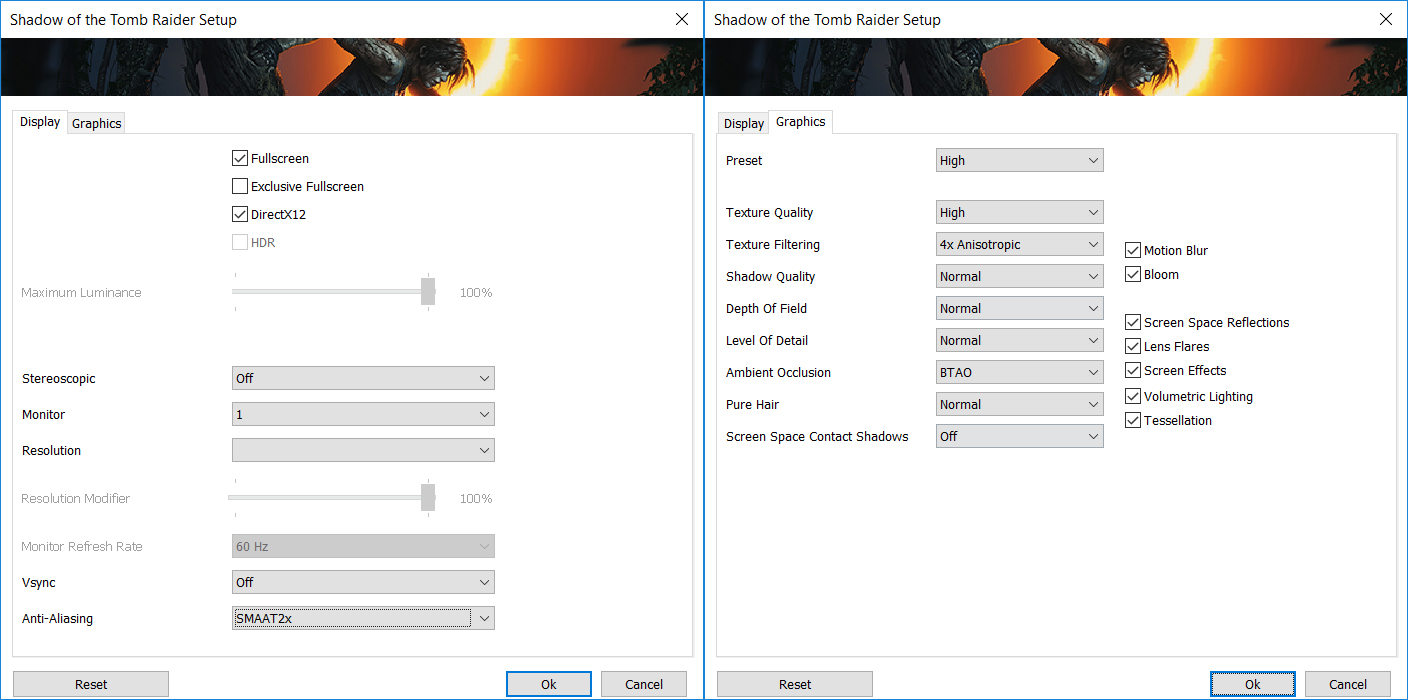
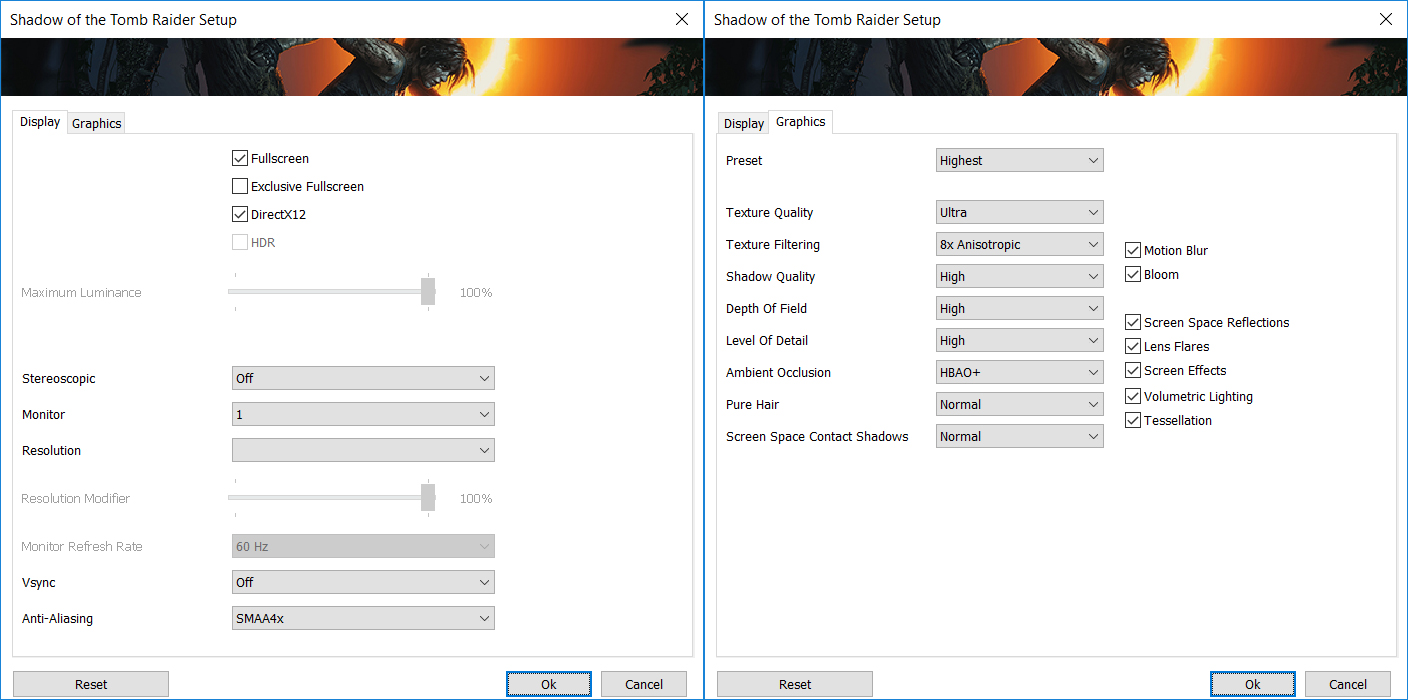
Shadow of the Tomb Raider also runs comfortably at 1600p. The RTX 5060 achieved 106 FPS using the High preset and remained above the 60 FPS threshold on Highest, where it averaged 66 FPS.
| Shadow of the Tomb Raider | 1600p, High (Check settings) | 1600p, Highest (Check settings) |
| Average FPS | 106 FPS | 66 FPS |

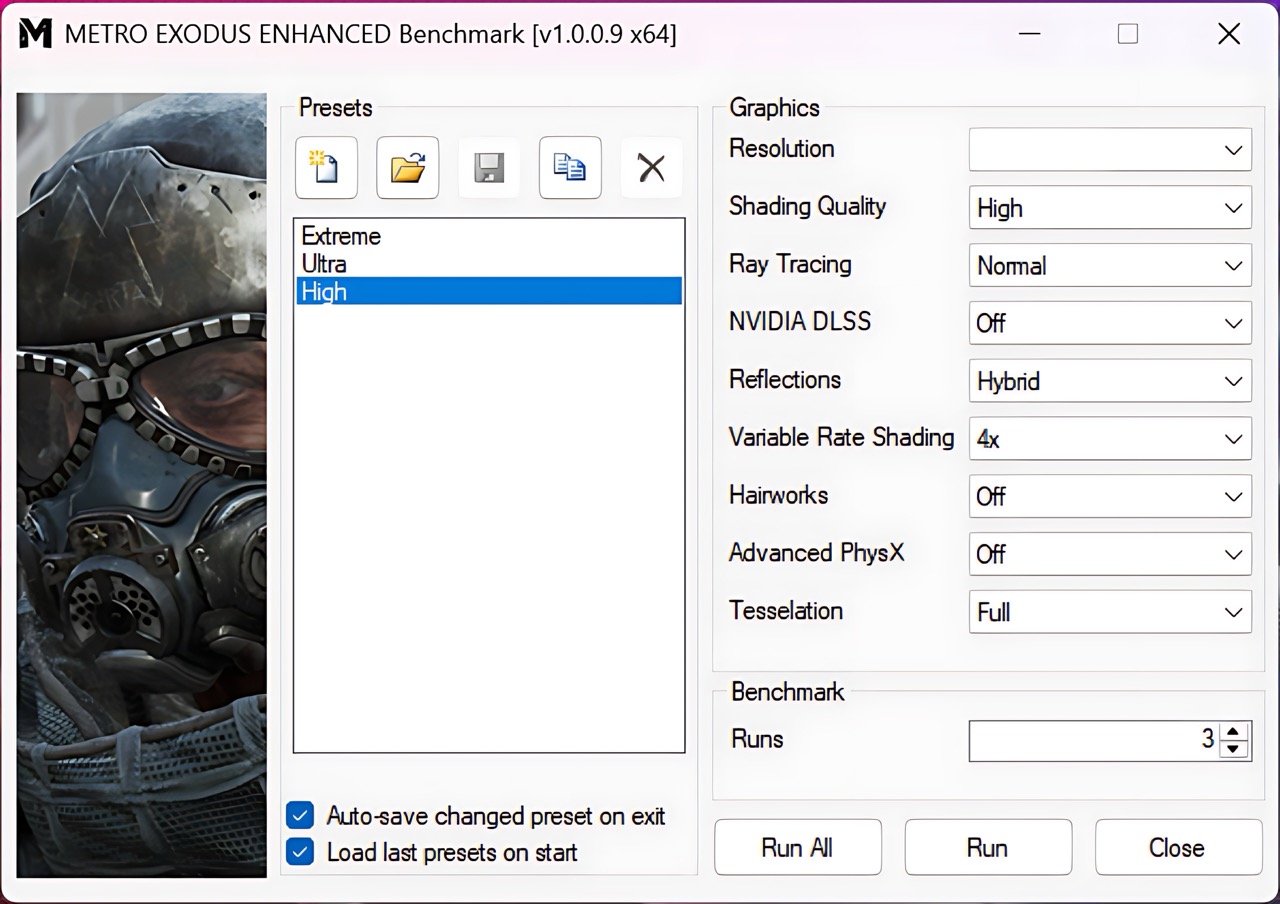
Metro Exodus Enhanced Edition uses hardware-accelerated ray tracing throughout the game and places a much heavier load on the GPU. At 1200p and the High preset, the laptop averaged 89 FPS. For similarly demanding ray-traced titles, reducing the resolution or enabling DLSS will generally provide a better balance between visual quality and performance than playing at native 1600p.
| Metro Exodus Enhanced Edition | 1200p, High (Check settings) |
| Average FPS | 89 FPS |
Overall, the RTX 5060 is a strong match for the WQXGA display. Competitive and moderately demanding games can be played comfortably at native 1600p, while the heaviest AAA and ray-traced titles may require DLSS, reduced settings, or a switch to 1200p. Given that all three GPU options are limited to 8GB of VRAM, the RTX 5060 is likely to be the most balanced configuration unless the RTX 5070 version is available for only a modest price premium.
Temperatures and Performance Stability
At idle, the Intel Core i7-14650HX CPU package settles at approximately 47°C. The cooling fans remain slightly audible, so the laptop is not completely silent even without a demanding workload.
All measurements below were recorded with Turbo Mode enabled in PredatorSense. This profile prioritizes maximum performance and aggressive fan operation. The quieter modes reduce power limits, performance, and noise, although their operating temperatures may not scale proportionally.
Office Work, Web Development, Design
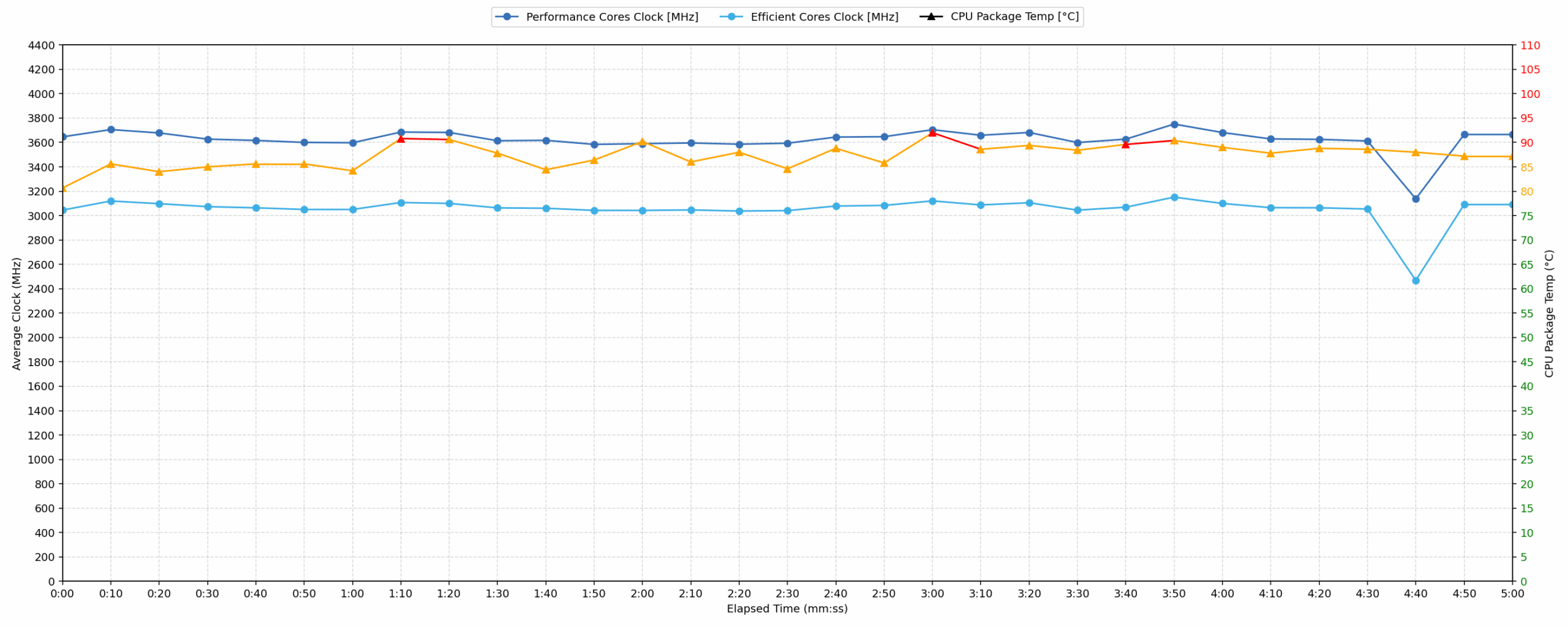
Short periods (0:00–0:10 s) of 100% CPU load
This test shows the CPU’s behavior during short bursts of heavy load. It is particularly relevant to workloads such as web development, programming, opening complex projects, and other tasks that require rapid bursts of processing power.
| Intel Core i7-14650HX | Avg. P-Core Clock | Avg. CPU Temp. | Avg. CPU Power |
| Acer Predator Helios Neo 16 (PHN16-I31) | 3646 MHz | 80°C | 103 W |
| MSI Katana 15 HX B14W | 3614 MHz | 73°C | 88 W |
The Helios Neo 16 adopts an aggressive approach to short CPU workloads. It maintains a slightly higher P-core clock than the MSI Katana 15 HX B14W, but requires approximately 15W more power and runs 7°C hotter to achieve that small advantage. Turbo Mode therefore favors immediate responsiveness over efficiency, allowing the processor to exceed 100W during brief bursts.
Video Editing, Scientific Computing, Software Compilation, 3D Rendering
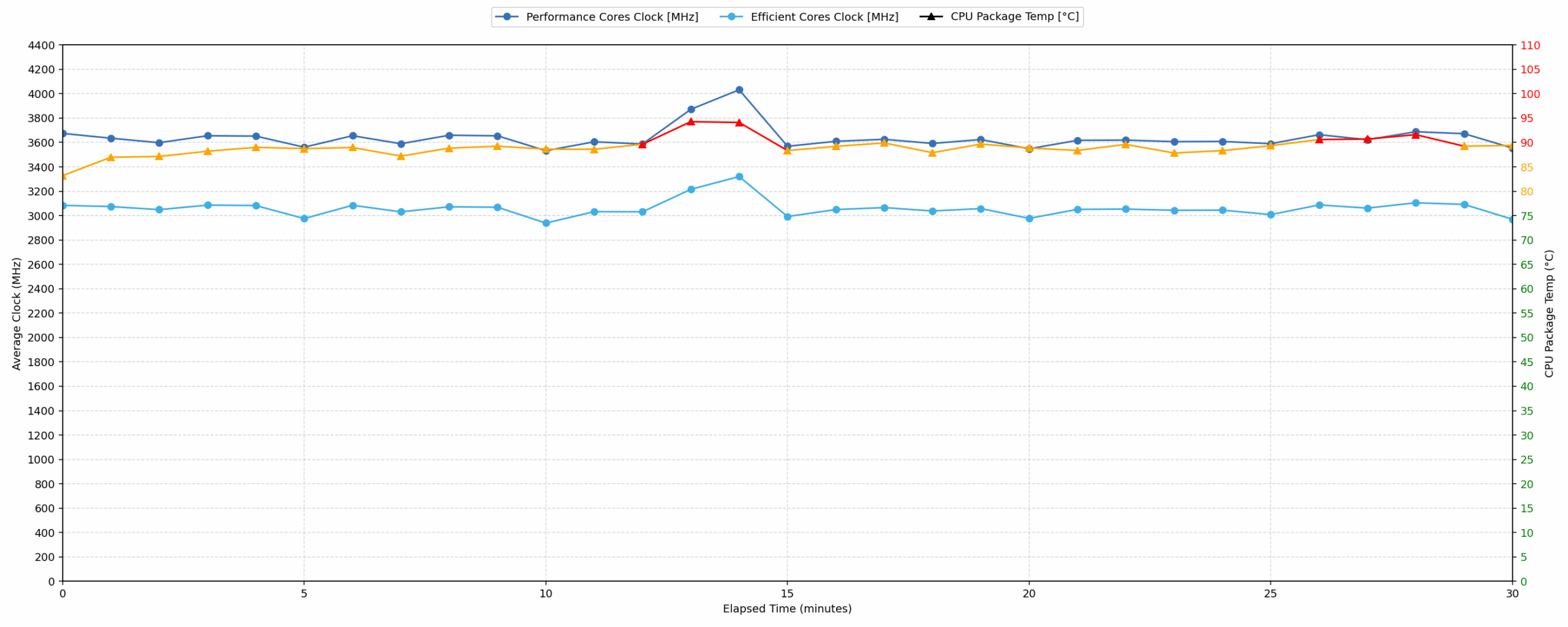
Long periods (0:00–30:00 min) of 100% CPU load
This test shows the CPU’s behavior during prolonged periods of heavy load. It is particularly relevant to users working with video editing, software compilation, scientific calculations, and CPU-based 3D rendering.
| Intel Core i7-14650HX | Avg. P-Core Clock | Avg. CPU Temp. | Avg. CPU Power |
| MSI Katana 15 HX B14W | 3680 MHz | 90°C | 99 W |
| Acer Predator Helios Neo 16 (PHN16-I31) | 3637 MHz | 89°C | 102 W |
During the 30-minute stress test, the Helios Neo 16 sustains an average P-core clock of 3.64 GHz while continuously operating at just over 100W. Its result is very close to that of the MSI Katana 15 HX B14W, with only a minor clock-speed difference and a nearly identical temperature.
More importantly, the Acer does not exhibit a progressive loss of performance as the test continues. The P-core and E-core frequencies remain remarkably stable throughout the run, indicating that the cooling system can sustain the processor’s high power consumption without a major long-term clock collapse. The average temperature of 89°C is high, but expected for an HX-series processor operating in its maximum-performance mode.
Gaming Stability
Continuous gaming simulation (1-hour test)
This test evaluates the laptop’s performance during a sustained GPU workload combined with high CPU usage.
| NVIDIA GeForce RTX 5060 | Avg. GPU Clock | Avg. GPU Temp. | Avg. Memory Clock | Avg. GPU Mem Temp. | Avg. GPU Power |
| Lenovo Legion Pro 5 (16″, Gen 10) | 2821 MHz | 75°C | 1400 MHz | 61°C | 113 W |
| Lenovo Legion 5i (15″, Gen 11) | 2817 MHz | 76°C | 1400 MHz | 72°C | 113 W |
| Lenovo Legion 5a (15″, Gen 11, 15AGP11) | 2773 MHz | 74°C | 1400 MHz | 72°C | 113 W |
| Lenovo LOQ 17IRX10 | 2742 MHz | 85°C | 1393 MHz | 77°C | 113 W |
| Acer Predator Helios Neo 16 (PHN16-I31) | 2638 MHz | 78°C | 1353 MHz | 73°C | 112 W |
| ASUS TUF Gaming A16 FA608 (2025) | 2708 MHz | 84°C | 1387 MHz | 78°C | 111 W |
| ASUS TUF Gaming F16 FX608 | 2714 MHz | 72°C | 1387 MHz | 60°C | 110 W |
| Lenovo LOQ 15 (Gen 10, 15AHP10) | 2626 MHz | 77°C | 1393 MHz | 74°C | 99 W |
| Lenovo Yoga Pro 9i Aura Edition (16″, Gen 11) | 2568 MHz | 71°C | 1375 MHz | 65°C | 99 W |
| Acer Nitro V 16 AI (ANV16-42) | 2575 MHz | 84°C | 1354 MHz | 79°C | 93 W |
| Lenovo Legion 7a (16″, Gen 11) | 2569 MHz | 75°C | 1400 MHz | 74°C | 92 W |
| ASUS V16 (V3607) | 2120 MHz | 76°C | 1232 MHz | 79°C | 68 W |
| MSI Cyborg 15 B2RW | 1971 MHz | 72°C | 1170 MHz | 73°C | 54 W |
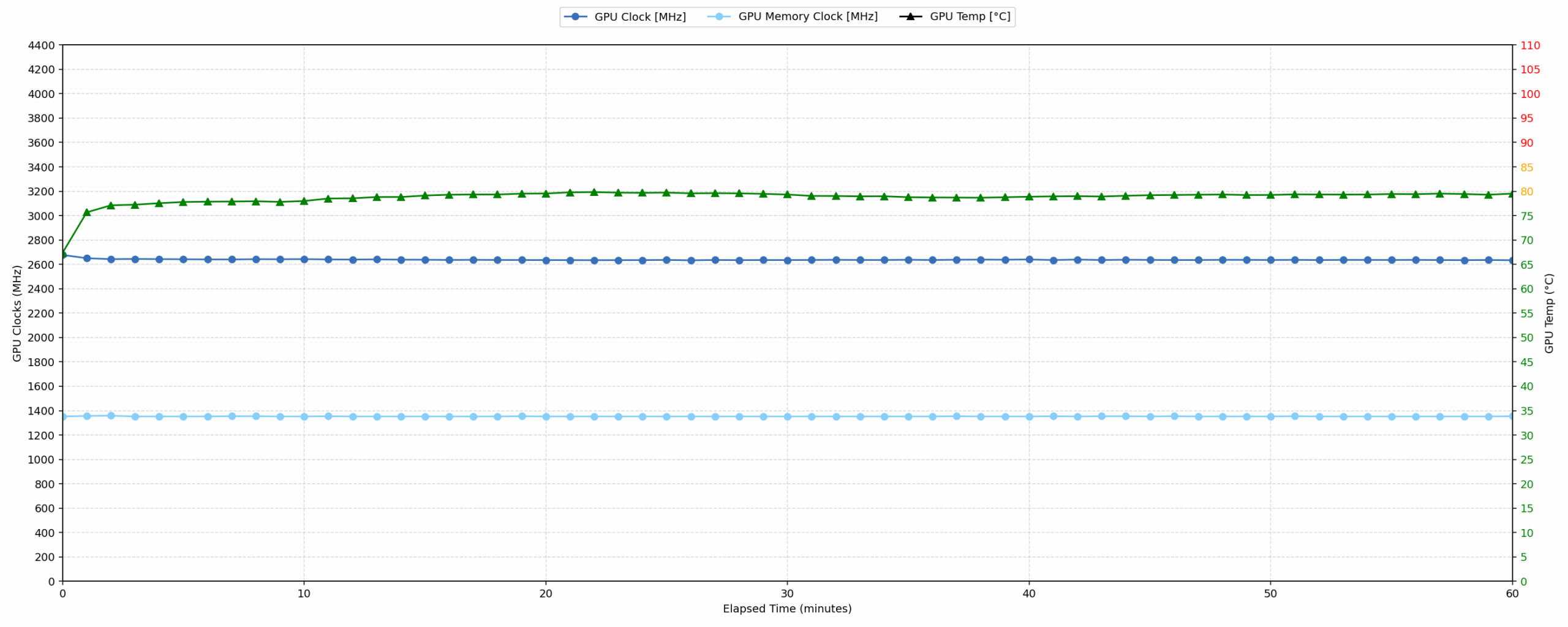
The RTX 5060 remains exceptionally stable throughout the one-hour gaming simulation. Its GPU clock stays close to 2.64 GHz for the entire run, while the memory frequency remains virtually unchanged and the GPU temperature levels off at approximately 78°C. There is no visible late-stage clock reduction or thermal collapse.
The Helios Neo 16 does not achieve the highest sustained RTX 5060 frequency in the comparison. The Lenovo Legion Pro 5 and Legion 5 models maintain higher clocks at a similar reported power level, while the ASUS TUF Gaming F16 also runs faster and cooler. Nevertheless, the Acer remains ahead of lower-powered implementations and delivers stable real-world performance without approaching the concerning temperatures recorded by some competitors.
Our monitoring reported an average GPU power of 112W, while Acer’s specification lists up to 100W of GPU subsystem power for this configuration. These figures may be based on different telemetry definitions, so they should not necessarily be treated as directly equivalent. What matters in practice is that the laptop sustained its reported power level and clock speeds throughout the full one-hour test.
Battery
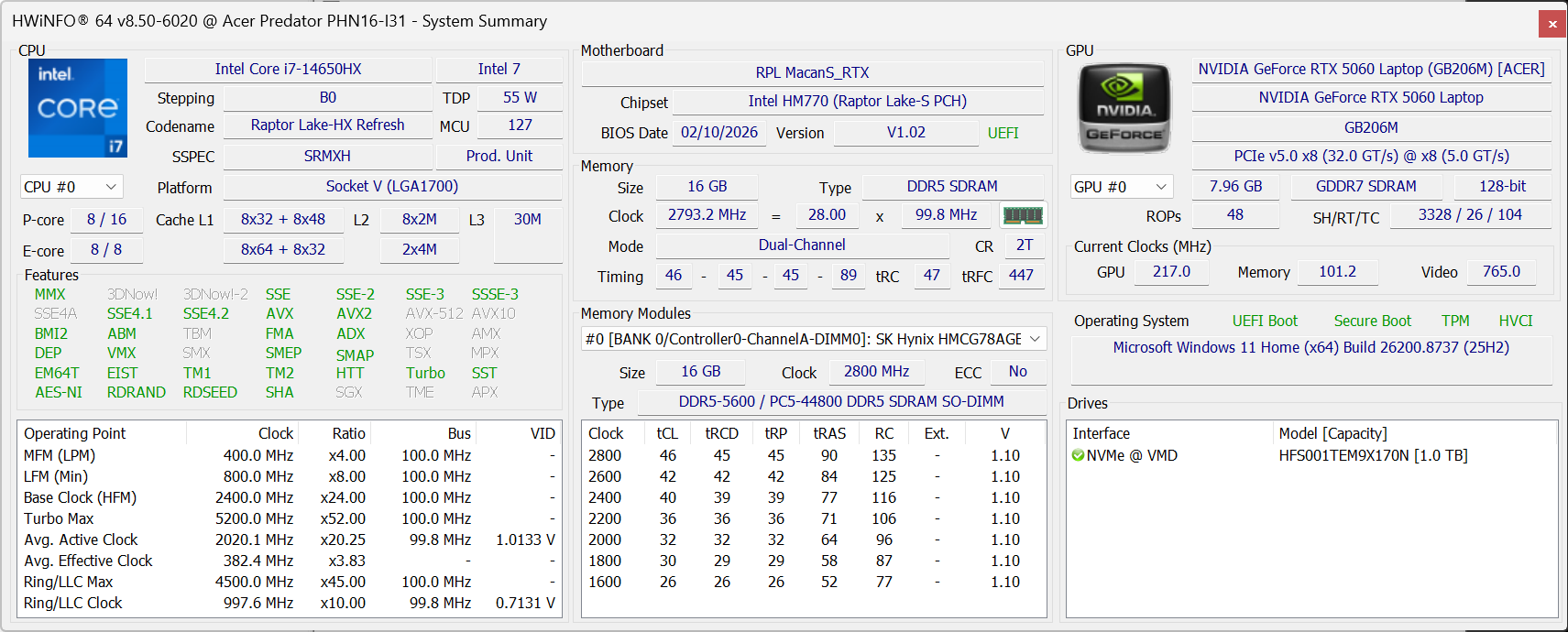
The Acer Predator Helios Neo 16 (PHN16-I31) uses a 4-cell AP24B7T lithium-polymer battery pack with a nominal voltage of 15.6V, a rated capacity of 91Wh, and a typical capacity of 92Wh.
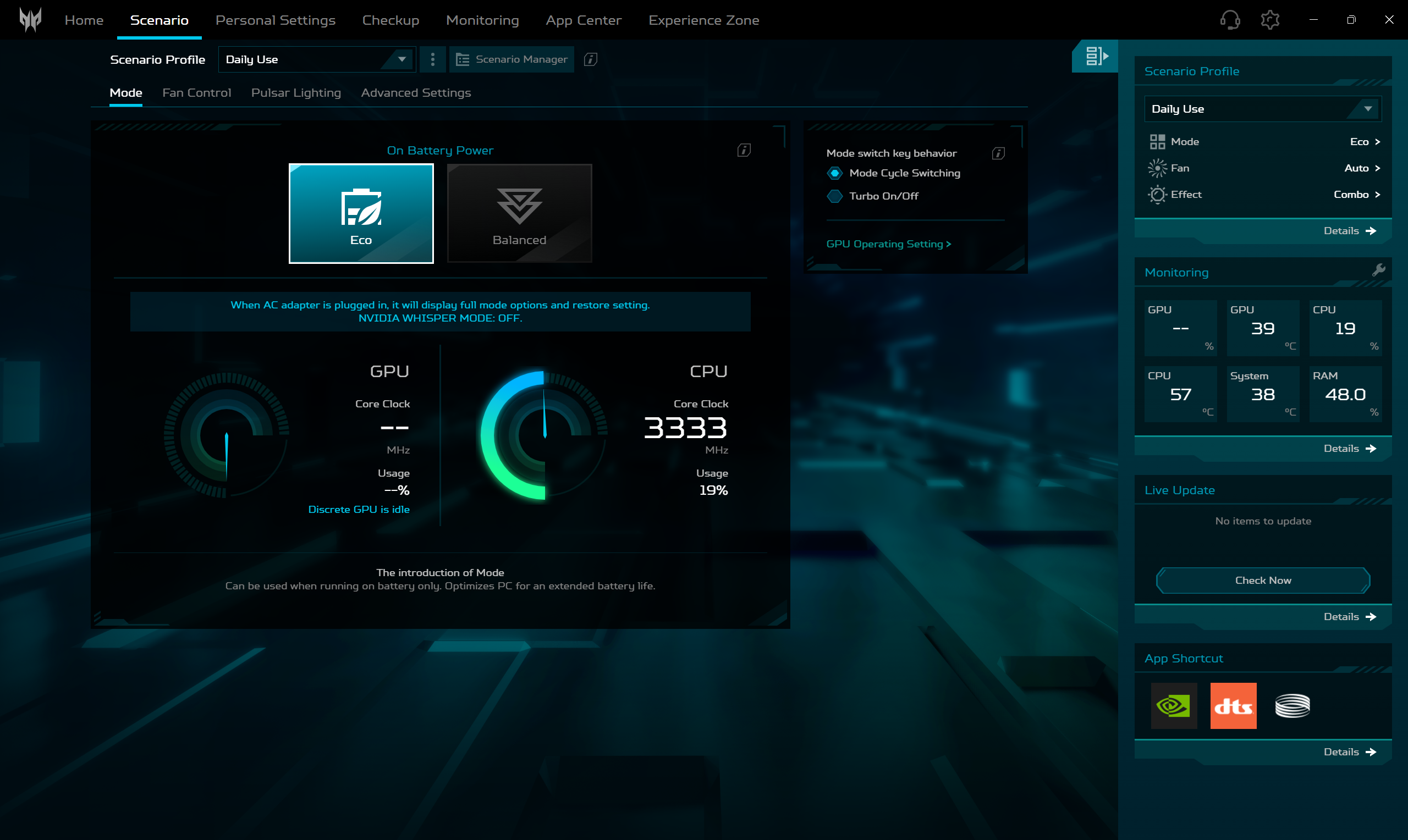
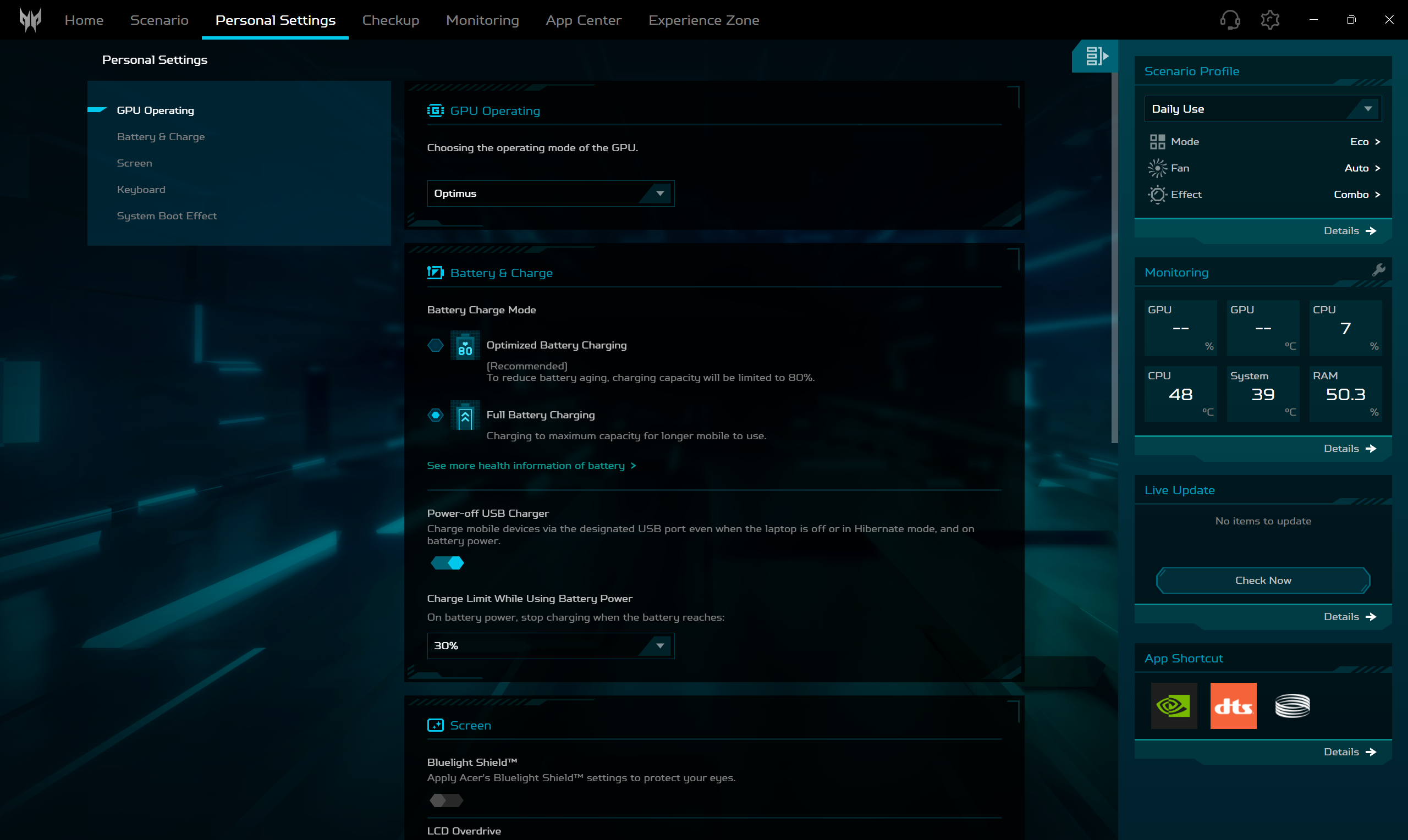
In our local video playback test, the laptop lasted 6 hours and 16 minutes. The display was set to 180 nits in SDR mode, while Eco Mode and Automatic Selection were enabled in PredatorSense.
The result is respectable for a powerful HX-series gaming laptop, although it is not particularly impressive considering the large 92Wh battery. The ASUS TUF Gaming F16 FX608 (detailed review) lasts around 43 minutes longer with a similarly sized battery. On the other hand, the Helios Neo 16 outlasts the slimmer Lenovo Legion 7a (16″, Gen 11) (detailed review) by almost an hour and performs dramatically better than the Lenovo Legion Pro 5 (16″, Gen 10) (detailed review).
Overall, the battery can cover several hours of video playback or lighter everyday work, but the Helios Neo 16 remains primarily a desk-oriented machine. For demanding gaming and sustained performance, the supplied 330W power adapter is still essential.
Brightness: 180 nits; Display Mode: SDR
Time to Full Discharge: Higher is Better
Disassembly, Upgrade Options, and Maintenance
Accessing the internals of the Acer Predator Helios Neo 16 (PHN16-I31) is reasonably straightforward. The bottom panel is secured by nine same-length Torx T6 screws and a series of firm plastic clips around the perimeter. A thin plastic prying tool is strongly recommended, and extra care should be taken around the large rear and side exhaust openings to avoid damaging the plastic frame or radiator fins.
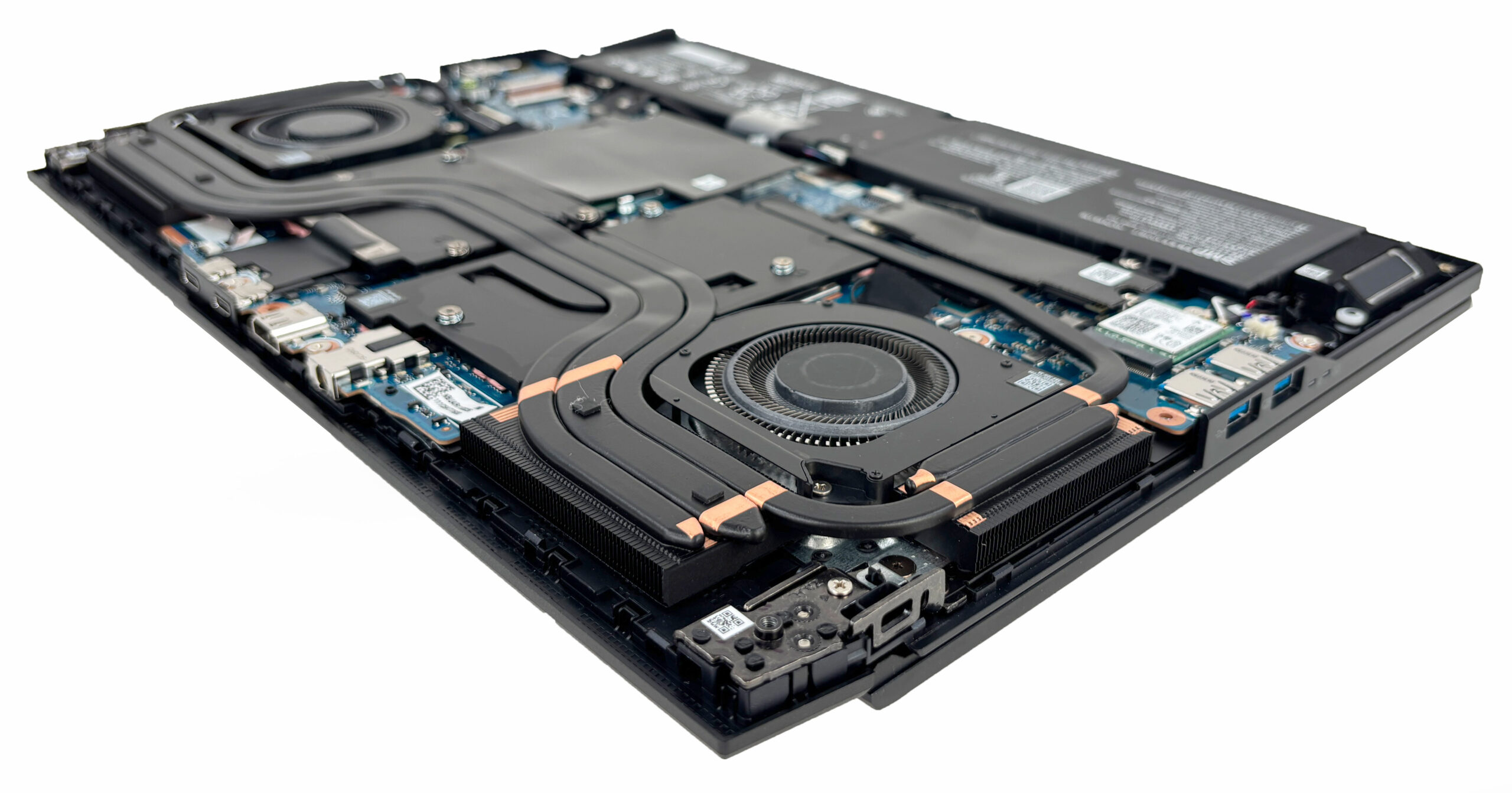
Once the panel is removed, the internal layout is relatively clean and well organized. The large battery occupies the front section, while the cooling system, memory, storage, and wireless components remain readily accessible.
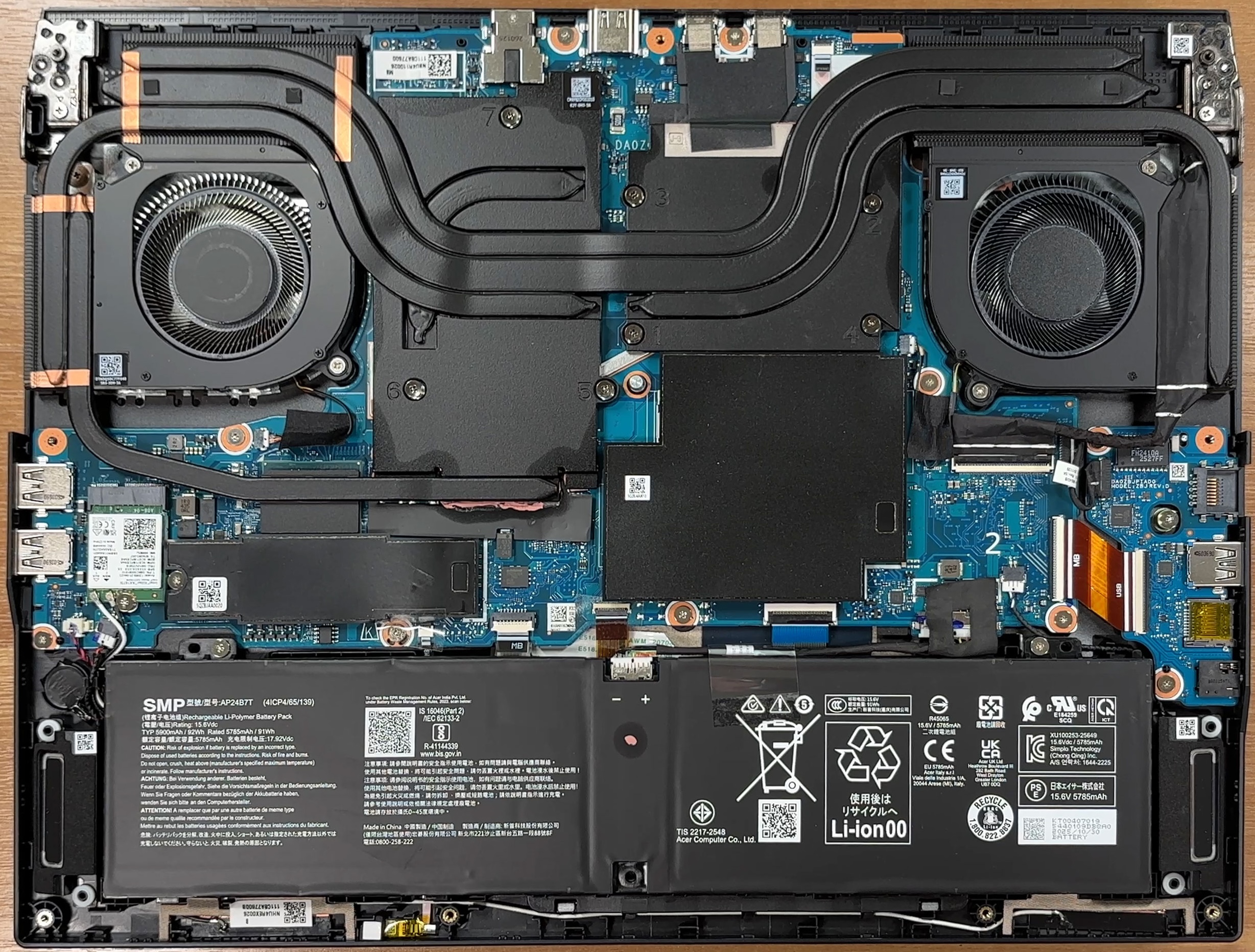
The cooling system uses two different fans rather than a matching pair. One is Acer’s 5th Gen Predator AeroBlade 3D fan with thin metal blades, while the other is a more conventional plastic fan. They are connected to a shared network of Vector heat pipes and large metal plates covering the processor, graphics chip, video memory, and surrounding power-delivery components.
This asymmetrical fan arrangement is unusual, especially for a Predator-branded gaming laptop. Despite the different fan designs, our sustained-load tests showed stable CPU and GPU frequencies without a progressive performance collapse.
The fans are accessible for cleaning after removing the bottom panel. Removing the complete cooling assembly, however, will require the thermal interface materials to be replaced before reassembly. The processor and graphics chip are soldered to the motherboard and cannot be upgraded.
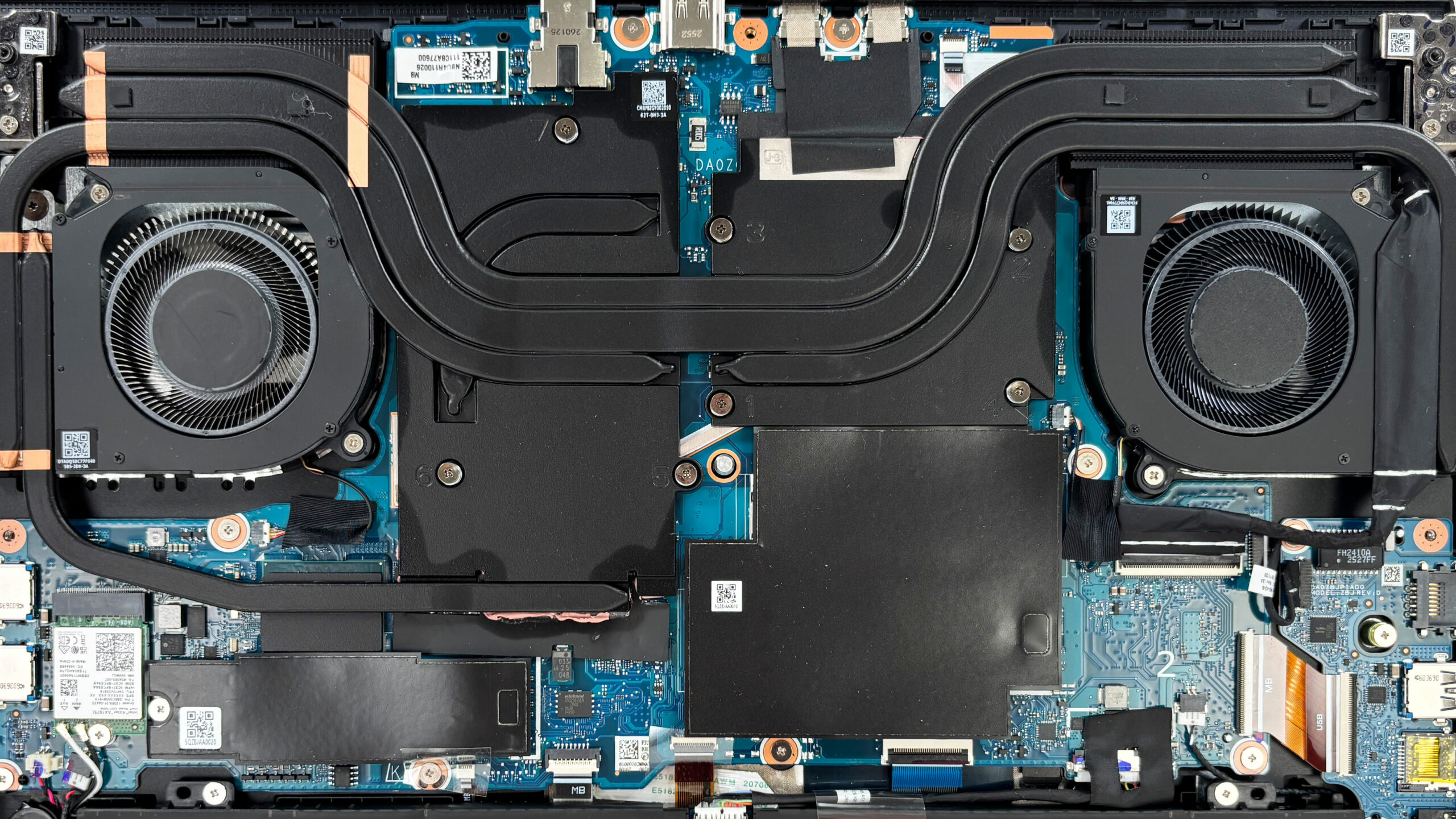
Storage upgradeability is handled by two M.2 slots for PCIe 4.0 NVMe SSDs. Both positions support standard M.2 2280 drives, allowing a second SSD to be installed without replacing the factory drive.
Our configuration arrived with a 1TB SK hynix HFS001TEM9X170N SSD, while the second M.2 slot was left available for expansion. The installed drive and the surrounding components are covered by protective shielding and thermal material.
The laptop provides two DDR5 SO-DIMM slots beneath protective metal covers. Our configuration uses a single 16GB SK hynix DDR5-5600 module, leaving the second slot free for a straightforward upgrade to dual-channel memory.
Acer officially supports up to 32GB of dual-channel DDR5 memory at speeds of up to 5600 MT/s. The final operating frequency may depend on the processor, memory configuration, and installed modules.
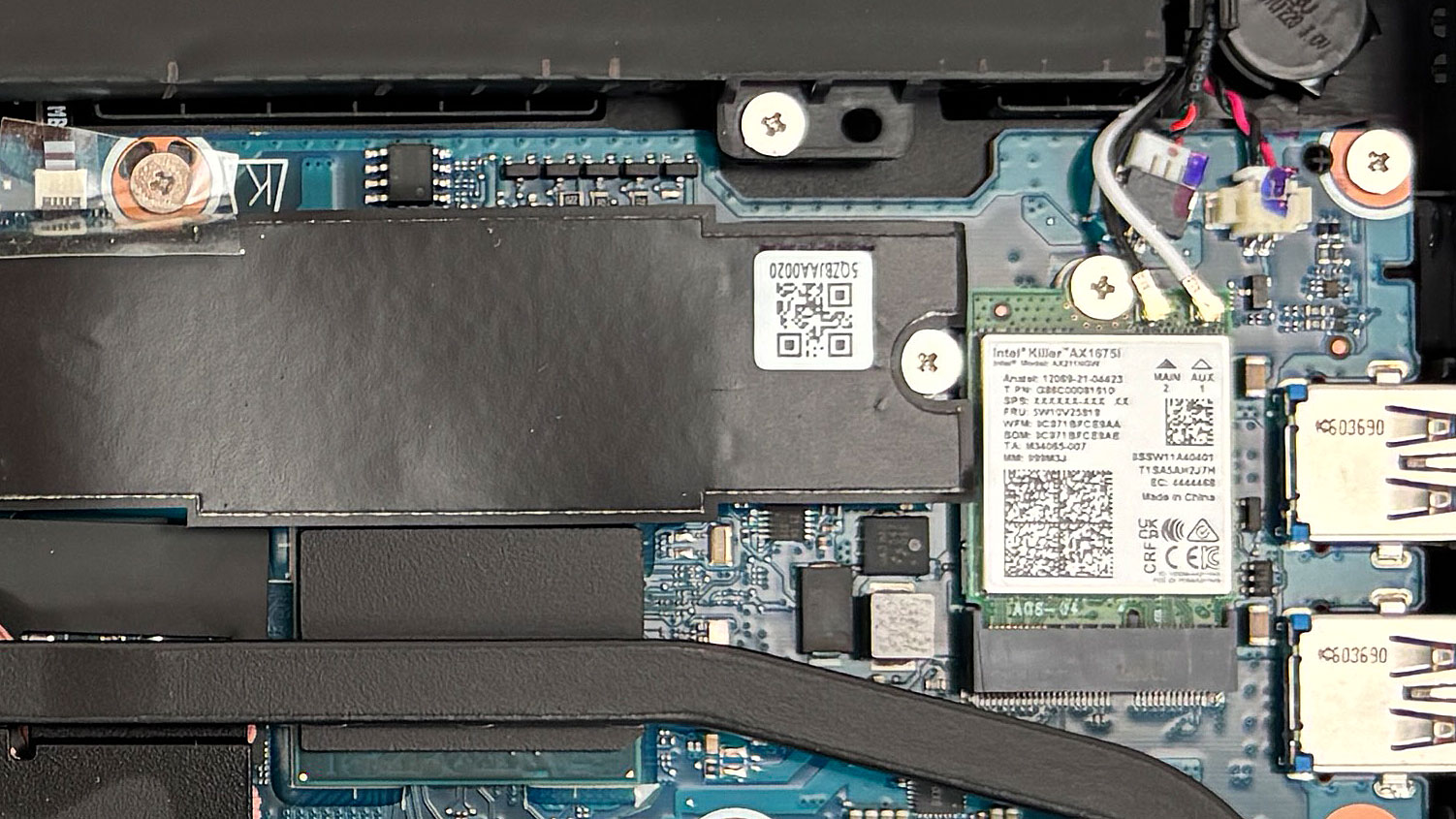
The wireless module is socketed and replaceable. Our laptop uses an Intel Killer Wi-Fi 6E AX1675i card with access to the 2.4GHz, 5GHz, and 6GHz bands, along with Bluetooth connectivity. The module is held in place by a single screw, while its two antenna leads remain easily accessible. This makes a future wireless-card replacement possible without removing the motherboard.
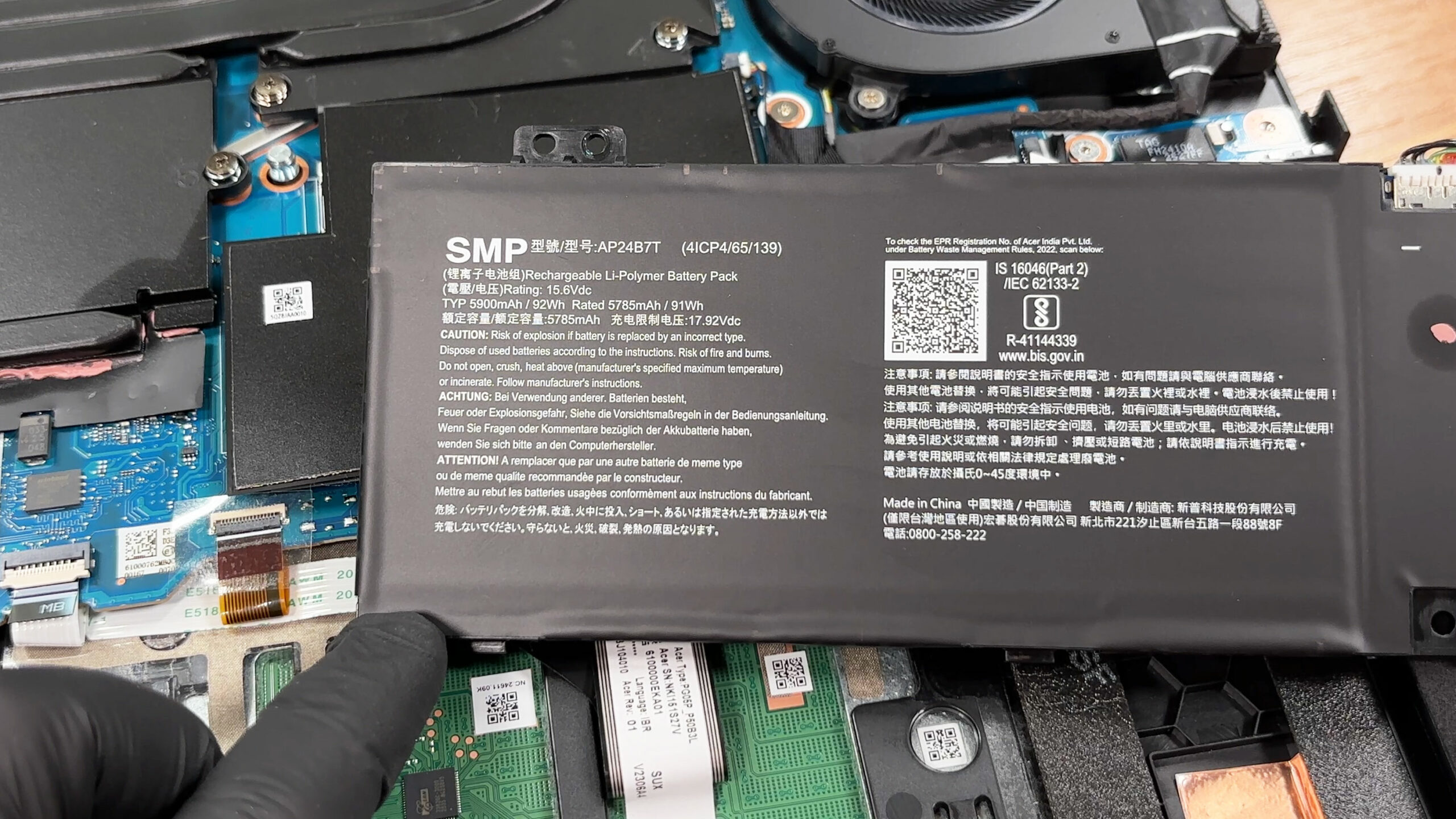
A large four-cell AP24B7T lithium-polymer battery occupies most of the front section of the chassis. It has a rated capacity of 91Wh and a typical capacity of 92Wh.
The battery is secured with screws rather than adhesive, making eventual replacement relatively uncomplicated. Its connector is positioned very close to the battery pack, so loosening the retaining screws and slightly lifting the battery first provides easier access when disconnecting it.
As with any internal upgrade, the battery should be disconnected before replacing the memory, SSD, wireless card, or other components.
Overall, the Predator Helios Neo 16 is easy to service for a performance-oriented laptop. Users receive convenient access to both DDR5 SO-DIMM slots, two M.2 2280 SSD positions, the replaceable wireless card, the battery, and both cooling fans.
Verdict
The Acer Predator Helios Neo 16 (PHN16-I31) makes its priorities clear: strong performance, sustained stability, practical connectivity, and excellent upgradeability take precedence over portability and cutting-edge design. It is a substantial 16-inch gaming laptop that performs consistently under prolonged workloads, although its aggressive Turbo Mode tuning results in high CPU temperatures and considerable power consumption.
It may lack the OLED display, slimmer construction, and more efficient processor platforms available in some newer rivals, but it compensates with a solid chassis, two SO-DIMM slots, two M.2 positions, and a very capable 180Hz IPS display. This is a machine for users who value dependable performance and long-term serviceability more than minimum weight or premium display technology.
You can check the prices and configurations in our Specs System: https://laptopmedia.com/series/acer-predator-helios-neo-16-phn16-i31/
✅ The Good
The strongest aspect of the Helios Neo 16 is its stable gaming performance. Our RTX 5060 configuration maintained consistent clock speeds throughout the one-hour gaming simulation without a progressive performance drop. It also performs well at the native 2560 × 1600 resolution, although the most demanding ray-traced games may still benefit from DLSS or reduced settings.
The 180Hz WQXGA IPS display is another major advantage. It covers 99% of sRGB, reaches an average brightness of 399 cd/m², offers a good 1400:1 contrast ratio, and becomes highly color-accurate with our profile. It also avoids PWM at every tested brightness level, making it comfortable for prolonged use in this respect.
Upgradeability is excellent. Both DDR5 SO-DIMM slots, both M.2 PCIe 4.0 positions, the wireless card, battery, and cooling fans are readily accessible. Connectivity is equally strong, with two Thunderbolt 4 ports, HDMI 2.1, 2.5GbE, three USB-A ports, and a microSD card reader.
The keyboard is comfortable and practical, offering 2.0 mm of key travel, a full NumPad, full-sized separated arrow keys, and four-zone RGB illumination.
❌ The Bad
 The laptop is also relatively bulky, and the complete travel package approaches 3.4 kg before the AC cable is included. Battery life is acceptable rather than impressive for a system equipped with a 92Wh battery.
Our configuration arrived with a single 16GB memory module, meaning that buyers must install a second module to obtain a dual-channel configuration. Other omissions include a physical webcam shutter, a fingerprint reader, and any meaningful HDR capability.
The cooling system’s use of one metal AeroBlade fan and one conventional plastic fan is unusual. It works well enough to maintain stable performance, but the asymmetrical design is less sophisticated than the matching premium-fan arrangements found in some higher-end gaming laptops.
🆚 The Competitors
Compared with the Lenovo Legion Pro 5 (16″, Gen 10) (detailed review), the Helios Neo 16 delivers considerably longer battery life and similarly stable gaming behavior, while the Lenovo maintains somewhat higher sustained RTX 5060 clock speeds.
The Lenovo Legion 7a (16″, Gen 11) (detailed review) is slimmer, lighter, and equipped with a much more impressive OLED display. The Acer counters with replaceable memory, broader internal upgradeability, and stronger sustained RTX 5060 performance.
Pros
- Strong and stable gaming performance
- Bright 180Hz WQXGA IPS display with 99% sRGB coverage
- Excellent color accuracy with our display profile
- PWM-free brightness regulation
- Two SO-DIMM and two M.2 upgrade slots
- Two Thunderbolt 4 ports and 2.5GbE connectivity
- Comfortable keyboard with full-sized arrow keys and NumPad
Cons
- Large and heavy when carried with the 330W adapter
- Single-channel memory in our factory configuration
- No physical privacy shutter or biometric login
- No meaningful HDR support
 Author: Simeon NikolovEditor-in-Chief at LaptopMedia.com with 20+ years of experience in testing and analyzing laptops and mobile devices.
 Author: eng. Kroum NikolovHead of Engineering at LaptopMedia.com, inventor and innovator with 40+ years of experience in electronics and high technology.

![[June 2026] Best-Selling Laptop Brands on Amazon Global – Apple’s Unrivaled Dominance in Units and Revenue](https://laptopmedia.com/wp-content/uploads/2026/07/GLOBAL-Best-Brands-400x225.jpg)
![[June 2026] Amazon Global: Top 10 Best-Selling Laptops – Apple’s New MacBook Neo Storms to #1, Reshaping the Market with Affordability](https://laptopmedia.com/wp-content/uploads/2026/07/Best-Selling-Laptops-GLOBAL-Top-10-400x225.jpg)
![[June 2026] Amazon Global: Top 10 Best-Selling Gaming Laptops – Acer’s Nitro V 16S AI Dominates Sales, While ASUS Leads Overall Revenue](https://laptopmedia.com/wp-content/uploads/2026/07/Best-Selling-Gaming-Laptops-GLOBAL-Top-10-400x225.jpg)
![[June 2026] Global Ranking of Best-Selling Laptop GPUs on Amazon – NVIDIA RTX 5060 is the Top-Selling Dedicated GPU](https://laptopmedia.com/wp-content/uploads/2026/07/Best-Selling-GPUs-GLOBAL-Top-10-400x225.jpg)
![[June 2026] Global Ranking of Best-Selling Laptop CPUs on Amazon – Apple M5 Dominates, AMD Ryzen 7 260 Gets Solid Premium Share](https://laptopmedia.com/wp-content/uploads/2026/07/Best-Selling-CPUs-GLOBAL-Top-10-400x225.jpg)