[January 2026] Best-Selling Laptop Brands on Amazon Japan – Apple Captures 35.7% of Revenue Despite Lenovo Leading Unit Sales
![Featured image for: [January 2026] Best-Selling Laptop Brands on Amazon Japan – Apple Captures 35.7% of Revenue Despite Lenovo Leading Unit Sales](https://laptopmedia.com/wp-content/uploads/2026/02/CO.JP-Best-Brands.jpg) The laptop market on Amazon Japan in January 2026 exhibited a highly competitive structure, characterized by high volume sales from Lenovo and premium revenue capture by Apple. ASUS maintained a strong third position in both units and revenue, benefiting from the widest selection of models. The top four brands—Lenovo, Apple, ASUS, and HP—accounted for nearly 95% of total unit sales, solidifying their dominance over the platform.
The laptop market on Amazon Japan in January 2026 exhibited a highly competitive structure, characterized by high volume sales from Lenovo and premium revenue capture by Apple. ASUS maintained a strong third position in both units and revenue, benefiting from the widest selection of models. The top four brands—Lenovo, Apple, ASUS, and HP—accounted for nearly 95% of total unit sales, solidifying their dominance over the platform.
Check out our Specs System with more than 700,000 laptop offers worldwide.
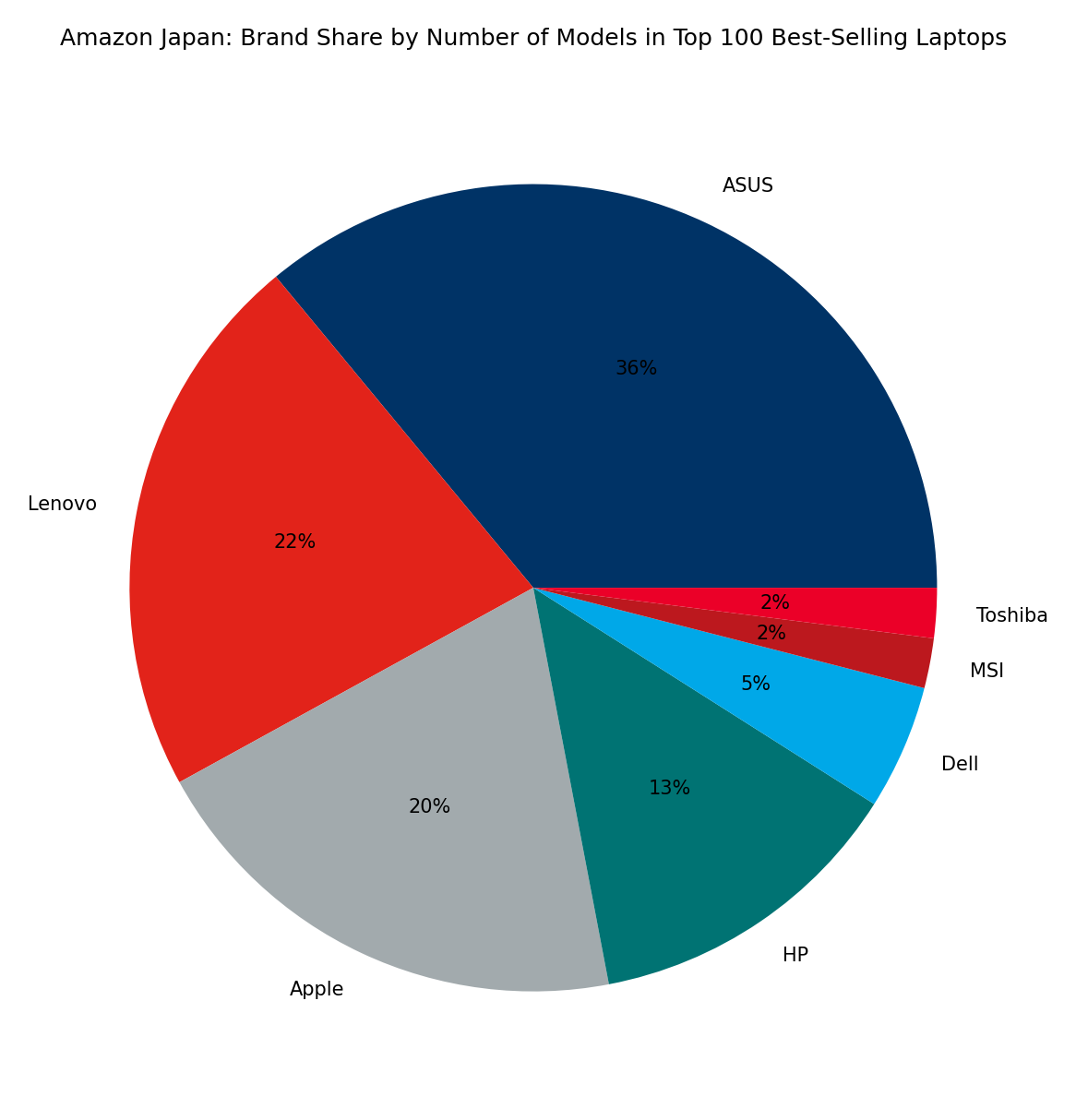
🇯🇵 Amazon Japan: Brand Share by Number of Models in Top 100 Best-Selling Laptops
ASUS leads the market in terms of product variety, offering 36 distinct models and capturing a 36% share of available products. Lenovo and Apple follow with 22 models (22% share) and 20 models (20% share), respectively, suggesting that broad product availability is key for market presence. HP rounds out the major players with 13 models (13%). Notably, smaller brands like MSI and Toshiba only offer 2 models each, representing a marginal 2% share of the overall product selection.
| # | Brand | Models | Share in Top 100 (%) |
|---|---|---|---|
| 🥇 | ASUS | 36 | 36% |
| 🥈 | Lenovo | 22 | 22% |
| 🥉 | Apple | 20 | 20% |
| #4 | HP | 13 | 13% |
| #5 | Dell | 5 | 5% |
| #6 | MSI | 2 | 2% |
| #7 | Toshiba | 2 | 2% |
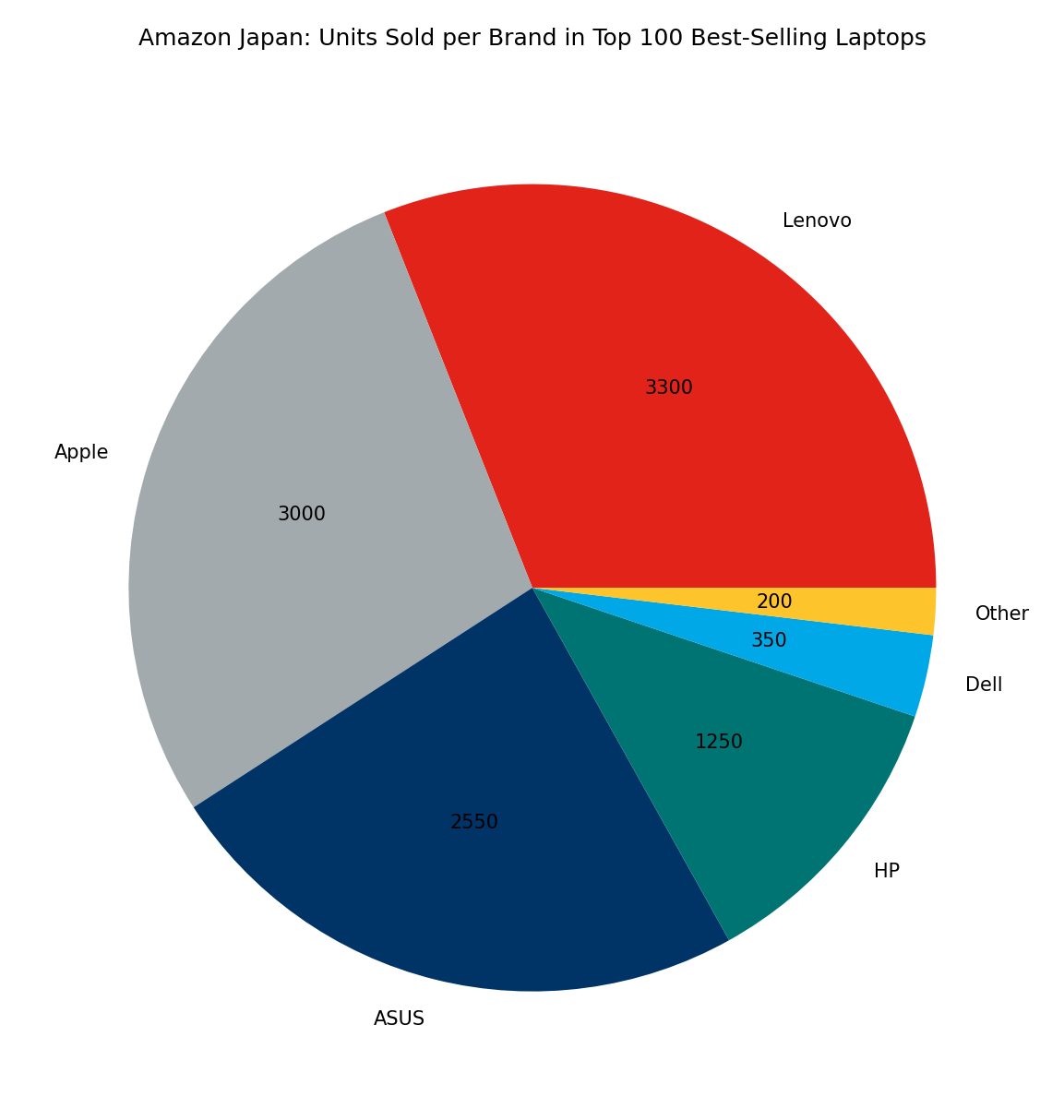
🇯🇵 Amazon Japan: Units Sold per Brand in Top 100 Best-Selling Laptops
Unit sales were led by Lenovo, which successfully moved 3,300 units and secured the largest market share at 31.0%. Apple was a close second, shifting 3,000 units for a 28.2% share. ASUS proved strong in volume as well, contributing 2,550 units, resulting in a 23.9% share. The top three brands collectively accounted for 83.1% of all units sold. HP followed with 1,250 units (11.7%). Dell, MSI, and Toshiba lagged significantly; MSI and Toshiba each sold only 100 units (less than 1% share).
| # | Brand | Units Sold | Share (%) |
|---|---|---|---|
| 🥇 | Lenovo | 3300 | 31.0% |
| 🥈 | Apple | 3000 | 28.2% |
| 🥉 | ASUS | 2550 | 23.9% |
| #4 | HP | 1250 | 11.7% |
| #5 | Dell | 350 | 3.3% |
| #6 | MSI | 100 | <1% |
| #7 | Toshiba | 100 | <1% |
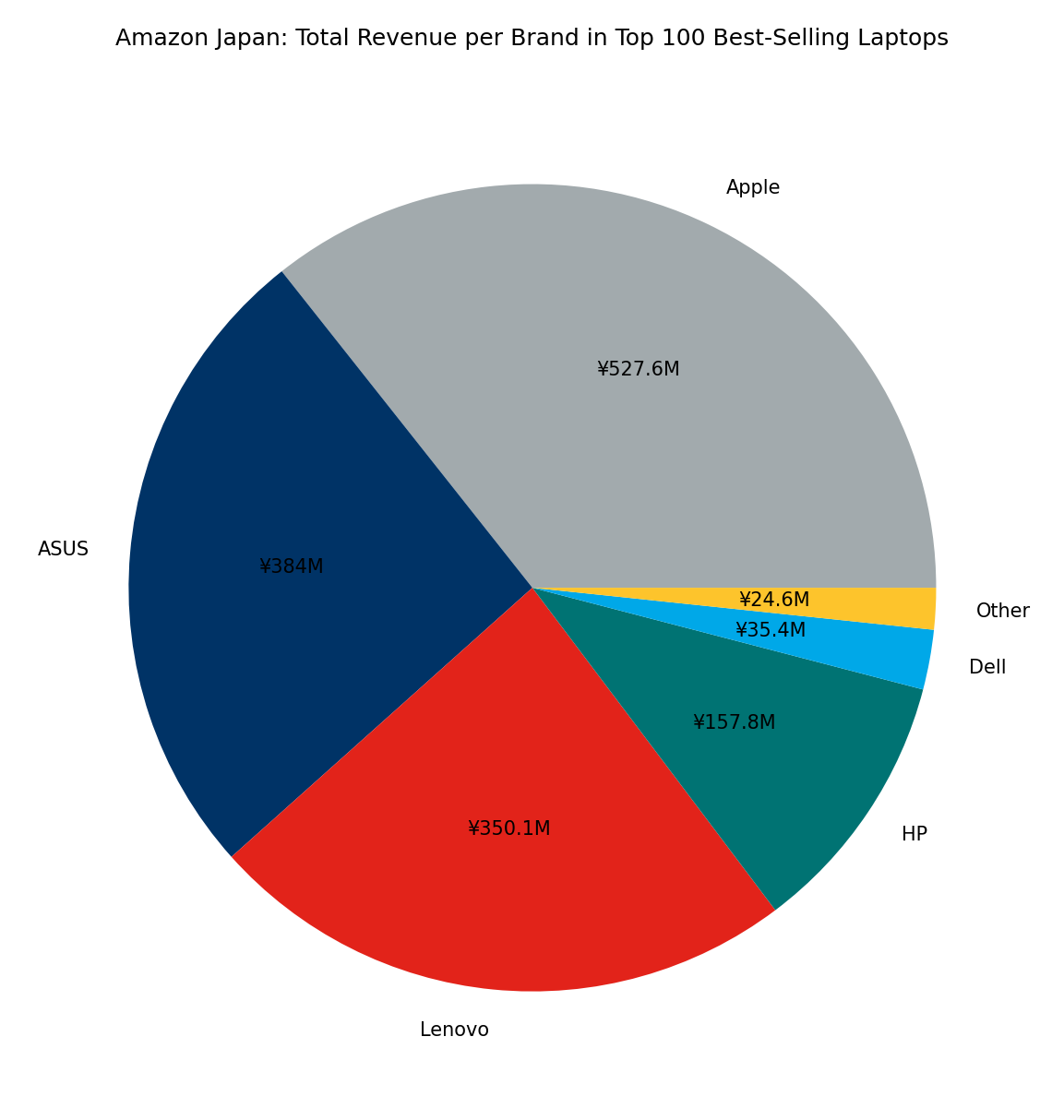
🇯🇵 Amazon Japan: Total Revenue per Brand in Top 100 Best-Selling Laptops
Apple was the overwhelming leader in revenue, generating ¥527,617,800, which translated to a significant 35.7% market share. This high revenue is directly attributable to its premium pricing strategy, boasting an average unit price of ¥175,873. ASUS ranked second in revenue with ¥384,043,200 (26.0% share), maintaining a solid average price of ¥150,605. Despite leading in unit sales, Lenovo took third place in revenue at ¥350,100,650 (23.7%), primarily due to its comparatively lower average unit price of ¥106,091. MSI, despite having the highest average price point overall at ¥189,800, only captured ¥18,980,000 (1.3%) in total revenue due to its extremely low volume.
| # | Brand | Average Price (JPY) | Total Revenue (JPY) | Share (%) |
|---|---|---|---|---|
| 🥇 | Apple | ¥175,873 | ¥527,617,800 | 35.7% |
| 🥈 | ASUS | ¥150,605 | ¥384,043,200 | 26.0% |
| 🥉 | Lenovo | ¥106,091 | ¥350,100,650 | 23.7% |
| #4 | HP | ¥126,277 | ¥157,845,650 | 10.7% |
| #5 | Dell | ¥101,182 | ¥35,413,600 | 2.4% |
| #6 | MSI | ¥189,800 | ¥18,980,000 | 1.3% |
| #7 | Toshiba | ¥56,196 | ¥5,619,550 | <1% |
Conclusion
The January 2026 data illustrates a stark contrast between volume and value strategies on Amazon Japan. While Lenovo successfully cornered the volume market with aggressive pricing, Apple demonstrated superior profitability by focusing on high-ticket sales. ASUS remains a crucial middle ground competitor, leveraging broad product availability and competitive average pricing. The market is highly concentrated, with the top four brands controlling the vast majority of sales and earnings, suggesting significant barriers to entry for smaller competitors like Dell and Toshiba.
For more detailed insights and analysis, check out our Specs System featuring offers from around the globe.
 Author: Simeon NikolovEditor-in-Chief at LaptopMedia.com with 20+ years of experience in testing and analyzing laptops and mobile devices.

![[August 2026] Amazon Global: Top 10 Best-Selling Laptops – Apple MacBook Neo Dominates the Charts as Budget and Mid-Range Windows Portables Fight for Volume](https://laptopmedia.com/wp-content/uploads/2026/09/Best-Selling-Laptops-GLOBAL-Top-10-400x225.jpg)
![[August 2026] Best-Selling Laptop Brands on Amazon Global – Apple Dominates Revenue While HP Leads in Model Variety](https://laptopmedia.com/wp-content/uploads/2026/09/GLOBAL-Best-Brands-400x225.jpg)
![[August 2026] Amazon Global: Top 10 Best-Selling Gaming Laptops – HP Victus 15 Captures the Crown as Budget-Friendly Models Dominate the Charts](https://laptopmedia.com/wp-content/uploads/2026/09/Best-Selling-Gaming-Laptops-GLOBAL-Top-10-400x225.jpg)
![[August 2026] Best-Selling Laptop Brands on Amazon Japan – Apple Dominates Market Share and Revenue Led by Strong Unit Sales](https://laptopmedia.com/wp-content/uploads/2026/09/CO.JP-Best-Brands-1-400x225.jpg)
![[August 2026] Best-Selling Laptop Brands on Amazon USA – Apple Dominates Market Revenue and Volume Despite Lower Model Diversity](https://laptopmedia.com/wp-content/uploads/2026/09/COM-Best-Brands-1-400x225.jpg)