Lenovo Yoga 9i 2-in-1 Aura Edition (14″, Gen 11) review – 2.8K OLED, Great Speakers, and 15+ Hours of Battery
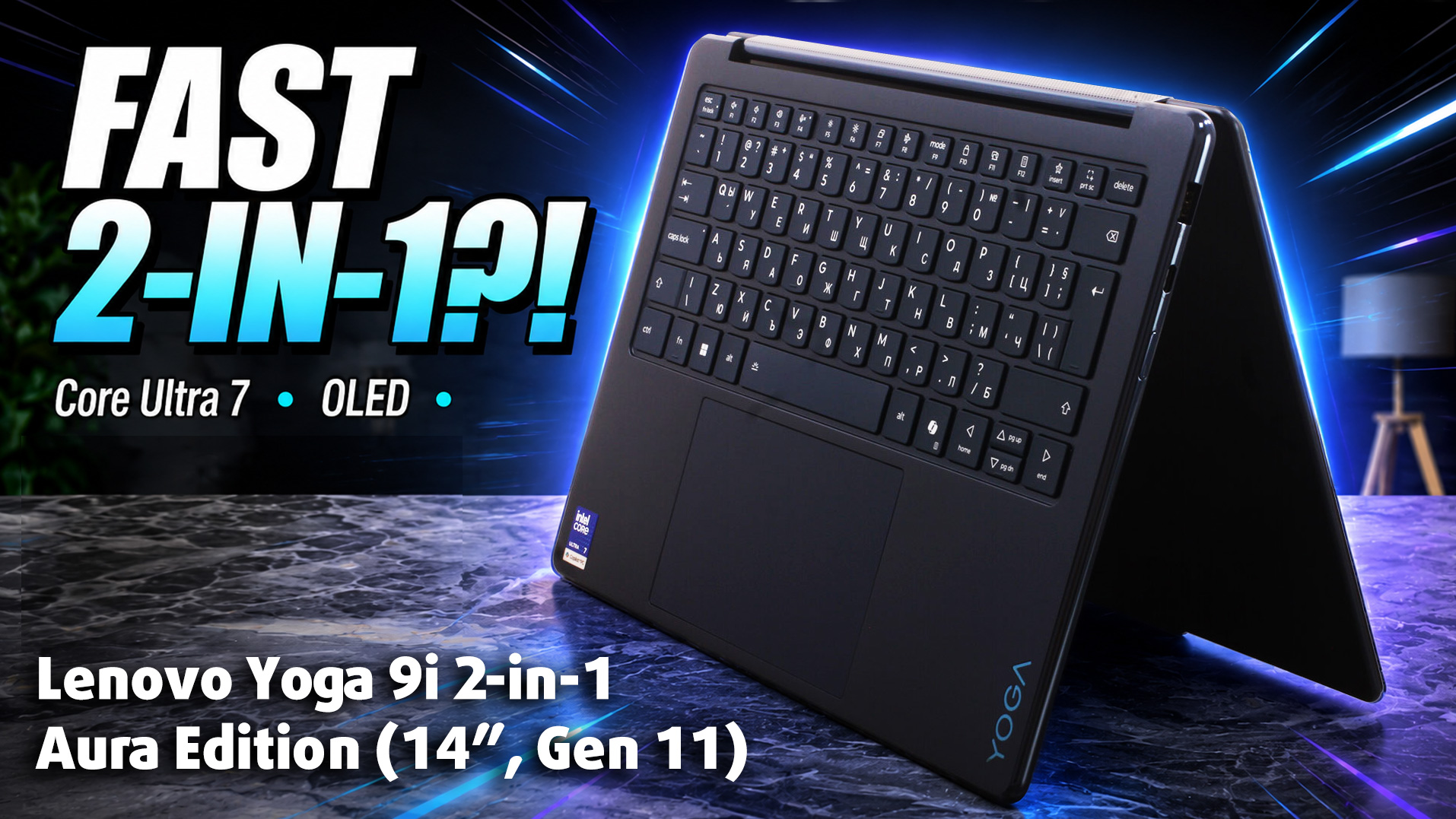 The Lenovo Yoga 9i 2-in-1 Aura Edition (14″, Gen 11) is one of those laptops that immediately feels special. It is aimed at users who want a premium convertible first: executives, creators, students, and anyone looking for a stylish 14-inch machine with a great screen, pen support, strong speakers, and excellent mobility. The Cosmic Blue aluminum chassis, glossy side rails, and signature rotating soundbar hinge give it a refined look without making it feel flashy.
What surprised us most, however, was the 2.8K 120Hz OLED touchscreen with an Intel Core Ultra 7 processor, yet it still delivered more than 15.5 hours of offline video playback in our battery test. It also feels impressively fast in everyday work, especially in short CPU bursts, which is exactly where most daily tasks live.
Of course, the thin 2-in-1 form factor comes with clear trade-offs. The RAM is soldered, storage expansion is limited to a single M.2 2242 slot, and long sustained CPU workloads show the limits of the compact chassis. So the real question is simple: does the Yoga 9i’s premium design, OLED display, battery life, and everyday responsiveness outweigh these limitations? Let’s find out.
TESTED CONFIGURATION:
– Intel Core Ultra 7 355
– Intel Graphics (4-Cores)
– 32GB LPDDR5X-7467
– 1TB SSD NVMe
– 14″ 2.8K WQXGA+ (2880×1800), OLED, 120 Hz
You can check the prices and configurations in our Specs System: https://laptopmedia.com/series/lenovo-yoga-9i-2-in-1-aura-edition-14-gen-11/
Contents
Specs, Drivers, What’s in the box
Lenovo Yoga 9i 2-in-1 Aura Edition (14", Gen 11) - Specs

- HDD/SSD
- up to 2000GB SSD
- M.2 Slot
- 1x 2242 M.2 NVMe PCIe 4.0 x4 See photo
- RAM
- up to 32GB
- OS
- Windows 11 Pro, Windows 11 Home
- Battery
- 70Wh
- Body material
- Aluminum
- Dimensions
- 317.21 x 222.62 x 15.29 mm (12.49" x 8.76" x 0.60")
- Weight
- 1.29 kg (2.8 lbs)
- Ports and connectivity
- 1x USB Type-A
- 3.2 Gen 2 (10 Gbps)
- 2x USB Type-C
- Thunderbolt 4, Power Delivery (PD), DisplayPort
- HDMI
- 2.1 (8K@60Hz)
- Card reader
- Ethernet LAN
- Wi-Fi
- Wi-Fi 7
- Bluetooth
- 5.4
- Audio jack
- 3.5mm Combo Jack
- Features
- Fingerprint reader
- Web camera
- 5.0MP + IR, with privacy shutter, fixed focus
- Backlit keyboard
- Microphone
- Quad-microphone array, 3D array
- Speakers
- 4 stereo speakers, 2W x2 (woofers), 2W x2 (tweeters), optimized with Dolby Atmos®, Smart Amplifier (AMP)
- Security Lock slot
All Lenovo Yoga 9i 2-in-1 Aura Edition (14″, Gen 11) configurations
Drivers
All drivers and utilities for this notebook can be found here: https://pcsupport.lenovo.com/bg/en/products/laptops-and-netbooks/yoga-series/yoga-9-2-in-1-14iph11/downloads
What’s in the box?
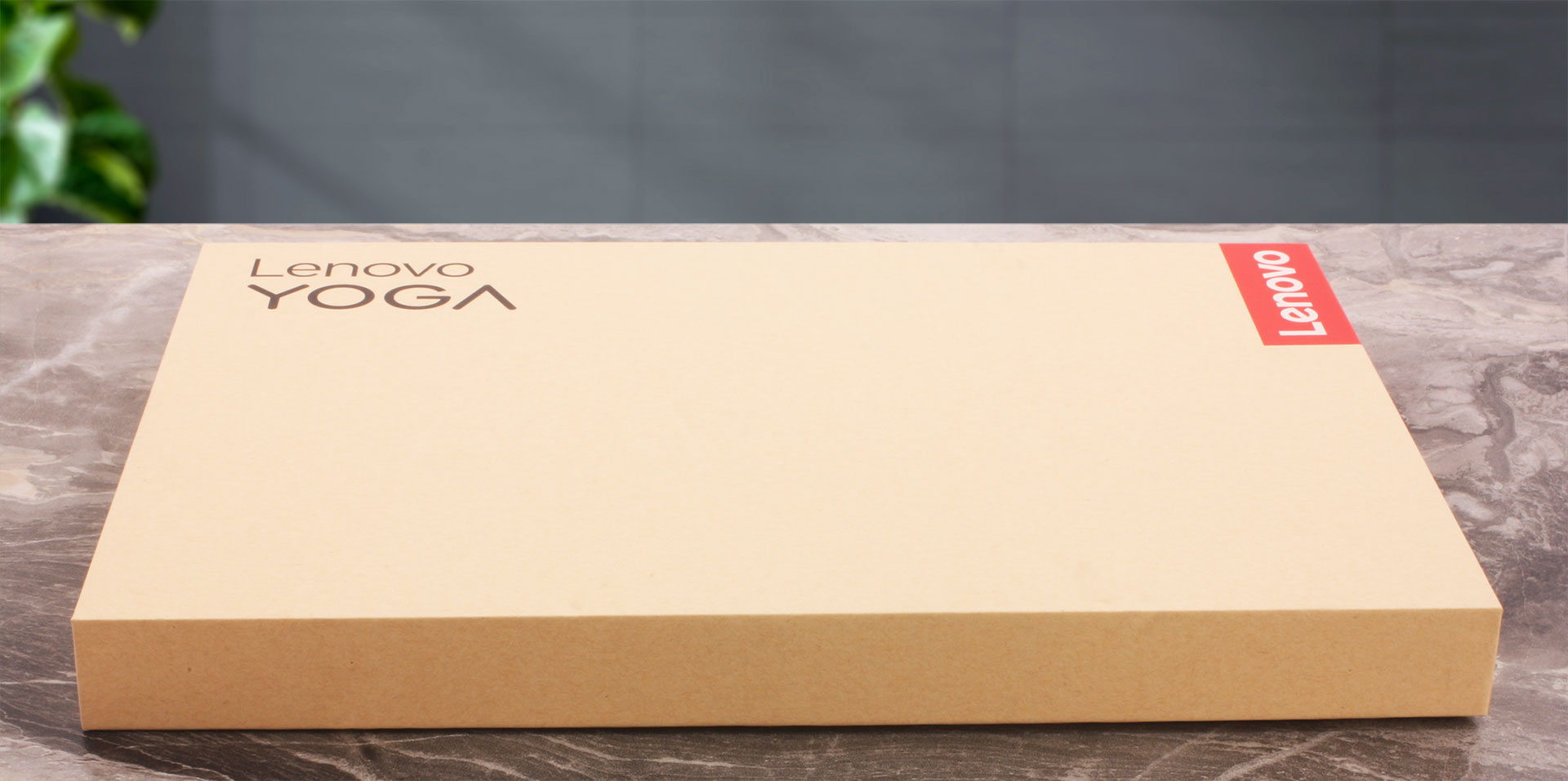
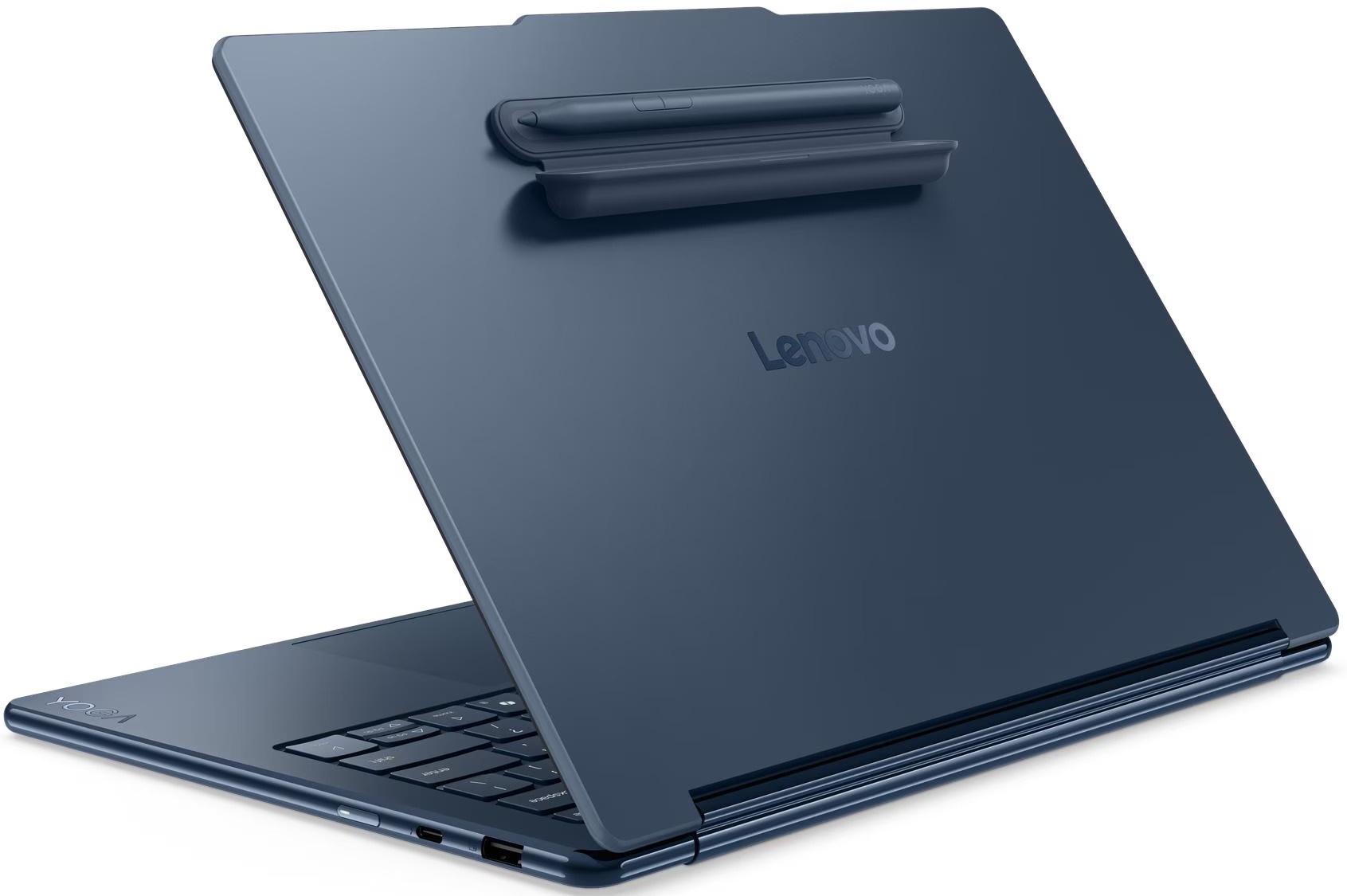
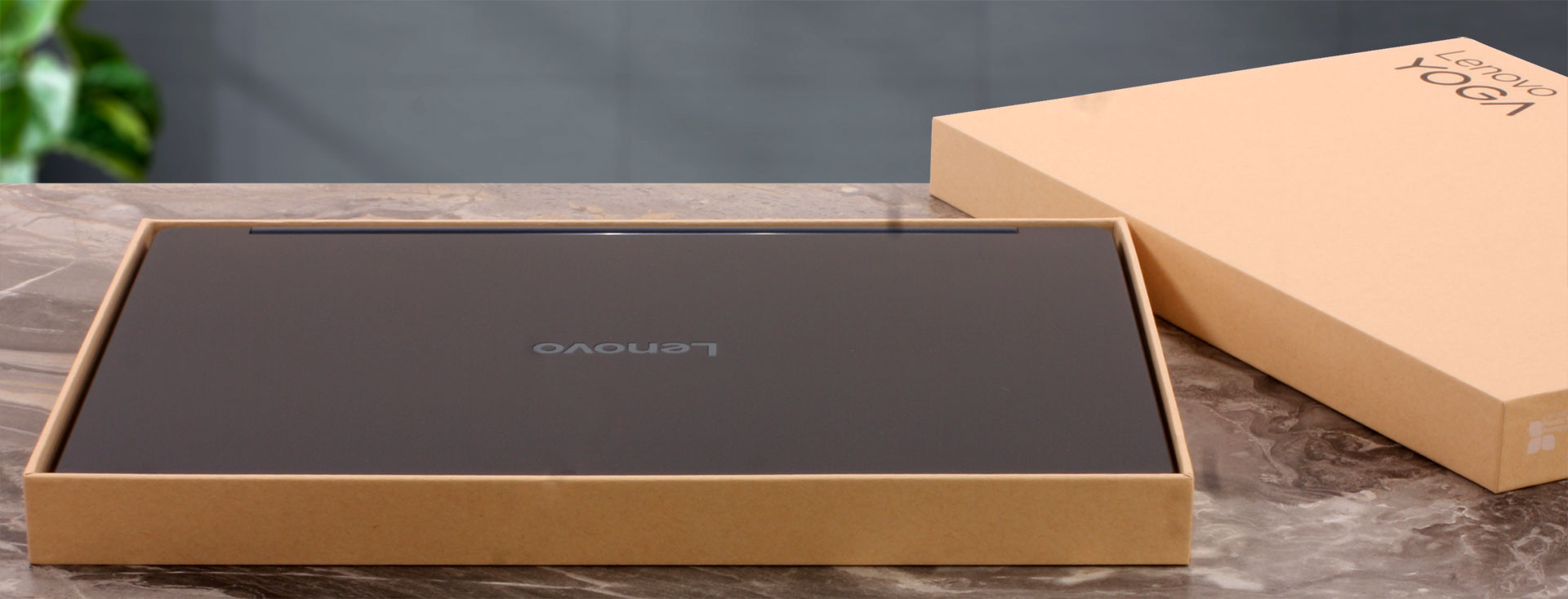
The box includes the Lenovo Yoga Pen Gen 2 in Cosmic Blue, but our European package did not include a power adapter. This is definitely something to check before purchase, because some regional configurations may still ship with a 65W USB-C slim charger, while others require you to use or buy a separate USB-C power adapter.
Design and construction
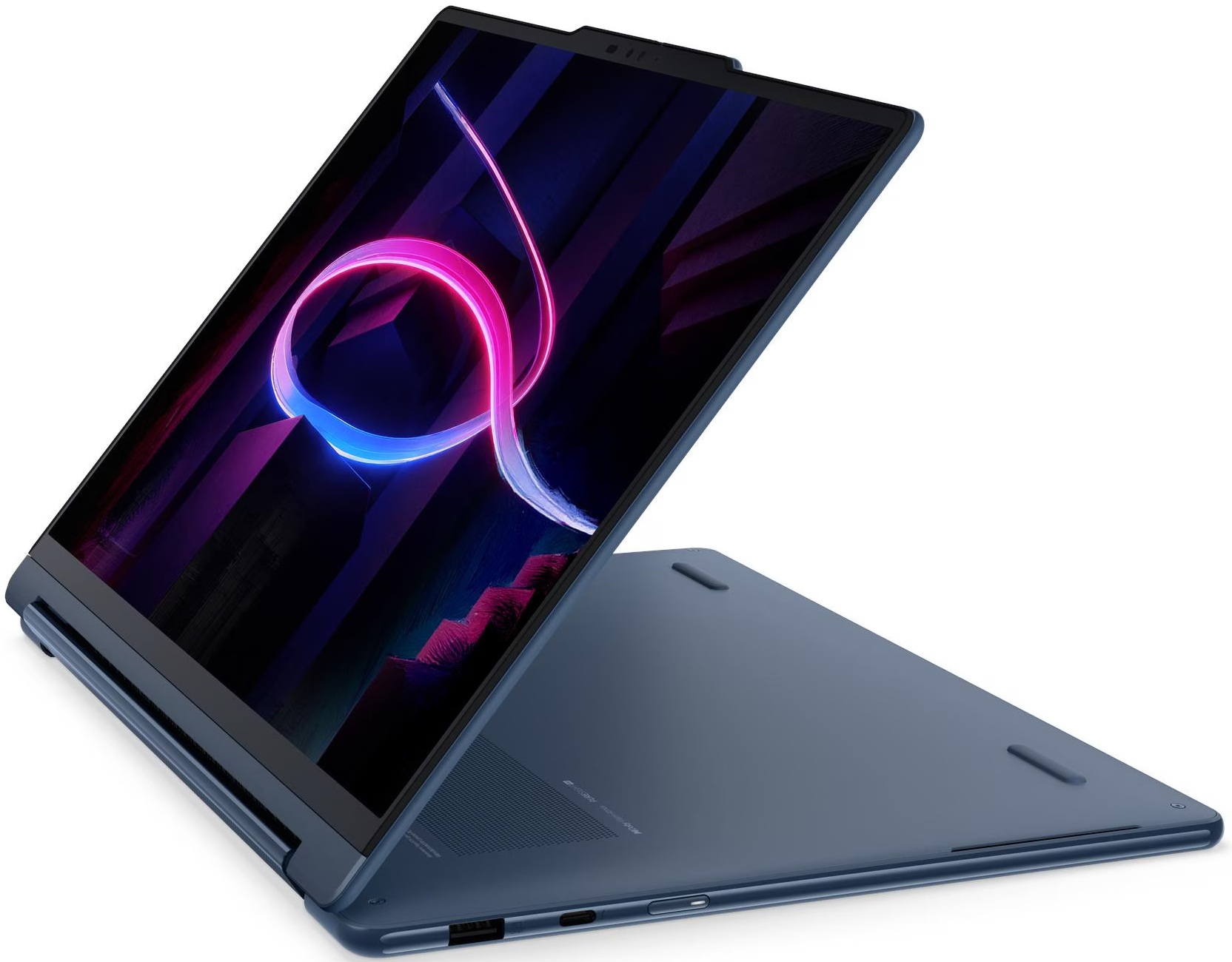
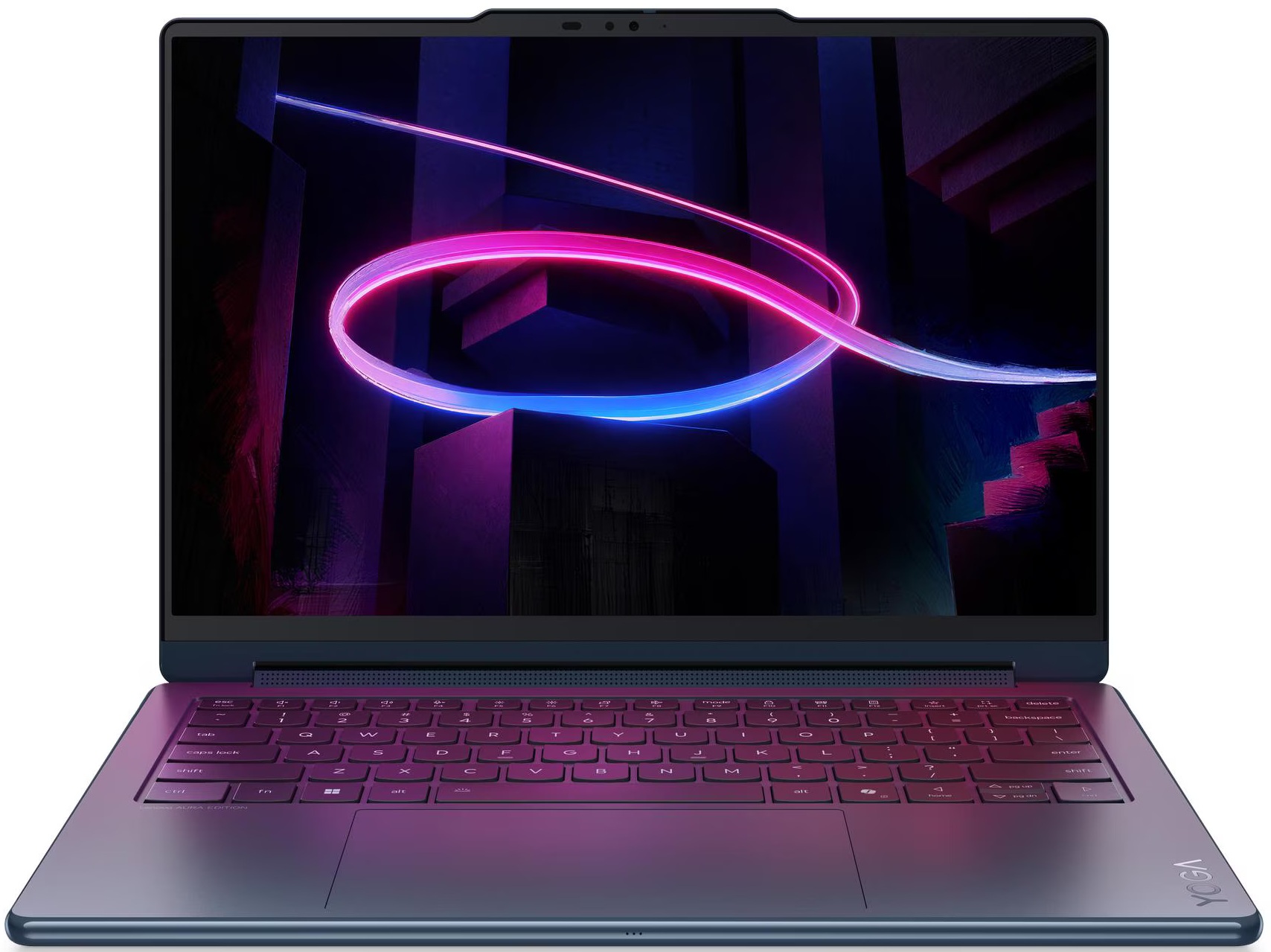
The Lenovo Yoga 9i 2-in-1 Aura Edition (14″, Gen 11) is a device that immediately stands out with its elegant, premium appearance. It does not try to look aggressive or overly utilitarian. Instead, Lenovo has gone for a refined “jewelry-like” design, with softly rounded edges, glossy side rails, and a dark finish that catches the light in a very subtle way. The rotating soundbar hinge is another familiar Yoga 9i signature. It is not only part of the audio system, but also one of the main visual elements that makes the machine instantly recognizable.
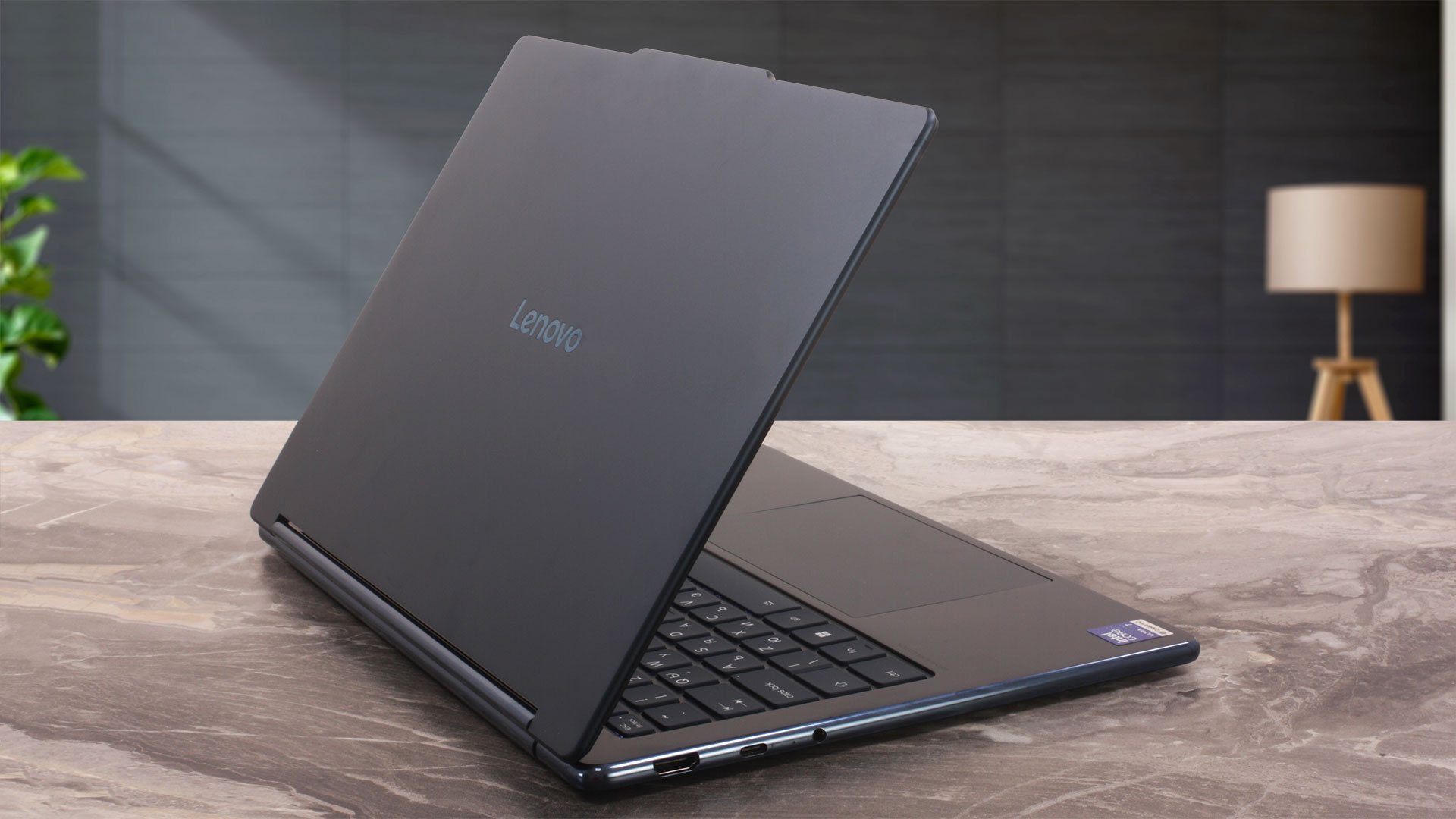
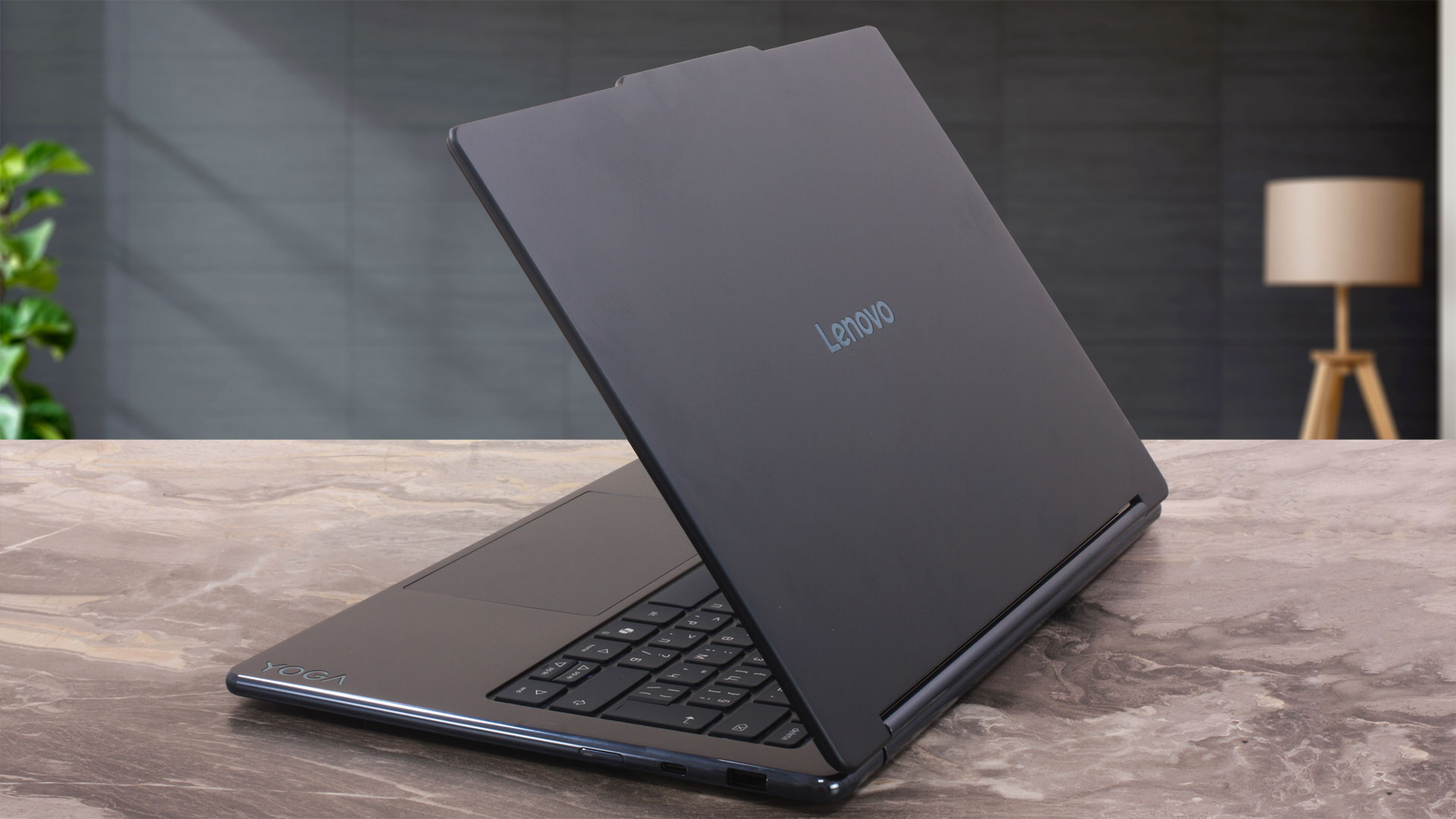
We ordered a configuration in Cosmic Blue, a deep and sophisticated shade that suits the premium positioning of the device very well. It looks almost black in darker environments, but the blue tone becomes more visible under stronger light. At least for the currently listed 14IPH11 configurations, Cosmic Blue appears to be the main color option.
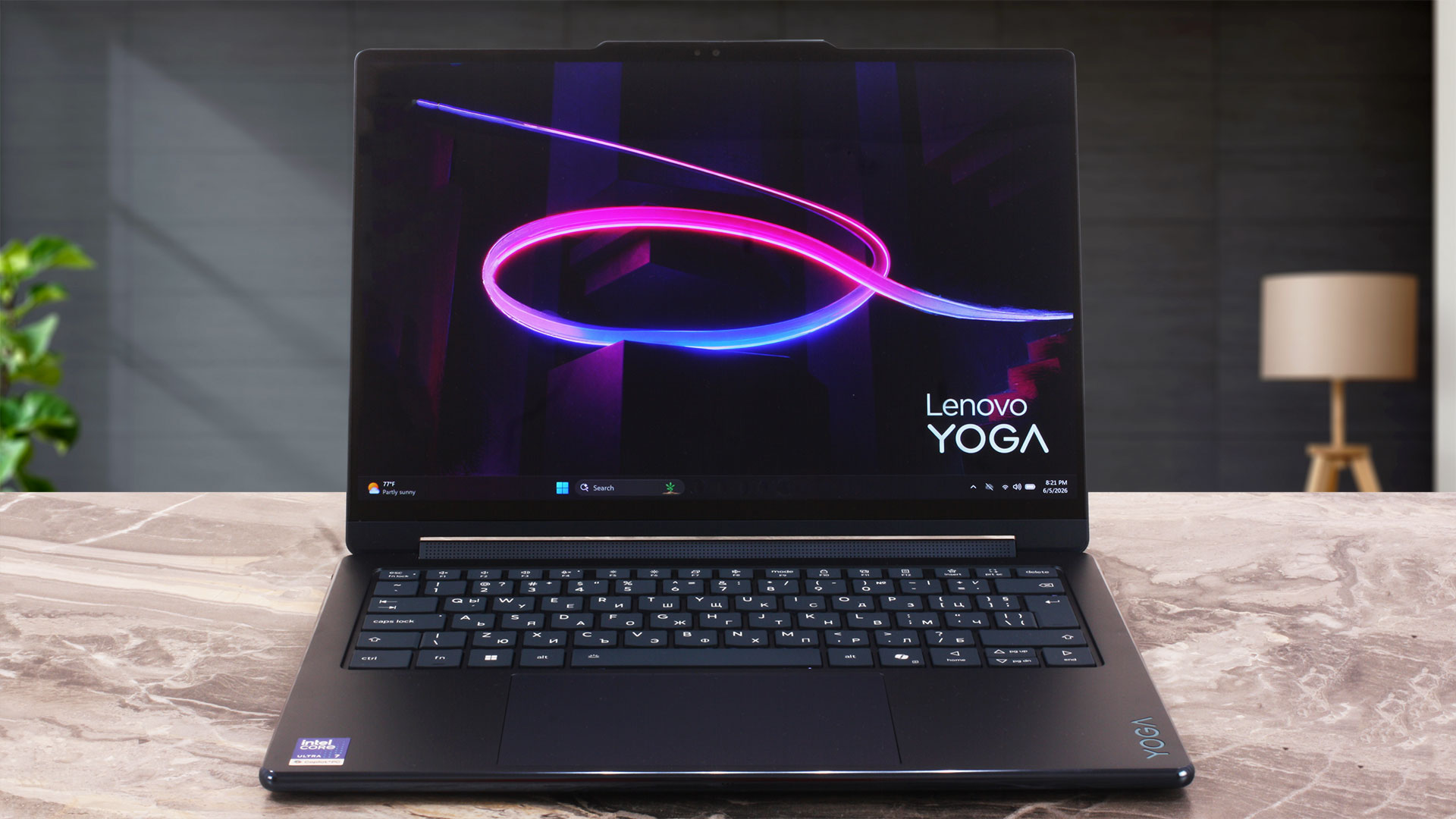
Construction quality is exactly where you would expect it to be for a flagship Yoga model. The top and bottom covers are made of aluminum, with an anodized sandblasted finish and PVD coating on selected surfaces. The chassis feels solid, with no worrying flex in normal use, and Lenovo also states that the machine has passed MIL-STD-810H tests. This does not make it a rugged laptop, of course, but it is reassuring for a thin convertible that will often be carried around, opened, folded, and used in different modes.
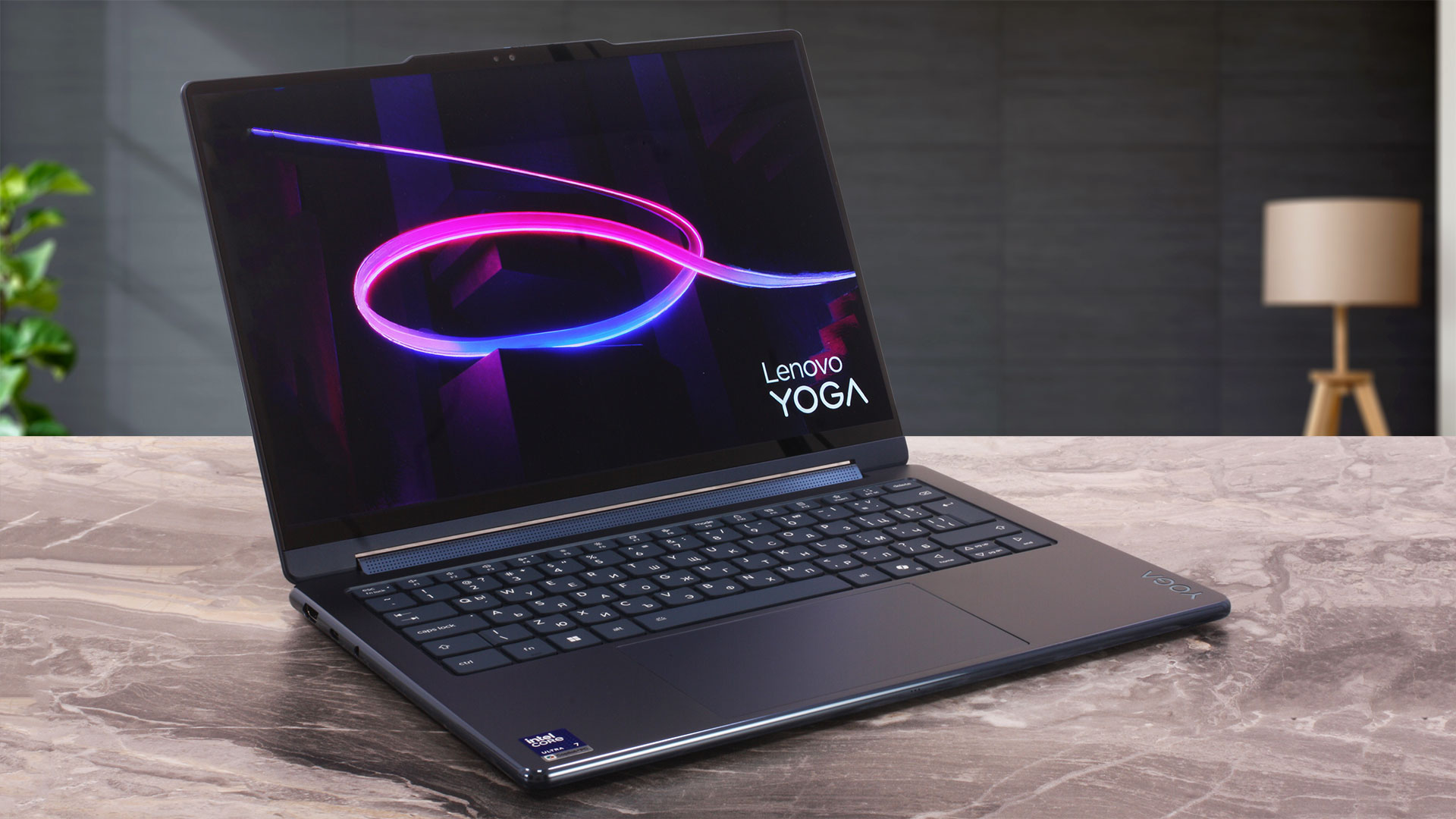
There is one small cosmetic caveat. Lenovo advertises an anti-fingerprint coating, and it helps, but the dark Cosmic Blue finish is not completely immune to smudges. Fine fingerprints and skin oils can still become visible around the palm rest, the touchpad area, and especially along the glossy side rails. The laptop does not look dirty immediately, but occasional wiping will keep it looking its best.
As a 14-inch convertible, portability is a big part of the appeal. The Yoga 9i 2-in-1 Aura Edition is thin and light enough to carry around easily, while still feeling dense and premium in the hand.
| Lenovo Yoga 9i 2-in-1 Aura Edition (14″, Gen 11) | Dimensions | Weight |
| Metric units | 317.21 mm x 222.62 mm x 15.29 mm | 1.29 kg |
| U.S. customary | 12.49 in x 8.76 in x 0.60 in | 2.84 lbs |
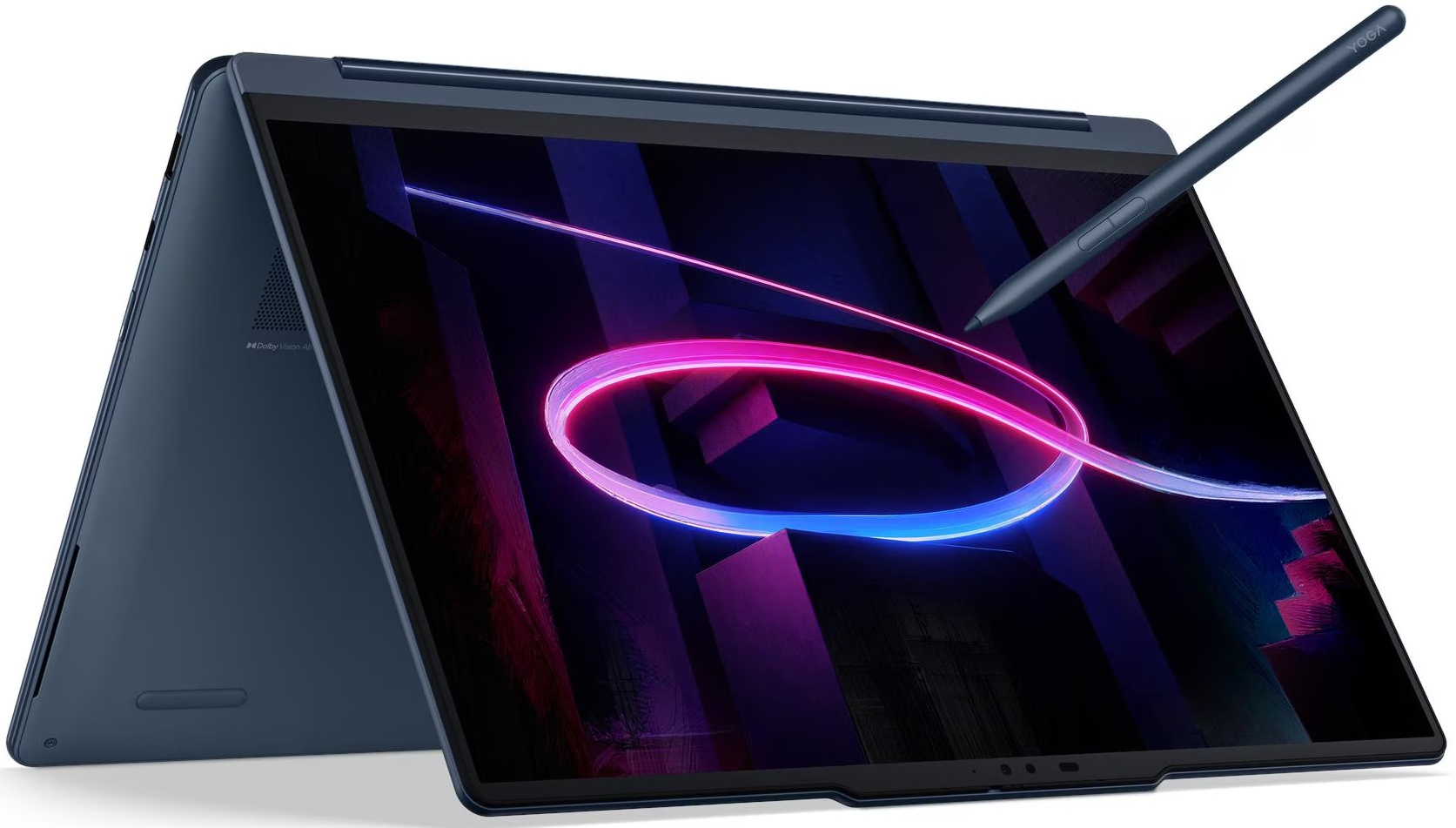
The 360-degree hinge allows the screen to rotate all the way back, so the laptop can be used in the usual laptop, tent, stand, and tablet modes. The hinge feels intentionally firm, which is important for a device with touch and pen support. The top bezel has a small outward bump that works as a convenient grip when opening the lid and also houses the camera system.
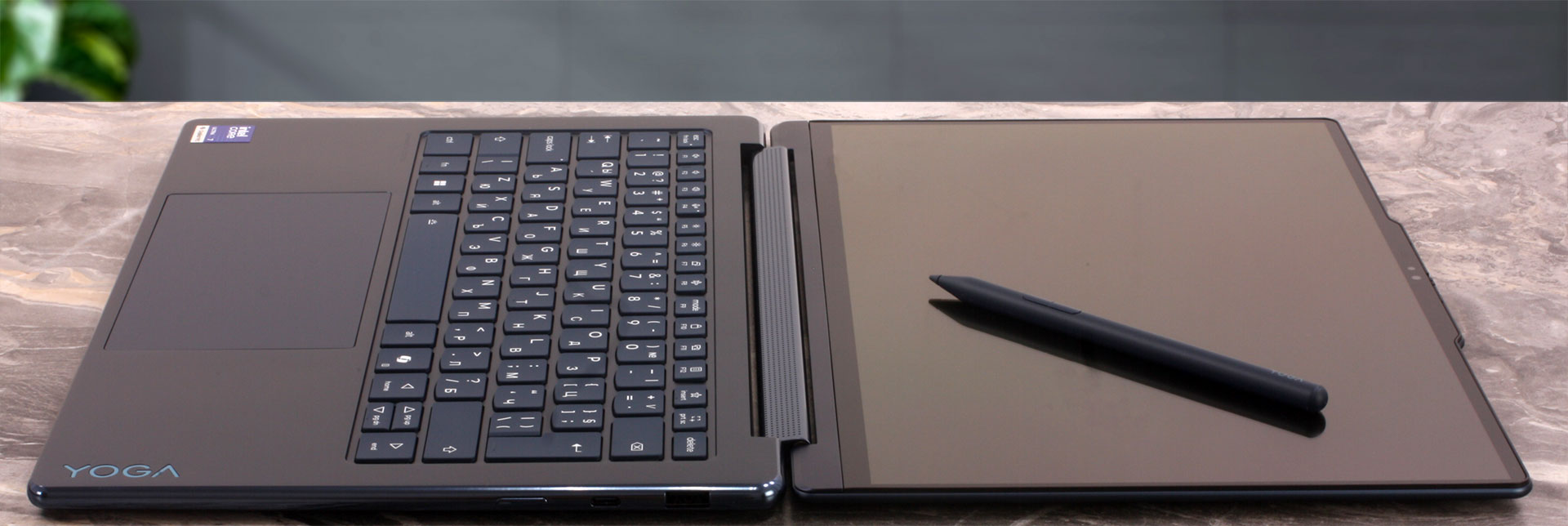
The side bezels are slim, while the top bezel is slightly thicker because of the camera hardware. The machine is equipped with a 5.0MP + IR camera, Windows Hello facial recognition, Ultrasonic Human Presence Detection, and a physical privacy shutter. There is no fingerprint reader on this model, so biometric login is handled entirely by the IR camera.
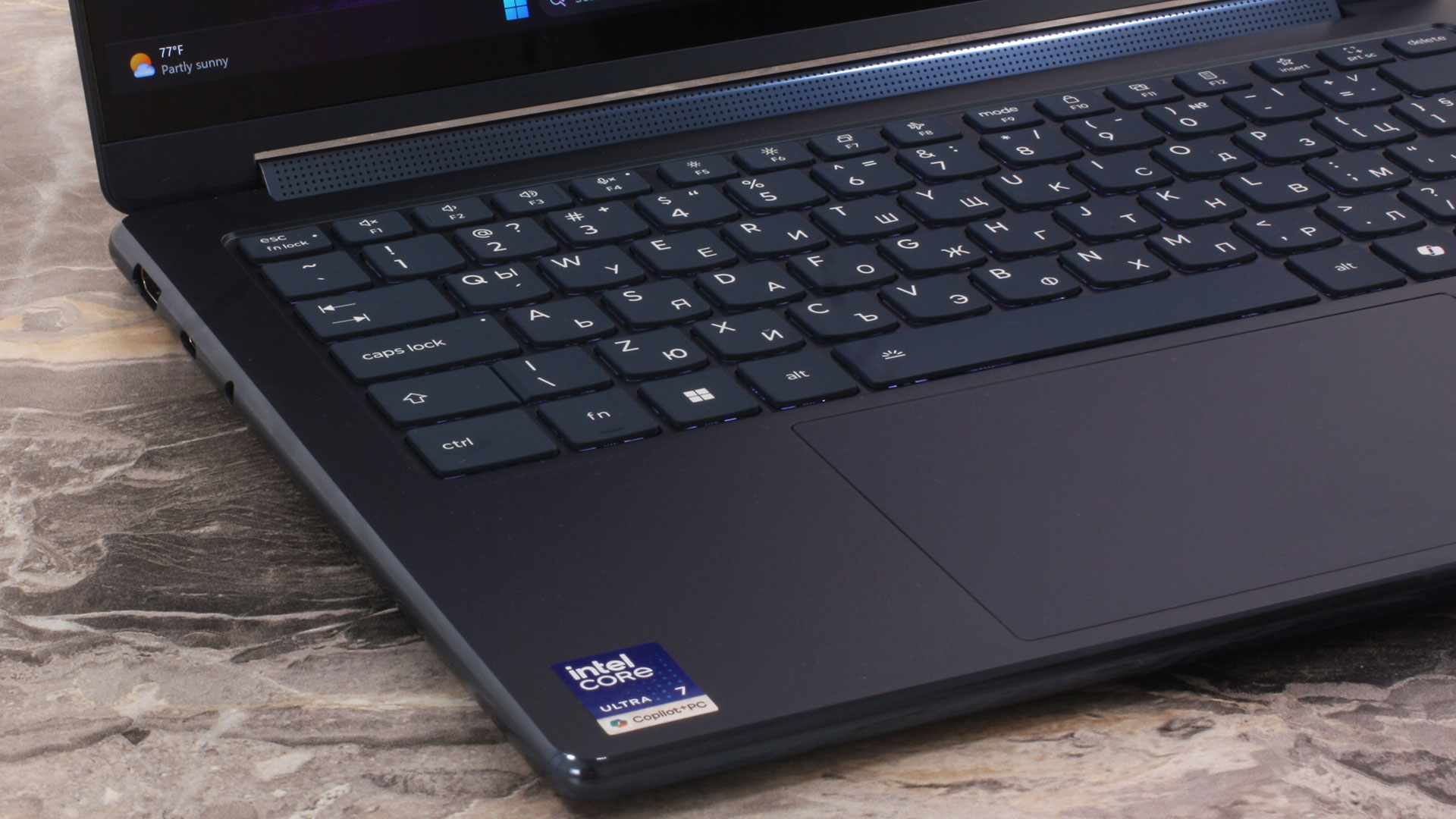
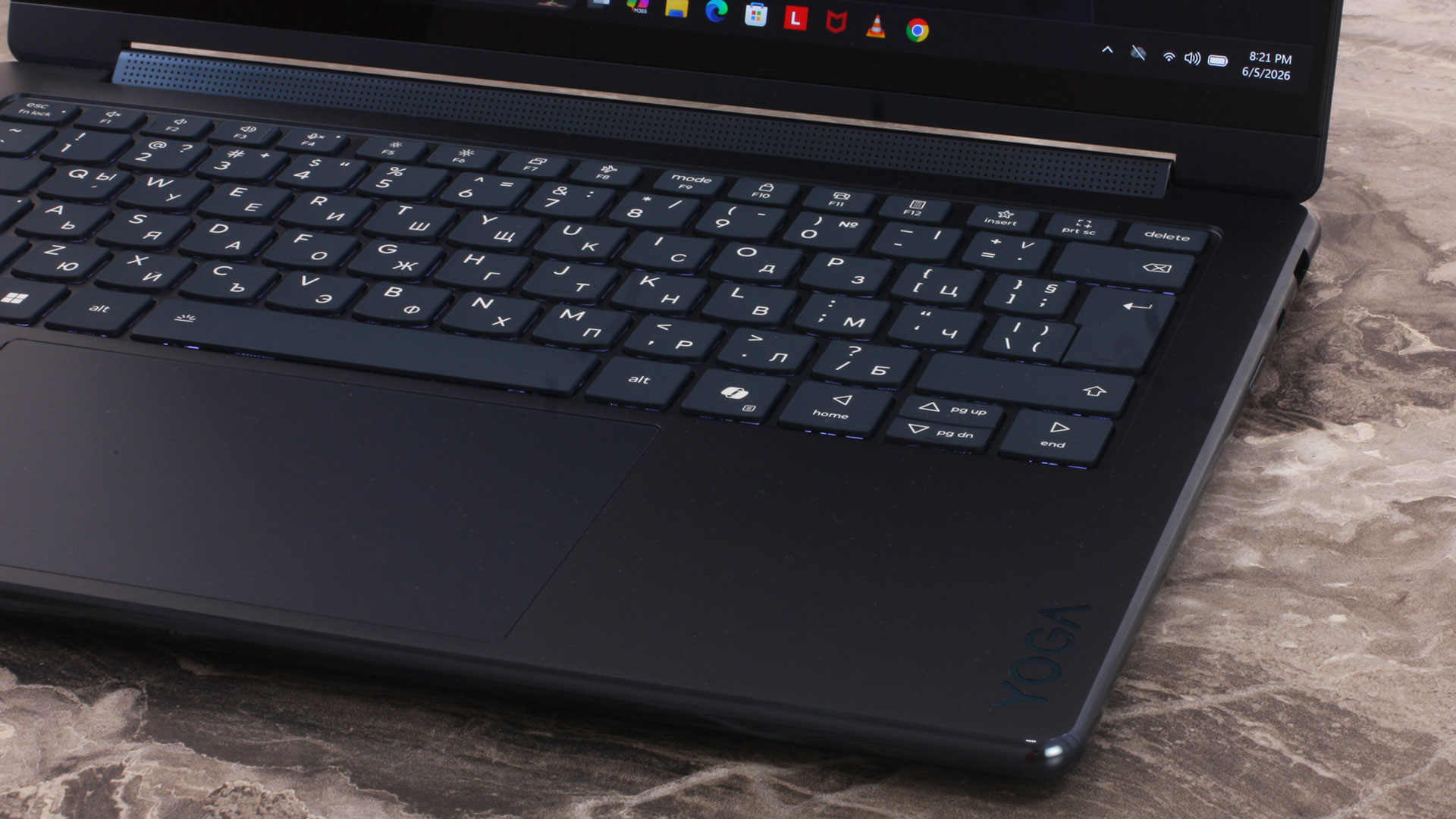
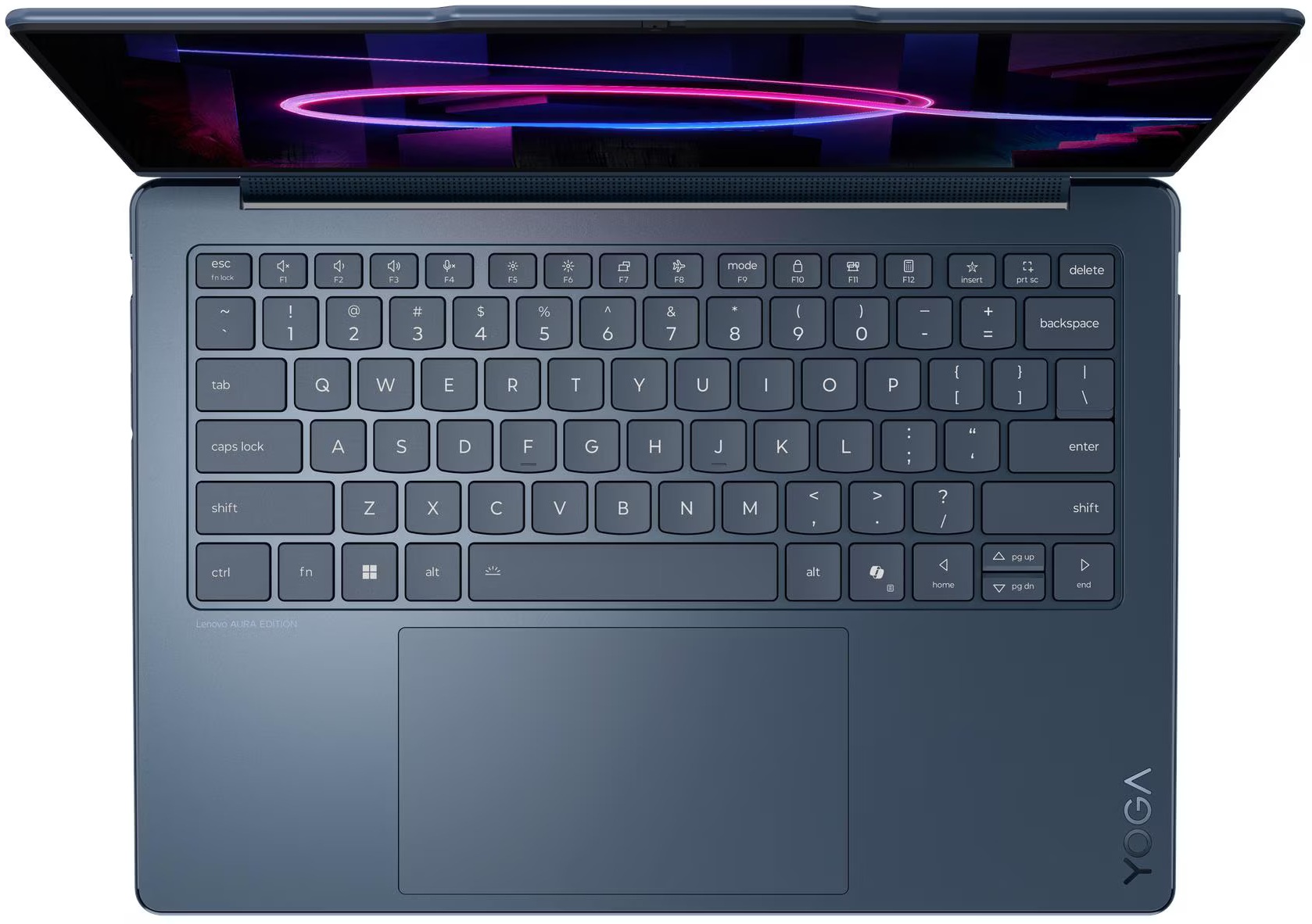
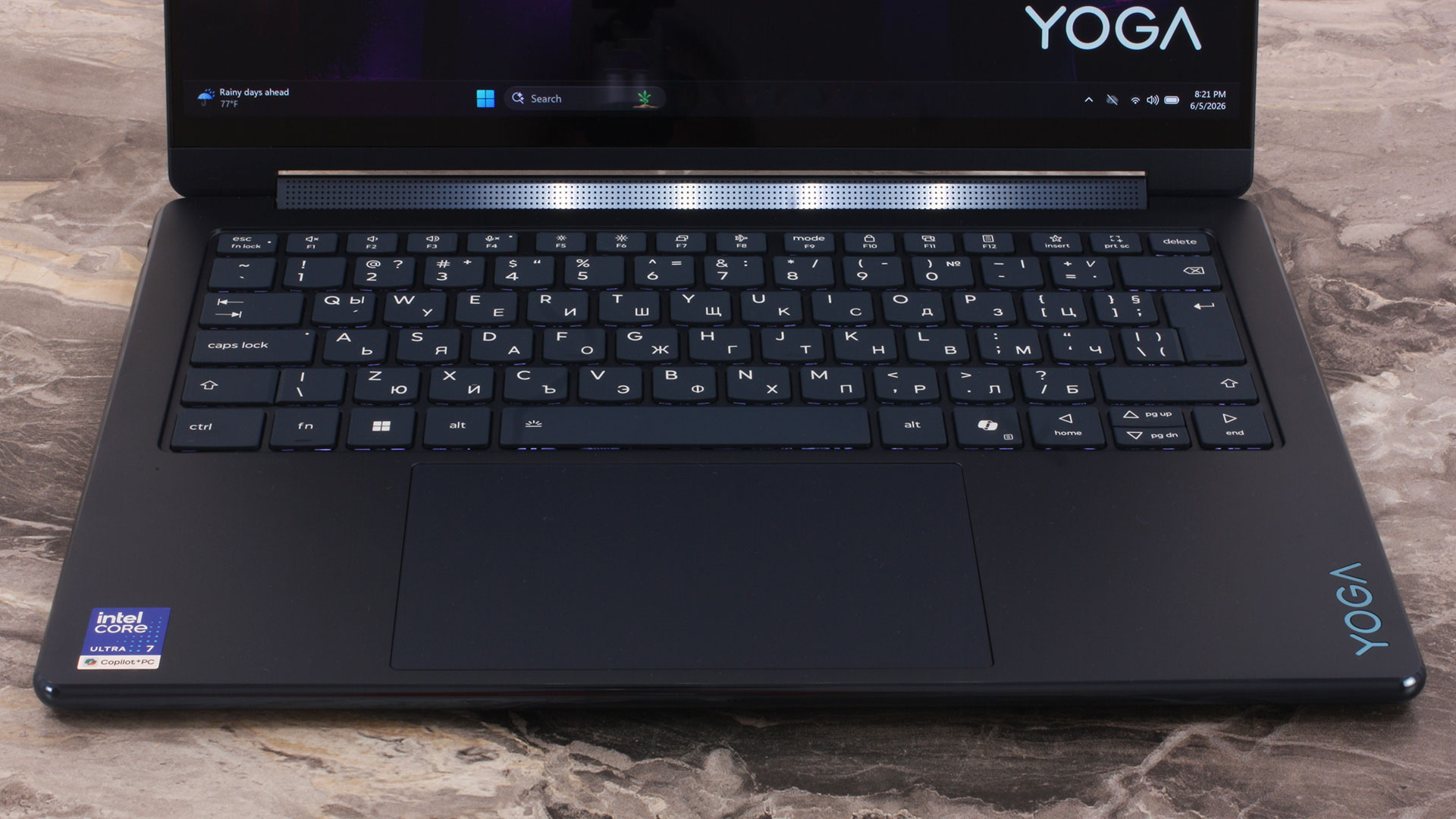
The keyboard deck follows a compact 14-inch layout and, naturally, there is no NumPad. Our machine has a backlit Bulgarian keyboard. The main keys are well-sized and comfortable for long typing sessions, while the only obvious layout compromise is the arrow key cluster. The Left and Right arrows are full-sized, but the Up and Down arrows are half-height, which takes some getting used to if you rely on them often.
The power button is placed on the side of the chassis, so it remains accessible in tablet and stand modes. The touchpad is a large buttonless glass unit measuring 80 x 135 mm (3.15 x 5.31 inches). It is centered below the keyboard, supports Precision TouchPad gestures, and provides plenty of room for multi-finger navigation.
Ports and Connectivity
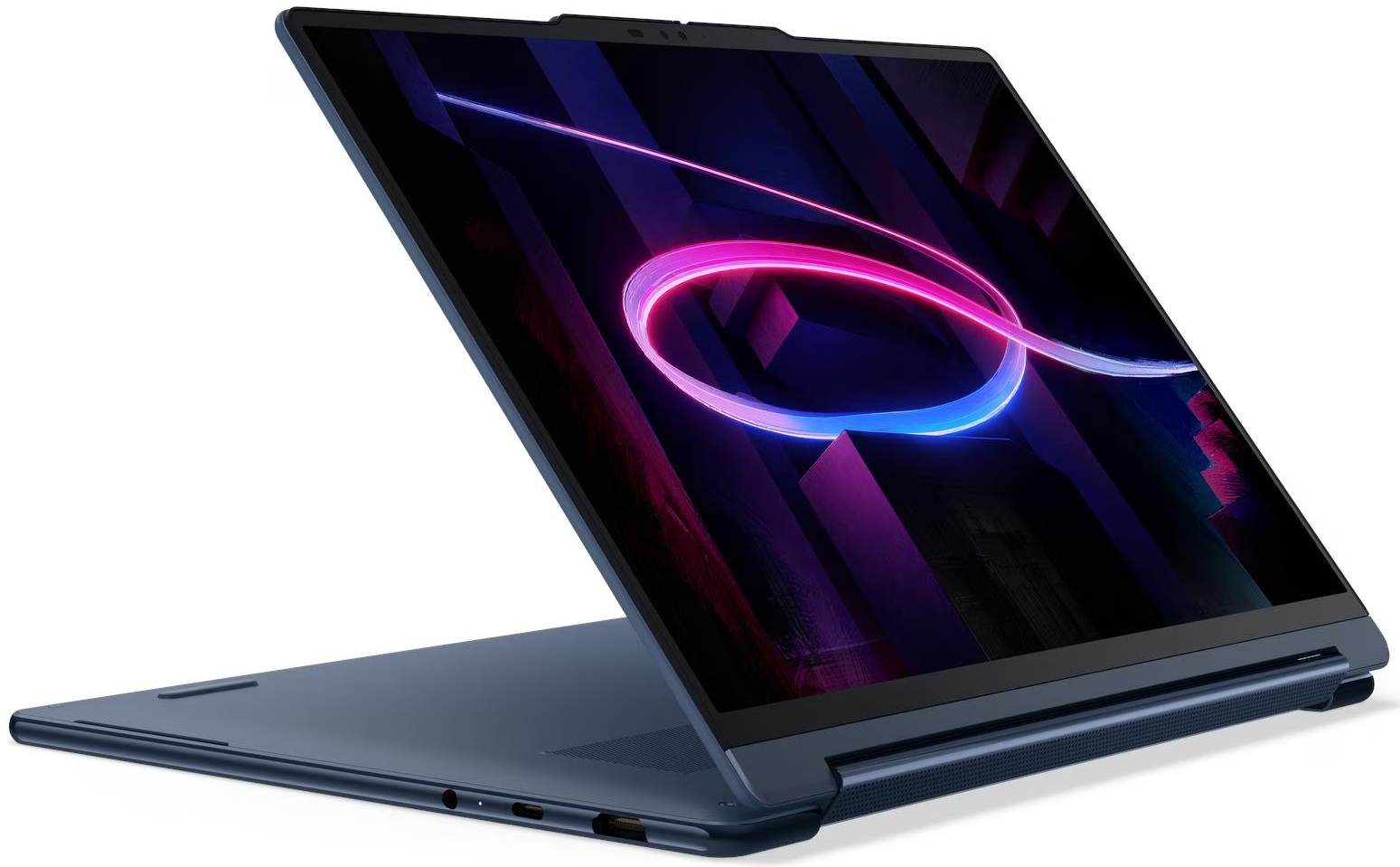
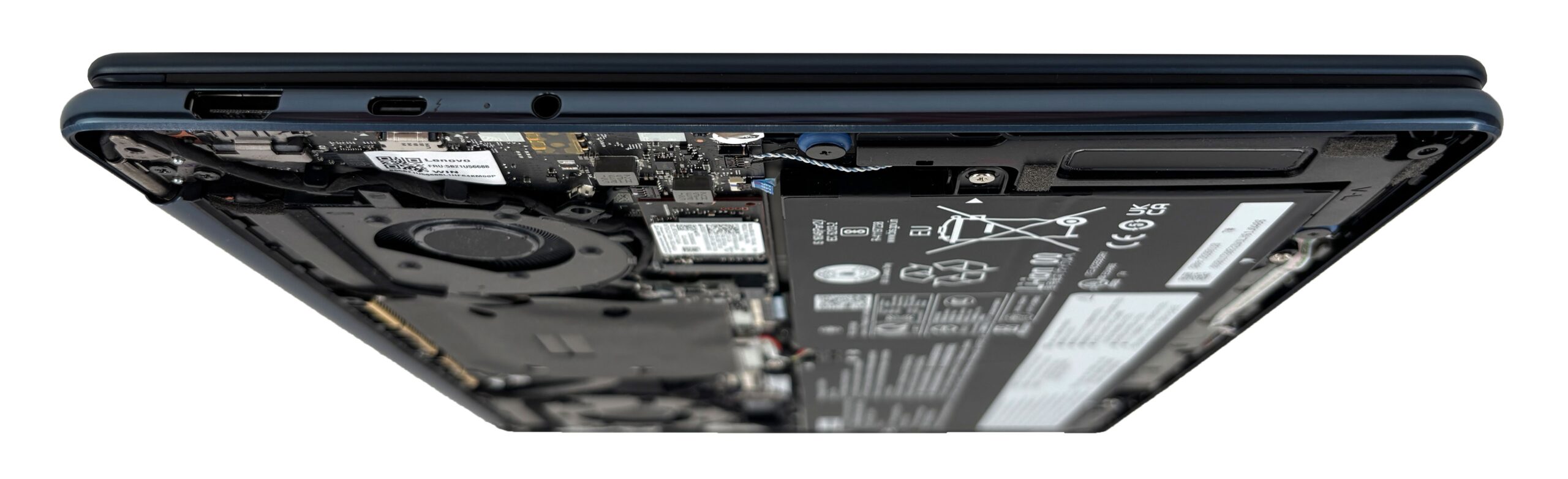
The port selection is very practical for a slim 14-inch convertible. On the left, you get HDMI 2.1, one Thunderbolt 4 port with USB Power Delivery and DisplayPort 2.1 support, plus a 3.5mm combo audio jack. The full-size HDMI port is especially useful if you often connect the laptop to external monitors, TVs, or projectors.
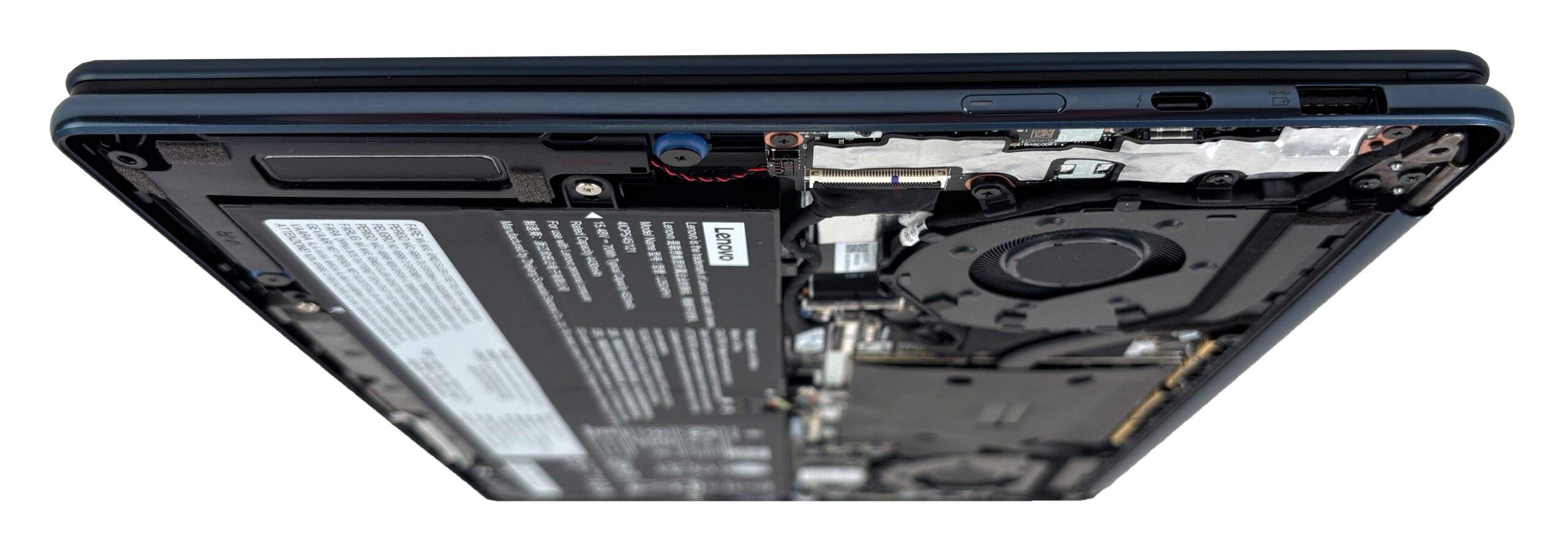
On the right, there is a second Thunderbolt 4 port, a USB-A 10Gbps port with Always On functionality, and the side-mounted power button. The USB-A port is a welcome inclusion, since it keeps the laptop compatible with older accessories without requiring a dongle. There are no ports on the rear, as the entire back edge is occupied by the 360-degree soundbar hinge.
Wireless connectivity is handled by Wi-Fi 7, 802.11be 2×2, and Bluetooth 5.4. There is no built-in Ethernet port and no WWAN/SIM support, so wired networking requires an adapter.
Display and Sound Quality
The display is one of the strongest parts of the Lenovo Yoga 9i 2-in-1 Aura Edition (14″, Gen 11). The rating breakdown reflects what we see in practice: excellent color accuracy, exceptional color coverage and contrast, very good brightness, and a very sharp image thanks to the high pixel density. The area that keeps the score from going even higher is eye comfort: this is a glossy touch OLED panel, so reflections and OLED light pulsation should be considered by users who are sensitive to glare or flicker.
We ordered the Lenovo Yoga 9i 2-in-1 Aura Edition (14″, Gen 11) with the WQXGA+ (2880 × 1800), 120 Hz, OLED screen option.
| Lenovo Yoga 9i 2-in-1 Aura Edition (14″, Gen 11) | LEN140WQ+ (LEN8AD6) |
| Diagonal | 14.0 inches (35.6 cm) |
| Panel Type | OLED |
| Resolution | 2880 × 1800 pixels |
| Max Refresh Rate | 120 Hz |
| Aspect Ratio | 16:10 |
| Pixel Density | 242 PPI |
| ‘Retina’ Distance | Greater than or equal to 36 cm |
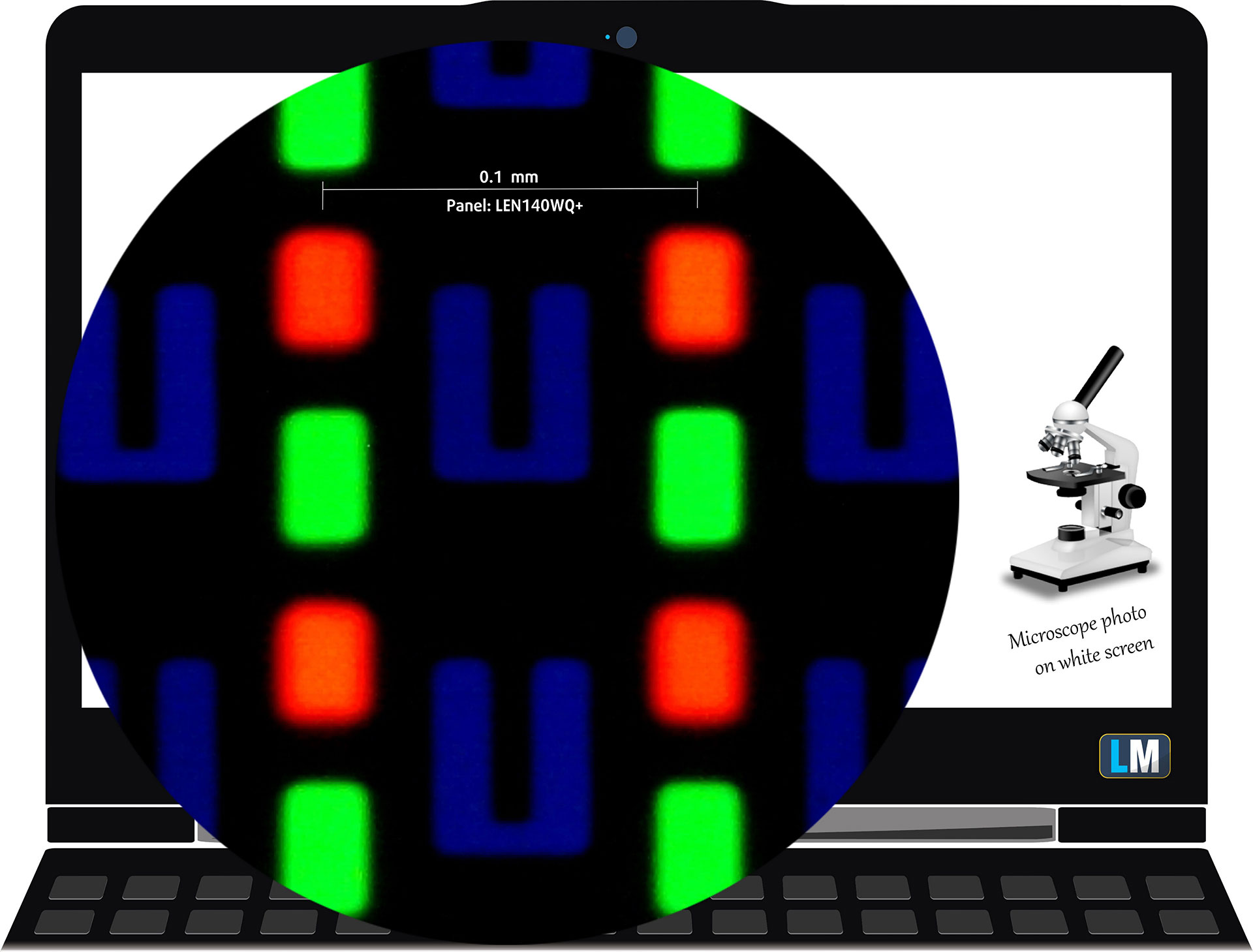
The WQXGA+ (2880 × 1800), 120 Hz, OLED display variant under our microscope
Viewing Angles
Viewing angles are excellent, as expected from an OLED panel. Colors and contrast remain stable even when the screen is viewed from the side, although the glossy glass surface can introduce visible reflections depending on the lighting around you.
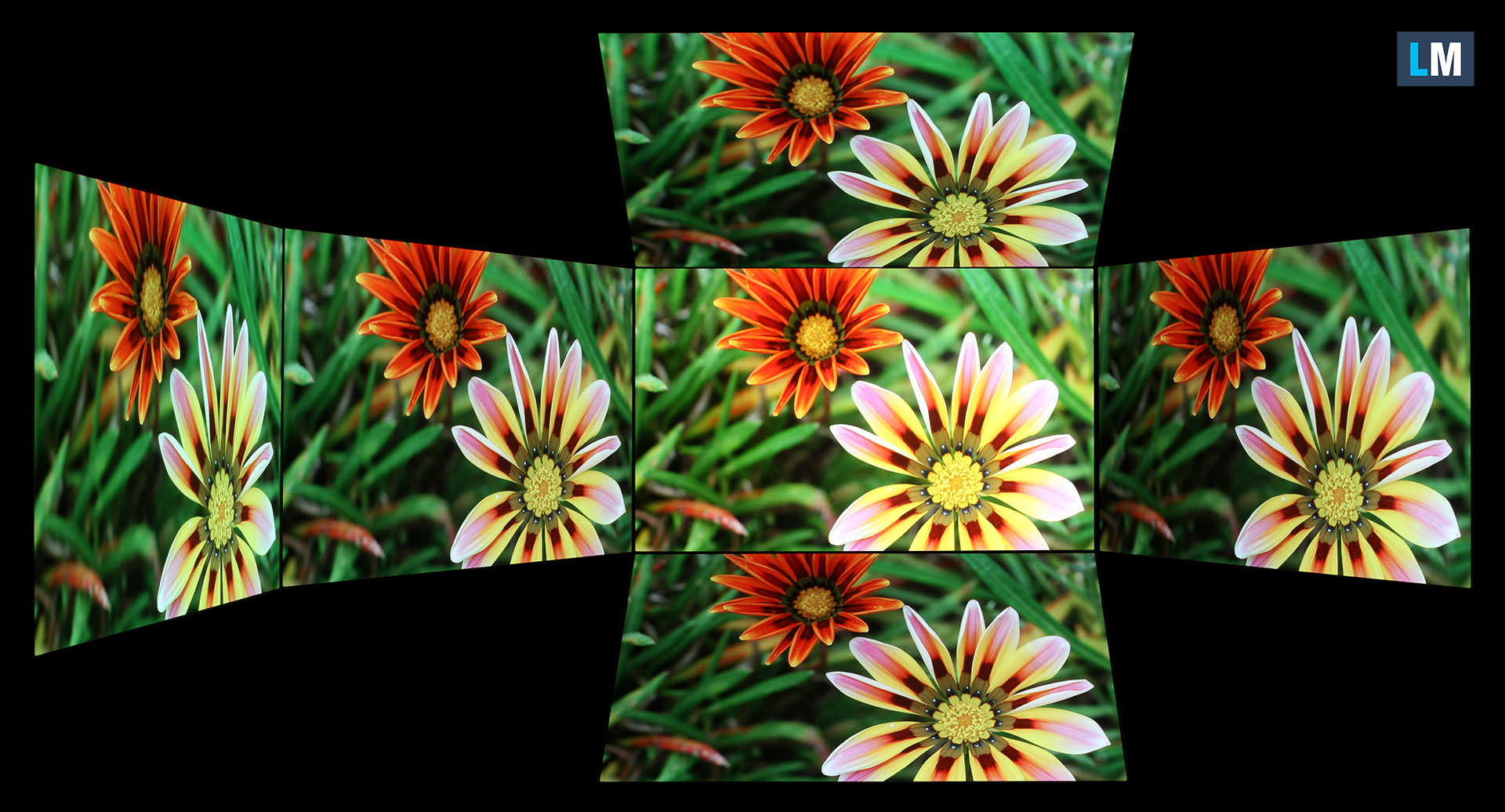
We also include a video recorded with locked focus and exposure.
Color Coverage
The whole “sail-shaped” map below (Fig. 1) consists of all the colors we can see, while the black crooked line shows the colors from real-world scenes and nature around us.
For reference, sRGB is the main standard for web content, Adobe RGB is important for print-oriented workflows, DCI-P3 is widely used for modern photography, video, and cinema content, while Rec. 2020 represents one of the widest consumer HDR color standards.
The yellow dashed triangle shows the color range covered by the display of the Lenovo Yoga 9i 2-in-1 Aura Edition (14″, Gen 11). In our tests, the panel covered 100% of the sRGB color gamut and 100% of the DCI-P3 color gamut.
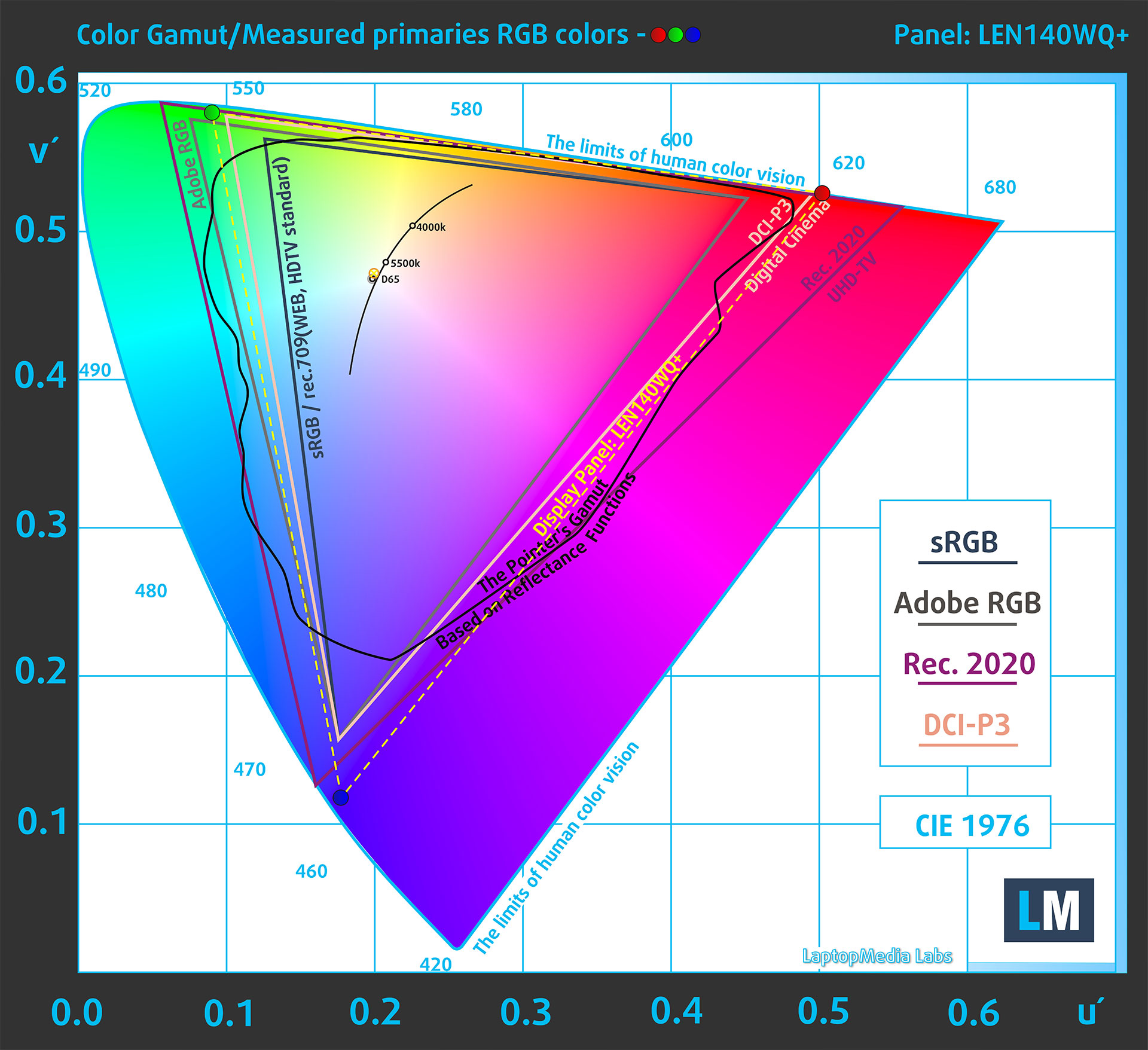
(Fig.1) Native mode
The display can also emulate several color spaces through Lenovo Vantage with X-Rite Factory Color Calibration. This is important because it allows users to choose a more accurate mode for the type of work they are doing instead of being locked into an oversaturated native OLED mode.

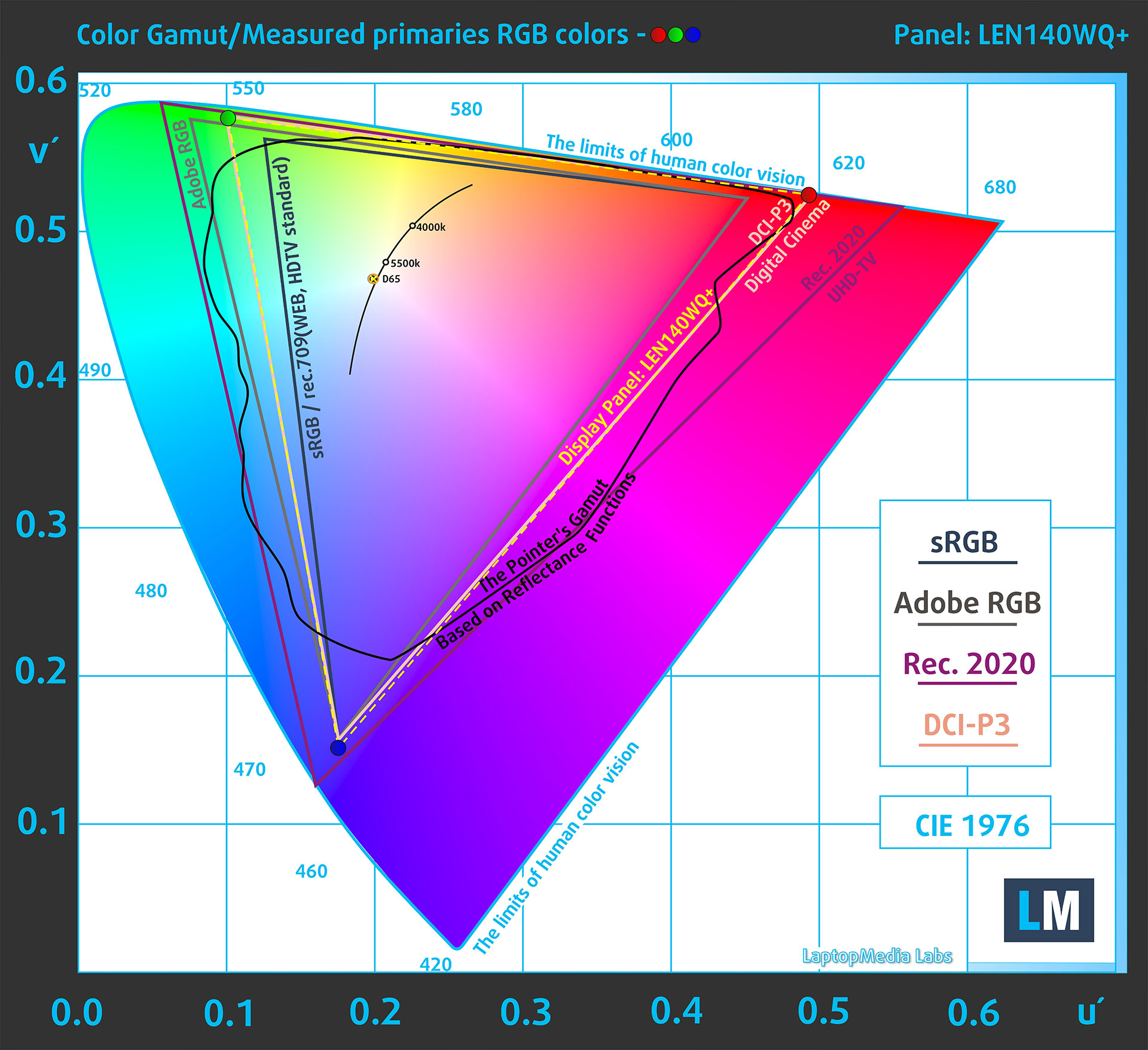
(Fig.2) Display P3 mode
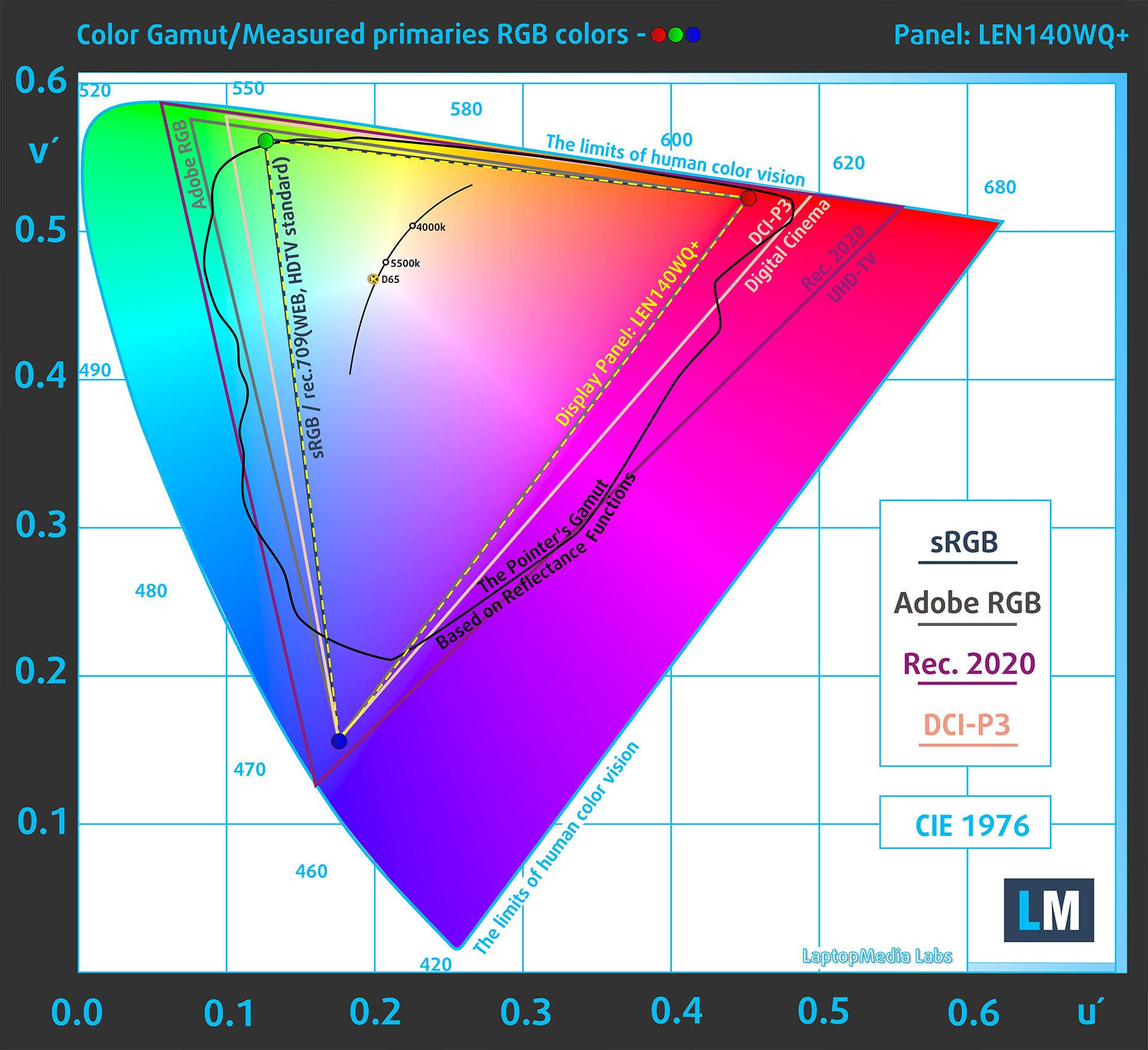
(Fig.3) sRGB mode
Brightness and Contrast
The peak brightness in HDR mode is 1020 cd/m² at 8% white fill and 655 cd/m² on a full white screen.

The maximum brightness in SDR mode is 503 cd/m².
The Correlated Color Temperature (CCT) on a white screen at maximum brightness is 6440K in Native mode.
The contrast ratio of OLED panels is excellent because individual pixels can turn off completely when displaying black. This gives the screen very deep blacks and makes HDR content look noticeably more impactful than on most IPS panels.
Uniformity: Luminance, Contrast, and Color Deviation
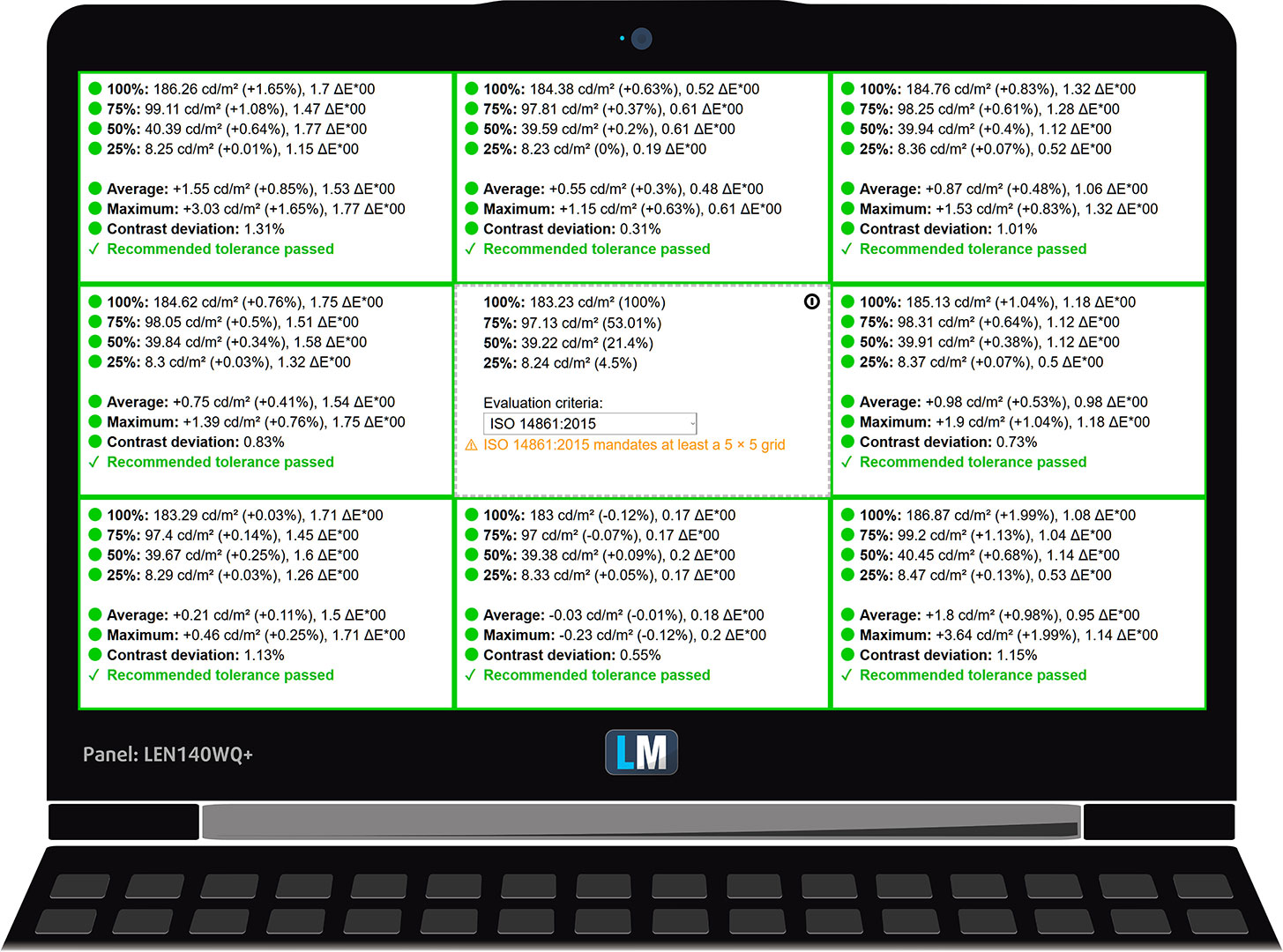
The figure below shows the results from our uniformity test across different sections of the screen. It is measured at 180 nits — a brightness level we consider typical for standard working conditions.
DeltaE values below 4.0 are acceptable for regular users. For those working with colors, screens with DeltaE values no higher than 2.0 are recommended.
Color Accuracy
Let’s check the difference between real colors and those you’ll see on the Lenovo Yoga 9i 2-in-1 Aura Edition (14″, Gen 11). We measure that distance in DeltaE — the higher the number, the more different they look.
Values below 4.0 are acceptable for regular users, while values below 2.0 are suitable for color-sensitive work. A value below 1.0 means the difference is indistinguishable to the naked eye.
For the next graph, we’ve selected 24 common colors, including dark/light skin, blue sky, green grass, and others.
Below are the results of the Lenovo Yoga 9i 2-in-1 Aura Edition (14″, Gen 11) in its factory condition, using the sRGB mode in Lenovo Vantage, compared to the sRGB color space.
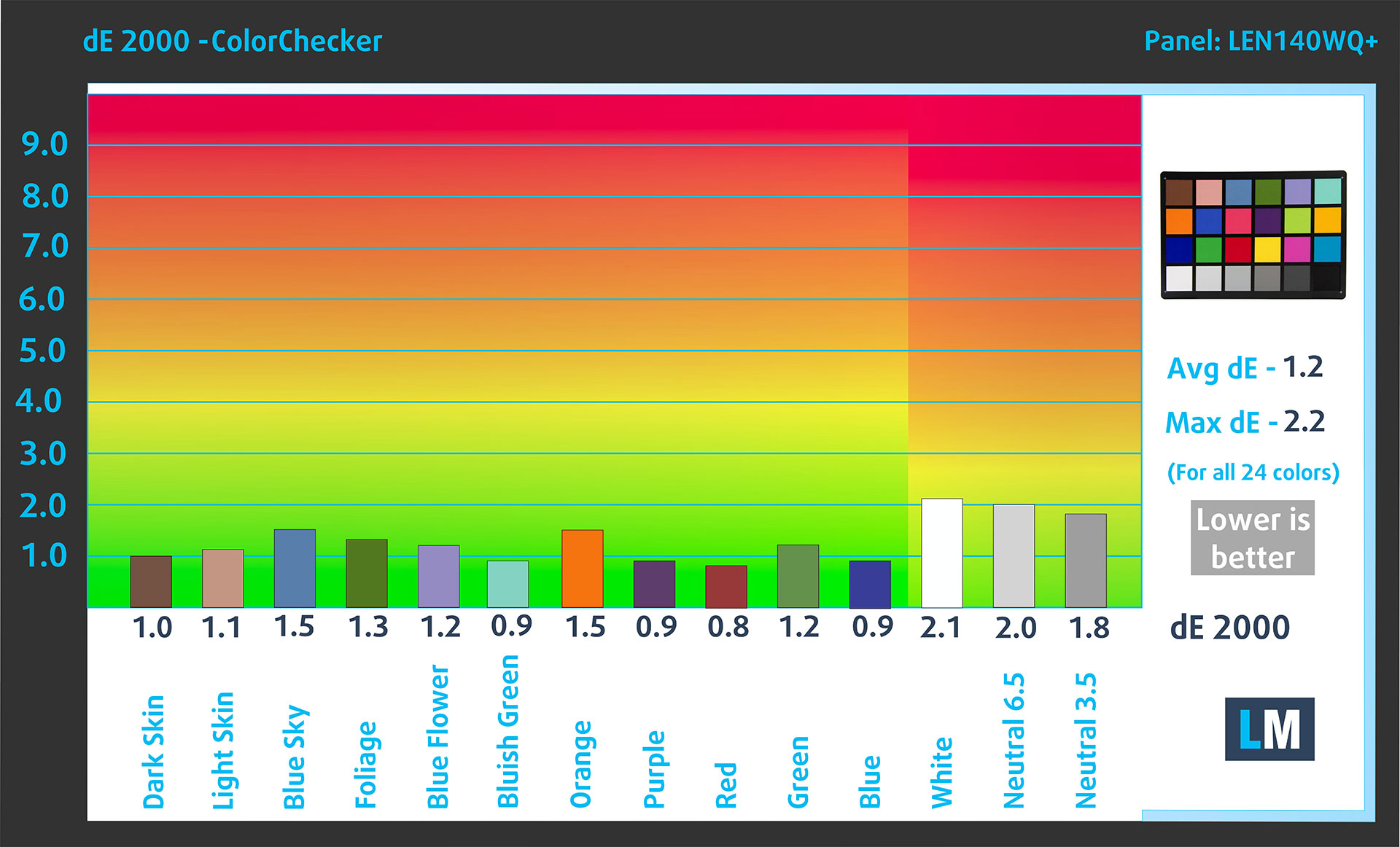
Comparison in the sRGB color space.
Below are the results in P3-D65 / Display P3 mode, compared to the Display P3 color space.
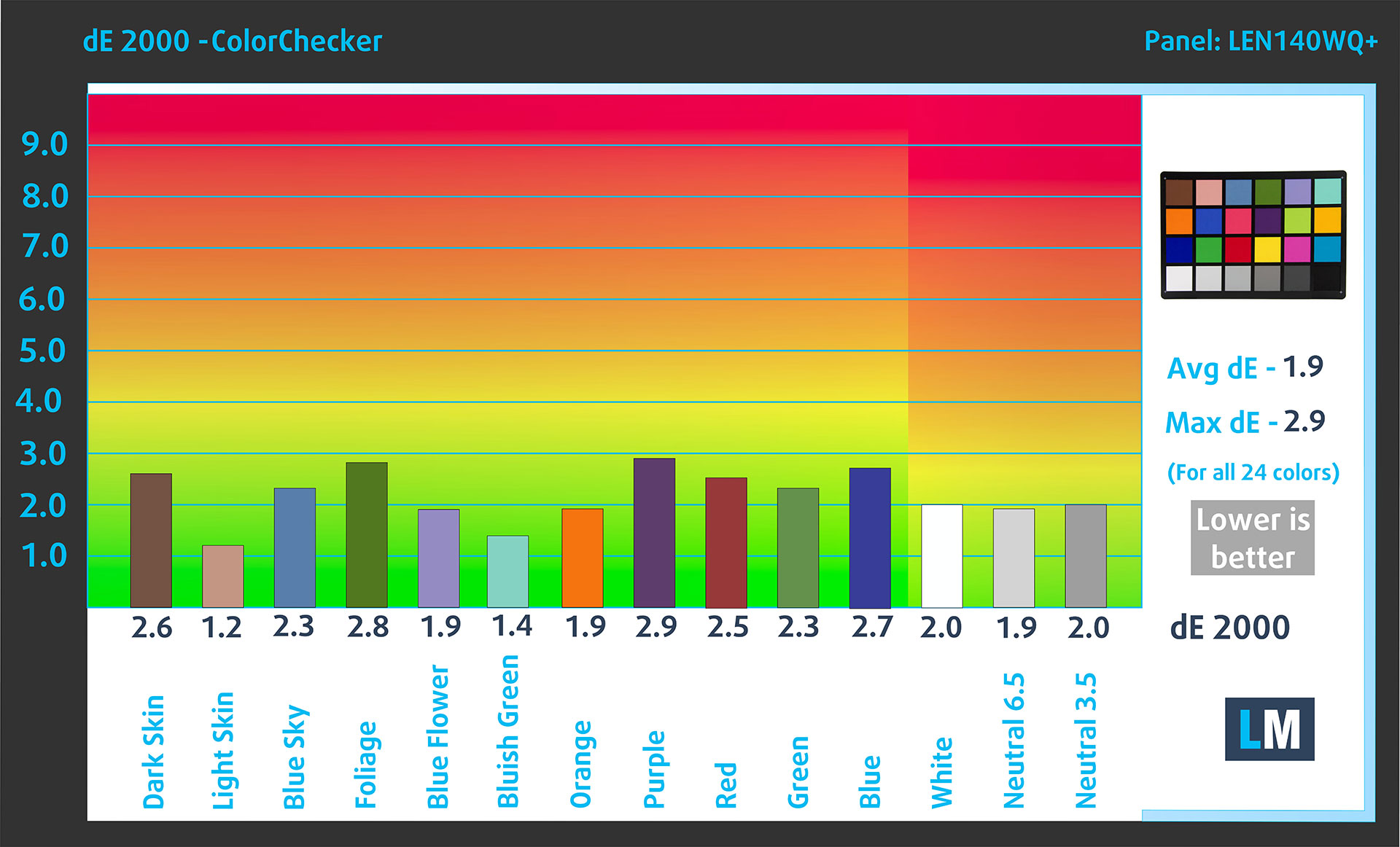
Comparison in the Display P3 color space.
The factory settings offer accurate color matching, with an average dE 2000 of 1.2 in sRGB mode and 1.9 in P3-D65 / Display P3 mode, thanks to X-Rite Factory Color Calibration. This makes the panel suitable not only for media consumption, but also for web, photo, and video work where the correct color mode is selected.
Health Impact: PWM (Screen flickering)
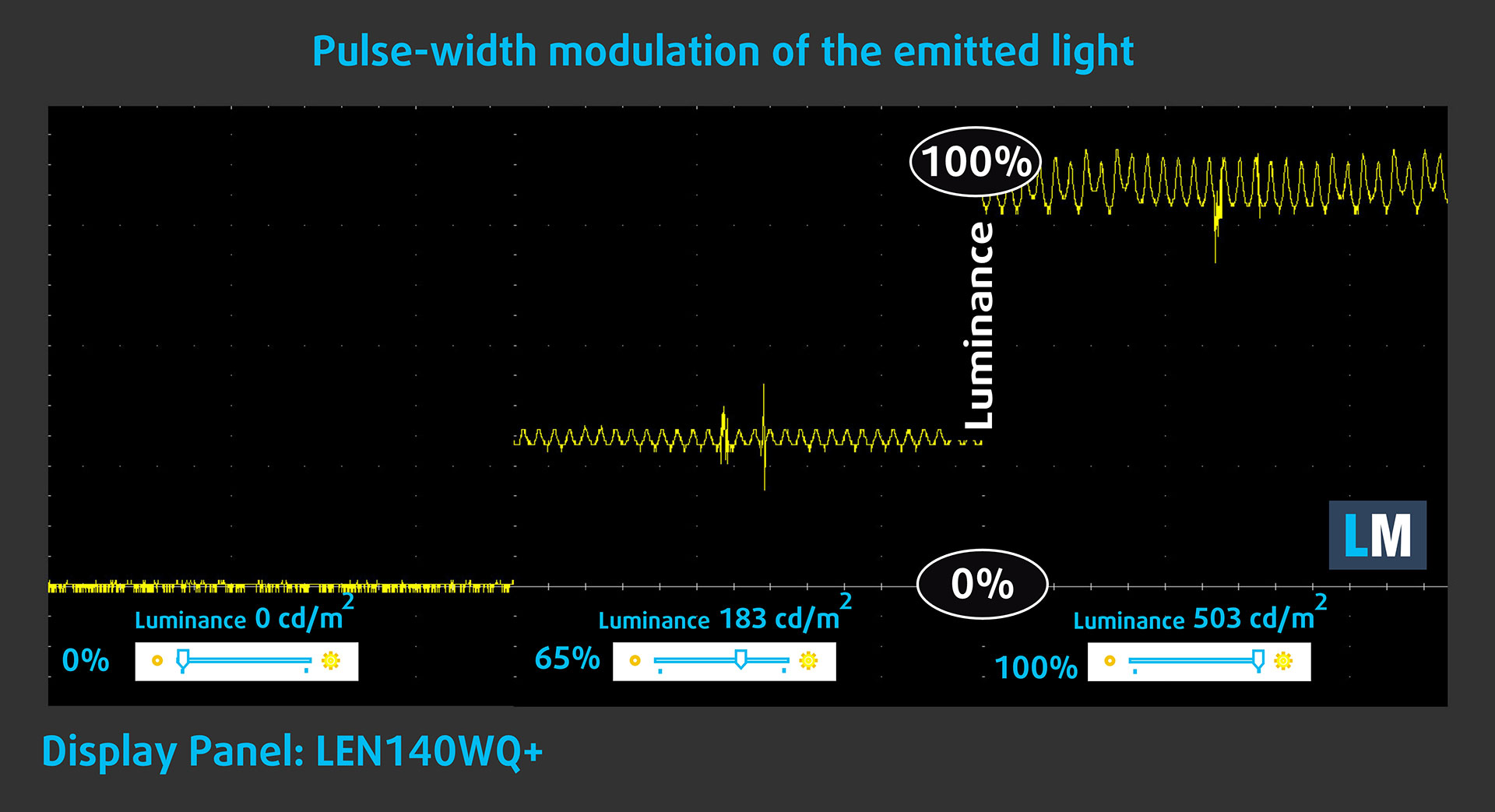
Some displays use PWM to regulate brightness, which means that instead of reducing the light intensity, they pulse or flicker. Our brain merges the image, so it appears darker, but this can increase eye strain, especially when the pulse frequency is low. You can read more about that in our dedicated article on PWM.
In the graph below, you see the intensity of light at different brightness levels. The vertical axis shows the luminance of the emitted light, while the horizontal axis shows time.
The display light of the Lenovo Yoga 9i 2-in-1 Aura Edition (14″, Gen 11) pulsates, but with limited amplitude across the brightness range. This is better than many OLED panels with more aggressive brightness modulation, and we find the display relatively comfortable in this regard. Still, users who are highly sensitive to flicker should keep this behavior in mind.
Health Impact: Screen Reflectance
Glossy-coated displays can cause eye fatigue in high ambient light conditions due to reflections. We measure the level of screen reflection with the display turned off, at a 60° angle.
The screen reflectance of the Lenovo Yoga 9i 2-in-1 Aura Edition (14″, Gen 11) is 134 GU. This is a high-gloss result, and the panel is very reflective. The strong brightness helps indoors, but in bright rooms or near windows, reflections can become distracting.
High Gloss: >70 GU
Medium Gloss: 30 – 70 GU
Low Gloss: <30 GU
Sound
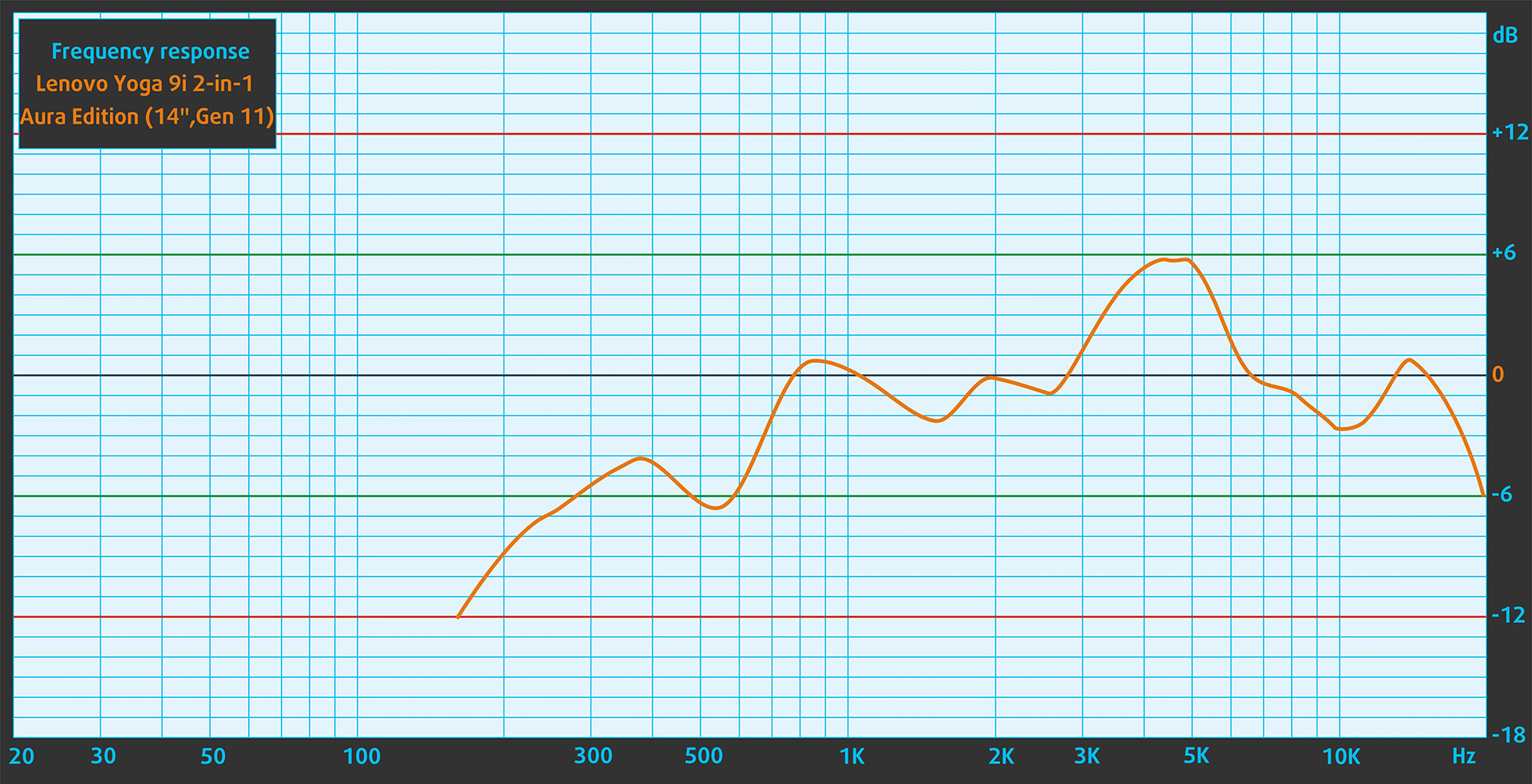
The Lenovo Yoga 9i 2-in-1 Aura Edition (14″, Gen 11) has a strong speaker setup for a 14-inch convertible, helped by the rotating soundbar hinge. The sound is clear in the low, mid, and high frequencies, and voices are easy to distinguish. As expected from such a thin device, deep bass is still limited, but the overall presentation is fuller and more spacious than what we usually hear from compact laptops.
Work Performance: CPU, Storage, AI
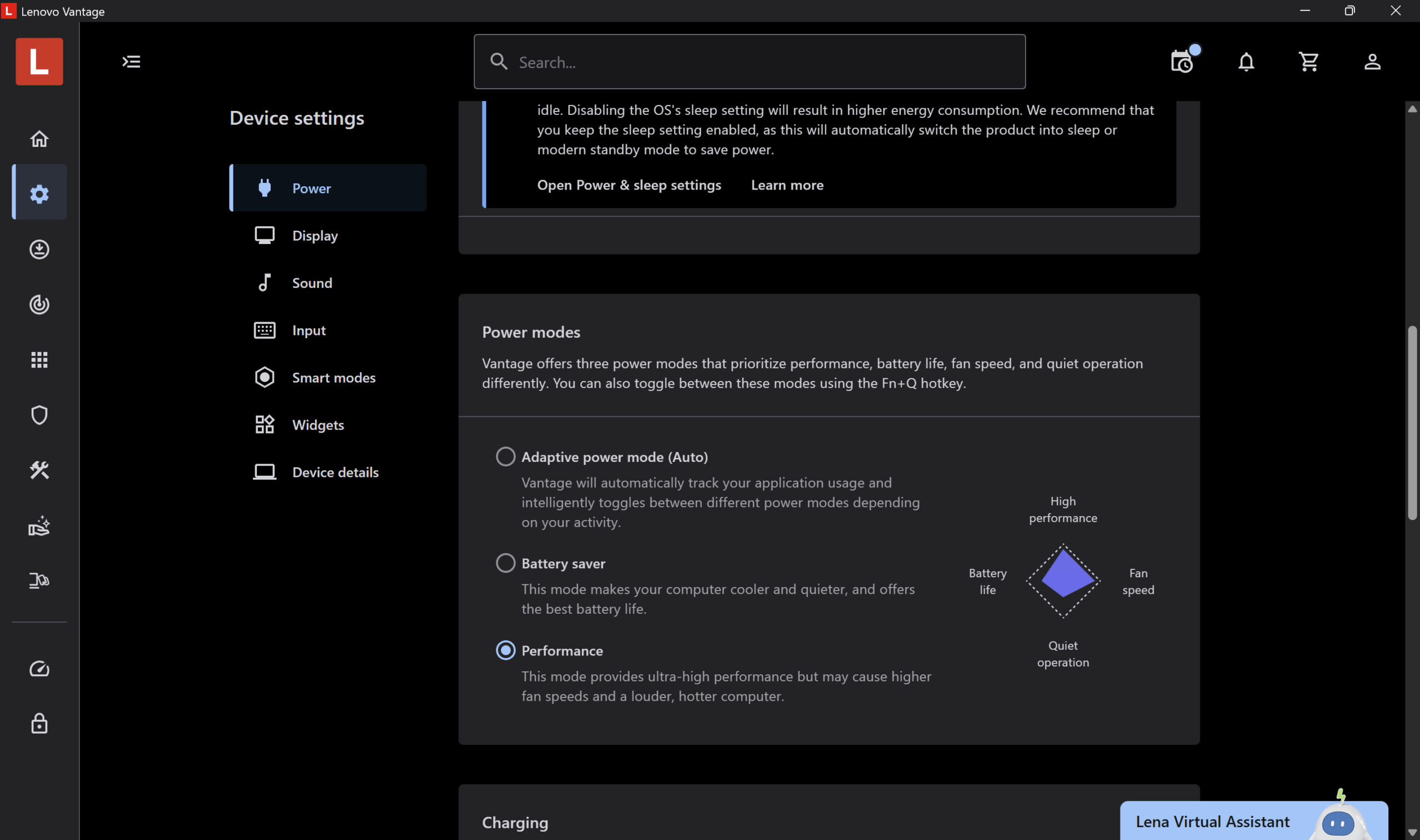
All performance and temperature tests are conducted with Performance mode activated in Lenovo Vantage:
CPU and Work Performance
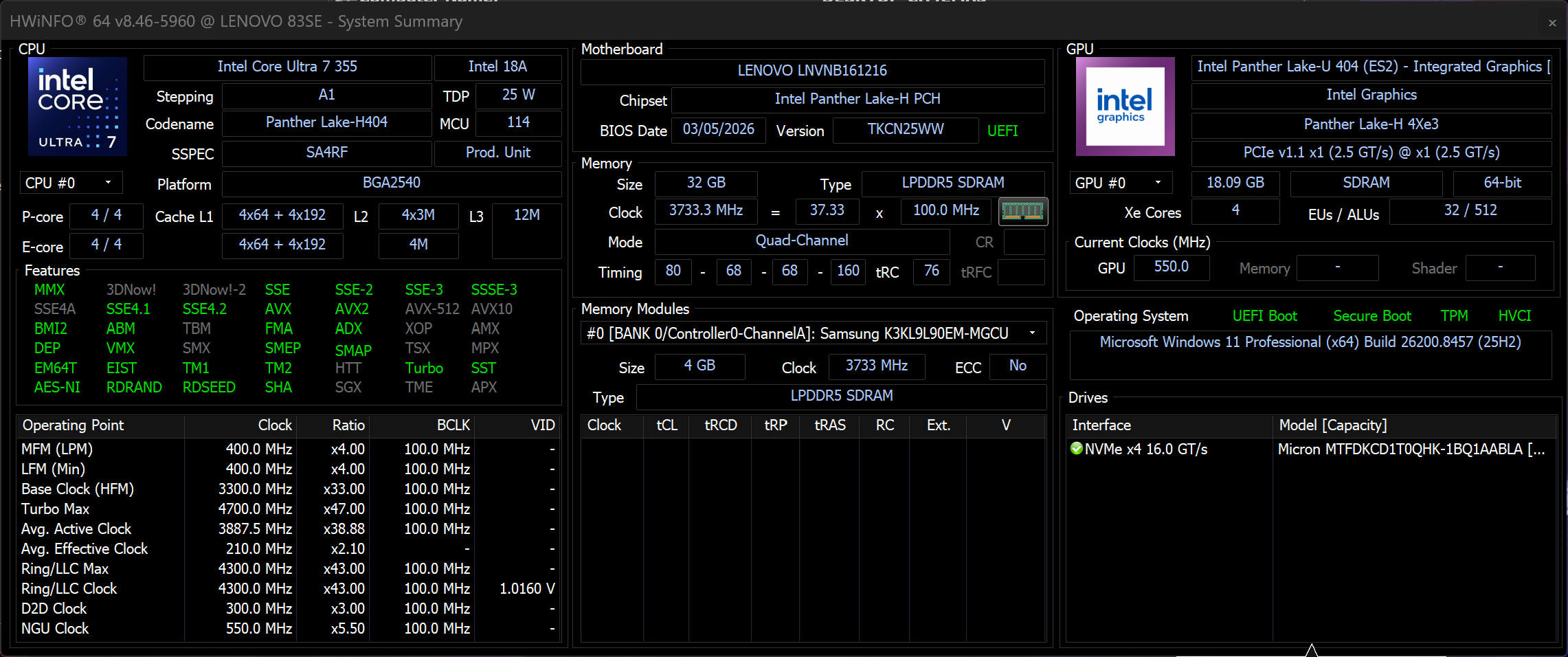
The Lenovo Yoga 9i 2-in-1 Aura Edition (14″, Gen 11) is configured with the Intel Core Ultra 7 355, a power-efficient processor aimed at premium thin-and-light convertibles. It is a good match for everyday productivity, multitasking, video calls, office work, and light-to-moderate creative tasks. For a broader comparison with other laptop processors, check our Top Laptop CPU Ranking.
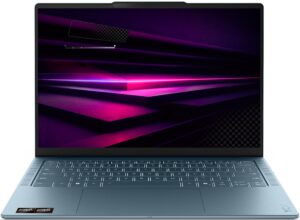
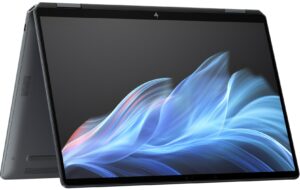
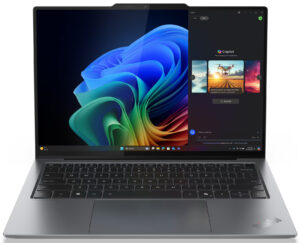
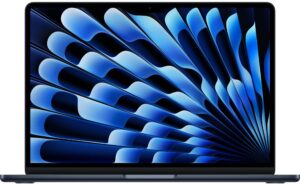
Compared to other premium compact machines, the Core Ultra 7 355 performs very well. Its single-core score is close to the best results in this group, while the multi-core performance is especially strong, staying ahead of machines such as the Lenovo Yoga Slim 7a (14″, Gen 11) (detailed review), Dell XPS 13 9350 (detailed review), and Lenovo ThinkPad X9-14 Gen 1 (detailed review) in Geekbench 6 Multi-Core.
In Cinebench 2024, the Yoga is again near the top, practically matching the Ryzen AI 7 445-powered Lenovo Yoga Slim 7a (14″, Gen 11) (detailed review). It is not a workstation, but the CPU performance is excellent for a thin 14-inch convertible.
Single-core performance ensures smooth operation and responsiveness in operating systems, providing a better user experience.
Results are from the Geekbench 6 Single-Core test (higher is better)

Multi-core performance is essential for handling complex and demanding tasks, such as Video editing, CAD, and Scientific simulations.
Results are from the Geekbench 6 Multi-Core test (higher is better)
Here, we evaluate the CPU's performance using a real-world 3D rendering task, assessing its ability to handle complex computations and rendering workloads efficiently.
Results are from the Cinebench 2024 Multi-Core test (higher is better)
Storage Performance
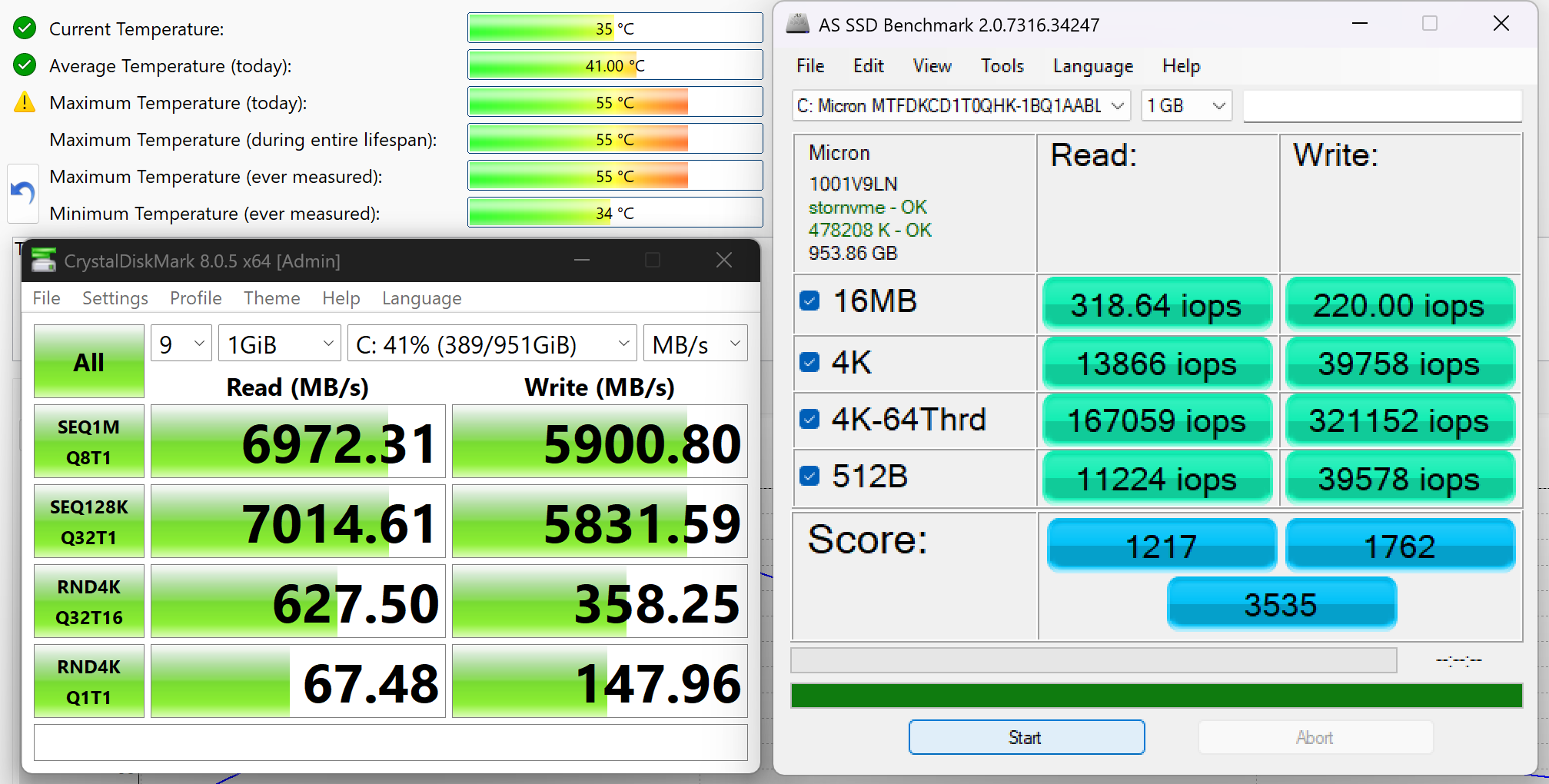
We ordered a configuration with 1TB of storage, and the Lenovo Yoga 9i 2-in-1 Aura Edition (14″, Gen 11) arrived with a Micron MTFDKCD1T0QHK-1BQ1AABLA NVMe SSD.
The drive is a very fast PCIe 4.0 model, reaching 7.0 GB/s sequential read and 5.9 GB/s sequential write speeds in our benchmark, while keeping temperatures low.
AI Performance
Here you can see the position of the GPUs and CPUs (NPUs) found within the Lenovo Yoga 9i 2-in-1 Aura Edition (14", Gen 11) in our AI Hardware Performance Rankings based on their AI processing power, measured in TOPS (Tera Operations Per Second) - a critical metric indicating the computational throughput, particularly for AI tasks.
The first column shows peak performance for INT8/FP8 precision, which is the most widespread metric for evaluating AI inference capabilities. We exclude Sparsity to provide a more accurate reflection of AI performance in dense computation scenarios where sparsity optimizations may not be applicable. The second and third columns show the performance with Sparsity, and FP4 TFLOPS, when supported.
For SoCs, the results reflect the peak performance of the integrated NPU. Additionally, it’s important to note that, according to Microsoft, a NPU must have at least 40 TOPS of AI computing power for the PC to be considered “AI-capable.”
| # | GPU / CPU (NPU) | TOPS INT8/FP8 No Sparsity | TOPS INT8/FP8 Sparsity | TFLOPS FP4 Sparsity |
|---|---|---|---|---|
| 1576. | Intel Core Ultra 7 355 | 49 | — | — |
GPU and Gaming Performance
Graphics are handled by integrated Intel Graphics with 4 cores. This GPU is designed for office work, media playback, video acceleration, light photo editing, and general GPU-assisted tasks rather than serious gaming or heavy GPU rendering. You can compare it with other integrated and discrete GPUs in our Top Laptop Graphics Ranking.
In 3DMark Time Spy, the Yoga 9i 2-in-1 Aura Edition is clearly faster than the Radeon 840M in the Lenovo Yoga Slim 7a (14″, Gen 11) (detailed review), but it trails the stronger Intel Arc Graphics 130V and 140V solutions found in some competing compact laptops.
Wild Life Extreme is more favorable for the Yoga. It again beats the Radeon 840M and even edges ahead of the Intel Arc Graphics 130V in the Dell Pro 14 Premium (PA14250) (detailed review), although Intel Arc Graphics 140V machines remain faster overall. In practice, this is enough for light games, older titles, and casual gaming at reduced settings, but demanding modern games are outside its comfort zone.
The results are from 3DMark Time Spy (Graphics). Higher is better.
The results are from 3DMark Wild Life Extreme Unlimited. Higher is better.
Gaming tests

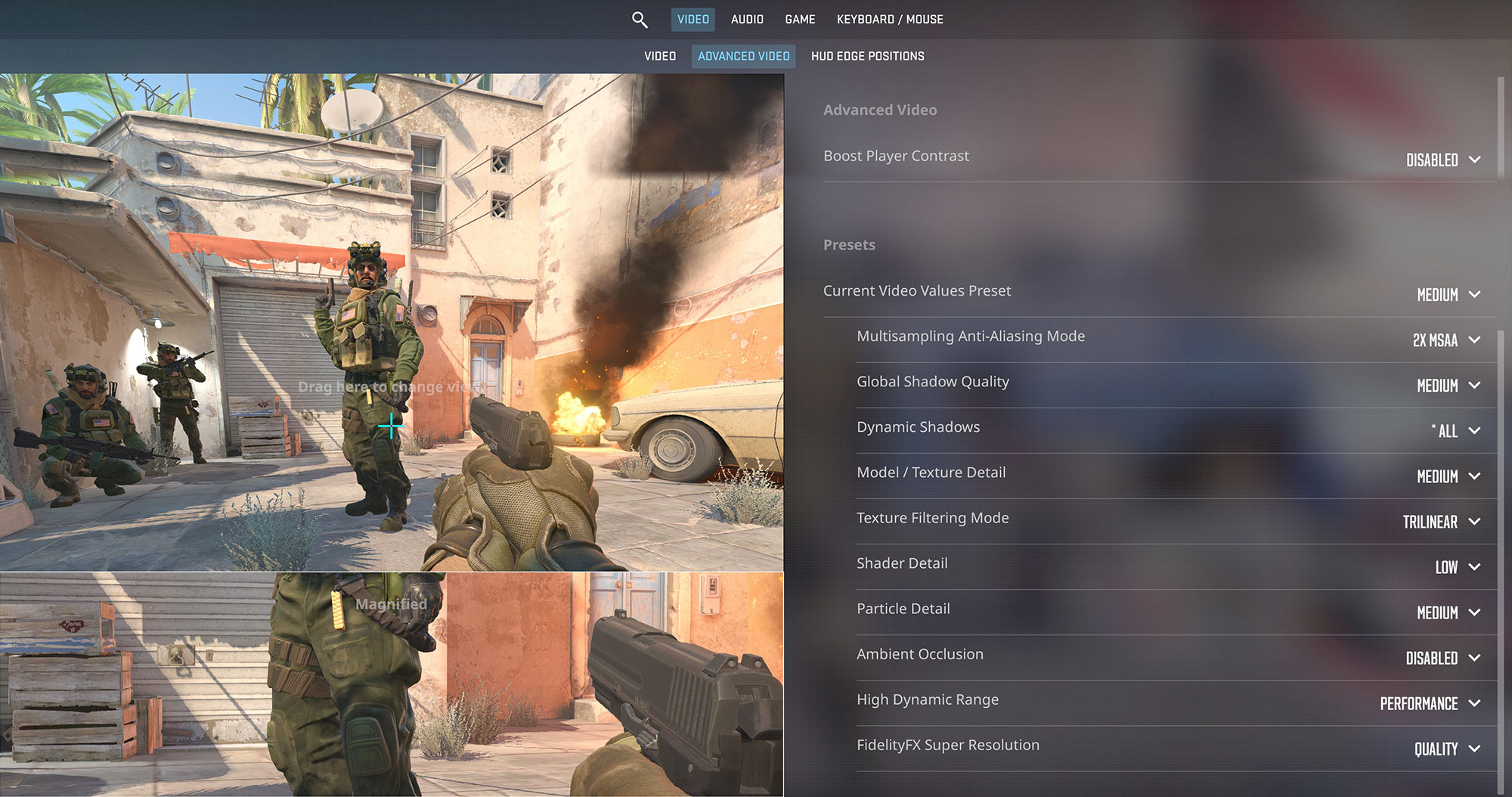
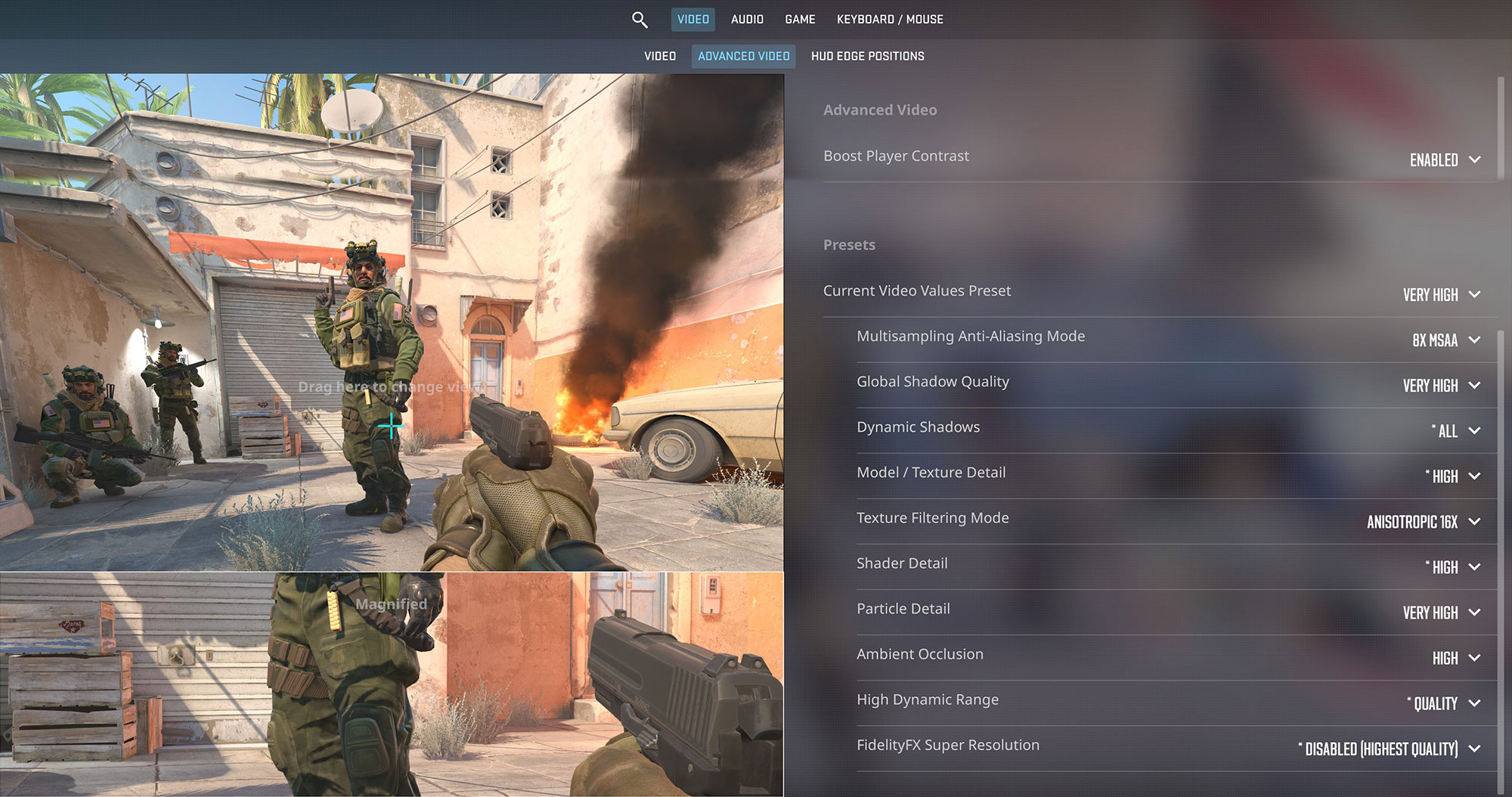
The integrated Intel Graphics in the Lenovo Yoga 9i 2-in-1 Aura Edition can handle some casual gaming, but expectations have to be realistic. In Counter-Strike 2, 1200p Medium delivers 52 FPS, which is playable for casual matches, but not enough to make full use of the 120 Hz display. Very High settings are much heavier, and the native 1800p resolution is simply too demanding for this GPU.
| Counter-Strike 2 | 1200p, Medium (Check settings) | 1200p, Very High (Check settings) | 1800p, Very High (Check settings) |
| Average FPS | 52 FPS | 34 FPS | 19 FPS |

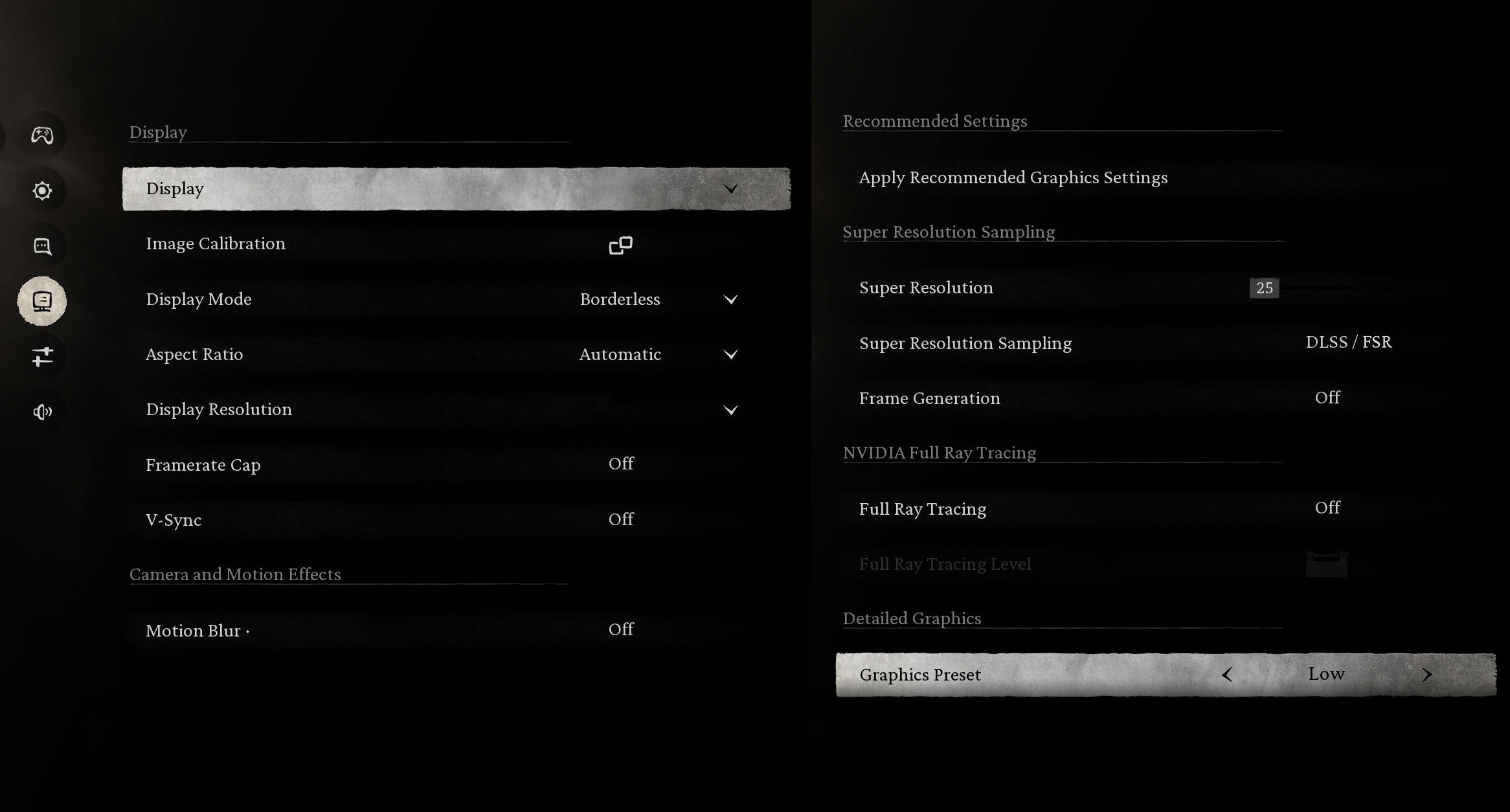
Black Myth: Wukong is a much more demanding title, so the result is surprisingly usable for a thin convertible with integrated graphics. At 1800p Low, the Yoga averages 41 FPS. This is not a high-detail experience, but it shows that lighter AAA gaming is possible if you are willing to lower the visual settings.
| Black Myth: Wukong | 1800p, Low (Check settings) |
| Average FPS | 41 FPS |

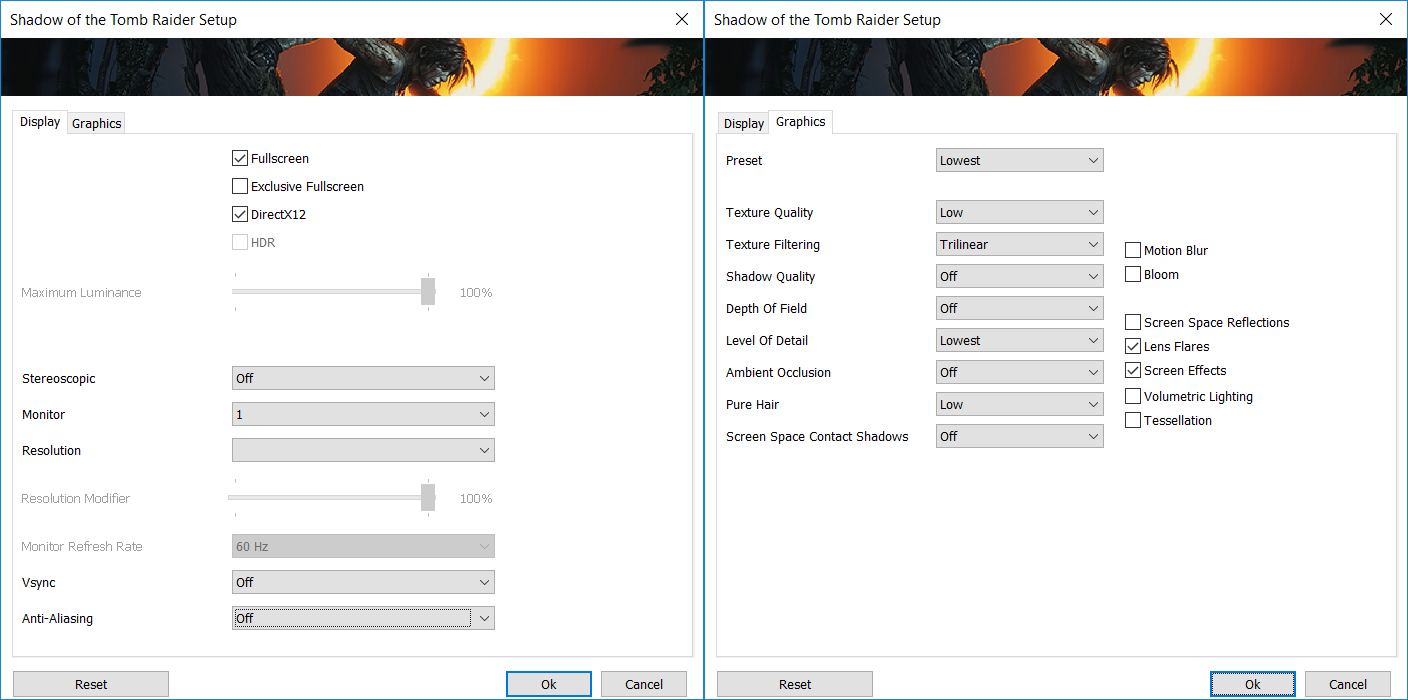
Older single-player titles are a better fit. Shadow of the Tomb Raider runs at 41 FPS at the native 1800p resolution on the Lowest preset, which is adequate for casual play. Overall, the Yoga 9i can handle light and older games, but demanding modern titles require serious compromises in settings and resolution.
| Shadow of the Tomb Raider | 1800p, Lowest (Check settings) |
| Average FPS | 41 FPS |
Temperatures and Comfort, Noise, Stability
At idle, the CPU package of the Intel Core Ultra 7 355 maintains a temperature of 44ºC, and the notebook remains completely silent.
Before looking at the stress-test results, keep in mind that the comparison below is not between direct competitors. The Lenovo LOQ 15 (15IPH11) is a larger gaming laptop with much more thermal headroom. We include it because it is the only machine we have tested with the same Intel Core Ultra 7 355 processor, so it helps show how the chip behaves in a thin 14-inch convertible chassis.
Office Work, Web Development, Design
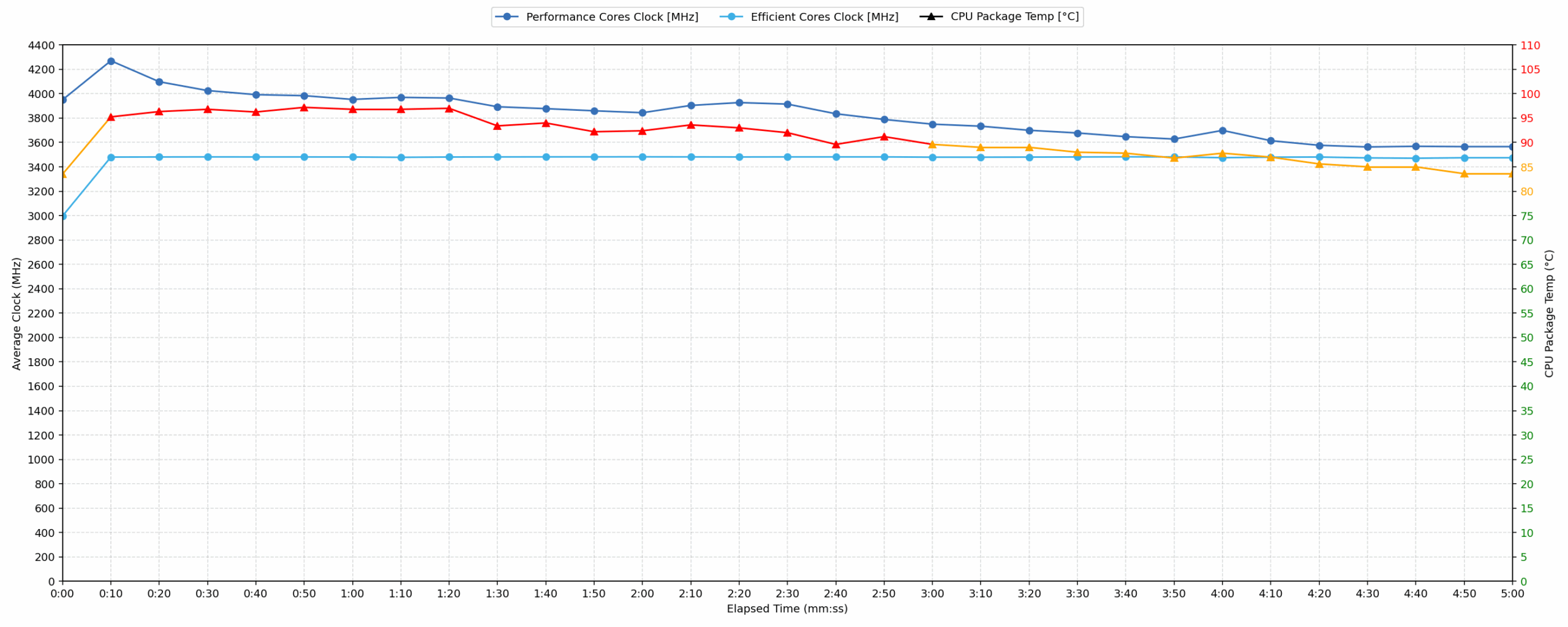
Short periods (0:00 – 0:10 s) of 100% CPU load
This test shows the CPU behavior during short periods of serious load. It is important for users who are looking for laptops suitable for tasks like Web Design and Programming.
| Intel Core Ultra 7 355 | Avg. P-Core Clock | Avg. CPU Temp. | Avg. CPU Power |
| Lenovo Yoga 9i 2-in-1 Aura Edition (14″, Gen 11) | 3950 MHz | 83 °C | 29 W |
| Lenovo LOQ 15 (15IPH11) | 3941 MHz | 51 °C | 32 W |
The short-load result is excellent. The Yoga 9i matches — and even slightly exceeds — the P-core clock of the much larger Lenovo LOQ 15 with the same processor. For short CPU bursts, Lenovo has managed to deliver big-laptop responsiveness in a very compact 14-inch convertible. That’s a great result!
This is exactly the type of load users experience most often in everyday work. Apps open, pages load, small exports finish, and productivity spikes usually last only a few seconds. In these scenarios, the Yoga 9i feels genuinely powerful. Its CPU temperature is higher than in the LOQ 15, but 83°C during a short full-load burst is perfectly reasonable for a modern laptop processor. The real story here is how impressively cool the much larger LOQ 15 remains, rather than the Yoga running unusually hot.
Video editing, Scientific computing, Software compilation, 3D rendering
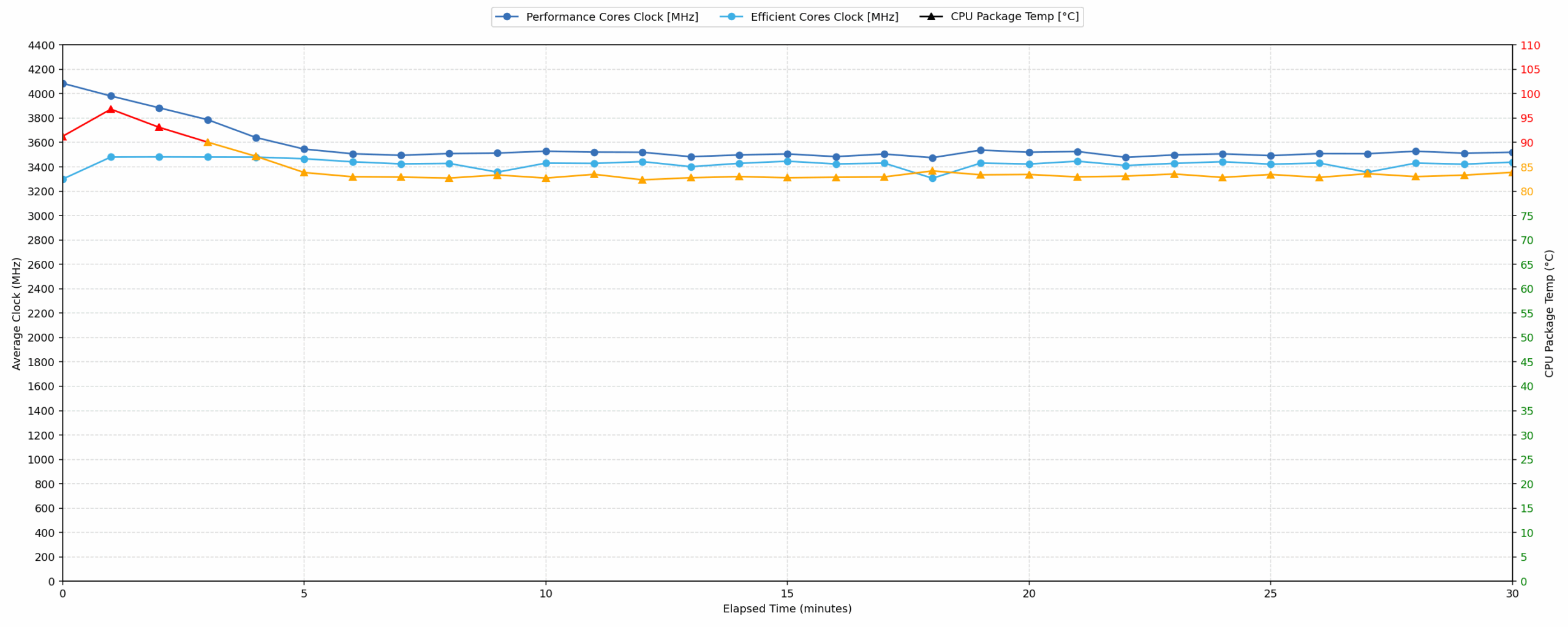
Long periods (0:00 – 30:00 min) of 100% CPU load
This test shows the CPU behavior during long periods of serious load. It is important for users who are looking for laptops suitable for tasks like Video Editing and 3D Rendering.
| Intel Core Ultra 7 355 | Avg. P-Core Clock | Avg. CPU Temp. | Avg. CPU Power |
| Lenovo LOQ 15 (15IPH11) | 4338 MHz | 47 °C | 40 W |
| Lenovo Yoga 9i 2-in-1 Aura Edition (14″, Gen 11) | 3560 MHz | 84 °C | 28 W |
Under long CPU loads, the form-factor difference becomes much more obvious. The Yoga settles at 28 W and lower clocks, while the larger LOQ 15 can sustain 40 W with much lower temperatures. This is the expected limit of a slim 14-inch 2-in-1: the Yoga 9i is fast for everyday work and short demanding tasks, but it is not built for repeated long rendering, compilation, or heavy scientific workloads.
Battery Life
The Lenovo Yoga 9i 2-in-1 Aura Edition (14″, Gen 11) is equipped with a 4-cell Li-ion battery, model L25D4PH1. It has a nominal voltage of 15.48V and a capacity of 70Wh.
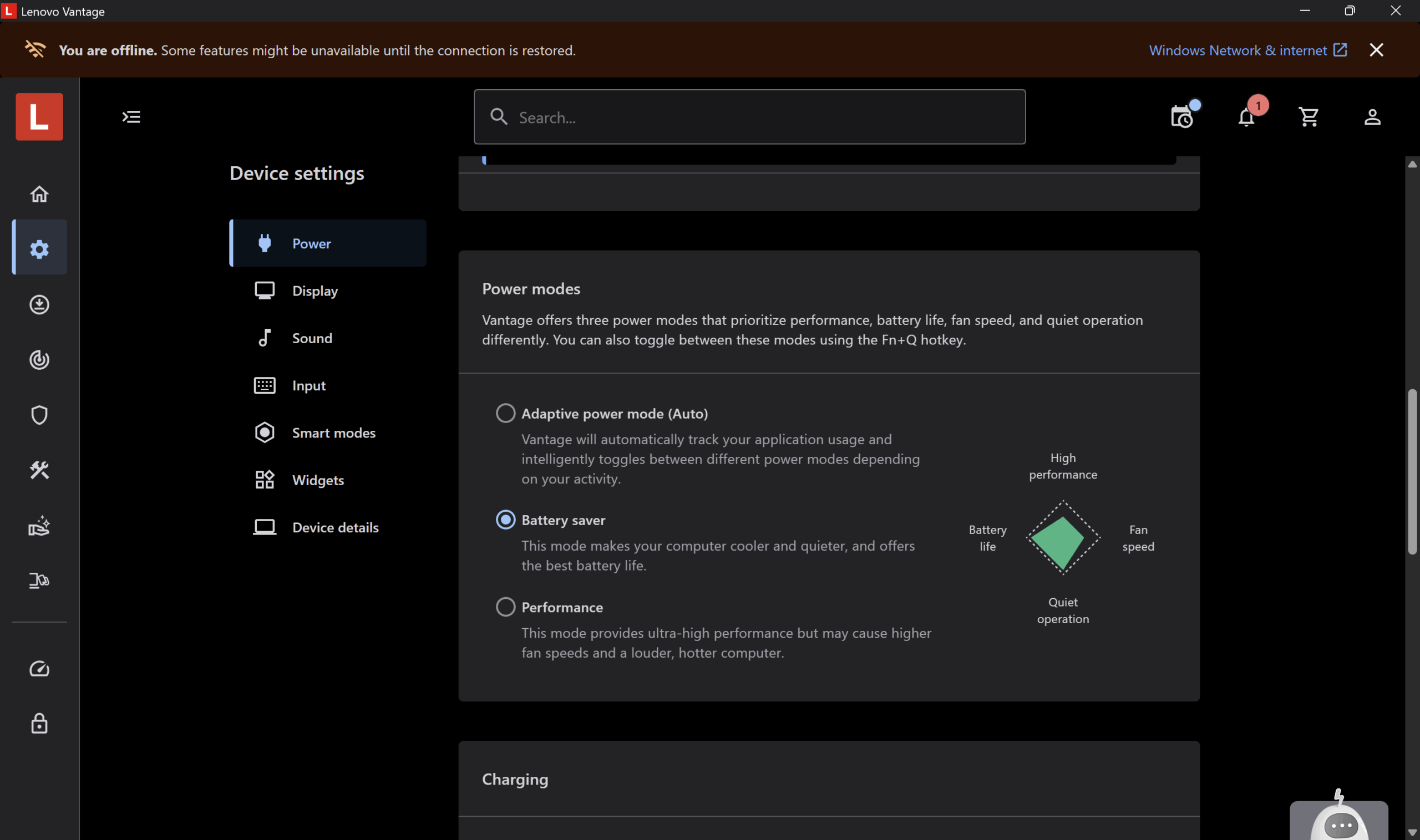
We tested the battery with Battery Saver mode activated in the Lenovo Vantage app, with the display set to 180 nits and SDR mode enabled.
The result is excellent: 15 hours and 39 minutes of offline video playback. This puts the Yoga 9i ahead of many premium compact machines in our comparison, including the Lenovo Yoga Slim 7a (14″, Gen 11) (detailed review), Dell XPS 13 9350 (detailed review), and Dell Pro 14 Premium (PA14250) (detailed review). The Lenovo ThinkPad X9-14 Gen 1 (detailed review) lasts longer in this test, but the Yoga 9i still delivers a very strong result, especially considering its high-resolution OLED touchscreen.
Brightness: 180 nits; Display Mode: SDR
Time to Full Discharge: Higher is Better

Disassembly, Upgrade options, and Maintenance
Getting inside the Lenovo Yoga 9i 2-in-1 Aura Edition (14″, Gen 11) takes a bit more patience than usual. The bottom panel is held by seven screws, but three of them are hidden under the long rear rubber foot between the display hinges. The foot is attached with adhesive and plastic clips, so remove it carefully if you want to reuse it cleanly during reassembly.
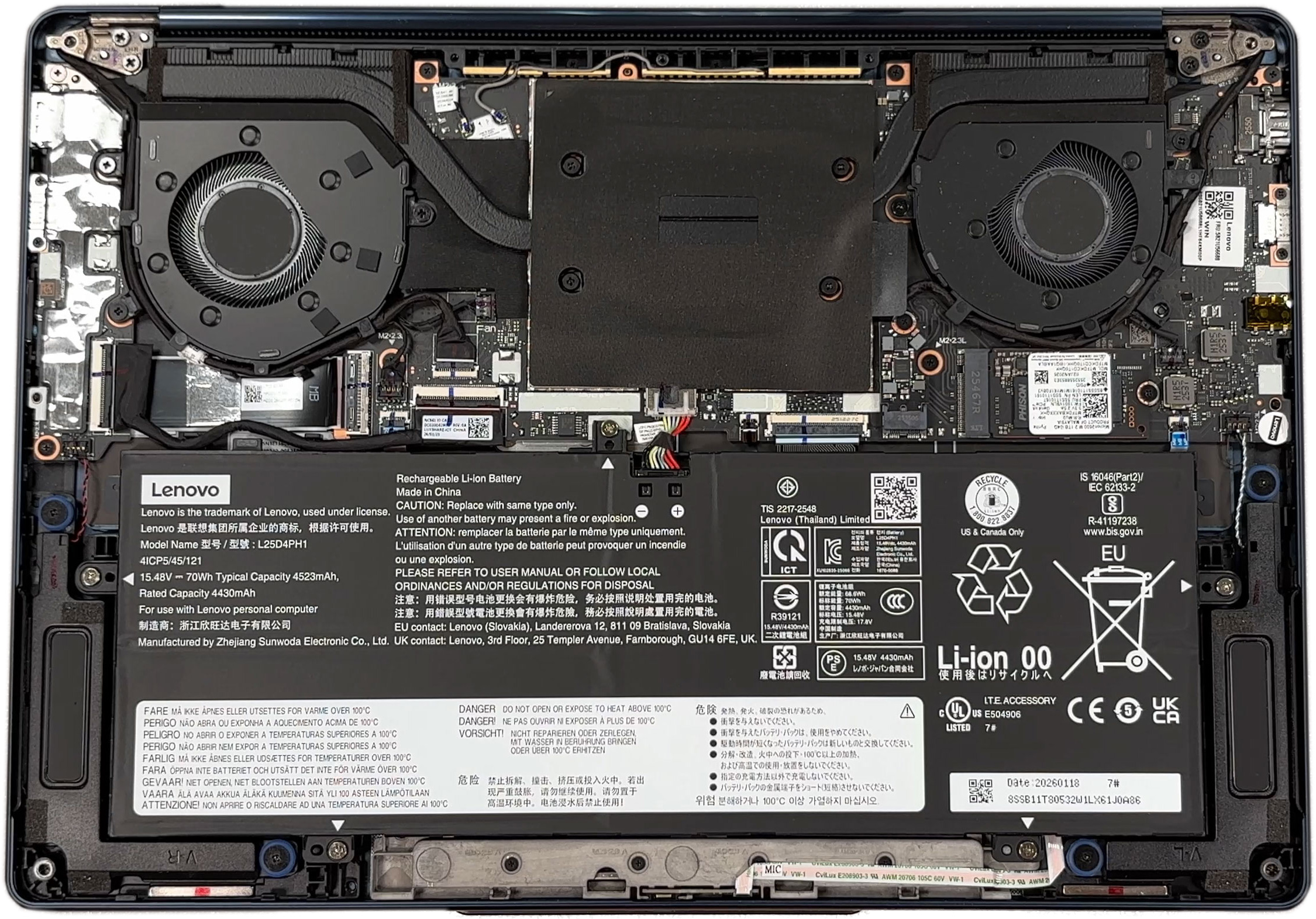
Once the cover is removed, the internal layout is straightforward. The large 70Wh battery takes up most of the lower half of the chassis, while the cooling system sits above it and uses two fans. Seeing a dual-fan setup in such a slim 14-inch convertible is a positive sign for sustained comfort and short CPU bursts.
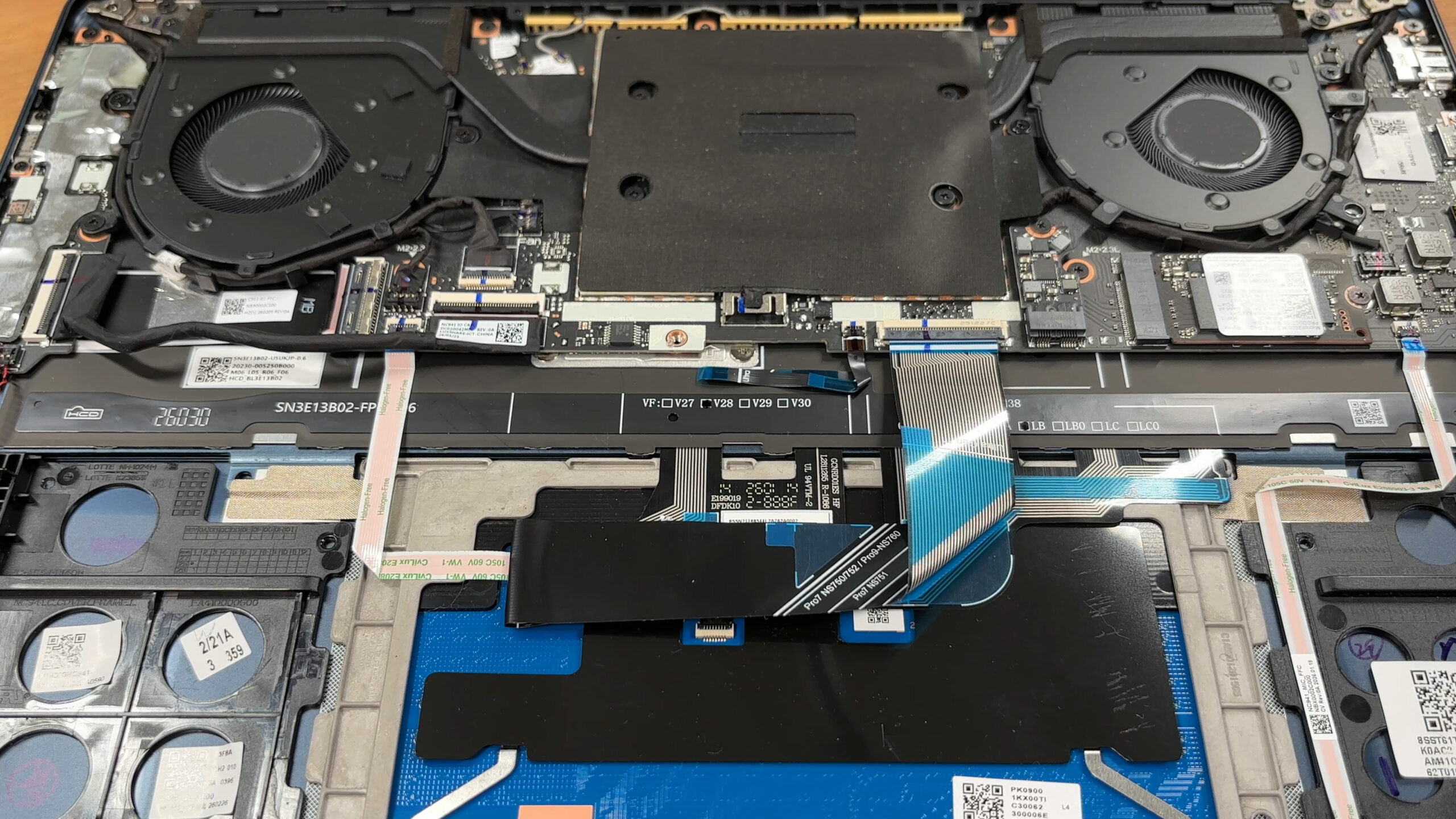
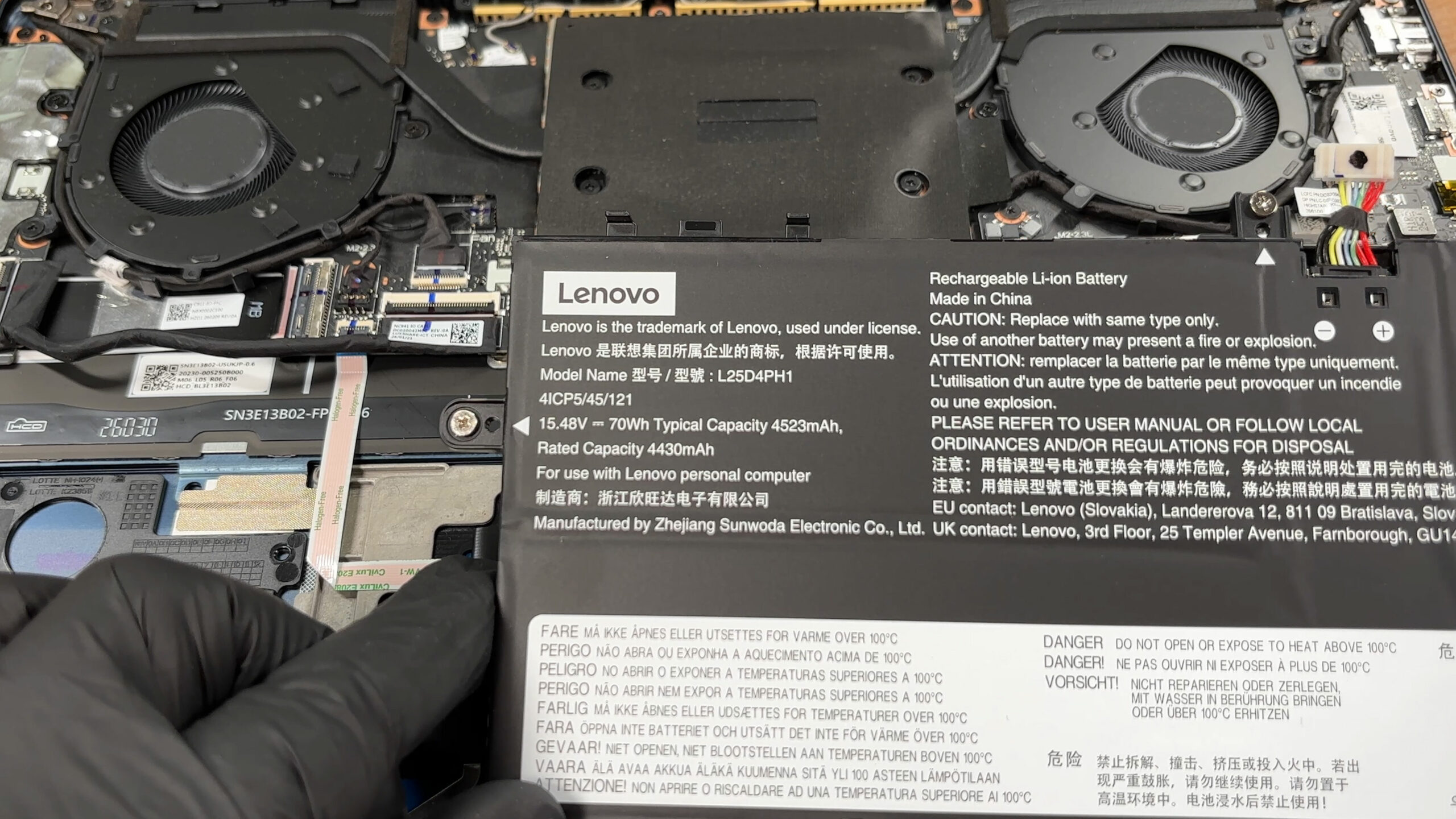
Before touching the rest of the hardware, the battery connector should be disconnected first. Its cable is short, so the easier approach is to loosen the battery screws and shift the pack slightly to gain better access to the connector. The battery in our machine is a Sunwoda L25D4PH1 lithium-ion pack with a rated capacity of 70Wh, and its screws appear to be captive, which makes servicing a little cleaner.
Memory is the main upgrade limitation. The configuration we ordered comes with 32GB of soldered LPDDR5X-7467 RAM, and there are no SODIMM slots. This is not unusual for a thin premium convertible, but it means you should choose the right memory configuration at purchase, because it cannot be upgraded later.
Storage is handled by a single M.2 2242 slot with PCIe 4.0 x4 support. Our machine is equipped with a 1TB Micron NVMe SSD, while Lenovo lists support for one drive, up to a 2TB M.2 2242 SSD. The SSD is replaceable, but there is no second slot, so a storage upgrade means replacing the existing drive rather than adding another one.
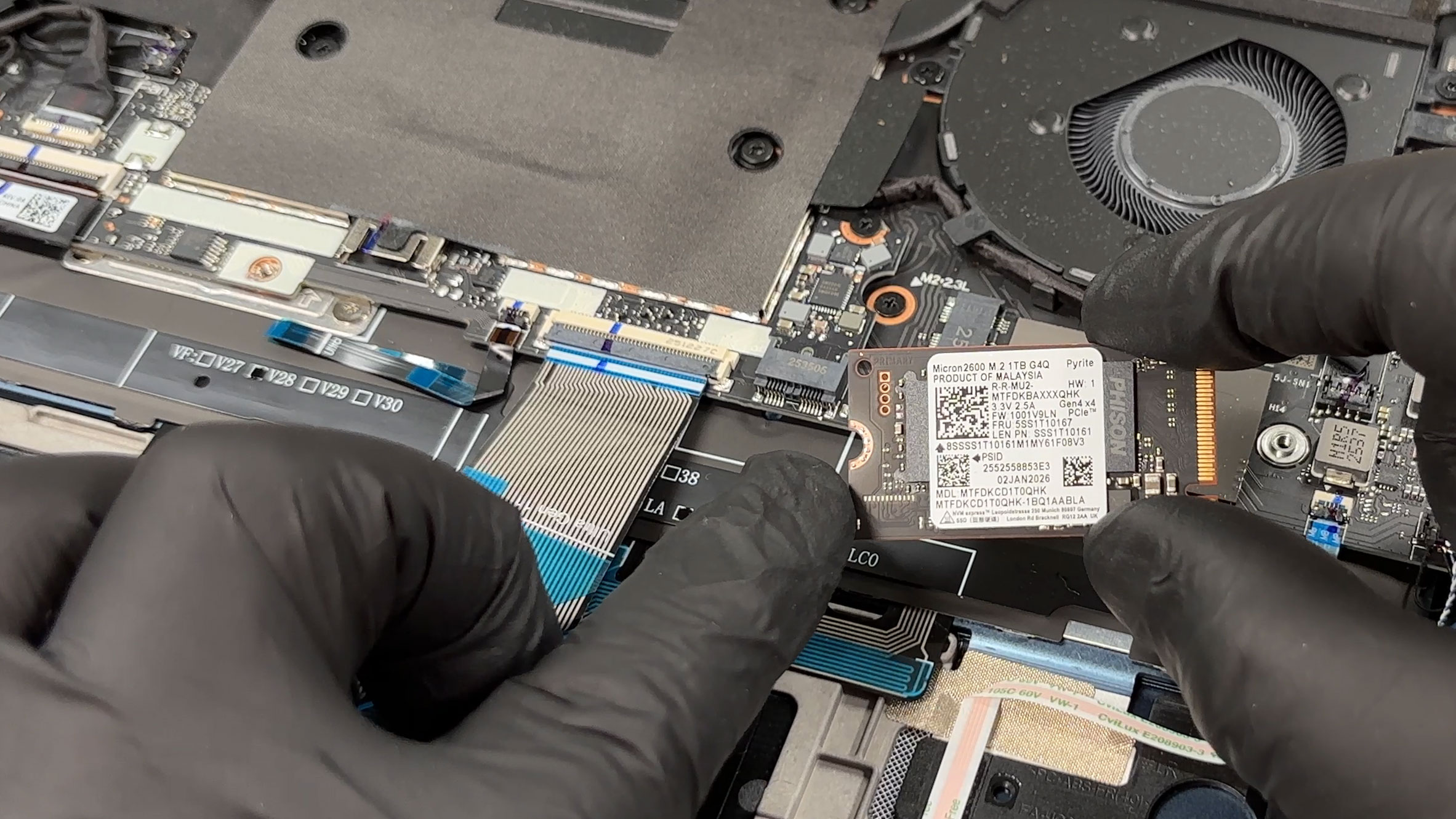
The wireless module is also accessible, and this configuration supports Wi-Fi 7, 802.11be 2×2, plus Bluetooth 5.4. Other serviceable parts include the battery, SSD, fans, and some internal cables, while the CPU and memory are soldered to the motherboard.
Overall, maintenance is manageable once you deal with the hidden screws and the clipped rubber foot. Upgradeability, however, is limited: the RAM is soldered, there is only one short M.2 2242 SSD slot, and there is no room for a second drive.
Verdict
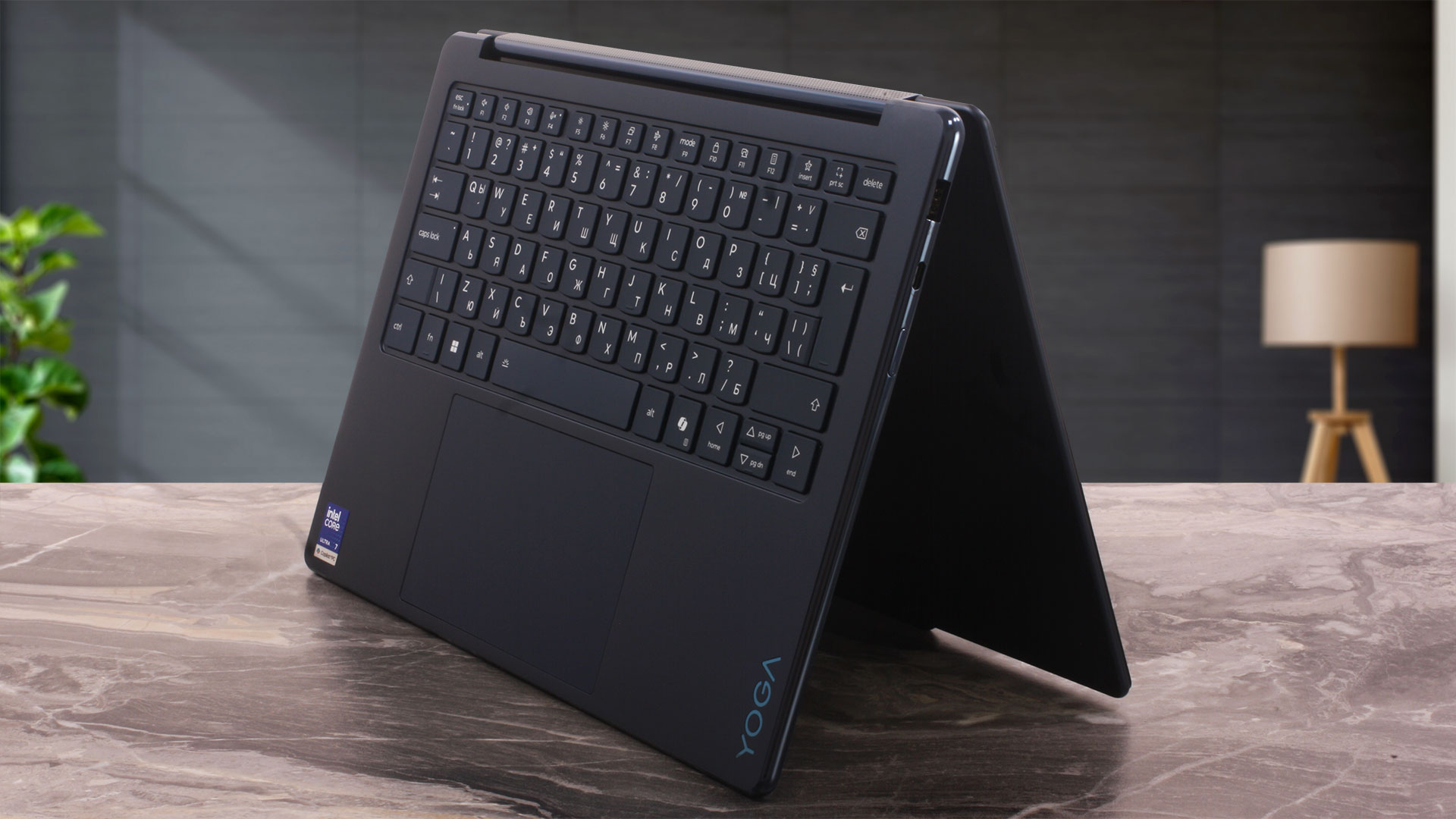 The Lenovo Yoga 9i 2-in-1 Aura Edition (14″, Gen 11) is exactly what a premium Yoga should be: elegant, versatile, and packed with high-end features. It does not chase aggressive styling or raw workstation power. Instead, it focuses on design, mobility, display quality, audio, pen support, and fast everyday responsiveness. The all-aluminum chassis, glossy side rails, Cosmic Blue finish, and rotating soundbar hinge make it feel special from the moment you open it.
What impressed us most is how complete the experience feels. The OLED display is excellent, the battery life is fantastic, the speakers are stronger than what we usually hear from compact laptops, and the Core Ultra 7 355 feels genuinely fast in short bursts. This matters a lot, because most real-world tasks — opening apps, loading web pages, quick edits, small exports, multitasking spikes — are finished within seconds.
Of course, the slim 2-in-1 form factor comes with limitations. The Yoga 9i is not meant for long rendering sessions, heavy 3D work, or users who expect meaningful upgrades after purchase. The RAM is soldered, there is only one M.2 2242 SSD slot, and the glossy OLED screen is very reflective. Still, as a premium convertible for everyday work, travel, media, meetings, note-taking, and light creative tasks, this is a very strong machine.
You can check the prices and configurations in our Specs System: https://laptopmedia.com/series/lenovo-yoga-9i-2-in-1-aura-edition-14-gen-11/
✅ The Good
The highlight is the 2.8K 120Hz OLED display. It offers excellent contrast, full sRGB and DCI-P3 coverage, strong brightness, and very good factory color accuracy through Lenovo Vantage and X-Rite Factory Color Calibration. It is a beautiful panel for media consumption, web work, photo editing, and video workflows where the correct color mode is selected.
Battery life is another major strength. In our test, the Yoga 9i lasted 15 hours and 39 minutes of offline video playback, which is excellent for a high-resolution OLED touchscreen convertible. The laptop also feels very responsive in everyday work, with the Core Ultra 7 355 delivering excellent short-burst performance despite the compact 14-inch chassis.

The build quality is top-tier, the large glass touchpad is comfortable, and the rotating soundbar speaker system gives the Yoga 9i a fuller and more spacious sound than most compact laptops. Connectivity is also strong, with two Thunderbolt 4 ports, HDMI 2.1, USB-A, Wi-Fi 7, and Bluetooth 5.4.
The included Lenovo Yoga Pen Gen 2 in our package, the physical camera privacy shutter, and the IR camera with Windows Hello add practical value to the premium design.
❌ The Bad
The biggest long-term drawback is the soldered RAM. You cannot upgrade it later, so choosing the right memory configuration at purchase is important. Storage upgradeability is also limited: there is only one M.2 slot, and it uses the shorter 2242 format, so upgrading means replacing the existing SSD rather than adding a second drive.
Sustained heavy workloads also show the limits of the slim convertible chassis. The Yoga 9i is fast in short bursts, but it is not built for repeated long rendering, heavy compilation, or workstation-class CPU loads. The OLED screen is another double-edged sword: it looks fantastic, but its glossy surface is highly reflective in bright environments.
Maintenance is possible, but not effortless. Three of the bottom screws are hidden under the long rear rubber foot, which is held by adhesive and clips. Also, our European package did not include a power adapter, so buyers should check the exact regional bundle before ordering.
🆚 The Competitors
Compared to the Lenovo Yoga Slim 7a (14″, Gen 11) (detailed review), the Yoga 9i adds the flexibility of a 360-degree 2-in-1 design, pen support, a more distinctive speaker setup, and much longer battery life in our video playback test. The Slim 7a remains an interesting ultraportable, but the Yoga 9i feels like the more complete premium device.
Against premium convertibles like the HP OmniBook Ultra Flip 2-in-1 (detailed review), the Yoga 9i stands out with excellent battery endurance, strong short-burst CPU performance, and a better audio experience thanks to the rotating soundbar hinge. The HP may have an advantage in some CPU/GPU configurations, but the Lenovo delivers a very polished balance of design, display quality, sound, battery life, and everyday usability.
Pros
- Excellent 2.8K 120Hz OLED display with full sRGB and DCI-P3 coverage
- Very good factory color accuracy with Lenovo Vantage color modes
- Premium all-aluminum build quality
- Fantastic battery life — 15 hours and 39 minutes in our test
- Very snappy responsiveness in short CPU bursts
- Strong rotating soundbar speaker system
- Large and comfortable glass touchpad
- Two Thunderbolt 4 ports, HDMI 2.1, USB-A, and Wi-Fi 7
- IR camera, physical privacy shutter, and Human Presence Detection
- Lenovo Yoga Pen Gen 2 included in our package
Cons
- Soldered RAM with no upgrade options
- Only one M.2 slot, limited to the shorter 2242 SSD format
- Not ideal for long sustained heavy workloads
- Highly reflective glossy OLED screen
- Hidden screws under the rear rubber foot complicate maintenance
- No power adapter included in our European package
 Author: Simeon NikolovEditor-in-Chief at LaptopMedia.com with 20+ years of experience in testing and analyzing laptops and mobile devices.
 Author: eng. Kroum NikolovHead of Engineering at LaptopMedia.com, inventor and innovator with 40+ years of experience in electronics and high technology.

![[August 2026] Amazon Italy: Top 10 Best-Selling Laptops – Apple MacBook Neo Claims the Crown as Budget and Mid-Range Windows Machines Dominate Volume](https://laptopmedia.com/wp-content/uploads/2026/09/Best-Selling-Laptops-IT-Top-10-400x225.jpg)
![[August 2026] Amazon Italy: Top 7 Best-Selling Gaming Laptops – ASUS V16 Claims the #1 Spot Amid Strong Mid-Range Demand](https://laptopmedia.com/wp-content/uploads/2026/09/Best-Selling-Gaming-Laptops-IT-Top-10-400x225.jpg)
![[August 2026] Best-Selling Laptop Brands on Amazon Italy – Lenovo Dominates Market Share and Revenue Leadership](https://laptopmedia.com/wp-content/uploads/2026/09/IT-Best-Brands-400x225.jpg)
![[August 2026] Amazon India: Top 10 Best-Selling Laptops – Apple MacBook Neo Dominates the Charts with Massive Sales Lead](https://laptopmedia.com/wp-content/uploads/2026/09/Best-Selling-Laptops-IN-Top-10-400x225.jpg)
![[August 2026] Amazon India: Top 10 Best-Selling Gaming Laptops – HP Victus 15 Dominates the Market with Massive Unit Lead](https://laptopmedia.com/wp-content/uploads/2026/09/Best-Selling-Gaming-Laptops-IN-Top-10-400x225.jpg)