Surface Laptop Ultra: Microsoft’s Most Serious MacBook Pro Rival in Years
Surface Laptop Ultra deserves its own place in our COMPUTEX 2026 coverage because it is more than another RTX Spark device. Until now, Windows on ARM laptops were usually sold around battery life, portability, and light productivity. Surface Laptop Ultra changes the conversation. Microsoft is now talking about RTX Spark, up to 128GB of unified memory, local AI workloads, creator workflows, a mini-LED display, and a port selection that actually looks useful for professional users.
Read our COMPUTEX 2026 recap here:
The Most Interesting Laptop and PC Hardware We Saw at COMPUTEX 2026
Why Surface Laptop Ultra deserves attention
Surface has always been strong in design, displays, touch, and premium build quality. But for many power users, Surface laptops were not the obvious choice for heavy work. They were polished, but often conservative. Surface Laptop Studio tried to serve creators with a different form factor, but it remained a niche product.
Surface Laptop Ultra feels like a more direct answer. It keeps the traditional laptop form factor, but adds a much more ambitious platform underneath. This is the kind of machine that Microsoft can use to show that Windows on ARM is ready for more than thin-and-light office laptops.
The main question is whether it can deliver the full experience. On paper, the hardware is serious. In practice, the device will be judged by software compatibility, sustained performance, thermals, fan noise, battery life, display behavior, and price.
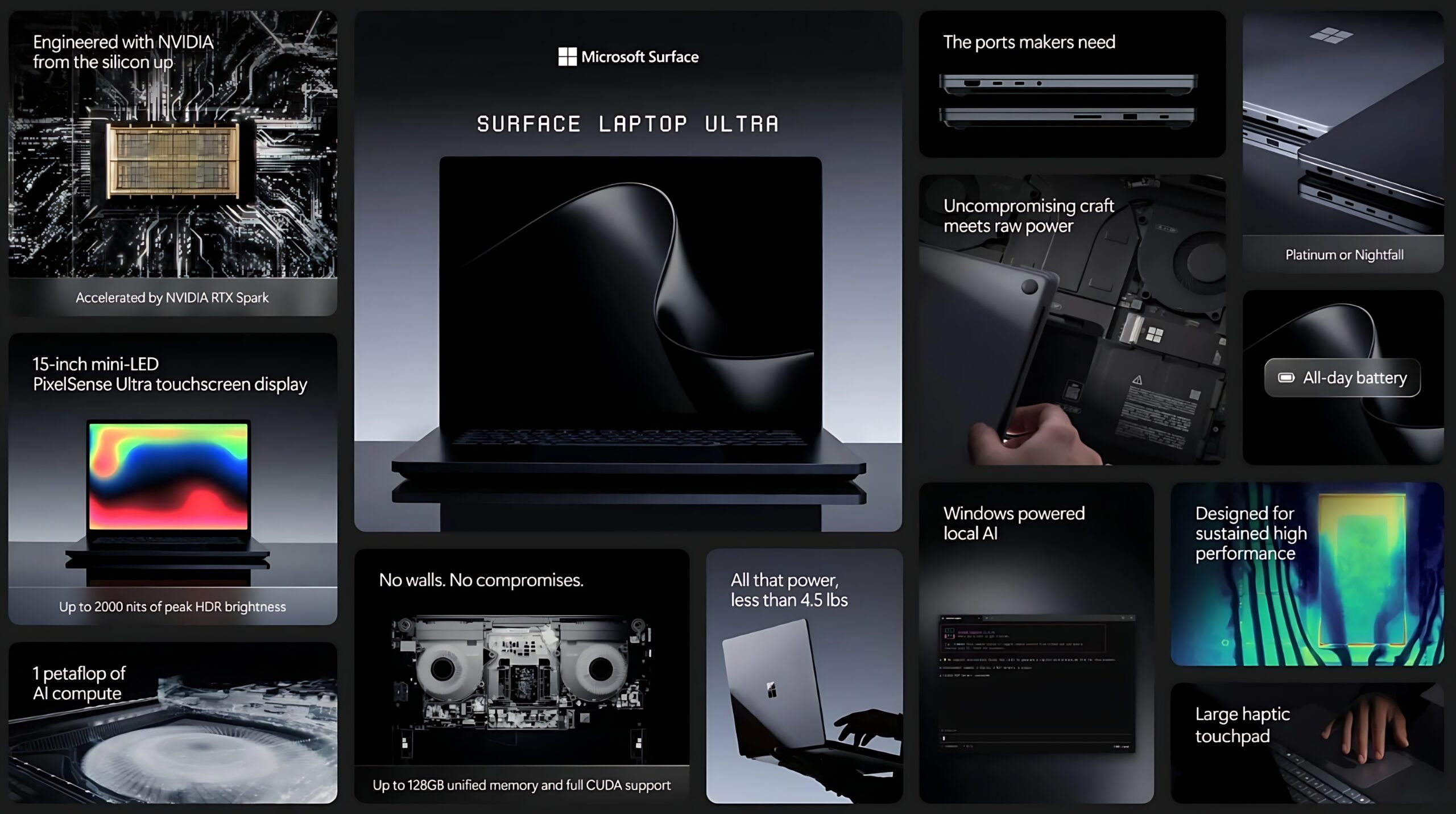
Surface Laptop Ultra: Detailed Specs
| Product | Microsoft Surface Laptop Ultra |
| Category | Premium Windows on ARM laptop / creator and AI PC |
| Platform | NVIDIA RTX Spark |
| Operating system | Windows 11 |
| Processor | 20-core ARM-based NVIDIA Grace CPU |
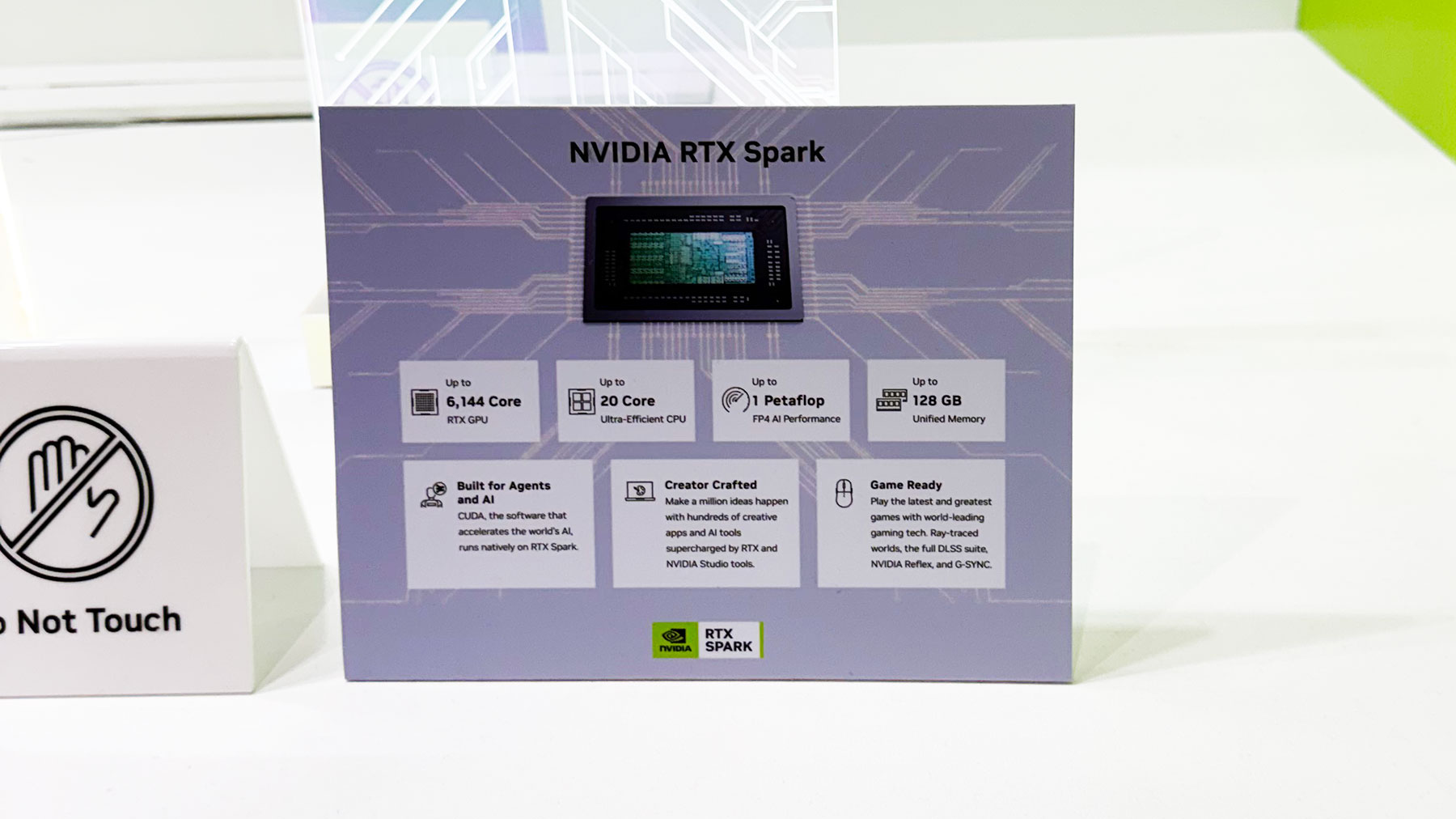
| Graphics | NVIDIA Blackwell RTX GPU with 6144 CUDA cores and 5th Gen Tensor Cores with FP4 support |
| CPU / GPU interconnect | NVIDIA NVLink-C2C |
| AI performance | Up to 1 petaflop FP4 AI compute |
| Memory | Up to 128GB unified LPDDR5X memory, up to 300GB/s memory bandwidth according to early coverage |
| Local AI capability | Designed for large local AI workloads; NVIDIA cites up to 120B-parameter LLM use cases for RTX Spark |
| Storage | User-replaceable SSD |
| Display | 15-inch mini-LED PixelSense Ultra touchscreen, 2880 x 1920 resolution, 3:2 aspect ratio, 262 PPI, up to 2000 nits peak HDR brightness |
| Input / authentication | Precision haptic touchpad, over 30% larger than the previous 15-inch Surface Laptop generation; Windows Hello facial recognition |
| Ports | USB-C, USB-A, HDMI, full-size SD card reader, 3.5mm headphone jack |
| Cooling | New dual-fan thermal system, with up to 2.5x the thermal capacity of Surface Laptop 7th Edition 15-inch |
| Battery | All-day battery life claim |
| Dimensions / weight | Under 18 mm thick, under 4.5 lbs / about 2 kg |
| Colors | Platinum and Nightfall |
| Serviceability | Internal wayfinding, published repair guides, replacement parts, and user-serviceable storage drive |
| Security | Hardware-rooted security, Windows Hello, firmware / credential protection claims |
| Availability | Expected later in 2026 / fall 2026 window |
| Pricing | Not officially announced yet |
The RTX Spark platform is the real reason this laptop exists
The most important part of Surface Laptop Ultra is the platform underneath it. RTX Spark combines an ARM-based NVIDIA Grace CPU, a Blackwell RTX GPU, CUDA support, and a large unified memory pool. That gives Microsoft a much stronger hardware story than a normal “AI PC” label.
The up to 128GB unified memory configuration is especially important. Local AI models, large datasets, heavy creative projects, and GPU-accelerated workflows can quickly run into memory limits. A large shared memory pool gives the CPU and GPU more room to work on the same tasks without constantly moving data between separate memory pools. That does not automatically make Surface Laptop Ultra a perfect mobile workstation. Memory capacity is only one part of the equation. Model format, software support, memory bandwidth, thermals, sustained power, and application optimization still matter. But compared with many AI PC announcements, this feels like a more serious attempt to solve real workflow problems.
The display and ports make it feel more like a real pro laptop
The display is another major reason Surface Laptop Ultra deserves attention. Microsoft is using a 15-inch mini-LED PixelSense Ultra touchscreen with a 2880 x 1920 resolution and up to 2000 nits peak HDR brightness. That sounds much more appropriate for a creator and developer laptop than a standard ultrabook display.
Mini-LED can be excellent for HDR and high brightness, but it also needs careful testing. Peak brightness alone does not tell the full story. We would want to measure color accuracy, brightness stability, local dimming behavior, blooming, PWM, uniformity, reflections, coating behavior, and HDR tone mapping before judging the panel properly.
The port selection is also worth mentioning. HDMI, USB-C, USB-A, an SD card reader, and a headphone jack make the machine feel more practical for creators and field work. A laptop aimed at developers, editors, photographers, and AI users should not rely entirely on dongles.

The MacBook Pro comparison
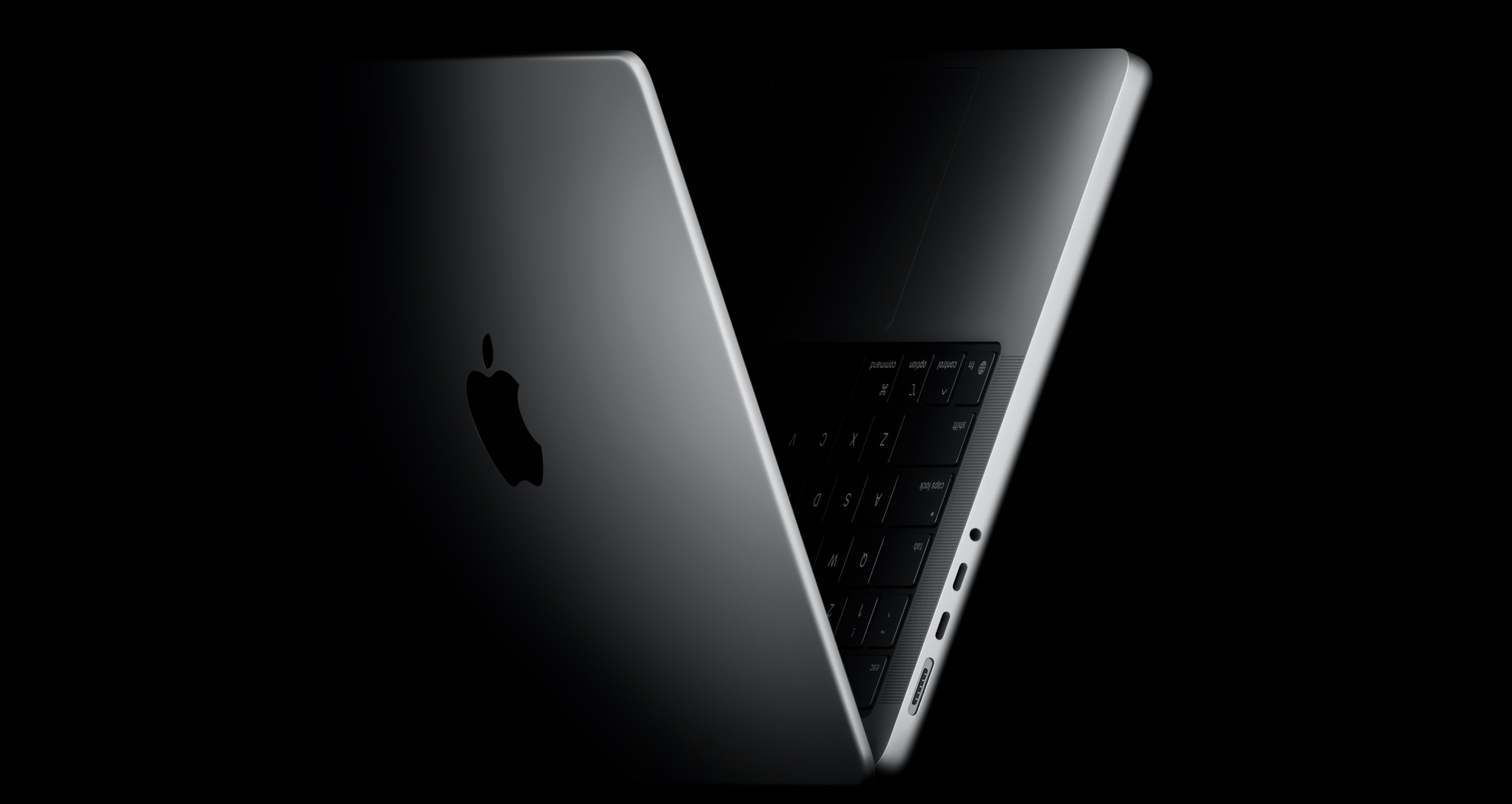 Surface Laptop Ultra will naturally be compared with MacBook Pro-class machines. That does not mean we should call it a MacBook Pro killer but the comparison makes sense because Microsoft and NVIDIA are clearly trying to bring a more integrated, unified-memory, creator-focused platform to Windows laptops.
Apple has been very strong in this area because it controls the hardware, memory architecture, operating system, and creator software ecosystem more tightly. Surface Laptop Ultra is Microsoft’s chance to show that Windows can offer a similar level of platform ambition while keeping the advantages of the Windows ecosystem: CUDA acceleration, broader hardware compatibility, more ports, and wider professional software choice.
The challenge is that Apple’s strongest advantage is not only performance – MacBook Pro users expect strong battery life, quiet operation, reliable sleep and resume, predictable creator-app behavior, and very few compatibility surprises. Surface Laptop Ultra has to compete with that kind of everyday reliability, not only with spec-sheet numbers.
Surface Laptop Ultra vs MacBook Pro 16: Platform Comparison
| Category | Microsoft Surface Laptop Ultra | Apple MacBook Pro 16 |
| Platform idea | Windows on ARM performance laptop built around NVIDIA RTX Spark, CUDA acceleration, local AI, and creator workflows | macOS pro laptop built around Apple Silicon, unified memory, strong media engines, and a mature creator ecosystem |
| Processor | 20-core ARM-based NVIDIA Grace CPU | Apple M5 Pro or M5 Max, up to 18-core CPU |
| Graphics | NVIDIA Blackwell RTX GPU with 6144 CUDA cores and 5th Gen Tensor Cores with FP4 support | Apple integrated GPU, up to 40-core GPU with hardware-accelerated ray tracing |
| AI / compute angle | Up to 1 petaflop FP4 AI compute, CUDA / RTX ecosystem, local AI workloads, large model support | 16-core Neural Engine, Neural Accelerators, Apple Intelligence, strong on-device processing inside Apple’s own ecosystem |
| Unified memory | Up to 128GB unified LPDDR5X memory, with up to 300GB/s memory bandwidth according to current detailed coverage | Up to 128GB unified memory on M5 Max, with up to 614GB/s memory bandwidth |
| CPU / GPU memory architecture | CPU and GPU connected through NVIDIA NVLink-C2C, with a shared unified memory pool | Apple Silicon unified memory architecture, tightly integrated across CPU, GPU, Neural Engine, and media engines |
| Display | 15-inch mini-LED PixelSense Ultra touchscreen, 2880 x 1920 resolution, 3:2 aspect ratio, 262 PPI, up to 2000 nits peak HDR brightness | 16.2-inch Liquid Retina XDR display, 3456 x 2234 resolution, 254 PPI, ProMotion up to 120Hz, 1000 nits sustained XDR, 1600 nits peak HDR |
| Touch / pen | Touchscreen | No touchscreen |
| Ports | USB-C, USB-A, HDMI, full-size SD card reader, 3.5mm headphone jack | 3x Thunderbolt 5, HDMI, SDXC card slot, MagSafe 3, 3.5mm headphone jack |
| Storage | User-replaceable SSD; final capacity options not fully detailed yet | Up to 8TB SSD on M5 Max configurations |
| Battery / power | All-day battery life claim; final battery capacity and charger details not fully detailed yet | 100Wh battery, up to 24 hours video streaming on M5 Pro or up to 22 hours on M5 Max, 140W USB-C Power Adapter |
| Weight | Under 4.5 lbs / about 2 kg | 4.7 lbs / about 2.14–2.15 kg, depending on chip |
| Software strength | Windows ecosystem, CUDA, RTX acceleration, local AI frameworks, broader hardware and peripheral flexibility | Mature macOS creator ecosystem, optimized Apple Silicon apps, strong media engines, consistent sleep / resume and battery behavior |
| Main advantage on paper | CUDA / RTX ecosystem, large unified memory, local AI focus, touchscreen, practical port selection | Proven pro-laptop platform, higher maximum memory bandwidth, excellent battery claims, mature app optimization, Thunderbolt 5 |
| Main question | Windows on ARM compatibility, Prism emulation, drivers, plugins, thermals, fan noise, battery life, and price | Price, upgrade costs, no touchscreen, and whether Apple’s ecosystem fits the user’s workflow |
This is why the MacBook Pro comparison makes sense, but we should be careful with it. Surface Laptop Ultra has the right ingredients to compete in the same conversation: unified memory, a strong display, serious AI and creator positioning, and a more practical port selection than many modern ultrabooks. But Apple already has the harder part solved: platform maturity. MacBook Pro users expect predictable performance, long battery life, quiet operation, excellent sleep / resume behavior, and strong app optimization.
Surface Laptop Ultra needs to prove that Windows on ARM, RTX Spark, CUDA acceleration, and large unified memory can work together reliably enough for creators, developers, and local AI users. That is the comparison we actually want to test.
The software question is bigger than the hardware question
This is where the excitement needs balance. Surface Laptop Ultra can have impressive hardware, but Windows on ARM still has to be reliable for demanding users. That means native ARM app performance, Prism emulation, plugins, installers, drivers, calibration tools, docks, capture cards, audio interfaces, external displays, VPN clients, developer tools, game compatibility, and anti-cheat support. For casual use, one unsupported utility is annoying. For professional work, one broken plugin or driver can ruin the whole machine.
Verdict
Surface Laptop Ultra is one of the most important products from COMPUTEX 2026 because it shows Microsoft and NVIDIA taking Windows on ARM in a much more serious direction. The real story here is RTX Spark, unified memory, CUDA acceleration, mini-LED display quality, and local AI / creator workflows. At the same time, this laptop has more to prove than almost anything else at the show. If it works well, it could make RTX Spark feel like a real platform for premium Windows laptops. If it struggles with compatibility, thermals, noise, battery life, or price, it will remain an impressive concept with difficult trade-offs.
So yes, Surface Laptop Ultra deserves attention. It is Microsoft’s clearest attempt yet to make Windows on ARM feel like a professional platform, not only an efficiency platform. Now we need to see whether the software ecosystem is ready for that ambition.
Read our COMPUTEX 2026 recap here:
The Most Interesting Laptop and PC Hardware We Saw at COMPUTEX 2026
 Author: Simeon NikolovEditor-in-Chief at LaptopMedia.com with 20+ years of experience in testing and analyzing laptops and mobile devices.

![[August 2026] Best-Selling Laptop Brands on Amazon USA – Apple Dominates Market Revenue and Volume Despite Lower Model Diversity](https://laptopmedia.com/wp-content/uploads/2026/09/COM-Best-Brands-1-400x225.jpg)
![[August 2026] Amazon USA: Top 10 Best-Selling Laptops – Apple MacBook Neo Dominates the Market with Massive Unit Sales!](https://laptopmedia.com/wp-content/uploads/2026/09/Best-Selling-Laptops-COM-Top-10-400x225.jpg)
![[August 2026] Amazon USA: Top 10 Best-Selling Gaming Laptops – ASUS ROG Strix G16 Dominates the Market with Massive Unit Sales](https://laptopmedia.com/wp-content/uploads/2026/09/Best-Selling-Gaming-Laptops-COM-Top-10-400x225.jpg)
![[July 2026] Amazon Global: Top 10 Best-Selling Laptops – Apple MacBook Neo Dominates the Charts as Budget and Premium Notebooks Split the Market](https://laptopmedia.com/wp-content/uploads/2026/08/Best-Selling-Laptops-GLOBAL-Top-10-400x225.jpg)
![[July 2026] Amazon Global: Top 10 Best-Selling Gaming Laptops – ASUS ROG Strix G16 Dominates the Global Market with Record-Breaking Unit Sales](https://laptopmedia.com/wp-content/uploads/2026/08/Best-Selling-Gaming-Laptops-GLOBAL-Top-10-400x225.jpg)
CUDA in a Surface laptop is a big deal if compatibility is good
This is the first Surface in years that sounds genuinely exciting for power users not just students and office work.