Dell Pro Max 16 (MC16250) Review – Built for Work, Built to Last
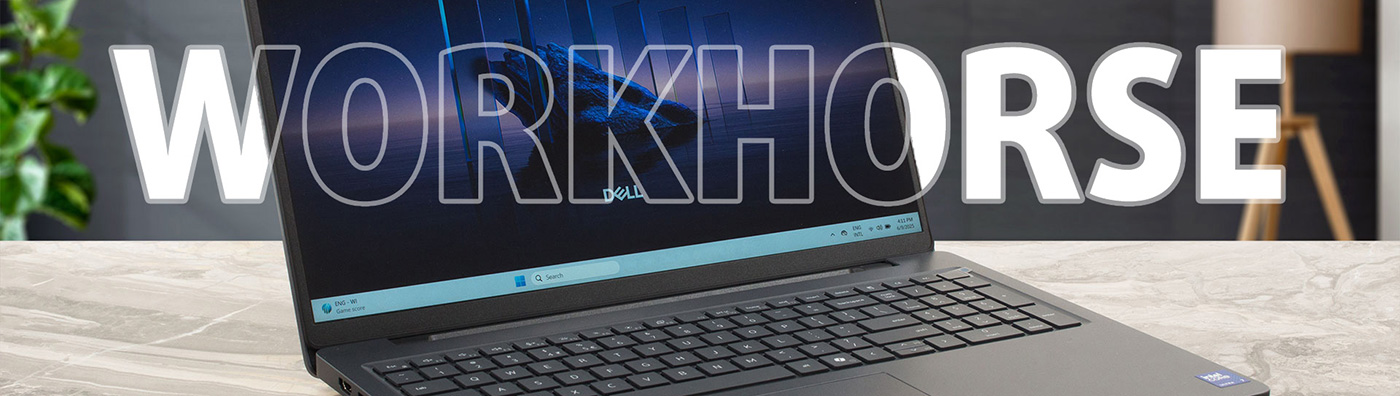
In a world of soldered RAM and sealed chassis, the Dell Pro Max 16 (MC16250) feels like a breath of fresh air for professionals. It’s a serious, no-nonsense workstation that prioritizes function and longevity over fleeting trends. With a robust magnesium build, a fantastic keyboard, and a level of upgradeability that is becoming increasingly rare, it aims to be the ultimate reliable partner for the modern workforce. But does this focus on practicality come at the cost of excitement? We put it to the test to see if this workhorse has enough power to match its pro-grade features.
You can check the prices and configurations in our Specs System: https://laptopmedia.com/series/dell-pro-max-16-mc16250/
Contents
Specs, Drivers, What’s in the box
Dell Pro Max 16 (MC16250) - Specs
- Display
- 16.0”, WUXGA (1920 x 1200), IPS

- HDD/SSD
- up to 2000GB SSD
- M.2 Slot
- 2x 2280 PCIe NVMe 4.0 x4 See photo
- RAM
- up to 64GB
- OS
- Windows 11 Pro, No OS, Windows 11 Home
- Battery
- 64Wh
- Body material
- Magnesium alloy
- Dimensions
- 358 x 256 x 15.08 - 19.08 mm (14.09" x 10.08" x 0.59")
- Weight
- 2.20 kg (4.9 lbs)
- Ports and connectivity
- 1x USB Type-A
- 3.2 Gen 1 (5 Gbps)
- 1x USB Type-A
- 3.2 Gen 1 (5 Gbps), Sleep and Charge
- 2x USB Type-C
- 4.0, Thunderbolt 4, Power Delivery (PD), DisplayPort
- HDMI
- 2.1
- Card reader
- microSD (microSD, microSDHC, microSDXC)
- Ethernet LAN
- 10, 100, 1000 Mbit/s
- Wi-Fi
- Wi-Fi 7
- Bluetooth
- 5.4
- Audio jack
- 3.5mm Combo Jack
- Features
- Fingerprint reader
- optional
- Web camera
- FHD IR
- Backlit keyboard
- optional
- Microphone
- Digital Array Microphones
- Speakers
- 2x 2.5W Stereo Speakers
- Security Lock slot
- Wedge Lock
All Dell Pro Max 16 (MC16250) configurations
Drivers
All drivers and utilities for this notebook can be found here: https://www.dell.com/support/product-details/en-us/product/dell-pro-max-mc16250-laptop/drivers
What’s in the box?
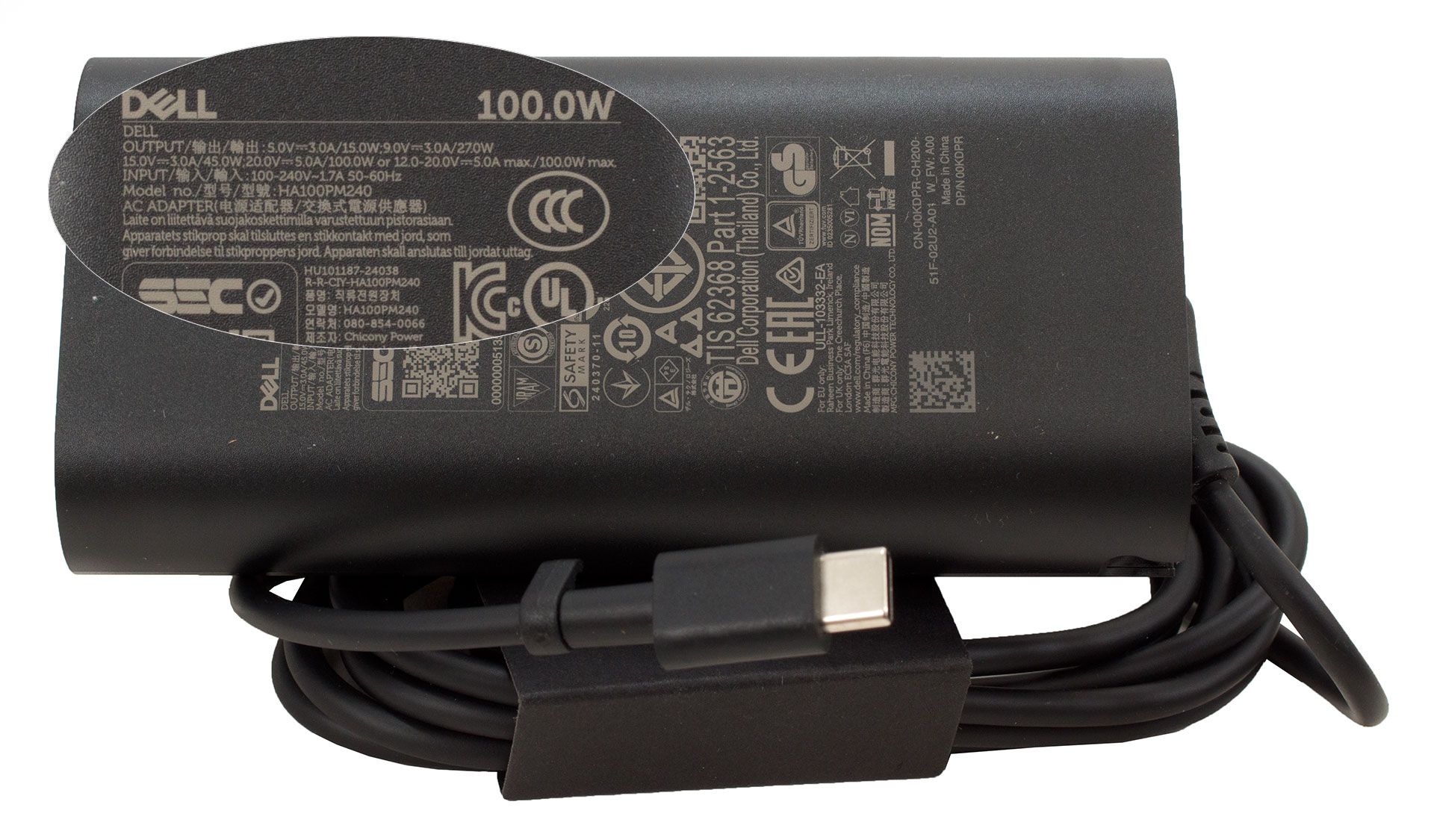
The unboxing of the Dell Pro Max 16 is a lesson in elegant simplicity, featuring a beautifully organized box. Inside, the laptop is presented in a luxurious-looking cloth sleeve, accompanied only by its powerful 100W Type-C charger. No clutter, just the premium essentials designed for a focused experience.
Design and construction
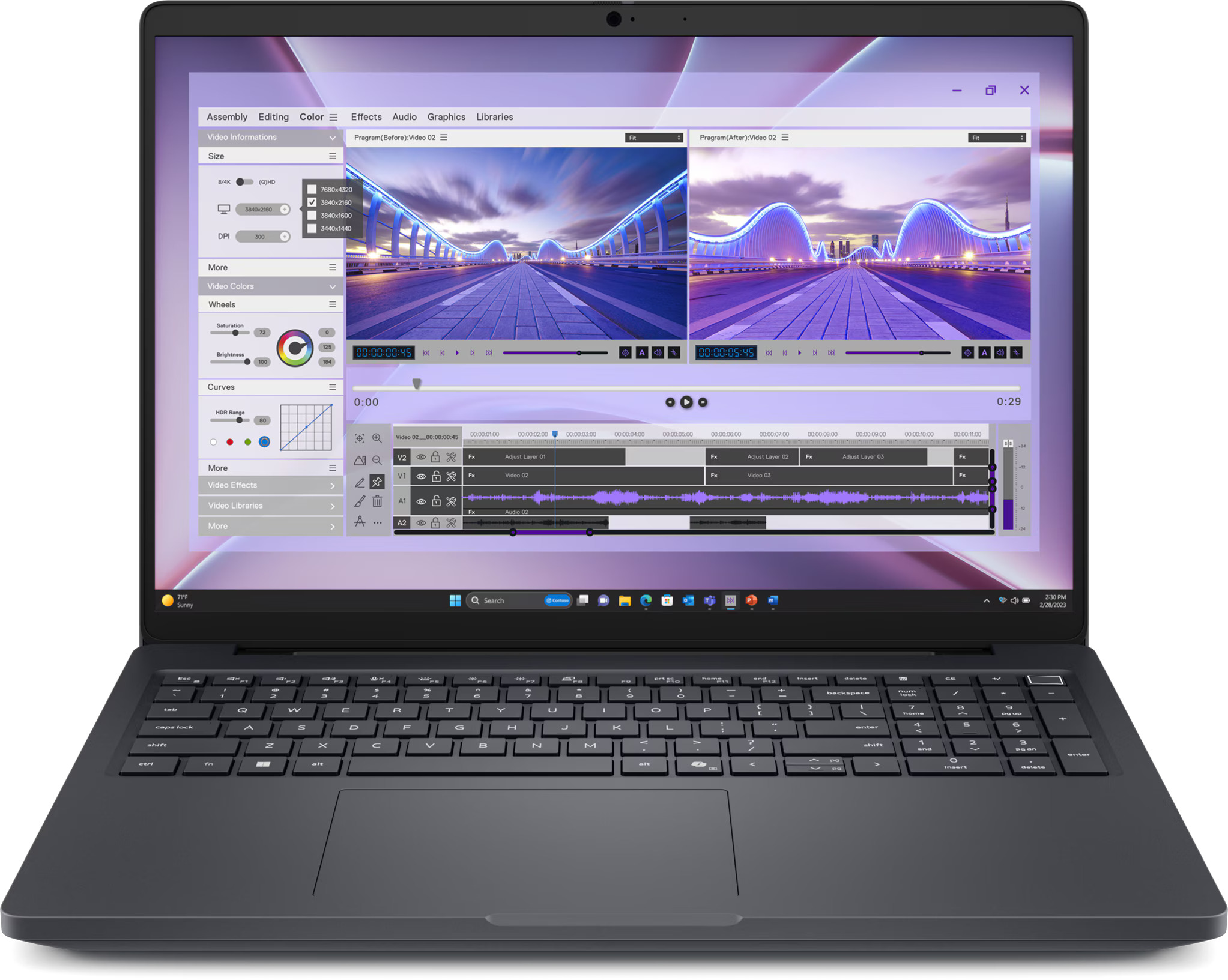
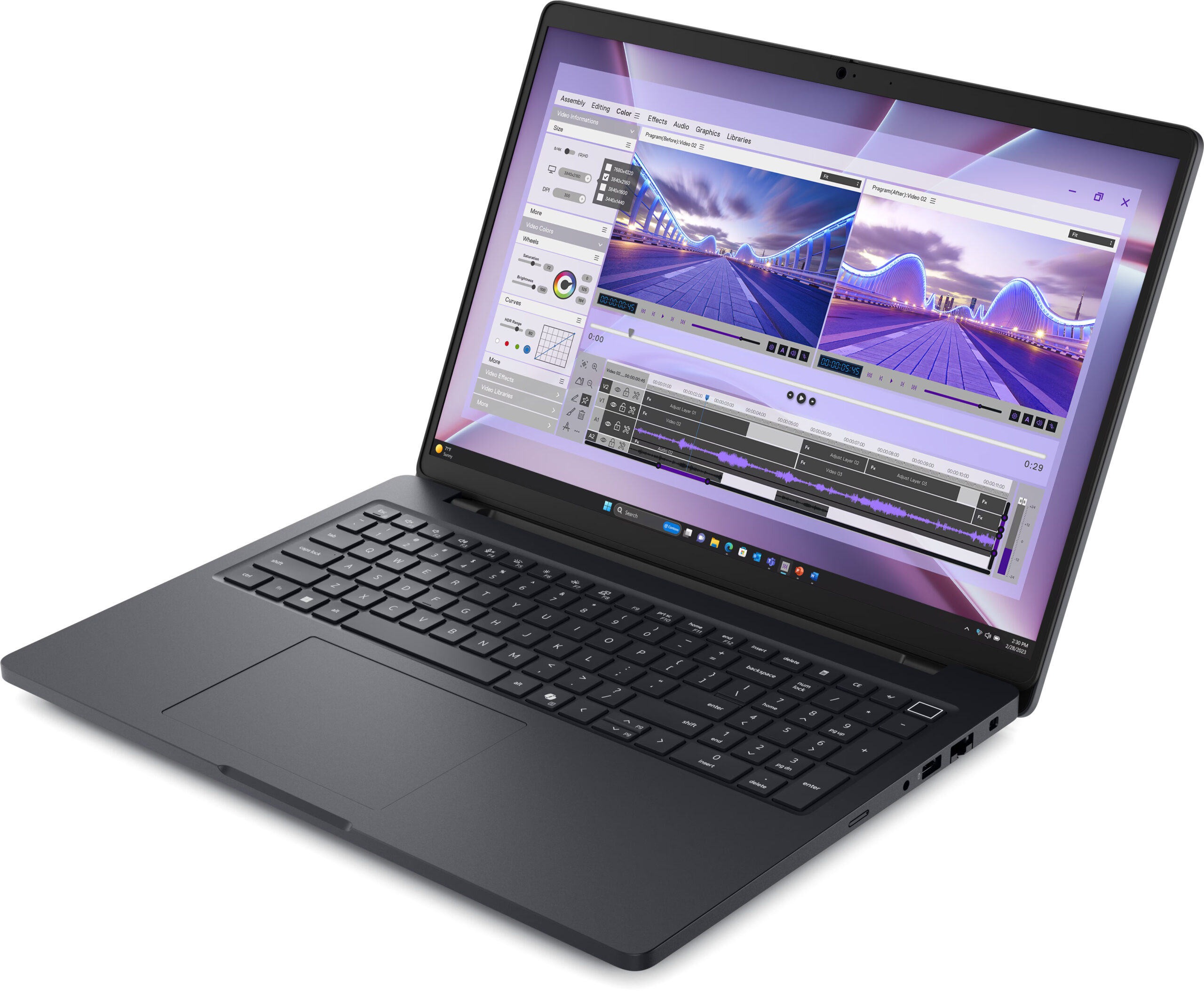
The Dell Pro Max 16 (MC16250) carries itself with an elegant and simple aesthetic, exactly what you’d expect from a professional workstation.
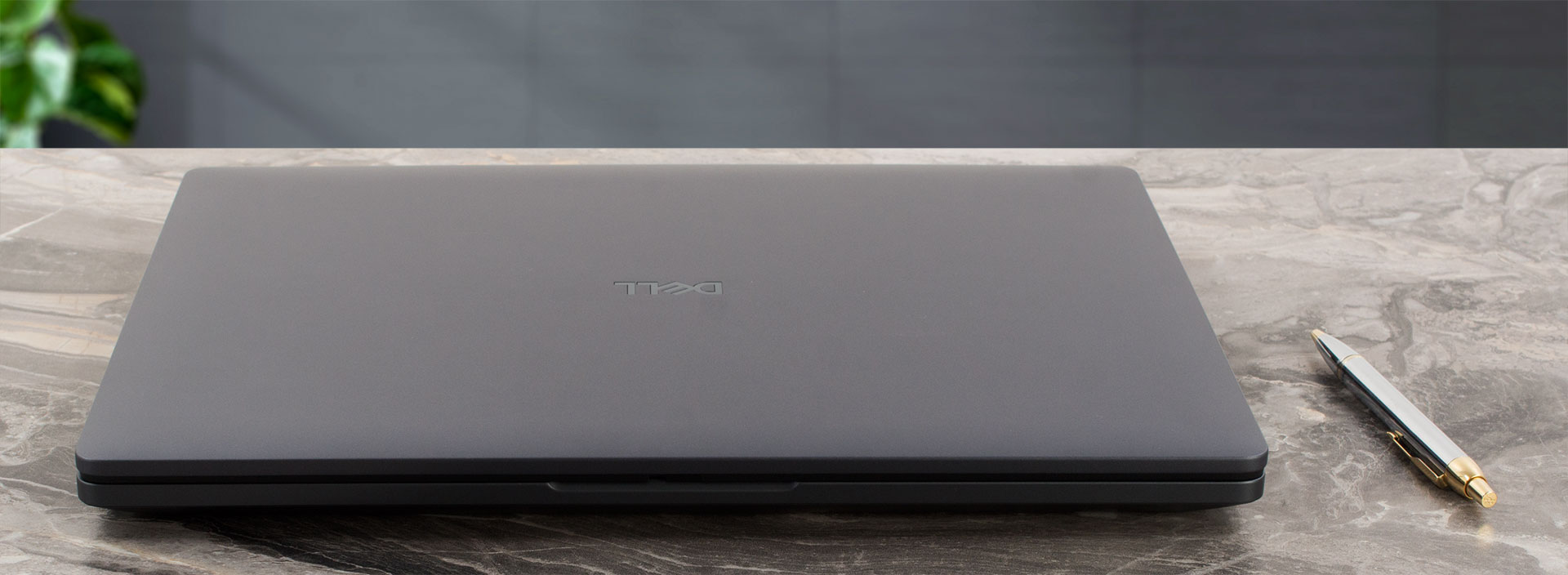
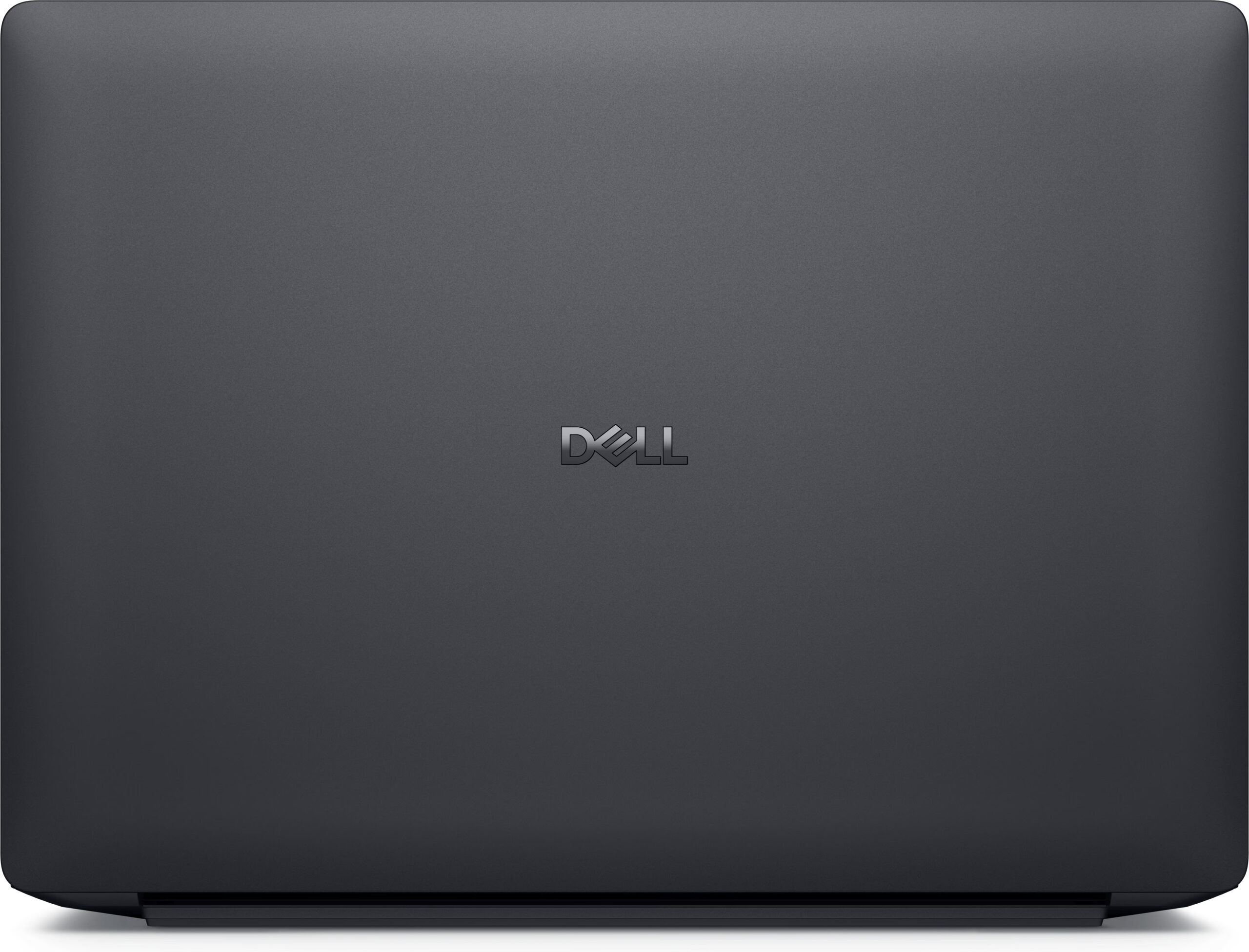
While the “C” in its model code technically designates it as a “base variant” within Dell’s complex naming hierarchy, don’t be fooled – this machine definitely doesn’t look or feel cheap. Considering it can be configured with powerhouse components like an Intel Core Ultra 9 285H and an RTX PRO 2000 GPU, it sits much closer to the high-end spectrum of the market. It comes in a sophisticated dark grey finish called “Magnetite” – a nod to a ferromagnetic mineral that gives it a look very similar to Apple’s Space Gray. It suits the laptop perfectly, adding to its stylish, professional demeanor.
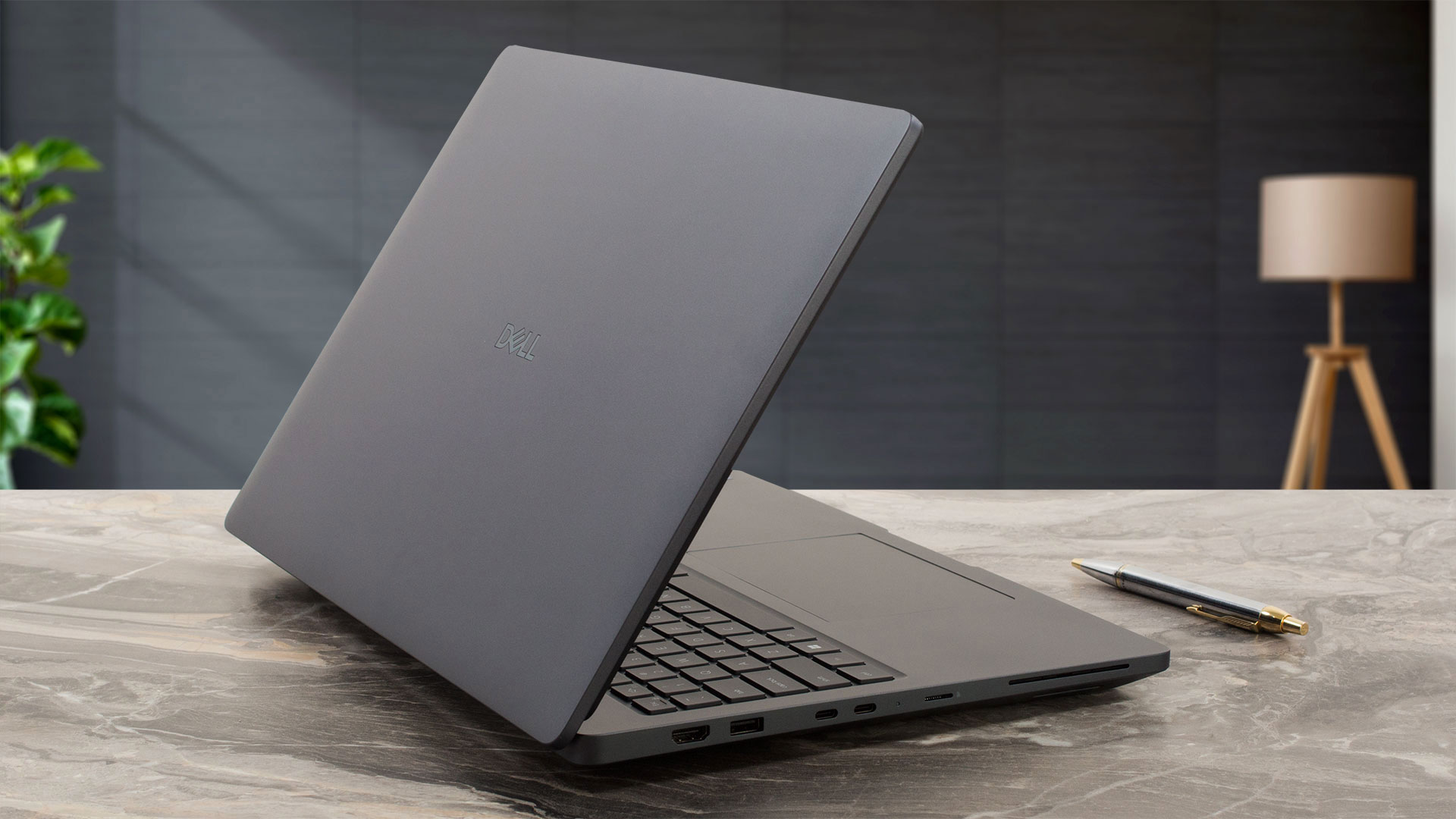
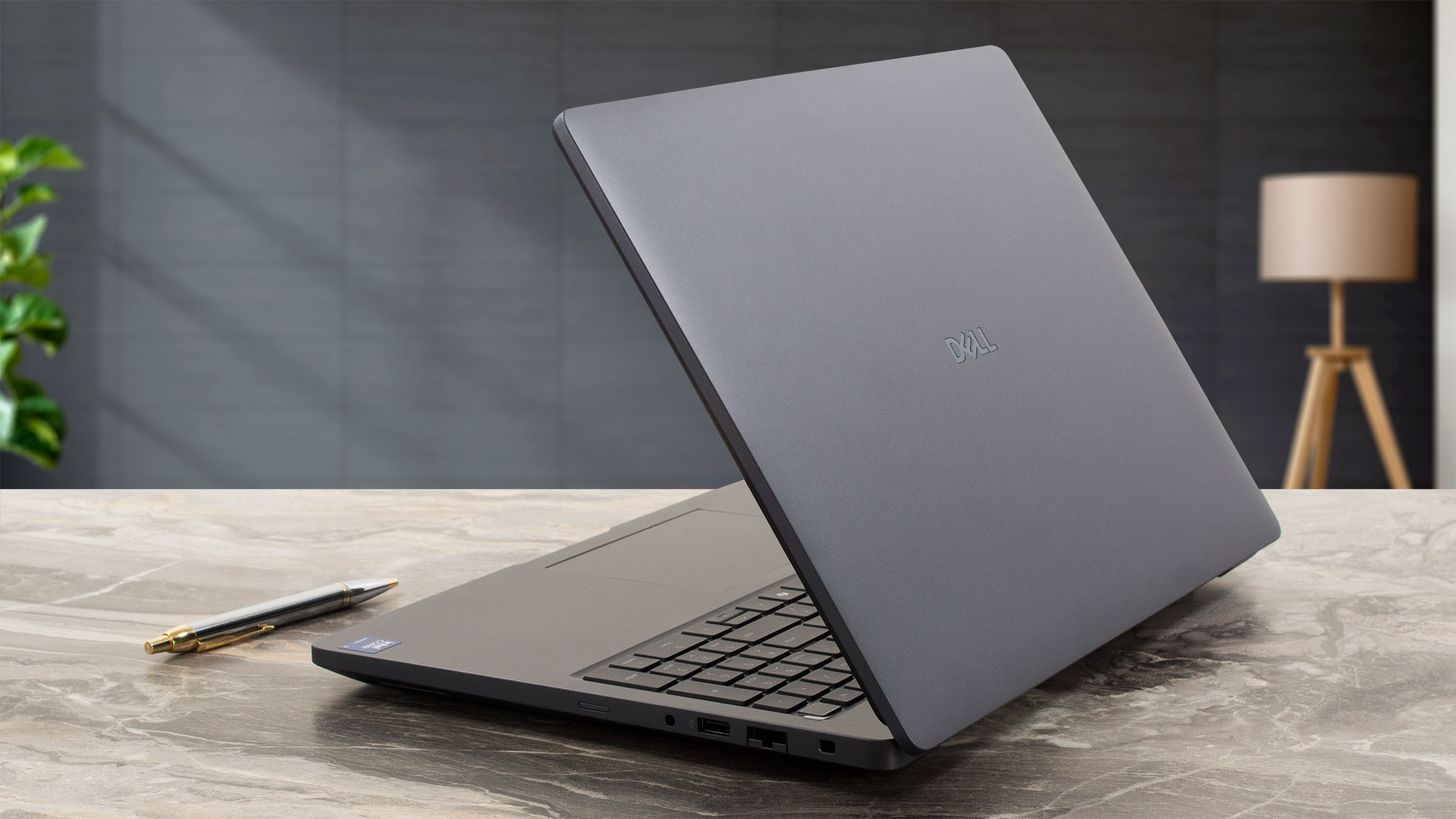
Physically, the Pro Max 16 is a substantial machine, prioritizing stability and cooling over extreme thinness. Here are its dimensions:
| Height (rear): 19.08 mm (0.75 in.) |
| Height (peak): 25.60 mm (1.01 in.) |
| Height (front): 15.08 mm (0.59 in.) |
| Width: 358 mm (14.09 in.) |
| Depth: 256 mm (10.08 in.) |
| Weight (minimum): 2.10 kg (4.65 lb) |
While certainly not the thinnest on the block, this bulk is a necessary trade-off for a workstation designed to handle serious hardware. The chassis is constructed from 90% recycled magnesium, which lends it a premium feel and significant durability. During our standard smudge test (where we intentionally don’t clean the laptop for several weeks) the Magnetite finish held up well. It doesn’t really pick up distinct fingerprints, though some faint, hard-to-see smudges can appear over time, easily wiped away with a microfiber cloth.
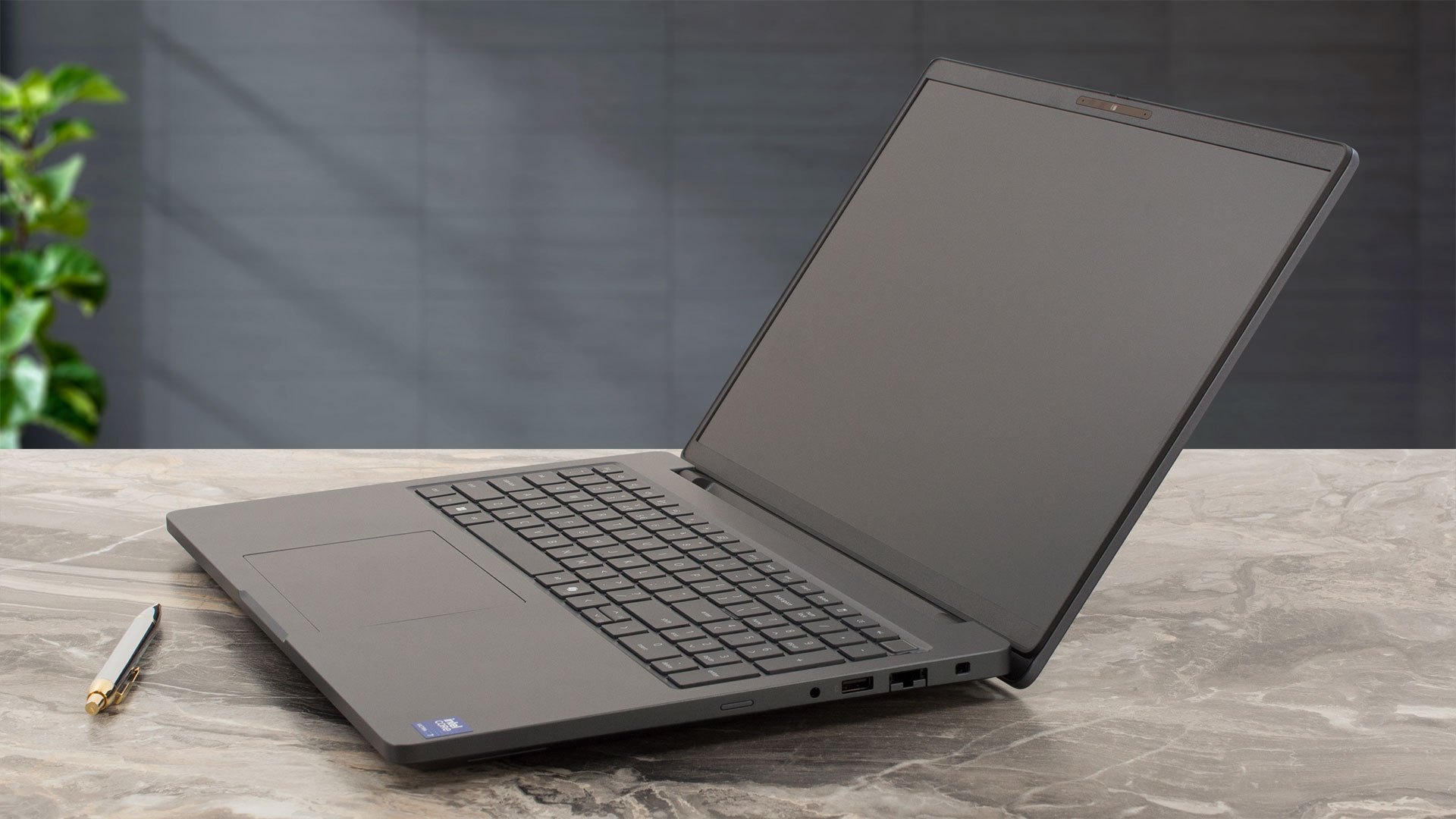
Structurally, it feels very solid; even with firm pressure, flex is minimal. This robustness is backed by MIL-STD 810H certification, ensuring it can withstand demanding conditions. The hinges are quite stiff, prioritizing screen stability over the luxury of a one-handed open.
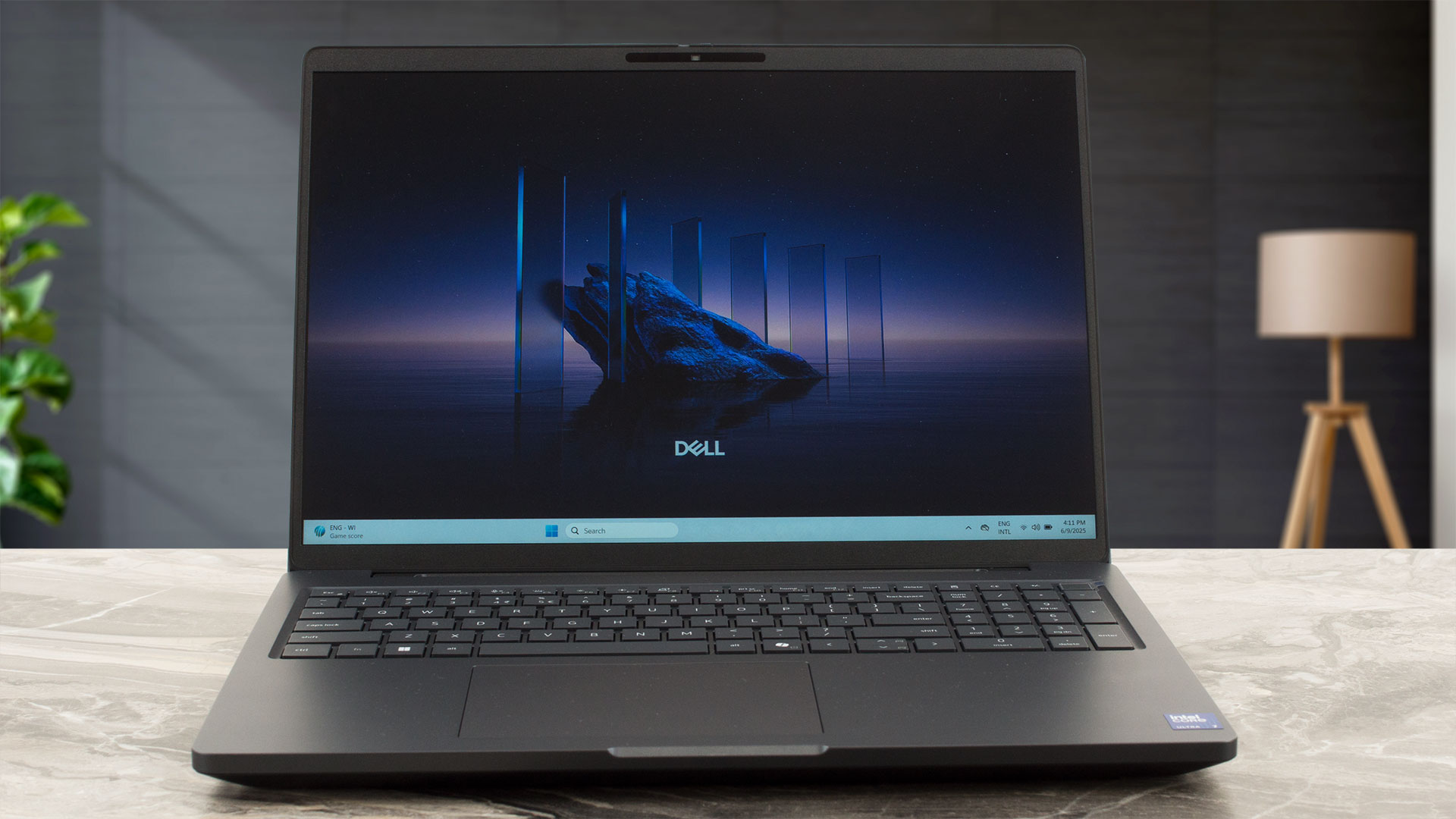
The display is framed by 6.5 mm side bezels and a thicker 13.5 mm top bezel. This top section houses a comprehensive sensor array, including dual microphones and either a standard 1080p FHD+ camera or an FHD+ IR camera for Windows Hello. Dell has also promised a future 8MP+ HDR IR camera option with an ambient light sensor. Crucially for privacy, a physical camera shutter is included.
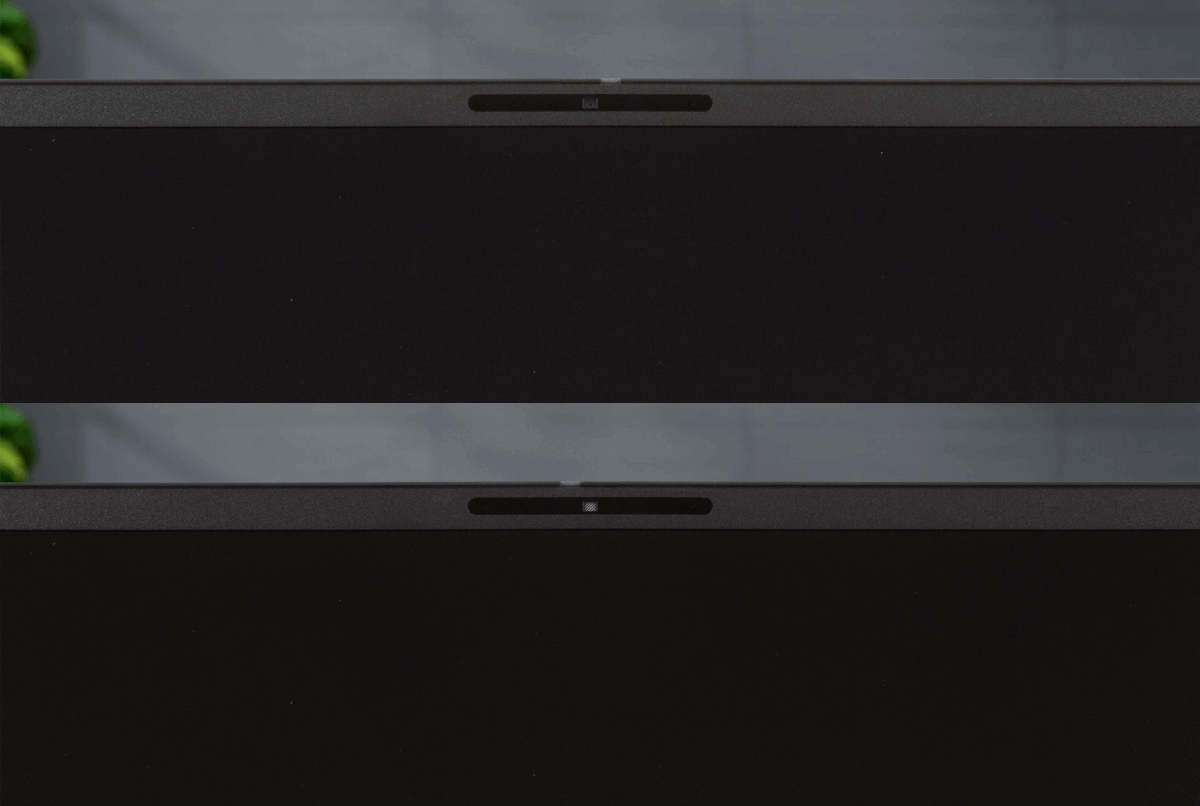
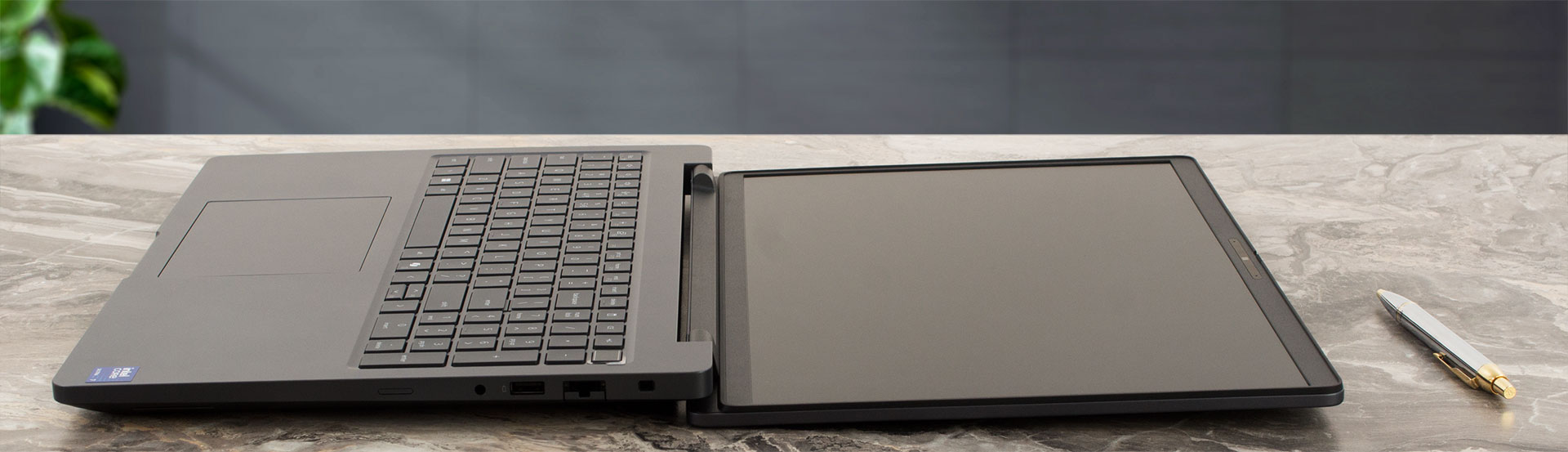
The screen hinge allows for a full 180-degree opening angle, a feature that complements the optional touchscreen configuration, though we ordered the laptop with a standard non-touch display.
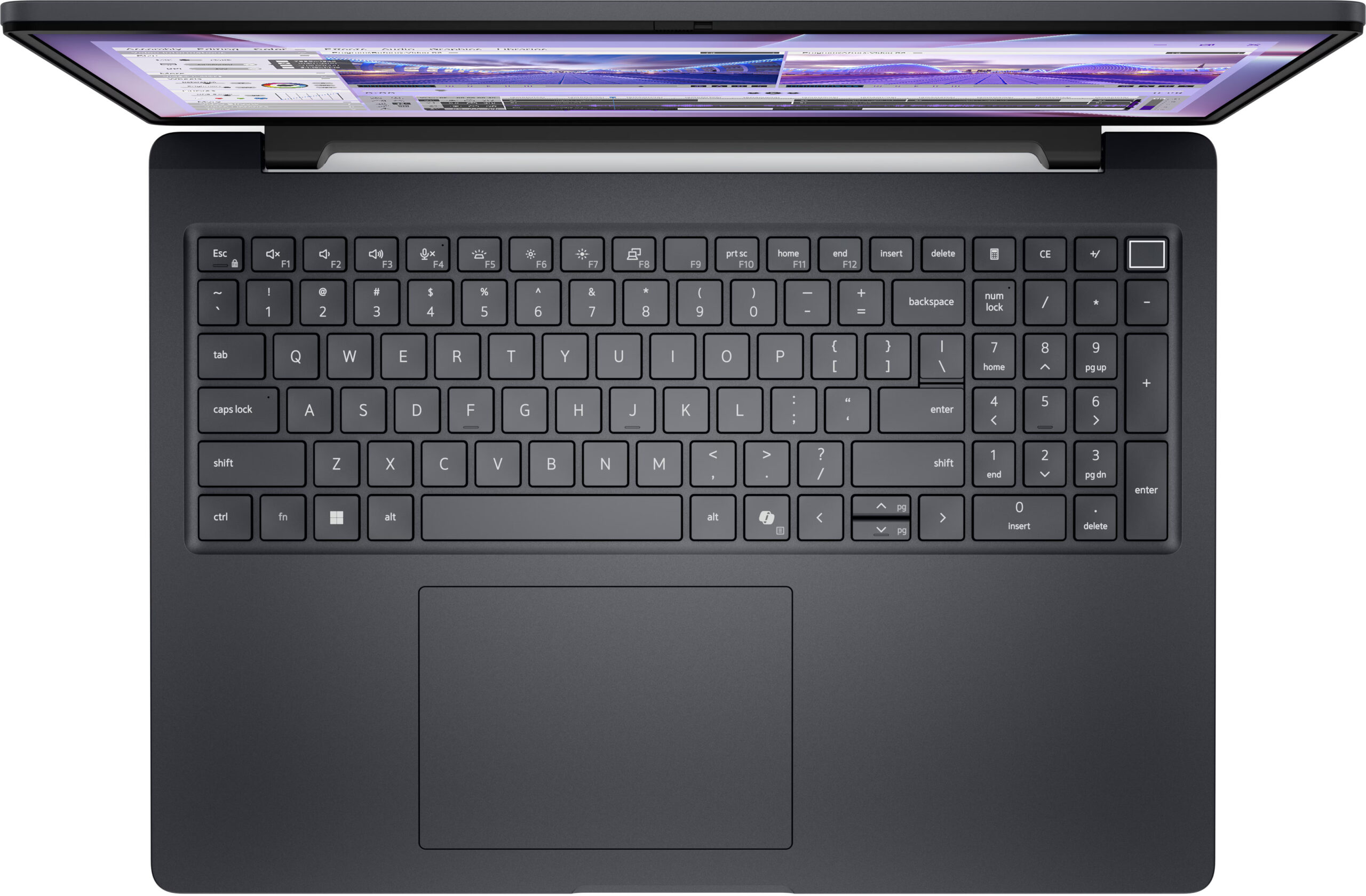
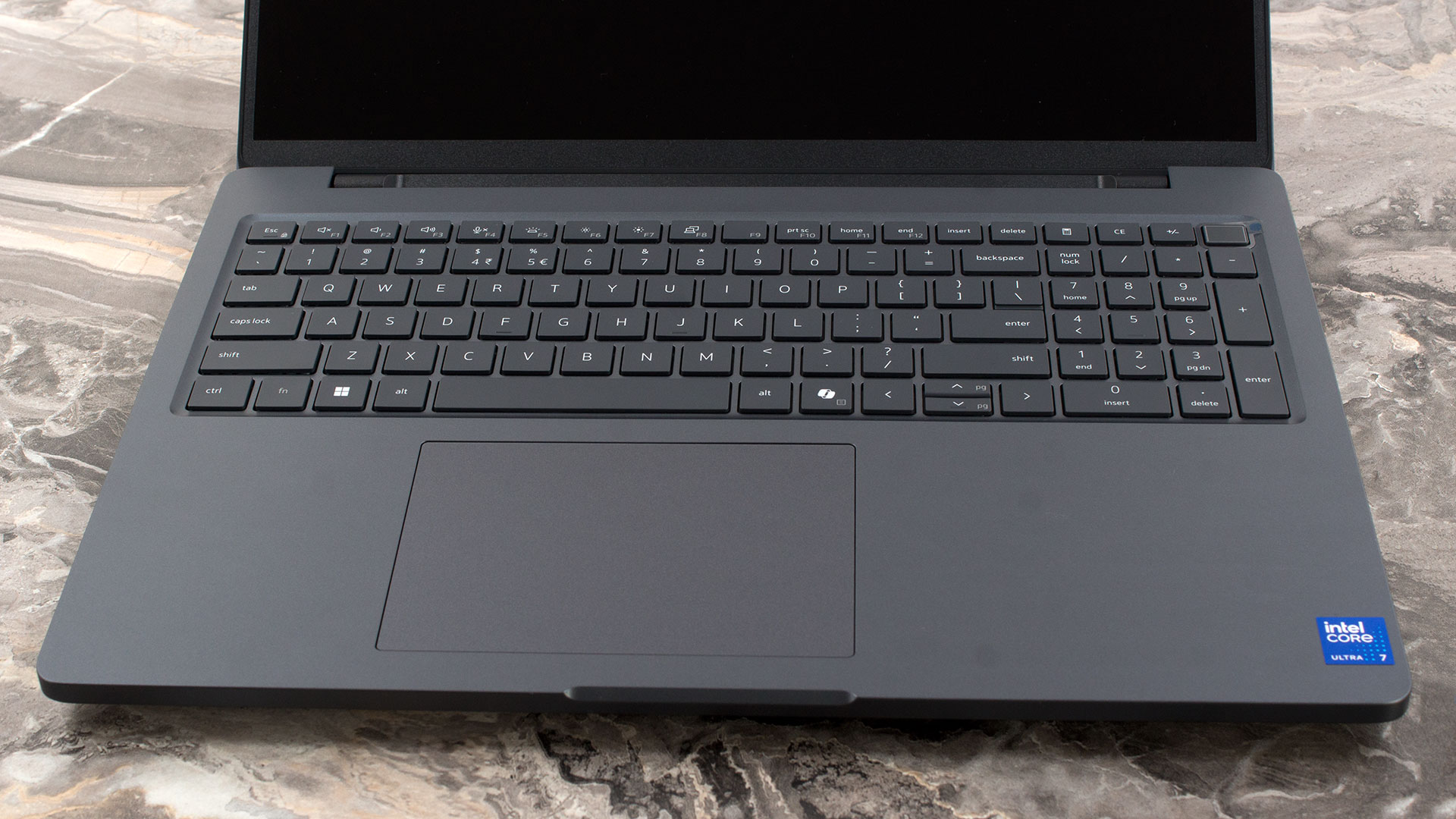
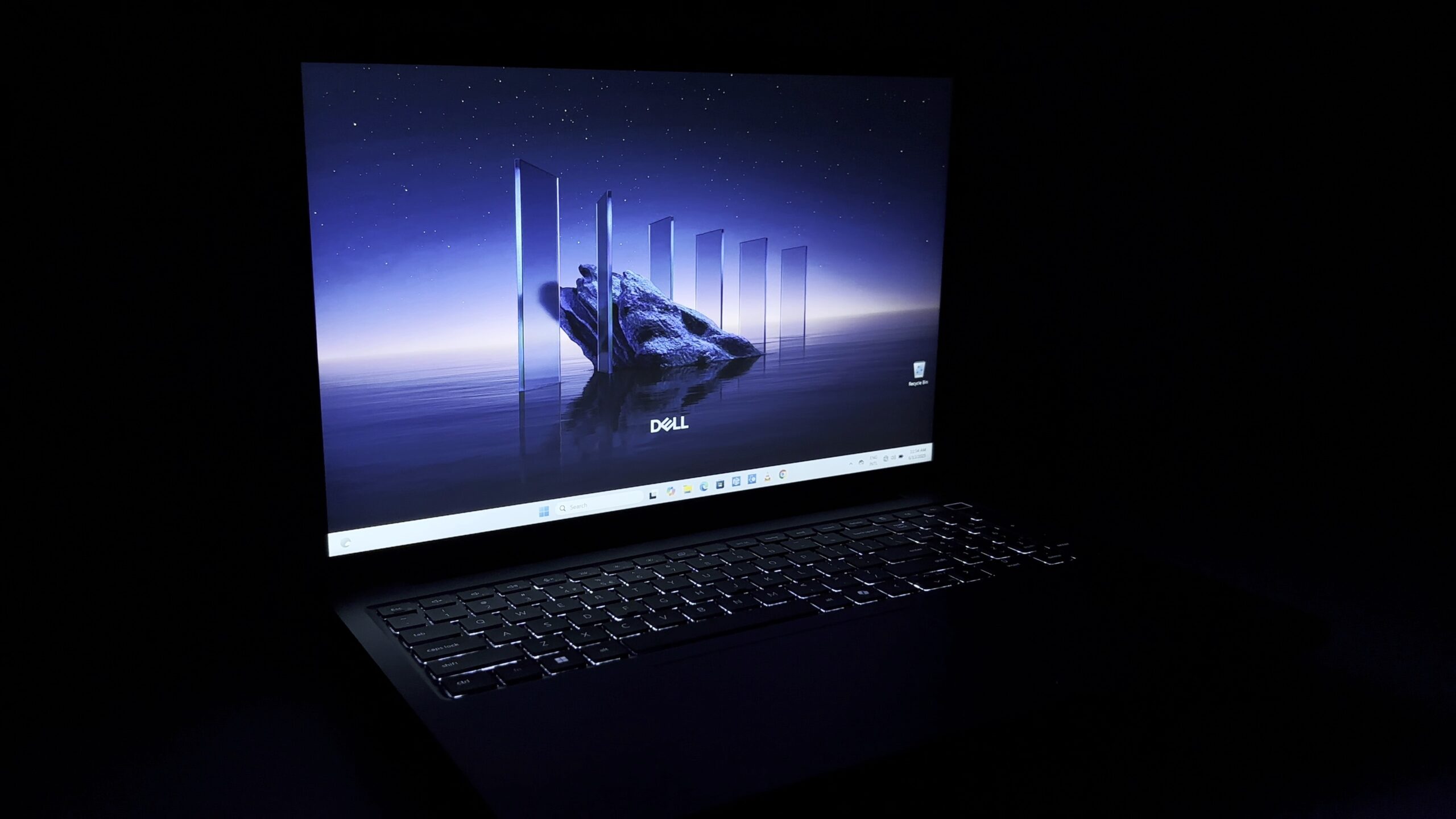
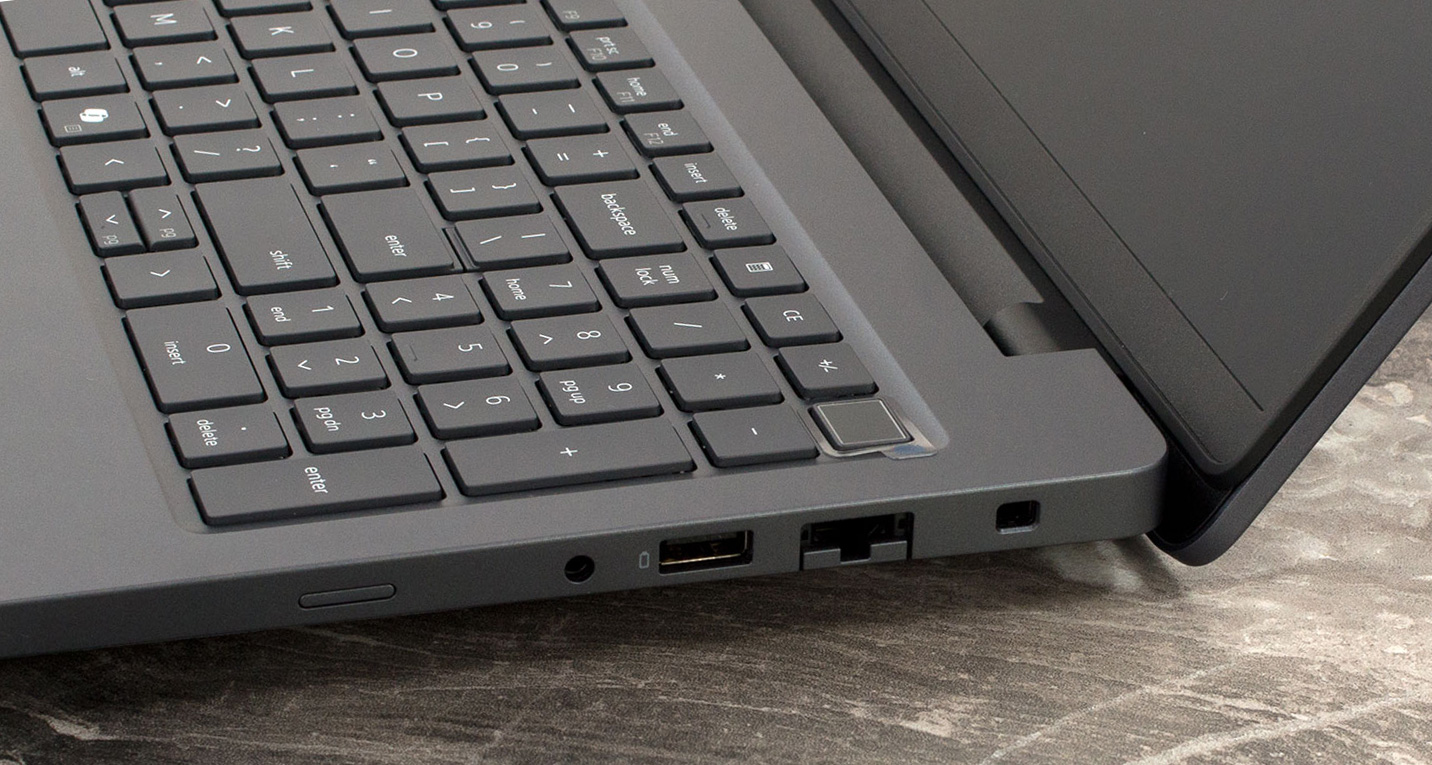
The keyboard deck takes full advantage of the 16-inch chassis, incorporating a NumPad with nearly full-sized keys, a boon for productivity, although it sits very close to the main key cluster. The keyboard is comfortable to use and features a two-level white backlight. A word of caution for international buyers: while most versions include backlighting standard, specific layouts like English, French Canadian, or Spanish might not, so check the specs carefully. Interestingly, our unit came with a fingerprint reader integrated into the top-right power button – a feature that wasn’t listed on our spec sheet, making for a pleasant surprise. Below the keyboard sits a generously sized trackpad measuring 125 x 88 mm (approximately 4.92 x 3.46 inches), which we found to be precise and comfortable for daily navigation.
Ports and Connectivity
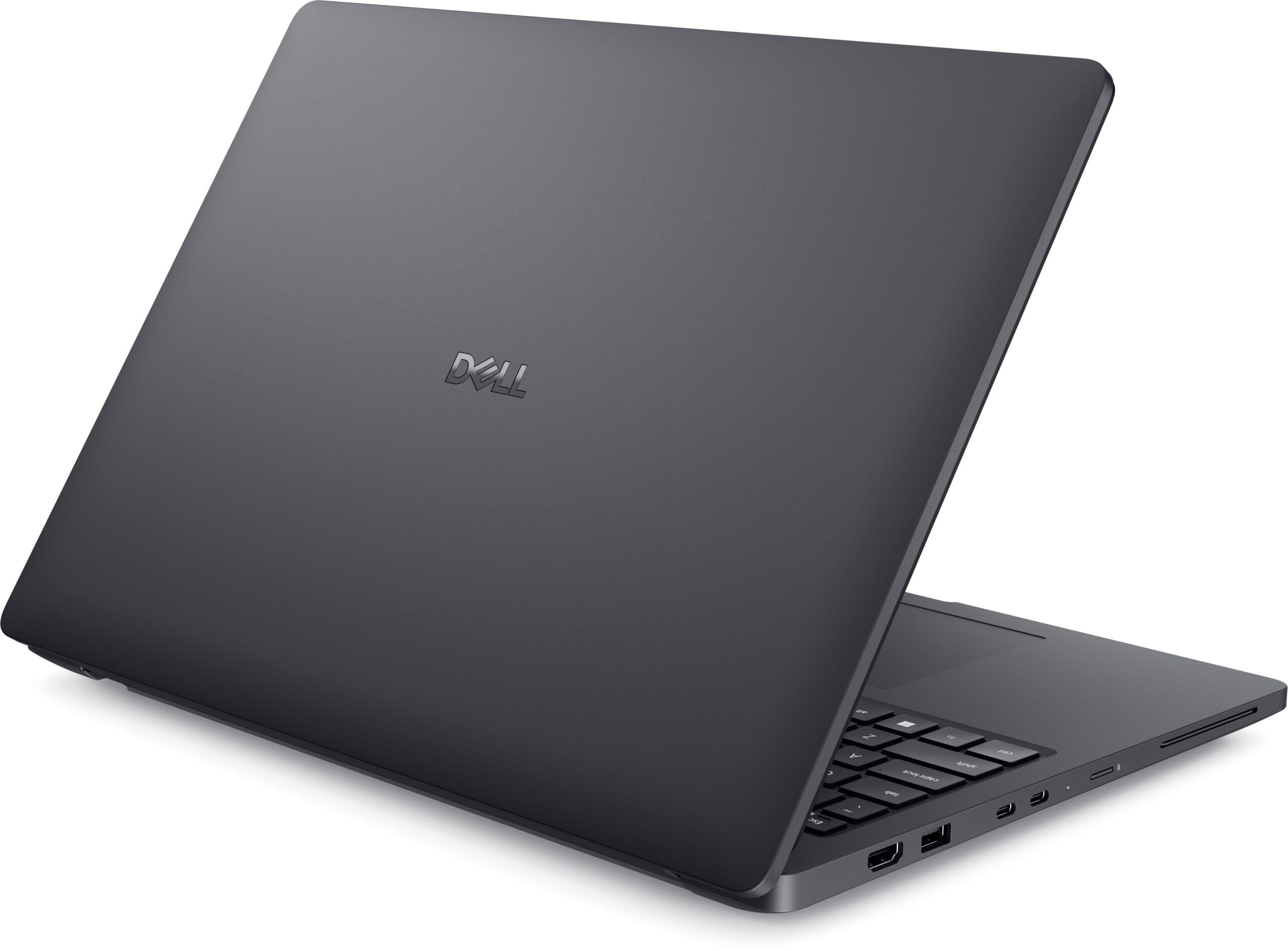
The Dell Pro Max 16 (MC16250) offers a surprisingly rich and extensive port selection, exceeding expectations for a machine in its class. On the left side, you’ll find a powerful HDMI 2.1 port for high-resolution video output, alongside a standard USB 3.2 Gen 1 Type-A port (5 Gbps). The highlight here is the inclusion of two high-performance Thunderbolt 4 ports (40 Gbps), both supporting Power Delivery and DisplayPort video output. Content creators and business users will appreciate the built-in microSD card slot, and depending on the specific configuration, an optional Smart Card reader may also be present on this side for enhanced security.

The right side continues the generous connectivity with an optional Nano-SIM card slot for models equipped with mobile broadband. Audio needs are handled by a universal audio port (combo jack). There is also a second USB 3.2 Gen 1 Type-A port (5 Gbps) which features PowerShare, allowing you to charge peripherals even when the laptop is off. Crucially for office environments, a dedicated RJ45 Gigabit Ethernet port (1 Gbps) is included for stable wired networking, along with a wedge-shaped lock slot. However, a notable design choice is the lack of a dedicated barrel-plug charging port. This means one of the two Thunderbolt 4 ports must be used for charging. Since these ports are positioned centrally on the left side rather than at the rear corner, users will likely have a charging cable protruding from the middle of the laptop’s flank most of the time.

Wireless connectivity options are modern and robust, though they vary by configuration. Users can choose between an Intel Wi-Fi 6E AX211 card paired with Bluetooth 5.3, or the newer Intel Wi-Fi 7 BE201 card which includes Bluetooth 5.4 for the latest in wireless speed and efficiency. For those needing internet access on the go, configurations shipped with WWAN support include a MediaTek T700 5G modem, which is eSIM capable.
Display and Sound Quality, Display Profiles
We ordered the laptop with its entry-level screen panel, which is a good idea if the laptop is going to be used with an external monitor. If the integrated screen is going to be your main one, you should check out the other 4 variants:
| Dell Pro Max 16 (MC16250) | FHD+ (1920 × 1200), 60 Hz, IPS, Non-Touch, Anti-Glare, 300 nit, 45% NTSC Panel: AUO HJ3NT-B160UAN (AUOFDB1) | FHD+ (1920 × 1200), 60 Hz, IPS, Touch (no pen), Anti-Glare, 300 nit, 45% NTSC | QHD+ (2560 × 1600), 120 Hz, IPS, Non-Touch, Anti-Glare, 300 nit, 100% sRGB, ComfortView Plus | FHD+ (1920 × 1200), 60 Hz, IPS, Non-Touch, Anti-Glare, 400 nit, 45% NTSC | QHD+ (2560 × 1600), 120 Hz, IPS, Non-Touch, Anti-Glare, 400 nit, 100% sRGB, ComfortView Plus |
| Diagonal | 16.0 inches (40.6 cm) | 16.0 inches (40.6 cm) | 16.0 inches (40.6 cm) | 16.0 inches (40.6 cm) | 16.0 inches (40.6 cm) |
| Panel Type | IPS | IPS | IPS | IPS | IPS |
| Resolution | 1920 × 1200 pixels | 1920 × 1200 pixels | 2560 × 1600 pixels | 1920 × 1200 pixels | 2560 × 1600 pixels |
| Max Refresh Rate | 60 Hz | 60 Hz | 120 Hz | 60 Hz | 120 Hz |
| Aspect Ratio | 16:10 | 16:10 | 16:10 | 16:10 | 16:10 |
| Pixel Density | 141 PPI | 141 PPI | 189 PPI | 141 PPI | 189 PPI |
| ‘Retina’ Distance | Greater than or equal to 62 cm | Greater than or equal to 62 cm | Greater than or equal to 46 cm | Greater than or equal to 62 cm | Greater than or equal to 46 cm |
| Brightness (typical / peak) | 300 nit (typical) | 300 nit (typical) | 300 nit (typical) | 400 nit (typical) | 400 nit (typical) |
| Color Gamut / Notes | 45% NTSC (typical) | 45% NTSC (typical) | 100% sRGB (typical) | 45% NTSC (typical) | 100% sRGB (typical) |
| Surface | Anti-glare / micro-edge | Anti-glare | Anti-glare | Anti-glare | Anti-glare |
| Touch | None | Yes (No pen support) | None | None | None |
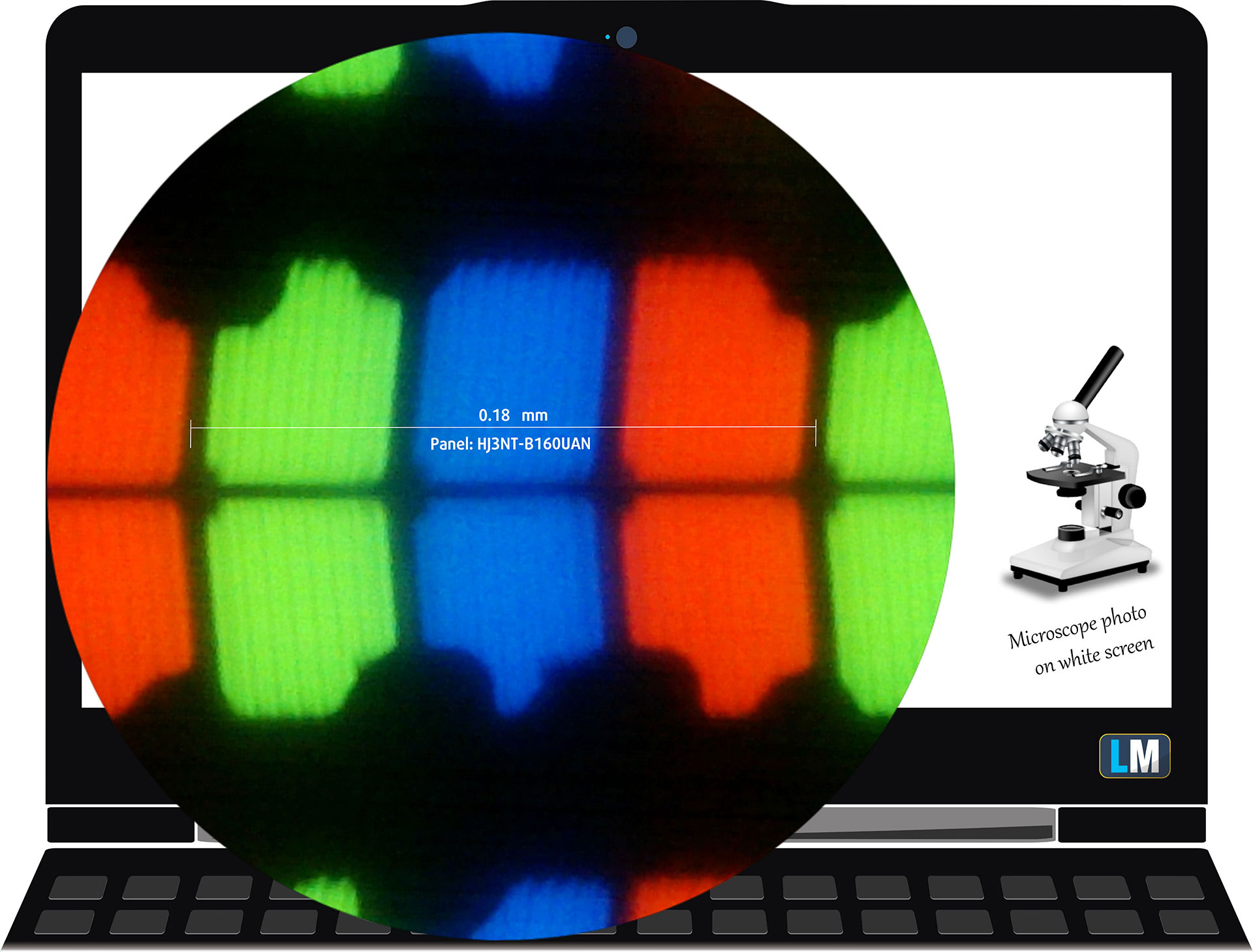
The 1200p IPS panel under our microscope
Viewing Angles
Viewing angles are good. We take photos from different angles to evaluate the quality.
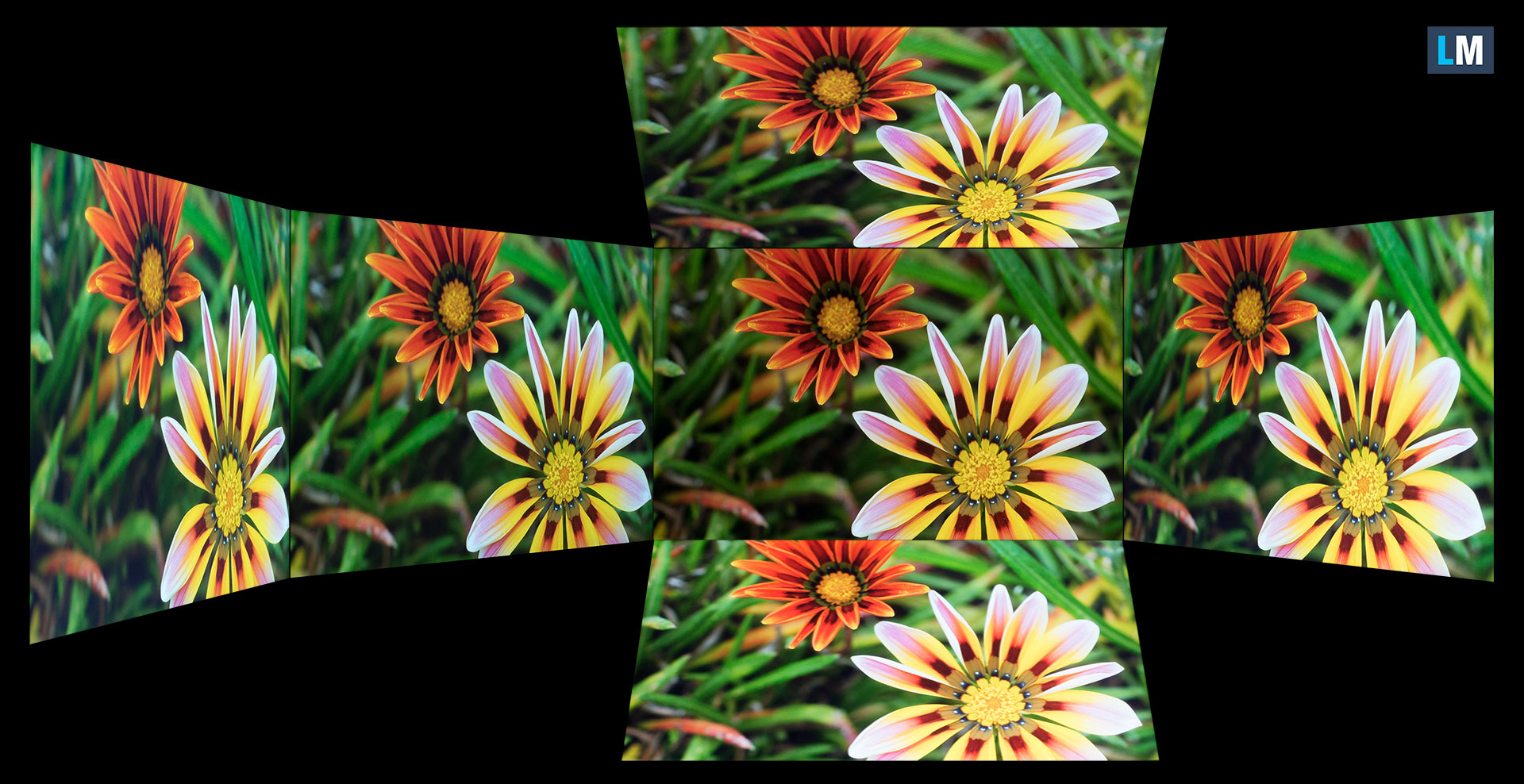
Also, a video with locked focus and exposure.
Color Coverage
The whole “sail-shaped” map below (Fig. 1) consists of all the colors we can see, while the black crooked line shows all the colors from real-world scenes and nature around us.
Then, we’ve drawn some of the most important and interesting color spaces, compared to the colors the panel of Dell Pro Max 16 MC16250 can show:
Standard/For Web: sRGB – widely used color space for most consumer devices, ideal for Web design and development
For Print: AdobeRGB – used in professional photo editing, graphic design, and print
For Photographers/Video Editors: DCI-P3 – used in high-end film production, post-production, and digital cinema
Premium HDR: Rec.2020 – the widest consumer ITU color standard, covering a massive 75.8% of the visible spectrum, a benchmark for premium HDR content.
Dell Pro Max 16 MC16250: the yellow dashed triangle (– – – – – –) represents the range of colors this monitor can show.
In our tests, we calculated the total color coverage of the display at 52% of the sRGB color gamut and 42% of the DCI-P3 color gamut.
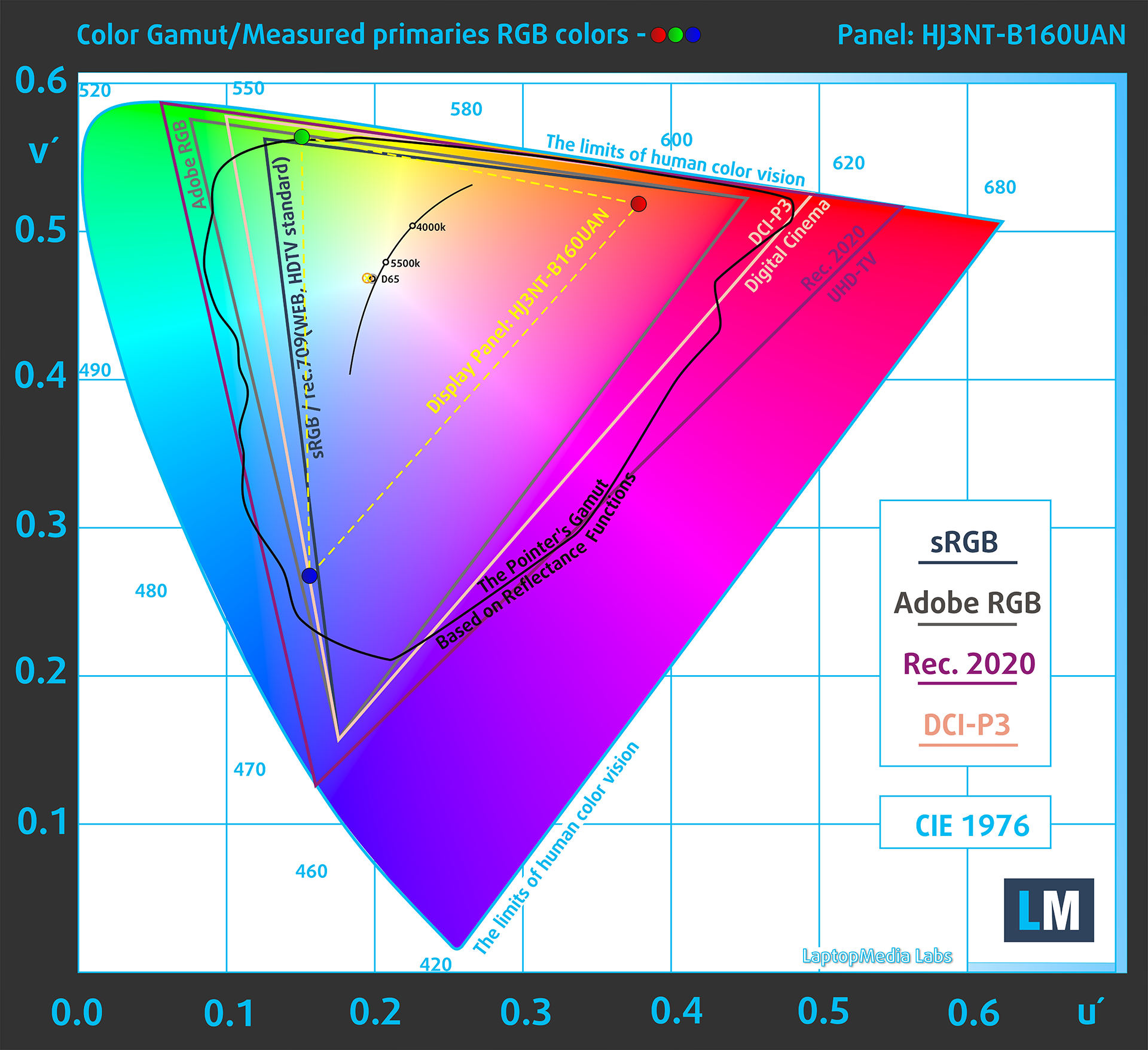
(Fig.1) Dell Pro Max 16 MC16250 covers 52% of the sRGB gamut
Brightness and Contrast
The maximum brightness in SDR mode is 333 cd/m² in the center of the screen and 331 cd/m² averaged across the surface with a maximum deviation of 7%.
The Correlated Color Temperature (CCT) on a white screen at maximum brightness is 6740K.
The contrast ratio is 1020:1.
Uniformity: Luminance, Contrast, and Color Deviation
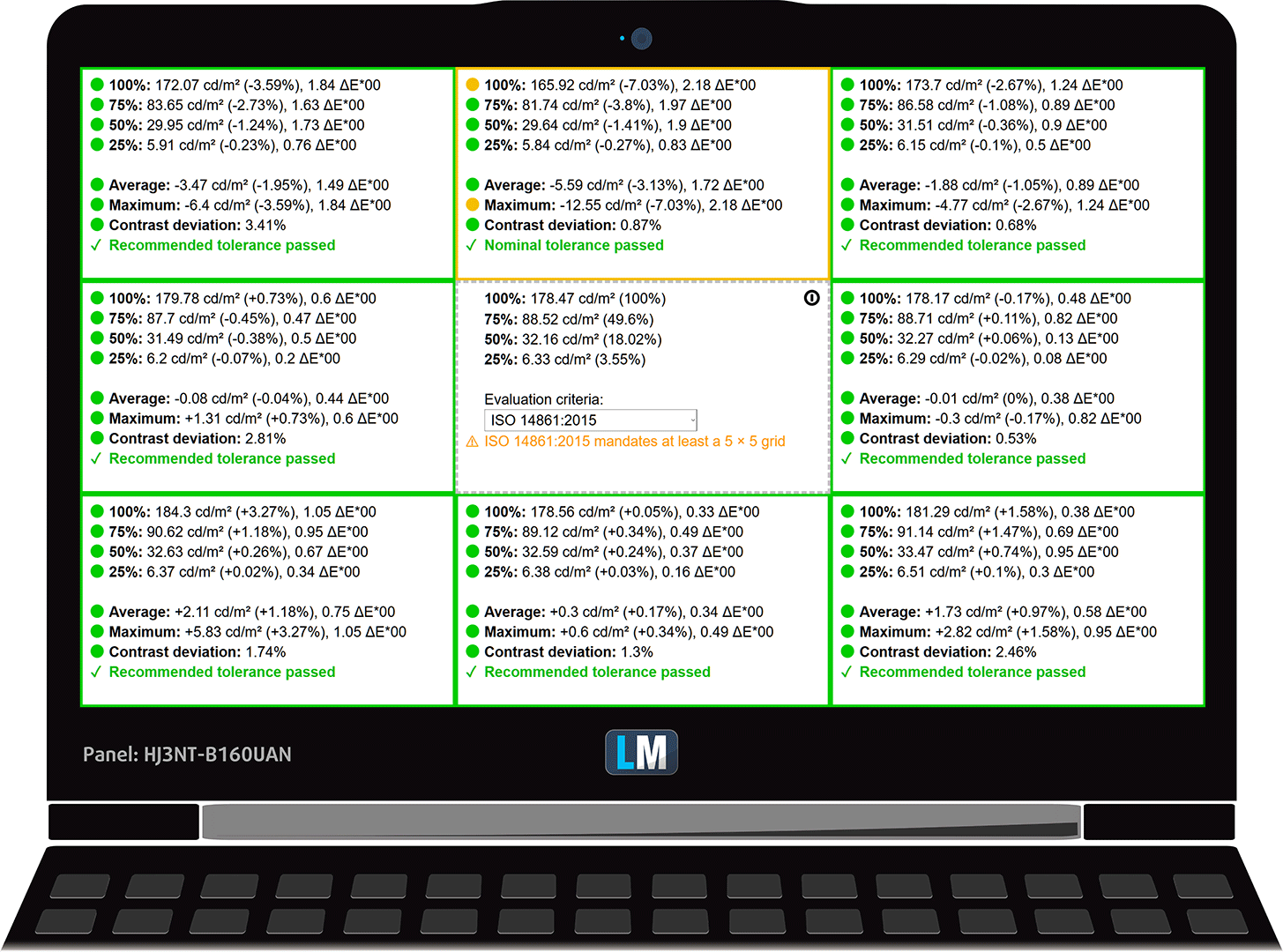
The figure below shows the results from our uniformity test across different sections of the screen. It’s measured at 178 nits (Windows slider = 53%) — a brightness level we consider typical for standard working conditions.
DeltaE values below 4.0 are acceptable for regular users. For those working with colors, screens with DeltaE values no higher than 2.0 are recommended.
Color Accuracy
Let’s check the difference between real colors and those you’ll see on the Dell Pro Max 16 MC16250. We measure that distance in DeltaE – the higher the number, the more different they look.
Values below 4.0 are acceptable for regular users, while values below 2.0 are suitable for color-sensitive work. A value below 1.0 means the difference is indistinguishable to the naked eye.
For the next graph, we’ve selected 24 common colors, including dark/light skin, blue sky, green grass, etc.
Before our calibration of the Dell Pro Max 16 MC16250, the Average color accuracy was 5.0 dE (Fig. 2), and with our Design and Gaming profile, it lowered to 3.8 dE (Fig. 3).
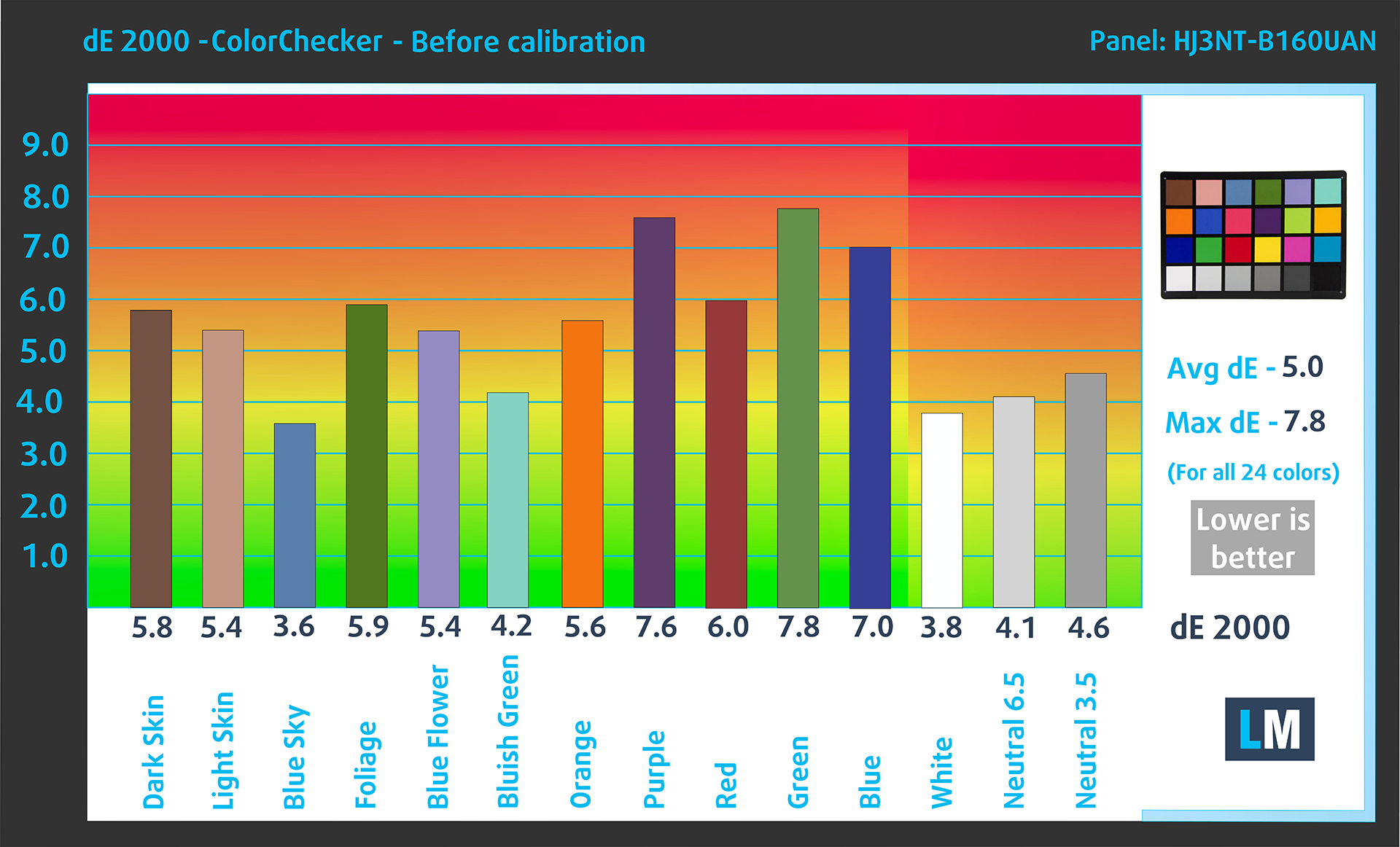
(Fig. 2) Dell Pro Max 16 MC16250 in its factory condition
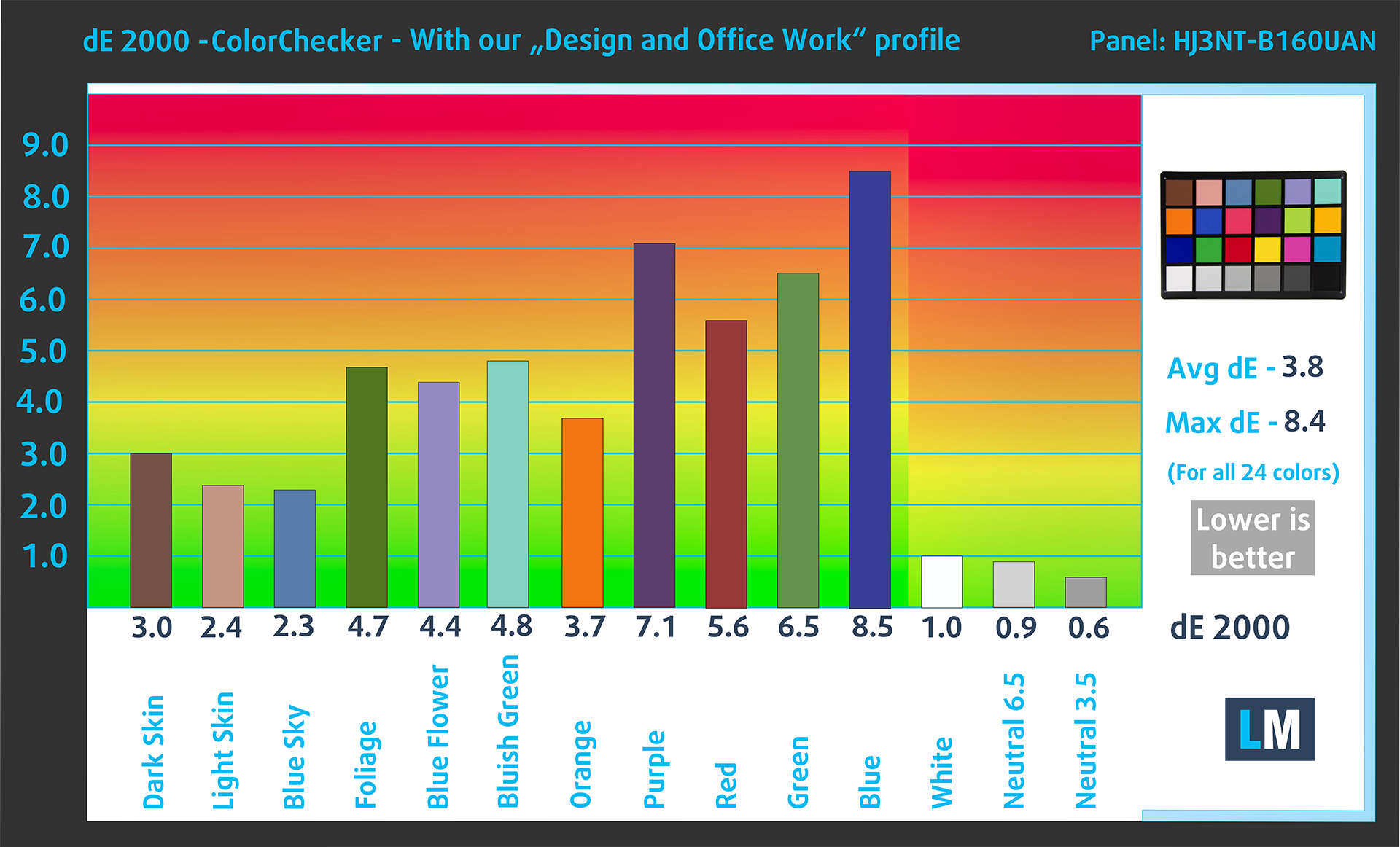
(Fig. 3) Dell Pro Max 16 MC16250 with our display profile
Comparison in the sRGB color space.
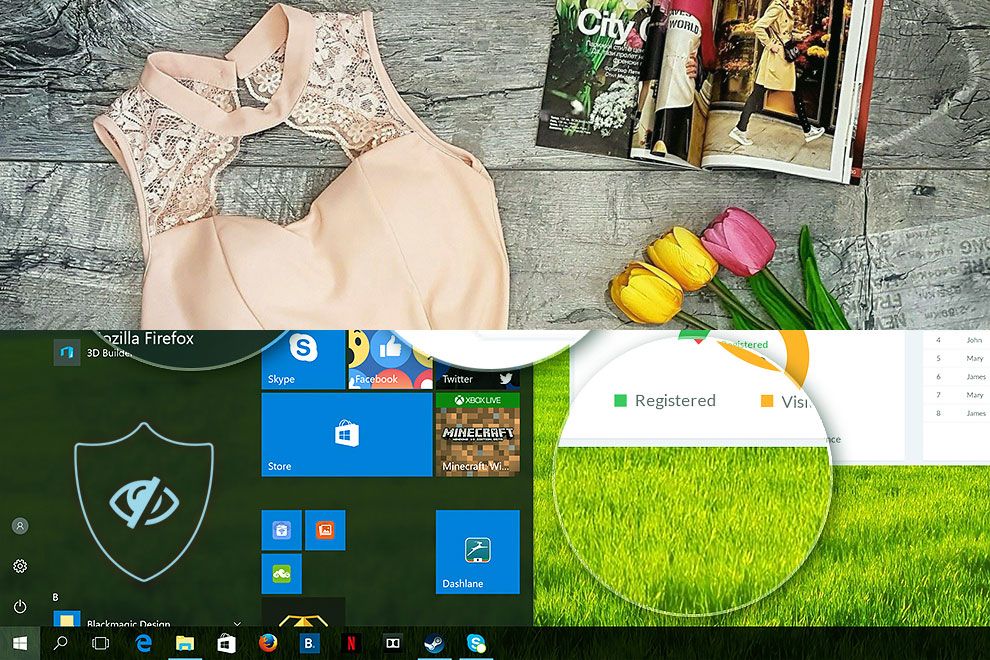
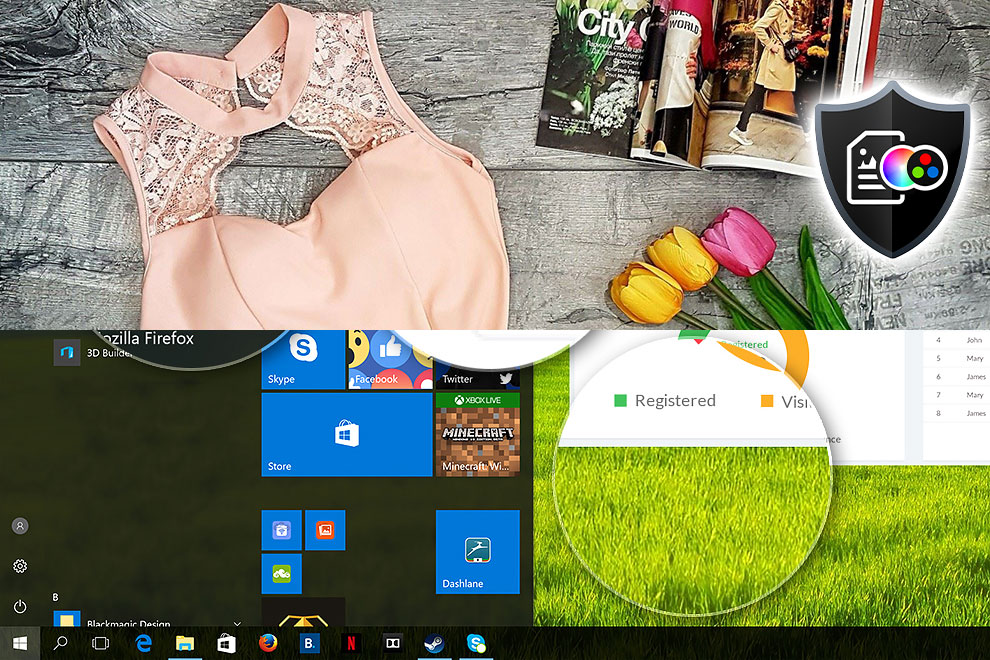
Here’s an illustration of what the Design and Office profile aims to deliver:
Left: No Profile | Drag the slider to see the difference | Right: Design & Office Profile
Visibility in dark scenes
Have you ever watched a movie with dark scenes where you could barely see anything? This often happens because many display panels struggle to differentiate the darkest nuances, making them appear the same.
The next figure illustrates how well the display reproduces these dark nuances. The left side of the image shows the display with stock settings, and the right side shows it with our Gaming and movies profile activated.
On the horizontal axis are the grayscale levels, and on the vertical axis – the corresponding display brightness.
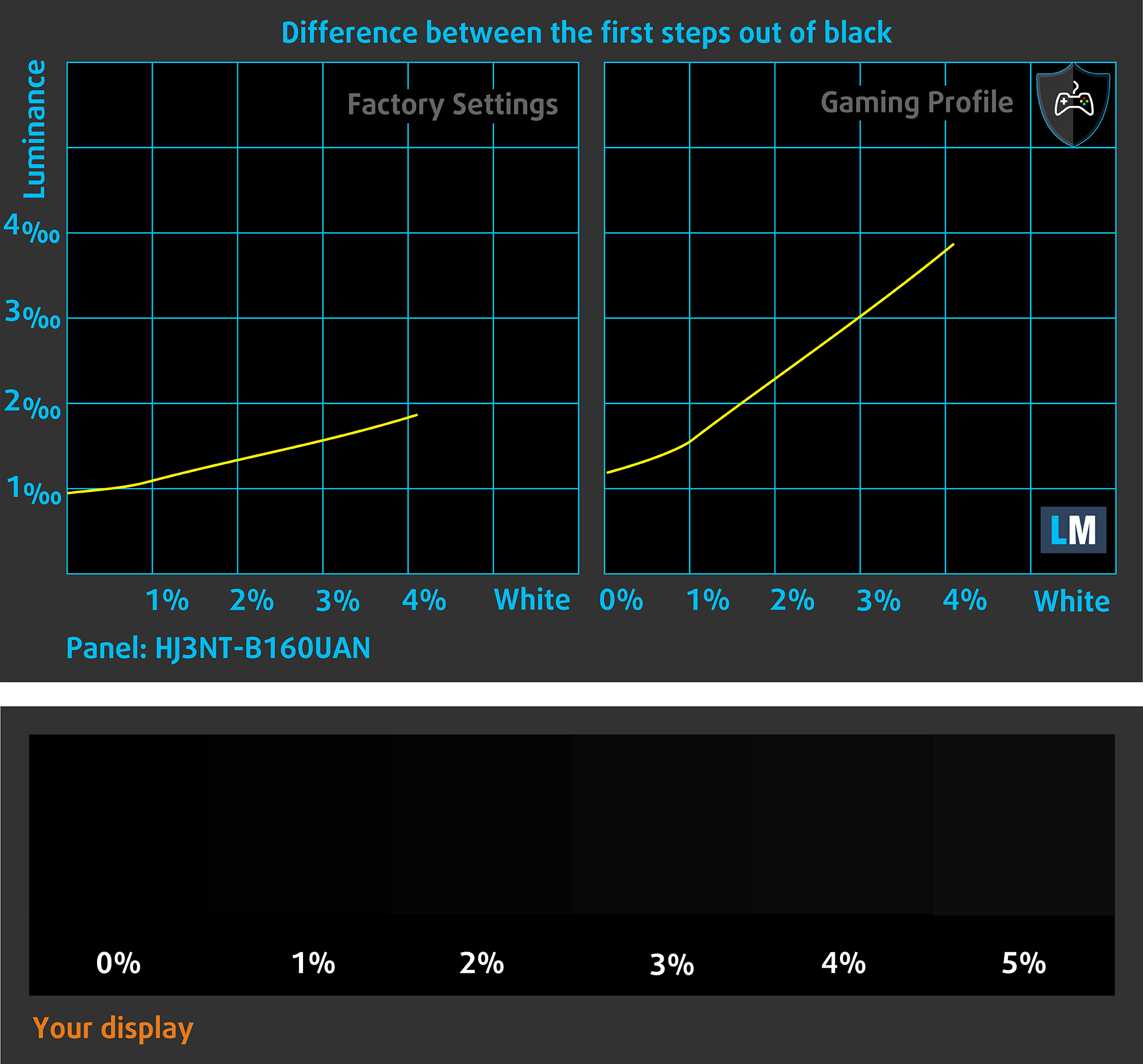
You can also check how your display handles the darkest nuances but keep in mind that this also depends on the settings of your current display and the surrounding light conditions.
Response time (Gaming capabilities)
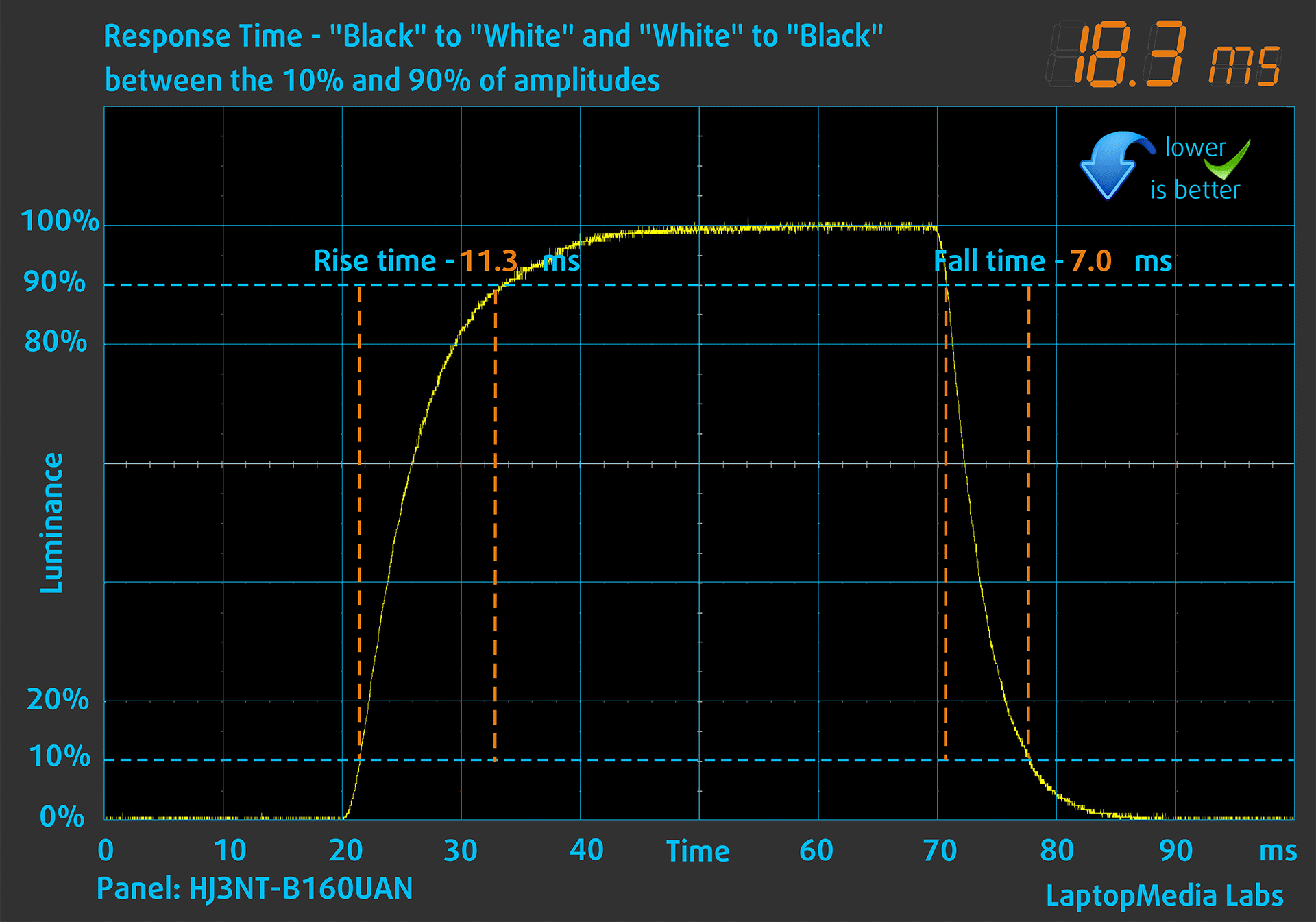
We test the reaction time of the pixels with the usual “black-to-white” and “white-to-black” method from 10% to 90% and vice versa.
We recorded Fall Time + Rise Time = 18.3 ms. Short pixel response time is a prerequisite for a smooth picture in dynamic scenes.
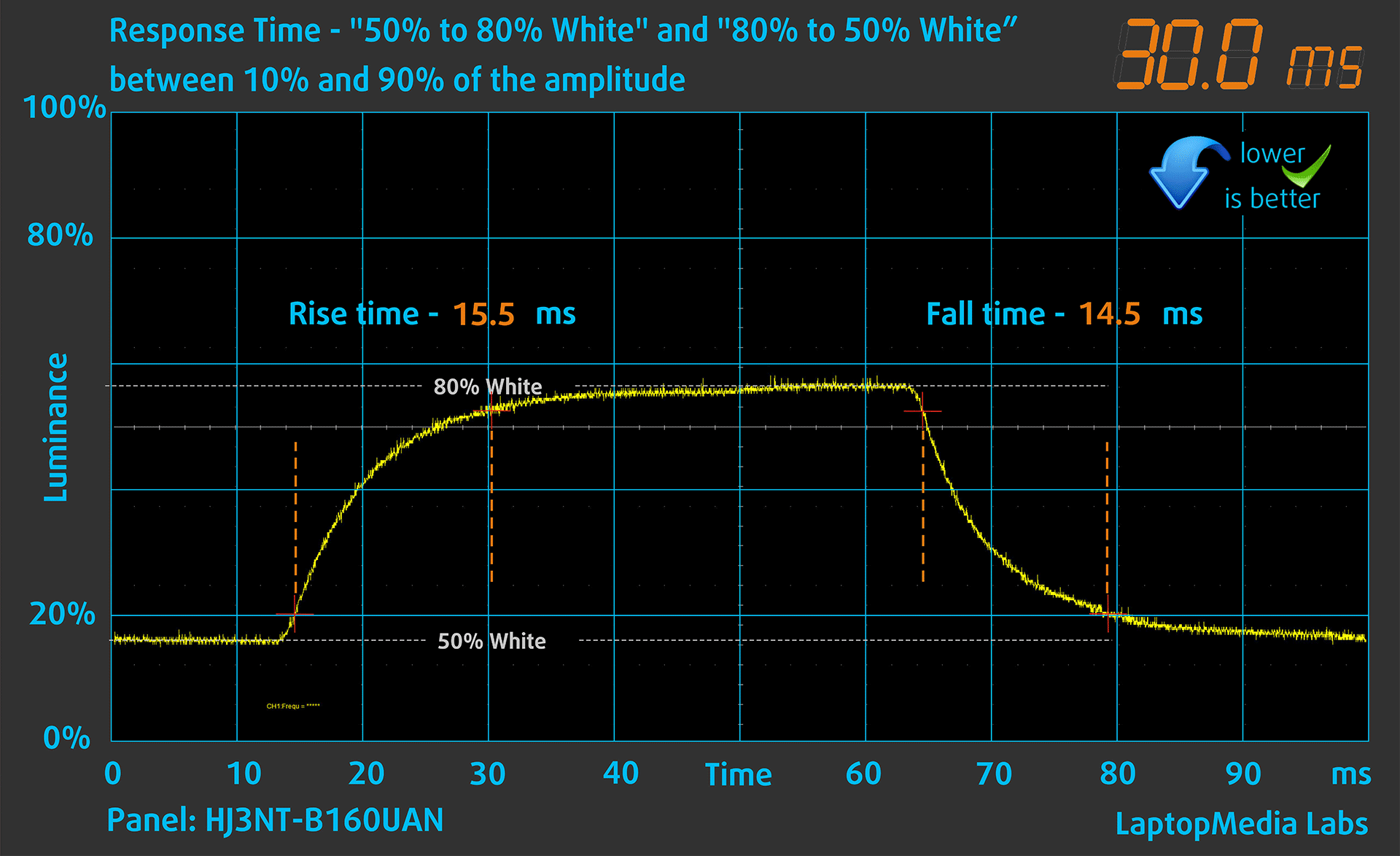
After that, we test the reaction time of the pixels with the usual “Gray-to-Gray” method from 50% White to 80% White and vice versa between 10% and 90% of the amplitude.
Health Impact: PWM (Screen flickering)
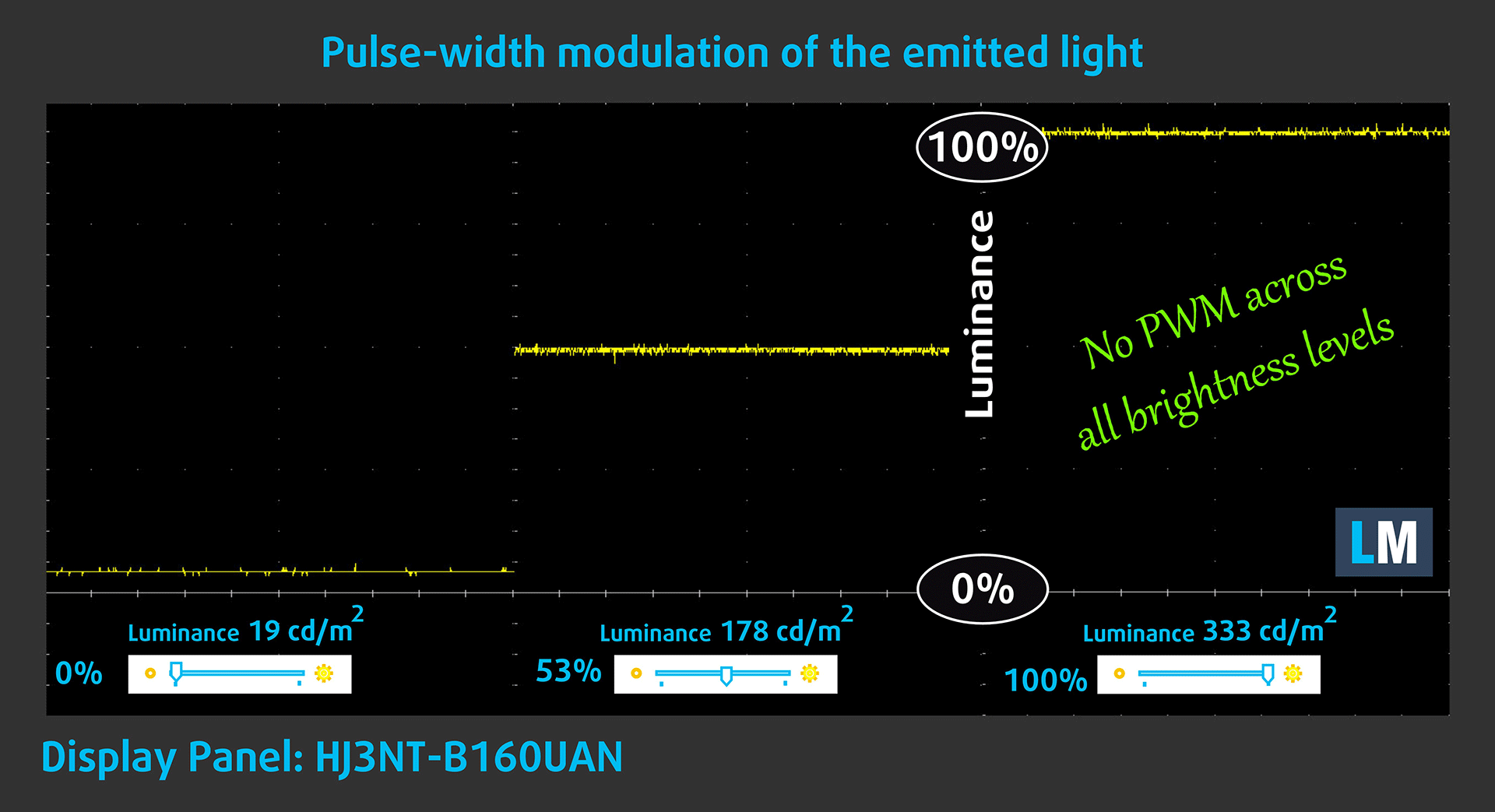
Some use PWM to regulate their brightness, which means that instead of reducing the light intensity, they pulse or flicker. Our brain merges the image, so it appears darker, but this strains both it and our vision, especially when the frequency of the pulses is low. You can read more about that in our dedicated article on PWM.
In the graph below, you see the intensity of light at different brightness levels—on the vertical axis is the brightness of the emitted light, and on the horizontal axis—time.
The light from the backlight of the Dell Pro Max 16 MC16250 display is not pulse-width modulated, providing visual comfort in the discussed aspect.
Health Impact: Blue light emissions
Installing our Health-Guard profile reduces harmful Blue Light emissions while keeping the colors of the screen perceptually accurate.
If you’re not familiar with the Blue light, the TL;DR version is – emissions that negatively affect your eyes, skin, and your whole body. You can find more information about that in our dedicated article on Blue Light.
Health Impact: Screen Reflectance
Glossy-coated displays can cause eye fatigue in high ambient light conditions due to reflections. We measure the level of screen reflection with the display turned off, at a 60° angle.
The reflectance of the Dell Pro Max 16 MC16250’s screen is 51.2 GU. This is a very good result!
High Gloss: >70 GU
Medium Gloss: 30 – 70 GU
Low Gloss: <30 GU
Get our profiles
Since our profiles are tailored for each individual display model, this article and its respective profile package are meant for Dell Pro Max 16 MC16250 configurations with HJ3NT-B160UAN (AUOFDB1), 1920 x 1200, IPS panel.
*Should you have problems with downloading the purchased file, try using a different browser to open the link you’ll receive via e-mail. If the download target is a .php file instead of an archive, change the file extension to .zip or contact us at [email protected].
Read more about the profiles HERE.
In addition to receiving efficient and health-friendly profiles, by buying LaptopMedia's products you also support the development of our labs, where we test devices in order to produce the most objective reviews possible.
Design and Office
The Design and Office profile makes display colors as close to real as possible.Ideal not only for professionals but also for everyday users, it meets sRGB standards (D65 white point, sRGB gamma) with minimal DeltaE for precise color reproduction on your panel.

Gaming and Movies
Have you ever watched a movie where, during dark scenes, you can barely see anything? Many displays fail to distinguish dark tones properly. Our Gaming and Movies profile enhances low-light performance, like HDR tech, using a gamma curve tailored to human perception — ideal for gamers seeking faster reactions and clearer visuals.

Health-Guard
Our Health-Guard profile protects your eyes by eliminating PWM flickering, reducing strain and fatigue, and minimizing harmful Blue light exposure that can disrupt sleep and health. It uses software dimming and a gamma curve tailored to human perception for comfort and safety during screen use.
Get All The Profiles With 33% Discount!

Sound
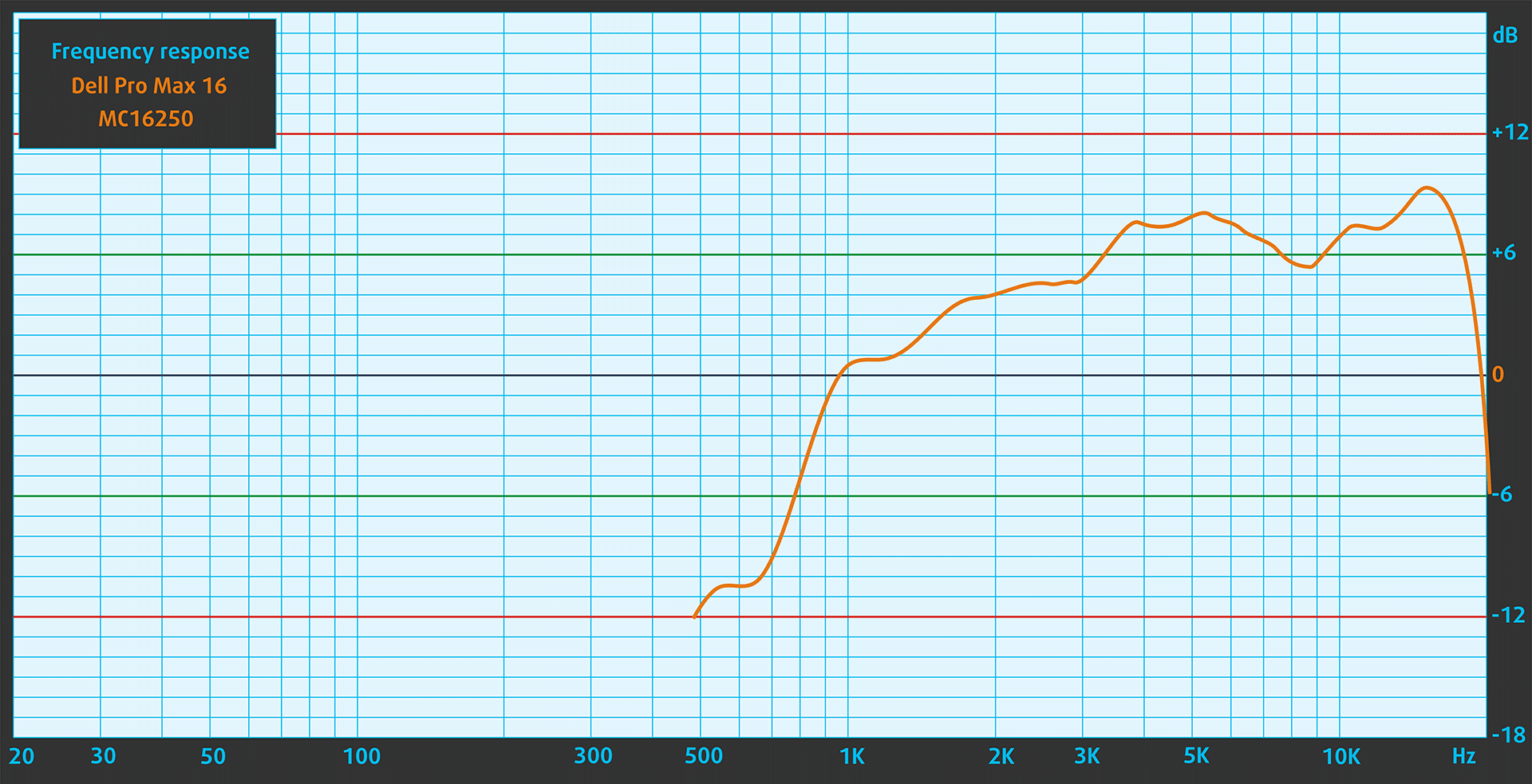
When we subjectively listen to a sound file through the built-in speakers, the sound quality offered by the Dell Pro Max 16 MC16250 is very good.
Work Performance: CPU, Storage, AI
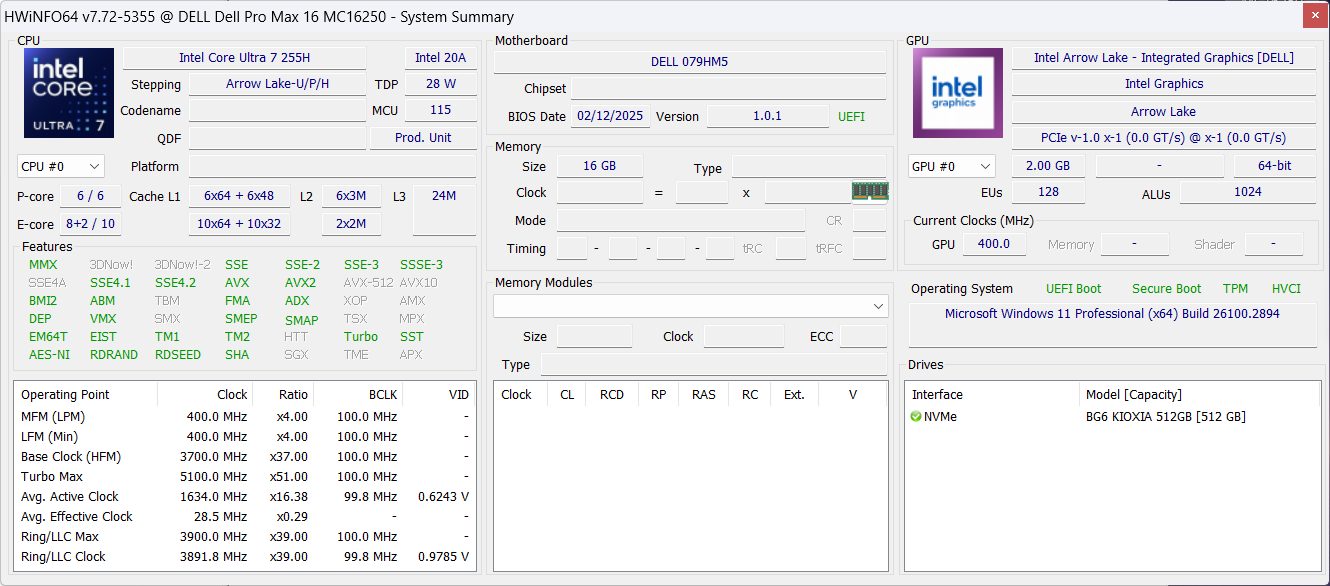
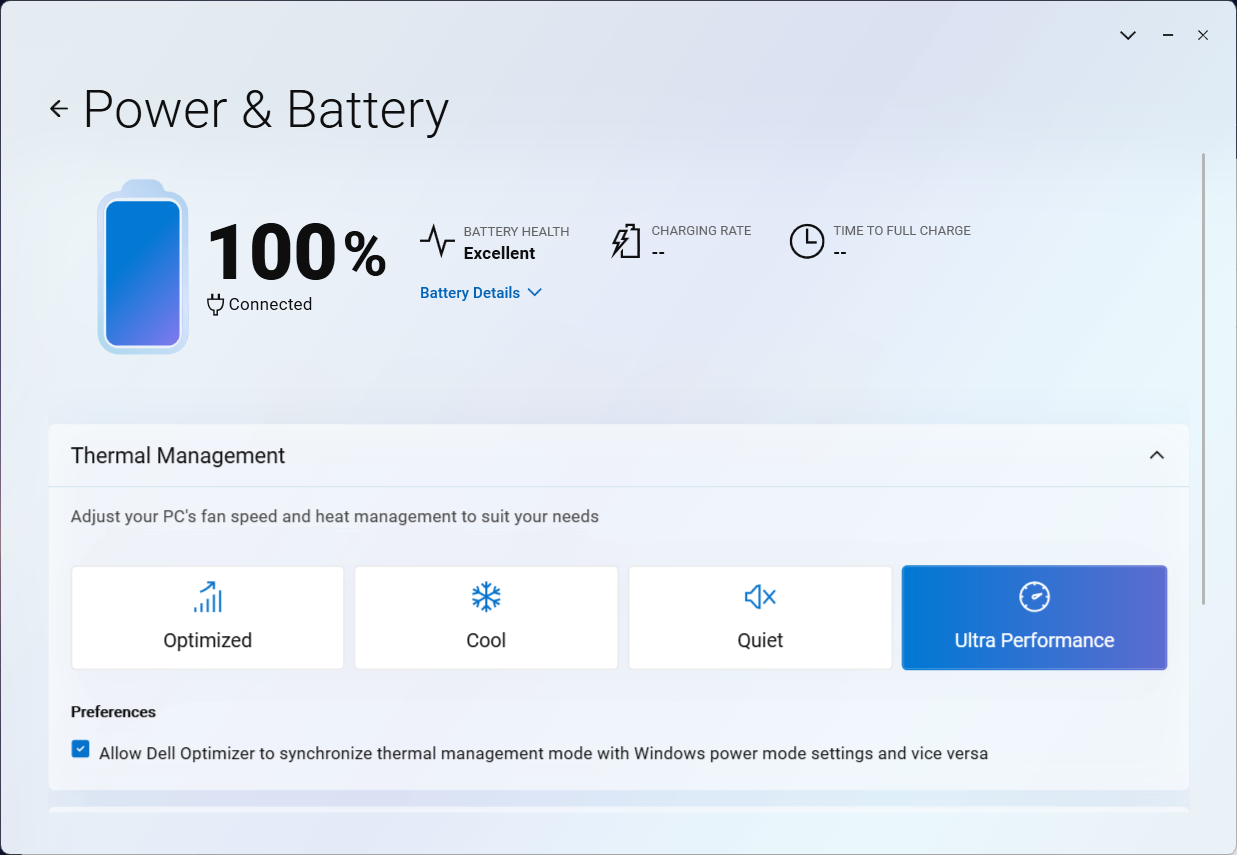
All performance and temperature tests are conducted with “Ultra Performance” mode activated in Dell Optimizer:
CPU and Work Performance
The Dell Pro Max 16 (MC16250) series offers a range of Intel Core Ultra processors, providing options for different performance needs.
Configurations start with the Core Ultra 5 235H, featuring 14 cores and a boost clock up to 5.00 GHz. For users requiring higher performance, there are several Core Ultra 7 options, including the 255H and 265H, both with 16 cores and maximum turbo speeds of 5.10 GHz and 5.30 GHz respectively.
The top-tier choice in the lineup is the Core Ultra 9 285H, also with 16 cores but reaching up to 5.40 GHz, designed for the most demanding workloads. As you can see, the Intel Core Ultra 7 255H is a great performer in Dell Pro Max 16, especially in the 3D rendering test.
For those interested in how these CPUs stack up against the competition, you can check out our comprehensive laptop CPU ranking.
Single-core performance ensures smooth operation and responsiveness in operating systems, providing a better user experience.
Results are from the Geekbench 6 Single-Core test (higher is better)
Multi-core performance is essential for handling complex and demanding tasks, such as Video editing, CAD, and Scientific simulations.
Results are from the Geekbench 6 Multi-Core test (higher is better)
Here, we evaluate the CPU's performance using a real-world 3D rendering task, assessing its ability to handle complex computations and rendering workloads efficiently.
Results are from the Cinebench 2024 Multi-Core test (higher is better)
Storage Performance
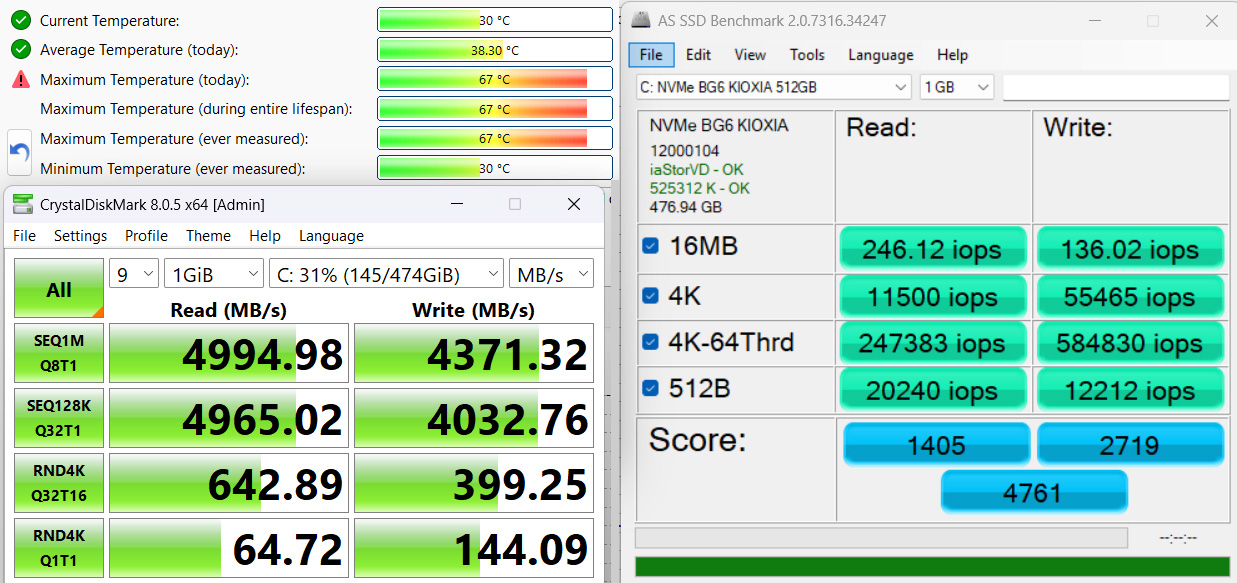
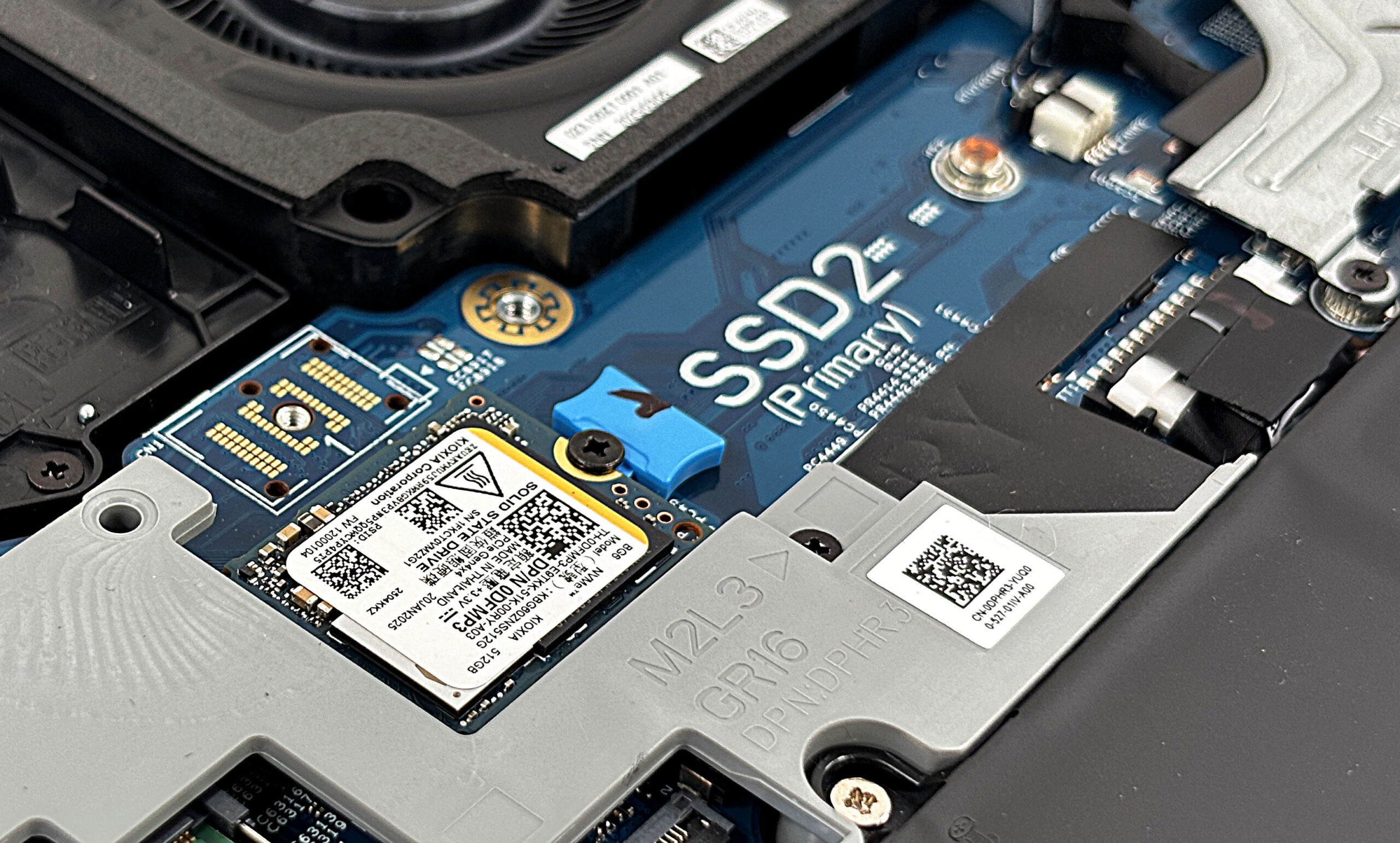
We ordered the 512GB storage variant and it arrived with KIOXIA BG6 NVMe – one of the most popular NVMe SSDs. The sequential read and write speeds are good – 5.0GB/s and 4.4GB/s, respectively. During the benchmark tests the SSD reached 67ºC which is acceptable.
AI Performance
Here you can see the position of the GPUs and CPUs (NPUs) found within the Dell Pro Max 16 (MC16250) in our AI Hardware Performance Rankings based on their AI processing power, measured in TOPS (Tera Operations Per Second) - a critical metric indicating the computational throughput, particularly for AI tasks.
The first column shows peak performance for INT8/FP8 precision, which is the most widespread metric for evaluating AI inference capabilities. We exclude Sparsity to provide a more accurate reflection of AI performance in dense computation scenarios where sparsity optimizations may not be applicable. The second and third columns show the performance with Sparsity, and FP4 TFLOPS, when supported.
For SoCs, the results reflect the peak performance of the integrated NPU. Additionally, it’s important to note that, according to Microsoft, a NPU must have at least 40 TOPS of AI computing power for the PC to be considered “AI-capable.”
| # | GPU / CPU (NPU) | TOPS INT8/FP8 No Sparsity | TOPS INT8/FP8 Sparsity | TFLOPS FP4 Sparsity |
|---|---|---|---|---|
| 1736. | Intel Core Ultra 7 255H | 13 | — | — |
| 1738. | Intel Core Ultra 7 265H | 13 | — | — |
| 1740. | Intel Core Ultra 9 285H | 13 | — | — |
| 1746. | Intel Core Ultra 5 235H | 13 | — | — |
GPU and Gaming Performance
In terms of graphics, the laptop can be configured either with integrated Intel Graphics or with powerful discrete options from NVIDIA’s Blackwell generation: RTX PRO 500 (6 GB GDDR7), RTX PRO 1000 (8 GB GDDR7), and RTX PRO 2000 (8 GB GDDR7). These GPUs are designed for professional applications and can significantly accelerate workflows.
To see how these graphics cards compare to others on the market, visit our detailed laptop graphics ranking.
You can find the performance rating of all the GPUs on the market in our Top Laptop Graphics Ranking.
The results are from 3DMark Time Spy (Graphics). Higher is better.
The results are from 3DMark Wild Life Extreme Unlimited. Higher is better.
Gaming tests

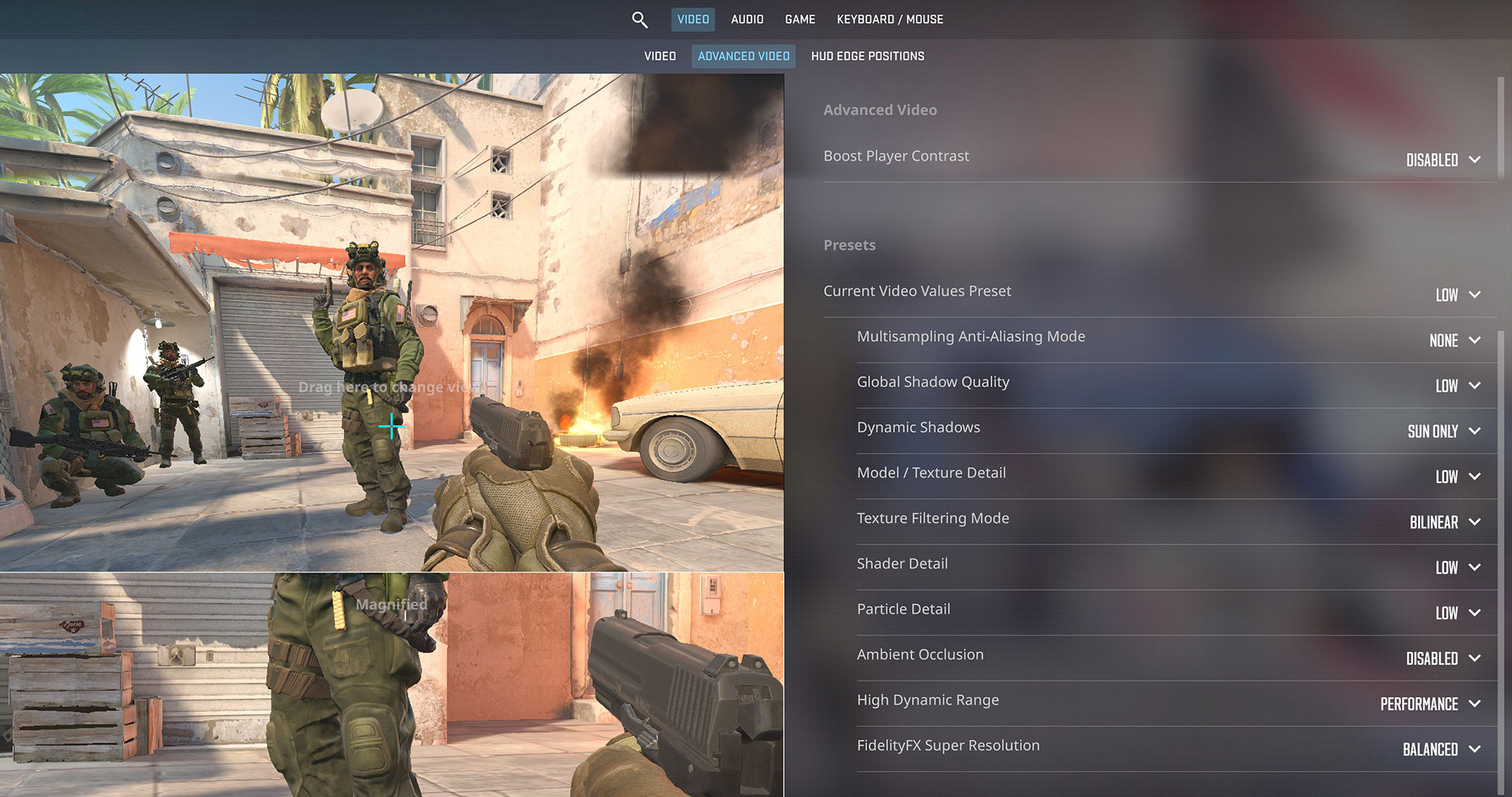
While this is a workstation and far from a gaming laptop, the Intel Arc 140T graphics in the Dell Pro Max 16 handle light competitive gaming quite well. In Counter-Strike 2, the laptop achieves a smooth 89 FPS at 1200p on Low settings, which is plenty for casual matches.
| Counter Strike 2 | 1200p, Low (Check settings) |
| Average FPS | 89 FPS |

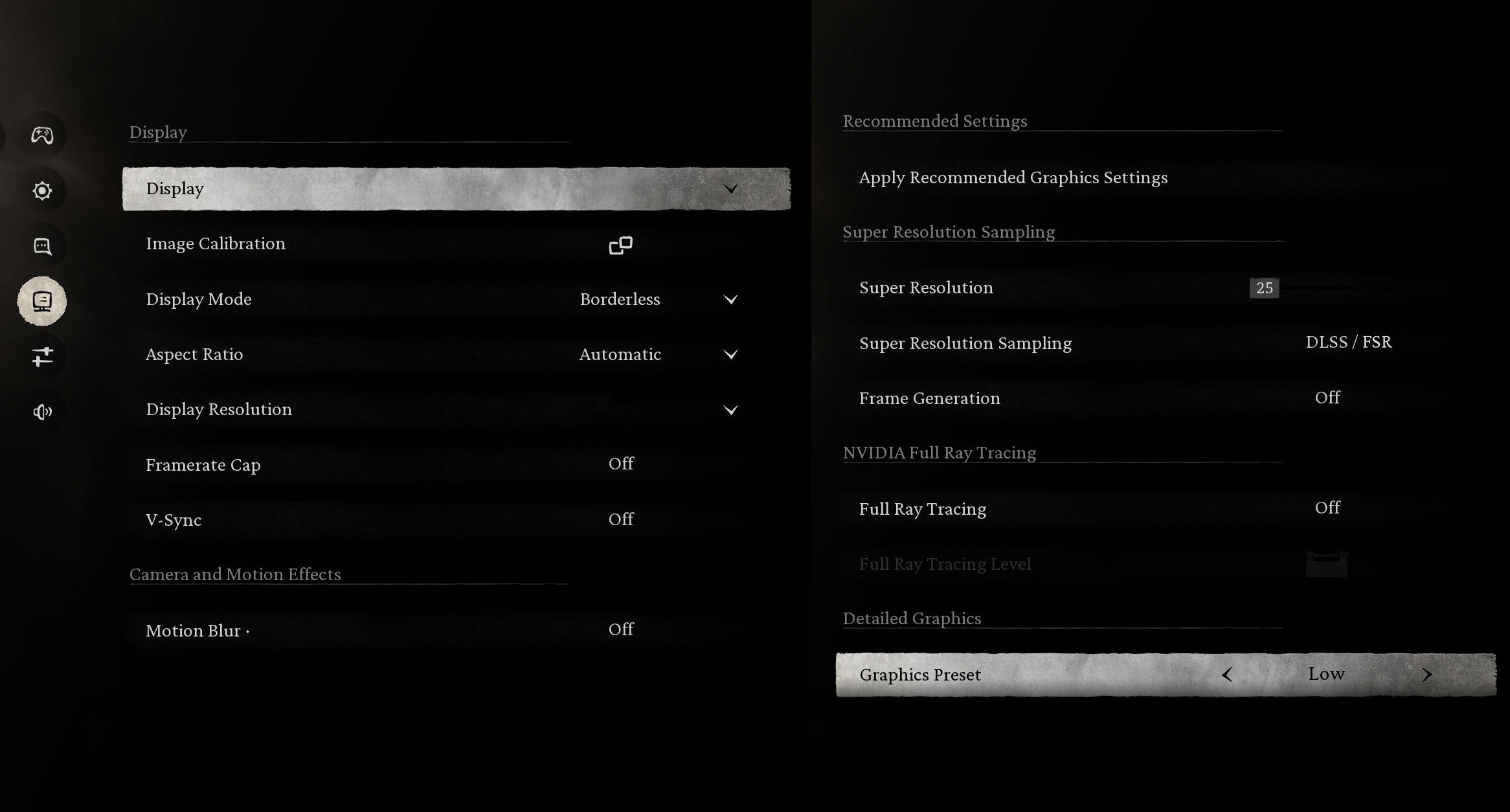
Surprisingly, the integrated graphics can run the demanding Black Myth: Wukong at playable frame rates. On Low settings at 1200p, it averages 49 FPS, which is an impressive result for this class of hardware.
| Black Myth: Wukong | 1200p, Low (Check settings) |
| Average FPS | 49 FPS |

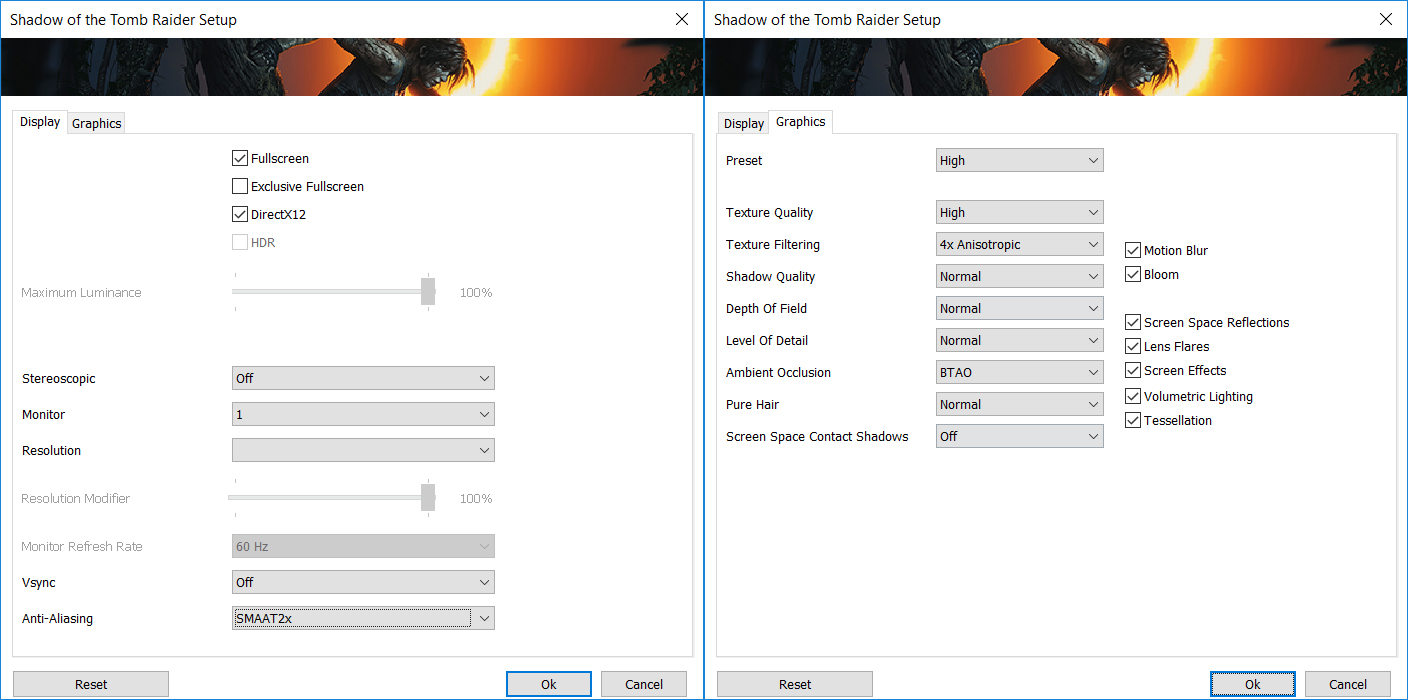
For adventure games like Shadow of the Tomb Raider, the machine hits the sweet spot. It delivers a solid 60 FPS average at 1200p on Low settings, ensuring a smooth experience for casual gaming sessions.
| Shadow of the Tomb Raider | 1200p, Low (Check settings) |
| Average FPS | 60 FPS |
Temperatures and Comfort, Stability
Office Work, Web Development, Design
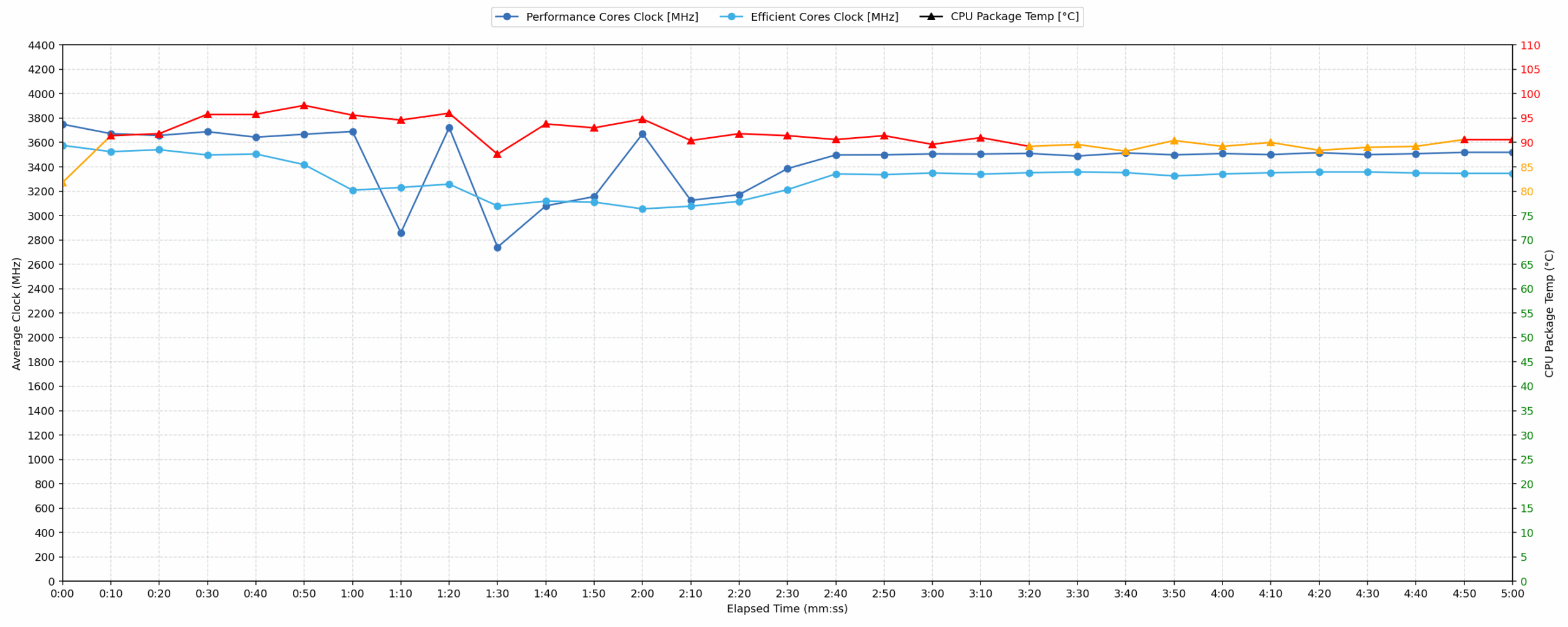
Short periods (0:00 – 0:10 s) of 100 % CPU load
This test shows the CPU behavior during short periods of serious load. It’s important for users who are looking for laptops suitable for tasks like Web Design and Programming.
| Intel Core Ultra 7 255H | Avg. P-Core Clock | Avg. CPU Temp. | Avg. CPU Power |
| Dell Pro Max 16 (MC16250) | 3749 MHz | 81 °C | 72 W |
| Lenovo Yoga Book 9i (14″, Gen 10) | 3371 MHz | 96 °C | 56 W |
The Dell Pro Max 16 exhibits strong burst performance. Its average CPU clock speed over 10 seconds reached an excellent 3749 MHz, significantly outpacing the Lenovo Yoga Book 9i’s 3371 MHz with the same processor. This is supported by a robust 72 W average power draw, compared to Lenovo’s 56 W. While the average CPU temperature settled at an acceptable 81 °C, a peak temperature of 105 °C was recorded, indicating a high thermal spike during the initial load. The CPU’s ability to briefly achieve 3859 MHz peak clock is notable, though it rapidly drops to 1016 MHz, a substantial 2843 MHz reduction from its peak within the first minute.
Video editing, Scientific computing, Software compilation, 3D rendering
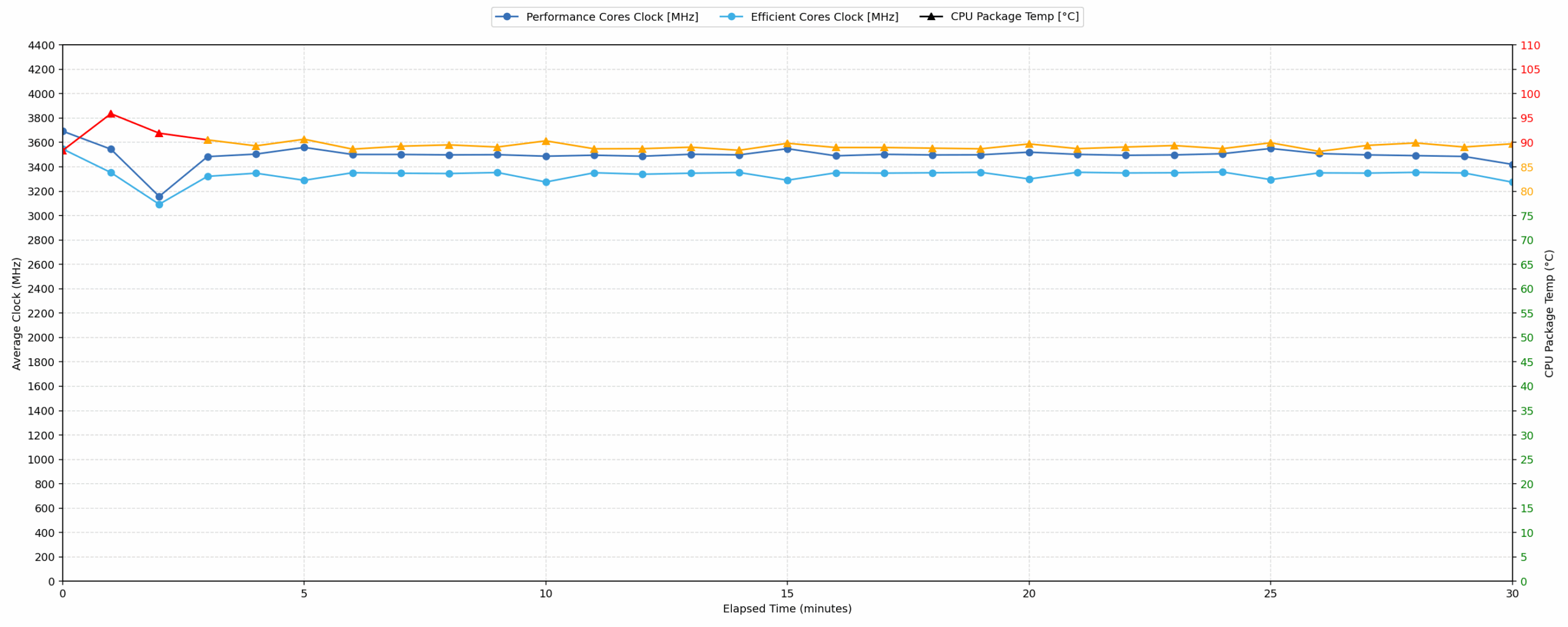
Long periods (0:00 – 30:00 min) of 100 % CPU load
This test shows the CPU behavior during long periods of serious load. It’s important for users who are looking for laptops suitable for tasks like Video Editing and 3D Rendering.
| Intel Core Ultra 7 255H | Avg. P-Core Clock | Avg. CPU Temp. | Avg. CPU Power |
| Dell Pro Max 16 (MC16250) | 3495 MHz | 89 °C | 65 W |
| Lenovo Yoga Book 9i (14″, Gen 10) | 2583 MHz | 79 °C | 32 W |
For extended, demanding tasks, the Dell Pro Max 16 demonstrates impressive sustained capabilities. Over a 30-minute period of 100% CPU load, it maintained a strong average clock speed of 3495 MHz. This significantly surpasses the 2583 MHz average achieved by the Lenovo Yoga Book 9i using the identical Intel Core Ultra 7 255H CPU. The Dell’s superior sustained performance is directly linked to its higher average power consumption of 65 W, compared to the Lenovo’s 32 W. The average CPU temperature of 89 °C is acceptable, indicating effective thermal management for prolonged heavy usage.
Battery Life
You can order the Dell Pro Max 16 with 64Wh or 96Wh battery, and you have the option to choose a “Long Life Cycle” which typically means a 3-years warranty. Our configuration has the smaller one – 64 Wh.
We tested the battery with Quiet mode selected in Dell Optimizer.
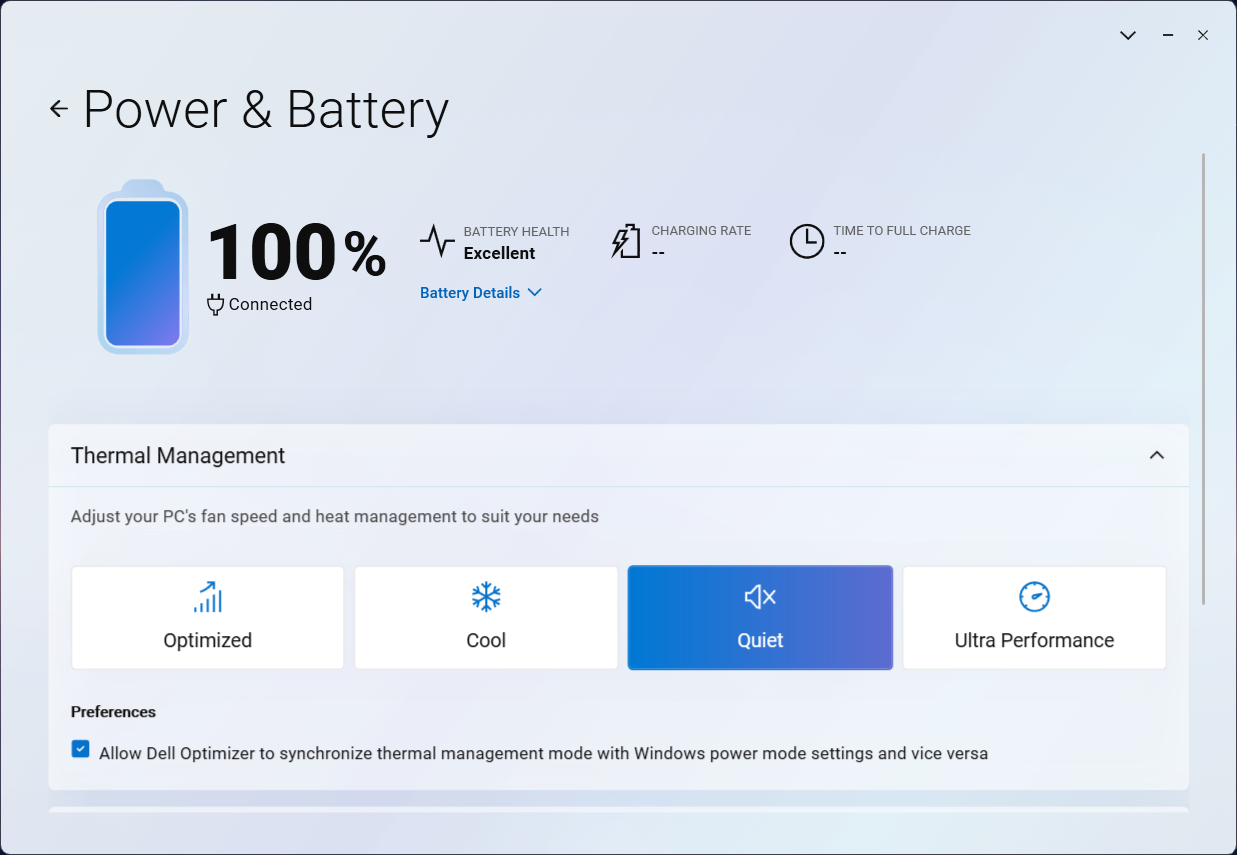
The battery life is more than 10 hours which is great, given that we choose the variant with a smaller battery. As we noted, you can order the laptop with a battery that has 50% bigger capacity.
Brightness: 180 nits; Display Mode: SDR
Time to Full Discharge: Higher is Better

Disassembly, Upgrade options, and Maintenance
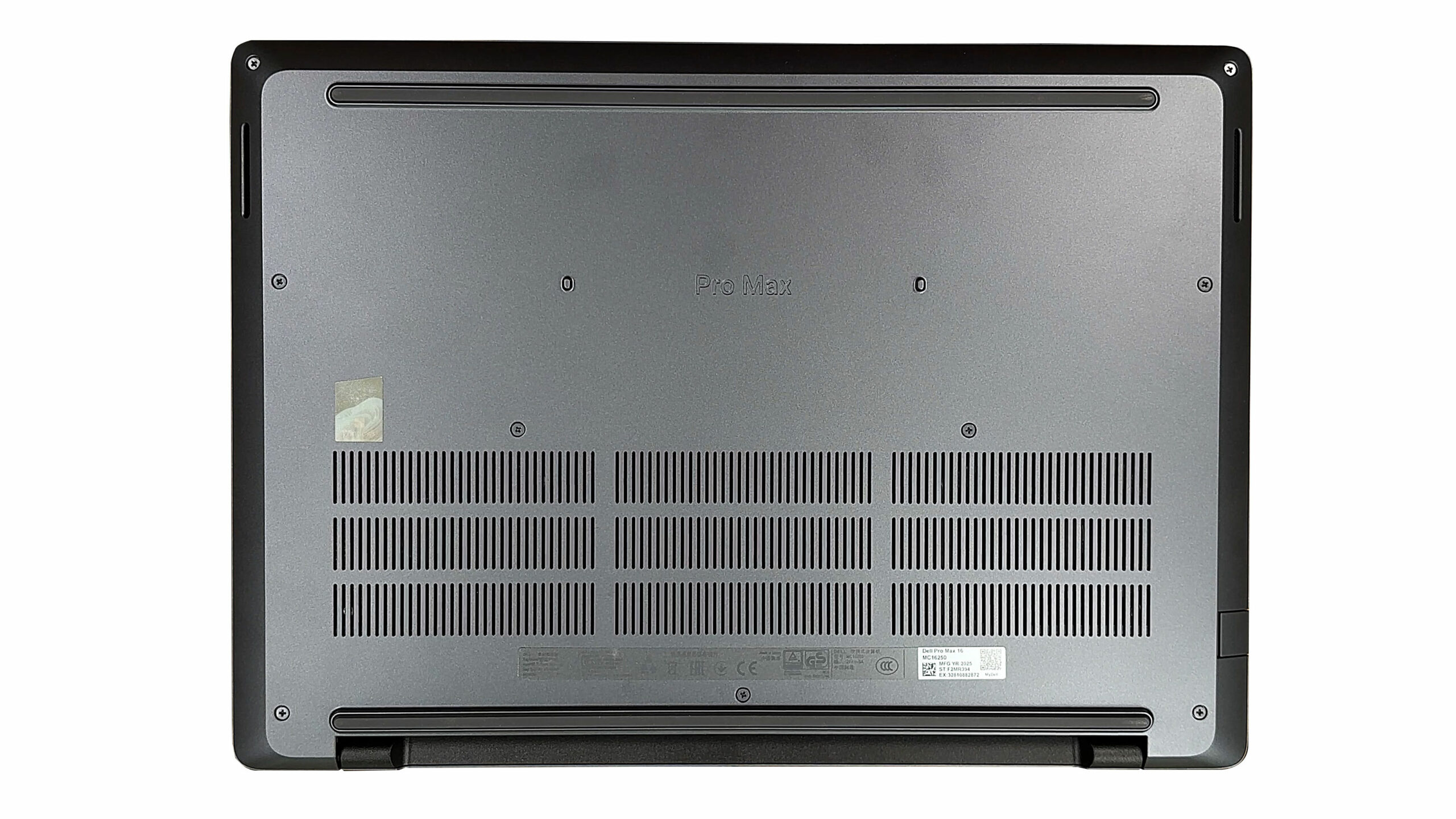
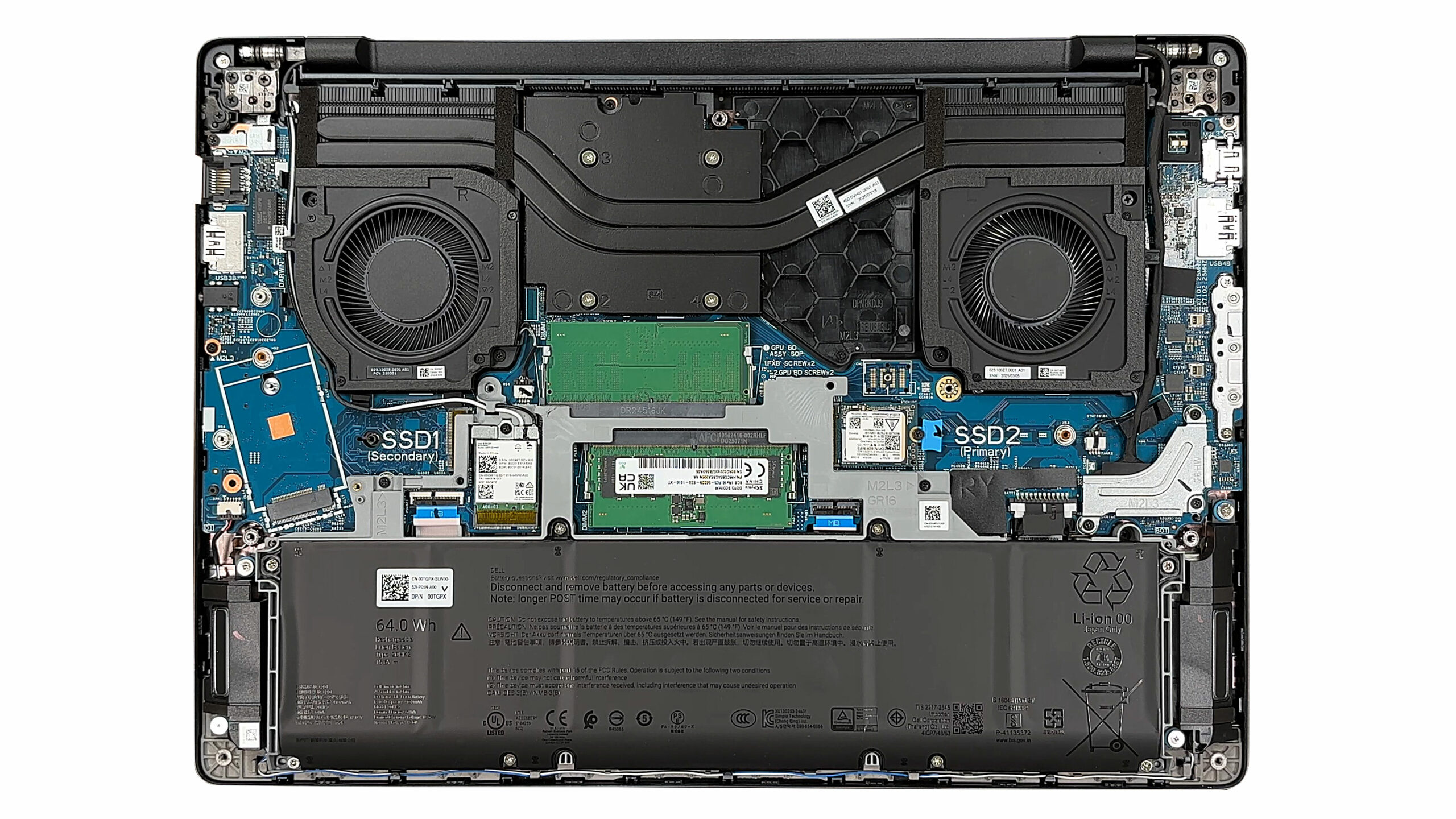
The bottom panel comes off after removing nine captive Phillips screws and popping a line of sturdy plastic clips. Getting inside is straightforward once you work a plastic pry tool around the edges.
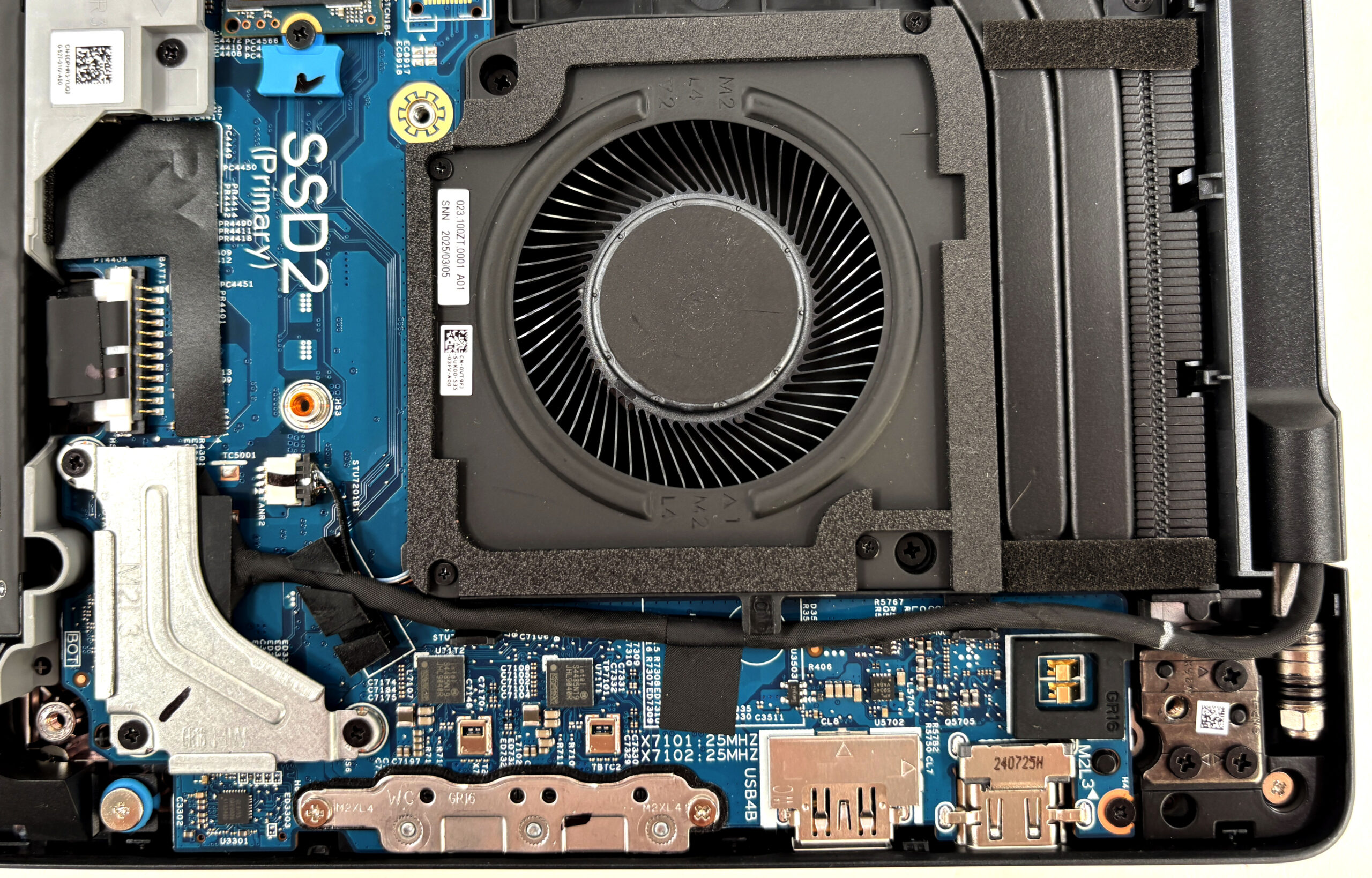
Dell relies on a dual‑fan, dual‑heat‑pipe design that spans the entire motherboard. The fans are radial blowers that push air through two fin stacks at the rear, while a pair of thick copper pipes draw heat from the CPU and GPU into a shared vapor‑chamber‑style cold plate. A dense array of foam seals keeps airflow directed through the heatsink instead of back into the chassis.
System memory sits underneath a silver retention shield in the center of the board. Both slots use DDR5 SO‑DIMM modules rated at 6400 MT/s, and our unit comes populated with a two 8 GB sticks from SK Hynix. Officially, you can install up to 2 × 32 GB for a theoretical 64 GB ceiling.
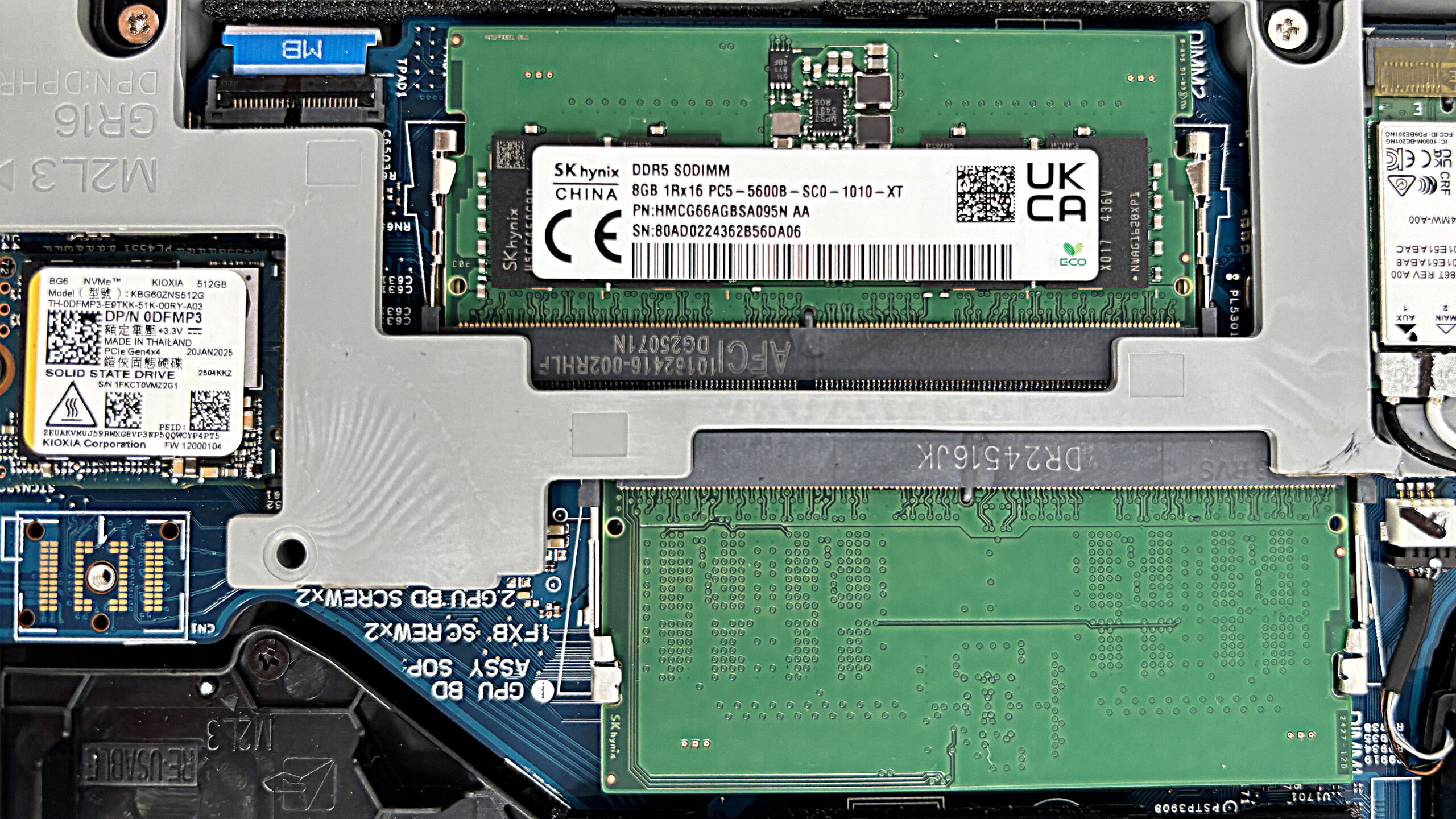
Two M.2 sockets handle NVMe storage. The primary bay on the right accepts full‑size 2280 drives, while the secondary bay on the left doubles as the WWAN slot and is physically limited to 2230 modules whenever a 5 G modem is installed. Both ports run at PCIe 4 speed.
Wireless connectivity is served by either Intel’s Wi‑Fi 6E AX211 or the brand‑new Wi‑Fi 7 BE201, depending on configuration. Laptops ordered with mobile broadband arrive with a MediaTek T700 5 G card fitted to the WWAN socket you see empty below.
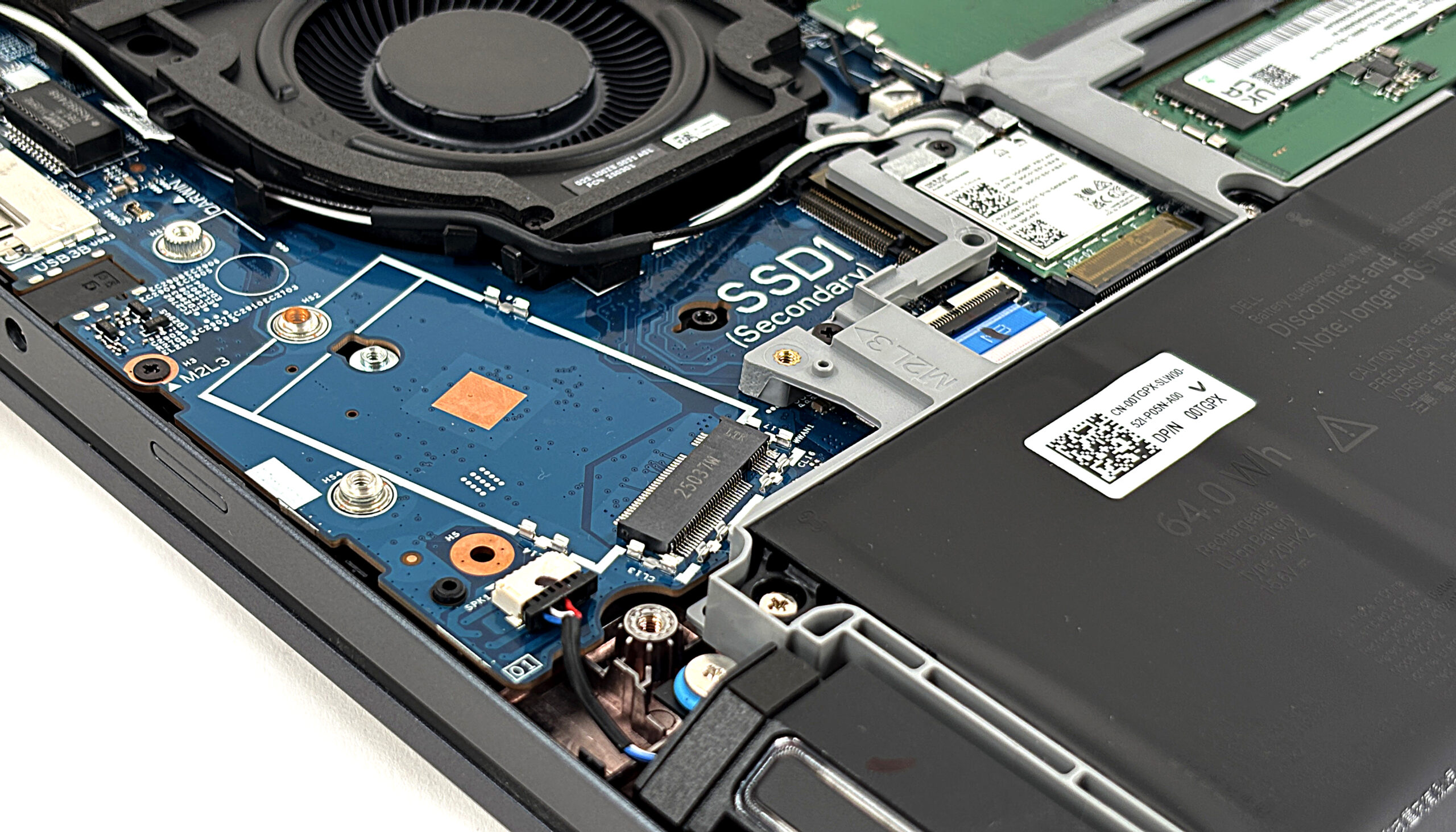
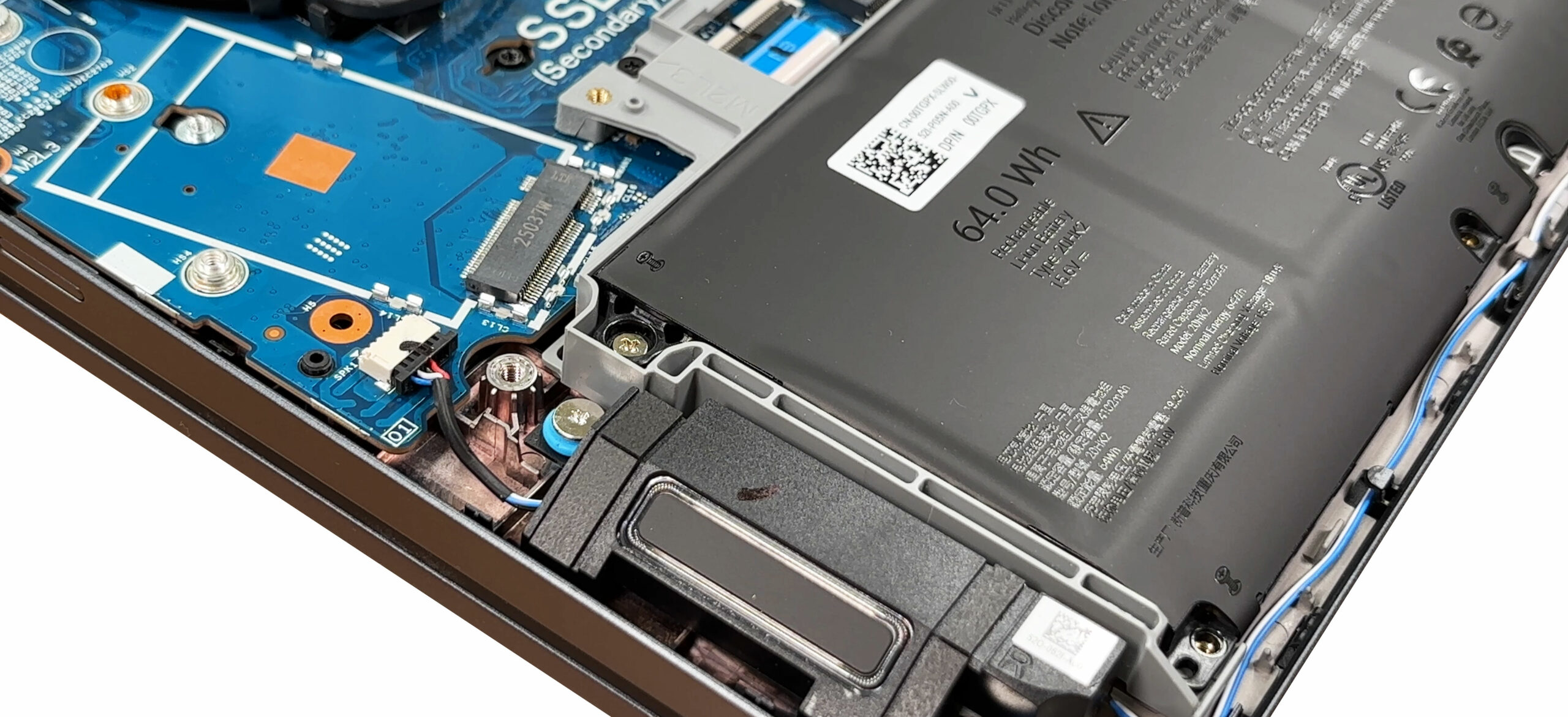
A slender 64 Wh Li‑Ion pack spans the entire palm‑rest area. Dell also offers a 96 Wh option that fills the same footprint but adds thickness, so double‑check the part number if you plan a swap. The pack is held by eight screws and connects with a vertical pull connector.
Here’s a full view of Dell Pro Max 16 (MC16250), opened:
And an exploded view:
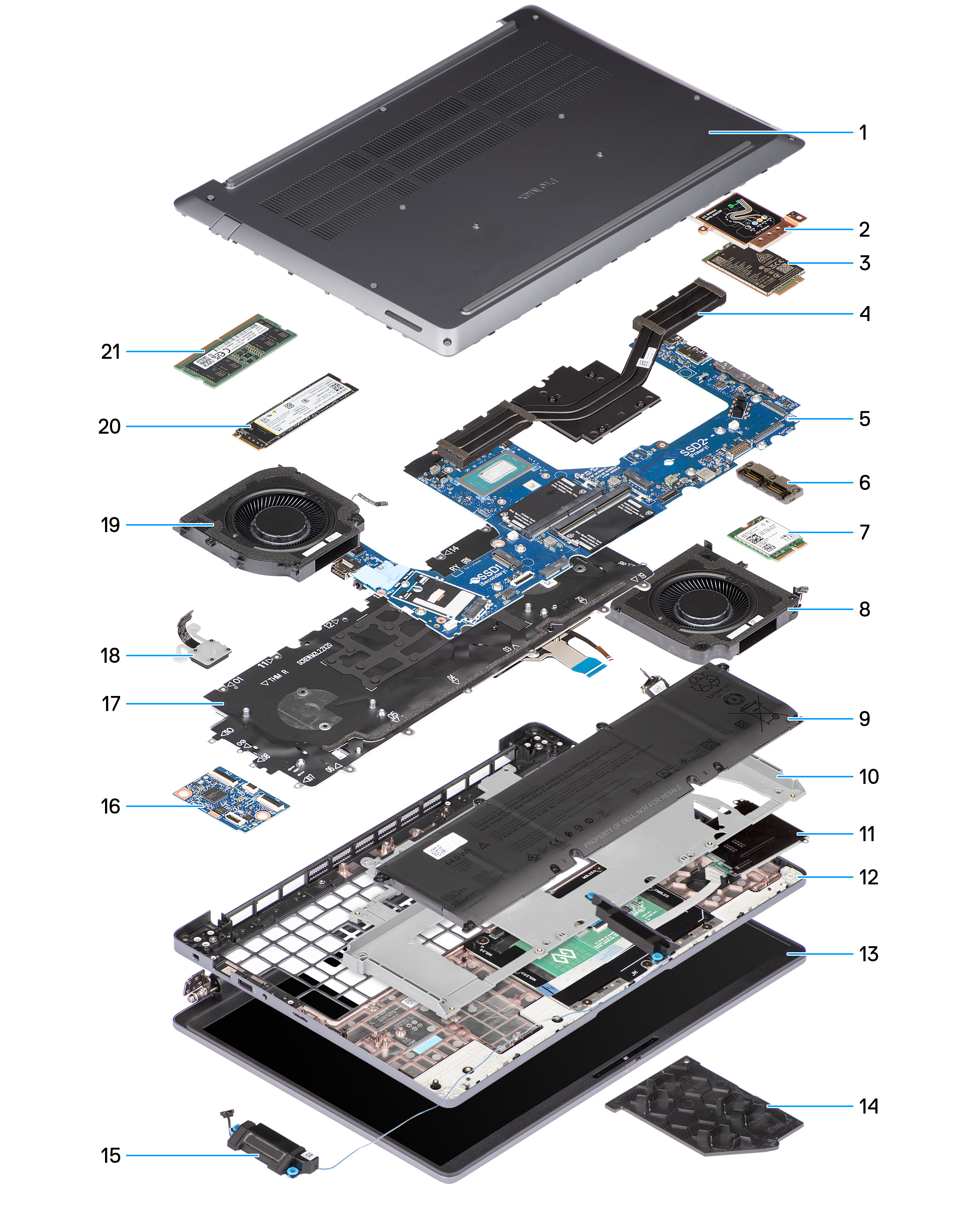
| Dell Pro Max 16 (MC16250) components | |||
|---|---|---|---|
| 1. Base cover | 2. WWAN-module shield | 3. WWAN module | 4. Heat sink |
| 5. System board | 6. USB Type-C module | 7. Wireless card | 8. Left/Video fan |
| 9. Battery | 10. Battery frame | 11. Palm-rest assembly | 12. Display assembly |
| 13. GPU filler | 14. Speakers | 15. USH board | 16. Keyboard assembly |
| 17. Power button (fingerprint) | 18. Right/Processor fan | 19. Solid state drive | 20. Memory module |
Verdict
The Dell Pro Max 16 (MC16250) is a testament to understated competence. It is a serious workstation that prioritizes function, stability, and user-centric features over flashiness. It delivers exactly what professionals need: a robust build, a fantastic keyboard, and a level of upgradeability and flexibility that is becoming increasingly rare in modern laptops. It’s a machine designed to get the job done, reliably and efficiently.
While it makes a few compromises, most notably with the base-model display and a slightly confusing charging port placement, the overall package is exceptionally well-rounded. It stands as a strong contender for any professional seeking a versatile and durable 16-inch workstation.
You can check the prices and configurations in our Specs System: https://laptopmedia.com/series/dell-pro-max-16-mc16250/
✅ The Good
Dell Pro Max 16 has great upgradeability. With two accessible SODIMM slots for RAM and two M.2 slots for storage (one doubling as a WWAN slot), it offers fantastic long-term value and flexibility, allowing the machine to grow with your needs. The build quality is also top-notch, featuring a durable, MIL-STD certified chassis made from 90% recycled magnesium that feels premium and resists fingerprints remarkably well.
The user experience is further elevated by a superb keyboard with a NumPad and a large, precise trackpad. The port selection is comprehensive, including two Thunderbolt 4 ports, RJ-45 Ethernet, and a Smart Card reader option. Performance-wise, the CPU delivers strong, sustained power for demanding tasks, and the battery life is impressive, lasting over 10 hours even with the smaller battery option.

Finally, the base model display, while not vibrant, has a critical strength: it is completely PWM-free and features a great anti-glare finish, making it exceptionally comfortable for long workdays.
❌ The Bad
 The most significant weakness is the quality of the base-model display. With poor color coverage at just 52% sRGB, it is dull and unsuitable for any color-critical work. Professionals who need accurate colors must opt for one of the higher-tier panel options. The CPU also tends to run hot under heavy load, with high initial temperature spikes.
A minor but annoying design quirk is the lack of a dedicated charging port. You are forced to use one of the side-mounted Thunderbolt 4 ports for power, which can lead to awkward cable management in the middle of the laptop’s left flank.
Additionally, the secondary M.2 slot is limited to the smaller 2230 format if you don’t use it for WWAN, restricting your storage choices slightly.
🆚 The Competitors
When compared to the Lenovo Yoga Book 9i (detailed review), the Dell Pro Max 16 demonstrates significantly better sustained CPU performance, making it the superior choice for heavy, long-duration workloads like rendering or compiling code. The Dell is a workhorse, while the Yoga is more of a specialized, dual-screen innovator.
Against a rival like the ASUS Zenbook Pro 16X (detailed review), the Dell Pro Max 16 offers a more traditional, business-focused experience with better port variety (like Ethernet) and easier serviceability. However, the ASUS often provides a superior display out of the box for creatives. The Dell Pro Max 16 carves its niche as the practical, upgradeable, and reliable choice for the enterprise and professional user.
Pros
- Excellent upgradeability with two RAM slots and two M.2 slots
- Premium, durable build quality with 90% recycled magnesium
- Great sustained CPU performance for heavy workloads
- PWM-free display is comfortable for all-day use
- Comprehensive port selection including Thunderbolt 4 and Ethernet
- Impressive battery life (10+ hours), even with the 64Wh battery variant
Cons
- Base model display has poor color coverage (52% sRGB)
- No dedicated charging port; uses a side USB-C port
- CPU runs hot with high initial temperature spikes
- Secondary M.2 slot is limited to 2230 size (shared with WWAN)
 Author: Simeon NikolovEditor-in-Chief at LaptopMedia.com with 20+ years of experience in testing and analyzing laptops and mobile devices.
 Author: eng. Kroum NikolovHead of Engineering at LaptopMedia.com, inventor and innovator with 40+ years of experience in electronics and high technology.

![[August 2026] Best-Selling Laptop Brands on Amazon Japan – Apple Dominates Market Share and Revenue Led by Strong Unit Sales](https://laptopmedia.com/wp-content/uploads/2026/09/CO.JP-Best-Brands-1-400x225.jpg)
![[August 2026] Best-Selling Laptop Brands on Amazon USA – Apple Dominates Market Revenue and Volume Despite Lower Model Diversity](https://laptopmedia.com/wp-content/uploads/2026/09/COM-Best-Brands-1-400x225.jpg)
![[August 2026] Amazon Germany: Top 8 Best-Selling Gaming Laptops – Acer Dominates the Market as the Premium Nitro V 17 AI Takes the #1 Spot](https://laptopmedia.com/wp-content/uploads/2026/09/Best-Selling-Gaming-Laptops-DE-Top-10-1-400x225.jpg)
![[August 2026] Best-Selling Laptop Brands on Amazon France – Apple Dominates Revenue Despite Lenovo and HP Leading in Catalog Breadth and Volume](https://laptopmedia.com/wp-content/uploads/2026/09/FR-Best-Brands-1-400x225.jpg)
![[August 2026] Amazon Italy: Top 10 Best-Selling Laptops – Apple MacBook Neo Claims the Crown as Budget and Mid-Range Windows Machines Dominate Volume](https://laptopmedia.com/wp-content/uploads/2026/09/Best-Selling-Laptops-IT-Top-10-400x225.jpg)