ASUS ROG Zephyrus G16 GA605 review – A Thin and Solid Gaming Laptop With Caveats
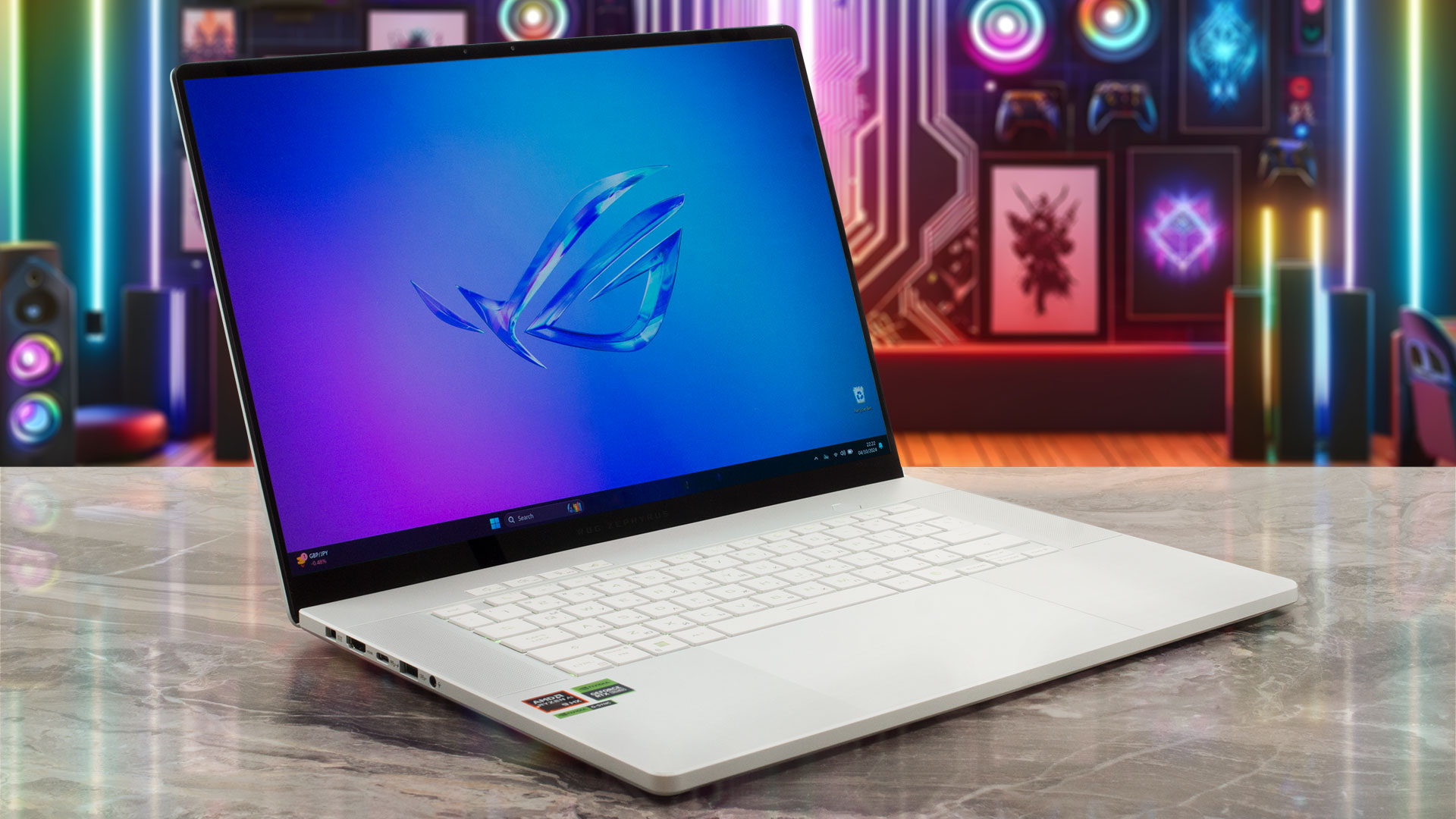 The ROG Zephyrus G16 GA605 is equipped with the all-new AMD Ryzen AI 9 HX 370 that has a powerful NPU with 50 TOPs. If you order a laptop with the most punchy GPU option you can rely on up to 321 TOPs for AI tasks. This is a very thin notebook and yes, the memory is soldered. The maximum amount here is 32GB LPDDR5x RAM. If you need 64GB memory, you can get the ASUS ProArt P16 (H7606) which boasts a similar design and dimensions. Speaking of which, the Meteor-Lake-based ROG Zephyrus G16 GU605 is the Team Blue sibling of the GA605. Unfortunately, the top-end GPUs like RTX 4080 and RTX 4090 are reserved for the Intel model.
We picked a maxed-out configuration with an RTX 4070 and a 1600p 240Hz OLED screen. The latter is a superb piece of tech with very good color accuracy. For a lesser amount of money, you can get the default IPS display option that has similar specs.
To cool the powerful internals, you’ll find a vapor chamber or a 3-fan cooling under the bonnet. The CPU is treated with liquid metal. Gamers should be happy because extras like G-Sync, MUX Switch, NVIDIA Advanced Optimus, and a 6-speaker Dolby Atmos audio setup are on board.
You can check the prices and configurations in our Specs System: https://laptopmedia.com/series/asus-rog-zephyrus-g16-ga605/
Contents
Specs, Drivers, What’s in the box
ASUS ROG Zephyrus G16 GA605 - Specs
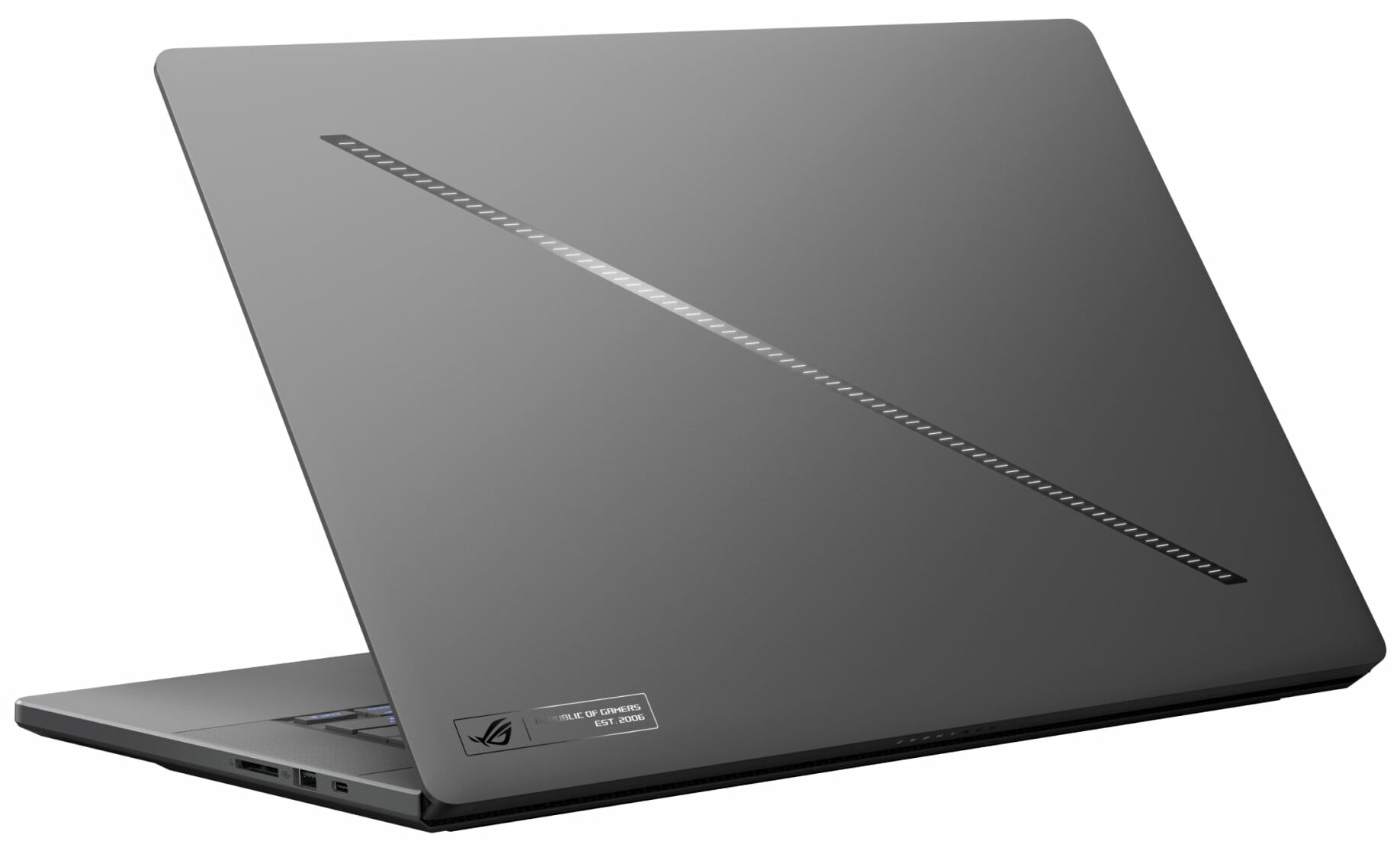

- HDD/SSD
- up to 16000GB SSD
- M.2 Slot
- 1x 2280 M.2 NVMe PCIe 4.0 x4 + 1x 2280 M.2 NVMe PCIe 4.0 x2 See photo
- RAM
- up to 32GB
- OS
- Windows 11 Home, Windows 11 Pro, DOS
- Battery
- 90Wh
- Body material
- Aluminum
- Dimensions
- 354 x 246 x 14.9 - 16.4 / 16.2 - 17.2 mm (13.94" x 9.69" x 0.59")
- Weight
- 1.85 kg (4.1 lbs)
- Ports and connectivity
- 2x USB Type-A
- 3.2 Gen 2 (10 Gbps)
- 1x USB Type-C
- 3.2 Gen 2 (10 Gbps), Power Delivery (PD), DisplayPort
- 1x USB Type-C
- 4.0, Power Delivery (PD), DisplayPort
- HDMI
- 2.1
- Card reader
- SD (SD, SDHC, SDXC)
- Ethernet LAN
- Wi-Fi
- 802.11be
- Bluetooth
- 5.4
- Audio jack
- 3.5mm Combo Jack
- Features
- Fingerprint reader
- Web camera
- FHD IR with Windows Hello
- Backlit keyboard
- optional
- Microphone
- 3x Microphone Array with AI noise-canceling
- Speakers
- 4-speaker (dual force woofer) system with Smart Amplifier Technology, 2 Tweeters, Dolby Atmos
- Optical drive
- Security Lock slot
All ASUS ROG Zephyrus G16 GA605 configurations
Drivers
All drivers and utilities for this notebook can be found here: https://rog.asus.com/laptops/rog-zephyrus/rog-zephyrus-g16-2024-ga605/helpdesk_download/
What’s in the box?
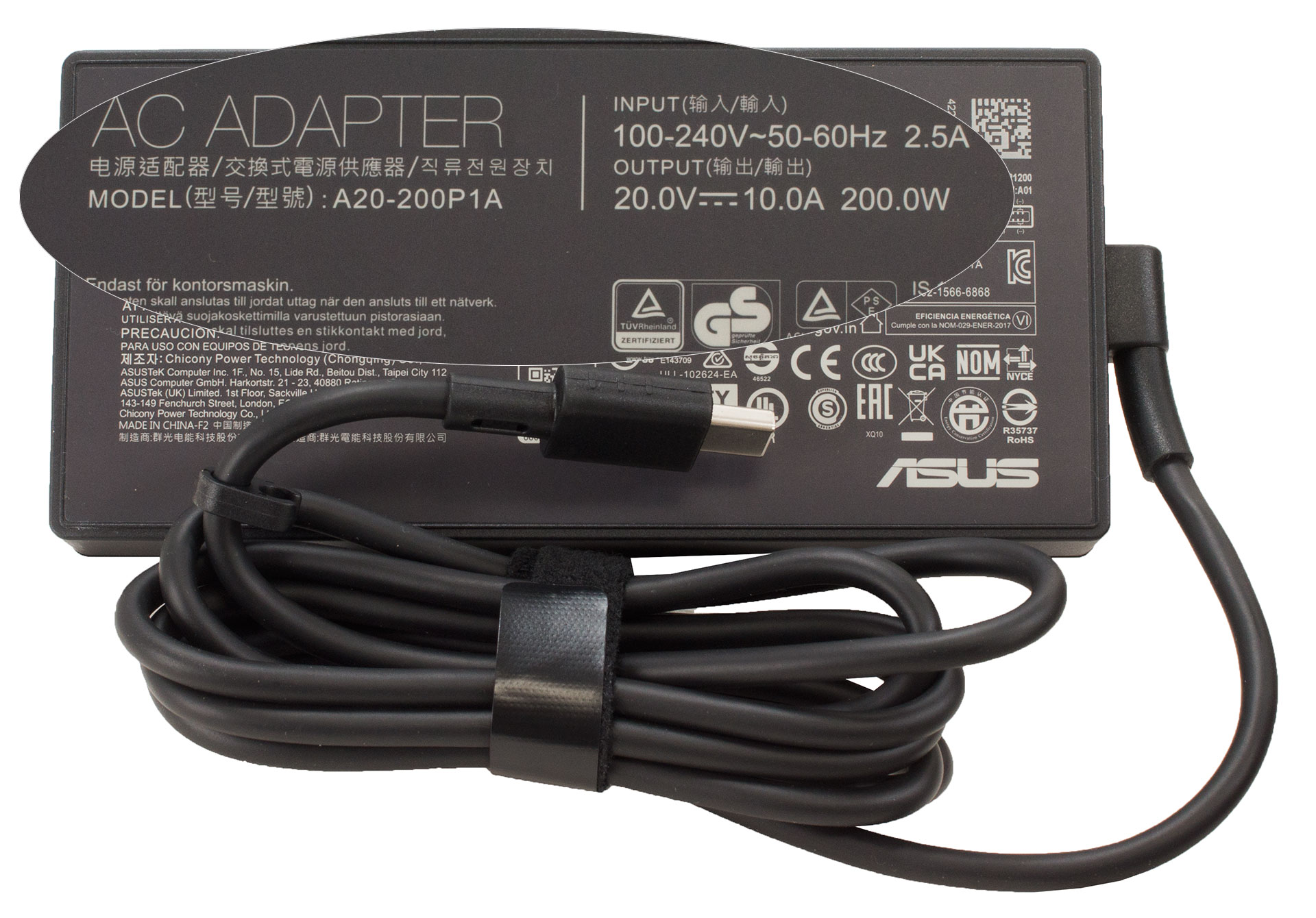
Inside the bigger box, you’ll find a smaller one that houses the laptop. The package contains usual things like tons of paperwork and a 200W charger. In some regions, you can also get optional goodies such as a sleeve, a ROG Impact Gaming Mouse, and a compact 100W Type-C adapter.

Design and construction
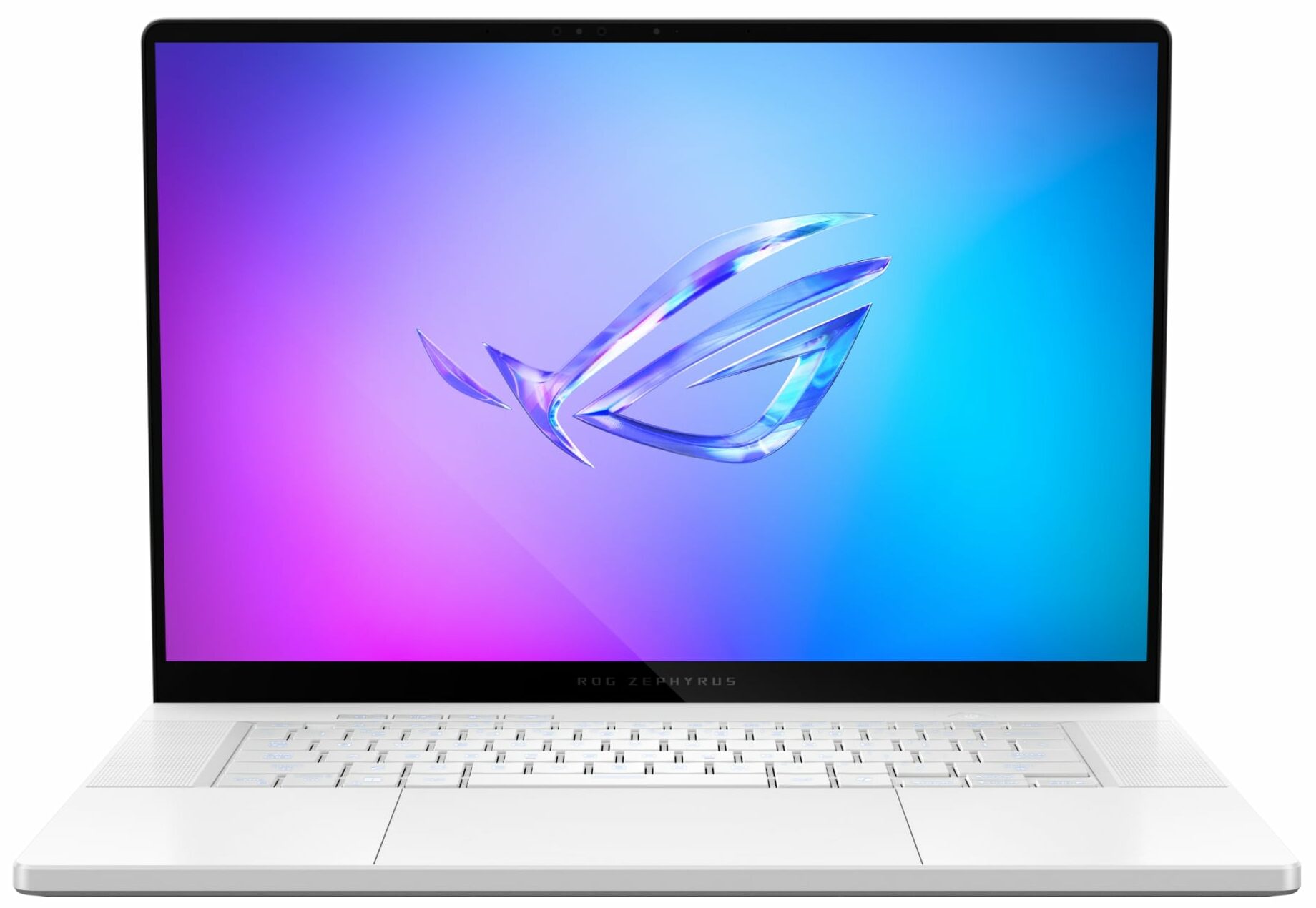
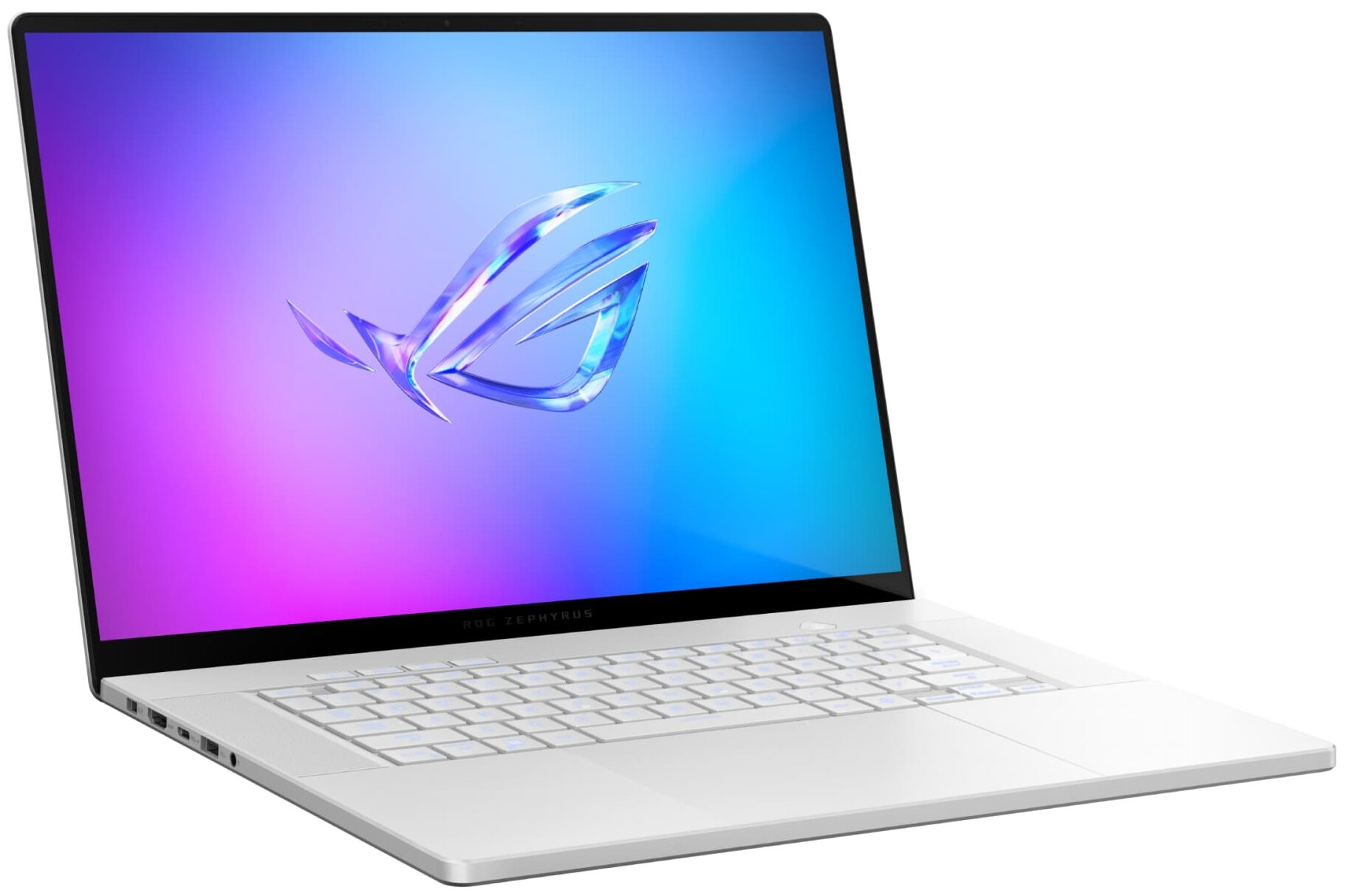
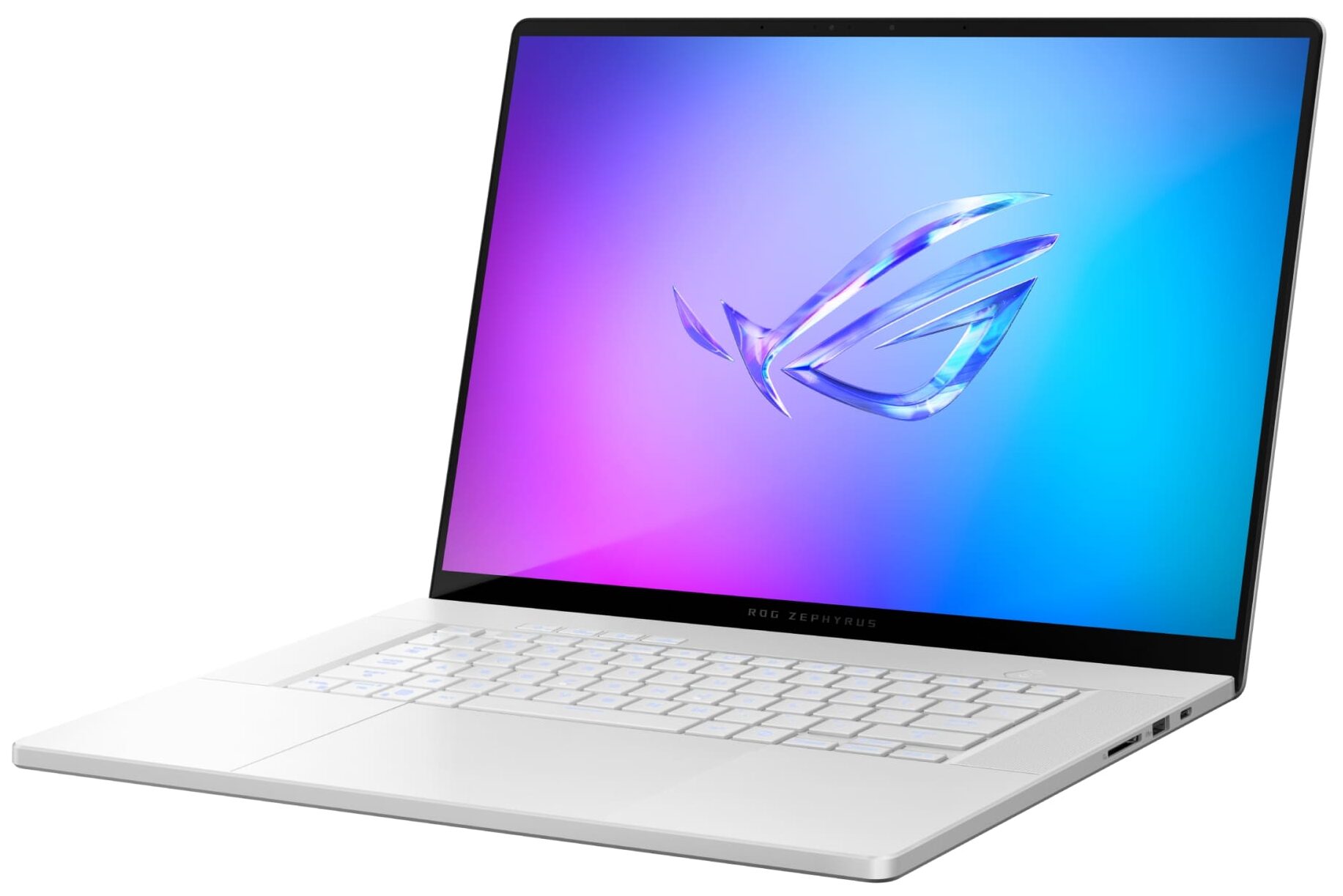
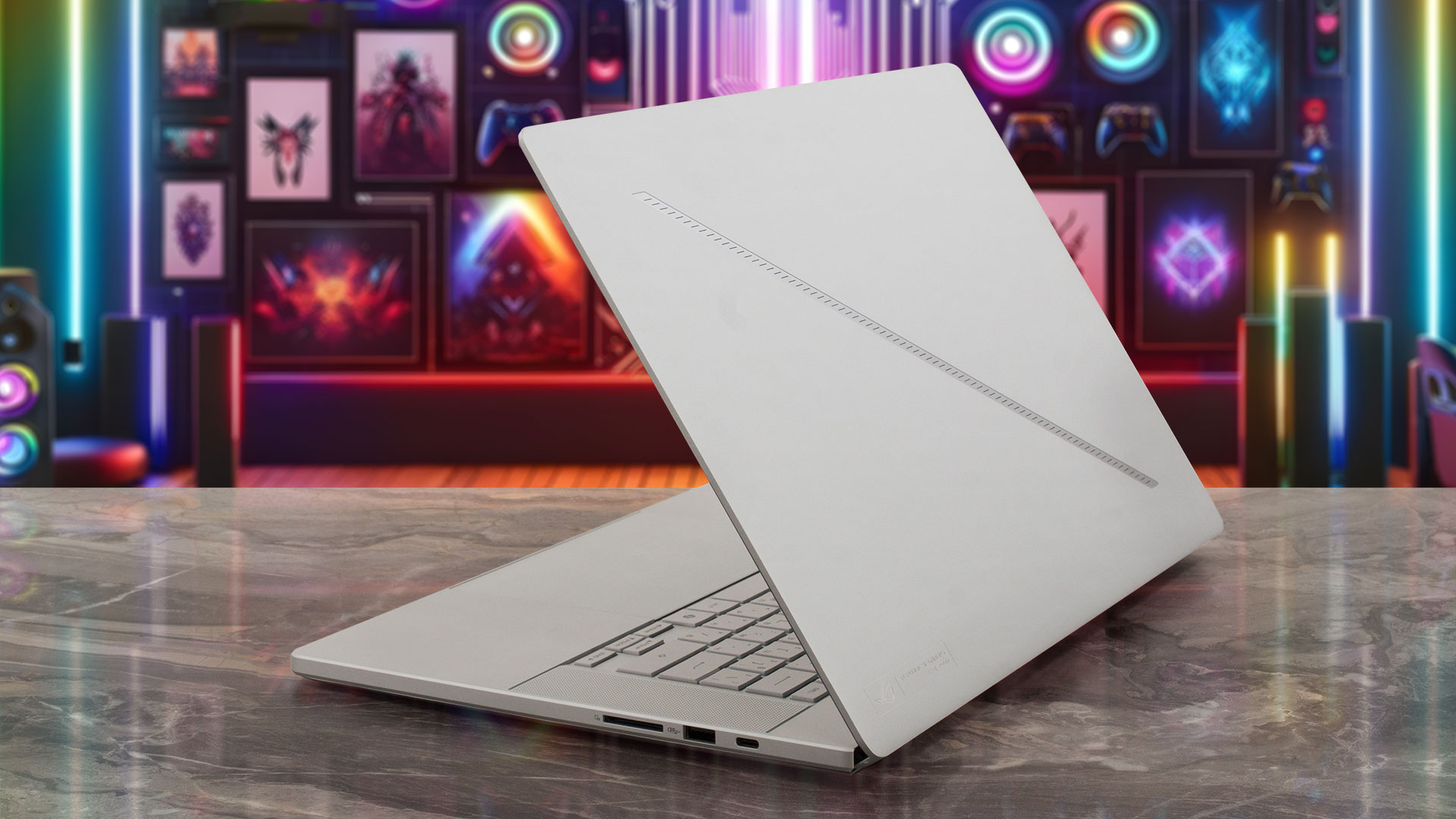
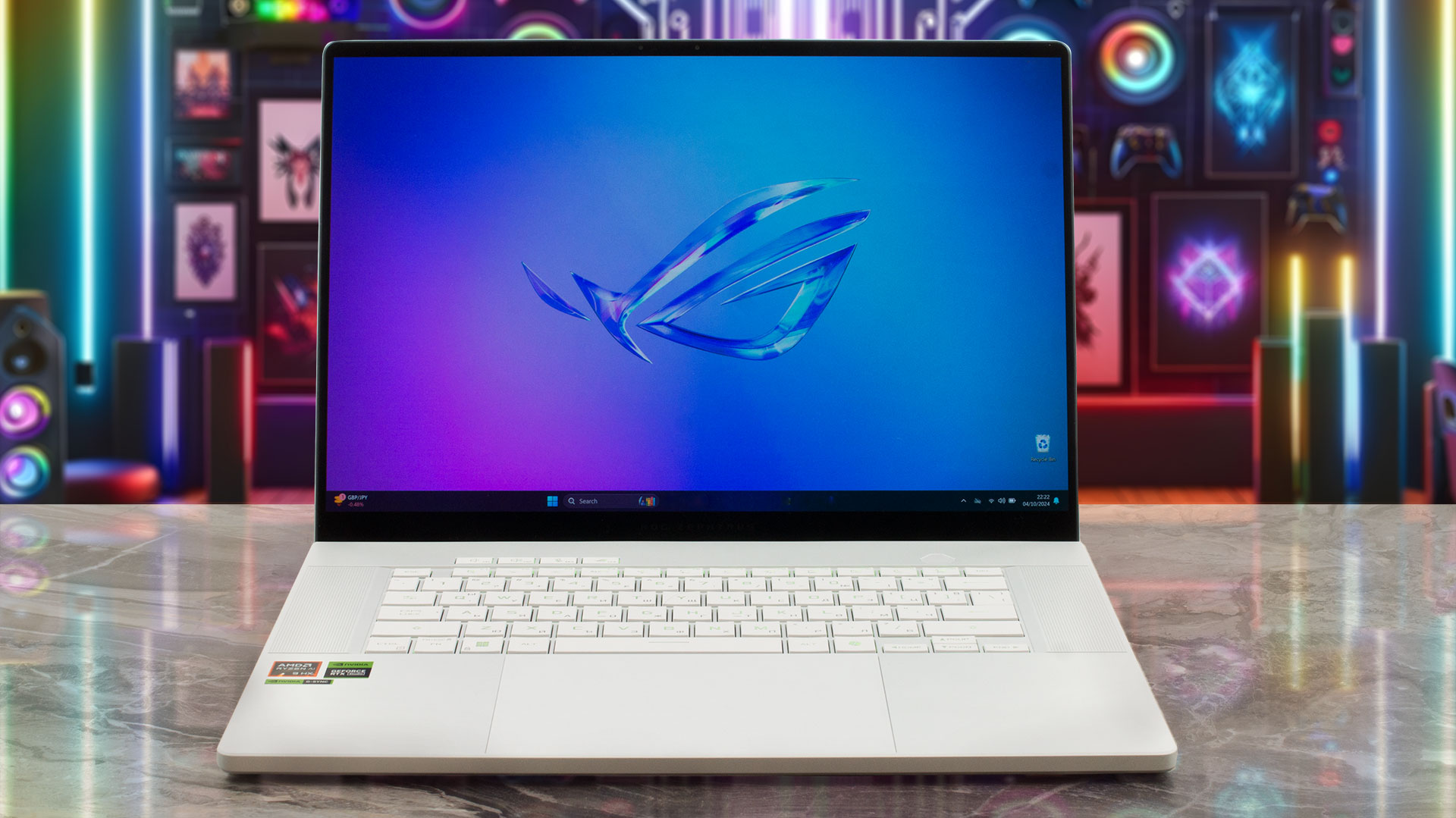
The ROG Zephyrus G16 GA605 shares the same design language as the GU605 model. It has a modern look with rounded edges. The aluminum chassis is impressively solid, even the super-thin lid. This machine stops the scales at 1.85 kilos which sounds good for a 16-inch device with a 90Wh battery and big cooling. The iterations with an IPS display are slightly thicker (16.2 – 17.2 mm) than the ones with an OLED screen (14.9 – 16.4 mm).
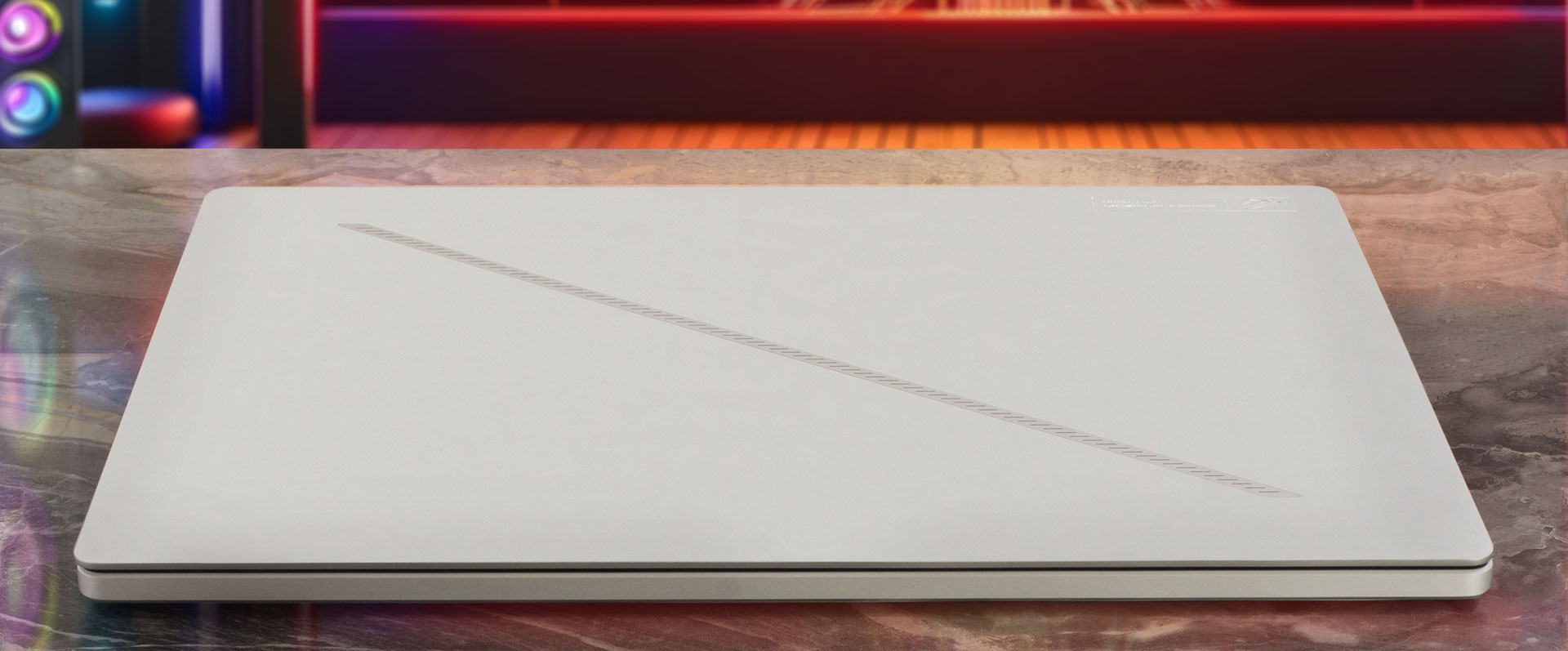
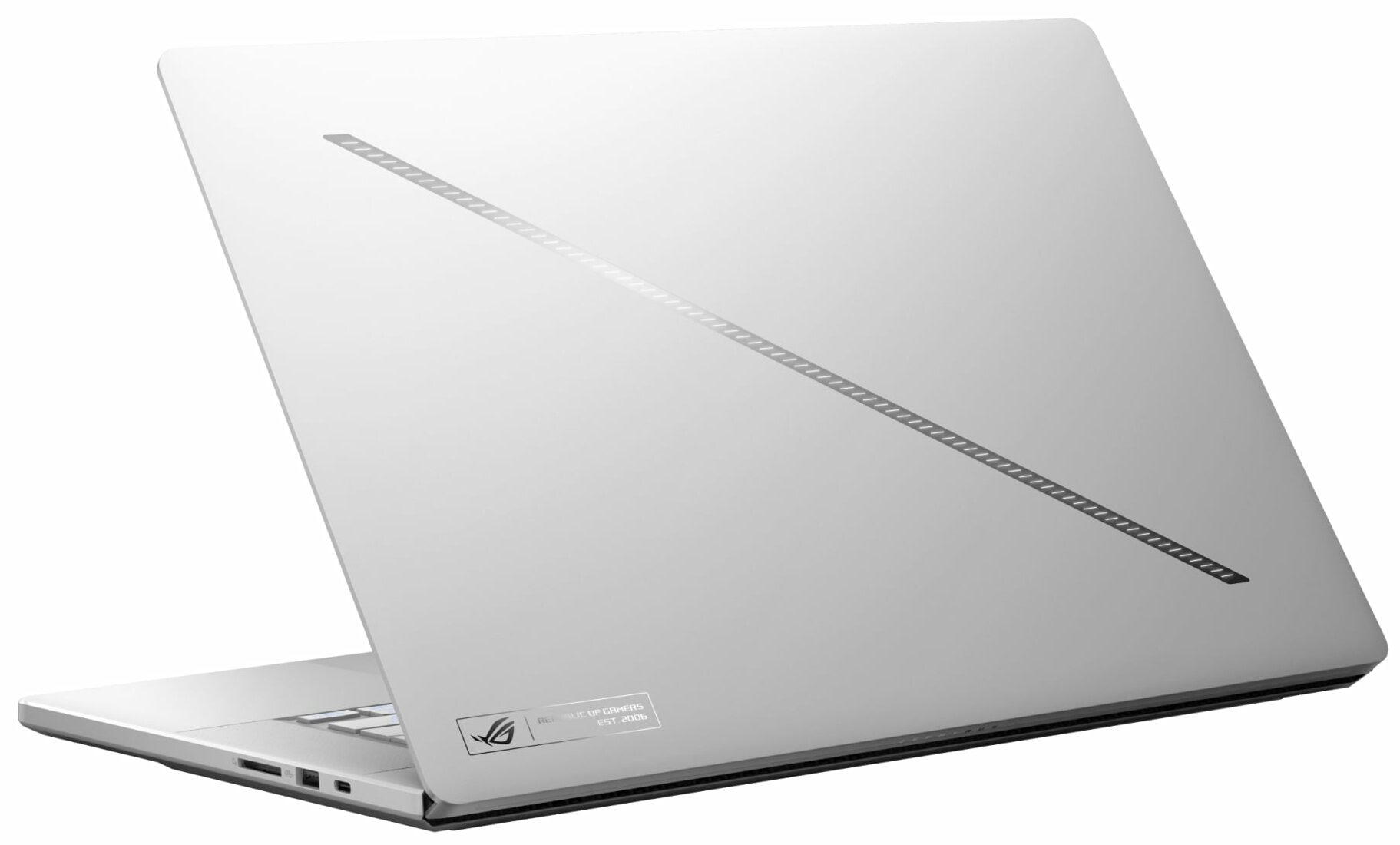
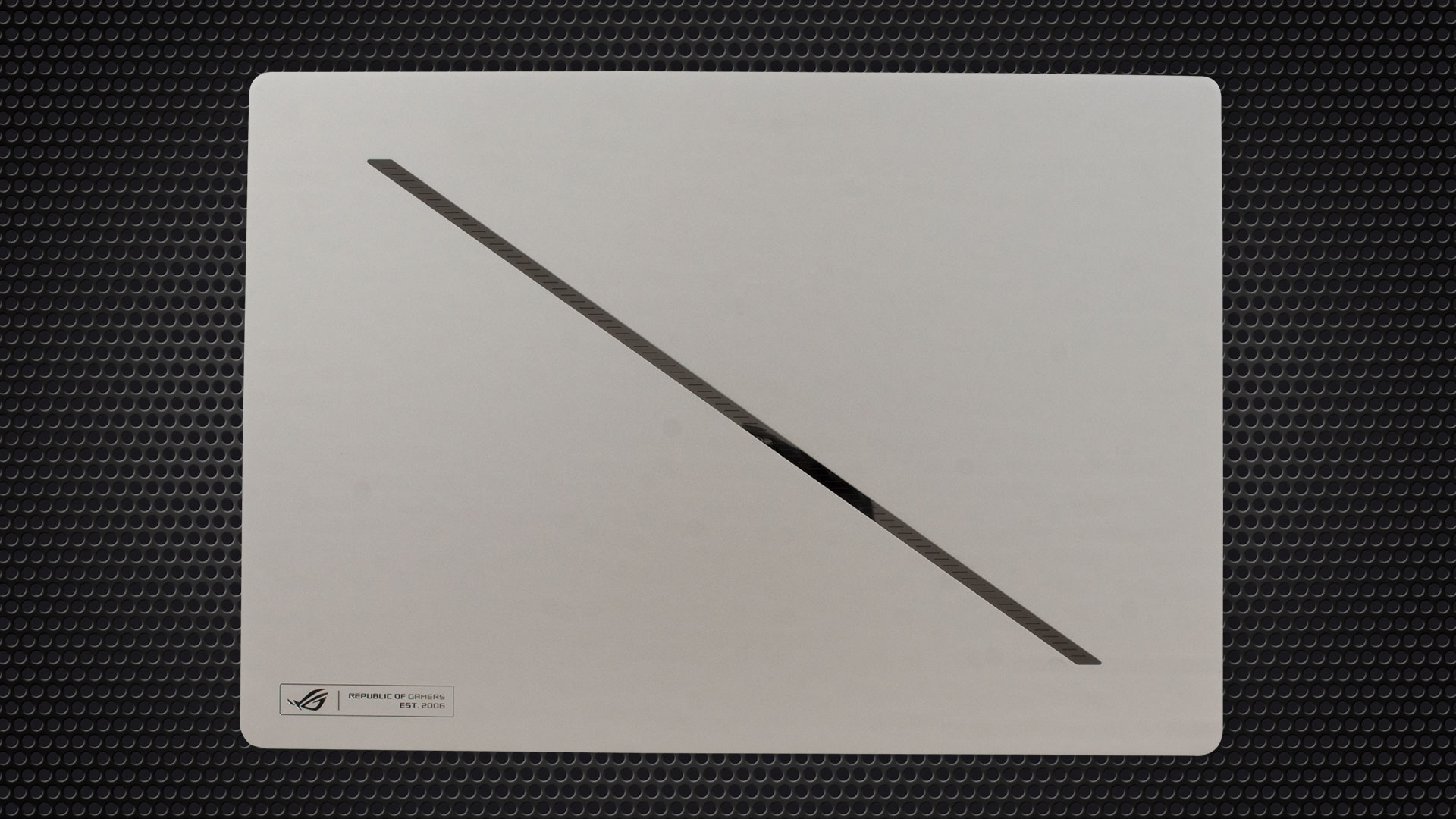
The so-called “Slash Lighting” array is a useful feature thanks to its notification mode. You can also try the 15 preprogrammed animations which are eye-catching.
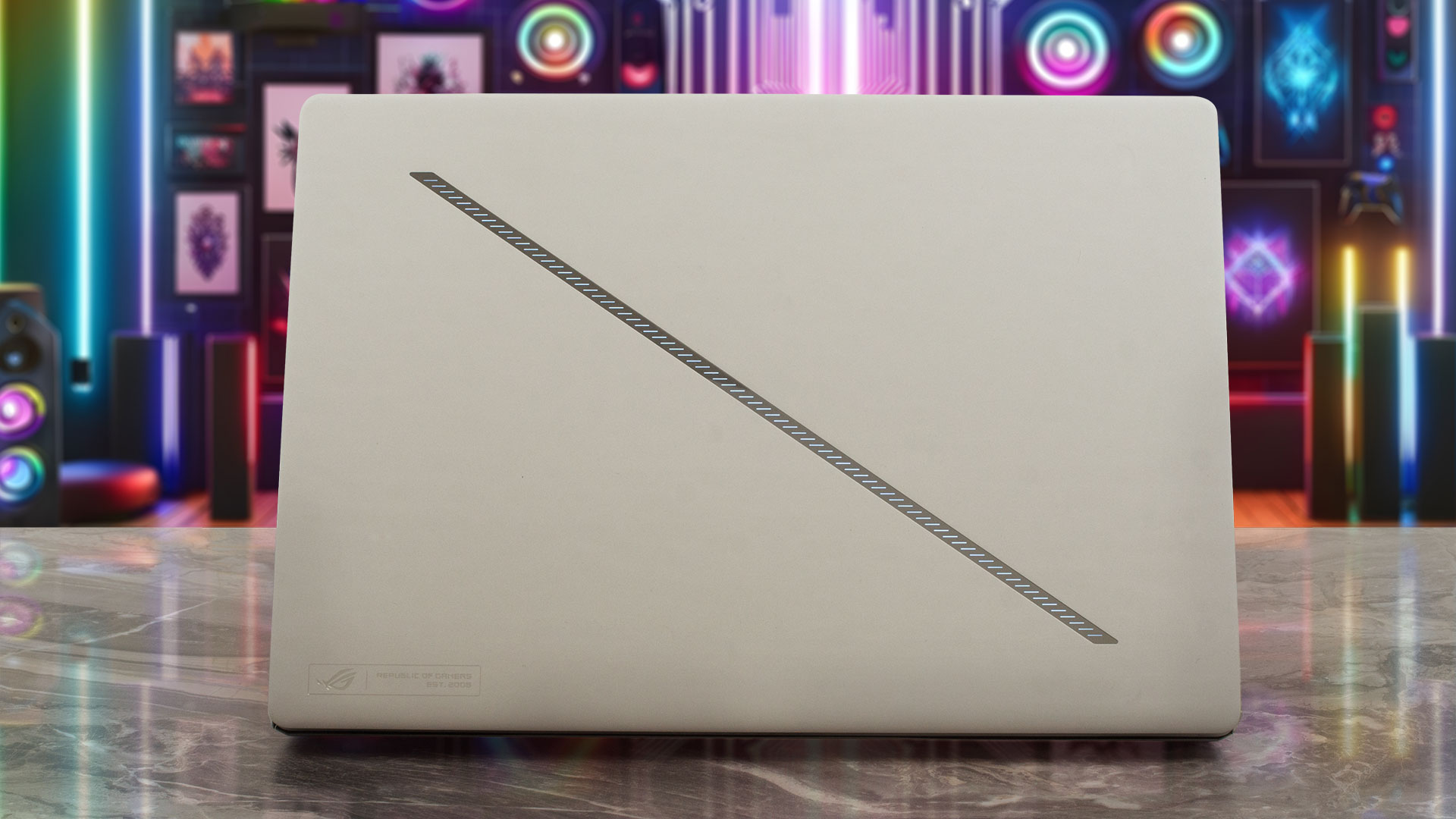
Opening the lid with one hand feels incredibly smooth.
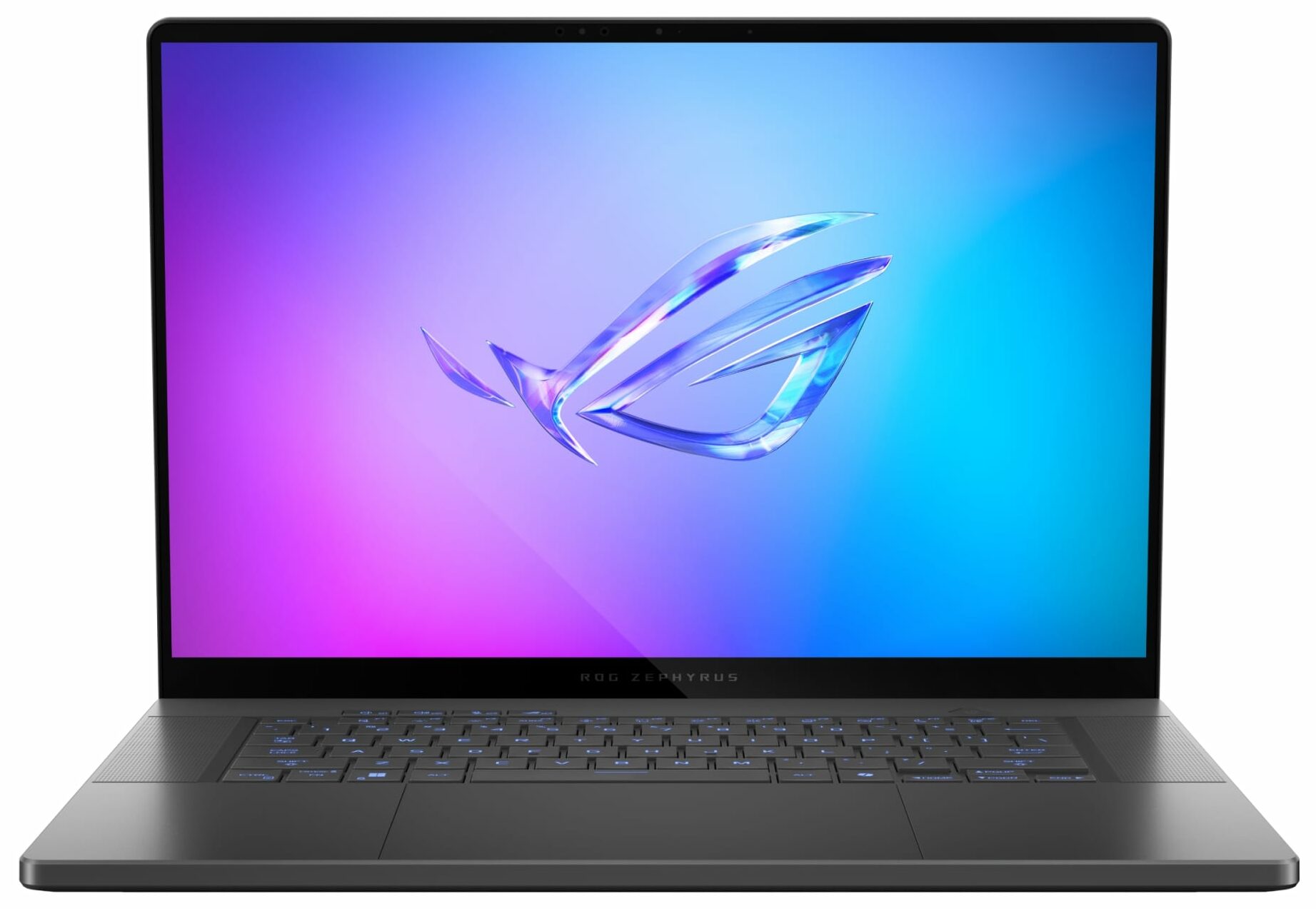
The thin dark bezels contact well with the Platinum White color of the main body. 1080p Web camera with face recognition is positioned on top of the panel.
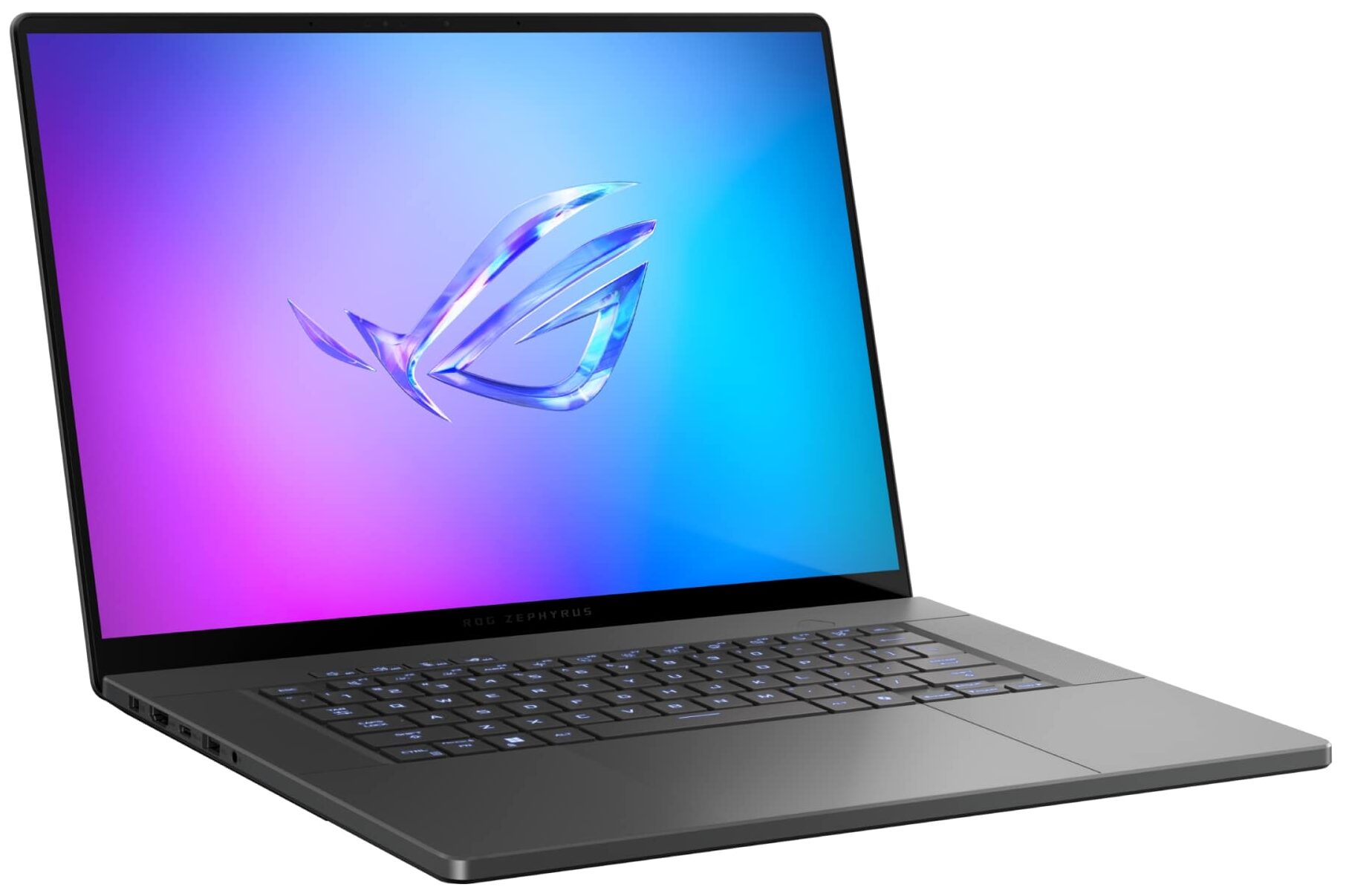
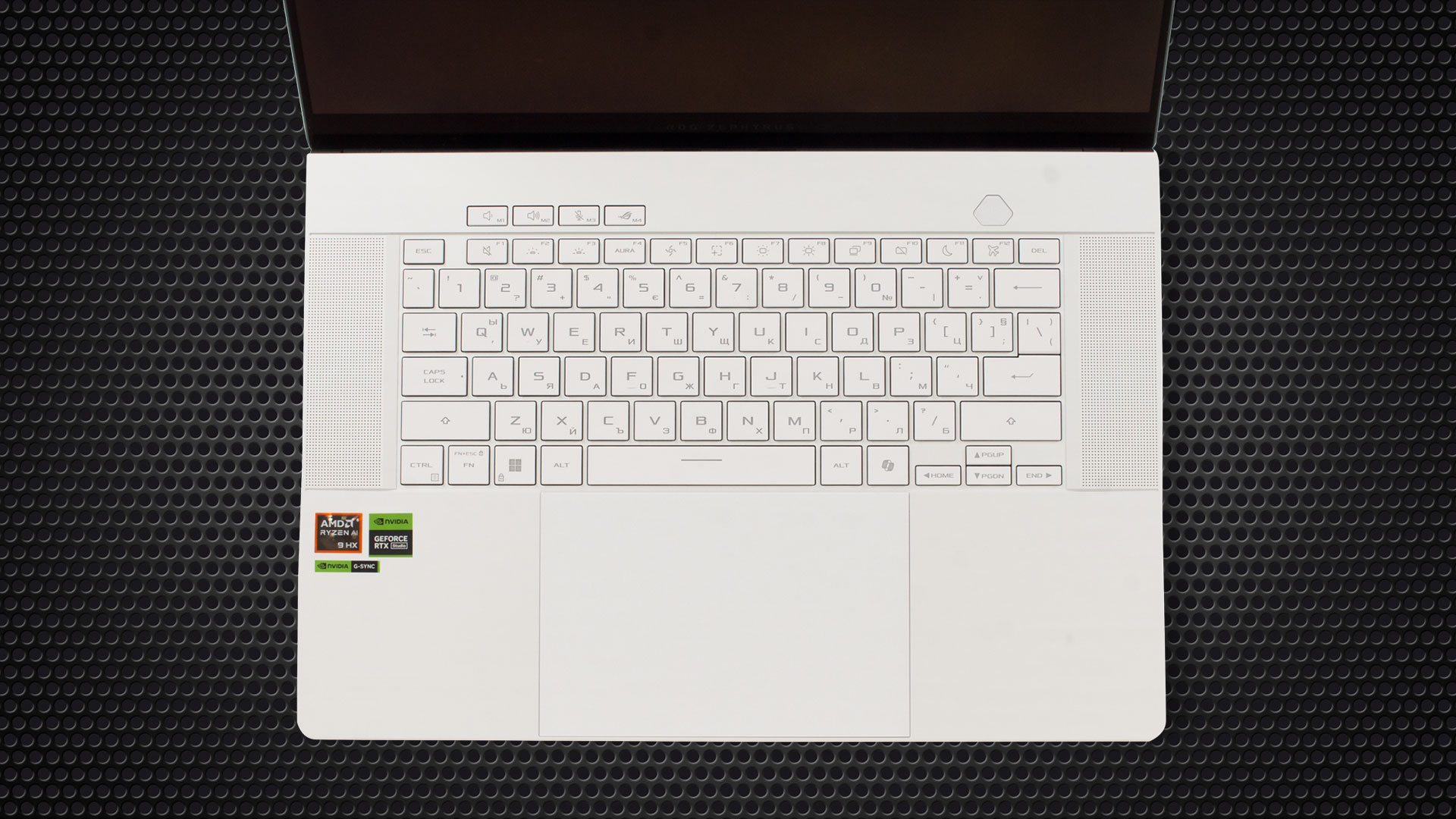
The keyboard is surrounded by two tall grills. Beneath them are hidden the front-firing tweeters.
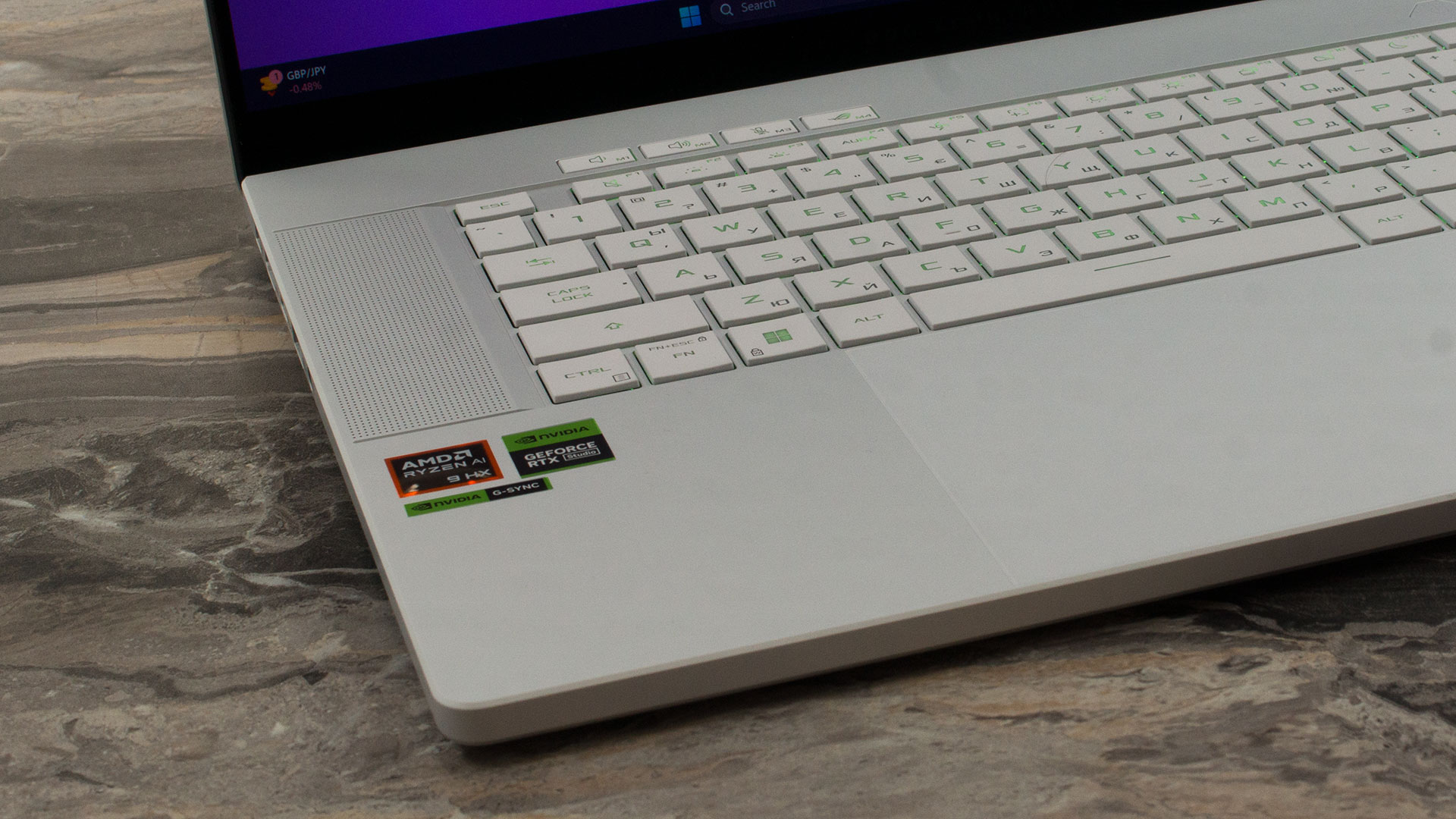
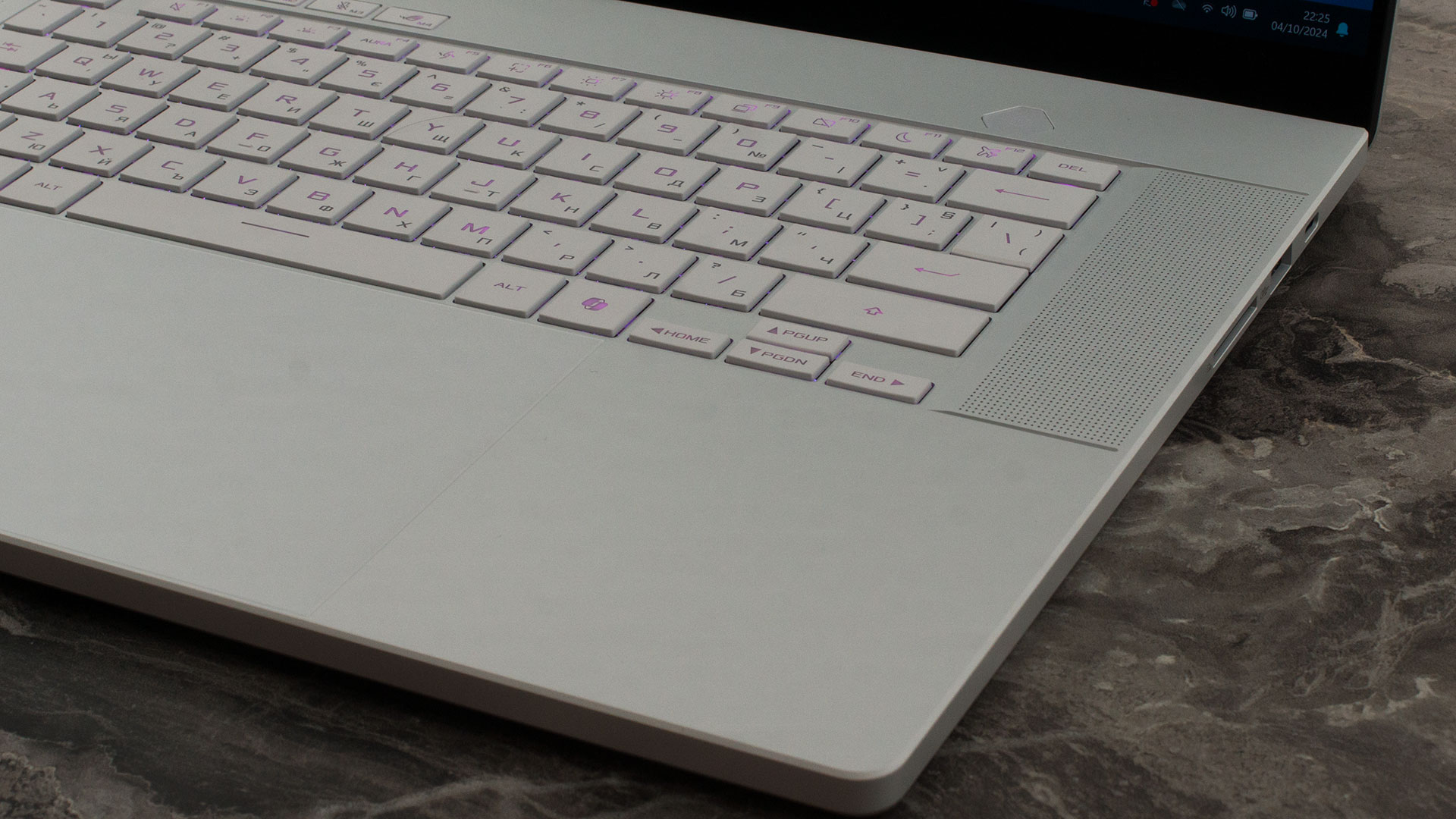
The four multimedia keys and the Power button with a glass surface are separated above the keyboard. The board’s single-color backlight is controlled by the Armoury Crate app.
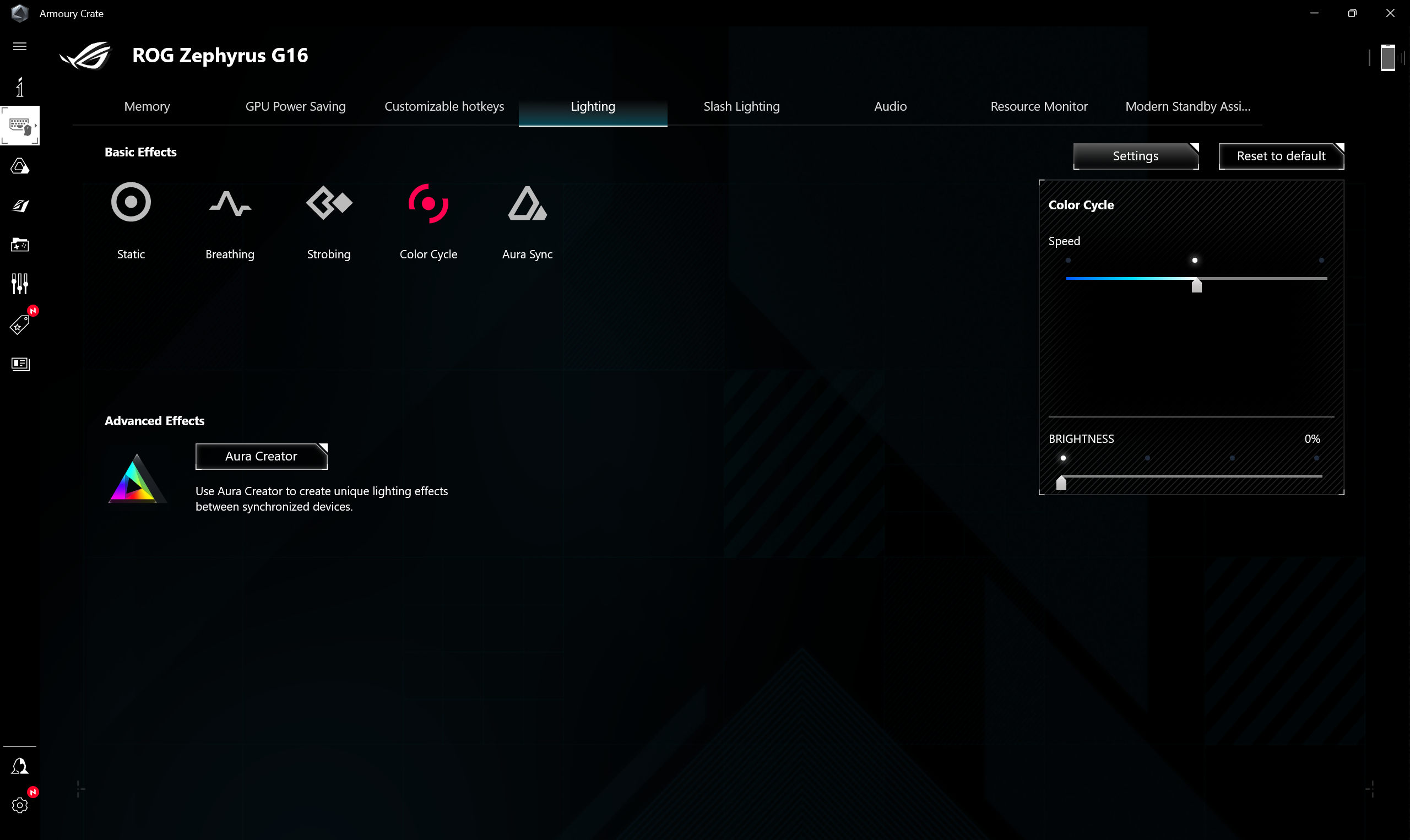
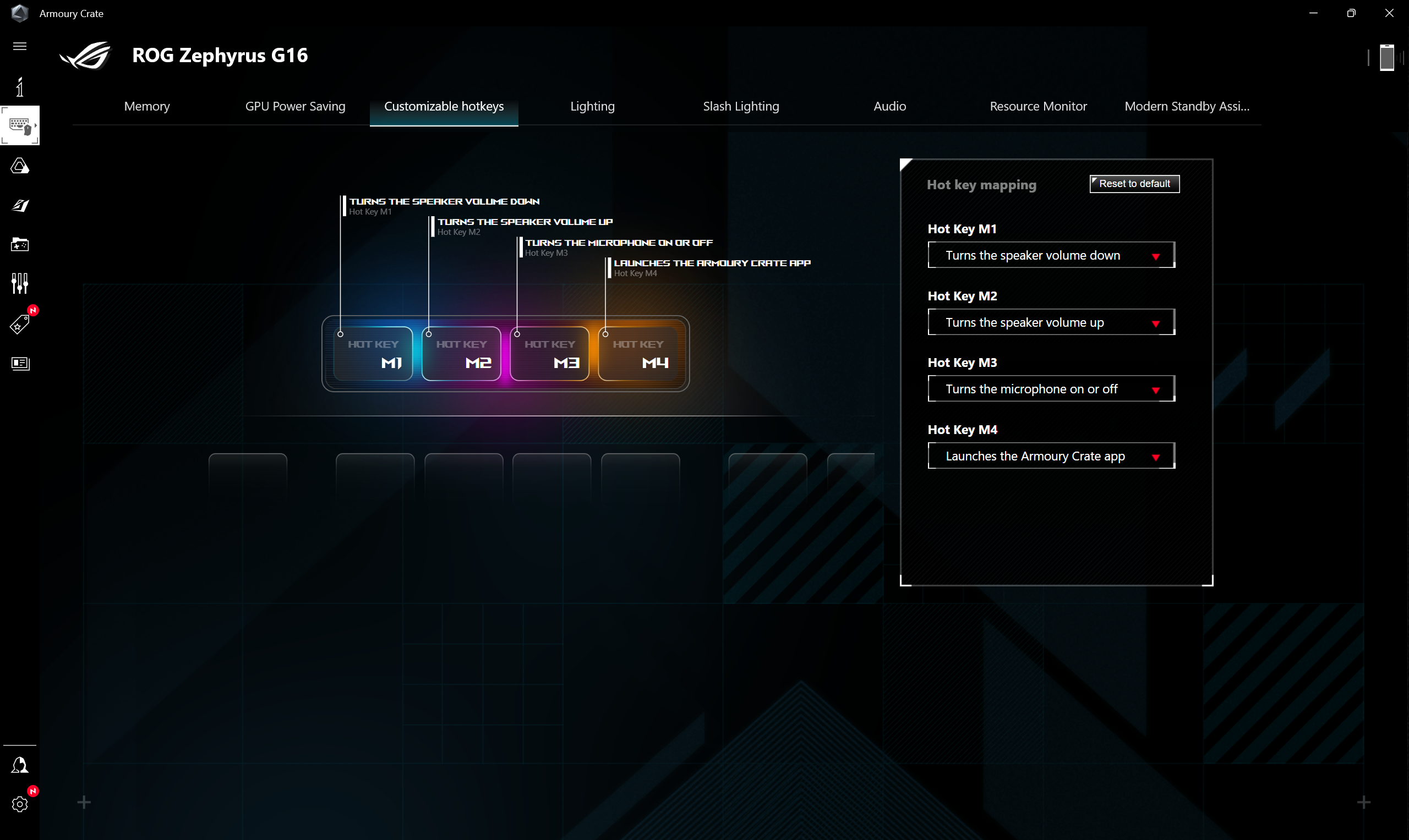
If we put the half-sized Arrows out of the equation, the keyboard is perfect. Despite the thin profile, the keycaps have long travel and nice feedback. This makes the unit suitable for all kinds of usage – home or office work, gaming, you name it!
The gigantic touchpad is smooth and very accurate. Its clicking mechanism isn’t noisy.
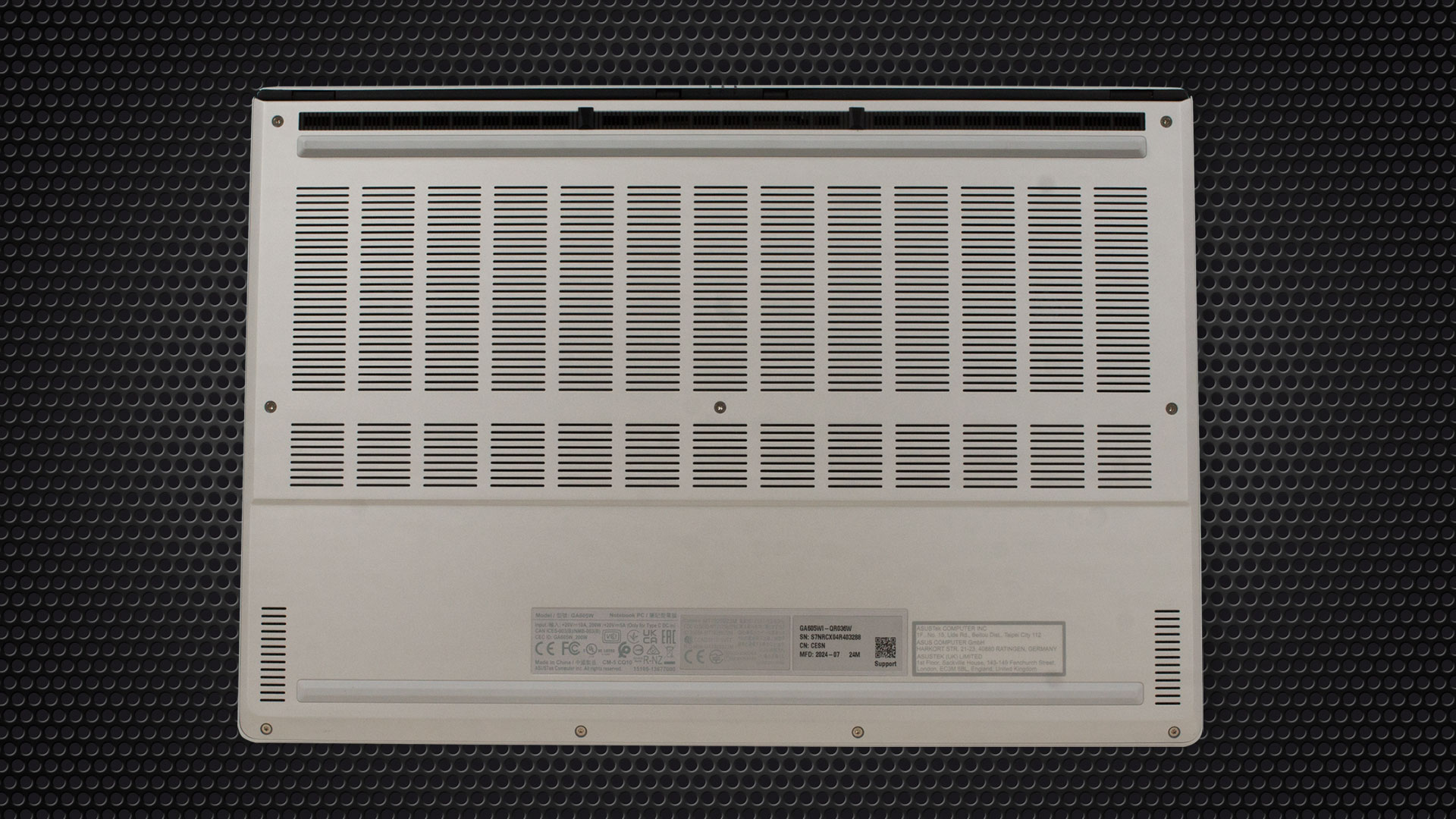
Turning over the laptop reveals two big ventilation grills, a pair of speaker cutouts for the double-sided woofers, and two extra long rubber feet that are grippy. The heat is guided via two vents on the back. The hinge cover is on top of them which blocks the hot air from directly reaching the display during gaming.

Ports
On the left, you get a power plug, an HDMI 2.1 FRL, a Thunderbolt 4 / USB4 port with DisplayPort 2.1, a USB Type-A 3.2 (Gen. 2) port, and an Audio combo jack. On the right, we can spot a USB Type-C 3.2 (Gen. 2) that supports DisplayPort 1.4, another USB Type-A 3.2 (Gen. 2) port, and an SD card slot (SD Express 7.0). The two Type-C ports support Power Delivery 3.0 (input: 20V/5A).


ASUS ProArt PZ13 (HT5306)
Display and Sound Quality, Get our Profiles
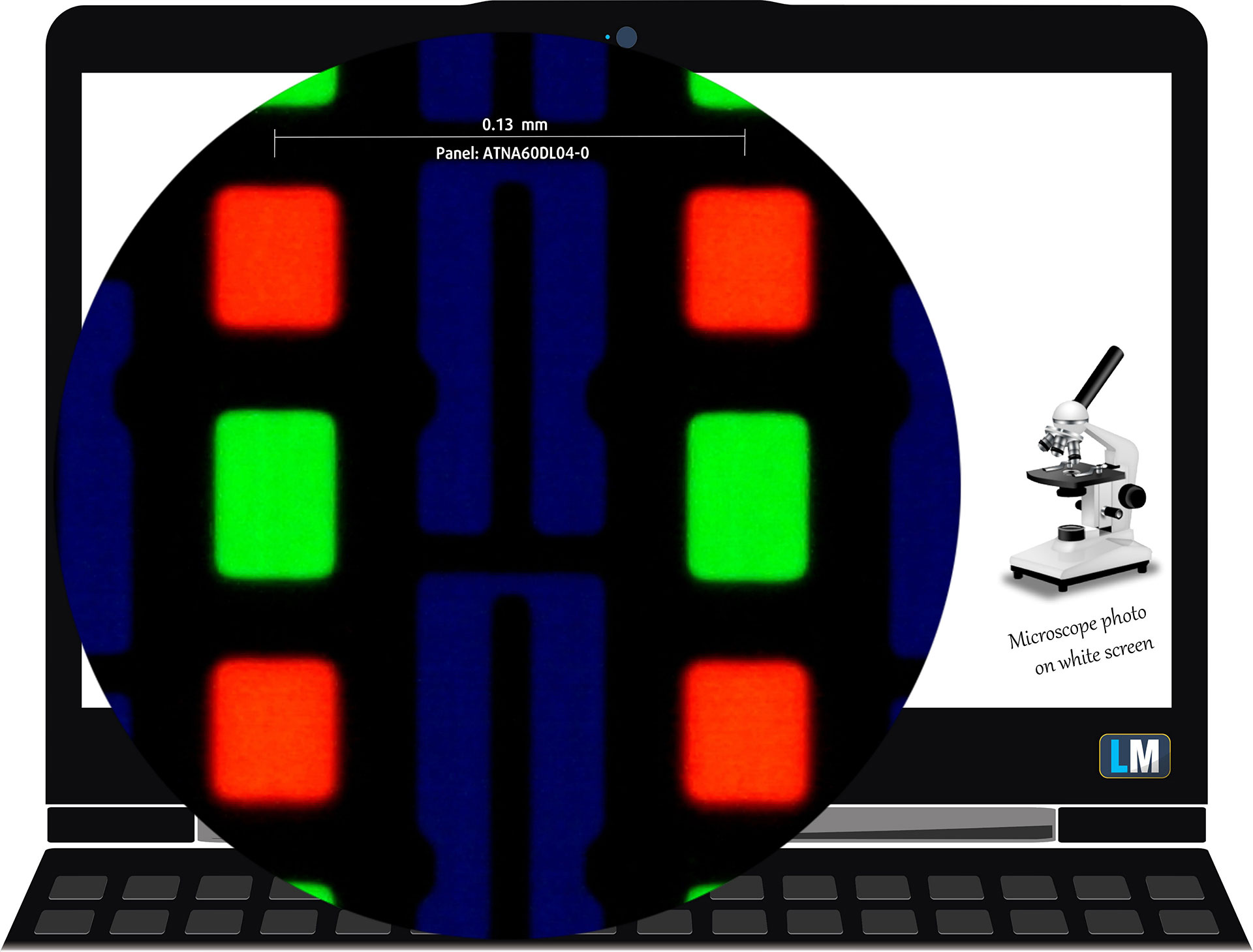
| ASUS ROG Zephyrus G16 GA605 | ATNA60DL04-0 (SDC41AE) |
| Diagonal | 16.0 inches (40.6 cm) |
| Panel Type | OLED |
| Resolution | 2560 x 1600 pixels |
| Max Refresh Rate | 240 Hz |
| Aspect Ratio | 16:10 |
| Pixel Density | 189 PPI |
| ‘Retina’ Distance | Greater than or equal to 46 cm |
Viewing Angles
Viewing angles are good. We take photos from different angles to evaluate the quality.

Also, a video with locked focus and exposure.
Color Coverage
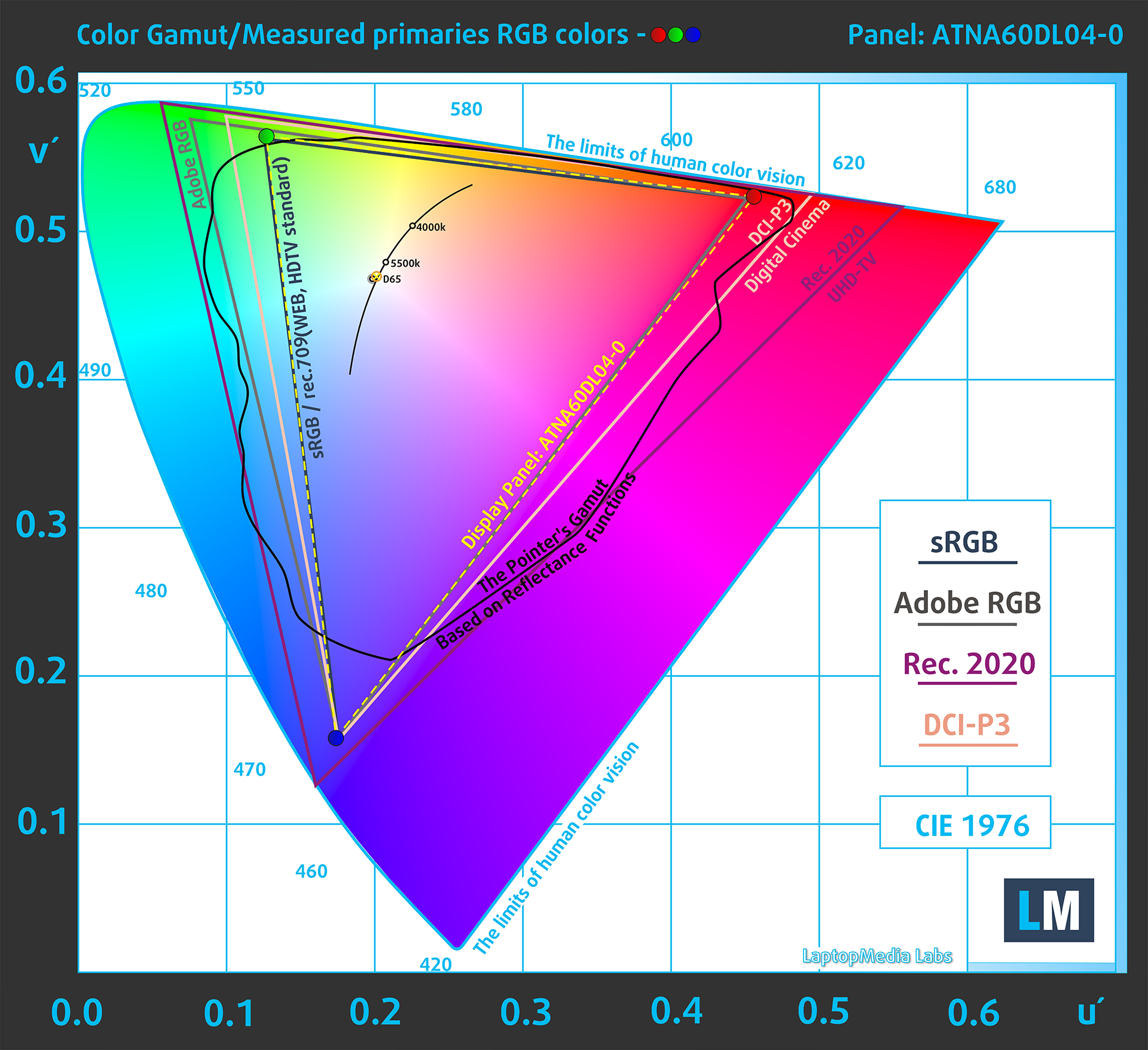
The whole “sail-shaped” map below (Fig. 1) consists of all the colors we can see, while the black crooked line shows all the colors from real-world scenes and nature around us.
Then, we’ve drawn some of the most important and interesting color spaces, compared to the colors the panel of ASUS ROG Zephyrus G16 GA605 can show:
Standard/For Web: sRGB – widely used color space for most consumer devices, ideal for Web design and development
For Print: AdobeRGB – used in professional photo editing, graphic design, and print
For Photographers/Video Editors: DCI-P3 – used in high-end film production, post-production, and digital cinema
Premium HDR: Rec.2020 – the widest consumer ITU color standard, covering a massive 75.8% of the visible spectrum, a benchmark for premium HDR content
ASUS ROG Zephyrus G16 GA605: the yellow dashed triangle (– – – – – –) represents the range of colors this monitor can display.
In our tests, we calculated the total color coverage of the monitor at 100% of the sRGB color gamut and 100% of the DCI-P3 color gamut.
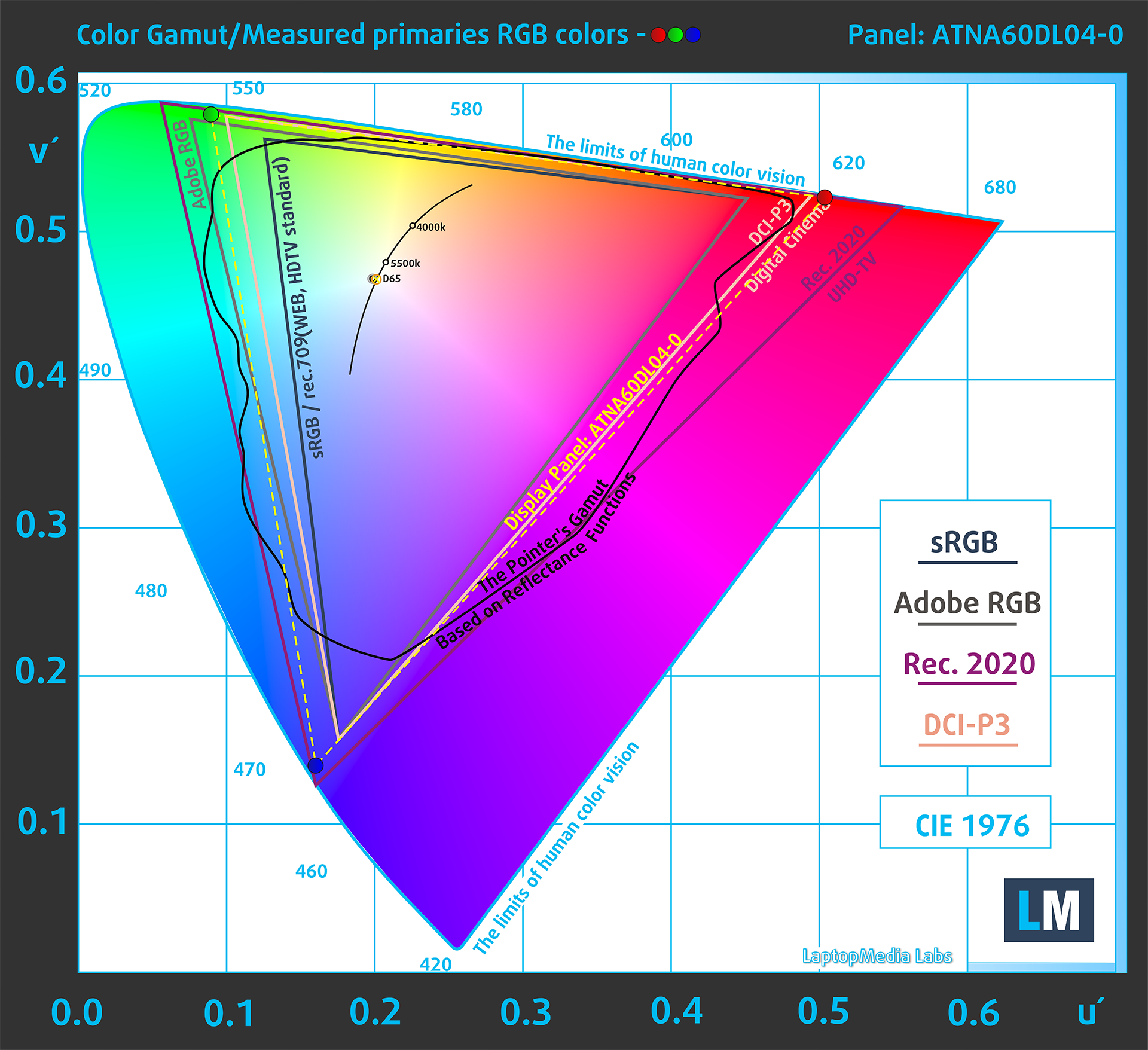
(Fig.1) ASUS ROG Zephyrus G16 GA605 covers 100% of the DCI-P3 gamut
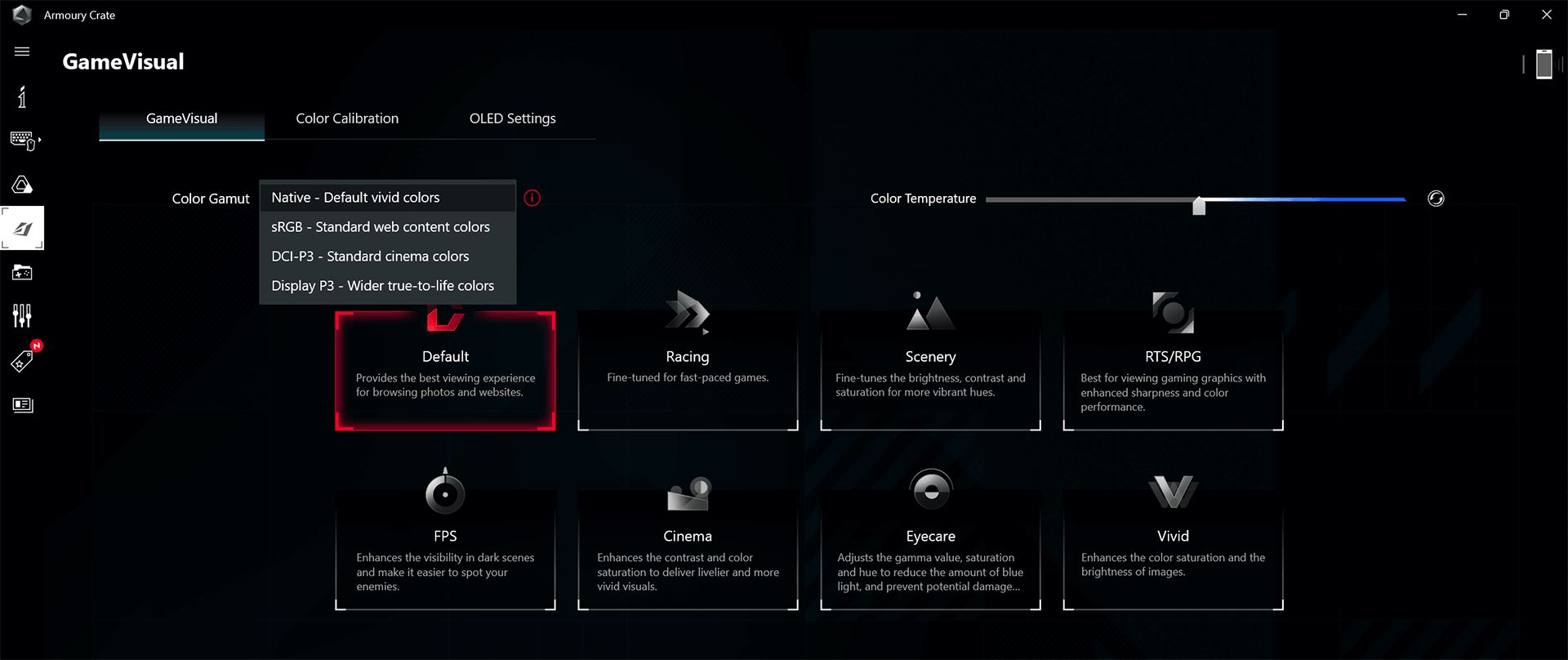
The “Armoury Crate” app emulates Display P3 and sRGB color spaces.
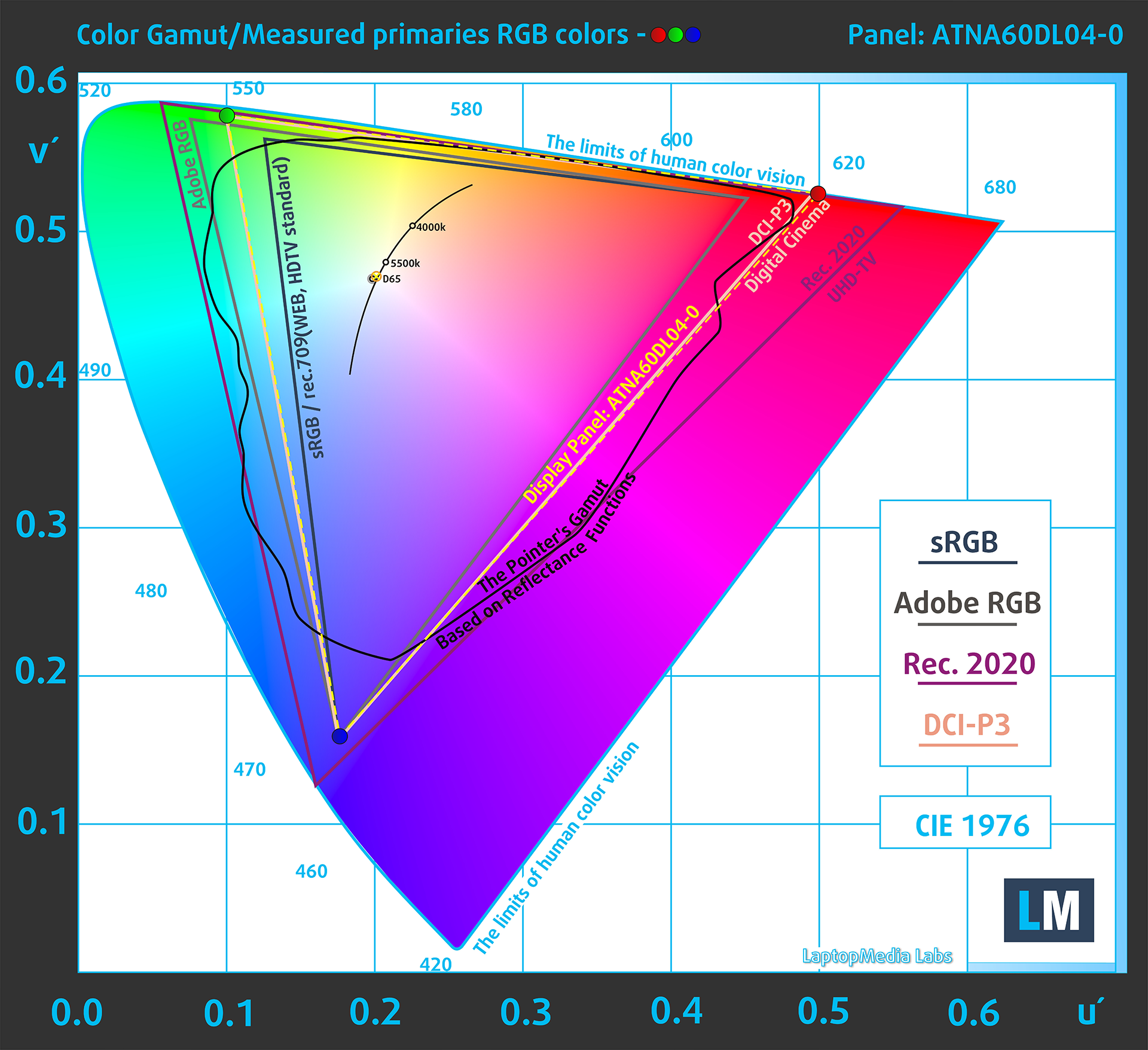
(Fig.2) Display P3
(Fig.3) sRGB
Brightness and Contrast
The maximum brightness in SDR mode is 407 cd/m² in the center of the screen and 407 cd/m² averaged across the surface with a maximum deviation of 1%.
The Correlated Color Temperature (CCT) on a white screen at maximum brightness is 6280K (“Native-Default, Normal” mode in “Armoury Crate” app).
The contrast ratio of OLED panels is excellent because the pixels turn off completely when displaying black.
Uniformity: Luminance, Contrast, and Color Deviation
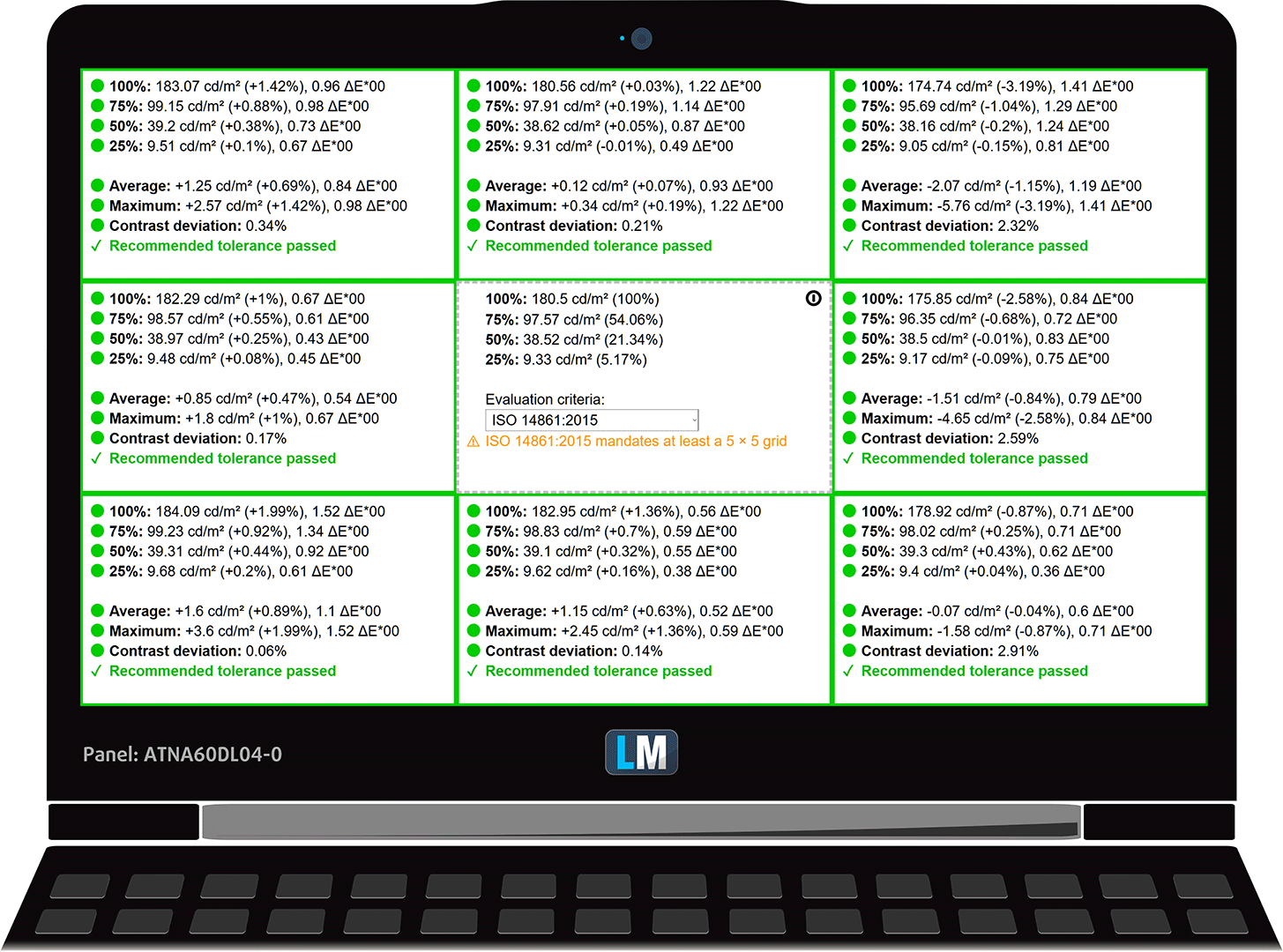
The figure below shows the results from our uniformity test across different sections of the screen. It’s measured at 180 nits (Windows slider = 69%) — a brightness level we consider typical for standard working conditions.
DeltaE values below 4.0 are acceptable for regular users. For those working with colors, screens with DeltaE values no higher than 2.0 are recommended.
Color Accuracy
Let’s check the difference between real colors and those you’ll see on the ASUS ROG Zephyrus G16 GA605. We measure that distance in DeltaE – the higher the number, the more different they look.
Values below 4.0 are acceptable for regular users, while values below 2.0 are suitable for color-sensitive work. A value below 1.0 means the difference is indistinguishable to the naked eye.
For the next graph, we’ve selected 24 common colors, including dark/light skin, blue sky, green grass, etc.
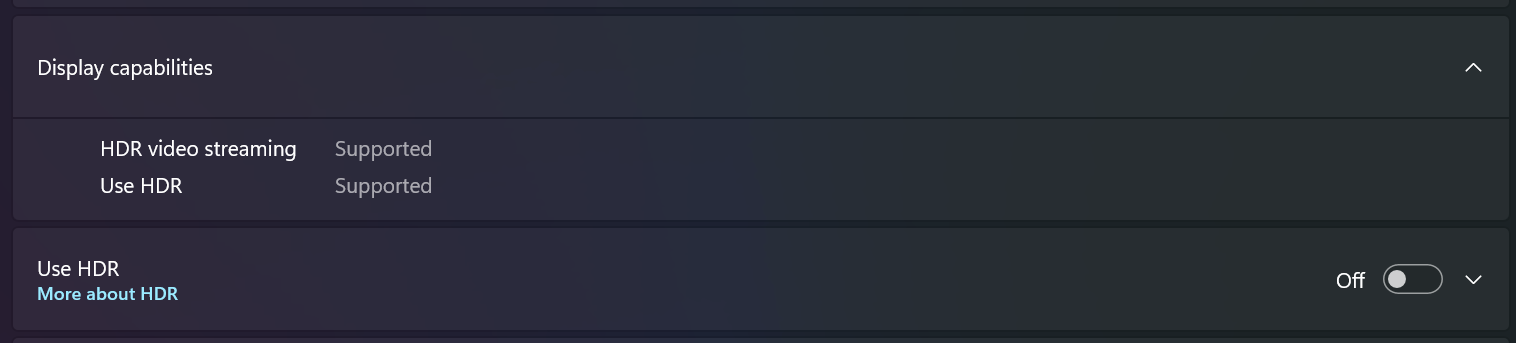
Below are the results of the ASUS ROG Zephyrus G16 GA605 in its factory condition (HDR off) compared to Display P3 and sRGB color spaces.
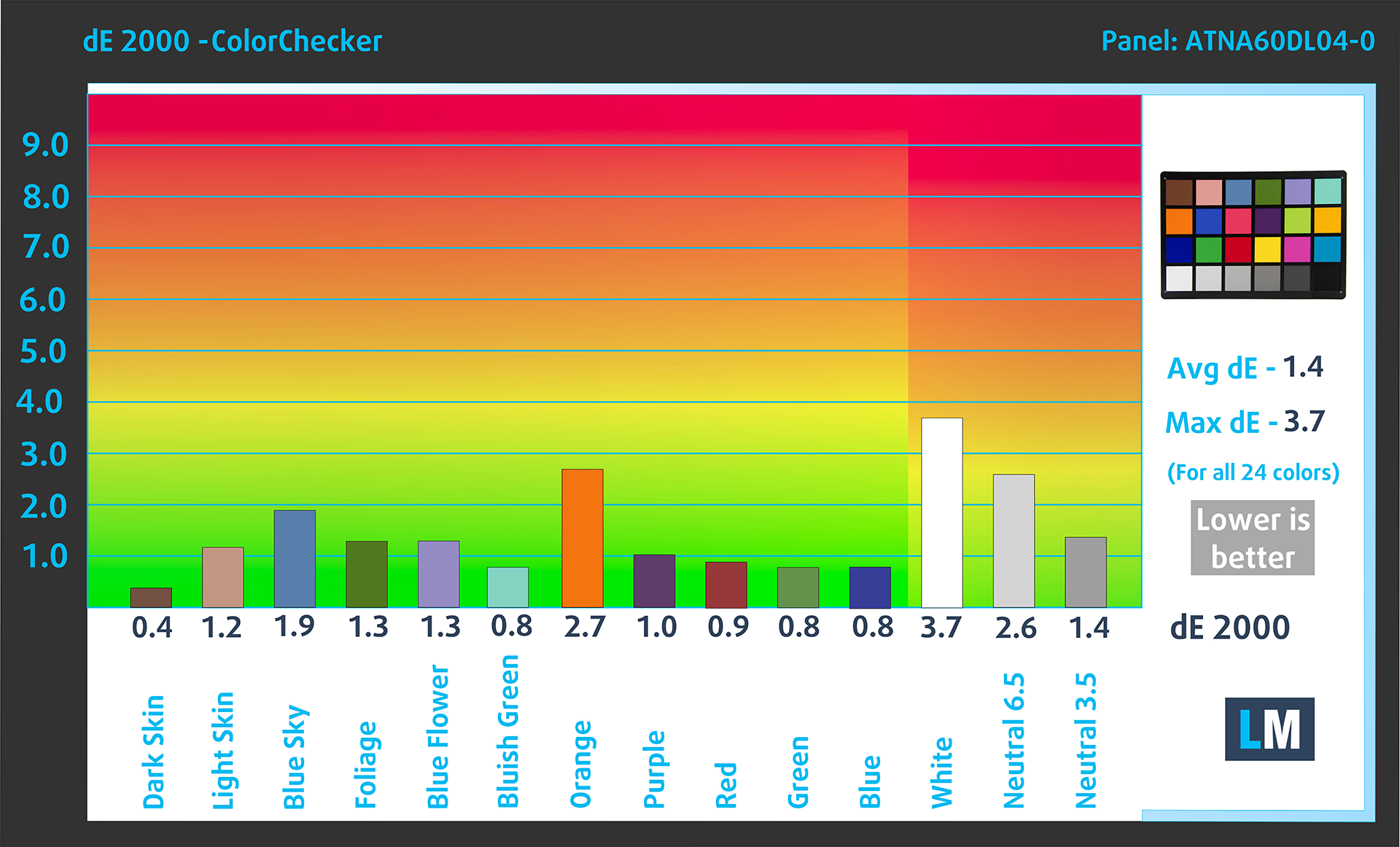
(Fig. 4) ASUS ROG Zephyrus G16 GA605 in Display P3
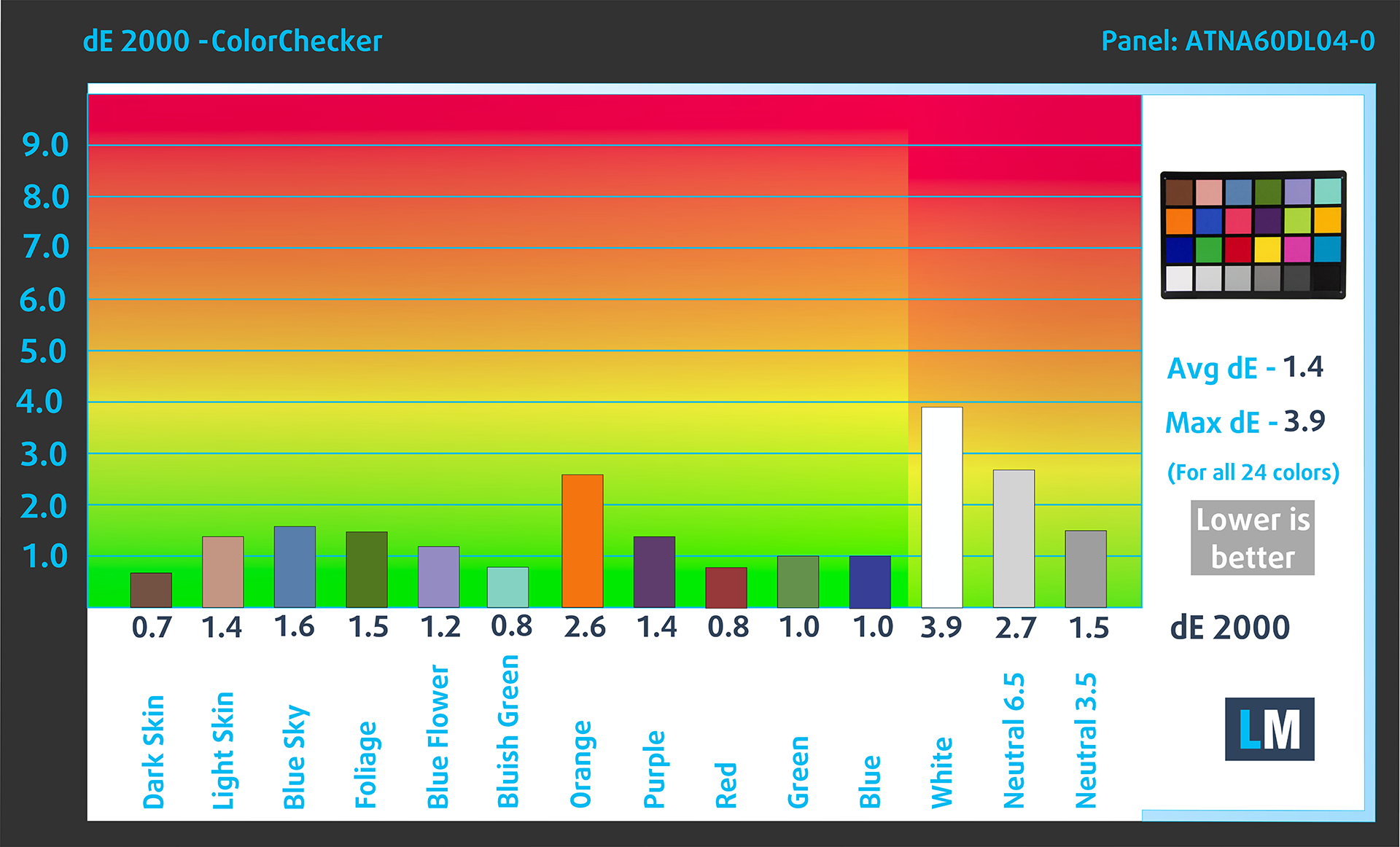
(Fig. 5) ASUS ROG Zephyrus G16 GA605 in sRGB
Health Impact: PWM (Screen flickering)
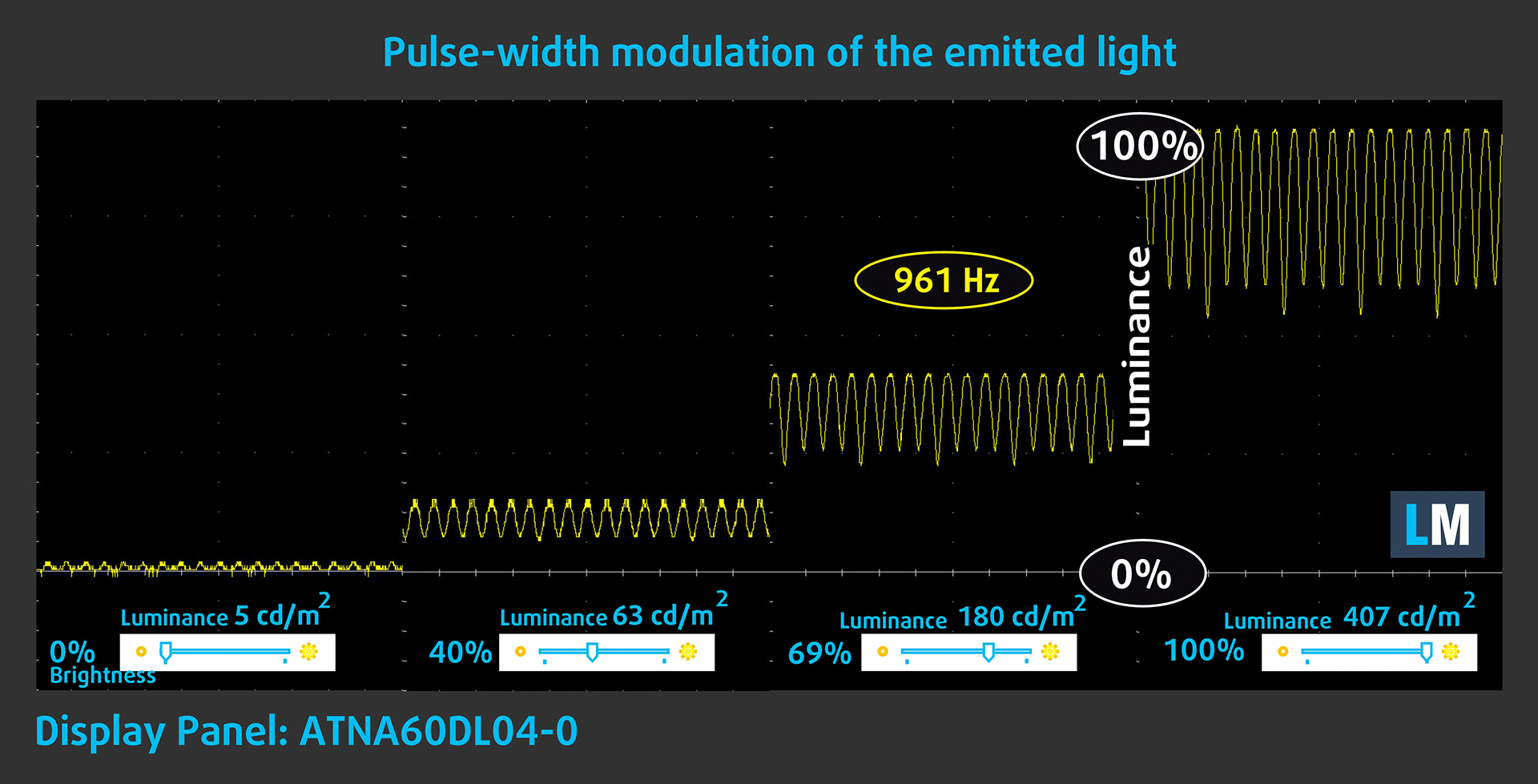
Some use PWM to regulate their brightness, which means that instead of reducing the light intensity, they pulse or flicker. Our brain merges the image, so it appears darker, but this strains both it and our vision, especially when the frequency of the pulses is low. You can read more about that in our dedicated article on PWM.
In the graph below, you see the intensity of light at different brightness levels—on the vertical axis is the brightness of the emitted light, and on the horizontal axis—time.
For the entire brightness range of the ASUS ROG Zephyrus G16 GA605 display, we observe ripples of limited amplitude and relatively high frequency, which makes the screen comfortable to work with and does not strain the eyes in this regard.
Health Impact: Blue light emissions
Installing our Health-Guard profile reduces harmful Blue Light emissions while keeping the colors of the screen perceptually accurate.
If you’re not familiar with the Blue light, the TL;DR version is – emissions that negatively affect your eyes, skin, and your whole body. You can find more information about that in our dedicated article on Blue Light.
Health Impact: Screen Reflectance
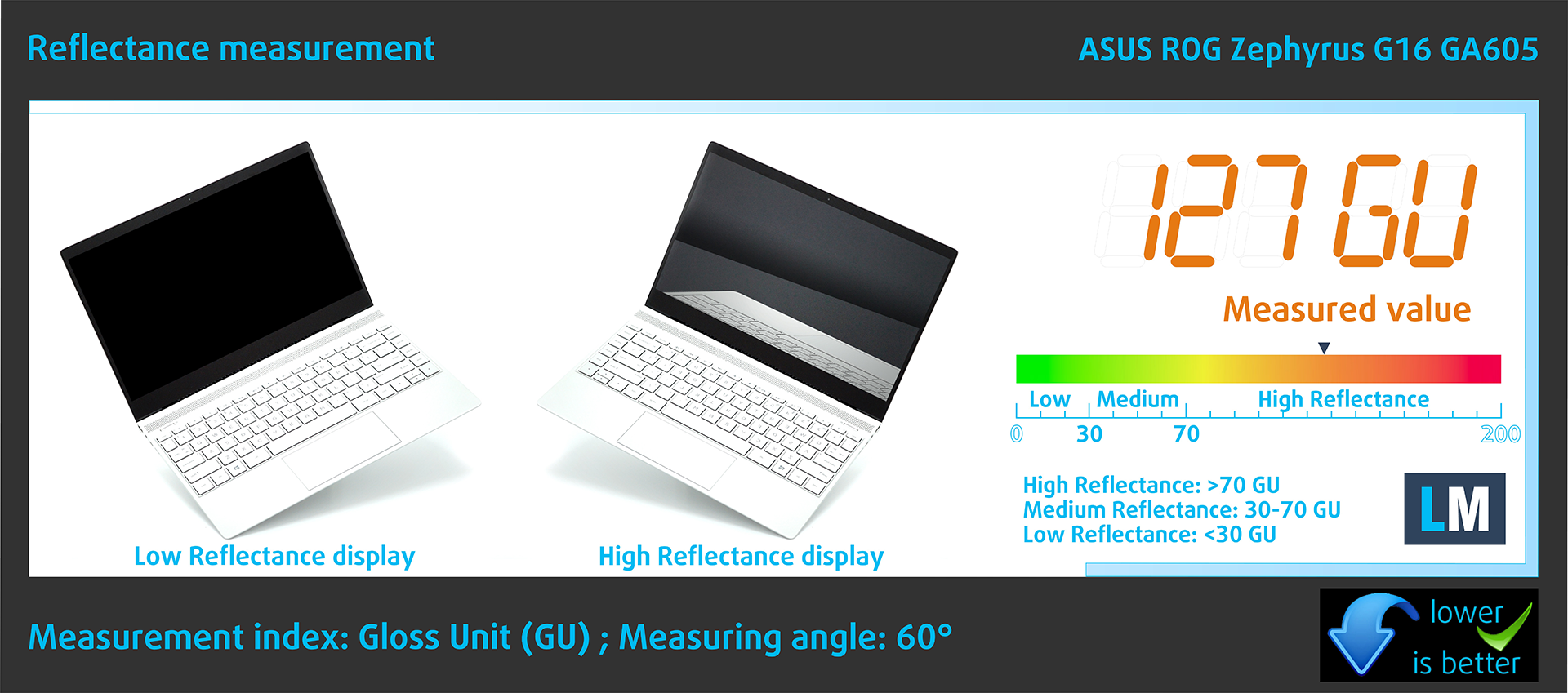
Glossy-coated displays can cause eye fatigue in high ambient light conditions due to reflections. We measure the level of screen reflection with the display turned off, at a 60° angle.
The reflectance of the ROG Zephyrus G16 GA605’s screen is 127 GU.
High Gloss: >70 GU
Medium Gloss: 30 – 70 GU
Low Gloss: <30 GU
Get our profiles
Since our profiles are tailored for each individual display model, this article and its respective profile package are meant for ASUS ROG Zephyrus G16 GA605 configurations with ATNA60DL04-0 (SDC41AE), 2560 х 1600, OLED panel.
*Should you have problems with downloading the purchased file, try using a different browser to open the link you’ll receive via e-mail. If the download target is a .php file instead of an archive, change the file extension to .zip or contact us at [email protected].
Read more about the profiles HERE.
In addition to receiving efficient and health-friendly profiles, by buying LaptopMedia's products you also support the development of our labs, where we test devices in order to produce the most objective reviews possible.

Office Work
Office Work should be used mostly by users who spend most of the time looking at pieces of text, tables or just surfing. This profile aims to deliver better distinctness and clarity by keeping a flat gamma curve (2.20), native color temperature and perceptually accurate colors.

Design and Gaming
This profile is aimed at designers who work with colors professionally, and for games and movies as well. Design and Gaming takes display panels to their limits, making them as accurate as possible in the sRGB IEC61966-2-1 standard for Web and HDTV, at white point D65.

Health-Guard
Health-Guard eliminates the harmful Pulse-Width Modulation (PWM) and reduces the negative Blue Light which affects our eyes and body. Since it’s custom tailored for every panel, it manages to keep the colors perceptually accurate. Health-Guard simulates paper so the pressure on the eyes is greatly reduced.
Get all 3 profiles with 33% discount

Sound
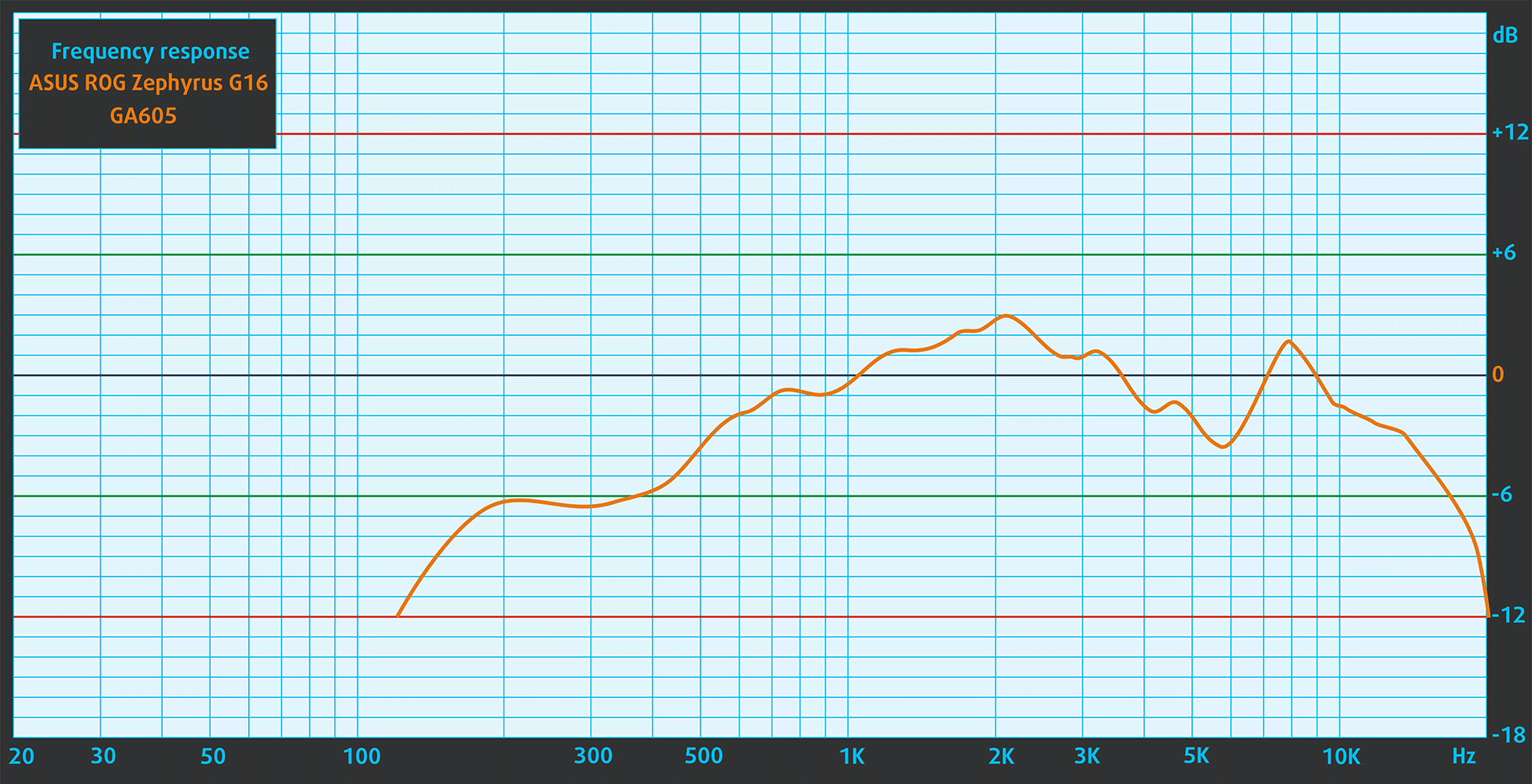
The ASUS ROG Zephyrus G16 GA605’s speakers are of very good quality. The low, mid, and high frequencies are clear.
Performance: CPU, GPU, Storage
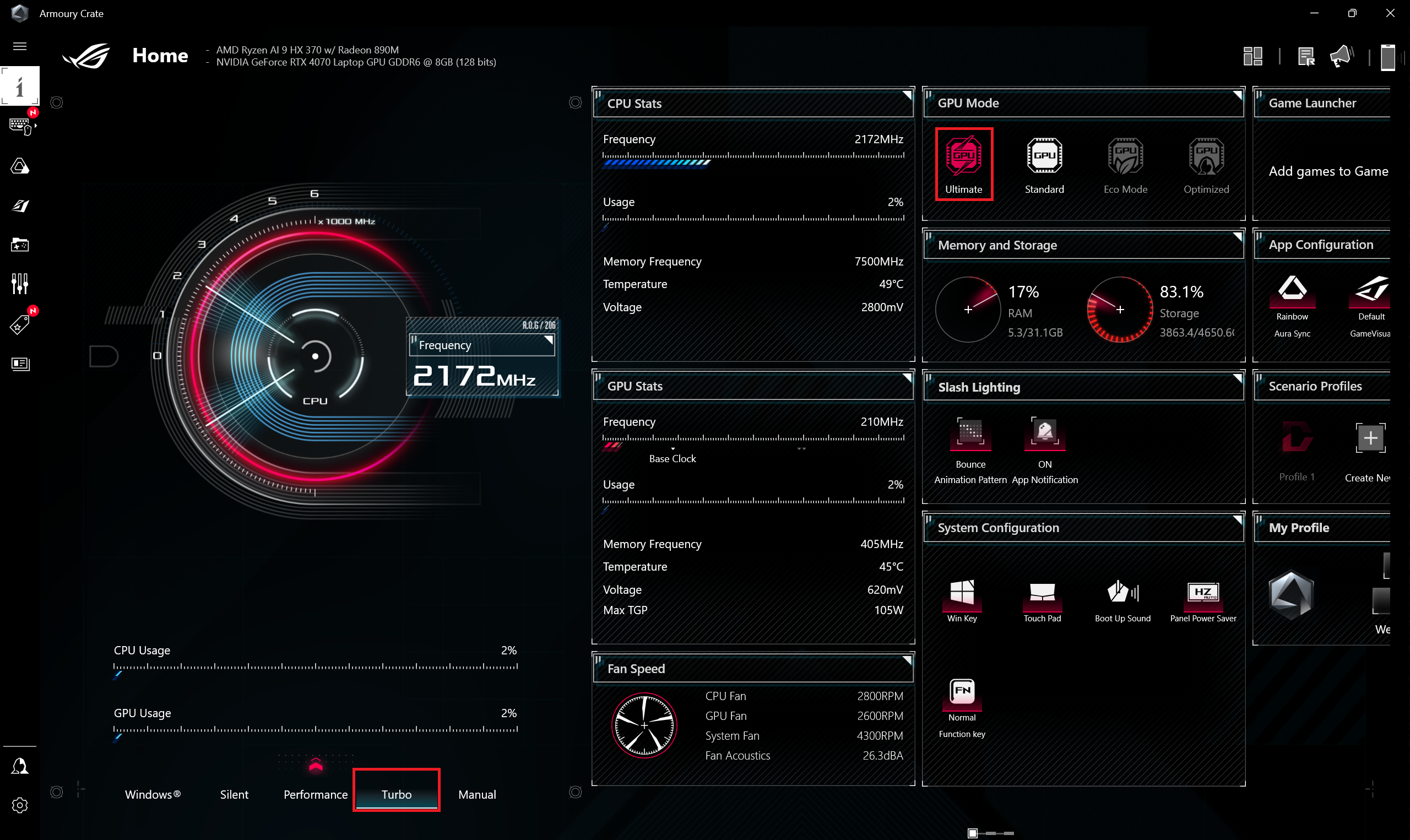
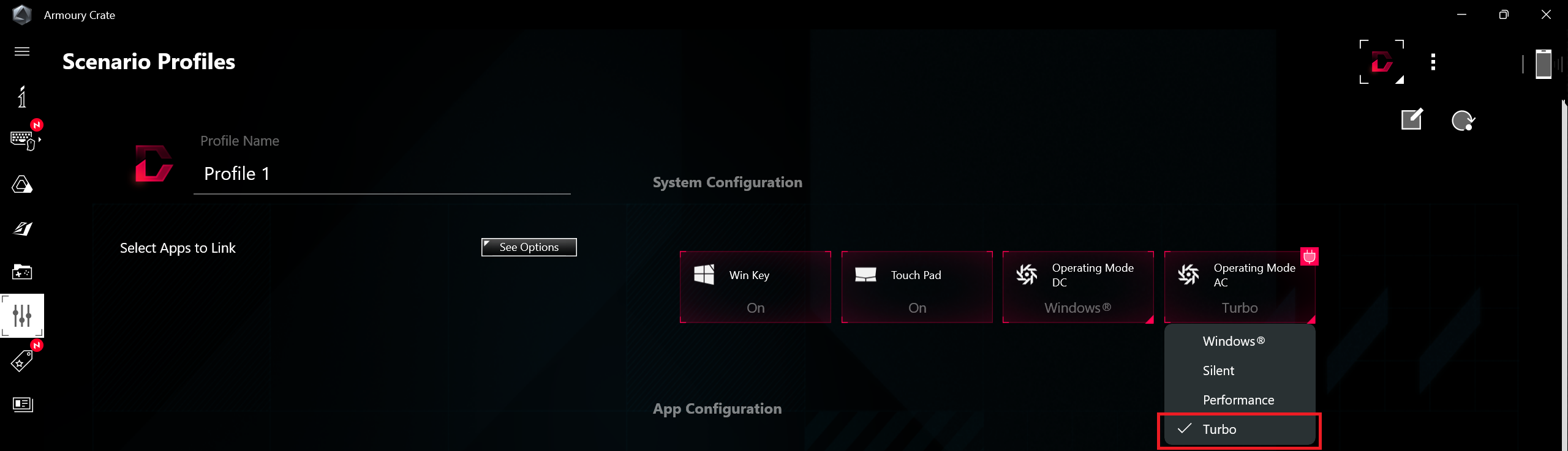
All benchmarks and tests were conducted with the “Turbo” profile activated in the Armoury Crate app. Also, the “Ultimate” mode (dGPU-only) is turned on and the AC fan mode is set to “Turbo”. The “Best performance” preset is applied in the Windows “Power & Battery” menu.

CPU options
At the time of writing this article, the Ryzen AI 9 HX 370 is the only CPU model for this ASUS series.
Single-core performance ensures smooth operation and responsiveness in operating systems, providing a better user experience.
Results are from the Geekbench 6 Single-Core test (higher is better)
Multi-core performance is essential for handling complex and demanding tasks, such as Video editing, CAD, and Scientific simulations.
Results are from the Geekbench 6 Multi-Core test (higher is better)
Here, we evaluate the CPU's performance using a real-world 3D rendering task, assessing its ability to handle complex computations and rendering workloads efficiently.
Results are from the Cinebench 2024 Multi-Core test (higher is better)
GPU options
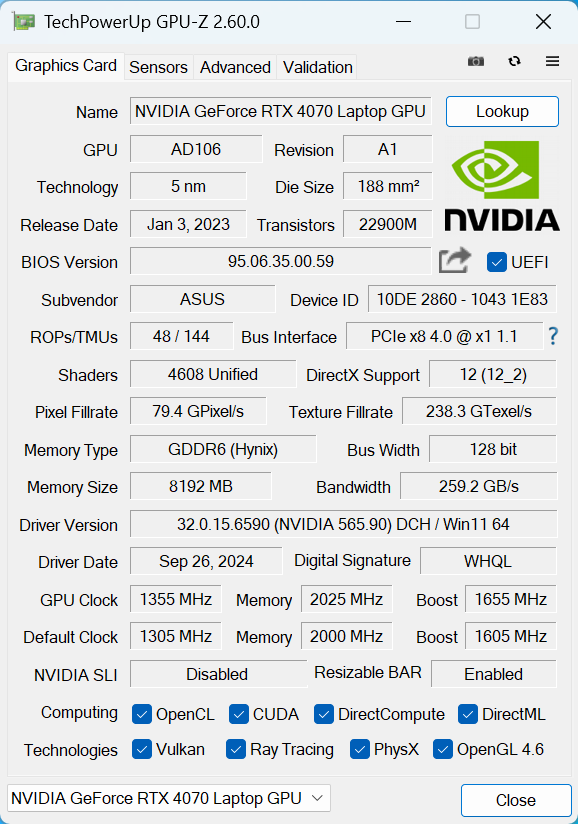
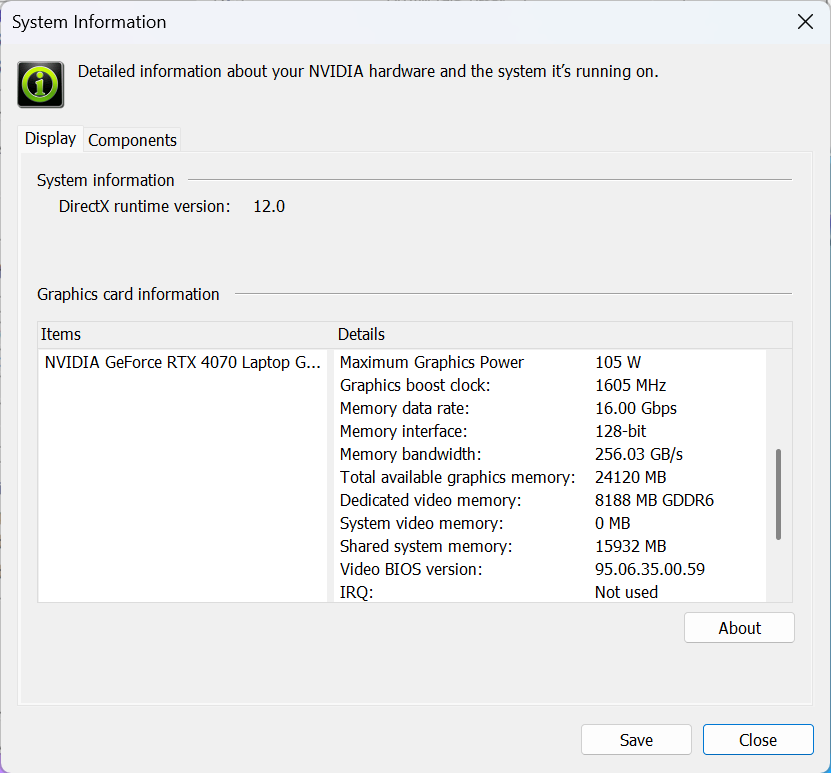
You get a choice of two 105W GPUs – GeForce RTX 4060 or RTX 4070.
The notebook that we bought has a 4070.
The results are from 3DMark Time Spy (Graphics). Higher is better.
The results are from 3DMark Wild Life Extreme Unlimited. Higher is better.
Gaming tests

| Metro Exodus | Full HD, Low (Check settings) | Full HD, High (Check settings) | Full HD, Extreme (Check settings) |
|---|---|---|---|
| Average FPS | 161 fps | 96 fps | 48 fps |

| Borderlands 3 | Full HD, V.Low (Check settings) | Full HD, Medium (Check settings) | Full HD, High (Check settings) | Full HD, Badass (Check settings) |
|---|---|---|---|---|
| Average FPS | 161 fps | 137 fps | 116 fps | 99 fps |

| Far Cry 6 | Full HD, Low (Check settings) | Full HD, High (Check settings) | Full HD, Ultra (Check settings) |
|---|---|---|---|
| Average FPS | 137 fps | 114 fps | 107 fps |

| Gears 5 | Full HD, Low (Check settings) | Full HD, Medium (Check settings) | Full HD, High (Check settings) | Full HD, Ultra (Check settings) |
|---|---|---|---|---|
| Average FPS | 197 fps | 153 fps | 140 fps | 128 fps |
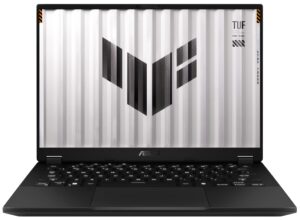
Aside from Ultra / Extreme settings, the 14-ich ASUS TUF Gaming A14 with the same CPU and a 100W RTX 4060 is faster or near the results of this 16-incher with an RTX 4070. This is clearly visible in Far Cry 6 where the smaller device is always faster.
Storage performance
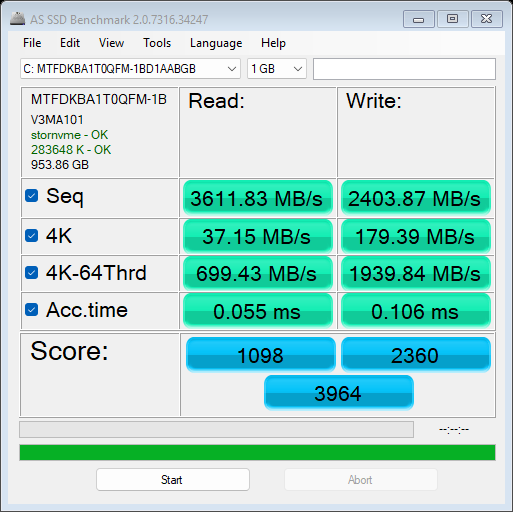
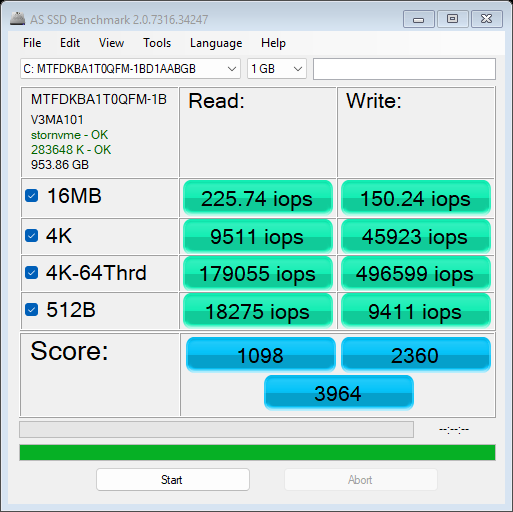
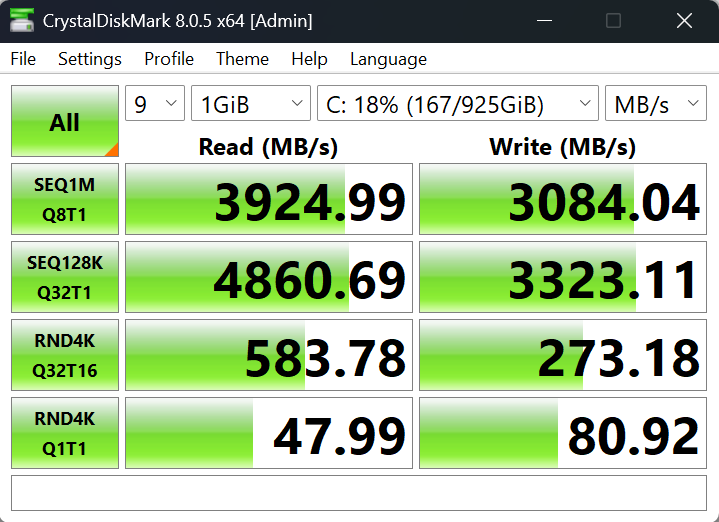
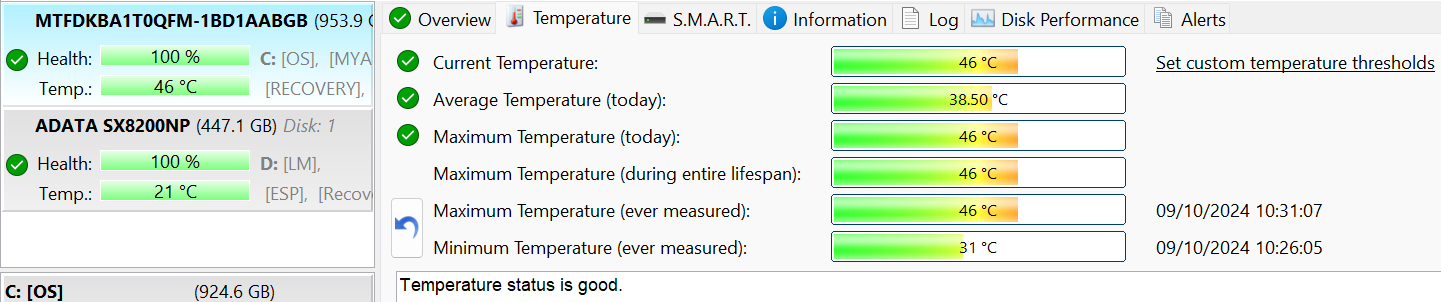
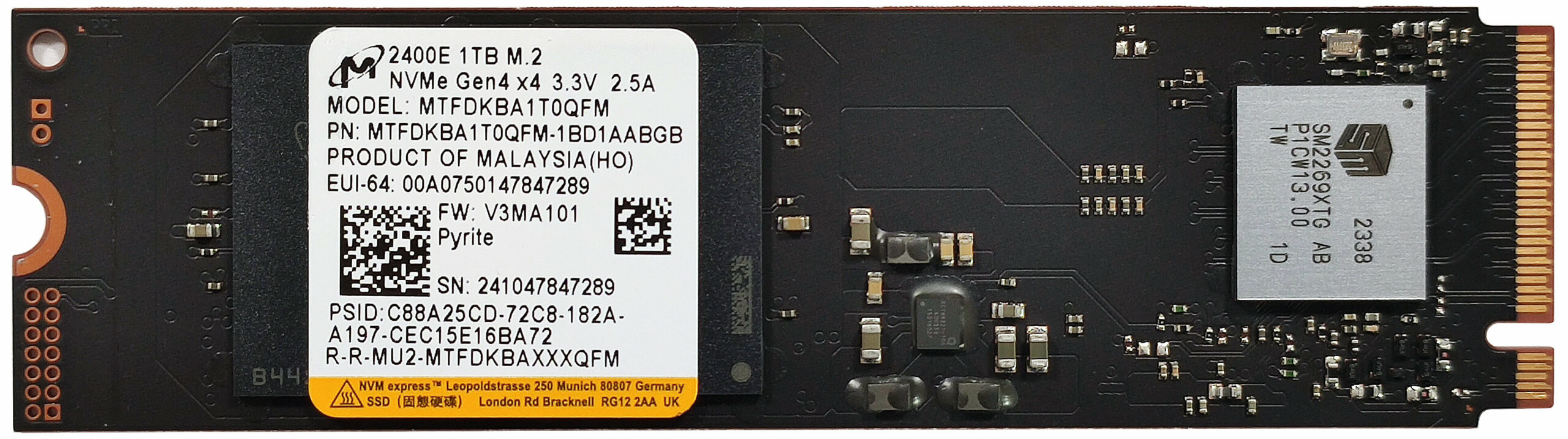
Our device has a 1TB Micron 2400E MTFDKBA1T0QFM-1BD1AABGB. This is a Gen 4 QLC-based NVMe.
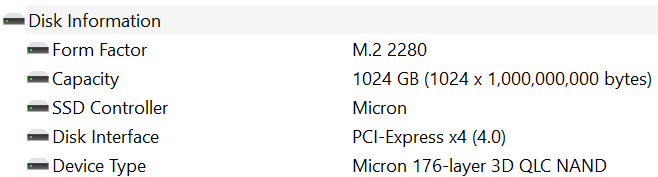
The speeds are decent and the temperatures under load are low which is good.
[eBook Guide + Tools] How to MAX OUT Your Laptop
You can make your laptop Faster. LaptopMedia has tested thousands of models in the last 15 years, and we have yet to see a notebook that couldn't be made more powerful through modifications.
That's why we decided to bundle everything we know about how to achieve this in an Easy-to-Follow, Step-by-Step, and Laboratory-Tested, all in one project.
Read more about it here:
[eBook Guide + Tools] How to MAX OUT Your Laptop
🛠️ GPU Modifications: vBIOS, Overclocking, Undervolting
⚙️ Building Fast/Reliable RAID configuration
💻 Hardware upgrade tips for best results
🖼 Display enhancing
💾 OS Optimization for best performance
Temperatures and comfort, Battery Life
Max CPU load
In this test we use 100% on the CPU cores, monitoring their frequencies and chip temperature. The first column shows a computer’s reaction to a short load (2-10 seconds), the second column simulates a serious task (between 15 and 30 seconds), and the third column is a good indicator of how good the laptop is for long loads such as video rendering.
Average P-core frequency; Average E-core frequency; CPU temp.; Package Power
| AMD Ryzen AI 9 HX 370 (28W TDP) | 0:02 – 0:10 sec | 0:15 – 0:30 sec | 10:00 – 15:00 min |
|---|---|---|---|
| ASUS ROG Zephyrus G16 GA605 | 3.56 GHz @ 2.34 GHz @ 74°C @ 65W | 4.42 GHz @ 3.30 GHz @ 92°C @ 80W | 4.26 GHz @ 3.25 GHz @ 95°C @ 76W |
| ASUS TUF Gaming A14 (FA401) | 4.56 GHz @ 3.16 GHz @ 78°C @ 77W | 4.58 GHz @ 3.31 GHz @ 96°C @ 78W | 4.35 GHz @ 3.23 GHz @ 97°C @ 72W |
| ASUS ProArt P16 (H7606) | 4.45 GHz @ 3.29 GHz @ 79°C @ 80W | 4.41 GHz @ 3.30 GHz @ 91°C @ 80W | 4.19 GHz @ 3.25 GHz @ 95°C @ 77W |
| ASUS Zenbook S 16 (UM5606) | 3.00 GHz @ 2.03 GHz @ 69°C @ 33W | 2.96 GHz @ 2.01 GHz @ 78°C @ 33W | 2.68 GHz @ 1.80 GHz @ 83°C @ 28W |
The clocks of the Ryzen AI 9 HX 370 inside this ASUS laptop need a bit more time before boosting pretty high to 4.42 GHz / 3.30 GHz for the P and E cores in medium loads. The frequencies in long loads are impressive for such a thin device but the chip temperature hits 95°C.
Real-life gaming
| NVIDIA GeForce RTX 4070 | GPU frequency/ Core temp (after 2 min) | GPU frequency/ Core temp (after 30 min) |
|---|---|---|
| ASUS ROG Zephyrus G16 GA605 | 2277 MHz @ 79°C @ 105W | 2258 MHz @ 82°C @ 105W |
| ASUS ProArt P16 (H7606) | 2284 MHz @ 74°C @ 105W | 2270 MHz @ 76°C @ 105W |
| HP OMEN Transcend 16 (16-u0000) | 2490 MHz @ 83°C @ 130W | 2280 MHz @ 83°C @ 109W |
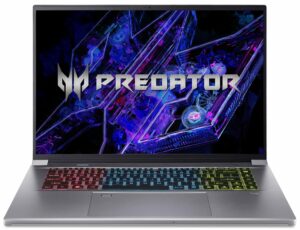
| Acer Predator Helios Neo 14 (PHN14-51) | 2595 MHz @ 79°C @ 124W | 2514 MHz @ 84°C @ 124W |
| Acer Predator Triton Neo 16 (PTN16-51) | 2383 MHz @ 73°C @ 110W | 2363 MHz @ 78°C @ 110W |
| Acer Nitro 16 (AN16-42) | 2640 MHz @ 70°C @ 125W | 2640 MHz @ 72°C @ 125W |
| Alienware m16 R2 | 2440 MHz @ 78°C @ 120W | 2427 MHz @ 84°C @ 119W |
| MSI Stealth 14 AI Studio A1V | 2048 MHz @ 78°C @ 90W | 1981 MHz @ 85°C @ 89W |
| Acer Predator Helios Neo 16 (PHN16-72) | 2535 MHz @ 80°C @ 139W | 2503 MHz @ 86°C @ 139W |
| MSI Sword 16 HX B14V | 2373 MHz @ 73°C @ 115W | 2372 MHz @ 73°C @ 115W |
| MSI Sword 17 HX B14V | 2395 MHz @ 73°C @ 114W | 2388 MHz @ 75°C @ 114W |
| Alienware m18 R2 | 2550 MHz @ 68°C @ 132W | 2550 MHz @ 72°C @ 133W |
| Lenovo Legion Slim 5 (16″, Gen 9) | 2580 MHz @ 81°C @ 130W | 2580 MHz @ 86°C @ 132W |
| Acer Predator Helios Neo 18 (PHN18-71) | 2610 MHz @ 77°C @ 131W | 2610 MHz @ 82°C @ 134W |
| Lenovo Legion Pro 5i (16″, Gen 9) | 2535 MHz @ 74°C @ 129W | 2535 MHz @ 75°C @ 130W |
| Acer Nitro 17 (AN17-41) “Turbo” preset | 2535 MHz @ 66°C @ 121W | 2535 MHz @ 67°C @ 122W |
| Acer Nitro 17 (AN17-41) “Performance” preset | 2475 MHz @ 72°C @ 123W | 2475 MHz @ 73°C @ 123W |
The RTX 4070 can maintain a stable 105W TGP during long gaming sessions.
Comfort during full load
The Armoury Crate app is all you need to fine-tune the laptop’s power – three power presets, four GPU modes, and a manual control for the CPU and the GPU power limits.
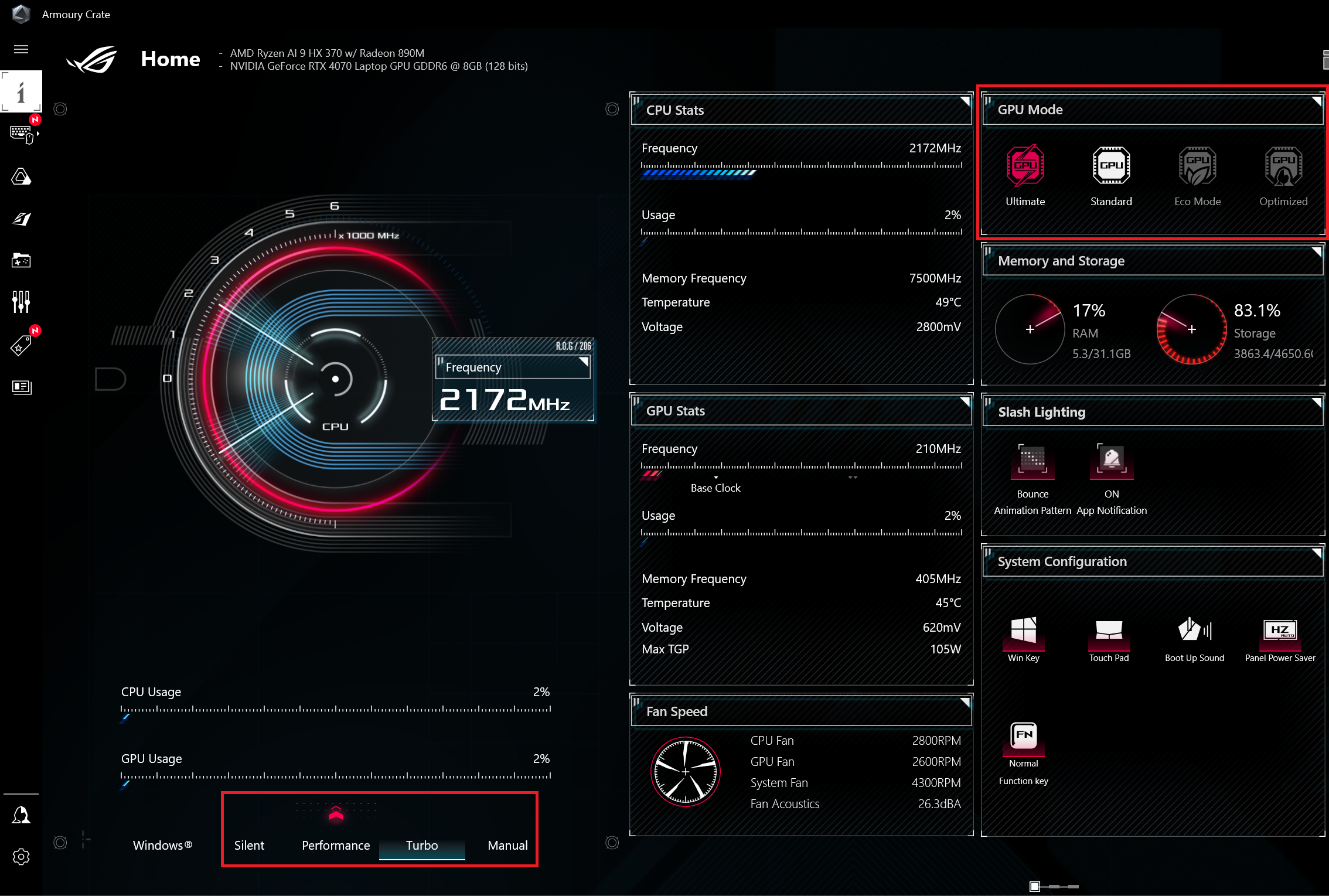
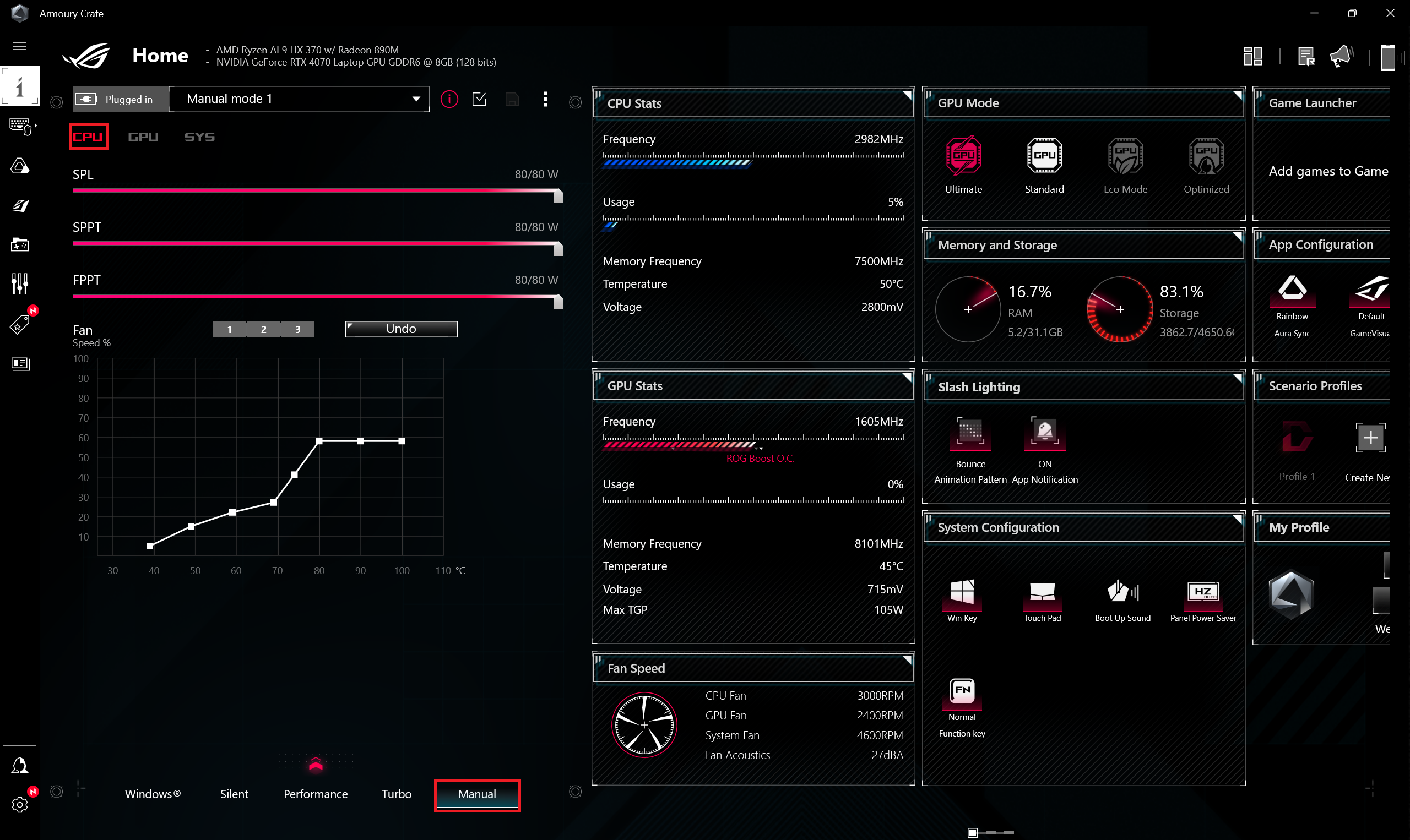

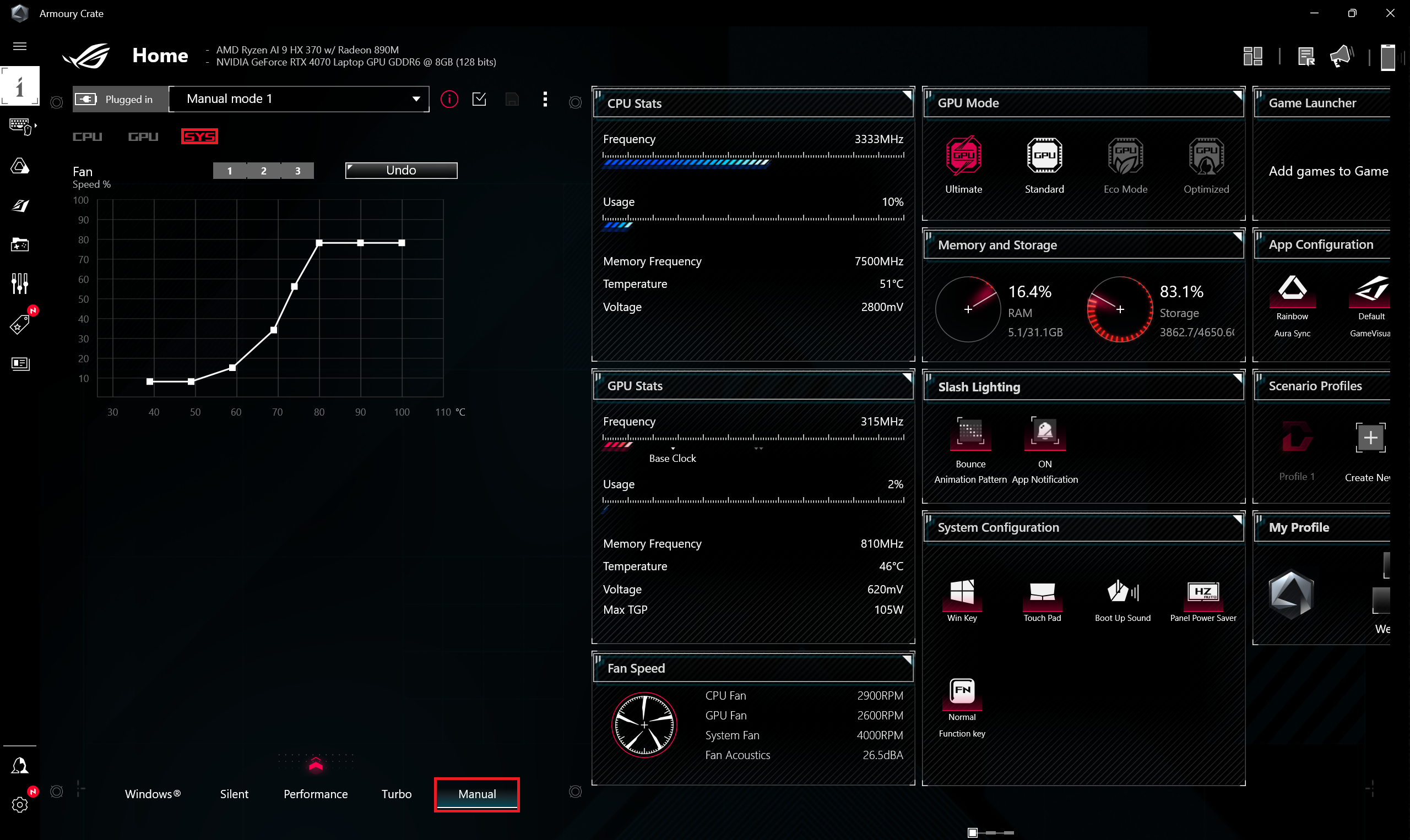
During light loads in Turbo mode, the fans are slightly auditable but you can fix that if you choose the “Silent” mode which turns off the fans in idle. You can manually bump the fans to their maximum speed of 6300 / 6100 / 8900 RPM which is loud but not too extreme.
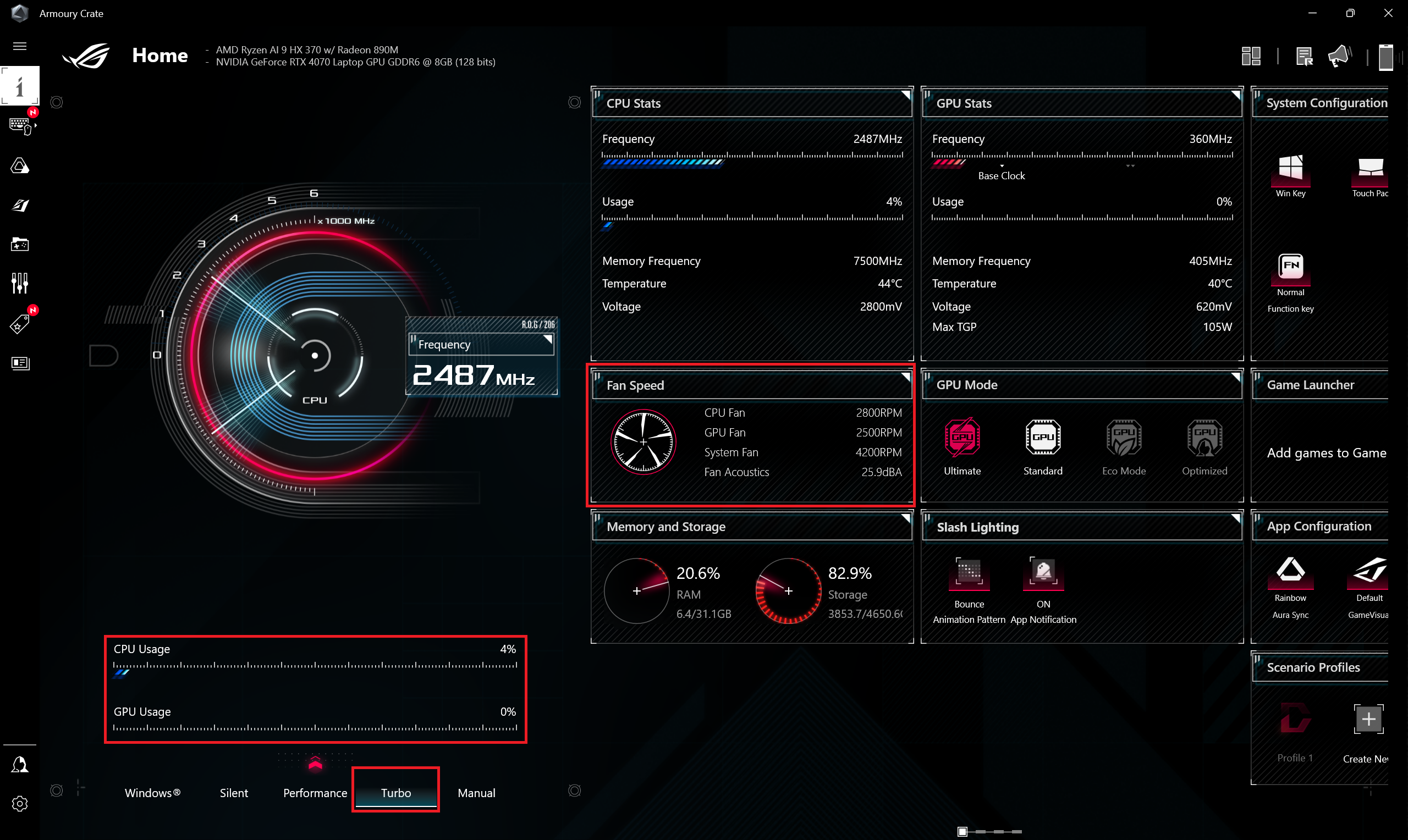 “Turbo” fan speed
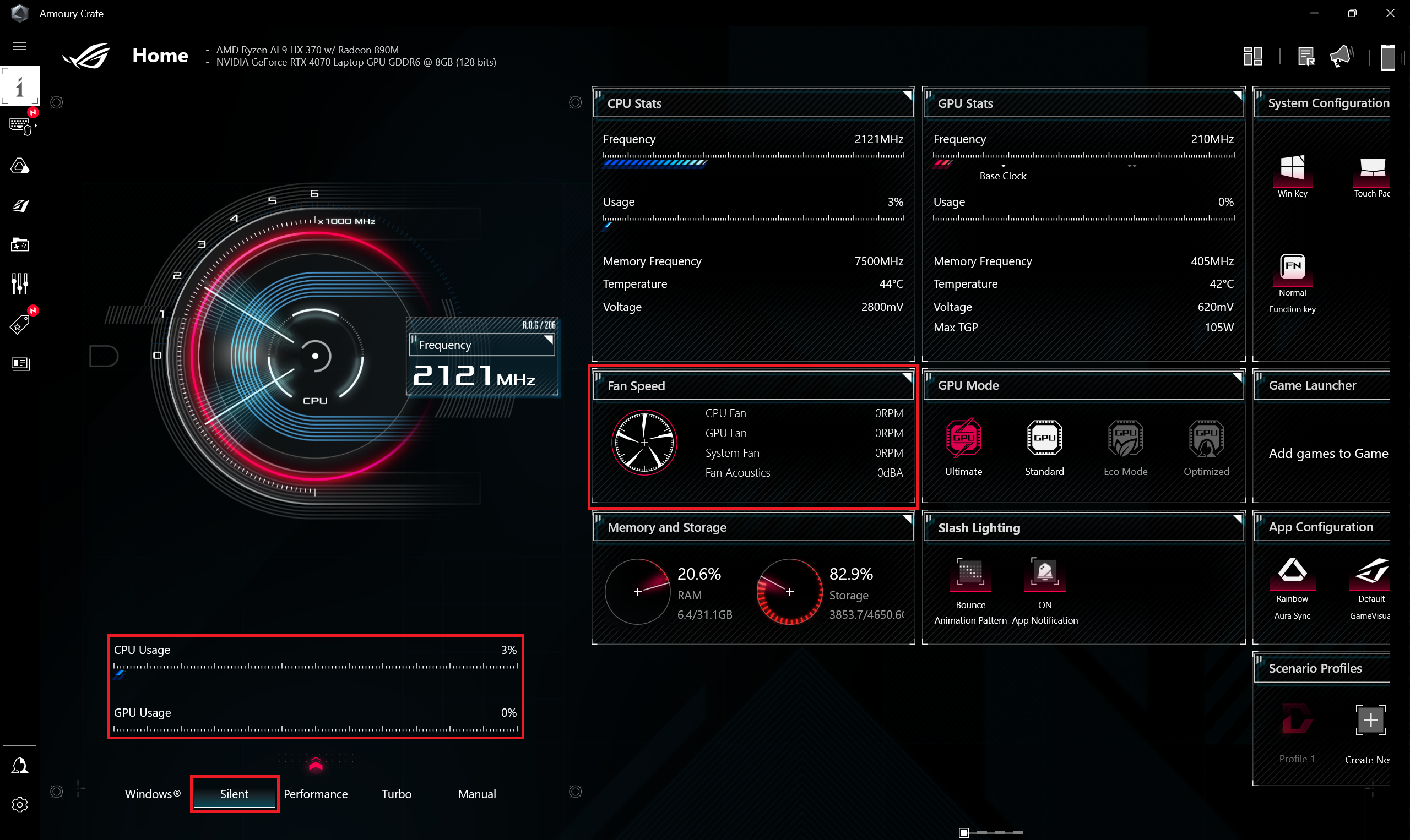 “Silent” fan off
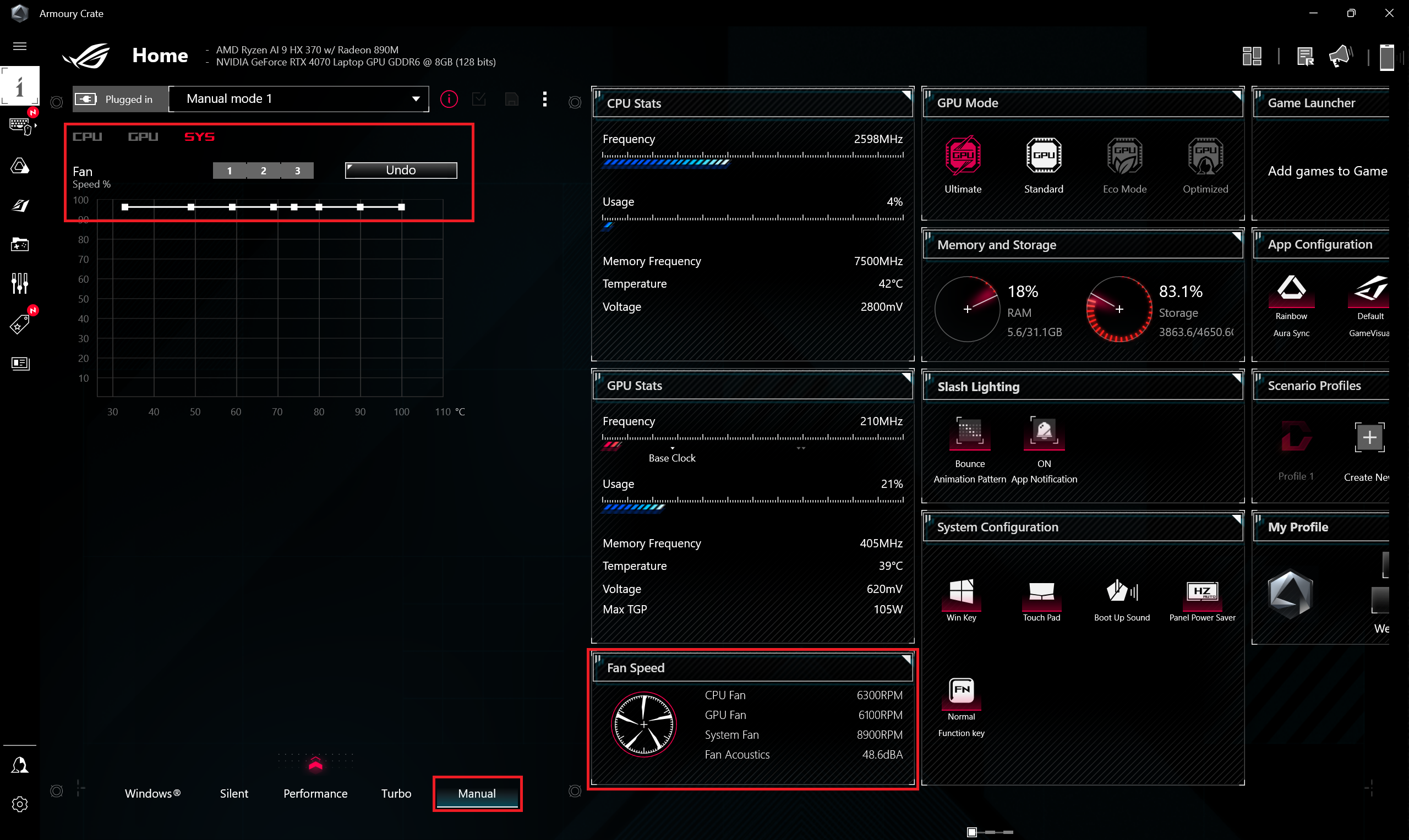 Max fan speed
The “Performance” preset is actually a good choice if you don’t need the full power of the laptop. The fans are more tamed compared to the “Turbo” mode (6300 / 5800 RPM vs 4700 / 4500 RPM) and the P and E cores reach ~ 3.70 / 2.80 GHz which is still way higher than the official AMD base 2.0 GHz clock for this CPU.
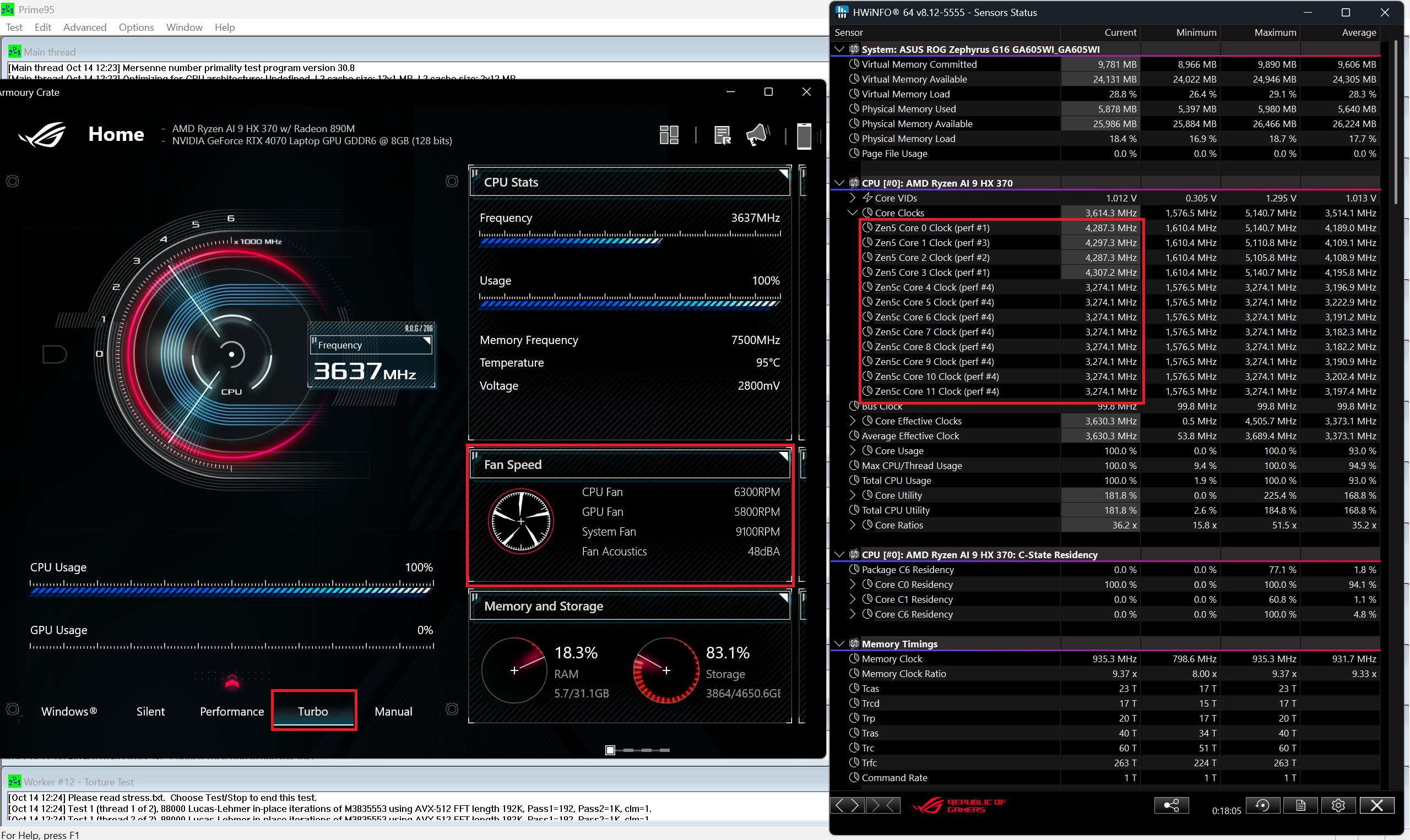 Max CPU Load “Turbo”
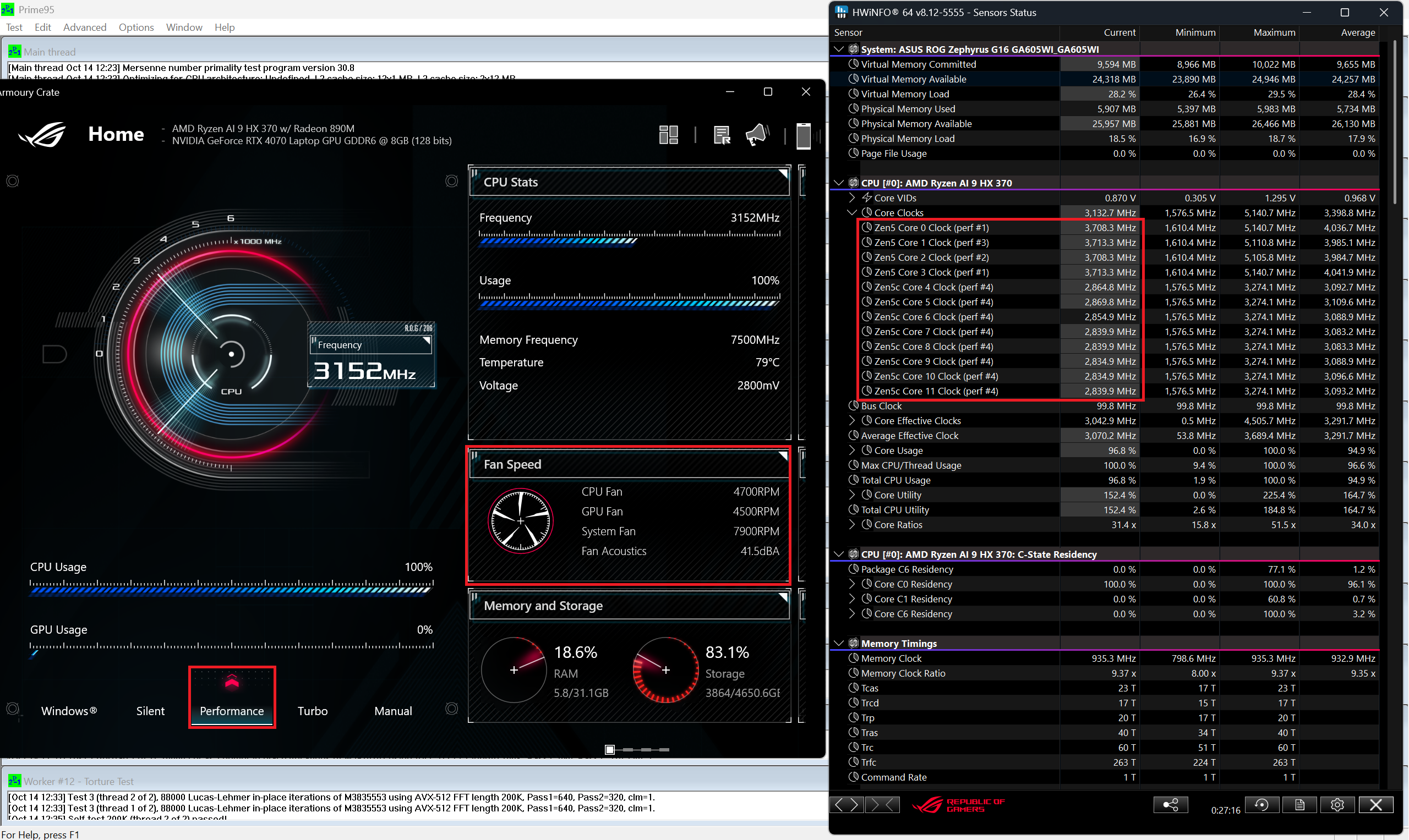 Max CPU Load “Performance”
The fans are a bit less aggressive while using the machine for gaming. The 105W TGP is only available when the “Turbo” mode is applied. The “Performance” preset graphics power limit is around 80W which isn’t that low plus the fans produce less noise.
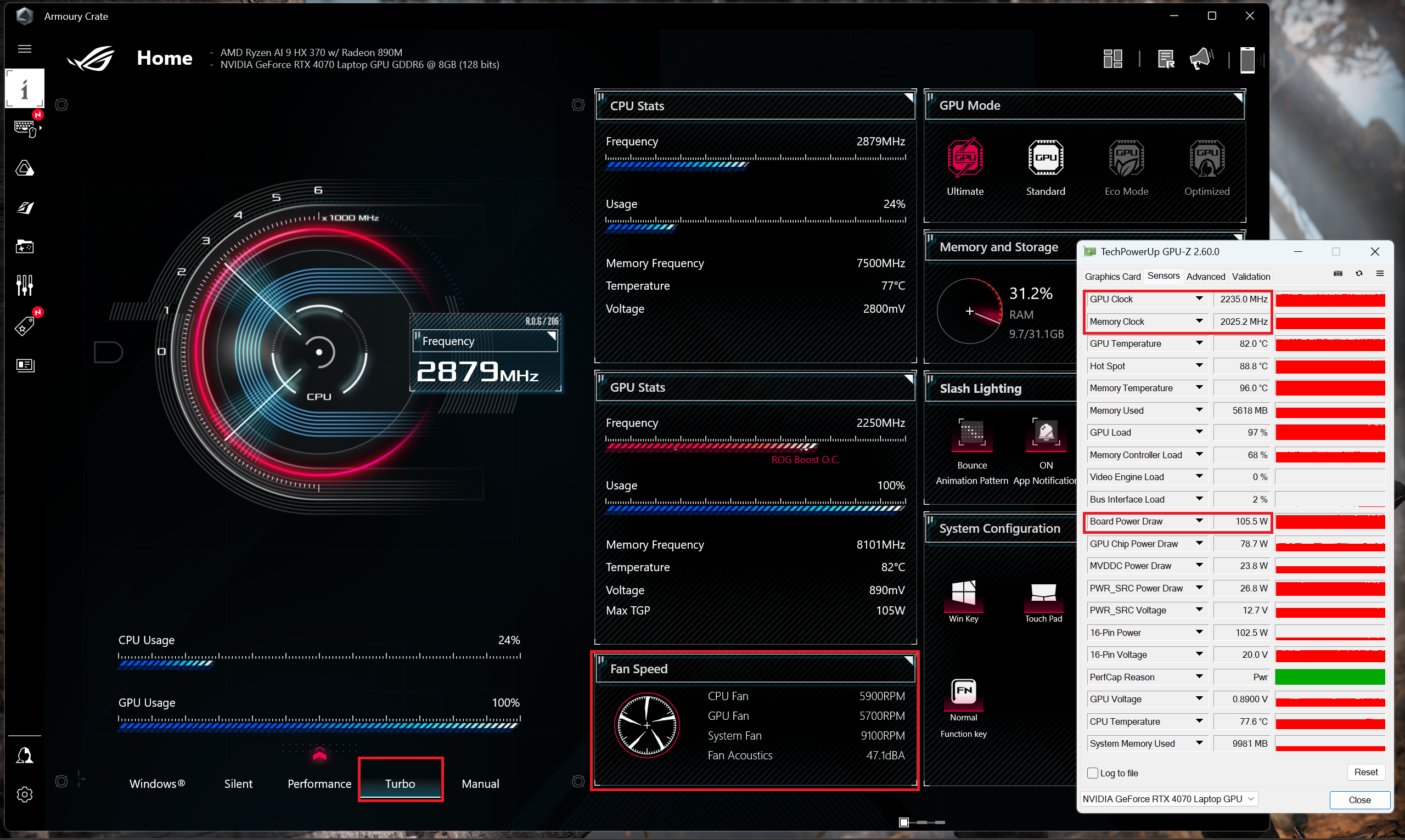 Gaming “Turbo”
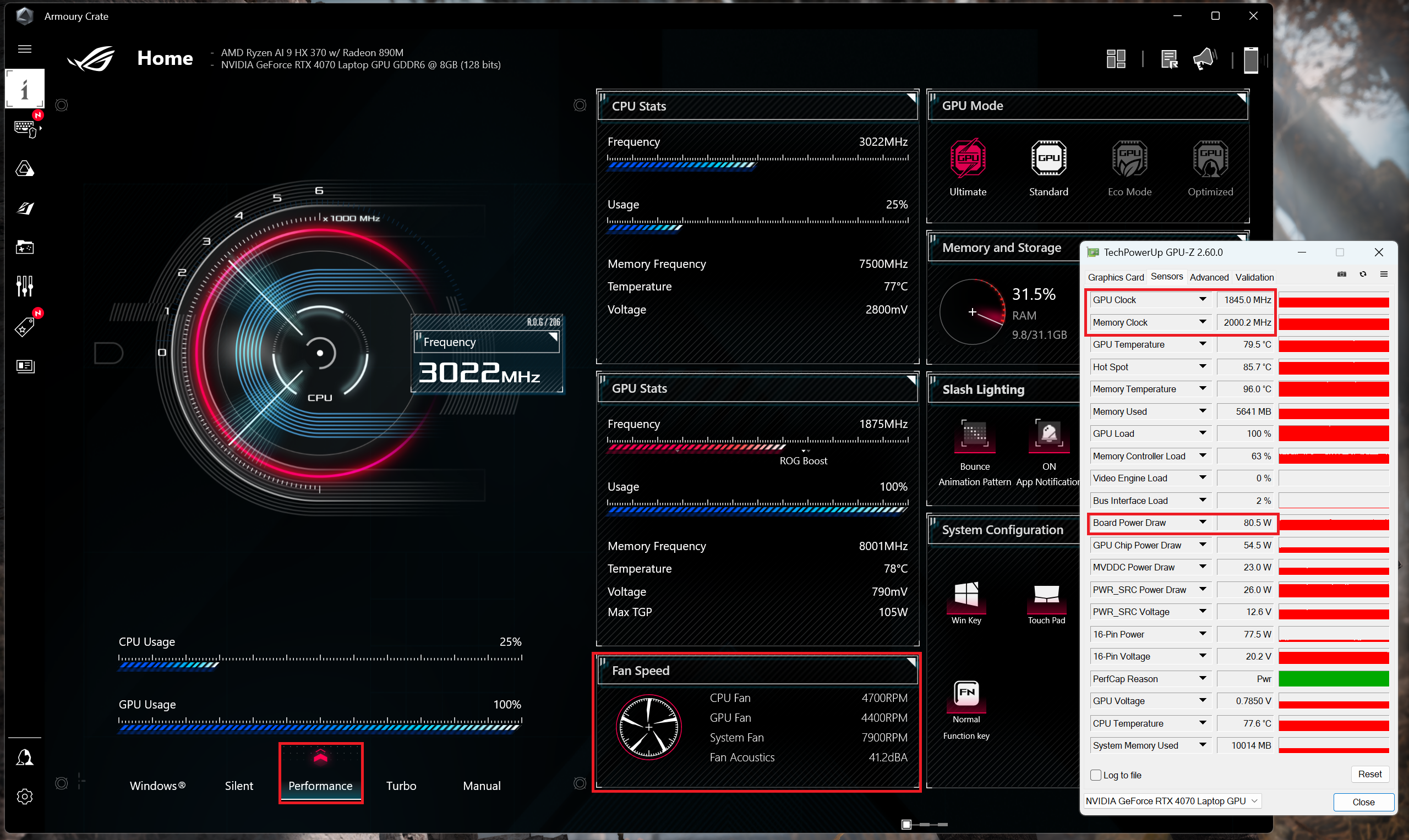 Gaming “Performance”
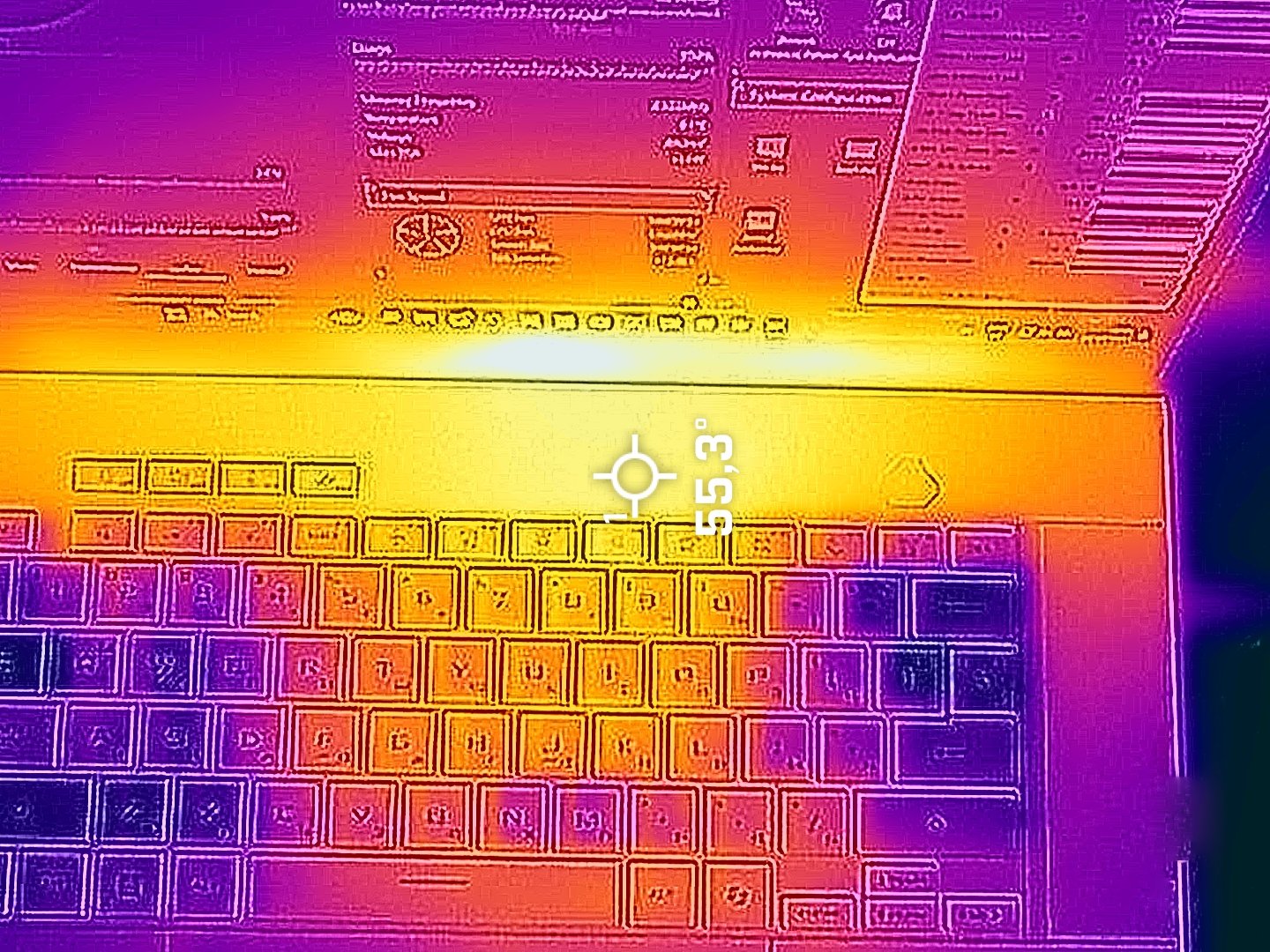
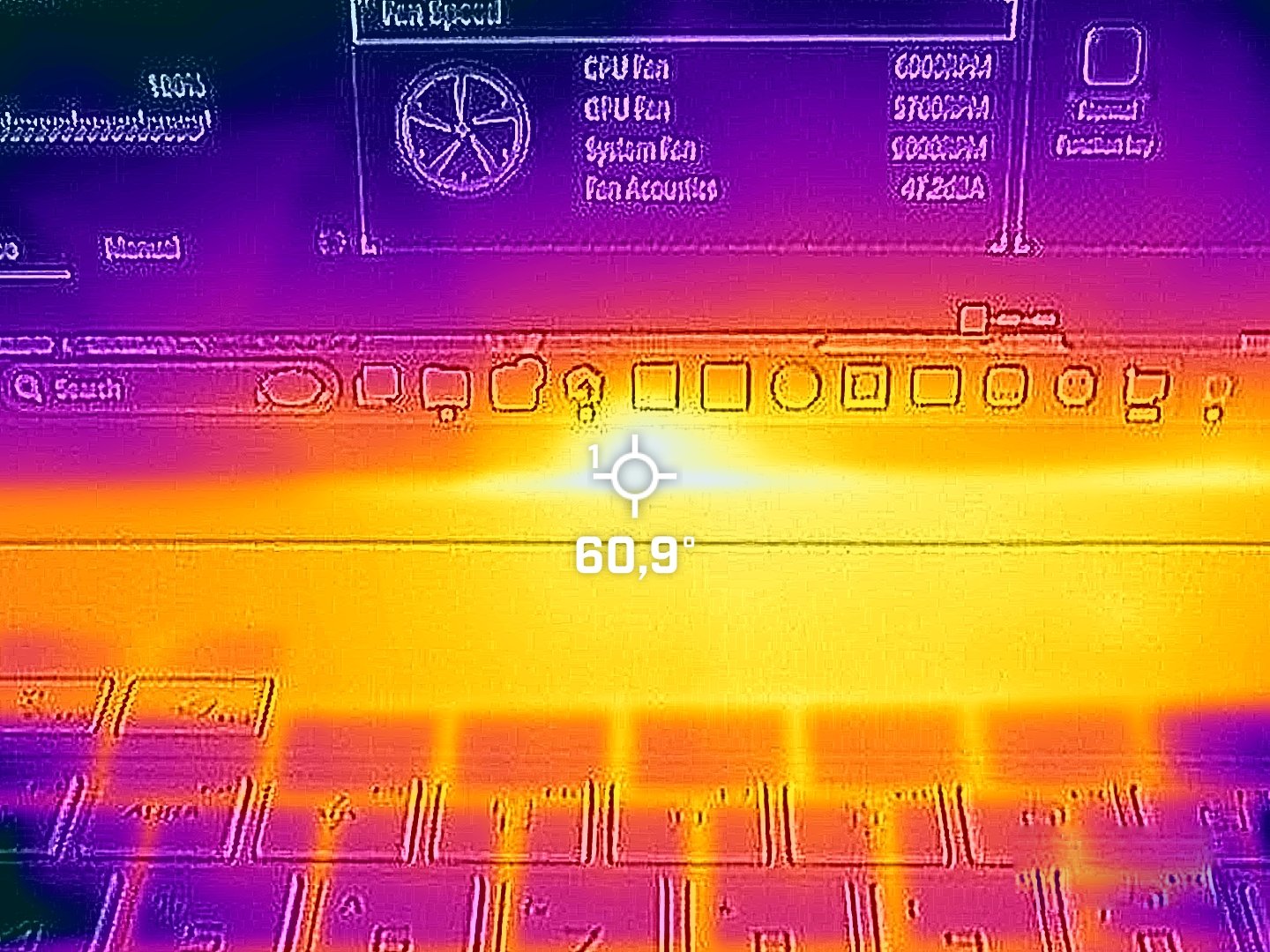
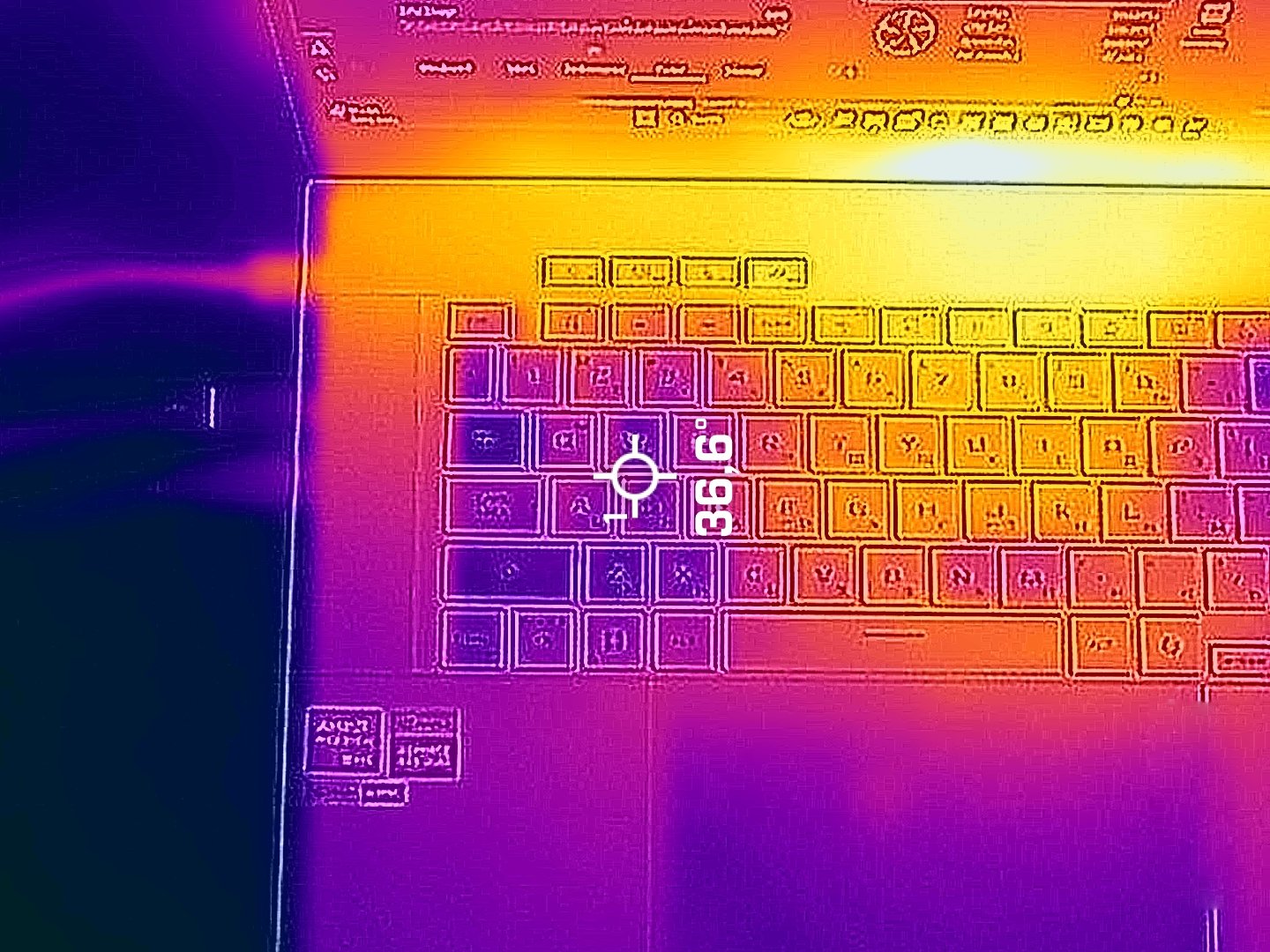
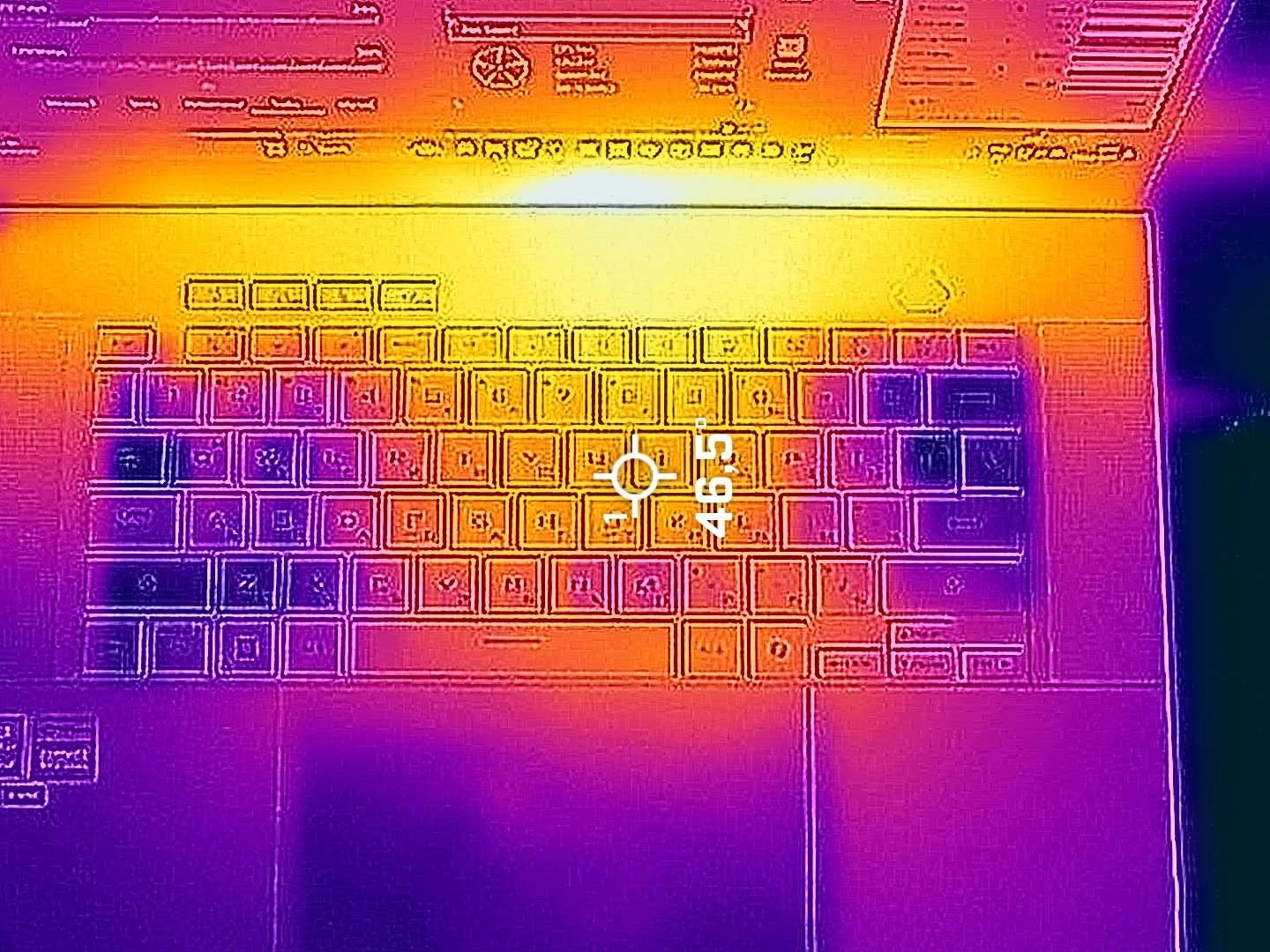
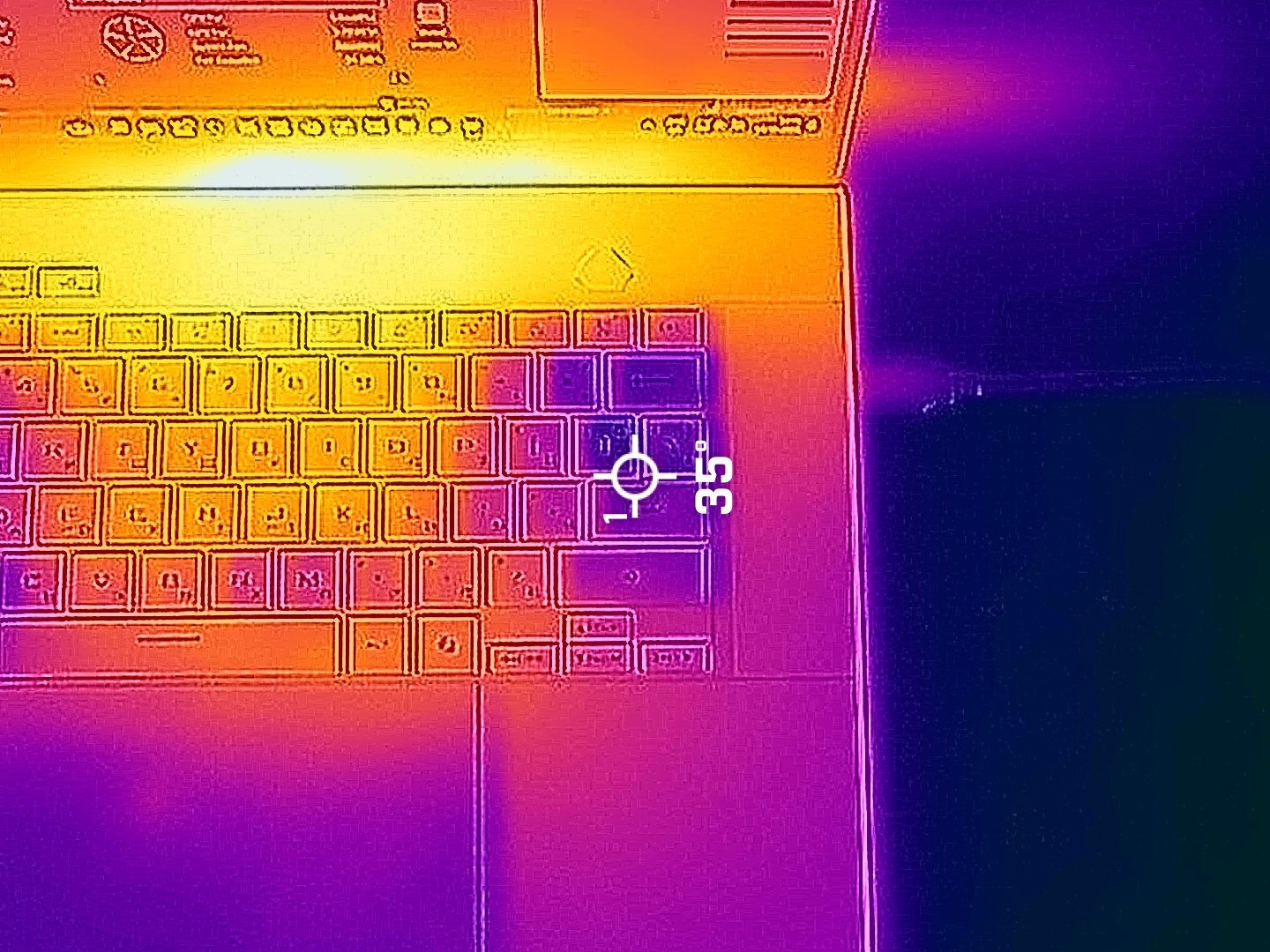
If the CPU and the GPU are loaded heavily, the hot spot on the keyboard on the top row of keys reaches 53°C which doesn’t feel scorching hot to the touch. We also measured 61°C on the bottom bezel of the display close to the right rear vent. This raises concerns about the long-term durability of the high-end screen.

Aside from the upper part of the board, its other zones are cooler.
Battery
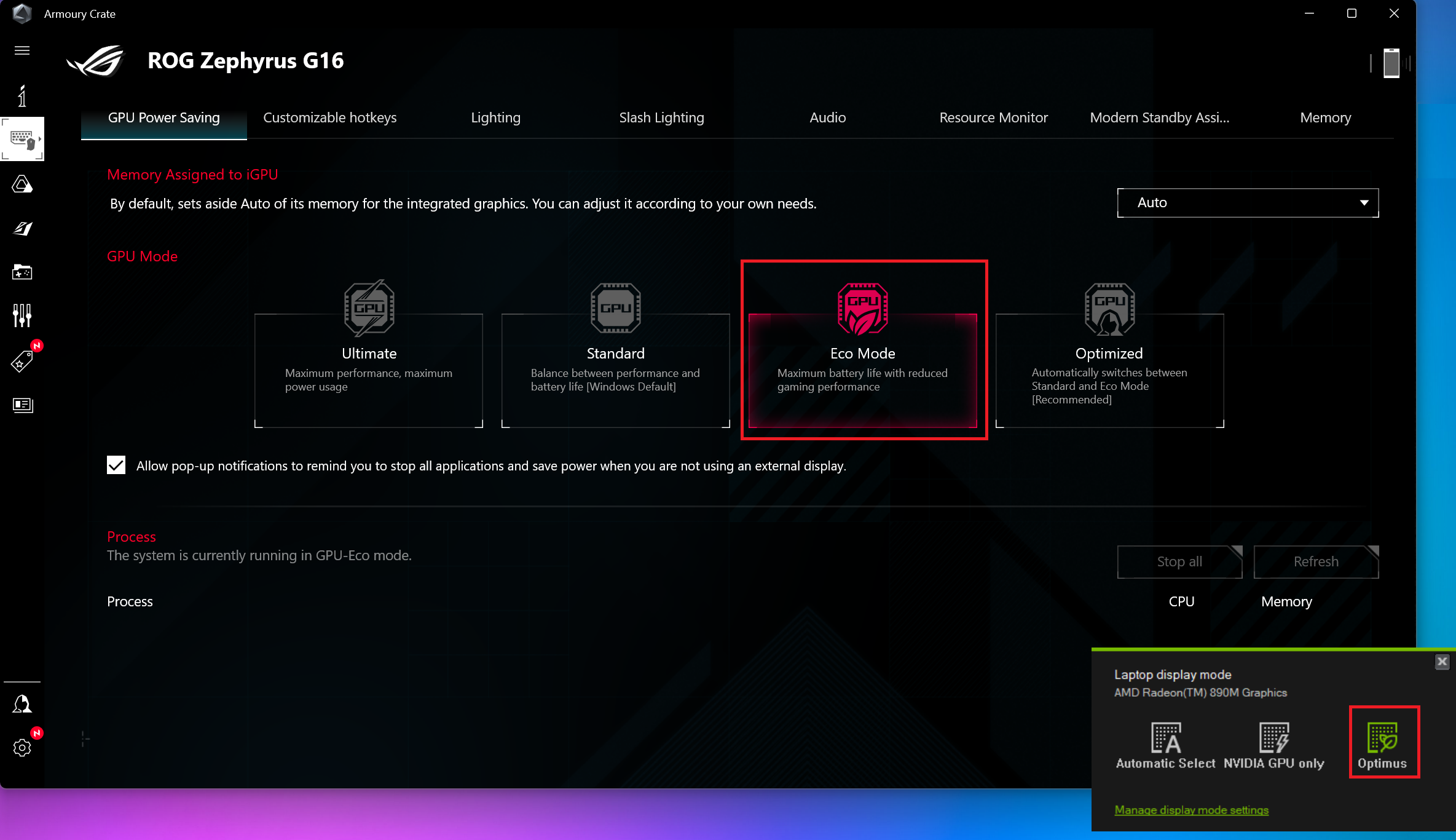
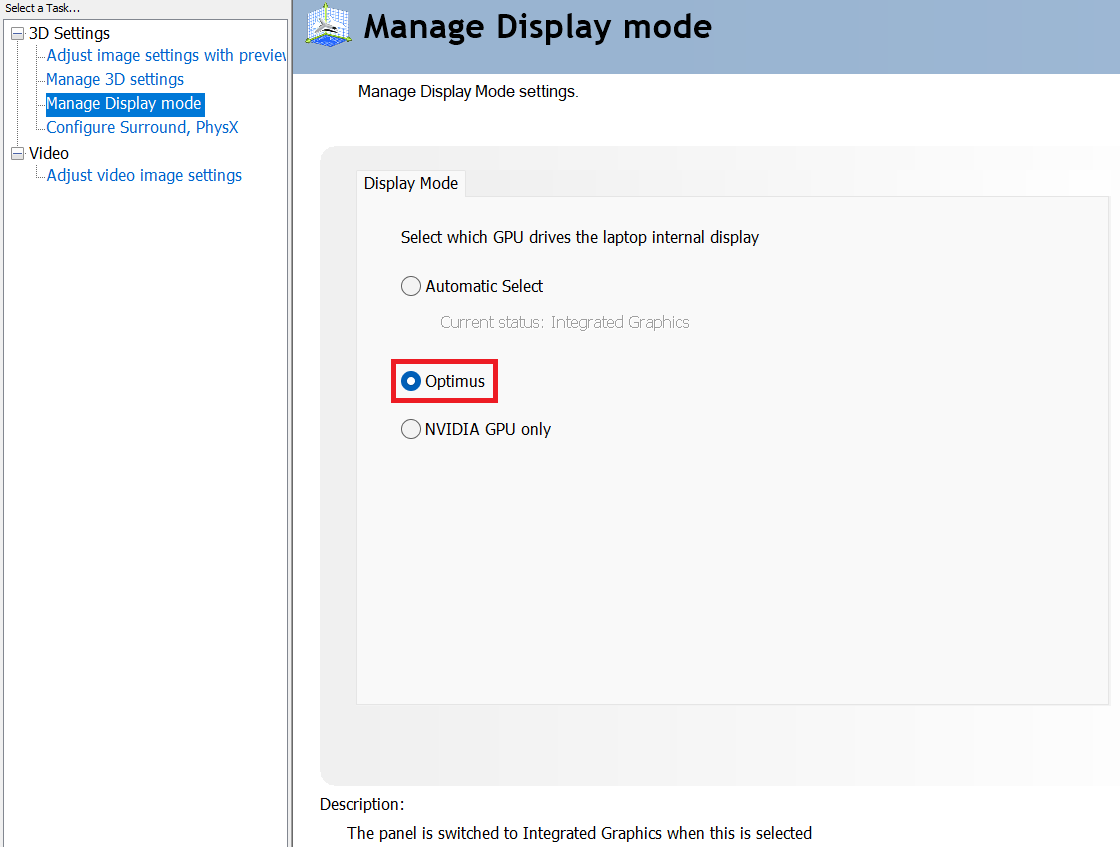
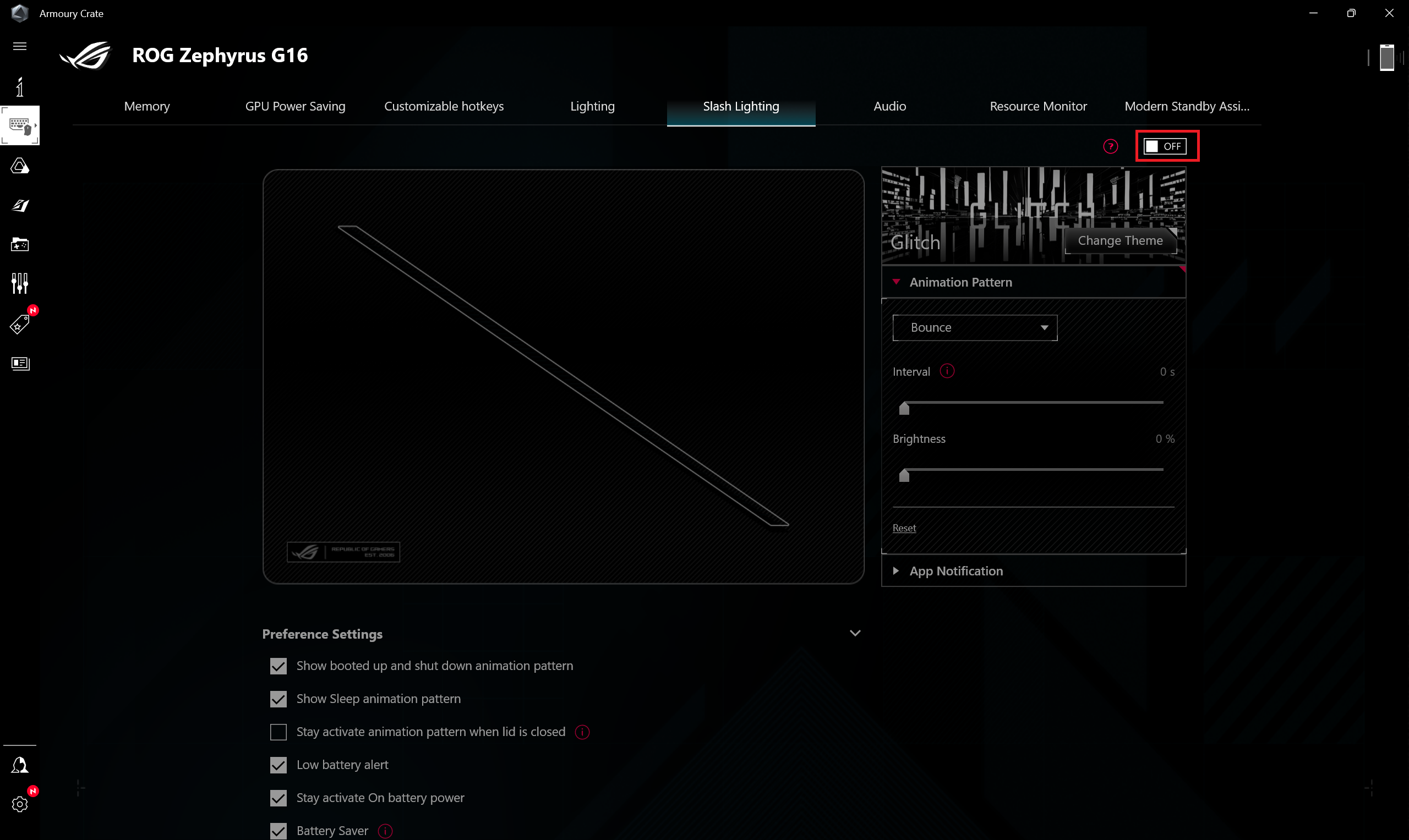
Now, we conduct the battery tests with the Windows Best Power Efficiency setting turned on, screen brightness adjusted to 180 nits and all other programs turned off except for the one we are testing the notebook with. This laptop’s 90Wh battery lasts for around 12 hours and a half of video playback. That’s a superb result considering the high-res OLED display and the powerful processor and graphics card! To achieve that, you have to apply the “Performance” and “Eco” presets in the MyASUS app and the Optimus mode in the NVIDIA Control Panel. The Slash Lighting is turned off.
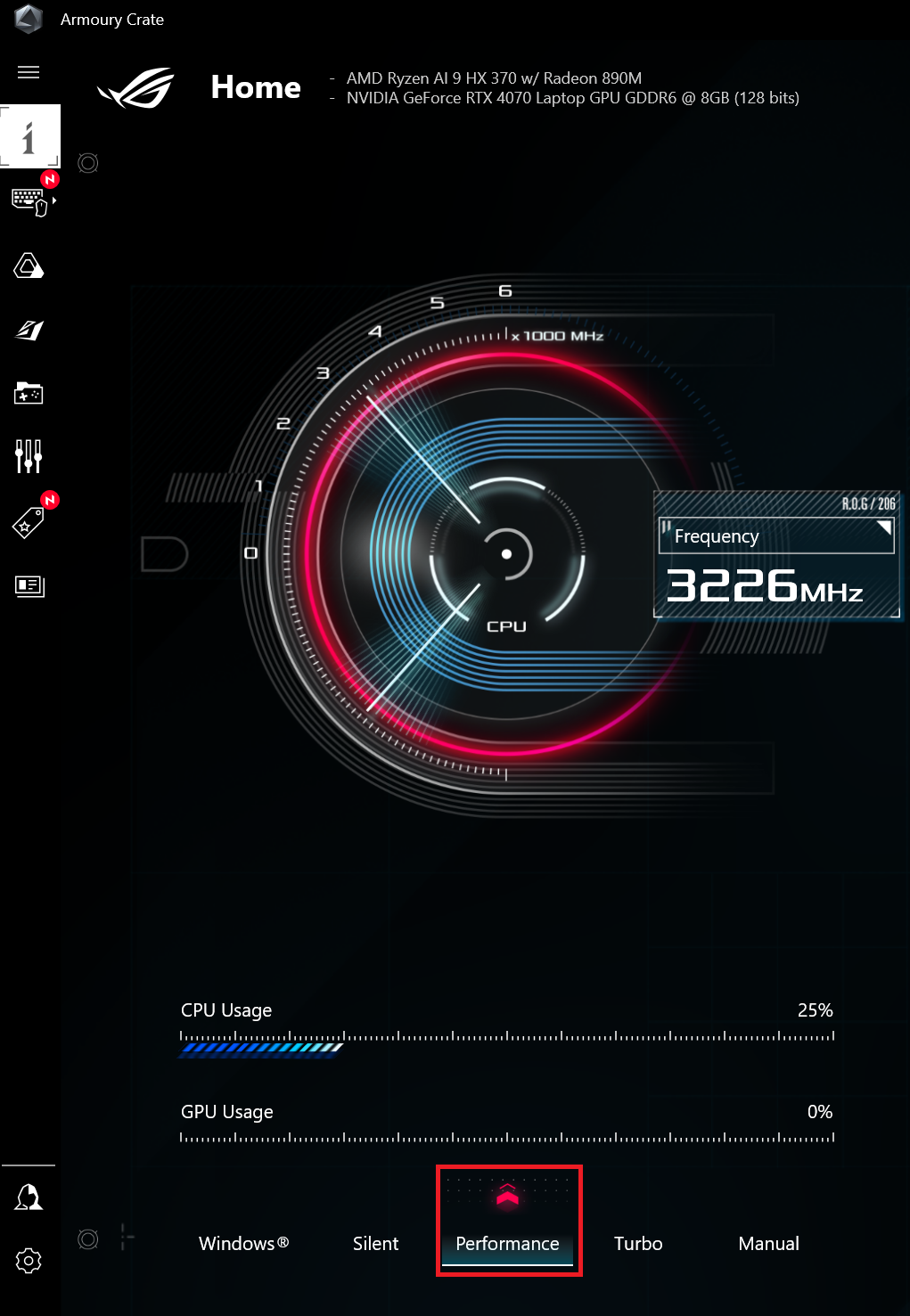
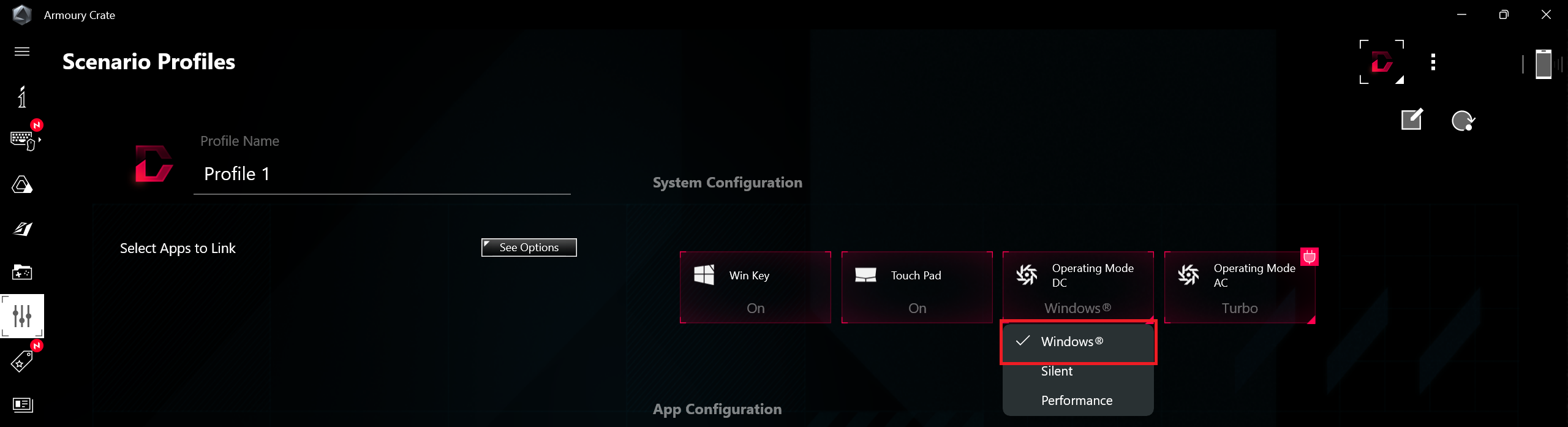
The “Operating Mode DC” is set to “Windows” preset.
Brightness: 180 nits; Display Mode: SDR
Time to Full Discharge: Higher is Better

Disassembly, Upgrade options, and Maintenance
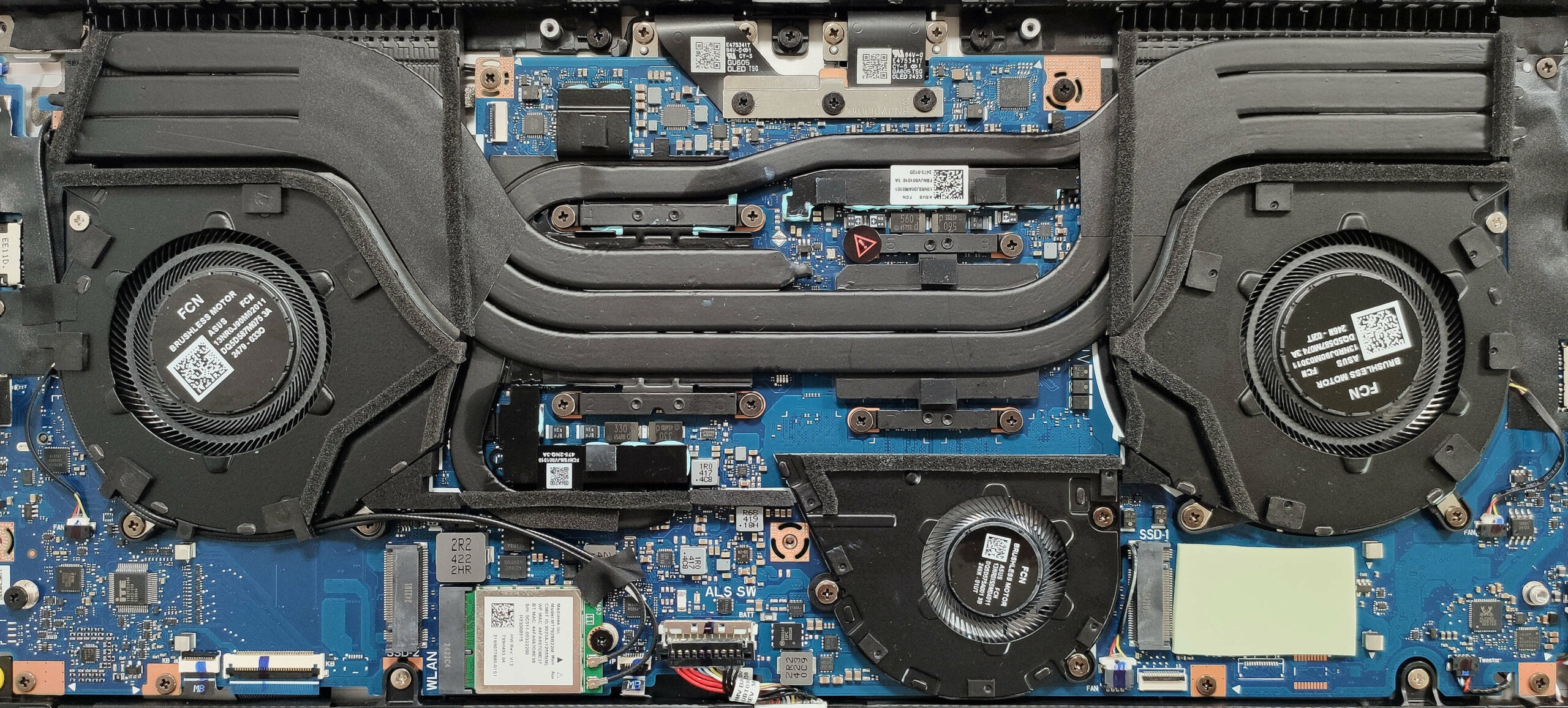
To gain access to the internals of this thin gaming device, you have to undo 11 Torx-head screws. The top two in the middle are hidden underneath rubber caps, so you must unglue them first. When that is done, there are visible slight gaps in the bottom edges which is a great starting point. Pry the front and the sides. With that out of the way, you can pop the back. Insert a thin plastic tool in between the plate and the chassis and slide it gently. Don’t push too hard because the clips there are pretty stiff and you can snap them if you aren’t careful.
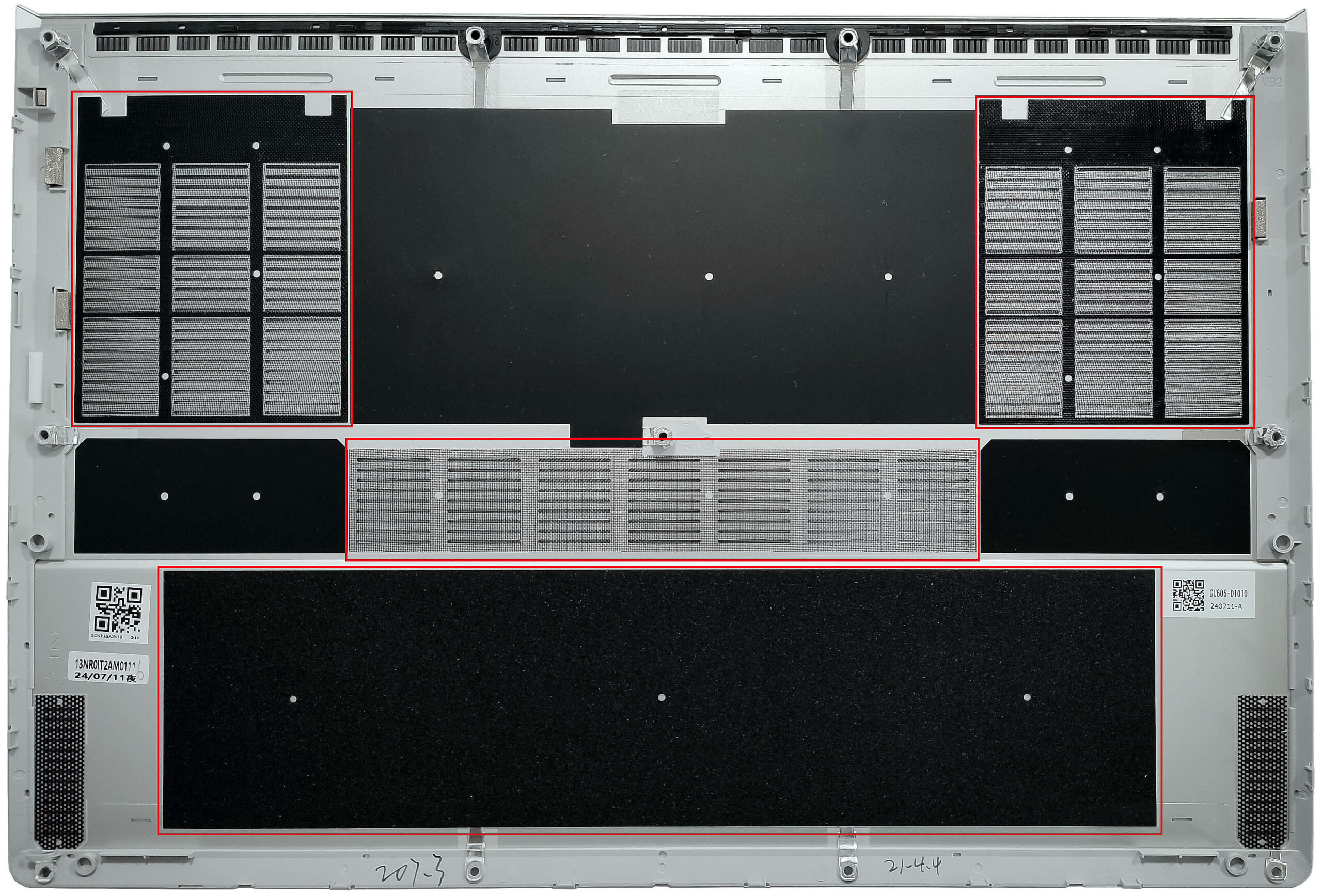
On the inside of the bottom plate, we can spot a rubberized-like material that protects the battery from scratches and three dust filters for the fans.
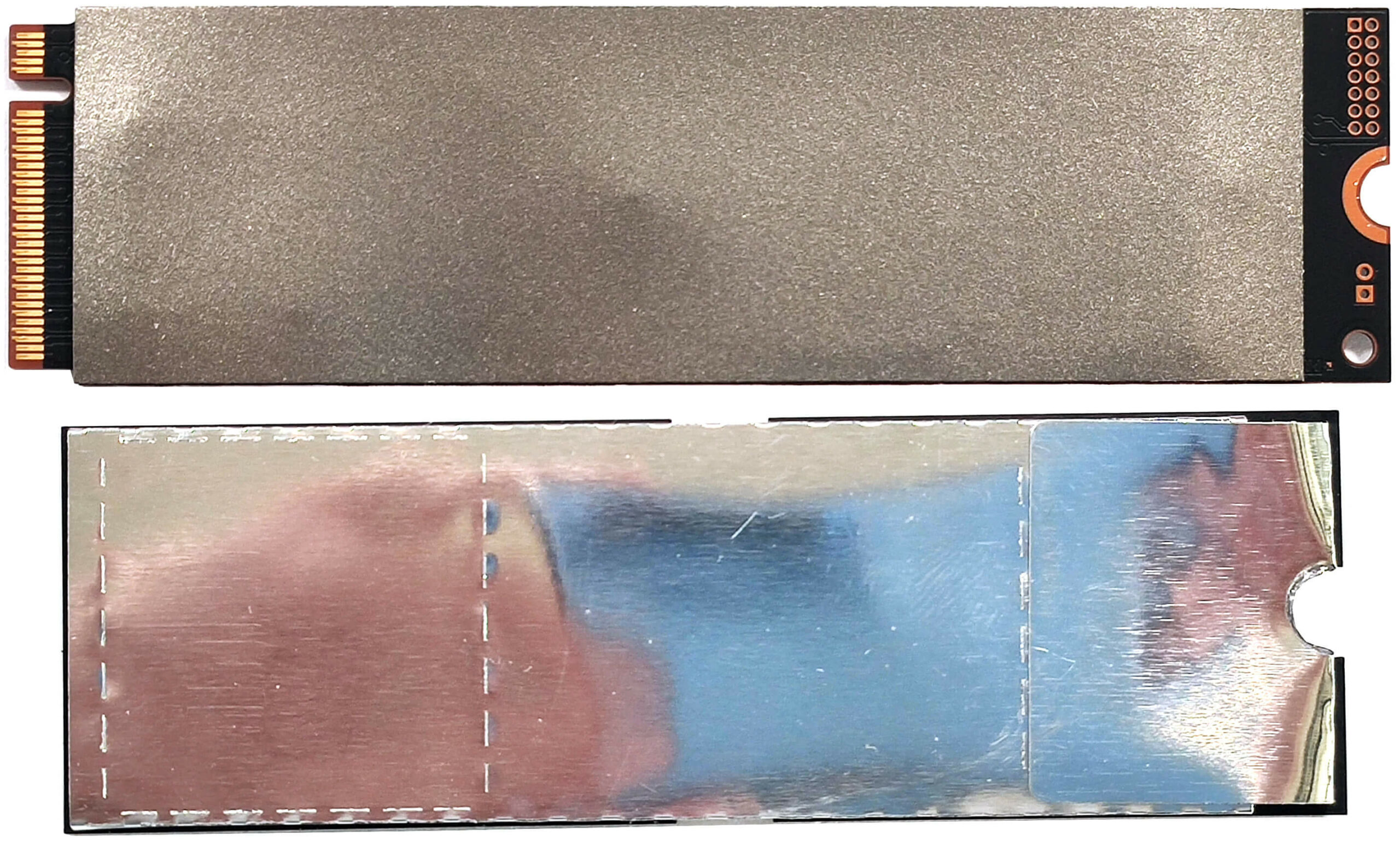
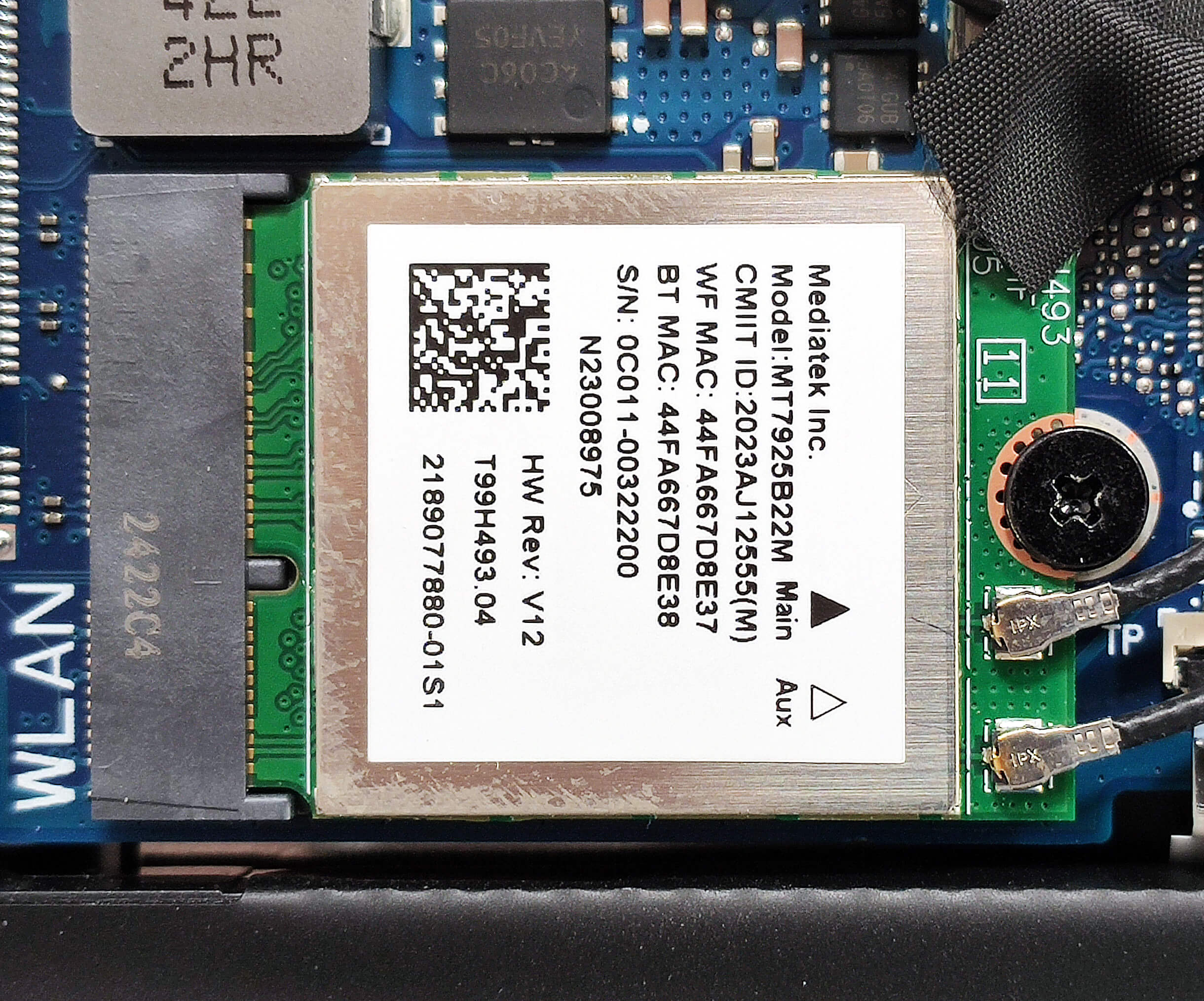
The laptop’s Wi-Fi card and SSD have heat shields.

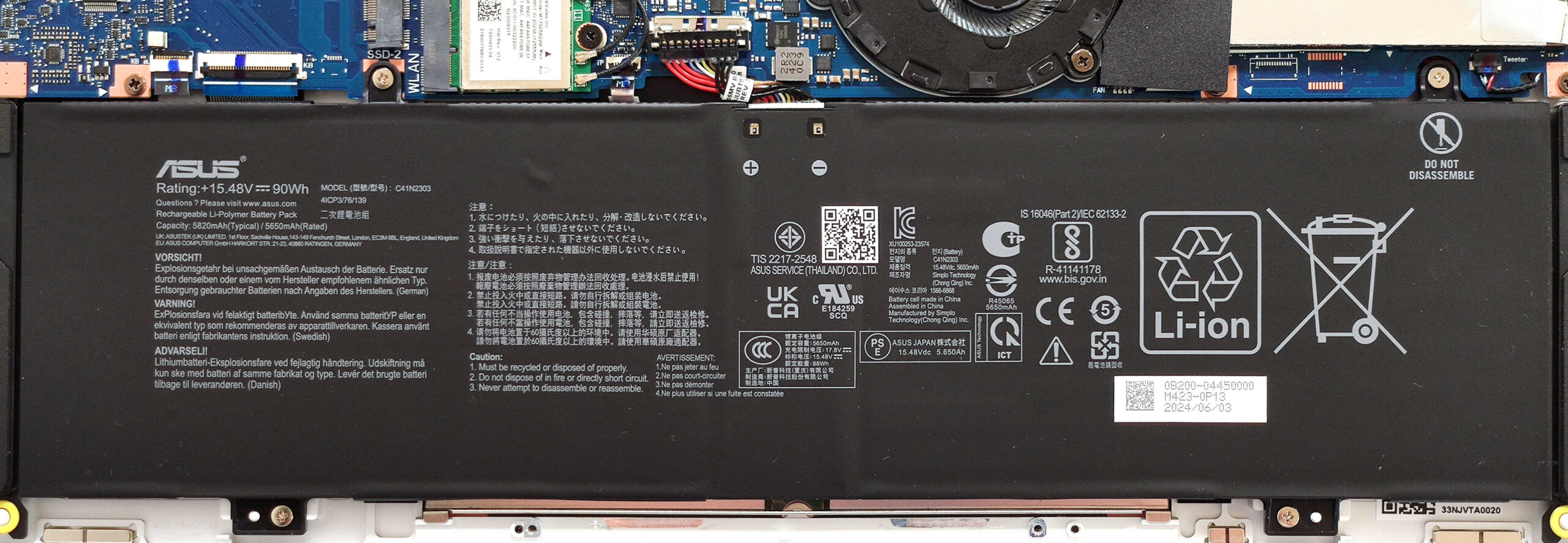
This battery is a 90Wh model. To take it out, remove the plastic shroud on the top side that covers the battery connector and unplug the connector from the motherboard. Then, undo the 4 Phillips-head screws that secure the unit fixed to the base. The capacity is enough for around 12 hours and a half of video playback.
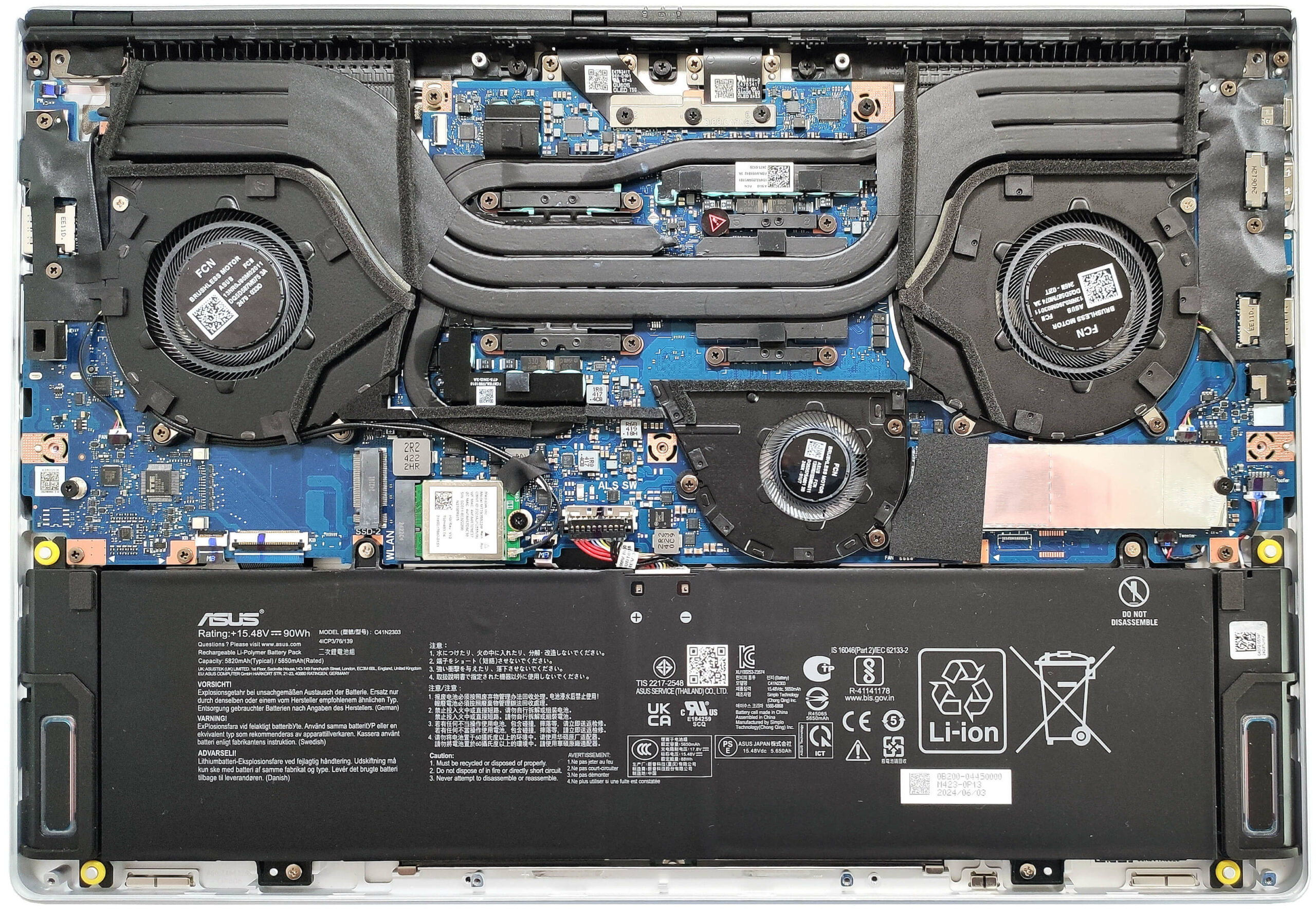
You get up to 32GB of soldered LPDDR5x-7500MHz RAM in dual-channel mode. When it comes to storage, you can rely on two M.2 slots compatible with 2280 Gen 4 SSDs. The left one offers half of the PCIe lanes (PCIe 4.0 x2) compared to the one on the right (PCIe 4.0 x4).

A decently sized thermal pad cools the preinstalled NVMe from below. Here is a picture of the preinstalled NVMe.
The Wi-Fi card is placed near the battery connector.
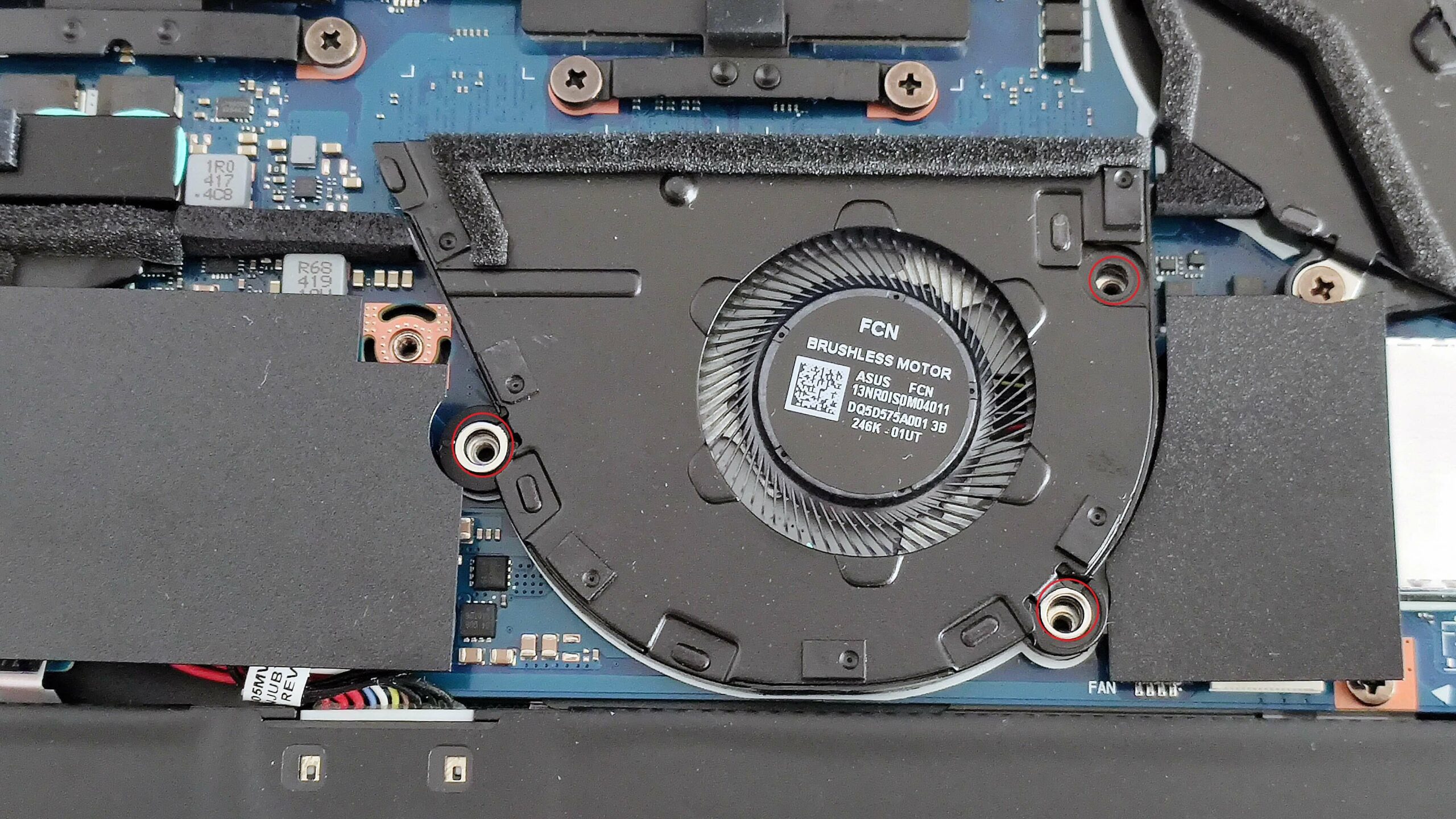
The bottom cooling fan could be removed if you undo its three Phillips-head screws. This fan helps to move the heat to the rear exhausts as fast as possible.
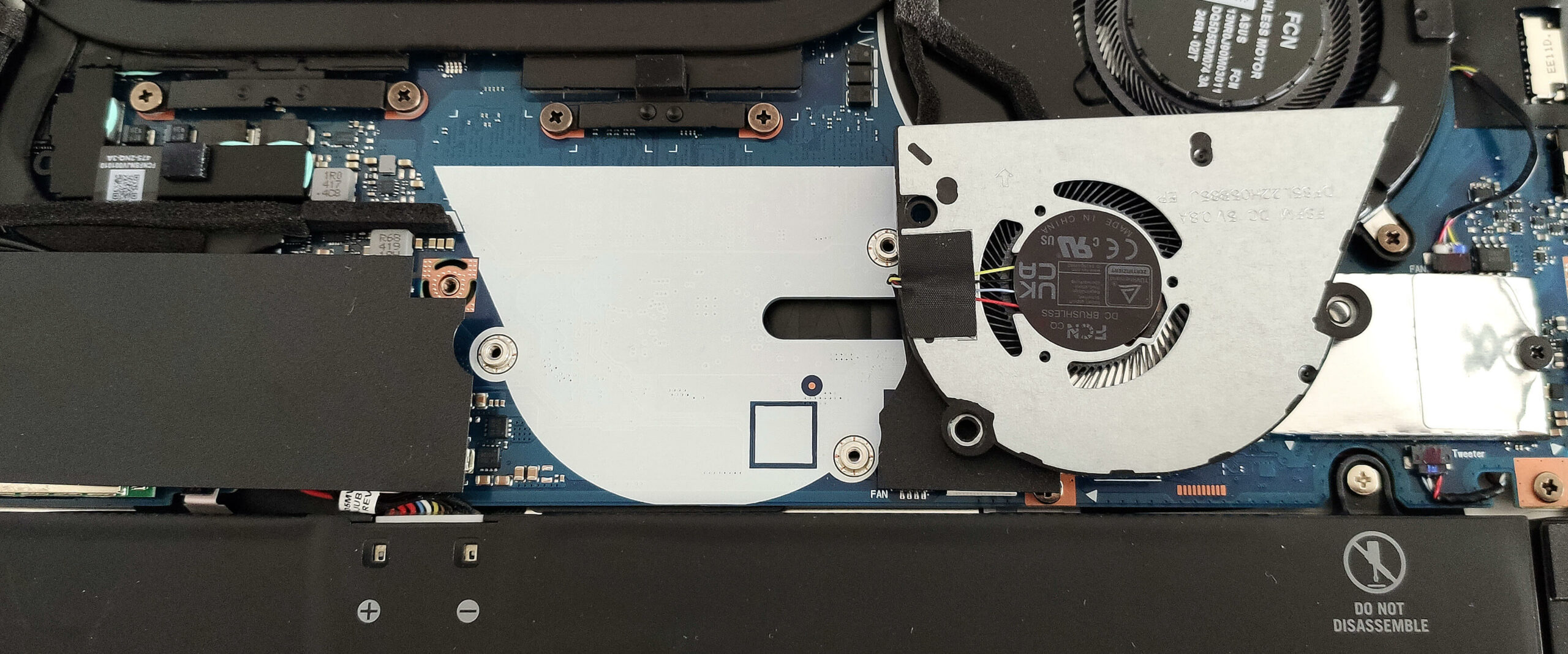
The three-fan thermal system relies on a trio of long heat pipes shared between the CPU and the GPU, and a fourth one is solely dedicated to the graphics card. We can also see two top-mounted heat sinks and four heat spreaders which are different in size.
Verdict
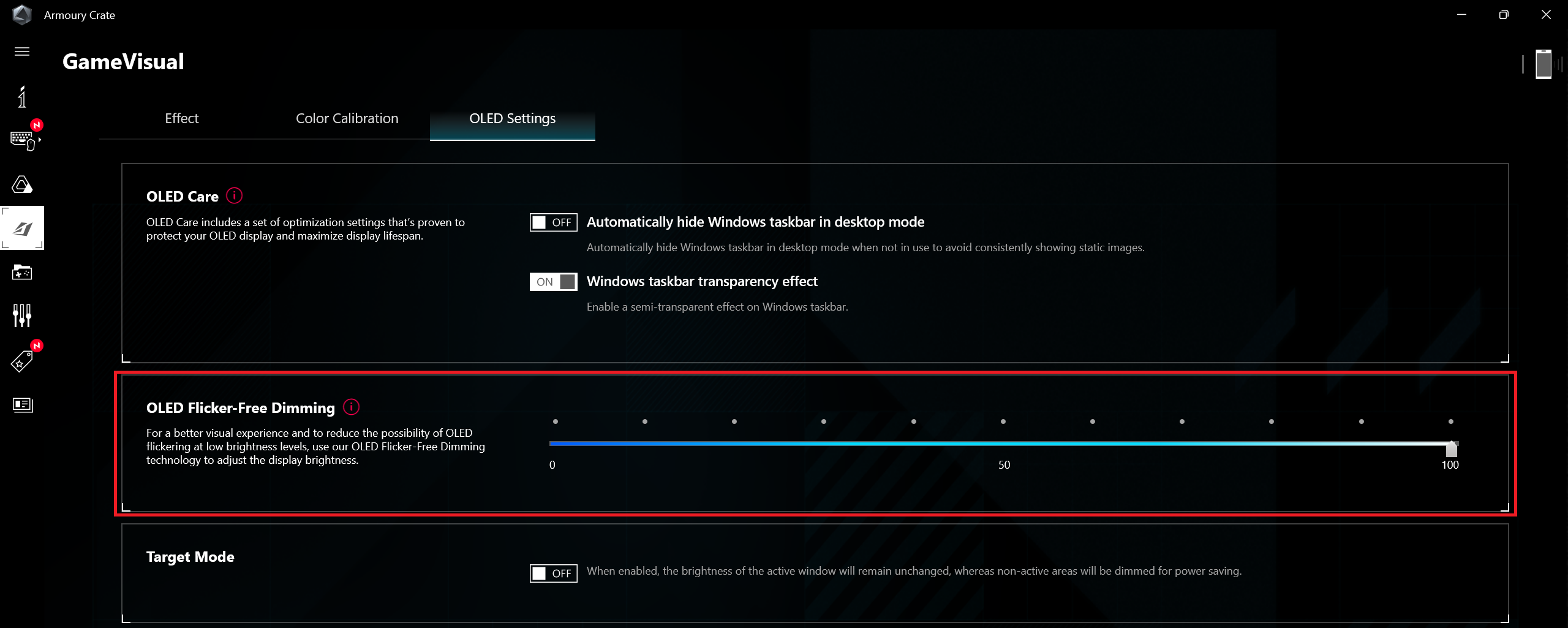
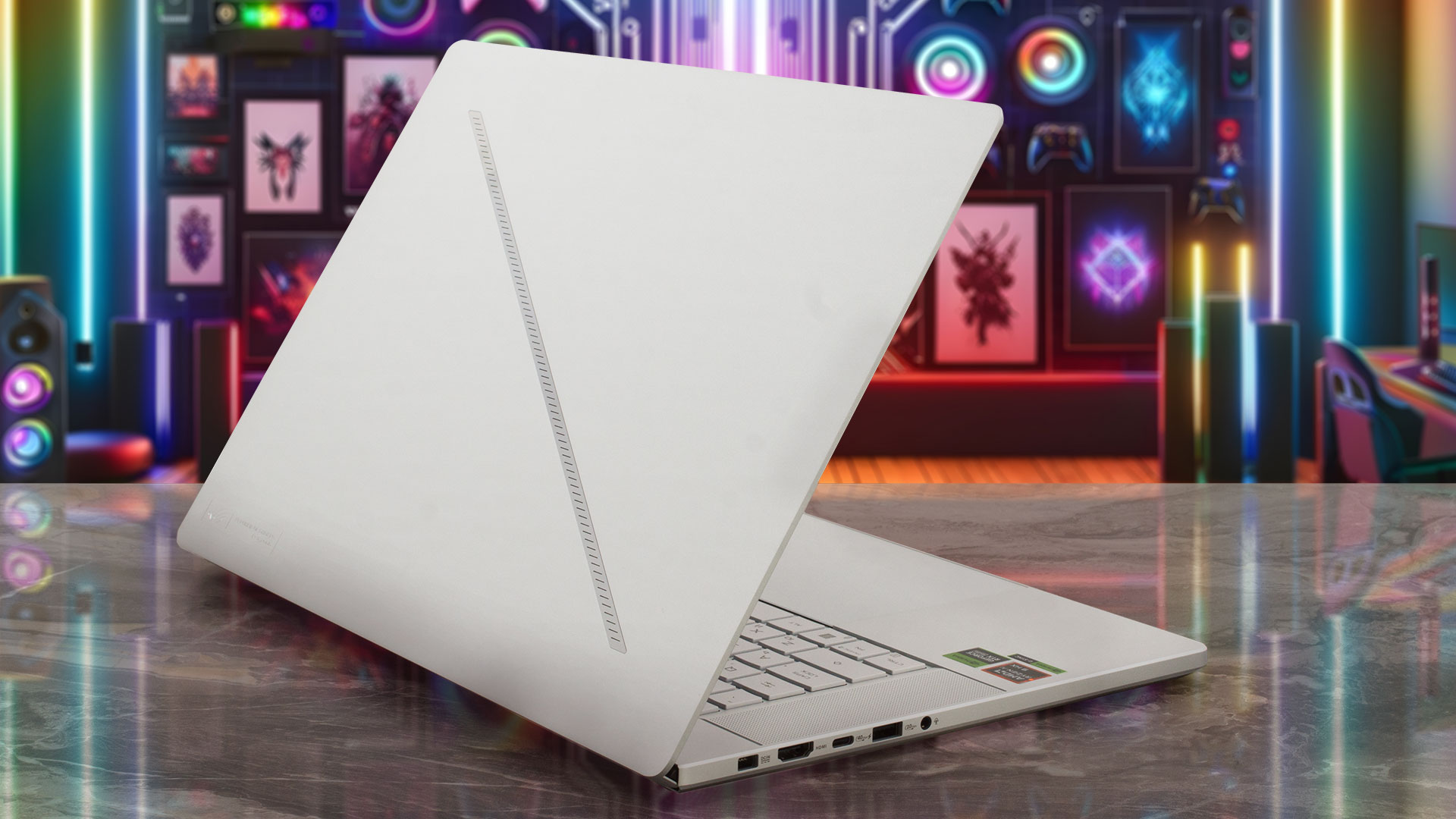 If you need a new thin and powerful laptop, the ROG Zephyrus G16 GA605 could be on your shortlist. It’s a well-built solid metal device with a great keyboard and touchpad. The other feature that could catch the buyer’s attention is the optional color-accurate OLED display (ATNA60DL04-0 (SDC41AE)). The 240Hz screen with HDR capabilities covers fully the sRGB and the DCI-P3 gamuts. It’s not a PWM-free unit but its pulsations have a high frequency of 961Hz which makes the screen comfortable for work. Actually, the writer of this review didn’t experience any kind of eye strain or headaches after a day of usage. Still, you can find an OLED Flicker-Free Dimming slider in the Aromory Crate app that could be useful for more sensitive users.
The keyboard doesn’t become excessively hot during gaming but this can’t be said about the lower display bezel which hotspot reaches whooping 61°C. Aside from that, the comfort during full loads is fine – the fans’ noise is comparable to other way thicker gaming laptops with similarly powerful hardware.
The port selection is up to date and includes two Type-C and a pair of Type-A connectors. The connectivity of Wi-Fi 7 + Bluetooth 5.4 is as modern as it gets. In terms of upgradability, you get two M.2 slots and a replaceable Wi-Fi card. By the way, our laptop has a QLC SSD which is a strange choice considering how expensive this machine is. The RAM is soldered. If money isn’t a problem, our advice is to pick a device with 32GB LPDDR5x memory which is way more future-proof than the base amount of 16GB.
The Zephyrus G16 GA605 offers great build quality, comfortable input devices, long battery life, superb OLED display, and powerful hardware in a thin chassis.
You can check the prices and configurations in our Specs System: https://laptopmedia.com/series/asus-rog-zephyrus-g16-ga605/
Pros
- 2x M.2 Gen 4 slots + replaceable Wi-Fi card
- Very good CPU performance
- Compact and light (14.9 – 16.4 mm / 1.85 kg)
- Zen 5 CPU
- High processor frequencies and power limits during heavy stress (4.26 GHz / 3.25 GHz P and E-core clock + 76W)
- The RTX 4070 can sustain a stable 105W during gaming
- MUX switch + NVIDIA Advanced Optimus + G-SYNC
- Four USBs + Wi-Fi 7 and Bluetooth 5.4
- OLED display with infinite contacts (SDC41AE)
- 2560 x 1600 resolution + 240Hz refresh rate (SDC41AE)
- Full sRGB and DCI-P3 coverage + good out-of-the-box color-accuracy (SDC41AE)
- 407 nits of max brightness (SDC41AE)
- The Armoury crate app offers tons of customization options
- Comfortable backlit keyboard + precise touchpad
- Long battery life (~12 hours of video)
- The fans don’t spin during light loads in “Silent” mode
- Solid metal built
- Well-cooled SSD (Micron 2400E)
- Good audio qiality
Cons
- Soldered RAM + the left M.2 slot is limited to PCIe 4.0 x2
- Pricey
- High CPU temperature in medium and long loads (~92°C / 95°C)
- The display’s hotspot on the bottom bezel reaches 61°C
- The real-life gaming performance on sub-Ultra details is a bit lower than expected
- QLC SSD in this price class is a non-optimal decision by the manufacturer
 Author: Nikolay Palaozov
 Author: eng. Kroum NikolovHead of Engineering at LaptopMedia.com, inventor and innovator with 40+ years of experience in electronics and high technology.
TOP 100 GAMING LAPTOPS


TOP LAPTOP RATINGS
HIGHLIGHTS view more
![[August 2026] Amazon Global: Top 10 Best-Selling Laptops – Apple MacBook Neo Dominates the Charts as Budget and Mid-Range Windows Portables Fight for Volume](https://laptopmedia.com/wp-content/uploads/2026/09/Best-Selling-Laptops-GLOBAL-Top-10-400x225.jpg)
[August 2026] Amazon Global: Top 10 Best-Selling Laptops – Apple MacBook Neo Dominates the Charts as Budget and Mid-Range Windows Portables Fight for Volume
Sep 12, 2026![[August 2026] Best-Selling Laptop Brands on Amazon Global – Apple Dominates Revenue While HP Leads in Model Variety](https://laptopmedia.com/wp-content/uploads/2026/09/GLOBAL-Best-Brands-400x225.jpg)
[August 2026] Best-Selling Laptop Brands on Amazon Global – Apple Dominates Revenue While HP Leads in Model Variety
Sep 12, 2026![[August 2026] Amazon Global: Top 10 Best-Selling Gaming Laptops – HP Victus 15 Captures the Crown as Budget-Friendly Models Dominate the Charts](https://laptopmedia.com/wp-content/uploads/2026/09/Best-Selling-Gaming-Laptops-GLOBAL-Top-10-400x225.jpg)
[August 2026] Amazon Global: Top 10 Best-Selling Gaming Laptops – HP Victus 15 Captures the Crown as Budget-Friendly Models Dominate the Charts
Sep 12, 2026![[August 2026] Best-Selling Laptop Brands on Amazon Japan – Apple Dominates Market Share and Revenue Led by Strong Unit Sales](https://laptopmedia.com/wp-content/uploads/2026/09/CO.JP-Best-Brands-1-400x225.jpg)
[August 2026] Best-Selling Laptop Brands on Amazon Japan – Apple Dominates Market Share and Revenue Led by Strong Unit Sales
Sep 10, 2026![[August 2026] Best-Selling Laptop Brands on Amazon USA – Apple Dominates Market Revenue and Volume Despite Lower Model Diversity](https://laptopmedia.com/wp-content/uploads/2026/09/COM-Best-Brands-1-400x225.jpg)
[August 2026] Best-Selling Laptop Brands on Amazon USA – Apple Dominates Market Revenue and Volume Despite Lower Model Diversity
Sep 10, 2026
REVIEWS view more

Acer Nitro V 15 (ANV15-A31) review – A Practical Budget Gamer with One Major Catch
Aug 13, 2026Lenovo IdeaPad Slim 5a (16″, Gen 11) review – 2.8K OLED, Ryzen AI 7 450, and Rare Upgradeability
Aug 09, 2026HP OmniBook 5 16 (16-bc1000) review – Big Screen, Solid CPU, Limited Upgrades
Aug 06, 2026Lenovo ThinkPad X1 Carbon Gen 14 Aura Edition review – The Ultimate Business Laptop Gets Modular
Aug 03, 2026ASUS ExpertBook Ultra (B9406) review – Core Ultra X7 & Tandem OLED Tested
Jul 28, 2026